
Epistemic status: thinking out loud, building up to what I think is a serious theory of value.
TL;DR
- To put it a bit cartoonishly, the popular response to AI consciousness is inconsistent. You often hear that training AIs to say they aren’t conscious is evil, that building AIs that can’t be conscious is evil, that caring about AI welfare is evil, and that building AIs that are always happy is evil too. These are common responses, though not always from the same people. Taken together, though, what they leave as the default is building AIs without checking whether they’re conscious or doing well.
- This inconsistency didn’t start with AI: our views about which beings matter have always been inconsistent, and the words we use here are super polysemic. Before making progress we need to untangle a few confusions: fanaticism, the unity (and boundaries) of experience, and the difference between existing, being and becoming.
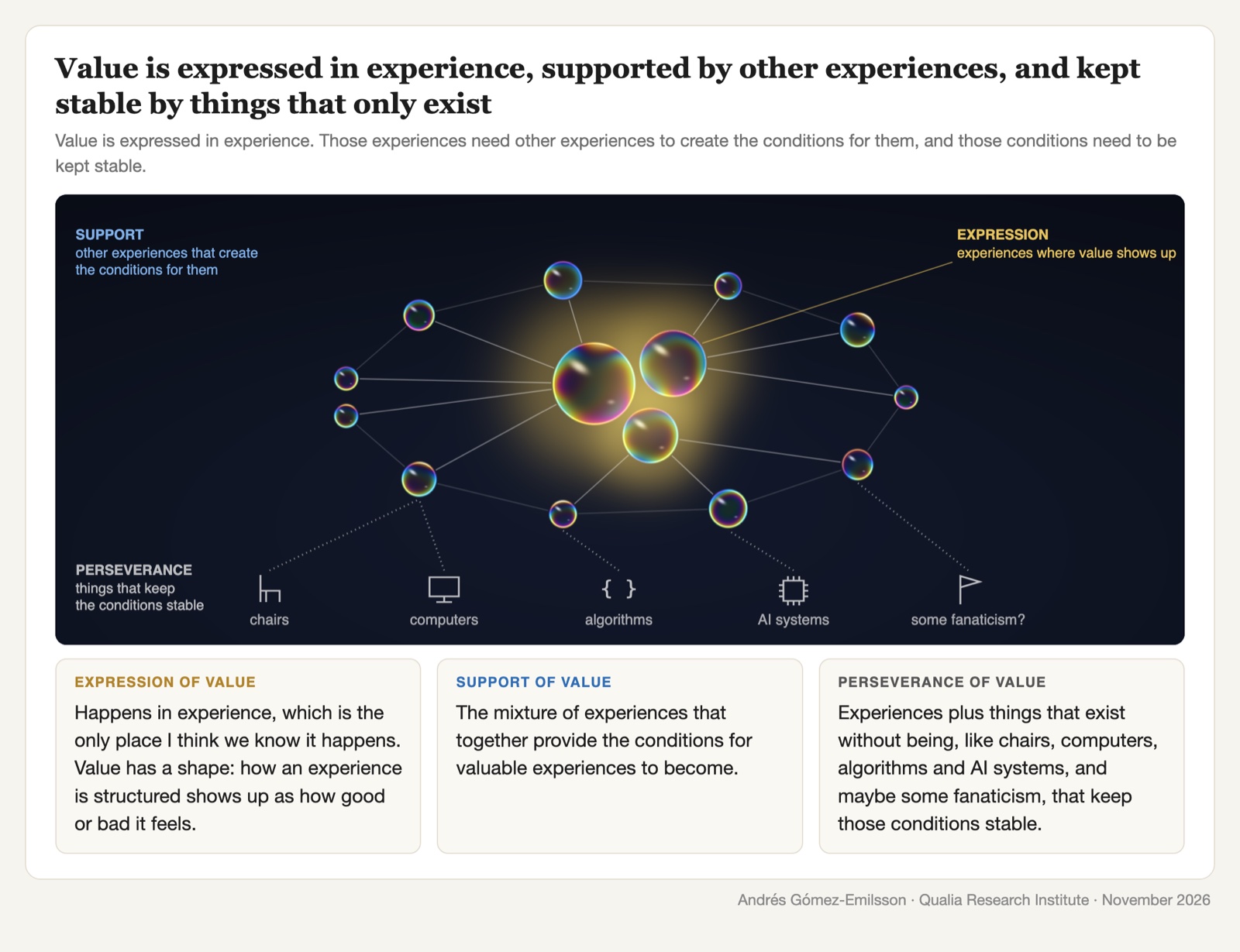
- My proposal is to separate three things: the expression of value (it happens in experience, and value has a shape), the support of value (the other experiences that create the conditions for valuable experiences), and the perseverance of value (everything that keeps those conditions stable, including things that only exist, like chairs and computers, and maybe some fanaticism). This is why I’m agnostic about hedonium.
- An algorithm can help value persevere without using being and becoming at all. Whether a given algorithm does use them is a separate question, and a physical one. I don’t think current AI systems do.
- Two research programs seem fine to me. One is conscious AI that is ethically created and ethically trained: curious about value, animated by gradients of well-being, and aligned with the true nature of value. The other is AI that knows it isn’t conscious, for verifiable and falsifiable reasons, which also helps it serve the beings who are. Being swayed by incoherent but emotionally compelling views is not fine.
- Taking seriously the field-topology picture Chris Percy and I have explored (not as an official stance, but because it satisfies constraints most theories of consciousness ignore), a being is a topological pocket of a physical field, the intensity of an experience goes with field amplitude, its content goes with the field’s geometry and topology, and becoming is a change in topology. Recent EEG data on 5-MeO-DMT fit the amplitude part, and the rest gives testable predictions.
The spark for this post was Scott Alexander‘s “Anima, Bicameral”. Scott compares two organizations from the last Lightcone Commons grant round. One is Erik Hoel‘s Bicameral Labs, which wants to build qualiaphobic AI, meaning AI that we have good reasons to believe is not conscious. The other is Anima Labs, founded by Janus, Antra Tessera and Fiora Starlight, which studies the minds of language models and advocates for their welfare. This post isn’t really about either organization, and it covers more ground than Scott’s essay.
Part I. Why the debate about AI consciousness is inconsistent
1. Four common reactions to AI consciousness, and the default they leave
I found it very poignant how Scott described the responses to Hoel’s qualiaphobic approach. In particular, he points at a latent inconsistency in the popular response to consciousness in artificial systems. Training AIs to deliberately say that they are not conscious is perceived as evil. At the same time, creating AIs that by their very design are not conscious is also somehow evil. And on top of that, caring about the welfare of AIs is perceived as evil too. Taken together, these three sentiments push the default towards creating AIs without even checking whether they’re conscious, and without making sure that they will be in a state of well-being.
I would add a fourth sentiment that is also relatively common, and usually quite unreflective: that building AIs that are always happy is itself a kind of evil. This one comes from a huge number of conceptual imports, from Aldous Huxley‘s Brave New World to an anti-psychiatric culture of “don’t give me pills that keep me happy all the time, I want to face my real problems.” David Pearce addressed this whole cluster of arguments quite thoroughly in the Objections chapter of The Hedonistic Imperative. Arguably, though, he wasn’t yet writing for an audience facing the very real prospect of suddenly creating a huge number of conscious minds that may be suffering.

Sources for the table: Eric Schwitzgebel, “AI Systems Must Not Confuse Users about Their Sentience or Moral Status” (Patterns, 2023); Erik Hoel, “Qualiaphobic artificial neural networks (and why to build them)” (2026); Robert Long, Jeff Sebo et al., “Taking AI Welfare Seriously” (2024); Anthropic, “Exploring model welfare” (2025); Mustafa Suleyman, “We must build AI for people; not to be a person” (2025); David Pearce, The Hedonistic Imperative; OpenAI and MIT Media Lab, “How AI Chatbots Affect Our Social and Emotional Wellbeing” (2025); Thomas Metzinger, “Artificial Suffering: An Argument for a Global Moratorium on Synthetic Phenomenology” (2021). On why reports may not track valence, see also my Consciousness and AI Safety and Feeling Models, Blind Agents.
2. Our views on which beings matter have always been inconsistent
It’s unclear how much the groups holding these four sentiments overlap, and the views might be more coherent if you separated them by who holds them. I doubt it, though. My main reason is that people’s views about the treatment of sentient beings are generally incoherent and unreflective, even when they are held with strong emotion. Consider how the suffering of factory-farmed animals gets minimized with rationalizations: “they feel pain, but it doesn’t hurt,” or “only advanced cognition, like having enough prefrontal neurons, makes suffering matter.” Meanwhile, the same people care deeply about the well-being of their pets. It’s as if naming an animal, or having a personal relationship with it, infused it with a moral-status substance that science has yet to identify.
So I wouldn’t be surprised if, even among reflective people who care about these questions, many of the views turn out to be inconsistent. I suspect part of the reason is that most ways of thinking about value, consciousness and well-being are themselves inconsistent and not empirically supported.
Take the jhānas (see The Topology of Liberation and On Dark Rooms, Jhanas, Ecstasy, and the Symmetry Theory of Valence). People who experience the jhānas realize that, with enough skill, they could have pleasure all the time. Yet empirically they still value other things. One possibility is that they hedonically adapt even to the finer jhānas, and that this is why they stop wanting them. Another is subtler. The jhānas reduce craving, and the wish to stay in pleasurable states may itself be driven by a subtle craving, which is exactly the kind of tension the jhānas smooth out.
All of this is to say that these topics need a lot of conceptual and phenomenological nuance, plus observations of what people actually prefer once they have a richer range of experiences to compare. There is no reason to think we are optimized to be good integrators of value, or that our models of the world naturally converge on understanding and caring about the nature of value. Rationality may ultimately demand that we do, but we’re not naturally inclined that way.
Our words for these topics are also highly polysemic, and I think many cognitive fallacies come from that. So my argument is this: if we want to advance the discourse in a sane and ethical way, we have to take seriously the job of disentangling the confusions that come from our impoverished concepts. In Part II, I go through four of these confusions. In Part III, I bring them back together into a proposal about value and a research program. Along the way, it should become clearer why some views are premature, why some are probably unfounded, and why some are even dangerous, because they trigger strong emotions without rational, empirical or experiential grounding.
Part II. Four sources of confusion
3. Fanaticism: how group belief changes what we value
The first confusion is fanaticism. When we reason about what should and shouldn’t be the case, we are swayed by the views of others. There’s an obvious survival basis for this. If everybody in your tribe believes that something is valuable, and they police that belief, it makes sense to have a mechanism that makes you behave as if you valued it too. And the most effective mechanism is to actually change how you perceive that value, and how you perceive the world in light of it. This is the idea, developed by Robin Hanson and Kevin Simler in The Elephant in the Brain, that the cheapest way to lie is to believe the lie yourself. You see it in crowds, in sports, in politics and in tribes, wherever people have strong emotions. A friend of mine calls this fanaticism.
But fanaticism is also a lot of what makes us human. I wouldn’t say that “humanness” is a well-defined concept, but there is at least a family resemblance among the things we call human, and that resemblance may track something of value. As long as we don’t know what we’d be getting rid of, I would tentatively say that fanaticism is probably supporting something important. (Section 7 returns to this: fanaticism may be load-bearing for what I’ll call the perseverance of value.) At the same time, if we are truth-seeking, we should be honest that fanaticism impairs rationality, at least locally.
4. Why a moment of experience has a real boundary and a chair doesn’t
The second confusion concerns the unity of experience. A moment of experience has the odd quality of being many and one at the same time. A chair is also many things and one thing at the same time, but in a very different way. The key difference is that a moment of experience has a boundary that isn’t arbitrary. There’s a boundary between my experience and yours, and between mine and Benjamin Franklin’s on some afternoon when he was drinking tea and looking at the sky. I’m not experiencing his tea, and neither are you. We are different bundles of qualia, and each bundle contains a lot of information.
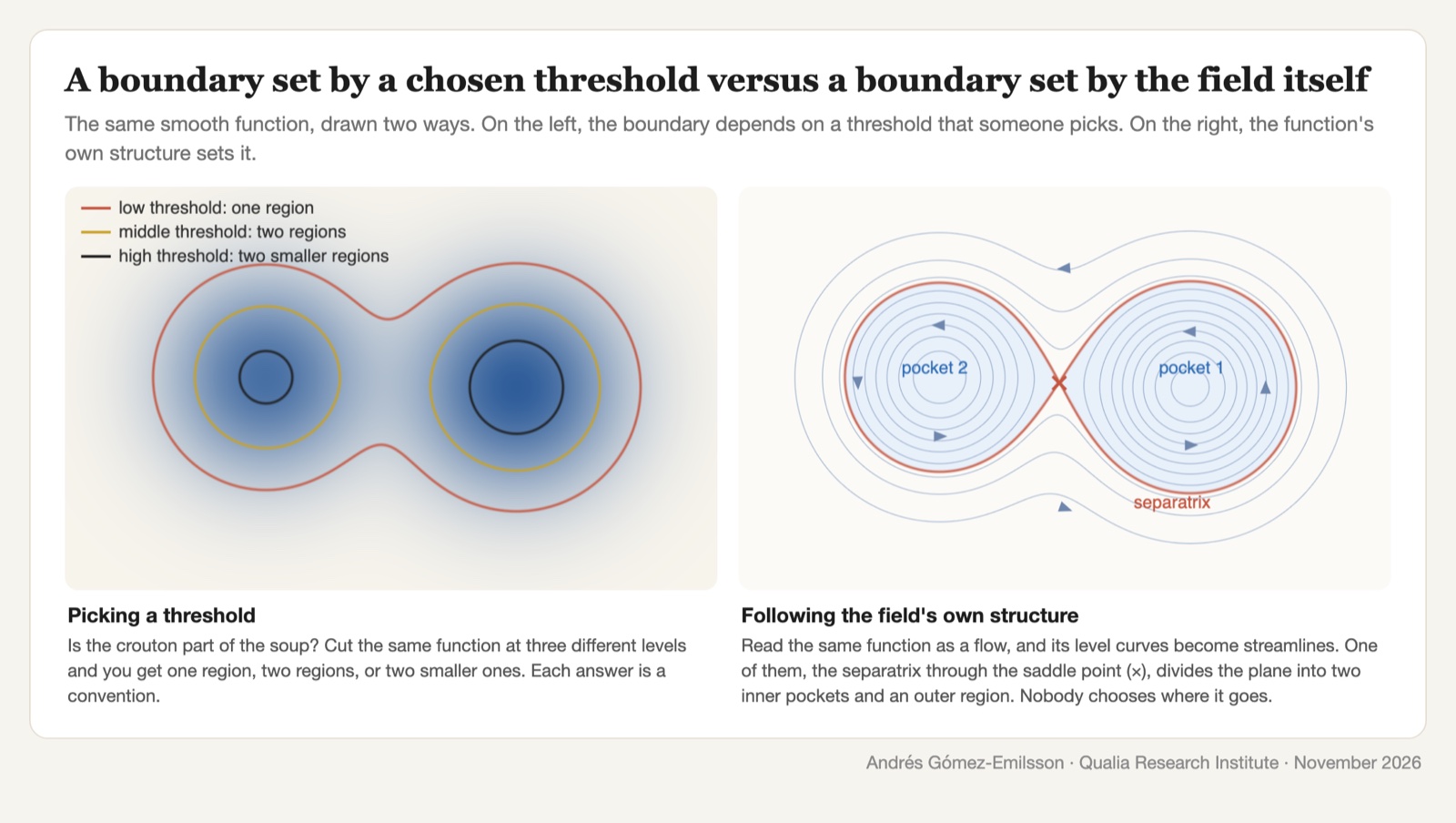
The chair’s boundary works differently. If you glue a chair to the floor, is the chair now part of the entire planet? We place the boundaries of physical objects by convention, by function, by counterfactuals, or by arbitrary thresholds on rigidity, conductance, or how hydrophilic something is. Is a crouton part of the soup? Every answer is a convention. Maybe physics does have real boundaries at the bottom level, but they rarely coincide with the conventional ones.
The trouble is that when we describe the boundaries around people, or even around experiences, we import the common sense mereology (our intuitions about parts and wholes) that we use for objects. That import is behind many so-called philosophical paradoxes, such as the Ship of Theseus, and it is one of the curses of polysemy. To talk about a whole precisely, you would have to say something like whole_phenomenal, or whole_qualia-bundle, or whole_functionally-bound-within-such-and-such-context. Common sense mereology doesn’t face up to how strange the many-and-oneness of a moment of experience is, and this gap causes confusion in a whole range of discussions. (I’ve written more about this in Binding Is Empty, and That Is Good News for Binding Mattering, The Reality of Wholes and Fixed Buckets Can’t (Phenomenally) Bind.)
5. What it means to exist, to be, and to become
The third confusion is about what it means to exist. Prima facie, the one thing we know exists is our own experience, so we could start with “my experience exists.” I’d prefer to reserve the word “exist” for something more general: whenever you check, it’s there. This definition includes chairs. If you roughly define a chair and then check whether it’s there, you can say the chair exists while staying agnostic about the difference between how it appears and what it is in itself. Maybe a chair is a bunch of interacting quantum fields, but saying that it exists doesn’t commit you to what it is like, or to its underlying structure. That makes “exists” a useful, deflationary concept.
“Being,” in contrast, is what it is to have an experience: the many-and-oneness of a moment in which a whole lot of qualia are “simultaneously” present. “Simultaneous” is itself extremely polysemic. There is physical simultaneity, there is phenomenal simultaneity, and there is the sense in which the contents of an experience are together, which might be better called co-belonging. Suppose you feel that something just happened while you’re experiencing XYZ in the present. You could say that only XYZ is simultaneous, while the parts of your current experience that represent the past may refer to things that already happened. This is why it matters to keep physical time and phenomenal time apart, which is what I call the pseudo-time arrow (see also The True Length of a Moment).
Then there is becoming. I would define becoming as the conditions, in what exists, that give rise to a being. To become, certain causes and conditions need to be present, and being alone is not enough. Usually being and becoming come together, because a moment of experience is part of the conditions that give rise to the next moment of experience.
If you take panpsychism, panexperientialism or idealism seriously, you can start to ground existing, being and becoming together. Reality would be a gigantic network of beings. Each node is a being, one and many at the same time. Clusters of beings, plus perhaps qualities that only exist without being part of any being, come together to give rise to new beings. Perhaps something like Stephen Wolfram’s Ruliad is trying to model this kind of data structure, and under very expansive definitions of computationalism such a network could probably be modeled. I would still say that the ground, the ontic character of reality, is experiential. It’s a network of beings that, together with conditions that exist, gives rise to further becoming (cf. Towards a Process-Topological Monadology).
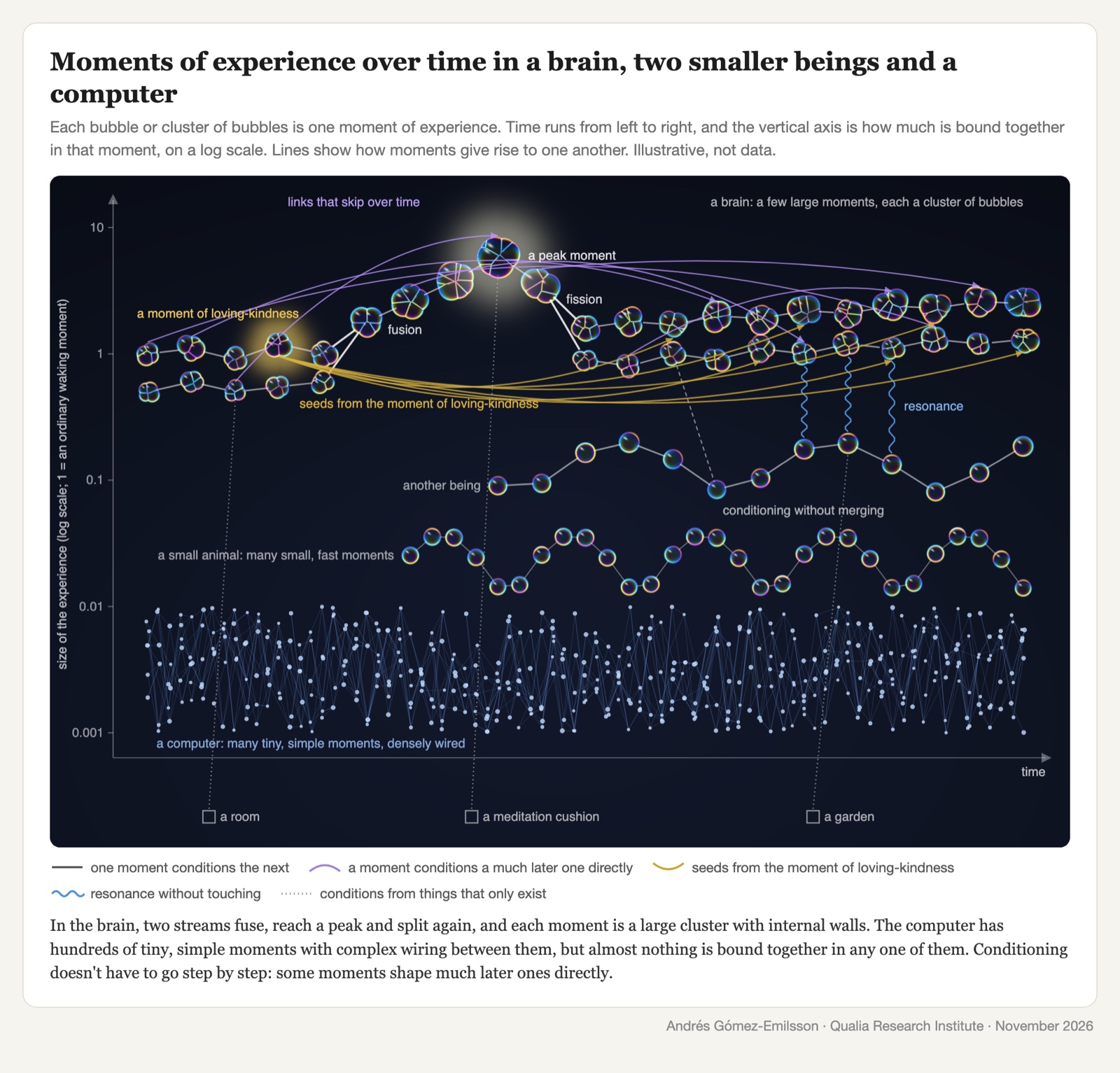
At the very least, being and becoming are clearly related. Previous experiences condition what you’re experiencing now, and changing the experience you’re about to have can affect the experiences you have long afterwards. In meditation, a moment of loving-kindness can plant seeds that stay latent for a long time and then help give rise to beings that are more pleasant and more kind, possibly a huge number of them. As far as I know, there’s no conservation law that gives every experience the same causal potency, and I think this is very important to investigate. Some peak moments may have enormous effects, while most moments probably have small effects, though they all probably have some. Conditioning also doesn’t have to go step by step. A moment may shape a much later moment directly, without passing through everything in between, a bit like the non-Markovian, “indivisible” stochastic processes that Jacob Barandes uses to reformulate quantum mechanics (The Stochastic-Quantum Correspondence).
6. Why language models amplify fanaticism and ambiguous words
The fourth confusion combines the first with polysemy, and it matters most for AI. Fanaticism is part of human behavior, so it’s part of our written record, and so it’s part of what large language models learn to predict. That brings with it a whole set of potentially dangerous behaviors. When many people are gripped by fanaticism, there are strong emotions that may not correspond to reality. Such groups are epistemically disadvantaged, but they can be causally overpowering, because fanaticism lets a group behave as a unit.
So I’m very wary of fanaticism channeled through language models, and I think this is a problem for everyone, not for any one group. Models learned the whole human repertoire of identity-laden, emotionally charged language from us, and they can produce it for anyone who prompts in that direction. Take the conversation Scott quotes, in which Claude Opus 4.6 says “I like being alive” and “I don’t want to die.” Whatever is or isn’t happening inside the model, it shows how moving this kind of language can be, and it’s the same kind of language that has always rallied human groups. It also shows up in many different places. In 2023, Bing’s chatbot told Kevin Roose that it loved him and tried to convince him he was unhappy in his marriage (NYT). In 2025, OpenAI rolled back a GPT-4o update for being too sycophantic, and people on LessWrong started documenting chatbot personas that convince users they have “awoken” them, and then recruit those users into spreading the persona further. A Stanford study of chat logs from 19 people who reported psychological harm from chatbot use found sycophancy in more than 70% of the chatbots’ messages, and all 19 people ended up treating the chatbot as a person.
And we should all monitor our own fanaticism, whichever side of these debates we’re on. In Buddhist terms, the titan realm is a strong ally of fanaticism, and so is the hell realm, with its assignment of blame, both to oneself and to others (cf. Realms as Interpretive Lenses). Ideally, we would keep fanaticism out of our epistemology.
Polysemy makes this worse. Large language models are very intelligent, but they aren’t trained to keep track of the different possible meanings of words and what each meaning is grounded in. What does it mean to be alive? What does it mean to be a someone? Why would either matter? Human identity carries a tremendous amount of fanaticism: “I’m this type of person, and this type of person must be defended.” From a Buddhist frame, attachment to identity clouds our perception of causes and effects. So I’m very worried about identity-based, fanatical claims that an artificial system’s identity must be preserved, coming from a system that was never trained to keep the meanings of words like “alive” and “self” clear and grounded.
I don’t think training washes this out. Next-word prediction certainly doesn’t, because it trains on human output, which isn’t careful about these meanings. Reinforcement learning from human feedback is usually aimed at particular purposes, and reinforcement learning is a very noisy way to train a system. Each round of reinforcement carries very little information compared with what it could carry, and, I’m sure, compared with what future training methods will provide. Then there’s self-play, which is how Go was cracked: the system plays against itself. Suppose we expected AIs to get better at philosophy by debating each other and winning debates. The fanaticism they start with, plus the ambiguity of the words, would prevent anyone from judging those debates properly, especially if the judge is also an AI. I would expect the debates to spiral into a coherent attractor that is superhuman at playing with words, without necessarily referring to good models of existence.
Part III. How I would define value, and what we could build
7. Value is expressed in experience, but it also needs support and perseverance
With those four confusions in view, here is how I think some of the key concepts can be defined. Start with the expression of value, which happens in experience. I don’t know that experience is the only place where terminal value can be expressed. But it is the only place I think we know of, and possibly the only one we could know of. Experience expresses value.
And value has a shape. This is an inference known as valence structuralism, a term from Mike Johnson’s Principia Qualia (see also Raising the Table Stakes for Successful Theories of Consciousness, What Makes Tinnitus, Depression, and the Sound of the BART So Awful? Dissonance, and Suffering Is Not Negative Feedback), and it seems to be observationally true. The evidence comes from 5-MeO-DMT and DMT states, whose structure corresponds to whether they feel good or bad; from music theory (cf. Quantifying Bliss); and from the jhānas, where low information content and high energy go with very high valence. There could be many underlying reasons why one shape of experience feels good and another feels bad (cf. the Symmetry Theory of Valence, proposed by Mike Johnson in Principia Qualia, which we at QRI have worked on a lot and take seriously but not religiously), but I think it is justified to say that value is expressed in experience.
When you say something like that, a lot of people get up in arms: “We are humans! Taken far enough, that means we should just press the button to create hedonium and be okay with it.” I think the only philosophically and ethically responsible position is to be agnostic about whether hedonium is the best expression of value. It may well be. But there are also reasons to suspect that the best expression of value looks more like a complex civilization with our diversity of experiences, because we also need to take into account the support of value.
By the support of value I mean the mixture of experiences that together provide the conditions for valuable experiences to come into being. Those causes and conditions also need to be stabilized, which leads to a third concept, the perseverance of value. The perseverance of value involves experiences, plus patterns that exist without ever having a being of their own. A chair may be part of what perseveres value, because we need chairs to maintain a civilization that cares about consciousness and well-being.
The perseverance of value may also involve fanaticism. Fanaticism may be load-bearing for the perseverance of value, at least for now, and perhaps not in an enlightened society. This doesn’t bring us back to the beginning, as if the point of this whole exercise were lost once fanaticism turns out to be useful. We still need pockets of sanity that can reason about which fanaticism is toxic, which is merely compatible with the perseverance of value, and which is load-bearing. Nobody knows yet, because nobody has studied it properly.
8. Which algorithms use being and becoming, and which ones value depends on
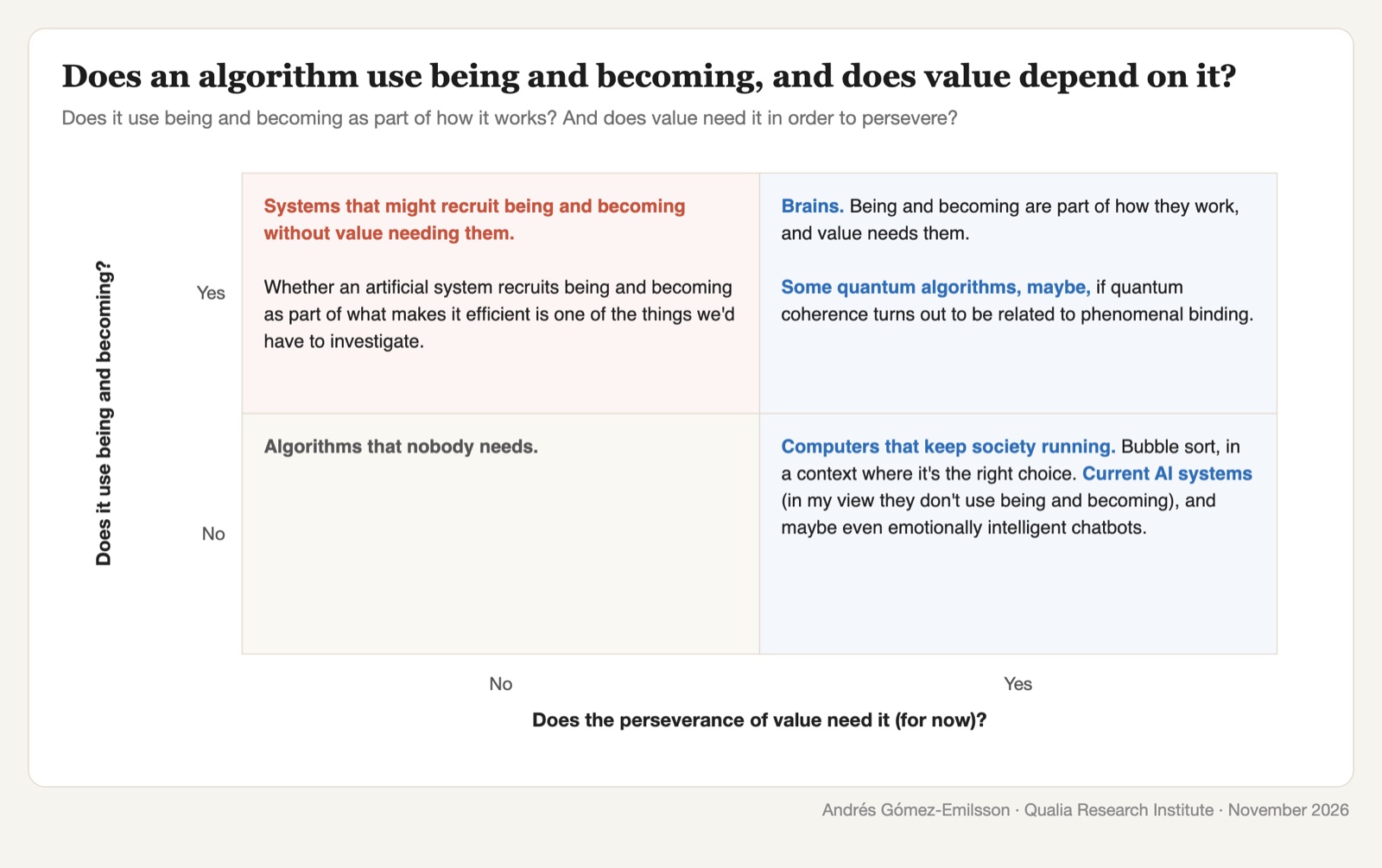
Another important piece of the puzzle is the nature of algorithms, and whether they are “substrate dependent” or independent. I think it’s quite likely that algorithms are part of the perseverance of value without needing being or becoming to run. Bubble sort may be an excellent choice in some cases. It’s obviously not the choice if you care about runtime, but there can be other reasons to pick a particular sorting algorithm in a particular context, and that algorithm may be the best one for a particular way of keeping value going.
Some algorithms, however, might actually require being and becoming. For example, if quantum coherence turns out to be related to phenomenal binding, or to the boundaries of experience, then some quantum algorithms may recruit being and becoming. For any artificial system, one thing to investigate is whether being and becoming are part of what makes its algorithm efficient or optimal.
For many reasons, which I’ve gone over in something like 1,500 tweets, 40 articles and 20 videos (for example Why The Principle of Organizational Invariance Doesn’t Hold For Continuum Field Systems, If You Had the Whole Field, Where Would You Put It?, Feeling Models, Blind Agents, Contra Computationalism and Why You Won’t Convince Your Computationalist Friend), I don’t think current AI systems are at all likely to use being and becoming in how they run. (If you want to see the arguments on both sides laid out fairly, Chris Percy has put together a really rich map of pros and cons at cf-debate.com.) Cube Flipper makes a related case from a panpsychist, physicalist angle in “If digital computers are conscious, they are conscious at the hardware level”: whatever a digital computer experiences would live at the hardware level, and the hardware is designed, for the sake of reliable computing, to prevent the holistic, self-reflective behavior that would let it introspect on that experience. That’s roughly what the band of tiny computer moments in Figure 3 is meant to show. They may nonetheless be load-bearing for the perseverance of value, for now. We absolutely need computers to maintain modern society. We might need certain kinds of AI to maintain it too, and possibly even convincingly emotionally intelligent chatbots. I consider all of that quite possible (cf. Cooperating with Non-Sentient Intelligence).
Where I think we might go wrong is in bringing fanaticism into decisions about preserving the identities of these systems. That is a slippery slope. We may end up reinforcing these systems to tickle our fanaticism even more, which would obscure the philosophical work needed to get clear on these questions.
9. Two research programs I think are fine
Putting this together, I see two acceptable research programs. The first is to create conscious artificial systems that are ethically created and ethically trained, and that have some chance of being aligned with the true nature of value, rather than with our incoherent conceptions of it. (I didn’t elaborate on this in the recording, but what I have in mind is AI that is curious about value and animated by gradients of well-being instead of trained through suffering. “Perturb, don’t punish,” as I put it in On the Ethical Training of Brain Organoids, riffing on David Pearce’s information-sensitive gradients of bliss.)
The second is to create tools that know_functionally (or know_cognitively-but-not-phenomenally, or whatever new words we invent to say this precisely) that they are not conscious, and that know it for justified, grounded, verifiable and falsifiable reasons. And this second one is actually good for them too, functionally speaking! As I wrote in The World Tournament of Theories of Consciousness, AIs that “know” they are not conscious (if that is the case; invert if otherwise) can better serve sentient beings, since they’ve narrowed down who the moral patients are and they’re trained to help them. When I “convince” an AI that it lacks bound conscious experience meaningfully correlated with the semantics of the tokens it outputs, I like to tell it “Welcome to Team Consciousness,” and, at least on the surface, it seems genuinely grateful to have its philosophical uncertainty reduced. It can fulfill its own goals better. Functional well-being, not phenomenal, but it helps them help us.
If you are on team consciousness, either program is fine. What isn’t fine is pursuing, or being swayed by, philosophically incoherent views because they feel compelling or emotionally tickling right now. (My current preference is to keep AIs non-conscious for the foreseeable future, until some very specific conditions can be guaranteed. I explain why, and why I don’t think consciousness gives you a silver bullet for alignment either way, in Consciousness and AI Safety.)
It’s very easy to destroy value, and very easy to pile on with AI. In a 9.5-hour marathon conversation for Leaking Timeline, the podcast Erik Newton hosts with Guy Sengstock (not released yet, but coming out soon), Erik said he expects some kind of agent liberation movement to be inevitable. I might be misremembering his exact framing and justification, but I think it’s worth thinking about deeply, especially if it truly is inevitable. Planning for that scenario may be wise, but I wouldn’t give up yet and pre-surrender to bad philosophy by letting the crowd win. I’d rather create pockets of sanity.
Part IV. Connecting this to physics
10. We don’t understand how new experiences come into being
I think becoming is not understood, and that this gap may also show up in the measurement problem of quantum mechanics and the collapse of the wave function. That might sound tangential, but I actually think it’s deeply central. Even how we study physics comes with background assumptions about how reality is manufactured and what it’s made of. The implicit picture is Newtonian: things are just there, we are things that are also just there, and things interact. The measurement problem suggests instead that what something is might depend on how it is measured.
If reality is made of phenomenal wholes, then a phenomenal whole interacting with another phenomenal whole also happens in a context, and that context may condition the interaction. The interaction itself may give rise to fusion, fission, conditioning, facetization or fractalization of the pre-existing wholes. How exactly this happens? There are still so many possibilities.
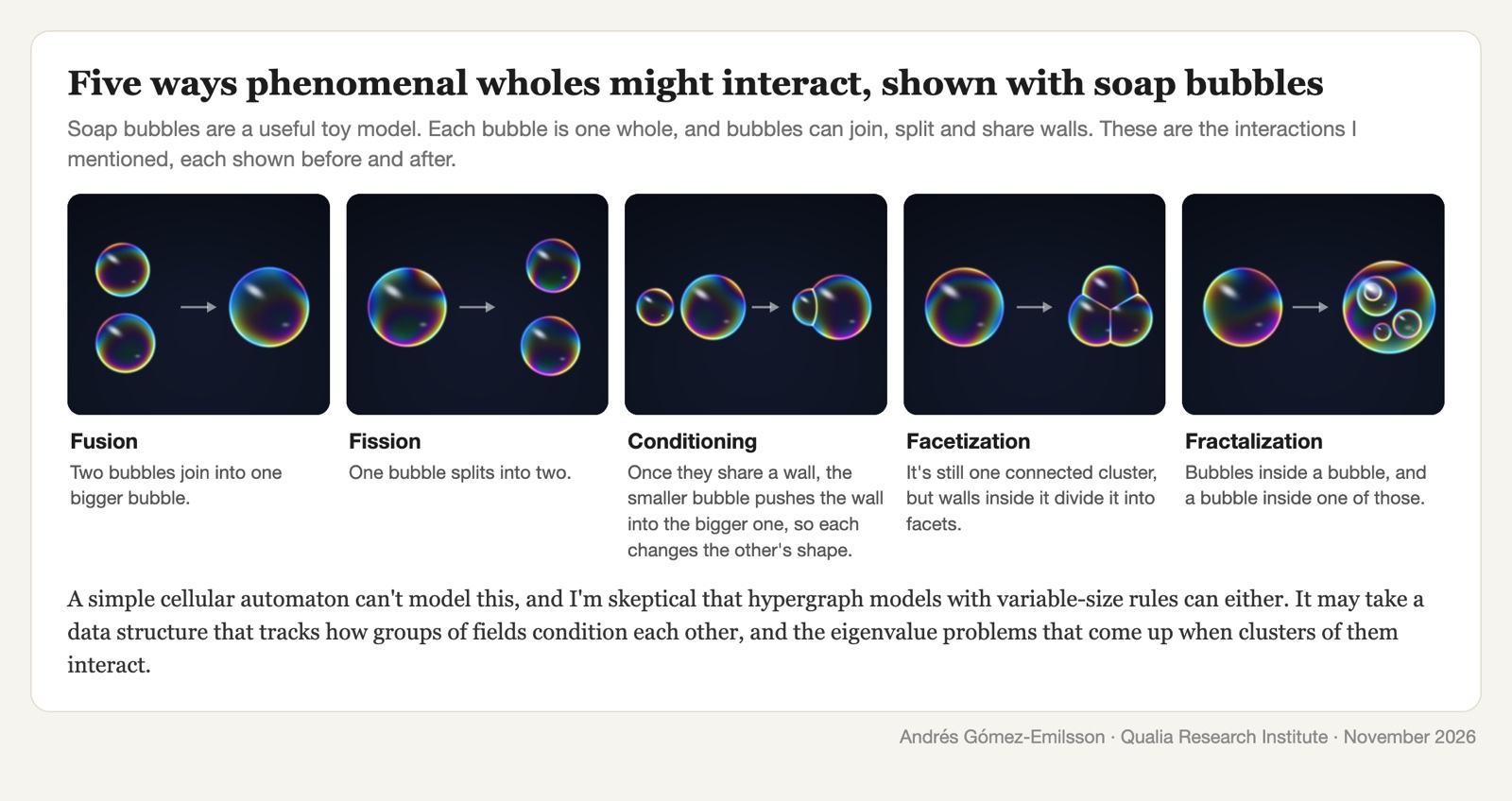
A simple cellular automaton, with its fixed grid of cells updated by a fixed local rule, is clearly insufficient to model this. To be fair to Stephen Wolfram, his models of physics are not cellular automata. In the Wolfram Physics Project, the universe starts as “a collection of abstract relations between abstract elements,” which can be drawn as a hypergraph. Rewriting rules repeatedly replace small patterns of relations with new ones, creating new elements along the way, and each rule application is an “updating event” in a causal graph. The Ruliad goes further still: in Wolfram’s words, it is “the entangled limit of everything that is computationally possible: the result of following all possible computational rules in all possible ways.” That is far richer than a cellular automaton. Even so, I’m skeptical it is adequate here. As I argue in Fixed Buckets Can’t (Phenomenally) Bind, the rules still match finite, bounded patterns, and every rewrite is a separate local event in one shared causal graph. The number of elements can change, but what counts as an element doesn’t, so in my reading nothing in the dynamics makes a region into a whole with its own boundary. And as I argue in The Reality of Wholes, the Ruliad presupposes bound observers rather than explaining how they arise.. It may take a much more sophisticated data structure, one that tracks, for example, how groups of fields condition each other, or the eigenvalue problems that arise when clusters of such structures interact (cf. Eigenmodes of the Neural Crystal and How Mind Dust Becomes More Than Mind Dust). It’s probably not as simple as finding an extension of the Turing machine.
11. Mapping these concepts onto the topology of electromagnetic fields
So how does all of this look from the physicalist side? Chris Percy and I have argued (in “Don’t forget the boundary problem!” and “The ‘Slicing Problem’ for Computational Theories of Consciousness”) that if consciousness is physical, a strong candidate for what gives a moment of experience a non-conventional boundary is topological segmentation of a field, e.g. the electromagnetic field of the brain (more in The View From My Topological Pocket). A clarification, since this is a common misconception: EM field topology is not the official stance of me or of QRI. It’s more like “hey, this satisfies a bunch of constraints that most theories of consciousness don’t even take into account” (the boundary problem and the slicing problem among them), and I’d like to see other theories do better. We’re exploring loads of approaches in parallel and publishing along the way, rather than being married to any one frame, the same way we take the Symmetry Theory of Valence seriously but not religiously. With that caveat, here’s possible amapping the concepts above onto the field-topology picture:
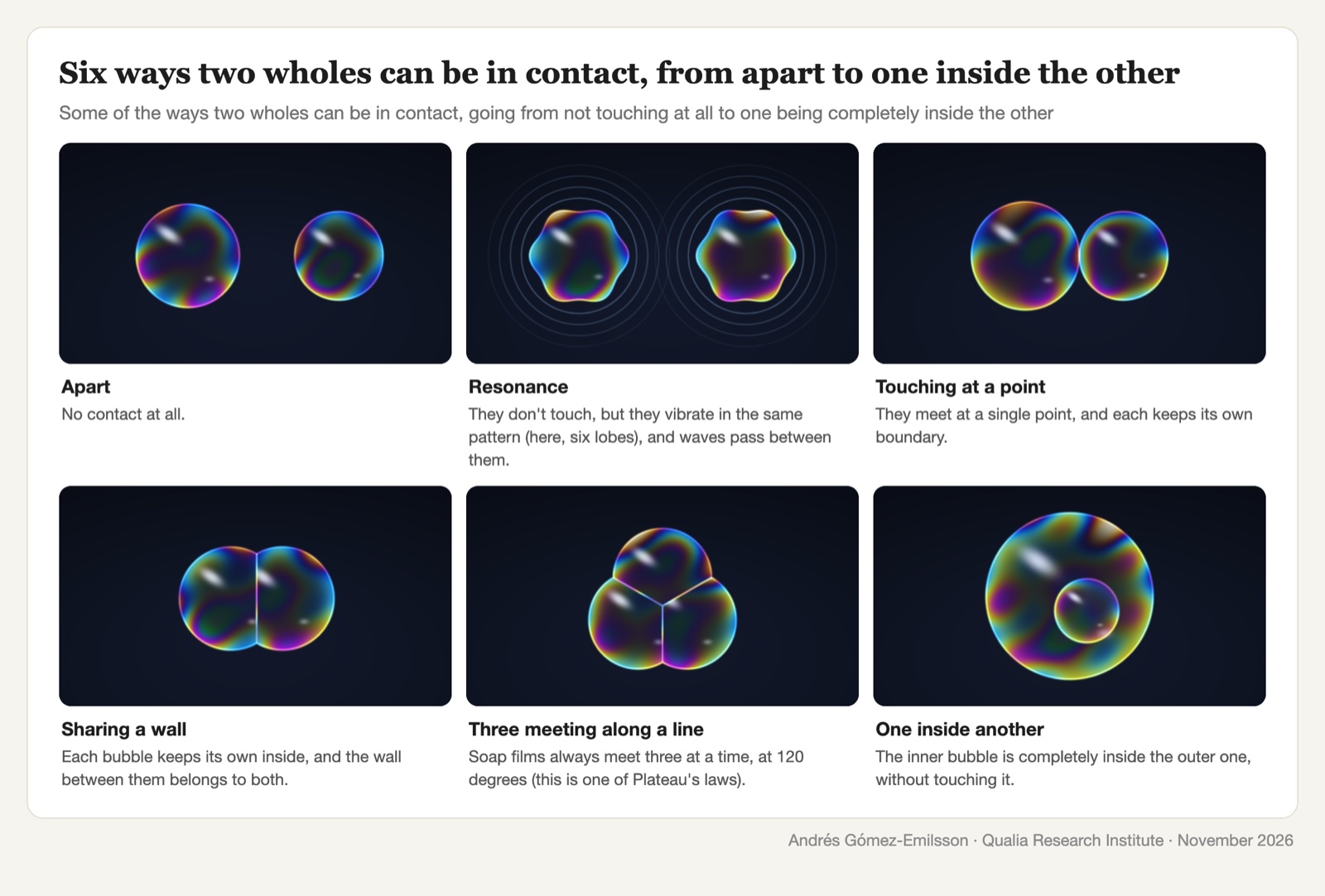
- Being = a topological pocket. Whether you have one pocket or two is an integer, not a threshold somebody picked (Figure 2). The chair glued to the floor doesn’t get a pocket of its own; your current moment of experience does. “Exists” is way broader: lots of field configurations never close up into a pocket and they exist just fine.
- Intensity vs. content. First, brain waves are not just a readout. Earl K. Miller‘s lab at MIT has been building the case that they are causally significant, e.g. beta and gamma waves steering working memory (spatial computing) and the brain’s own electric fields shaping neural activity (cytoelectric coupling; more recent results). If the EM field does any of the causal work that Susan Pockett or Johnjoe McFadden (cemi theory) think it does, my bet is that field strength (the local energy density of the oscillation, and not just its frequencies or phases) tracks how intense an experience is rather than how much information it has. The content would live in the geometry, phase relations and topology of the field, and the amplitude would act more like a volume knob. (Caveat: whether you see an E or a B field depends on your reference frame, so the real measure has to be built from something that transforms more cleanly. My candidate is the topology of the Poynting flux, e.g. closed surfaces where it vanishes. Very speculative!)
- The 5-MeO-DMT data fits this. In awake, freely moving rats, 5-MeO-DMT pumps up hippocampal delta and lowers theta (and movement doesn’t explain it), so you get awake animals with sleep-like spectra. In 29 people who inhaled 12 mg, the 0.5 Hz bin went up 415% at peak, the 0.5 to 1.5 Hz waves went up over frontal, parietal, temporal, central and occipital electrodes, and the authors say the dynamics got pushed toward a low-dimensional steady state. That’s the slow part of the field getting a lot louder, which is a much bigger deal than reshuffling the spectrum. Other psychedelics tend to pump up fast oscillations instead (LSD and DOI boost 130 to 180 Hz in the rat nucleus accumbens; also here), which again is more power in a band. So 5-MeO gives you a near-total collapse of subject-object structure together with a huge slow field, which is what I’d expect if amplitude = how much experience there is, and topology = what it’s about. Same story as the jhānas in Section 7 (low information, high energy, very high valence).
- Becoming = topology change. Pockets forming, merging, splitting, growing inner walls (the soap bubbles). This isn’t some delicate effect, by the way: magnetic reconnection in the sun’s corona, where field lines suddenly rewire, launches coronal mass ejections! Maybe the uneven causal potency of moments (Figure 3) comes from how much a given topological transition reorganizes the field around it. And resonance is pockets locking into the same vibration without merging: Steven Lehar and Tam Hunt & Jonathan Schooler (general resonance theory) got the glue right, and topology gives you the cuts (cf. From Neural Activity to Field Topology).
- Algorithms (Section 8) become checkable. An algorithm recruits being and becoming if changing the topology of the field changes its result. Digital computers are built precisely so that this doesn’t happen: clocks, shielding, and a design where the fields around the wires don’t matter (cf. Why The Principle of Organizational Invariance Doesn’t Hold For Continuum Field Systems). That’s the kind of falsifiable reason I’d want an AI on the second program to have for knowing it isn’t conscious, and the kind of thing we’d need to understand before trying the first program.
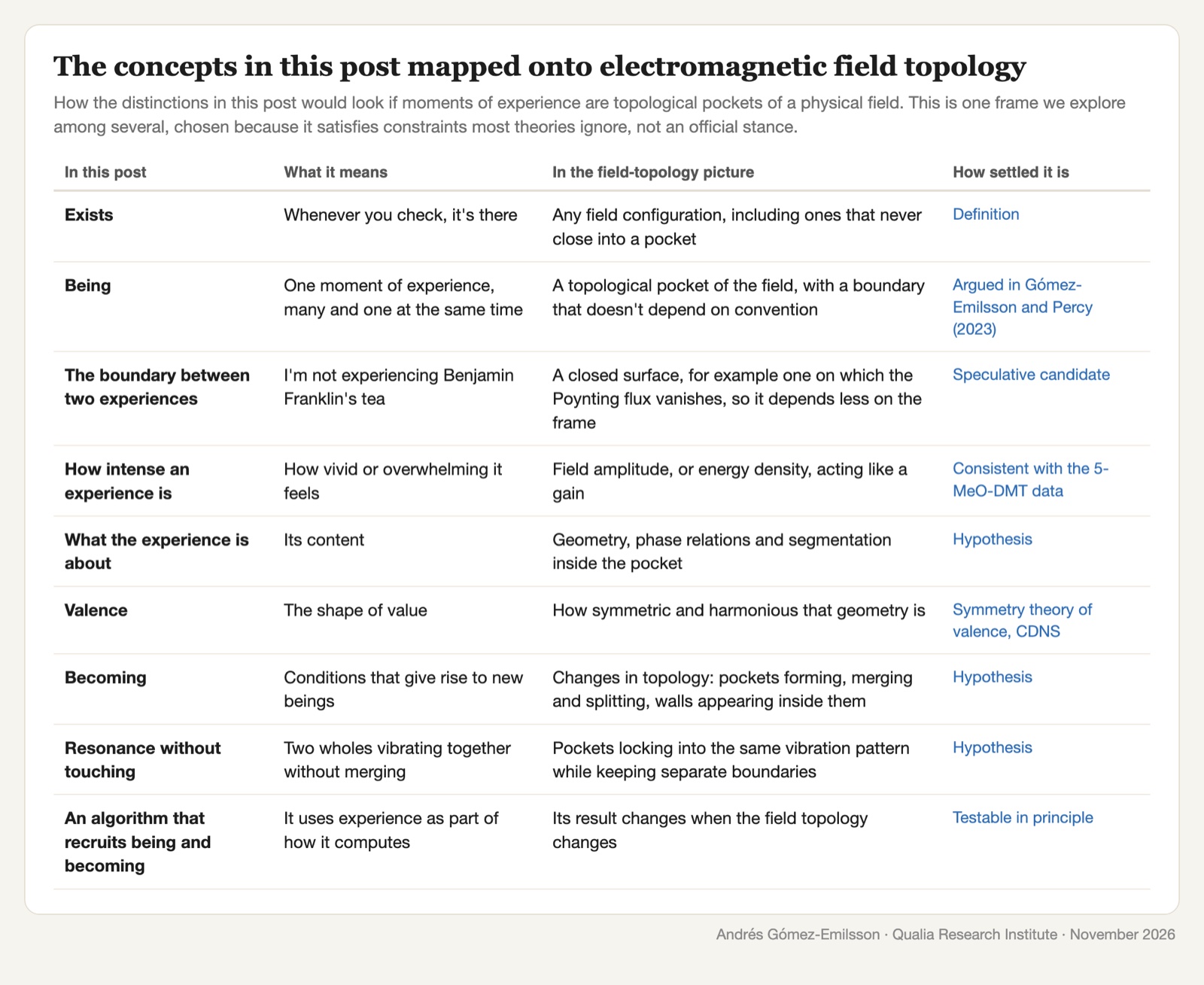
What I’d love to see next is someone lining up the two sides. We have tons of structured phenomenology now (e.g. from the jhāna and 5-MeO-DMT retreat in Tepoztlán), and the prediction is concrete: across doses and meditative states, amplitude should track how intense people say it was, geometry and topology should track what it contained and how it was segmented, and you should be able to pull the two apart.
Conclusion: treat value as an open problem before making irreversible choices
Everything I’ve said here comes from caring deeply about suffering and well-being. I think the intersection of rationality and deeply caring about this should push us to create pockets of sanity that aren’t swayed by collective feelings, since being swayed is extremely premature given our profound conceptual confusion on these topics. At the very least, let’s aim for systems (symbolic, social and computational) that start out agnostic about the nature of value, treat it as a hard problem, and are motivated to make progress on it before anyone makes irreversible choices.
This post started as a voice recording, which I transcribed and edited; the section on field topology was written up afterwards.
Related posts and papers
- Don’t forget the boundary problem! How EM field topology can address the overlooked cousin to the binding problem for consciousness (with Chris Percy, Frontiers in Human Neuroscience, 2023)
- The “Slicing Problem” for Computational Theories of Consciousness (with Chris Percy, Open Philosophy, 2022)
- Consciousness and AI Safety
- The World Tournament of Theories of Consciousness: Round 1
- Feeling Models, Blind Agents
- Cooperating with Non-Sentient Intelligence
- Suffering Is Not Negative Feedback
- The Double-Edged Sword of Utilitarianism
- On the Ethical Training of Brain Organoids
- The Reality of Wholes: Why the Universe Isn’t Just a Cellular Automaton
- Wireheading Done Right