This is more than a presentation. It’s an invitation to join the frontier of consciousness research 🙂
Spatiotemporal Coordinates: Thursday, November 20 – 4:00 PM – 10:00 PM PST – Frontier Tower (San Francisco, California)
Hello Qualia Community!
After a year of heads-down development (with glimpses shared on podcasts including Theories of Everything with Curt Jaimungal #1#2) QRI is ready to reveal the full scope of our work mapping the state-space of consciousness, modeling phenomenology, and identifying the computational properties of consciousness.
What We’ve Recently Accomplished In This Area:
In 2023, QRI’s High Energy Awareness Research Team conducted two legal psychedelic retreats exploring mushrooms, ayahuasca and 5-MeO-DMT, by bringing together an interdisciplinary coalition of meditators, psychonauts, physicists, and mathematicians and working as a Think Tank for weeks at a time (see heart.qri.org).
Systematic DMT phenomenology reveals repeatable phase transitions and geometric transformations, including hyperbolic curvature, symmetrification effects, and computational properties that demand explanation. The QRI period 2024-2025 has been about developing conceptual frameworks and computational models to make sense of these patterns, and then putting them to empirical test. We’ve discovered how coupling kernels (the rules of interaction between oscillating systems) can simultaneously shape both neural activity and the topological structure of physical fields, providing a potential causal chain from neurochemistry to the structure of conscious experience. It’s a conceptual framework where the pieces of the puzzle finally seem to fit together: how psychedelics modify coupling dynamics at the neural level, how these changes cascade through neural architectures to modulate field topology, and how this field structure feeds back into neural activity, avoiding the trap of epiphenomenalism while grounding phenomenology in processes with computationally meaningful properties.
What’s Next:
This event is divided into two parts.
We’ll present the core outputs of our research from the past year: methods, participants, results, and the theoretical frameworks we’ve developed. You’ll see interactive demonstrations and simulations that bring these concepts to life.
4:00 PM – Doors open, mingling with snacks and soft drinks
5:00-5:40 – Introductions and interactive demonstrations
5:40-6:40 – The Big Reveal: QRI’s psychedelic research over the last two years, including HEART retreat results, interactive simulations, and our theoretical breakthroughs
We’ll chart our path forward: In Q2 2026, we’re planning a legal psychedelic retreat where mathematicians, physicists, meditators, and visual artists will collaborate to test whether non-linear optics plays a role in psychedelic phenomenology (especially DMT). This generativeframework, which we take seriously and can rigorously test with proper funding, will combine physics simulations, psychophysics studies, and rigorous phenomenological mapping to reverse engineer the medium of computation of consciousness itself.
7:00-8:00 – The Next Chapter: 2026 retreat plans, mathematical modeling of consciousness, and testing our generative frameworks
8:00-9:00 – Q&A and group discussions
9:00-10:00 – Mingling and winding down
We anticipate that once we recognize consciousness’s computational role, we will move from cognitive science to consciousness engineering: systematically exploring the state-space of possible experiences and recruiting new qualia varieties to enhance our (conscious) cognitive capabilities.
Presenters at this event:
Andrés Gómez-Emilsson: As QRI’s President and Director of Research, his work at QRI ranges from algorithm design, to psychedelic theory, to neurotechnology development, to mapping and studying the computational properties of consciousness. Andrés blogs at qualiacomputing.com.
Cube Flipper: With a deep understanding of wave dynamics and visual perception, Cube is dedicated to uncovering the intricacies of visual phenomena. In addition to their research at QRI, they also share their insights and findings on their personal blog smoothbrains.net.
What We’re Fundraising For:
To continue this groundbreaking work, we’re seeking support for:
Core operations: Salaries to keep QRI’s team intact for another year (and hopefully many more)
Two major retreats: The 2026 DMT phenomenology retreat and a 5-MeO-DMT awakening retreat
Research outputs: Publishing papers and studies, including upcoming pain quantification research (currently private, soon to be released)
Technology development: Bringing crowdsourced phenomenology visualization tools to a fully functional state to crowd-source the mapping of the state-space of consciousness (first batch to be released on November 20th)
Whether you’re a researcher, artist, meditator, potential funder, or simply fascinated by the nature of consciousness, this event offers a rare opportunity to see cutting-edge phenomenological research as it unfolds. We’re also gauging interest for the 2026 retreat: if you have relevant expertise (mathematics, physics, meditation, visual arts), funding capacity, or alignment with this vision of consciousness research, we’d love to connect.
If you’re unable to make it but would still like to contribute to our research efforts, you can donate at qri.org/donate or with crypto on our Endaoment page.
This year’s QRI-associated essays reveal multiple converging lines of investigation:
Non-Linear Optics Framework: A generative framework exploring how the brain might render world simulations using optical elements. Key metaphors include Laser Chess (where local classical moves set constraints, then holistic standing wave patterns emerge) and Cel Animation (describing how the world simulation is constructed with independent layers controlled by different modules that overlap and interact in a shared perceptual workspace). This includes work on beamsplitter holography to explain Indra’s Net phenomenology.
Fractional Fourier Transform: Recent work explores how the brain may *utilize* the fractional Fourier transform, which is a generalization that smoothly interpolates between spatial and frequency domains. This could explain characteristic ringing artifacts in psychedelic visual fields and provide a biologically plausible mechanism for massively parallel pattern recognition.
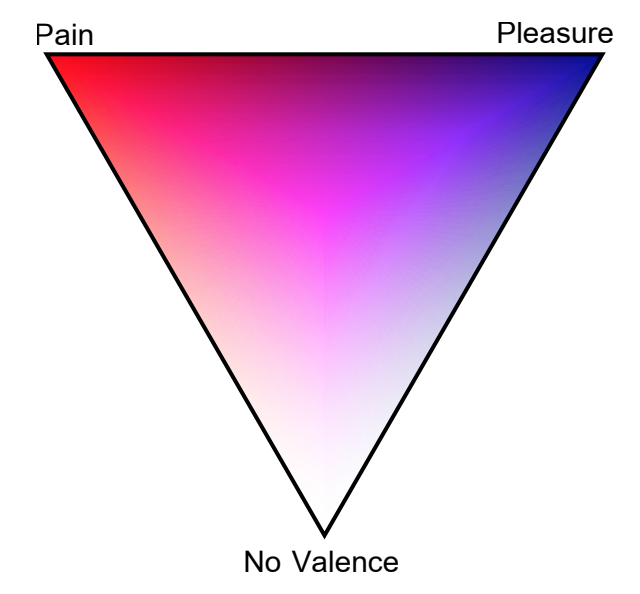
Coupling Kernels and CDNS and Field Topology: A breakthrough framework showing how systems of coupled oscillators can both tune into resonant modes and control the topological structure of fields. This provides a direct causal chain from molecular interactions (neurotransmitters, psychedelics) to the structure of conscious experience. The coupling kernel acts as a “field-shaping operator”, the same mathematical object simultaneously modulates neural dynamics and field structure, explaining how psychedelics produce such radically different yet structurally consistent effects across participants and experiences. We hypothesize that DMT effectively implements a Mexican-hat coupling profile (strong negative coupling at short distances, positive at medium distances) creating competing clusters of coherence, while 5-MeO-DMT drives systems toward global phase synchronization. This connects to the Consonance-Dissonance-Noise Signature (CDNS) approach, which describes valence in terms of spectral properties such as consonance tracking positive valence, dissonance negative valence, and noise neutral valence. We we will make the case for why this proof-of-concept demonstrations are compelling and point toward testable predictions.
Ongoing Foundational Work: QRI continues to develop frameworks including the CDNS approach, the Topological Solution to the Boundary Problem (explaining how unified experiences emerge with precise boundaries), liquid crystal dynamics as phenomenologically significant, and logarithmic scales of pleasure and pain for rigorous quantification of experiential quality.
I have not settled (and maybe it’s not for me to do it) on the core tenets of Team Consciousness. This would be a kind of philosophy or spirituality that tries to derive ethics from truth and actually get at the truth rather than a convenient approximation of it (or worse, a misrepresentation of it for the sake of memetic reproduction capacity). What I’ve thought for many years and has remained stable, is that we can reduce them to three core principles:
Oneness / Frame Invariance
Valence Realism
Math
First, we must realize that every point in reality is equally real. There are more or less intense experiences, of course, but this is in fact a measure of how much reality is expressed in each. The core idea here is not that every experience is literally equally significant (they’re not) but that the spatiotemporal coordinates of an experience are irrelevant for their significance. Your experiences or the experiences of the members of your tribe or species are not more or less real than those of anyone else, factoring in their degree and intensity of consciousness.
The second core idea is that valence – whether experiences feel good or bad – is the source of value. More so, valence structuralism (an implication of valence realism in light of empirical observations of what feels good or bad in practice) entails that the value of reality is encoded in the geometric and topological basis of consciousness. Indeed, there are better and worse forms of being, and this is not an arbitrary matter, but one that can be investigated directly and devoid of personal prejudice.
And finally: math. It is not the same to suffer for one second versus a million years. It is not the same for one person to suffer as it is for a billion persons in torment. It is not the same for love to exist for a minute versus it being the foundation of a civilization. Amounts matter; qualities matter. This is tautological, of course. But for strange reasons, our empathizing cognitive styles often neglect math. So we ought to correct for this bug.
I think that all of ethics can be reconstructed from these principles. And in fact, they might help solve many moral paradoxes and enigmas. Just apply them diligently and rigorously and see how they allow you to discern between good and evil.
My hope is that the reproductive capacity of these three core principles will come from the fact that (1) they are true (and truth is convergent for those who seek it) and (2) they are highly beneficial and generate excess value. On (2), I’d point out that valence realism and the oneness of consciousness principle have practical implications, ranging from a science of consciousness capable of reducing depression, anxiety, and chronic pain, to future consciousness-altering technologies that will greatly enhance our intelligence and collective coordination capacities. I wish for these tenets to not acquire additional clauses that are there merely for their reproduction capacity at the cost of truth or accuracy; they should stand on their own. But these might not be the final set. I’m open to suggestions and enhancements 🙂
In this video I discuss in depth the following topics:
1. MDMA is cardiotoxic and likely neurotoxic, with real and significant side-effects when taken often. Don’t do that. Respect and honor this beautiful state and save it for when you really need it.
2. The phenomenology is often described as “removing layers of conditioning and finding your essential, loving, and pure *core*”. It seems to significantly reduce greed, hate, and delusion, for at least a solid 90 minutes.
3. I argue that a good frame would be to think of the effects as drastically reducing both reactance and fear. Then you can assess a situation without the distortions of these two mental factors, which tend to generate rather self-serving thought-forms.
4. The concept of “authenticity” and its operationalization as a good lens with which to see the effects of MDMA. Big up to Matt Baggott, Co-founder and CEO of Tactogen, who is aiming to perfect MDMA and developed and applied the construct of authenticity in the scientific study of MDMA. Also thanks to Thomas S. Ray, who is on a similar path. Well done! Let’s get more people involved!
5. Another frame is to think of the state as clarifying what the “substance of thought” is like. We usually live under the illusion that emotional reactions follow Newtonian physics. They don’t. A better analogy would be corn starch and water, where applying force quickly can solidify (and even tear) the medium. Thus, we get in our own way and cause a lot of sense of solidity without even realizing it, which will take time and effort to soften and return to normal.
6. Discussion about QRI’s Psychedelic Thermodynamics model applied to MDMA.
7. Self-organizing principles, such as “repulsion-based algorithms” to undo knots, might explain what is happening to the field on MDMA.
8. A possible personality factor might be how “hard” someone is. I discuss personality disorders from a “hardness realism” point of view.
9. Emotional processing as a “skill tree” rather than “levels”.
10. High Entropy Alloys (HEA) are materials made of many metals that, in some cases, lead to really surprising effects, such as a new symmetry space group for their molecular organization (where none of the “ingredients” tend to crystalize that way, but as a whole they do). MDMA might be a bit of a unique HEA that balances serotonin (social anxiety reduction), dopamine (motivation and mental clarity), oxytocin (sense of closeness), and endorphins (bodily pleasure). It is more than the sum of the parts.
11. This leads to a speculation where the key high-level effects of MDMA, in addition to reducing fear and reactance, is the presence of courage, love and equanimity. I try to explain these features in terms of MDMA’s “vibratory signature”.
12. Deep discussion about self-honesty and why it develops in the state. I speculate it has to do with the de-modularization of our vascular clusters (or something else, if blood turns out to be a special case).
13. This blending of modules with each other results in an uncomfortable but helpful overlap between contradictory faces that we put in social settings. It is ideal to experience this with equanimity and patience, however difficult it is to acknowledge it to ourselves. The other side of this wall is light and beautiful, I promise.
14. It seems to me that MDMA creates a highly redundant and highly overdetermined Euclidean geometric phenomenal space, where each point “knows” really clearly how far it is from every other point. Psychedelics can sometimes do this for short periods of time, but they usually create complex fractaline phenomenal spaces. MDMA is different – highly “clear and normal” yet unblocked and euphoric.
15. The concept of Gnarliness as it relates to the “field knots” that MDMA can help unwind.
1) Explore the state-space of consciousness because you want to know it for yourself
2) Study it from many points of view because you want to understand it intellectually at a deep level
3) Intend to apply it for the benefit of all beings
I really like meditation, but I have never been a fan of not understanding how it works rationally. It seems to me that doing powerful things to your state of consciousness without having a good sense of what is going on can open you up to unfounded beliefs.
As I’ve gone deeper into meditation and energetic practices, though, I’ve come to realize that one can in fact make rational sense of what is happening. This guided meditation series condenses this knowledge into 9 sets of practices that have transparent and interpretable effects.
I go over the basics of how the mind works, with principles like what you pay attention to gets energized, energizing an internal representation highlights its resonant modes, sufficiently energized representations become plastic and malleable, and certain vibratory qualities feel better than others because they spread out stress more uniformly.
And then, with the basics covered, we go on to play and construct interesting states of mind, including heavenly realms of experience and computationally non-trivial mind acrobatics.
No magic needed; just curiosity and openness of being.
I hope you enjoy and learn from it! And also please feel encouraged to share feedback or reports of how it went for you.
Thank you!
The Varieties of Attention
This is a guided meditation provided by Andrés in order to enrich one’s conception of the nature of “attention”.
Attention is typically thought of as a fuzzy “spotlight” that redirects cognitive resources to a region of one’s experience. But this is just one of many varieties of attention. In fact, many changes to one’s state of consciousness have very little to do with changes to perceptual features like color, brightness, auditory pitch, tactile sensations, or the texture of thought. At times, one can tell that one’s state of consciousness has changed dramatically and yet it is very hard to pin-point exactly what that change consists of. In many of those cases, that’s because the change is primarily attentional. Thus, learning about alternative modes of attention is an important tool to enable higher quality phenomenological reports and replications. It has the added bonus that knowing a broad range of attentional modes can radically enhance one’s meditation practice.
Join us in this guided meditation to get acquainted with a much broader set of attentional modes.
In this guided meditation Andrés walks you through a variety of methods to modulate the “energy parameter” of experience. This is a building block for the framework of Neural Annealing in the nervous system, which explores how (suitably defined) energy impacts internal representations, facilitates solving constraint satisfaction problems, and has the potential to lead to sustainable high valence states of consciousness by reducing internal stress.
We explore energy sources such as (a) sensory input, (b) pleasure and pain, (c) attention, (d) and surprise. Additionally a wide range of techniques for how to build, manage, and skillfully deploy the energy are discussed and practiced.
QRI’s Tracer Tool (as an example for how to measure an aspect of the visual energy parameter)
Textures of Valence – Consonance, Dissonance, and Noise
In this guided mediation Andrés walks you through:
A factorization of experience into three main channels with their corresponding inner and outer versions: “see”, “hear”, and “feel”.
Using your energy body as an antenna capable of picking both shapes and frequencies of internal representations: the duality between form and vibration in the phenomenal world.
Symmetry & smooth geometry as the foundation for valence.
Consonance, dissonance, and noise as a way to obtain a readout of the valence of our world-simulation.
A number of pragmatic strategies for addressing phenomenal dissonance.
Relevant Links:
Michael Johnson’s Principia Qualia first introduced the Symmetry Theory of Valence, valence structuralism, and qualia formalism
The Consonance Disonance Noise Signature framework first introduced by Andrés Gómez Emilsson in Quantifying Bliss
In this guided meditation Andrés helps you explore the way in which attention constructs local binding connections between phenomenal features and how the flow of attention and awareness can be modeled with the graph algorithm called PageRank.
Topics covered:
Review of the nature of attention: what you pay attention gets stronger, gets locally bound, and gets connected to what you were paying attention right before
Noticing local binding in See, Hear, Feel (inner & outer)
Cross-modal coupling: divide and conquer technique for preventing negative valence and a coherence technique to enhance positive valence
Oscillatory complementarity between awareness and attention
How objects of perception can play the role of witnesses and witnessed elements of a scene
Hybrid attentional modes
Chains of witnessing and Nth-order intentionality
PageRank of attention
Space witnessing space
These are all very helpful techniques and insights to practice and add to your Qualia Mastery Toolkit.
The Thermodynamics of Consciousness and the Ecosystem of Agents
In this guided meditation Andrés walks you through QRI’s recent work on:
The Thermodynamics of Consciousness: how energy flows from energy sources (sensory stimulation, valence, attention, surprise, and the background noise signature) towards the bound field of consciousness, which is then shaped via the energy sink landscape of symmetry and recognition, and then exit via motor action or “outer field radiation”.
And,
The Ecosystem of Agents: our minds work somewhat similar to a next-token prediction engine like GPT-4, where the existing constraints help resolve the ambiguity of the regions of experience which remain amorphous. In order to make accurate predictions of the world, we need to actually simulate agentive behavior (because the world of full of agents). To do this we create “subagents” that play the role of agentive forces so that we can predict them (and ultimately remain safe).
The meditation also walks through a series of strategies for dealing with subagents in order to harmonize them and experience a healthy and wholesome ecosystem of friendly subagents that help each other in beautiful ways:
Improve the training data
Practice the meditation where you guide lost subagents to a pool of love that re-absorbs them
Good vibes as base: your mood provides the evolutionary selection pressures for agentive forces, so cultivating beautiful mindsets will enable more friendly agents to arise
More Dakka on equanimity and metta
Reward clean intentions before flattery (there’s a vibe to transparent intentions)
Explore different network structures for agents that are more easily manageable
High-Valence Calisthenics – Exploring the Heaven Worlds
In this guided meditation Andrés walks you through a wide range of possible high-valence states of consciousness, aka. phenomenal “heaven worlds”.
Calisthenics are exercises that you can perform with minimal equipment and that are intended to exercise every muscle group in the body. Now what would it mean to do “meditation calisthenics”? Well, that you exercise every kind of meditative approach in order to keep all of your “meditation muscles” fit. More specifically, “high-valence calisthenics” would be the practice of engaging with every kind of positive valence state of consciousness achievable without the aid of external aids (whether chemical, sensorial, or situational).
In this guided meditation we go through the high-valence configurations of “see, hear, feel” (inner & outer), artistic states of consciousness, social mindsets, metta, “cosmic party mode”, the worlds of insight, intellectual understanding, realization, and the modes of being of refined and purified high-valence (Jhanas).
We conclude by dedicating these beautiful qualities of the mind for the benefit of all beings.
“Calisthenics (American English) or callisthenics (British English) (/ˌkælɪsˈθɛnɪks/) is a form of strength training consisting of a variety of movements that exercise large muscle groups (gross motor movements), such as standing, grasping, pushing, etc. These exercises are often performed rhythmically and with minimal equipment, as bodyweight exercises. They are intended to increase strength, fitness, and flexibility, through movements such as pulling, pushing, bending, jumping, or swinging, using one’s body weight for resistance in pull-ups, push-ups, squats, etc. Calisthenics can provide the benefits of muscular and aerobic conditioning, in addition to improving psychomotor skills such as balance, agility, and coordination.” (source)
Divine Qualia – Open Sourcing God
Without making any ontological, philosophical, or metaphysical assertions or assumptions, we point out that the phenomenology of the divine and in particular the concept of “God” has an important resonance for the human soul. Therefore exploring this phenomenology is essential for a complete direct understanding of consciousness.
In this guided meditation Andrés walks you through an exploration of the phenomenology of different conceptions of the divine. The key guiding question for this exploration is: what does it feel like to inhabit the phenomenal world in which God is conceived in this or that way? Rather than pursuing a specific conception, we instead engage in an open ended exploration of the divine for the sake of developing Qualia Mastery. We call this approach “Open Sourcing God”, where one is not dependent on other’s interpretations or rules to access the God of one’s own understanding.
Conceptions of the divine explored include Chaos, Ingroup, Hierarchy, Creator, The Law, Archetype, Replication, Dynamics, Life, Energy, Coincidence and Synchronicity, Love, Compassion, Witness, Consciousness, Awareness, Oneness, Axis of Annealing, and Valence.
In this guided meditation Andrés walks you through a series of exercises that illustrates harmonic resonance in the energy body and then channels excess energy into high-valence tactile sensations (cf. Piti), which can be a possible foundation practice for the 1st Jhana.
The meditation focuses on the inner and outer “feel” channels for (see, hear feel) X (inner, outer) as formulated by the “factorization of experience” introduced by Shinzen Young in his Unified Mindfulness framework. When necessary feel free to use the inner and outer “see” channel for support, but try to keep “feel” primary. We explore the following kinds of oscillations:
On/off
Left/right
Top/bottom
Front/back
Expand/contract
Toroidal flow (up, down, both at once)
Checkerboard pattern
Zebra pattern
Homogenous attention in space
Space qualities: solid, liquid, magnetic, viscosity, gaseous, plasma
Pleasure, joy, peace
Laminal flow and energy management techniques
It is recommended that one first listens to the guided meditations about Energy, Attention, and Valence of this Qualia Mastery series before doing this one.
In this guided meditation Andrés guides you through what believing in different ontologies feels like.
Without making any claim (implicit or otherwise) about the nature of reality, one can still explore the phenomenology of ontology. Namely, explore what it is like to inhabit a phenomenal word in which the building blocks of reality are rendered as being this or that.
At a very high level, one key insight is that one can notice how different facets of one’s experience reify, solidity, and rigidify an ontology. For example, this shows up in “dualism”. In this ontology, one posits that the universe has both matter and mind. This has the tendency to trigger the feeling of being encased or trapped in your body. But pay attention! If you notice carefully, you will realize that this is implemented with somatic feelings that rigidify the sense of being caged inside your body. This sense is, ultimately, a fabrication, rather than a realization. It’s just how the mind chooses to render that particular sense of reality.
Following this insight, we notice how there is a transmutation from the ontology one believes in, into a characteristic phenomenology of existence (and back). In fact, “the pain of dualism” is a feedback loop that involves somatic sensations, and not something intrinsic to a belief system. Similarly, every other ontology tends to trigger phenomenological feedback loops for its rendering. Pay attention! 🙂
The ontologies we explore in this meditation include:
(1) Dualism: Mind and matter. (2) Trinitarianism of matter, consciousness, and space. (3) Atomism – we know that science confirmed the ancient view of atomism, but notice how without some kind of holism/binding, only “mind dust” can exist. (4) Jain ontology (in which there are ~9 fundamental kinds of ontological building blocks of reality) – space, time, dynamism (movement and rest), atoms that can combine, the soul, and all kinds of “karma particles”. (5) Monism – It’s all qualia. It’s all awareness. It’s all information. It’s all algorithms or computation. It’s all belief. It’s all a social construction (cf. Strong Tlon Hypothesis) (6) Ontologies of infinities. (7) Ontologies of Zero. In particular, we zoom in on David Pearce’s Zero Ontology, in which the reason why there is something rather than nothing is that “zero information” is the case (and this implies the existence of all mutually-consistent universes of bound qualia).
This last ontology is particularly powerful: when explored deeply, it can trigger the “Rainbow God” phenomenology, where all of the flavors of qualia come together and “cancel each other out”. This is highly related to the phenomenology of 5-MeO-DMT as well as that of the formless Jhanas.
Gain deeper phenomenological insights into consciousness and use them to enhance meditation practice, overall wellbeing, and your capacity to report your subjective experiences accuratelyhttps://t.co/8suXnHNmmxpic.twitter.com/8ZTGiP2SVy
— Qualia Research Institute (@QualiaRI) June 13, 2023
DMT Experience Report — Learning the Nonlinear Wave Computing theory of subjective experience and internalizing the Symmetry Theory of Valence (originally posted in r/rationalpsychonaut by ClarifyingCard).
Meta Info
This was a sub-breakthrough experience with firmly-set “intellectual” (integrative) intentions. So I wouldn’t really call this a trip report, but an experience report. It’s a little more in the direction of a freeform essay. Working through this experience to translate it into written word is proving very fruitful for annealing what I’ve learned, so I hope it can provide some insight to others. Contents include my real-time integration of QRI’s “nonlinear wave computing” model of subjective experience, and some explanatory applications. I also firmed up my epistemological relationship to the Symmetry Theory of Valence during this experience, so there are some insights integrating these with technical meditation & gender transition.
I hope the length doesn’t render this inaccessible, as I feel that there are many genuinely deep insights here. I’m not the type to typically write reports on experiences, but consuming lots of QRI content has seriously energized me! There’s this feeling of “Finally! People are doing the top-down neuroscience that I’ve been quietly building for years in isolation! People are seeing psychedelic experiences as legitimate tools for investigating the nature of the mind!” So, I’m feeling a drive I haven’t felt in a while, a drive not just to consume information & integrate it acausally, but to contribute & collaborate.
Context
Last night I sipped on a sizeable amount of DMT over the course of a few hours. I probably took over 20 hits from the vape overall, paced gently. I wasn’t specifically striving for a breakthrough, though I left open the possibility, and in fact I was deliberate to keep it sub-breakthrough for the first phase of the trip, since I was trying to use DMT to integrate information content from a video.
To me, coming to DMT fixated on a breakthrough feels like entering a relationship with a striving fixation on sex, or entering sex with a striving fixation on orgasm. So, much like taking your time to get to know someone intimately, or moving through a sexual experience without pushing or striving to let it blossom on its own terms, I’ve been flirting with & getting to know DMT on an increasingly deep level over time. This was the first time I’ve really leaned in & let it show me where it wants to take me.
(“wants” in terms of descending energy gradients, not in anthropomorphizing way. This is a central thread of this experience, so more on this below.)
So, I have not broken through yet; this definitely fell on the side of profound insight & bliss. I’m a deep subscriber to the theory of Neural Annealing, and DMT is so high-energy that metaphorically speaking it felt like pure, elemental annealing; anything my mind turned to, I could understand so crisply, with ease & immediacy, like I’m just letting my representations fall into parsimonious (low-entropy) resonant modes, the local minima that my conceptions have already been swirling around.
I also subscribe to the Symmetry Theory of Valence — well, my epistemological relationship to it has been a little fuzzy or hesitant, being sympathetic to it but not yet feeling like it deeply “clicked”, but after this experience, I not only “get it”, but I’ve felt, intimately, what it’s like to watch it play out in real-time. So that process of “spontaneous understanding” of the above paragraph, the symmetrization/entropy minimization felt really, really good. A truly profound bliss of methodically massaging out any point of tension in my representation field that my attention happened to rest upon.
I also want to point out that it didn’t really quite feel like the positive (additive) happiness of e.g. eating the candy bar you went to the store for, it felt like a negative (subtractive) happiness — in other words, relief from suffering. Very Buddhist in flavor, even at just the most basic level of Buddhist theory, the Four Noble Truths. In other words, the dukkha of the Three Characteristics. I’ve now got this idea in my head of maybe identifying dukkha with the mental tension that’s smoothed by annealing, to some degree at least. That correspondence is a space I’ll be playing in for a while, I can see.
So, here’s the actual report.
Demographic Information
Age: 29
Height: 5’9″
Genetic heritage: 39% Scotland, 33% England, &c.
Sex/gender: Trans female (late-stage, meaning enough years of estrogen & social transition to have largely reached mental & physical equilibrium in terms of gender/sex characteristics)
Personal Background
Tremendous experience over 8 years with 80+ different psychedelic/dissociative/otherwise acutely psychoactive substances, with a heavy focus on dissociatives. Sizeable understanding of contemporary technical meditation and Buddhism (my understanding is significantly stronger than my actual practice hygiene). Avid consumer of QRI content. History of engagement with Less Wrong-style rationality. Undergraduate education in math & physics, supplemental education in technical writing, linguistics, analytic philosophy (formal logic, philosophy of language, metaphysics, &c.).
Despite my drug experience, I haven’t used DMT proper before. Before this XP, I dipped my toes in the water with 3-4 puffs of this cart over a few hours about 2 weeks before. A few times over the next 2 weeks, I took a few intermittent puffs to continue feeling it out & acclimating.
The Experience
Two phases here: first on my couch processing a QRI video, 1 on my bed in a mindset of play & exploration.
XP Phase I
Setting: ~930p. On my couch, comfortable. Full lighting. No music.
For a few months, I’ve been ramping up my consumption of QRI content, technical meditation dharma, info about/reports on psychedelics, etc. Aside from general interest, I’ve been mentally preparing myself for a DMT breakthrough (my psychedelic experiences having waned in the past few years, and DMT being such a crown jewel of psychedelic strength/power).
I’ve had the idea to take solid but sub-breakthrough hits of DMT while attempting to integrate some QRI content. The video I chose was this:
I’m thrilled to say this was a great choice & fruitful exercise. I’m going to talk a lot about Andrés himself & his video style; I hope it’s not too effusive & doesn’t come across in a parasocial sort of way. It’s more like a walk-through of the subjective experience of what I happened to be doing, a snapshot of how it felt for my brain to process & operate in this state. It was very easy to feel what facets of experience were positive or negative, like my mental model of my valence system was in crystal clarity & intuited with immediacy. This is why this experience also had such an annealing effect for STV on me.
First of all, I was struck by how crystal-clear his vibe comes through in these videos where it’s just a single take of him talking into the camera for an hour! For the record, I’m saying nothing teleological here; no clue how much of this has been thought through explicitly. When I first started watching them, I was like, this could benefit from some cuts or superimposed visuals &c., but over time I’ve grown to deeply appreciate the style. The exact reasons why crystallized during this experience. It’s because it’s an extremely directed, one-pointed style, and it’s also more faithful to real life. For these reasons you can synchronize your mental representation of the content very deeply with the content itself (i.e. you can model Andrés’s attention with high fidelity, so as he goes through the material clearly & methodically, so are you). There’s no echoes of practice or rehearsal like an academic lecture, and there’s no attentional context-shifting that would be demanded by video cuts or superimposed visuals (though having experience with physics simulations & wave dynamics, I’d love to see some simulation visualizations of toy models exhibiting some of the wave dynamics in play here sometime). Instead, it feels more intimate in a way, like the feeling of someone in real life patiently teaching you a complicated concept 1-on-1. You’re watching Andrés think through material he’s familiar with in real-time. You can even see him spontaneously understand & explain new connections as he works through the existing material, and since your attentions are so synchronized, by watching him demonstrating the explanatory power of these models, you’re learning what it feels like to wield these concepts to refine something else into a simpler representation.
It’s not just the DMT that helped me understand this I think; poetically, the content of this specific video was very relevant. Later on in the video, he mentions the notions of “Metronome Quotient” & “Entrainment Quotient”, which could be seen as a kind of schematic for understanding the general process of one person transfering information, emotion, or other mental “vibe” complices to another. Knowing what I know about harmonic dynamics from physics, this is very intuitive. When conditions are right (person A is a suitable transmitter, person B is a suitable receiver, attention is localized favorably) — i.e. when the process works — it feels very similar to something like orbital resonance (which is why Jupiter’s moons Io, Europa, & Ganymede have orbital periods in the ratio 4:2:1 — here’s a Steve Mould video explaining this phenomenon). It’s an application of the “soap-bubble” energy-minimization principle: deviations from harmonic equilibrium inducing restoring forces to drag the system into low-entropy resonant modes.
Something else I noticed is Andrés’s emotional/hedonic vibe. He’s always got a smile, on his mouth & in his voice, you can tell that he’s just thrilled to understand this stuff & thrilled to be able to break it down for a willing audience. First of all, obviously this affects the valence of the experience of watching the video, just like smiling when you’re on the phone eases social friction. I think this emotional entrainment can bootstrap informational entrainment as well, by kindling or contributing to overall synchronization, which is neat. It’s intuitive to me; I already “knew” this because walking people through conceptual understanding, processing difficult experiences, &c. is a general passion of mine, and emotion sync is a big part of doing that effectively.
This power to deeply synchronize attention (acausally!) seems like really powerful way to integrate information. It’d have to be in favorable conditions — written word is right out, most likely. Low-stimulus density is important; you want the extraneous setting details/audiovisual landscape to be easy to ignore (to let fade from salience). I think being able to see facial expressions, posture changes, gestural communication, &c. is crucial to be able to really settle in to the entrainment (this is also true in real life — I have no idea why so many people seem almost blind to body language!). Then, by walking through the content in a deeply synchronized way, you know what it feels like to believe it, to synthesize with or wield it against other concepts. That little harmonic signature, that vibe, is there in your mind, ready to be cultivated or dampened by whatever other representations brush against it.
I should also say, I had lots of visual effects during this time of course. Strong tracers, lots of symmetry extrapolation on surfaces. Tons of shimmering on the edges of objects. When I was especially high, I noticed this really cool effect of lowering visual resolution, like a pixelation effect, but overlapping circular blobs of color & texture. They would resolve if I attended to the region. It felt like the corresponding regions of the visual cortex architecture were too energized to be localized properly, blurring/fuzzing of the wave activity translating to decreased specificity in the encoded content. Really neat. The visuals weren’t something I wanted to work with for the moment, so I let myself just enjoy them instead of striving to analyze or categorize.
PsychonautWiki seems to catalog this as environmental orbism. Interesting that they associate it primarily with dissociatives — I have not experienced it on dissos (or anything else). I wonder if there’s something Fourier transform-ish happening with the visual cortex activity, like higher-frequency activity dominating the encoding — if so, it could be thought of as a sort of inverse of symmetrization. No idea, will think about it.
Anyway, I watched the video for a while, frequently backtracking to process content carefully. Eventually it started feeling laborious, so I moved to my bedroom.
XP Phase II
Setting: ~11p. On my bed, very comfortable. Low purple mood lighting. No music.
CW: Some light talk of sexuality.
I wanted to make some time to play with the drug in a very soft, low-stimulus environment. So I just cleared my bed & spread out the top sheet layer, a lush fleece blanket, flat across the top. The space is full of pleasant, comfortable-vibe stuff, so on one side I was enveloped by super-soft blankets & pillows & stuffed animals, very pleasurable. Very deliberately setting an easygoing, pleasurable, sensual vibe for the drug to energize & amplify.
I started taking more hits, just resting comfortably on the blanket to see where it would take me. I just let myself frolick, enjoying the pleasurable touch sensations of my environment, rubbing my hands & legs against the soft surfaces, massaging my inner thighs, feeling out the effects it had on my muscles & sensory processing. I noticed the way my muscles subconsciously started to tense & tighten in anticipation of a hit, and then as the DMT washed through my mind, noticed how it smoothed & blurred & dissipated that tension & the angular mental prickles associated with it. I did a lot of rhythmic contraction & release for various muscles, just letting myself enjoy how relaxing it felt to let it go. I carry a lot of tension in my inner thighs (especially common for girls), so getting deep into the tissue & massaging it out was immensely pleasurable, almost orgasmic at times.
This made me think a lot about the distinction I was drawing earlier, of what I guess I’ll call “positive” vs. “negative”, or “additive” vs. “subtractive” pleasure. This was very much subtractive pleasure, which could maybe be accurately characterized better as “relief”. In other words, nirvana-wards.
I decided that I was in a good state for a breakthrough. I wasn’t sure whether it would happen, since my acute tolerance was probably increasing, so I set the intention that I wasn’t striving for it to happen and that it would continue being a wonderful XP if it didn’t. So I took several (3-4) puffs in succession and lay back to watch.
Here, I noticed a some decoupling of drug effects. I was still getting visuals from each hit, though the open-eye effects were a little less intense, and the CEVs perhaps more. I was still getting positive-valence mental effects — bliss, equanimity, parsimony, &c. However there was a dramatically lowering of that “roller-coaster” feeling, the overwhelming-ness, the sense a drug has seized your experiential field & is now in charge. It’s possible that this was due to me simply becoming more comfortable.
However, the missing qualia is a pretty somatic one, so I think it’s probably acute tolerance attenuating different effects at different rates. Is DMT norepinephrinergic at all? Or is this an endogenous NE effect, or not related at all? Unsure, will research later. That’s a neurochemical I don’t have as much of an intuitive feel for as much as serotonin/dopamine/GABA. Also I should get to know glutamate sometime. Maybe it’s more of a “roller-coaster” feeling because you’re feeling the pull of a novel attractor.
So, a breakthrough didn’t happen; I think that feeling is probably integral to a breakthrough (though I’m speaking from ignorance for now). But I did get huge waves of bliss & felt my all of my mental representations get highly energized. This felt “hyperbolic” in the sense of there being “too much” to fit neatly in onto the mental workspace, so things start jumbling & intersecting and “space” itself expands into itself to accomodate. This is on the level of conceptual representations, so what exactly “intersecting” and “space” mean is left unspecified.
Here’s 2 tangential paragraphs about this. I’ve had this effect before, especially on 4-AcO-DMT and other 4-subbed tryptamines — most extremely, on a truly stupid dose of 160 4-AcO-DMT several years ago, combined with a heavy dissociative I don’t recall (perhaps diphenidine). Never do this! This was many, many years ago, before I had my relationships/career/gender transition/life together, when my thirst for spiritual revelation & relief was matched by my thirst for annihilation & urge to self-harm. Every mental concept just got hopelessly jumbled together and I couldn’t parse a single aspect of my experiential field. It overtook [my model of] my body & external reality, violently smashing together and shredding them and blending them into uncountably many infinitely thin, infinitely long threads all furiously tangling and colliding. There was a sensation of being flung & pulled along this sharp, fast stream along with all the other shreds of my world. As high-entropy a state as I can imagine.
In other words, the entire modeling mechanism of reality, inside & out, underwent a catastrophic system crash. It was immensely physically painful — I felt every bit of physical reality smashing through each other — and it collapsed into this extremely dissonant state with very few experiential components: a 1-frame flashing of pale green & red, an unbearably loud Hypnotoad-esque droning, and sheer unimaginable physical pain. This went on for subjective eternity — to abuse some math notation, I had this intuitive, unshakeable knowledge that S(t + Δt) = S(t), period. I realize now that I was deep, deep in a hellish & steep local minimum. Perhaps you could consider this a “hell realm”. Combined with the “holing” effect of the dissociative, I think this could fairly be considered a seizure-like state. I’m not sure if I was physically moving in reality, as I didn’t have any thrashing marks & I was alone (don’t do that!!), but I do think I wet myself a little. It was one of the worst eternal moments of my life. Walking through this experience with ~5 years of learning & growth behind me, writing this out has actually helped me understand the experience a lot better, so forgive the tangent. Come to think of it, STV has a lot of explanatory power w.r.t. why this was so dysphoric & traumatic, lots of little clues sprinkled in here — my representation system smashed into a catastrophically high-entropy, short-term-unrecoverable state of unfathomable dissonance, inducing physical & psychic agony.
Anyway, back to DMT.
After those 3-4 hits, maybe another part of why it wasn’t overwhelming was related to the notion of “entropy sinks” mentioned in the DMT + hyperbolization video above. I was getting enormous energization of all my representations, but I had no difficulty in skillfully directing them, in applying them to existing mental & physical tension points & smoothing them out, so there was no runaway accumulation. Symmetrization was also very dramatic in CEVs, planar hyperbolic geometries all interweaving at different angles, and the experience of this geometry was itself immensely blissful & high-valence, another strong point in favor of STV. I’d like to strive for brighter, more defined CEVs soon — if I had looked for them earlier, I think they’d’ve presented.
I then took some time to play around with & appreciate my body some more. I let myself explore my body & just revel in my love for it. Lots of transition-centric thoughts here. I played with my breasts, just lightly rubbing & poking them, feeling them jiggle, reveling in how good & right it felt that I had finally grown them after all this time. I felt along the curves of my hips, groping & squeezing, reveling in how good & right it felt that I have this deeply estrogenic body & mind. How, like, over these years I’ve finally found myself falling into the attractor of this cute, bubbly, exciteable, empathic girl I’ve always been meant to become.
I remembered feeling the slightest inscrutable tugs towards it, all those years ago. I remembered blundering around in the dark trying to interpret those gradient descents towards peace with my identity & body. I remembered starting to discover, reveal, & construct this second “persona attractor”, finding this spark of hope & understanding & rightness that I would kindle & cultivate over the coming years. And I remembered the moment I felt myself at the inflection point between the two local minima, the realization that the I could just let myself fall into it, and the immeasurable relief washing over me. I’m nearly in tears recounting this to you, contextualizing this deep consonance & harmony I feel, realizing just how much literal blood, sweat, & tears were demanded of me to achieve it.
I think I annealed a deep understanding of the nature & valence structure of gender transition (at least for my personal case study). It’s not like this isn’t something I’ve thought about in intricate detail for years, so I’ve already earned a very clear picture for myself, but it’s even crisper now, such a simple story once it clicks. STV honestly seems to have tremendous explanatory power w.r.t. gender transition, something I’d like to think & write about more in the future.
I also played around a lot with my representation/experience of sexual pleasure, which I don’t need to get into toooo much detail about, but it was incredible playing around in that space. One weird thing about my mind is that I kind of have a mental “button” wired up for sensual, sexual, submissive pleasure. In other words, I can just push the button whenever I want (I have dissociatives to thank for getting this circuitry wired correctly) — I can feel this submissive pleasure at will. It’s especially effective if I fantasize, so I spent some time letting myself revel in fantasies about various partners of mine doing various things to me, letting the vividity of the feelings wash over me. This wasn’t especially, ah, “intellectual” work, so I’ll leave it at that.
(Side note: I theorize a lot of the “attainments” of technical meditation essentially come down to programming buttons like this. I’m thinking particularly of the brahmavihara (“divine/sublime abodes”). They’ve been conveyed to me as like finding a housekey, so that you can enter anytime.)
Here’s another phenomenon I noticed during this period. A few times I felt a different piece of neural machinery start to whir up — specifically this notion of “self-consciousness”, what I would conceptualize as the submodule of your reality model responsible for modeling the way others would model you back. In other words, I felt this tugging from my self-consciousness engine, nagging with questions like “Don’t you look ridiculous, writhing around alone in your panties? Aren’t you being frivolous, frolicking in pleasure without any thought to intellectual work? What would <Person X> think if they saw you like this? Do you really deserve to consider yourself cute?”
What I’m trying to point out with this is that I found it extremely easy not to engage with this submodule. I could simply fail to regard it, not energizing that representation. Politely say “no thank you” to that mechanism & gingerly place its suggestions on the ground. In the language of NLWV, I noticed this perturbation, but I let it play out & be gone instead of batting down the ripples of the pond. Very anicca-flavored protocol, very familiar to me from meditative experience.
I found I had this ability with all sorts of mental mechanisms. I’m generally mindful of & moderately good at this, but it was cranked up to 11. I had great control over which facets of experience I did or didn’t engage with. If I had a thought about work-related stress, or guilt over lapses in my exercise hygiene, or anxiety about my thumb (which has a damaged ligament), I could so easily say “It’s not skillful for me to engage with & feed this story right now. Now’s not the time.” Strong equanimity. In this sense, I felt ease with & authority over which representations composed how much of my awareness. This is one sort of skill that samatha meditation cultivates, I think. It makes me realize how much I’ve slipped w.r.t. this skill over the past few years, once my life started going well & started growing more complacent.
So, in that moment, I found it easy to cold-shoulder those nagging feelings tugging me out of animal-pleasure-mind. I was able to let myself indulge in the luxuries I’ve cultivated for myself, without shame, which is actually really hard for me usually. I struggle with strong guilt about deserving any success or happiness I achieve. This is something I know I need to work on — being blissful when it is skillful to feel bliss; suffering when it is skillful to suffer.
Speaking of that equanimity, I’ve made a lot of progress towards “skillful sex” (lol), sexual dysphoria being a central theme of my journey from androgenic to estrogenic libido. Allowing your mind to cloud is always a great way to derail sexual pleasure or orgasm, so I’m happy to pick up more skills here.
Anyway, after a while of this, it felt like a good time to pack it up & let the afterglow run its course, starting to integrate the experience. So I put on some music (Strange Diary by Psychic Twin), lay down, & chilled for a while, eventually turning on a light-complexity video & eating some snacky food (which I typically avoid). I took 0.5 mg clonazepam to help still my mind. This XP kept me up till about 2am, but once I lay down to sleep, it didn’t take too long.
[T + 1 day]
I awoke & got up with ease, which is unusual for me. Perhaps residual stimulation combined with the benzo wearing off during the night, but this is also a known fruit of metta meditation which I’ve cultivated for long periods in the past, so this is something I’ll keep an eye on next time. Metta is something that I’ve practiced skillfully before and it’s at the top of my priority list for improving my meditation hygiene.
Mentally, I feel good. I took my standard 10 mg adderall & 300 mg gabapentin after waking, and I’ve had the energy & focus (and desire!) to write this report, which has taken several hours lol.
I do also have this sensation of being drained, too. It’s hard to explain because it’s not really valence-negative or preventing me from action. It kind of feels like a flatness; my closest approximation is not a recreational drug or crash but how I feel if I’m late with my estrogen injection. But in any case, I do know I need to have patience with & take care of myself today.
Conclusion
Damn! This bliss-stick is extremely powerful — not just in terms of how powerful its psychedelic grasp is, but in terms of the applicability of that power. I can see DMT helping me smooth out all sorts of specific (tactics-level) things about my life, and deliberately integrate all sorts of content, in addition to the sheer spiritual blastoff effects. A central theme in this XP is that feel of rounding out “angular” points of tension in mental representations, slipping down those parsimony gradients, massaging the joints of your mind.
I do get the strong intuition that this is a substance to be taken seriously. I won’t be using it casually… (well, for the most part. We’ll see). It’s funny to me that I tried so many drugs so many years ago before finally trying DMT, but I’m honestly glad I’m getting to know the crown jewel at this point in my life, with many different avenues of life experience to synthesize for interpretation & integration.
My cart is running fairly low. I’ll be getting more. I think if I had really gone for it right away, I would have had a breakthrough, so I’ll probably go for it soon 😊
Peace! 💜
Related trip report by Cube Flipper (pseudonym of an anonymous reader):
Vaping the Genderfluid: Exploring Gender Identity on DMT
Some background on me: I’m in my early thirties, AMAB, somewhere on the autism spectrum (which mostly manifests as skin sensory issues), and a long time Qualia Computing reader.
Sometime last year, my “egg cracked”, to use the parlance of our day. I’d read in the past how autism and gender dysphoria were heavily correlated. I revisited events from my past and decided it was worth exploring whether or not some of my experiences could be explained by gender dysphoria. I suspected that leaning into a more feminine gender identity might feel more comfortable and help me to “vibe” better.
I shaved my legs, got my ears pierced, and started adopting a more feminine identity internally. This felt not unlike flipping a Necker cube on myself from masculine to feminine. I figured out how to see a more female face in the mirror. I started to move differently. I experimented with my voice. I would mostly do this in social settings, though I’m not sure how noticeable it was from the outside.
I even spent three months on estrogen at one point, hoping that its use would help with my sensory issues (it did), before discontinuing its use for a number of unrelated reasons. The phenomenological effects were too numerous to go into detail here; I hope to write up a detailed “HRT trip report” at a later date. Long story short, I found estrogen to be anti-dissociative – like the opposite of ketamine (this assessment is informed by Zinnia Jones’ writeup comparing the effects of HRT with Lamotrigine). My senses felt more tightly integrated – less skin sensitivity, less “noise”, less annoying prediction errors – it was euphoric.
However, my gender identity still felt in flux, unstable. I wasn’t even sure ‘identity’ was a real thing – what is the qualia of identity?
Anyway, I recently gained access to a DMT vape pen, and have been using it on a daily basis to perform a low level annealing on myself, usually in the mornings after a bit of exercise.
I should describe my practice: I lie down, remove any uncomfortable clothing, and ensure my body is relaxed and in a symmetrical position with no muscles under tension. I take one or two puffs on the vape pen – not enough to see more than faint visuals – but enough to feel the bodily vibrations arise, settle, and crystallise throughout my body. I should be clear that my gender identity was not the focus of these experiences, high valence and annealing was.
I am a believer in Leharian force fields: Our sense of touch, bodily awareness, and space is embedded in something like a three-dimensional vector field. As we experience various stressors throughout our daily lives, various contractions, foldings, and distortions can work their way into the “force fields” which guide the way we move and the way we direct our attention. When I smoke DMT like this, I sometimes feel these contractions unfold themselves. This can be kind of unsettling at the time, but in the wake of these experiences I notice my awareness is more expanded and I feel I am navigating a much smoother, less crumpled “possibility space” as I go about my life. Notably, these “unfoldings” don’t tend to happen a second time after vaping DMT again afterwards.
Additionally, colours felt more vivid, and my senses felt brighter – not unlike how I felt on estrogen!
I continued this practice for perhaps a couple of weeks. Something I began to notice was that I was no longer flipping the Necker cube on myself; I was no longer bothering to lean into the feminine identity I had been experimenting with in social settings.
I theorise that the annealing process had drawn my self-model – a giant tree of priors – back towards the stable attractor of my pre-existing masculine identity. Imagine tuning the parameters on a slightly distorted Sierpinski pyramid, bringing it into alignment with itself. I felt comfortable with my masculinity again.
I hope nobody misunderstands me, I don’t mean to say that if you are transgender DMT can draw you back to a pre-transition identity. Quite the contrary, I think DMT can grant you the bandwidth necessary to assess which identity feels most internally robust to you. It’s quite likely that estrogen also can give you the boost required to explore and stabilise your sense of identity.
I had fun exploring my feminine side, and there’s parts of that experience which still stick with me; I still wear earrings and I still shave my legs (because it feels good… and it helps deal with sensory issues). I may yet return to these experiences someday.
I’d discussed these experiences with Andrés a couple of days ago, and we both ran across u/ClarifyingCard’s spectacular writeup today. I hope she continues to enjoy the benefits of DMT!
See also:
High-Valence Meditation – which provides a set of meditation instructions in order to explore the tight correspondence between symmetry and valence in one’s experiential field
By an anonymous reader (this was sent by someone who was formerly deeply skeptical of the Symmetry Theory of Valence. The experience described below made them reconsider QRI’s explanatory frameworks and paradigms. In their own words: “[this experience I] recently had made me think “hmm so maybe there _is_ something to the STV”).
There was a sequence of going back into old experiences, each of them somehow positive or negative. The very earliest one that came to mind was a memory of my mother talking to me with love and delight when I was maybe one year old. There was a sense that my mind and body had been in a particular kind of position when that had happened. Ever afterwards, they had been trying to shift themselves back into that same position, on the theory that the same internal configuration would recreate the same external environment and recreate the same experience of being loved.
There was a sense of the bodymind holding a pattern that was a snapshot of that moment of love, and that the bodymind had been trying to also align the external world into the same kind of a position, out of an understanding that the pattern could only be completed – the puzzle piece matching the rest of the puzzle – if the external world provided the right fit for the bodymind’s internal configuration, letting them interlock in the way that would recreate the old pattern.
In the moment of completely seeing this, there was an understanding of the wisdom that the stuck pattern held – it had correctly seen and recorded a facet of reality, of what I had been like and how that had gotten me love – and also of the fact that its vision had only captured an incomplete facet, with it being impossible to go back to being a baby and replay the same experiences.
As this was seen, seeing the pattern that the stuck energy had been trying to complete caused it to be completed, the parts interlocking once more. There was a sense of the stuck energy pattern being released and melding back into a pattern of universal harmony and love that could be felt in the body. There was an understanding that the stuck pattern had previously acted as a constraint, trying to repeatedly pull the bodymind into a particular configuration whenever possible in order to recreate the original harmonic pattern, when the harmonic pattern had actually been available all along.
Something shifted and the legs felt like they opened and spread out, a pull relaxing that the mind hadn’t even known was there.
There was a sense of tapping into the universal harmony that could now be felt in the body, as a stream of energy trying to run up from the root chakra to the top of the head. As the body tried to upright itself to align with the energy, it found more stuck patterns interrupting the flow, each of them associated with a past experience and a particular configuration of the bodymind that was at odds with the one that the stream was trying to upright the body to.
There was a seeing that the bodymind’s configuration would affect the bodyminds of the people around it, all other people also moving in a constant process of trying to recapture particular configurations, trying to pull their environment into shapes that would complete specific patterns. In seeing this, there was a sense of testing possibilities. If this bodymind wanted to upright itself, what positions would that pull the bodies of others into? How would those positions constrain this body’s positions, and what was the shape that it would be pulled towards in turn?
Each of those considerations brought up a new pattern of stuck energy, a time when the bodyminds of others had been in a particular position, and this bodymind had learned to adapt or avoid a particular position in response. Whenever such patterns were found, they temporarily turned into reality, with the bodymind reliving the experience and seeing both how the pattern held within a piece of wisdom – a true fact about what reality had been like – and how that pattern was at the same time incomplete and unintegrated with the rest of the bodymind’s knowing.
Sometimes that lack of integration caused the pattern’s understanding to be a mistake overall. There were situations when an energy pattern had been scanning for signs of others reacting negatively and stored that as the primary interpretation of the experience, seeing only that and missing out on the way that the thing had been too minor to matter, or missing out on the way that others had been able to see the positive aspects as well.
There was a sense that the act of trying to assume specific configurations required selectively taking in information, so as to not see things that would destabilize the desired postures. There was a sense that the content of consciousness gets selectively filtered so as to create particular mindstates, to allow certain configurations to be reliably recreated.
There were fears around the possibility of being seen, a sense that others would not necessarily take well to a bodymind that was standing upright, and would try to bring it back down. There was a sense that the configurations of their bodyminds had constantly been pulling this bodymind back into more cramped positions, as a way for it to stay safe.
There was a sense that many of the configurations the bodymind has been trying to contort itself into have been physically impossible, different people requiring different physical positions that have been impossible to satisfy at once. There was a thought that it’s no wonder that this bodymind has been grinding teeth at night, given all the contradictory expressions that the jaw and the face have been trying to take at once.
There was also a sense of how some other people’s erratic behavior had been a result of them trying to twist themselves into impossible sets of overlapping configurations. There was a sense that bodyminds will allow the tension of the physically incompatible postures to tear themselves apart, so that different parts of the whole can get split off to adopt different postures at once.
There was a sense of people occasionally catching from the corner of their eye a glimpse of something that a part of them thinks they absolutely cannot be allowed to see, their bodymind instantly making a sharp angle to rotate away from the sight of it and blocking all line of vision, in a single movement of pure terror.
There was a perception that despite everything, the positions of other people didn’t need to matter, and that if this bodymind could tap into the universal resonance of harmonious energy, then that resonance would pull at the body stronger than any other bodyminds can.
There was a sense that if the bodymind tapped into the universal resonance, it wouldn’t need to contort itself to others, but would rather dance together with others who were part of the same resonance, standing effortlessly upright at all times if it so desired.
—
The bodymind tries again to align with the resonance, to find a stable flow of energy going up from the pelvis through the body.
As stuck energies stored in different parts of the body are released, those parts test whether the rest of the body is capable of holding their full energy. The body parts trash against their restraints, then relax as they become assured that it is safe to do so. Waves of laughter and contented sighs bubble up through the system, a flavor like warm pleasant honey.
There’s a seeing that all the different holds and stuck energies have been attempts to capture the universal resonance and that the way to relax them is to lean into them until they meld back into the resonance, each of their energies containing a fragment of home that shows the way back.
As one leans into them they each become more like reality, are reality, and then there is a recollection and recognition of their essential truth as it’s merged into the whole. Each such merging allows one constraint to be released, for the dynamic system that is the bodymind to move more fluidly between positions, no longer forced to twist and contort itself into a particular rigid shape whenever it comes near to that region of configuration space.
Rather it can do what bodyminds exist to do, weave a smooth and graceful path between configurations that make sense in any given situation, dancing in a way that still repeats specific configurations but with a fluidness that is every human’s birthright.
To have too many constraints is to be torn apart; to have no constraints is to be a newborn incapable of action; to have just the right amount of constraints, pulling the bodymind into configurations that are the right expressions of its essential self, is to be a mature and competent adult.
As this happens, it is as if resonance patterns spread across the body, connecting parts that were previously disconnected. The feet start drumming together, remembering that they are brothers who can do their own thing. The throat spontaneously joins the chants and the song of the people around. The pelvis finds more of its energy, though large parts of it still feel blocked off.
As constraints are dropped and the bodymind manages to better tap into the universal harmony, it begins looking for a new shape, one that would be harmonious both with the universal resonance and the bodymind’s own pattern of energy. Parts of the body try tuning themselves into the song and music and try what it’s like to be in harmony with the universal resonance, what it’s like to generate their own resonance patterns that are separate from the universal resonance but harmonious with each other, how to create something of one’s own that combines with that which is not one’s own. The bodymind explores a role and an identity as a bard-shaman of earth, song and myth, sees where parts of that would fit and where they would not.
There is a sense of harmonious delight and love, of everyone in the room being connected to the same universal resonance that is pulling everyone together, each of them also contributing a piece of their own unique essence into the whole. There is an experience of seeing this bodymind from the outside, and a feeling of it being beautiful and lovable. These new patterns are absorbed into the bodymind to act as the foundation for a new way of being.
See Also:
Healing Trauma with Neural Annealing might help explain this quote: “There was a sense that the act of trying to assume specific configurations required selectively taking in information, so as to not see things that would destabilize the desired postures.” In particular, note the proposed duality between physiological dissonance and resisting information discussed in that article (special emphasis on “denial”).
Buddhist Annealing: Wireheading Done Right with the Seven Factors of Awakening (video). This might help explain: “As stuck energies stored in different parts of the body are released, those parts test whether the rest of the body is capable of holding their full energy.” Namely, that one key aspect of equanimity is increasing impedance matching between various parts of the nervous system so that one part can process the stress stored in another one.
Non-Linear Wave Computing: Vibes, Gestalts, and Realms. This video provides a conceptual framework capable of making sense of “stuck patterns” that “need to be completed by environmental circumstances”. In brief, these are stored non-linear patterns of resonance that require their oscillatory complement in order to become harmonious. Dissolving them allows you to instead rely on the natural harmonics of your nervous system and thus to not be dependent on external circumstances for positive valence.
Working with Feelings of Pleasure and with the Subtle Body
Encouraging feelings of well-being
The method just described, of focusing primarily on the sense of the whole body, involves the development of a sensitivity to what could be termed ‘the subtle body’ or the ‘energy body’.[8]
Almost from the start in this approach we deliberately but gently work at nurturing a sense of comfort, pleasure, or well-being in the body.
This can be done through the way we pay attention to the subtle body, as described above – opening out the awareness to encompass there the whole body space, and tuning into the more pleasant frequencies of feeling that are perceivable.
It is also possible to use the breath or the mettā to help elicit and support the pervasion of this sense of well-being. Simply sensitizing to, and enjoying, the way we feel the energetic resonances of the mettā or the breath throughout the whole space of the body – opening to and finding delight in their reverberations there – can gently move the experience in the direction of a more expansive well-being.
And when there is a state of agitation or anxiety, we can play with ways of breathing or practicing the mettā, and also ways of sensing the breath or mettā, that feel as if they soothe the subtle body and smooth out its energies. Delicately tuning into the felt experience of these qualities of soothing or smoothing-out will help them to gradually gain strength, and help the agitated energies to slowly subside.
The imagination, too, can be skillfully employed in order to gently encourage this sense of pleasure or well-being in the subtle body. While simultaneously pervading the whole body space with an awareness sensitive to the texture and tone of the energy of that whole field, it is possible, for example, to imagine the subtle body as a body of radiant light; then to open to and explore what that feels like. Any image formed in this way does not necessarily need to appear in precise detail, or even completely distinctly. It is, rather, the energetic sense of pleasure or well-being which it supports that is primary, since this is what primarily supports the samādhi.
Likewise, one may experiment with imagining various luminous lines of energy in the body – for example, between the perineum and the crown of the head, or from the lower belly out through the legs – and sense how any such lines of energy supports the whole body to feel upright, open, and energized. The imagination here may be visual or kinesthetic, or a combination of the two. And it need not always follow exactly the anatomical contours of the physical body or its posture. For instance, if sitting or kneeling with the legs crossed or bent, the luminous lines of energy imagined radiating from the lower belly or base of the spine need not bend with the legs, but may instead continue and extend straight out at the knees, if at that time that feels more supportive of openness, energization, and well-being.
If there is tension, or even pain, in one area of the body, rather than always conceiving of it in anatomical or physiological terms, it can sometimes be more helpful to conceive of and perceive that area in energetic terms, and to play with the perception of lines of energy in order to support a degree of comfort and ease.
There are many ways we may discover to bring about some sense of energetic openness and well-being in the subtle body. And as it is accessed more and more, this altered body feeling is one that eventually we can ‘remember’ and learn to deliberately recall – to summon by gentle intention. We can then move, usually gradually, into the focused steadiness of samādhi from that basis, by incorporating this perception of pleasure or well-being more centrally into the meditation.
Towards unification
Whether it has arisen through being deliberately recalled, or through focusing on the breath or mettā, there are again a number of possible ways of using the sense of pleasure or comfort to help guide the citta into the unification of samādhi.
Once it is easy sustaining for some minutes, we can gently begin to take that bodily feeling of well-being as the primary object of our focus. It is important not to ‘snatch at it’, but rather to ease the attention toward it gracefully, and gradually let it take up the full focus of attention. Then the attention and the citta can be encouraged to enjoy it as fully as possible.
The attention can at times probe it, burrowing into one area of the pleasure, perhaps where it feels strongest.
Or, at other times, a mode of ‘receiving’ it, really trying to open up to it, can be employed.
Either way, one attempts all the while to remain intimate with its texture, and actually to relish the pleasure as much as possible. In these ways (and in others that can be discovered) we can delicately work to gently sustain the bodily feeling of well-being, and to absorb the attention more fully into it.
Alternatively, it is possible to mix the sense of pleasure with the perception of the breath or the mettā, in order to support and deepen the quality of the samādhi.
Then it may seem, for example, as if one is breathing the pleasurable energy; or it may seem as if one is breathing into and out of that area of well-being.
In mettā practice, it may seem as if the mettā and the pleasurable energy have become fused, so that the feeling of the mettā at that time is the feeling of the well-being. And this can become the ‘flavour’ of the energy of mettā that is radiated outwards towards beings, or that wraps around and permeates one’s own body and being.
The area of pleasurable energy may also be perceived as the source of the mettā.
Steadiness of feeling is more important than strength
We should point out once more that sometimes the sense of well-being is really quite subtle. Although the feelings of pleasure might also be very strong at times, this is actually not necessary in order to use them in a helpful way. Over time, their strength will in fact vary naturally (and anyway, as the practice matures, at a certain stage they begin to mellow). What is more necessary is that they sustain relatively steadily for more than a few minutes. Then we can learn to sustain them for longer.
Within this larger steadiness, any perceived waves or movements of the energy are not at all problematic. We can try to open the space of the body to these inner currents as much as possible, allowing and fully enjoying them (and if they feel very intense, even playing with surrendering and abandoning our whole body and being to them). Doing so, their intensity will in time calm down.
Suffusing and saturating the whole body
Along with the steadiness of the feelings of well-being, and of the attention on those feelings, we are also gently aiming at eventually having the whole space of the body suffused by and saturated with the feeling of well-being or pleasure. Sometimes this happens by itself. But sometimes the sense of pleasure, when it arises or when it is recalled, only pervades one area of the body. There are a number of viable responses then.
One is to simply enjoy it in the area where it is located, in the ways that we have described, without pressuring the feeling to spread. It may then expand naturally at some point to pervade the whole body.
But even if it does not spread then, that need not be regarded as a problem. A vital aspect of the whole relationship with samādhi practice is to enjoy what well-being is there at any time, not to measure it and view it through a lens that somehow demands, even subtly, that it be ‘better’, bigger, stronger.
Having said that, it is in fact also possible at times to gently encourage the feeling of pleasure or well-being to spread – for instance by simply opening up the space of the awareness to embrace a larger area of the body. Sometimes then the pleasant feeling will automatically start to expand to fill that space.
Alternatively, the breath may be used to gently ‘massage’ the sense of well-being into other areas of the body. Although there is not space to enter into a full description of possibilities here, with practice the breath energy may be felt and perceived throughout the body, entering and flowing in all kinds of ways beyond the strictly anatomical movement of air into the wind-pipe and lungs. We can learn to sense the breath energy in and through the whole body. And as alluded to earlier, the breath energy can be mixed with the pleasure, so that the perceived movements of breath in the whole body space move and spread the perception of the pleasure.
There is also, again, no reason why one cannot just imagine the feeling of well-being permeating the body space more fully. The perception then often begins to follow the image.
These are some of the possibilities, but with repeated practice over time it will anyway become normal for the pleasurable feeling to effortlessly pervade the whole body whenever it arises.
Unblocking and smoothing out the subtle body energies
The harmonization and unification in well-being that is characteristic of samādhi can also be regarded as a harmonization, alignment, smoothing out, and opening of the flows of energies in the subtle body [emphasis mine]. All day and all night long our energy body is moving in and out of states of alignment and openness, constriction and blockage, in response to a whole range of conditions, physical, mental, and emotional. This is completely normal, and with attention and sensitivity to the experience of the body we notice these fluctuations more and more. Although they may be felt in any region, perhaps most commonly a block in energy will be felt as a constriction somewhere along the central axis of the body, anywhere from the perineum to the top of the head. As we move into a state of more samādhi there is an unblocking, untying, aligning, and harmonizing of the subtle body energies to some degree.
When the subtle energies are blocked and agitated, samādhi is to some extent blocked. And when the subtle energy is unblocked and unagitated, samādhi is not so far away. (Perhaps all that is needed then is a steadying of the attention on enjoying the pleasant feelings of the ‘unblocked’ subtle body, as described). In addition, therefore, to the ways of working to smooth out and soothe the energy body suggested earlier, it can be useful to learn means for gently unblocking the energies when there is any sense of energetic constriction, in order to open up again the potential of a degree of samādhi at that time. Again, with a light and playful attitude of experimentation, a variety of ways of working in meditation can be discovered.
For example, sensitive to the whole subtle body sense, the breath energy or mettā may be perceived and conceived in any way that feels helpful, as alluded above:
We may breath into and out of an area of blockage.
Or we may, perhaps gently, breathe the breath energy through that area.
In mettā practice, we may experiment with situating the centre or source of the energy of mettā right at that point of constriction, and explore what effects that has.
If these strategies prove difficult, it is again quite feasible to imagine the breath, the body energies, or the mettā flowing more freely through the area of blockage, or even flowing out of the body, and opening and unblocking in that way.
The Relation Between Samādhi and Insight
Insight brings samādhi
As well as those described above, there are many other practicable means to unblock the subtle body energies. In particular, most of the insight ways of looking that we shall introduce in the course of this book may also be used in the service of opening and deepening samādhi. Mindful observation will reveal that any craving or clinging is always accompanied by, and reflected in, blocks and knots in the subtle body [emphasis mine]. Now, insight, we have said, cuts that on which dukkha depends. And dukkha depends on craving. Thus, according our definition, insight is any way of looking that releases craving. As the insight and emptiness practices are developed, therefore, they can also be used at times to deliberately undo the craving that is mirrored in the knots in the energy body. This might involve using the insight practices ‘on’ the experienced subtle energy blocks themselves, as ways of looking at those perceptions and feelings. Or it might involve engaging these insight ways of looking just more generally in regard to any experience in the moment. Either way, the dissolving of craving to whatever extent will, at the same time and to a similar extent, untie the knots in the subtle body to unblock those energies and so deliver the possibility of some samādhi. Ha!
With more practice our skill grows and we find that it is in fact possible quite often to use the ‘letting go’ that insight brings to deliberately unblock the energies and the felt sense of the sublet body in this way. The pleasantness, openness, well-being, delightful and alive stillness, or joy that comes with this unblocking can be felt in the space and texture of the body sense. We can then tune into that. It is this tuning in to the frequency of the pleasant, and delicately attending to it, that ‘filters it out’ of the field of awareness, so that it begins to become more palpable and more prominent.
Then we can rest in it, allowing it to spread throughout the body space. And if, as before, we continue to tune in to and focus on the felt sense of the energy of this well-being, gently intent on allowing and opening to an enjoyment of it, and encouraging the attention to become absorbed in it, to fill up with it, this can carry us to the threshold of some samādhi.
Such a skill is useful for even the most experienced meditators. There are times in meditation when we may be trying to bring the mind to some unification, working with the intention for samādhi, and despite all our patience and adeptness in attempting different things samādhi does not come. We may need some insight to help us let go of some craving or clinging, perhaps even a craving we were unaware of, and then some samādhi becomes possible.
In addition to the opening and transformation of the energies of the subtle body just described, there is another, related aspect to what is occurring that can be pointed out. To a degree proportional to its strength, the push and pull of craving pushes and pulls the attention. It thus agitates the mind and makes it restless; or saps its energy and makes it dull [emphasis mine]. Relaxing craving through insight will therefore allow the mind to settle more naturally and easefully into stillness and a steadiness of attention. We can see then that the quality of steadiness of attention does not only come through holding the mind to one object.
Aside from being a skillful ‘trick’, however, all this suggests a number of things. One is that although usually we might conceive that ‘samādhi leads to insight’, (and clearly a certain amount of steadiness is generally needed before any insight can arise), as we explore we discover more and more that they can lead to each other.
[8] We can freely use a term like ‘subtle body’ or ‘energy body’, without needing either to assert or to deny the ‘reality’ of such a concept. It is enough for us that it is a perception, a way the body can be perceived which can be helpful. In fact, a little reflection reveals that the same could be said of concepts like ‘attention’. Is there really some ‘thing’ called ‘attention’ that can ‘go towards’ some other thing (or mental representation of an object) or ‘receive’ that thing? These are all ways of conceiving and perceiving useful on the path to freedom. Perceivable, useful, and, as we will come to see, thoroughly empty.
The following is an exchange of text messages with Roger Thisdell, a 26 year old accomplished meditator. He claims that this year he finally broke through into abiding in what he describes as an entirely new category of experience that matches the descriptions of classical Buddhist 4th path.
1) Utter centerlessness: no watcher, no sense of a watcher, no subtle watcher, no possibility of a watcher. This is immediately obvious just as color is to a man with good eyesight as the old saying goes. Thus, anything and everything simply and obviously manifests just where they are. No phenomena observe any others and never did or could.
2) Utter agencylessness: meaning no agency, no sense of doing, no sense of doer, no sense that there could be any agent or doer, no way to find anything that seems to be in control at all. Whatever effort or intent or anything like that that arises does so naturally, causally, inevitably, as it always actually did. This is immediately obvious, though not always the forefront of attention.
3) No cycles change or stages or states or anything else like that do anything to this direct comprehension of simple truths at all.
4) There is no deepening in it to do. The understanding stands on its own and holds up over cycles, moods, years, etc and doesn’t change at all. I have nothing to add to my initial assessment of it from 9 years ago.
5) There is nothing subtle about it: anything and everything that arises exhibits these same qualities directly, clearly. When I was on the third path, particularly late in it, those things that didn’t exhibit these qualities were exceedingly subtle, and trying to find the gaps in the thing was exceedingly difficult and took years and many cycles. I had periods from weeks to months where it felt done and then some subtle exception would show up and I would realize I was wrong yet again, so this is natural and understandable, and if someone claims 4th as I define it here and later says they got it wrong, have sympathy for them, as this territory is not easy and can easily fool people, as it did me many, many times over about 5 years or so. However, 4th, as I term it, ended that and 9 years later that same thing holds, which is a very long time in this business.
There are other aspects that may be of value to discuss at some other time, but those are a great place to start for those who wish to claim this. If you truly have those, then perhaps we can talk about a few other points that are less central and essential.
[Links added to aid reader’s comprehension – lightly edited for clarity]
In the beginning… Roger joined a private group where we discuss consciousness and started to get familiar with the vocabulary of the Qualia Research Institute (e.g. discussing meditation in terms of valence). He then posted this video, which caught my attention:
Where he claims that “Pleasure as a positive, as an actual added experience, does not exist. It certainly does not exist how a lot of us think it does … [whereas] negative valence experiences do exist as contractions.”
Andrés! This is Roger Thisdell […]. Thanks for giving me your number.
Do add me to the Phenomenology Club. That sounds like my jam! Cheers!
Andrés:
Excellent! Will do! 🙂
[…time…]
Roger:
Hey Andrés, it was great to hang out online last night and hear your explanations. A bunch of you are really elite thinkers. I’m inspired to learn how to speak more of your qualia language.
I would love to get into the topic of paradises with you. You seem to really sing their praise.
I said yesterday that I hold the view that actually what is most desirable is just the elimination of negative valence. As someone who frequently has cessations (when consciousness blanks out for a moment) where there is no subjective experience (no negative, no positive valence) in my book this is good enough. My thinking is also informed via complete ego death experiences in which there is still consciousness but no judgement on any part of experience (bad or good). At a local individual level these are the most desirable states. Out of all the states I have experienced (including bliss trips, jhanas, 5-MeO, MDMA, staring into the eyes of a lover without insecurities, laughing fits 🤣) if I had to choose a state to be in permanently it would either be cessation or ego death. I may have curated my brain too much to a Buddhist view and my level of emptiness insight is well entrenched, so that it is hard for me to really believe the ultimate good is to keep the cosmic consciousness party going and fueling it with positive valence.
I think that while consciousness is online we better make the best out of it and try to exist in as few low negative valence states as possible and help all sentient beings with this as well; all the while the positive valence that comes along is merely instrumentally valuable, like a compliment or added bonus.
For example if you are hungry it is nice to eat something tasty. But if you were never hungry in the first place then who cares how tasty something is – don’t need it 💁♂️ (this may be my strongly consolidated non-attachment showing).
I guess what I’m really asking is: can you convince me to intrinsically care for paradise states? I do believe I have experienced what you are referring to as paradise states, but maybe I just have too much non-attachment for them to think they are the goal/prize.
(apologies for being long-winded 🙏)
Andrés:
Perhaps:
You lost the ability to get excited about future experiences. You learned this because you were taught and you practiced techniques that associate being excited about the future with dukkha. Alas, the hedonic theories around the time of Buddha were incomplete and as a consequence a lot of the claims and teachings underfit reality (meaning that they generalize too much). In contrast, it turns out that there are a manifold of ways of experiencing excitement about the future in an epistemologically clear way and no delusions. More so, with that orientation one can see more clearly larger parts of the state-space of consciousness as one is not inhibiting them. I know you have experience with high valence states. But I suspect you have deconstructed a lot of the microcognitive apparatus that allow the insights coming from the reality of their existence from propagating across the entire nervous system.
Just as lack of awareness about e.g. cluster headaches phenomenology can give you the impression that reality has no stakes, so does acute lack of access to the ultra-positive realms. I think for many, Buddhism has a certain effect in how one conceptualizes such experiential realms after the fact that perhaps is not quite in tune with how they truly were. Interestingly, one could here examine Buddhism as an aesthetic itself, and renunciation as a kind of Soulmaking, where under the hood one is still pursuing a kind of high-dimensional meaning qualia of positive valence. Which takes me to:
Rob Burbea’s Soulmaking talking about how exploring not exhaustively breaking down dukkha always but letting a bit of e.g. Eros/passion for reality opens up new ways of seeing that recontextualize Buddhism. Not that we shouldn’t get rid of dukkha, of course. But it’s good to see the underlying aesthetic influences on how one generalizes about reality based on one’s experience.
What do you think? 😄
Thank you for joining! And also for sharing your thoughts. 🤠👌
First of all, I am so impressed with Burbea. His lectures were incredibly useful for me while learning the jhanas. And now I’m picking through his book ‘Seeing That Frees’.
I think his ontology and how he builds on Buddhism is sophisticated and gorgeous.
Reminds me of a remark about Hemingway, by his grandson – he quit journalism to dedicate himself to fiction because he was more interested in truth than facts. I relate this to Soulmaking in a way.
I love his notion of skillful fabrication. But it seems like it’s a compromise in a way. We can’t fully live without self, and thoughtforms, and conceptual frameworks, and so, while we are alive and have them, let’s learn to use them skillfully/beautifully. I’m on board! 🚂
Re your 2nd point: I would add that a lack of awareness of the existence of cessations, or Nirodha, or ego death experiences is another topographical blind spot which prevents people from making a more comprehensive assessment of what is most desirable. (I know that many people who say they’ve experienced ego death, when I enquire about it, it turns out to be more of just a partial ego loss experience, and not the full annihilation). I suppose we really need those who have deep expertise in bliss states and dukkha-less/unfabricated states to compare and contrast.
For what it’s worth, and to give you more a sense of my bias, I would claim to be someone who has explored a wide range of state-spaces: from suicidal depression, to psychosis-like damnation bad trips, to K-holes, to peak experiences, and now as of 21st of May [2021] I’m claiming Frank Yang-style MCTB [see: Scott Alexander’s book review] 4th path permanent abiding in centreless consciousness (IDK what that says about my nervous system and fully propagating insights as you mentioned).
Hands down 🙌, this is the best shift in my life that has ever taken place without a doubt (I thought stream entry was good, but this is another magnitude). My hedonic set tone is persistently so high. I’m often walking around smiling for no apparent reason. 11/10 I recommend this.
And 4th path gets you an ability to adopt a new perspective where you simultaneously see the Yin and the Yang and vice sera (emptiness is form and samsara is nirvana). It’s all one place, there is not out. All the while, still we quite obviously make value judgements between states. I know you speak of hellish corners of consciousness that shouldn’t be touched. And so, although we can/should adopt flexibility of perspectives on aesthetic frames (as Rob speaks about, which is helpful) and see value in many different views as best as we can… must we still do the hard job of really judging what is best? What is most desirable? (to talk from a metamodern perspective).
Ultimately, I still come down on: lights out unconsciousness tops everything 🤷♂️ [emphasis mine]. Getting all beings to Parinirvana would objectively be preferable for all beings rather than keeping the play going – if such a plan is possible or sensible or sensical even.
It’s funny though, at some point I think it may just come down to some split difference in intuition among people (perhaps that difference can be reconciled somehow). For me this was apparent when I hear from Kenneth Folk vs. Culadasa. Kenneth holds antinatalist sentiments (or he did when I emailed him a couple of years ago and actually asked him) which speaks to a siding with a belief that there is an asymmetry of weighted value between negative and positive valence. While Culadasa seems to emphasize the joyous journey and adventure of life, which may speak to an opposite weighting in favor of the positive valence being worth the negative valence that comes along with it. Certainly not all spiritual roads lead to Rome.
I am very open to the idea that I am missing something though, and I may just need to be led by the hand like a child to these heaven realms for me to change perspective 😇😂
Thanks for engaging, this is fun!
Andrés:
Thank you for engaging! This is super interesting! Let me think about what else I can say 🙂
[…time…]
Total valence vs. pureness of valence: see Principia Qualia pg. 41. It could be that during cessations consciousness disappears and the state literally does not exist in any way. But the states immediately before and immediately after do and have at least a tiny bit of information so they are mixed valence states. Yet, perhaps they are massively positive valence on net.
An alternative view is that unconsciousness is still ‘real’ in a way, in which case we could think of it as consciousness but with no content whatsoever. But it’s still there. The analogy would be like combing a vector field in a torus. Most states have the vector field collide with itself and therefore feel less than perfect valence (due to [the Symmetry Theory of Valence, aka.] STV). Only when the field is completely combed without any self-collisions (which would not be possible in a sphere) you get perfect positive valence. And although there is no information encoded in the field, it still exists just as it did before. There’s just nothing to report.
In that case paradise could actually still exist. Meaning, higher and more refined versions of this kind of experience. In particular, we could look for other mathematical objects where the field can also be combed perfectly. They would then be strangely a different kind of ‘unconsciousness’ perhaps capable of fitting more energy and higher dimensions. Still, they would have maximum positive valence.
What do you think?
Oh, I also forgot if I’ve asked you whether you’ve tried 5-MeO-DMT and how it compares to your new baseline.
Ah, yes, I see the kind of framework you’re thinking from now – anti-symmetry, symmetry, and asymmetry.
From Principia Qualia pg. 39: [paraphrasing] “…if we take our hypothesis and apply it to IIT, and then we attempt to maximize pleasure/symmetry, consciousness/[phi] drops very rapidly.”
All the way to the point that maximum pleasure entails no consciousness??? [emphasis mine]
I don’t have a lot of experience with 5-MeO. I only did it once at about a 6mg range.
My impression of 5-MeO was that it had a visual brightening effect somewhat similar to the 4th Jhana. And there was that psychedelic mirroring effect with eyes open. It also had the reduction of conceptual understanding that comes when you get into 8th [Jhana]. I interpret that as a significant down-regulation in top-down information processing??
5-MeO has the sense that it’s going somewhere, moving towards something, while the effects build and then dissipate. Like it’s growing into something (I guess this is before a peak breakthrough – which I didn’t have).
My current consciousness abode isn’t going anywhere. There isn’t a sense that things are building towards something. It has a forever ‘this is it’, locked-in quality. Like a somewhat superposition of emptiness and fullness simultaneously. (Before 4th path I always felt like I was flickering between form and emptiness, now the two cohabitate the experiential space at the same time).
5-MeO also seemed very hedonically volatile; like any subtle thought or movement could disrupt the peace.
Meanwhile my current state is super unperturbable. In the past 2.5 months I haven’t found something that has rocked my well-being.
A couple of weeks ago I listened to an interview of a North Korean defector tell her story of starvation and human trafficking and for a good 30 minutes I was crying at this tragedy. But it was crying from a place of still really high well-being. I didn’t feel like I was suffering and I didn’t mind that crying state at all. (Which is quite weird, I suppose).
In my normal state now, there are no more papañca attacks. Thoughts don’t capture the mind like they used to.
And another thing I love about this new state is that I still have all my cognitive functions intact and I can operate in the world totally normally – which can’t be said about being on 5-MeO.
I feel super sober; while on 5-MeO I don’t believe you do (if I remember correctly).
I would say I prefer my new baseline to what I experienced on 5-MeO because of the lack of volatility and practicality of still having my intellect on hand, all the while with the constant sense of ‘this is it’ and high, high well-being.
[…time…]
Roger and Andrés have a video call:
We discussed a number of things: his meditation journey, his thoughts on various philosophies, exploring QRI frameworks, and his interest in music. Curiously, Roger said that unlike other people who spend a lot of time in meditation healing traumas and processing past experiences, he was able to largely just focus on progress on the path. This, along with a very rigorous and consistent practice, is why he got to where he is at so early in life (26 years old).
One of my main interests in the discussion was to flesh out how 4th path states/traits and the Symmetry Theory of Valence (STV) were connected. If I recall correctly, there were three main ideas connected to this topic I shared with him:
Discussing the “levels of consciousness” experienced on a psilocybin trip and the way they might mirror some of Frank Yang’s descriptions of the levels of consciousness on the path to awakening,
A model of equanimity I’ve been developing where impedance matching is a key ingredient, and
The difference between a “recipe” of a state or transformation of consciousness and its “review”
Let’s briefly elaborate on these topics.
(1) Frank Yang talks about undergoing a meditative process with the following stages: (a) standard sense of self, (b) awareness of awareness, (c) God/Oneness/Being/Non-Duality/Self, (d) Emptiness/Non-Beng/Uni-Locality, (e) Neither Being Nor Non-Being, and finally (f) Enlightenment.
What makes his descriptions so incredible is that he provides very raw and unfiltered phenomenological accounts of the process without really trying to force them into any pre-existing framework. From the point of view of the mission of QRI this is very valuable. In particular, it allows us to examine his process of transformation with the framework of Qualia Formalism: we ought to ask, not what kind of spiritual/mystical/transcendent process is going on here (which will certainly take us nowhere), but rather, wonder if we can cast his descriptions in terms of *structural changes to the field of awareness*. For example, Frank talks about “the screen of God” that becomes apparent in (c), where waves of energy seem to travel without resistance across one’s experiential field. He also talks about phase transitions (similarly to Shinzen Young, he talks about a process of liquefaction and gasification of the field of awareness). If, as we believe at QRI, valence is a structural property of experience, these transformations would have profound effects on one’s sense of wellbeing. So, the reason why “the screen of God” is a profound experience is not because you literally merge with a divine being (which might not be possible if we assume indirect realism about perception), but because the field of awareness is now in a phase that allows an entirely new level of efficient stress dissipation.
I shared with Roger some details from a particularly interesting psilocybin trip report that described rapid phase transitions between (what appears to be) several of the levels Frank describes. In particular, “the screen of God” state seems to have the capacity to stresslessly locate sensations without generating reverbarions with a represented “small self to which those sensations belong”.
(2) In turn, this led to discussing a new model (we haven’t really touched upon in QRI publications yet, but which is coming) of equanimity based on experiences I had during a two-week retreat earlier this year (see: Buddhist Annealing). This model has at its core the idea that equanimity is a mental tool that increases impedance matching between nervous system harmonics. Ask yourself: why is it that when you pluck a guitar string it sounds louder if it is connected to a guitar? It is not, as many would think, that the “resonance box amplifies the sound” (for where would the extra energy come from?). Rather, the energy is the same; what changes is the speed at which it is discharged! The resonance box vibrates and dissipates the energy of the string much faster than the string could on its own (as an aside, this is exactly why you can sustain a note for so much longer in an electric guitar). We could thus postulate that a lot of inner dissonance comes from resonance in the nervous system that has no means of dissipating its stored stress. To an extent, this is because involuntary subliminal contractions in our nervous system compartmentalize and modularize its components. Equanimity is the practice of relaxing those contractions, and thus slowly allowing the nervous system to undergo a search process where it finds structures that can resonate with the stored stress, and in turn allow it to dissipate faster. More so, over time, you entrain (and rewire!) the nervous system to become highly efficient at stress-dissipation. Dissonance is still there, but it “unfolds” and gets “metabolized” so fast that it barely counts as suffering. Highly annealed nervous systems are powerful stress-dissipation engines!
(3) Finally, we also discussed the idea that there is a distinction between the “recipe” of a state of consciousness and its “review”. A recipe is the steps you take in order to achieve a certain state (or transformation) of consciousness. A review is instead an account of what the resulting state feels like. Just as the instructions for baking a cake are quite different from a Chef’s review of what the resulting cake tastes like, we can expect that meditation instructions (e.g. focusing on the three characteristics) will not necessarily reflect the nature of the transformations of consciousness that result from them. Thus, while a lot of the meditative path is nominally about “renouncing” the pursuit of high-valence states of consciousness (and thus avoid the pleasure paradox), the result is nonetheless a state of consciousness that is high-valence in nature! Paradoxical? I don’t think so. The confusion is merely the result of conflating recipe and review.
Thus, we can still apply valence theories to states of consciousness that are allegedly beyond valence. Frank Yang, for example, seems to resonate a lot with STV. See his December 2020 interview at The Stoa. There (and in other videos) he describes “God mind” consciousness as a very positive experience, which is very symmetrical but not perfect. But his true awakening is perfectly symmetrical (in the realm of space, observer, and sense of time, even if not in content). His experience became like a “hologram that has no center”. Quote:
“Have you seen those illustrations of a sphere or a circle, where one point connects to all of the other points? […] if you wanted me to describe my day to day, moment to moment, experience, well, it’s pretty symmetrical. As in, there is no center to experience. There is hearing but no hearer; there is just the seeing, there is no seer; on thinking there is just thinking and no thinker. It’s not, like, processed or filtered through a subject in the center. And it’s very immediate in the sense that all of the sensations, all 360 degrees, are synched up to themselves, without any delay, 24/7. And all the sensations, where there is body, you know sight, sound, thoughts, emotions… they are all on equal footing to each other […inaudible…] in symmetry, and that is for me an aesthetic experience. I would say a suffering mind is a mind that isn’t symmetrical. If your mind is asymmetrical, it means it’s defiled somewhere. So for me aesthetics runs in all different kinds of domains, not only on the perceptual domain, not only on the visual aesthetics domain, but even on the emotional and how you think.”
Yes, God Mind (left) is good, but have you tried no-self (right)? It is so much more symmetrical!
As we’ve discussed before, the homogeneity of phenomenal space and time might be a very large component of what accounts for positive valence. And what Frank is describing here suggests that’s the case. Disturbances in the attention field lines and the saliency of specific components of a mind can break the underlying symmetry of the phenomenal space and time of the resulting experience. Anxiety, for example, in this paradigm is described as unpleasant because it involves the bubbling up of low-level prediction errors causing “attention pinches” across your experience, and thus disturbing the free-flow of energy that would exist in a homogeneous field. Prediction errors are not inherently unpleasant; they are unpleasant only to the extent that they cause asymmetries in your field of awareness!
Frank Yang also says that his big awakening felt like a “quantum jump”. It makes sense that a strong anti-fragile attractor for a new network topology would be self-reinforcing (a new lowest-energy state, metaphorically speaking, perhaps akin to a false vacuum collapse inside one’s mind!). Again, this is all very compatible with valence structuralism, if not STV.
Roger said that he will have to think about all of this. In the meantime, he shared with me some (amazing!) pictures he made to illustrate how his field of awareness has been transformed with meditation over time. Like Frank Yang, he identifies several discrete phase transitions. These are: (a) standard perception, (b) The Witness, (c) Big Mind, (d) No Self, and finally (e) No Self & Centreless Awareness (4th path!):
Considering more what you said about impedance matching and adding resonance to experience:
Perhaps this is merely an analogy, but still: consider the tautness of a spider’s web. If a fly lands on it, at one part, the whole web will shake and the energy will transfer throughout in such a way that the spider can locate where on the web the fly landed. If the web is too taut then the energy of the fly landing won’t dissipate far enough for the spider to receive the information. However, if the web is too slack the fly could just break the structure of the web.
It might be interesting to consider why spiders build webs with a centre point and not as a straight or criss-crossing lattice.
So to relate this to consciousness and metabolizing stress… I would say my consciousness now feels like it’s more taut and lattice-woven rather than spider web-shaped with a middle [emphasis mine]. So this means when a stress point is activated somewhere in the experiential space, its energy doesn’t ripple as far out as it would have before, thus not being as disruptive.
And if we aliken the spider on the web to the epistemic agent, if he is situated on one spot and for all goings-on on the web to be known their information must travel to him, then the web must be not too taut so that all the ripples can reach him and he knows what’s going on. The problem with this set-up is that it means that knowing requires instability.
However, if we do away with the spider (a single point considered the epistemic agent) and make it so that the knowledge is attributed to the web itself, then the web can afford to be much more taut/less shaky/more robust, causing less negative valence.
So in some way I could say my experience (centerless consciousness) is more taut in this way, but this tautness doesn’t feel rigid or stiff, but rather very airy.
Indra’s net can have too much slack in it, if it’s not sewn together tightly and uniformly.
Pre-Awakening: The mind uses a fictitious “self-as-epistemic-agent” in a field of awareness that has slack and vibrates in unpleasant ways in the process of integrating information. The field of awareness relies on a network topology that is suboptimal for efficient stress dissipation.
Post-Awakening: The mind lacks any kind of center or self-as-epistemic-agent. The field of awareness is tout and extremely efficient at stress dissipation. The network topology has permanently changed to a far more symmetrical and regular configuration.
Just for interest’s sake, and I don’t know if this bears any significance, but I’m ambidextrous by the way.
I know symmetry plays a major role in your hypotheses of valence and such.
In some way, I have thought that not having such a prioritization and weightiness to just one side of the body has balanced out my experience and perception (perhaps more than others), I’m not sure.
R
(As of the 23rd of November 2021, Roger states that he continues to be in the blissful state of centreless consciousness)
Commentary by Andrés, after the fact:
This conversation (and further exchanges I may share in the future) has reinvigorated my quest to describe states (and transformations) of consciousness in terms of changes to the network topology that underlies our field of awareness. Enlightenment might be described in “mystical” ways, but this could be simply due to lack of an adequate formal conceptual framework to make sense of it. But perhaps STV, impedance matching, and efficient stress dissipation through radical network topology reorganization without compromising self-epistemics could take us much further than before in this quest.
Also, if Roger was able to achieve these transformations at the tender age of 26, what is stopping the rest of us from doing the same?
If I were to add one thing to the wish-list, I’d say (in unison with people like Nick Cammarata and David Pearce): if we could have access to MDMA-like states of emotional wellbeing and empathy on tap, that would be fantastic (for many reasons). Plus, non-addictive real pain relief might very well be right behind the corner. So to revise our (admittedly cartoonish and partial) wish-list for the medium-term future of sentience: “MDMA-like emotional palette, non-addictive pain relief, and physiological Arhatship: The rest is commentary”. See you there, my friends!
Happy Thanksgiving Everyone (including the Turkeys, of course)!
Presentation Given at the Centre for Psychedelic Research at Imperial College London by Andrés Gómez Emilsson (December 8th 2020)
Authorship note: The Symmetry Theory of Valence (STV) was first introduced by Mike Johnson in Principia Qualia (2015). This 2020 presentation summarizes and extends the theory as developed in subsequent research at the Qualia Research Institute since 2016.
Transcribed with otter.ai. Edited for grammar and clarity by Mackenzie Dion.
So, the Symmetry Theory of Valence. Just defining terms so that we’re all on the same page. There’s this thing called core affect which is basically what you get when you apply dimensionality reduction techniques to any one of many areas of psychology. There’s a surprisingly robust pair of dimensions that emerge in co-occurrences of words or even descriptions of behavior. These two axes, arousal and valence, seem to account for about 60% of the variance in terms of what information emotional words contain. And I mean, roughly speaking, arousal is the level of activation, how energetic you are, and valence is how good you feel. Most of what I’m going to be talking about is valence. That said, you need to also consider arousal in the picture to know what this is all about. Just a few examples: you have high arousal, high valence, so that would be kind of excitement and anticipation. But you also can have high energy, but not feeling really good, and that would be kind of anxiety or anger or irritation. Likewise, you have depression, which is low arousal, low valence, and serenity is peaceful, blissful calm, that would be low arousal, high valence.
This is just one example of one of the ways in which you can recover these dimensions of valence and arousal. This was a little study we conducted years ago. We were studying people who have experiences with all kinds of substances online. We were giving them the survey, where they were going to describe a particular substance along something like 70 different dimensions. Then I conducted factor analysis on that data set. Interestingly, we have three core dimensions of valence or valence-related axes, which give you a sense of, okay, what is the space of possible effects that you can get from some substances. There were actually six dimensions that emerged, but three of them are valence-related:
We have slow euphoria, which is equivalent to low arousal, high valence with top terms like calming and relieving. The negative predictors of it would be something like anxiety, producing difficult bodily discomfort. Fast euphoria is the sort of thing you get with stimulants, you know, energizing, sociable, the opposite of feeling spaced out and confused.
The other axis that kind of emerged was this notion of spiritual euphoria. That’s the term I used back then. I also used the term significance, or saliency nowadays. Now I would actually use the term criticality for other reasons that we can go into. There’s this other kind of axis for how you can experience intense valence with substances, which is different from slow and fast euphoria, which would roughly correspond to the psychedelic space. And that, you know, gets marked with things such as mystical, incredible, life changing. The opposite of that is trivial, self-centered, or irrelevant or something like that. This is just to complete the cube. And, you know, in a sense…
This is just a kind of change of basis, where you still get, in a sense, the valence dimension emerging out of this dimensionality reduction analysis. If you were to apply just one dimension, you know, if you ask the factor analysis to just give you one factor, it is going to be the valence factor. That’s the axis that accounts for most of the variance for the effects of drugs.
I’ve got to say that I absolutely acknowledge that emotions are far more complex and intricate than just valence and arousal. This is the result of my master’s thesis where we were analyzing this thing called mood updates, how people feel over time, day after day. I was computing the transition probabilities between emotions, and you can do cluster analysis here and finding attractors. You’ll see that there’s additional information. That said, we concluded that a big chunk of the additional information that is not valence and arousal is actually information about your trajectory in the valence arousal space. For example, we found there would be emotions that because of what they tell you about your emotional dynamics we called gateway emotions, like feeling relieved and feeling hopeful. These terms contain information that you were in a negative, kind of depressive attractor, and you’re moving towards the positive high arousal attractor. In essence, the terms we use for emotions give you not only information about where you are in the valence-arousal space but also what is your trajectory in that space. But in a sense, valence and arousal still account for a very, very big chunk of what an emotion is. Okay, so hopefully I’ve convinced you of the importance of valence, at least in this context.
Now, let’s jump into the Symmetry Theory of Valence (STV). The overall hypotheses and the first explicit argument for it appeared in this really, really awesome work by my collaborator, Michael Johnson, Principia Qualia. He has a really interesting skeleton of an argument that points to a lot of research threads that are really worth getting into. I highly recommend digging into this work.
One of the things that it lays out is the kind of conceptual framework to make sense of what type of thing valence might be. I’ll just define a couple terms, which is, first qualia formalism. If there’s one thing at QRI we are married to, you could say, it would be qualia formalism. That is, for any conscious experience, there exists a mathematical object isomorphic to it. We can make an analogy here to something like electromagnetism where we used to have lightning, and electricity, and magnets, and all of that seemed sort of somehow thinly related. But, it turns out that there’s actually just four equations of electromagnetism that tie together all of that phenomena. And you can compare it to something like élan vital, the essence of life. People used to think that maybe there is some kind of a substance that determines whether you’re alive or not. And we would say that, well, that kind of fell through, you know, in the end there is molecular complexity under more molecular complexity. There doesn’t seem to be such a thing as “life itself”. Life is not formalizable in the same way as electromagnetism is, but something that we would claim at QRI or we could even say something that we assume at QRI, because we believe it is a very generative frame, is that yes, there will be a set of deep mathematical structures to consciousness. In particular, if you expand this into other areas, we also think this is going to apply to valence: that there is going to be a deep and rich mathematical structure to valence, and that notion is called valence structuralism.
In Principia Qualia by Mike Johnson, he has this argument for it, which I definitely recommend reading, especially if you have the aesthetic of a physicist. I think you’ll really like this work, because I think it’s really, really good in that sense. What I’m going to do now is try to give you a kind of intuition for it. And then the whole empirical argument.
Importantly, there are a lot of theories of what valence is. Mike looked at the literature, did a very deep dive into it, and realized that they’re usually unsatisfactory, or at the very least, they don’t get at the true core of what an explanation for valence should be like. So basically, you have these accounts of, for example, valence sees how the brain represents value. Ultimately, that’s just a correlation. Value is a fuzzy abstraction. Some people think valence is the presence of opioids in the brain. But if you inject opioids in different parts of the brain, it doesn’t always feel good. It actually needs to be injected in a very narrow range of stripes in the pleasure centers, and otherwise, it just causes strange feelings or wanting, but it’s not the signature of valence itself. Or, for example, the pleasure centers. Just because you’re calling something “the pleasure center”, and it’s correlated with feeling good, it doesn’t mean you have an explanation. It’s not a very insightful, illuminating, account of valence.
So what could it be? I’ll focus to a large extent on what we are going to call bliss, which is just very positive valence. What is that? What is very positive valence? What is the sense of ecstasy, bliss, intense happiness? There’s a lot of intuitions. Definitely a lot of people think it’s some kind of spiritual signal, and I wouldn’t want to convince you out of that view. But the truth is that there are a lot of different spiritualities, and they sometimes say contradictory things. So it’s kind of strange to expect that there’s this underlying universal spiritual signal that whenever you’re doing something aligned with spirit, you feel good. Because sometimes you can do something very different than somebody else and still have that feeling. Also, the idea that it is “merely” chemical reactions in the brain, again, is not a super satisfactory explanation… same as with pleasure centers, health, few prediction errors, etc. Well, and in the end, I add, yes, symmetry and consciousness, which is what I will be arguing.
I also want to point out, and this is super important, that valence is not the same as healing, and it’s not the same as meaning. However, they’re correlated. I would also go as far as to say that high valence is necessary for healing and for meaning to a large extent. In a sense, you can have a lot of very high valence states that are actually very unhealthy for you. Just an example would be methamphetamine. It can feel great, but it’s unsustainable. To the extent that your nervous system is self-organizing around that high valence experience, it makes it kind of the center of your life. And, you know, it’s a dopamine releaser. It’s obviously unsustainable. You can’t actually do that long-term and expect good results. Whereas, something like meditation, or even psychedelics, because their tolerance mechanism is very, very different. You could say that, yeah, those might be high valence, highly meaningful, and also healing experiences.
So I just want to say that, you know, high valence doesn’t entail healing. And that in that sense, you might say, “Okay, why are we so interested in this?”, but I would say that high valence is a necessary condition for deep healing. And I would even go as far as to say that, for a psychedelic experience to be deeply healing, it has to involve high valence in one context or another. Of course, you may end up processing a lot of very difficult emotions.But ideally, it would be something that basically allows you to heal those difficult emotions and transform them into a state of mind that has many more of the positive qualities.
And more so, high valence, even according to the Buddha, is an important factor for awakening. Of the seven factors for awakening, I would actually say about five of them are very connected to valence. Mindfulness, joy, relaxation, concentration, equanimity; they are kind of different flavors of high valence. They’re different ways in which a very high valence experience can manifest. The Buddha says that these are important things. Even if you only care about awakening, enlightenment, you may also care about the mathematics of valence. It might point you in the right direction as well.
I’ll also mention, there’s a big difference between the recipe of a state of consciousness and what you might call the review, or the description, of that state of consciousness. I’ll make an analogy with cooking: if you have cooking instructions for how to make a cake, sometimes it’s very counterintuitive what the cake is going to taste based on those instructions. Like “add yeast” for example. A lot of things in the recipe you may not know exactly how are going to actually affect the result. So, the recipe may look very different from the review of the state. I would say that for a lot of meditation states, or even just general life advice, this idea of don’t mindlessly chasing pleasure or trying to satisfy all of your existing desires compulsively gives counter-intuitive results. Yeah, chasing pleasure compulsively is not going to result in a sustainable high valence. To some extent, a lot of meditation instructions tell you to neither approach nor withdraw from emotions to develop equanimity. Since you are not engaging with your emotions, it sounds like the result is a fully neutral experience, right? It sounds like it’s unrelated to valence, almost cutting out the valence. But I would say: that’s just the recipe. Those are the instructions for how you manage your attention in order to eventually change your brain to actually generate these very healthy, sustainable, high valence states. So I definitely want to overcome this prejudice of thinking that high valence is unrelated to spirituality. No, I think they’re actually very deeply, intimately connected.
Okay, so let’s go into the Symmetry Theory of Valence. I’ll just read these, but we will go into more depth into all of these. So, you know, we talked about qualia formalism, there is a mathematical object whose features are isomorphic to phenomenology. We believe that, yeah, harmony basically feels good because it’s symmetry over time. And basically, there’s kind of this duality between symmetry and space and synchrony in time. We will go over pleasure centers. The way we explain pleasure centers in this theory is that they are kind of tuning knobs (this was first proposed in Principia Qualia). They are there these bridges that, basically, when they get activated, they enable global large-scale synchrony in the brain. This is something that ultimately is very testable. Because if you can activate the pleasure centers, or inhibit whole brain harmony, we predict that’s going to actually negate the positive valence effects of the pleasure centers. Likewise, if we can induce large scale harmony, without activating the pleasure centers, or maybe even inhibiting the pleasure centers, we expect that to be a high valence state. So, it’s a cool, testable interpretation of what pleasure centers even are.
Boredom is kind of an anti symmetry mechanism. So that’s why even if you look at a cathedral or something like that, you’re not going to be happy forever. You’re going to be happy for a little bit. Because your brain realizes that you’re not learning anything, and adds kind of this dissonance in order to make you move on to something else. We are wired in such a way that what helps us reproduce symmetrifies our consciousness. So, it’s not that high calorie food in and of itself is symmetrical, it’s not that it in and of itself is pleasant. It’s more that the way our nervous system is programmed is such that when you eat high calorie food, it triggers high valence. And that triggered high valence is what would be symmetrical, not necessarily the chemicals that you’re eating.
Importantly, valence, we think, has these three dimensions, which is positive, neutral, and negative. And you can actually have highly mixed experiences. You can have experiences, I don’t know, an example is you’re at a concert, enjoying yourself, but also you have to go to the bathroom, and you just broke up with your boyfriend. You can have these very complex mixed valence experiences, where parts of your experience are very pleasant, parts are very distressing, parts of those are very neutral, and that’s fine. At the same time, it still kind of collapses into this ultimately, “Hey, are you having a good time or not?”.
And something that the Symmetry Theory of Valence would say, and this is a pretty interesting kind of relationship, and I’ll explain it in a couple slides. This is just to kind of put it out there in your head to bounce around as we go on, which is that we expect there to be a very, very intimate relationship between information content, and basically the range of valence that you have access to. So in brief, for very, very high valence states of consciousness, we expect those to have very close to zero information. Whereas, when you have this state that is close to pure white noise, we expect that to be basically zero valence. Hopefully, this will make more sense as we go along.
These are just some illustrations of this principle. Actually, we expect that some of the most negative experiences out there will actually be pretty close to very, very highly symmetrical. I put this disjointed lattice at the bottom. And I would claim that something like a bad 5-MeO-DMT experience is actually something that is very regular, except for some strange disjoints, or imperfections, that cause profound dissonance. Whereas, if you’re in the pure noise kind of range, it all feels blah, it all feels really close to neutral.
When we say the state of consciousness is highly symmetrical and such, you know, let’s say, 5-MeO-DMT, or jhanas, or something like that, we expect these to actually show up in many ways. If you look at the biorhythms, like heart rate and breathing, that’s going to show up, symmetry is going to show up in some ways, being a different kind of projection of the latent state. I mean, ultimately, the formalism, you know, this mathematical object corresponds to consciousness is not observable directly, at least not right now. So we have to kind of rely on these projections, these interpretations of what’s going on, these ways of getting at this unobservable, underlying state. And EEG, connectome harmonics, biorhythms, and so on, are different ways of getting at it. I’ll show you at least empirically that it’s all so far consistent with the Symmetry Theory of Valence.
Here’s kind of the big plan. All of these different projections of this underlying state. So we have basically this stimulus. These are kind of visualized also to give you an intuition. So there’s stimuli, basically more symmetrical stimuli with higher valence, then there’s the endogenous bodily state, you know, biorhythms, as well. The CNS State, the actual, okay, what’s going on in your brain, then the formalism, and then the phenomenology of valence. When you have high valence, we expect (and what we see is) that there’s symmetry all across the board, in each of these different ways of looking at the state of consciousness. In each of these projections of the latent state.
So I’ll go on and start with phenomenology. I know that phenomenology is such a tricky thing. It’s so difficult to do, right. It’s so difficult to do. You make a lot of mistakes in phenomenology, get confused, and become self-deceived. So I mean, hopefully, the observation I’ll relate to you is going to show you that at least we’re taking care of some of the failure modes of phenomenology.
So, first of all, we distinguish between intentional content and phenomenal character. So, if you smoke DMT, and you experience, you know, you say something like “I saw a dragon with my own eyes” that doesn’t mean there was actually a mind-independent dragon out there. And, you know, I take seriously your report that you saw a dragon, but I don’t know how significant that is necessarily. On the other hand, if you describe “Oh, and by the way, the dragon had scales that had a symmetry group of what’s called the glide mirror symmetry group, and it had a 17 hertz strobing effect“. Okay, yes, so we’re getting more into the phenomenal character. You’re actually describing what it felt like, not only what it was about. I would make the claim that these observations of symmetry being related to valence are about the phenomenal character. I don’t care that much about, you know, “What was the journey? What was the content of the experience?” I care more about what it felt like, what are the features of it, and what we observe is that there’s a deep connection here.
So I’ll just give you some examples. Basically, introspect. You know, the difference between massage and bodily pain. Massage is kind of this very, very pleasant, harmonious, tactile pattern throughout your body that gives you these very nice waves of pleasure, as opposed to bodily pain. Bodily pain, if you introspect on it, it’s almost kind of like there’s like pinch points and discontinuities and fragmentations and deformations in your sense of self and the continuity of your skin or your felt sense of your inner organs. Basically, I would make the claim that bodily pain always manifests in one way or another as a kind of symmetry breaking operation. Now, definitely keep this in mind if you ever have a pain again, hopefully not.
Also, let’s say anxiety versus relaxation. Anxiety, you could almost describe it as, constant prediction errors. “Oh, did my heart do something strange? Is my leg positioned properly?”. It’s a state of mind where all of these little imperfections bubble up to your awareness. I would say it’s interrupting the flow of your attention and creating these pinch points and deformations in the way you experience the world. As opposed to relaxation, where you’re almost kind of just completely melted into it. And it’s so regular, you can almost filter out most of your bodily sensations. And in that sense I would argue it has a very symmetrical quality.
There’s also this whole argument Mike brings up which is the phenomenology concerning non-adaptiveness, the non-adaptiveness principle, which is that basically, there’s a bunch of things out there that feel really good, but that weren’t in our evolutionary environment. Those are hints; we consider those hints that hey, if something wasn’t in the African savanna but feels great, it probably means that it’s kind of directly hacking into the patterns of valence somehow. We didn’t evolve to filter those out or to not get absorbed by them. And yeah, here are some examples, but I’ll go deeper into those.
Now, there’s also this exotic valence. Bodily pain, anxiety, relaxations: those would be examples of “normal valence”. It’s the valence that we’re all used to. But I would say that also in “strange valences”, like valences in weird states of consciousness, they also follow this pattern. That in some sense, symmetry explains their pleasantness. And I’ll give you some examples.
So,dream music. I’ve had the pleasure or displeasure, you could say, of having had a lot of sleep paralysis and lucid dreams, and this effect is something you can experience in either sleep paralysis or lucid dreams. If you’ve had a lucid dream, where you were making music, or you heard, you’re hallucinating that there was a radio playing, you will notice that, “Oh my gosh, the music can be beautiful, like… incredible”. And this music, maybe you have heard it before, maybe not. Maybe your brain is generating it on the fly. But it has a quality to it that is extraordinarily hedonic and pleasant. And I remember studying this on myself over many lucid dreaming experiences. At first, I thought, “Oh my gosh, my brain is just unlocking this ability to create awesome harmonies and melodies”. But then I ended up realizing that even if I just make a kind of an “om”, this meditation sound, even though that sound is extremely simple, the quality of the sound in the lucid dream is profound. I mean, it’s almost kind of a surround sound, like 360 surround sound, and stereoscopic and full of reverb and richness.
I would claim that it’s actually because, during a dream state, your brain is more resonant. You can kind of enter into these very, very resonant attractors, and it’s that quality that makes the music so compelling, not the melody. If you transcribe the melody, the melody may not be very significant. It was how it sounded that was so profound in the music in the dream.
Then you have meditation. Even these images, maybe, I don’t know if this is cheating, but representations of meditation, like high attainments, and so on, they usually come with these beautiful symmetries and whatnot. If you examine the phenomenology of jhanas, how they’re described, there seems to be kind of this projection of less and less information content in your experience. Going from having all of your attention concentrated in one point to then the experience of completely perfectly smooth, boundless space to then just pure consciousness, and then the experience of neither nothing nor something. In a sense, that’s kind of approaching the limit of zero information. And then people report these jhana experiences, they’re not pleasant in a conventional sense. It’s not like eating ice cream or something like that, but they’re still very, very high valence. They’re blissful, in an exotic way. But, I do want to point out that there’s this fascinating, strange relationship here between low information content and the blissfulness and the healing quality of the state.
And then there is exotic valence from psychedelics. I mean, again, I don’t want you to focus on the intentional content, what was the experience about. What you thought, of course, can influence your valence, but it’s more about the phenomenal character. There’s this phenomena of tracers, you move your hand around, and you see copies laying around, and in a sense, it’s giving a temporal depth to your experience. It’s almost kind of adding a new dimension of time, where qualia can pile up. And usually, if the trip is good, you’ll notice that these tracers are in a harmonic relationship with each other. That is kind of the essence of what makes them feel so good.
Likewise, there’s a psychedelic texture repetition. You stare at a piece of grass on LSD, and it starts to symmetrify. And I would totally say this is exotic valence because you ask the person, and they will say “the ground was symmetrifying, and I don’t know why, but it was awesome”. There was something really cool about it, and why would that be? Our interpretation here is that psychedelics are, in a sense, unlocking the valence capacity of your visual cortex. It’s kind of transforming your cortex into a pleasure machine, basically allowing it to exhibit these profound symmetries, and that is what actually is making them feel so compelling. People will struggle to explain “Why were the visuals cool? Why were they interesting?”. When it comes down to it, I think it is the symmetry.
Interestingly, these are called the wallpaper symmetry groups. There’s 17 possible ways of tessellating a two dimensional space. From subjective reports, we know that any of these can be experienced on a psychedelic. The ground, kind of chaotically, will arrive at one attractor of symmetry. It could be any of these 17, and they all feel great. They’re all extremely aesthetic and beautiful and blissful in one way or another. But it’s kind of a testament to just how general this effect is.
I would make the claim, and this is obviously a strong claim, but it matters for something like therapy, psychedelic therapy. We recently saw this fascinating research on psilocybin for major depression, and that a lot of these effects are mediated by whether you had a mystical experience or not. I would say that if you did have a mystical experience, and it was healing, I would bet that while you were having that experience, the sense of space and time was basically extremely, extremely symmetrical. And here is kind of why it’s so confusing. Because you come back and you say, “Well, I saw Jesus”, and you think that you got healed because of Jesus. I don’t want to dissuade you from that view, but I would basically ask you “Okay, but when you experienced Jesus, what was the feeling of space and time?”. They might say something like, “Oh, it had a beautiful light. It had this beautiful harmony and rainbows”. And I’ll claim that if you introspect on them then that it’s actually the quality of phenomenal space and time that is healing and blissful. The meaning, the religious meaning, is something that is helping your mind basically concentrate on that space, and take it seriously as a way of propagating this negentropy in your nervous system.
Now, another place where this shows up super, super clearly, phenomenologically, is on DMT. I definitely recommend this article we wrote that basically charts the DMT space. You can know a lot about where you are in the DMT space by describing what is your energy level on the one hand, and then what is the information content on the other. I would say DMT states that have close to zero information content would be kind of these geometric, perfectly repeating, symmetry groups, either 2D or 3D. Whereas, more chaotic states would be kind of in the middle. The energy level would be a matter of dose. The “height” you reach is very, very dose-dependent. But then the valence, I think it’s very, very dependent on actually where in the axis of information content you find yourself in.
Here again, there’s this diagram that the most blissful experiences you may have on DMT are going to be on these kinds of honeycombs and perfectly symmetrical patterns. The most unpleasant experiences are going to be just right next to those, they are going to be kind of dissonant honeycombs. Whereas you know, when you get to complex narratives, like machine elves and alien realms and all of that stuff, those experiences would be very mixed in their valence. There’s both dissonance, consonance, symmetry, anti-symmetry; those are very complex experiences.
Now, the information content, we think of them as basically attractors in feedback systems. You may end up in a chaotic attractor, you may end up in a limit cycle or a fixed point. And that will determine how much information content the state has.
Interestingly, this also can be used to describe the difference between DMT and 5-MeO-DMT. We think DMT tends to have a lot more information content.
So you have these very rich patterns, and I would say competing synchronies. On DMT, there’s all of these slightly different frequencies that are competing for your attention and creating a narrative out of that. That is like a very mixed experience; it is both blissful and distressing at the same time.
Whereas 5-MeO-DMT, which is described as far more powerful emotionally, tends to give you this sense of pure space, like the feeling of the insight into emptiness, the feeling of infinite boundless consciousness, very little information content. Yet, it’s so emotionally impactful to such an extreme extent.
Interestingly, I would say, the reports do come out that on 5-MeO-DMT, you may have the best experience of your time, or you may have the worst experience of your life. It’s kind of bimodal. It’s either amazing or it’s extremely bad. Often, it starts out really bad and then it gets amazing. I would describe that in terms of kind of this annealing process where it basically starts with dissonance, and, over time, things synchronize, and you do end up where all of your nervous system is entrained to the same frequency, and that feels very, very blissful. Whereas DMT is always kind of in this mixed state. It is very difficult for DMT to be pure negative or pure positive. It’s always this mixed state. So I would say, yeah, this is kind of the phenomenological case for the Symmetry Theory of Valence.
I’m two thirds of the way through the presentation. I’m just gonna walk you through the empirical evidence. So we were talking about phenomenology; that’s one of the projections of this formalism and its symmetry. There’s symmetry in the formalism. It’s gonna manifest in some forms of phenomenological symmetry. Likewise, you know, if you use external stimuli in order to generate a state, like, let’s say, watching a movie, playing music, playing stroboscopic stimulation, there’s a lot of evidence that indicates that the symmetry of the stimuli is the leading factor for how pleasant or unpleasant the resulting state is. We have all of this research in vision.
These are just some examples. It’s so stunning, right? Even if you know the effect, you still get the valence response. You go to a cathedral and think “Okay, I’m not gonna get high valence, I’m not going to get high valence”. You still get the response. It’s pretty automatic. As long as it has this rich, deep symmetry, oftentimes, it’s going to be very beautiful. There’s something very compelling about this.
Just some random pictures to give you a sense of this.
Why does this feel good? It really has very little to do with our ancestral environment.
Anyway, this is such a robust effect that, with the symmetry of faces, for example, even face paint can be used to modify the valence. So, if you don’t have a perfectly symmetrical face, but you add symmetrical face paint with beautiful patterns, you’re going to be judged as more beautiful. It’s just such a strong effect, that it can actually modify your perception of how beautiful somebody is. Likewise, if you add asymmetrical patterns, you look less beautiful. Now, this, I wouldn’t say this is that strong of evidence because this actually does have an evolutionary reason. Symmetry in faces is a marker of mutational load. So I don’t put that much stock in, symmetry of faces being that relevant. But symmetry in other forms is where I think it’s so stunning.
You also see this in symmetry in audio, basically, regular rhythms. Harmony is the leading predictor for whether a sound is going to be pleasant or unpleasant.
You know, this is Helmholtz’s big idea. He was the first one to figure out why playing two notes in a piano that are one semitone apart feels unpleasant. It’s because the harmonics are basically within what’s called the critical window. They generate beat patterns and the beat patterns can be described as basically symmetry breaking operations in the waveform. Those symmetry breaking operations, in essence, cause irritation. So basically, the more beating there is in sound, and the more beating across the spectrum, the more irritating and distracting and rough the sound is going to sound like. Whereas, when you have these harmonic relationships, you play one note, one piano note, and another at an octave of difference, the harmonics line up perfectly. Actually, the sound is very compressible because you don’t have this extra information of where all the other harmonics lie. They’re just the harmonic sequence. And that is universally described as a more pleasant sound.
When you add up all the harmonics, you get these interesting curves. The height here is the amount of dissonance. When you have a relationship of one to two, basically an octave, you have zero dissonance, and that feels really good. Now, music is very complicated. We have to factor in the boredom mechanism. If you just play the same octave over and over, you get bored, and there’s an inner sense of restlessness and dissonance. But if you just hear it for the first time, then there’s a super, super strong relationship between symmetry and valence.
These are just examples of a piano chord.
Dissonant sounds. I can send you a link to all of these sounds after the presentation*, but I have some links for a SoundCloud account where you can kind of get convinced that “Oh gosh, these are actually really bad sounds”. It’s not that I’m saying they’re bad. If you ask 100 people, like 99% of people will say they’re awful.
Likewise, reverb basically symmetrifies any waveform. Reverb is almost kind of this hack that you take almost any dissonant sound and you add reverb to it and is going to sound a lot less bad, a lot less distracting, irritating, and so on. So this is comparing the sound of a baby crying, which by the way, like in our analysis, it shows that babies crying, it’s almost like their sound is optimized for dissonance. It’s almost kind of as dissonant as it gets for a sound made by a human. For good evolutionary reasons, it has to be distracting, and catch your attention, bring the desire to stop it. But you add reverb and to give you a sense, that’s like if the baby was in a huge cave, you get all these echoes averaging out the beat patterns. It sounds way better, way less distracting, probably not good from an evolutionary standpoint. But, it’s just a fascinating kind of transformation you can apply to any waveform.
And here, I just want to illustrate that valence can happen across the spectrum. So I also have this file**, and you’re welcome to listen to it after the presentation where you can have consonance anywhere in the spectrum, mixed in with dissonance anywhere in the spectrum, mixed in with noise anywhere in the spectrum. That ends up basically creating these very mixed states.
So basically, when I say “Oh, I had a mixed experience, a mixed valence experience” that underdetermines what I experienced because we don’t know if the positive part was in the high frequencies or in the low frequencies. We don’t know that. That’s why the full picture of valence would also include the spectrum for positive, negative, and neutral valence. You can have high frequency pleasure, you can have low frequency pleasure, etc. So that kind of explains why there’s a tremendous diversity of possible mixed experiences even though ultimately they’d still come down to symmetry. Deep down, they can all still be explained with symmetry.
Now, endogenously generated symmetry, this is fascinating research. That when you have this “biorhythm coherence” you feel happier. And the way of computing biorhythm coherence is very related to musical consonance. Breathing entrained with heart rate variability is reported as giving rise to a just much, much better positive mood, and is one of the things that long-term meditation achieves. Meditation entrains these biorhythms and basically makes them interlock with one another. That is reported as giving rise to positive mood which is an interesting finding and very consistent with STV.
Here are just some quotes. Cool.
And you know, the heart palpitations. I mean, it’s similar to anxiety in that if you have like this usually regular metronome, and it’s failing, is generating these imperfections, that gives rise to unpleasant states of mind. I’m sure heart disease is terrible for your valence. Likewise, meditation is a wonderful tool for heart disease because it allows you to overcome those imperfections and still feel good despite the problem.
In terms of other endogenously generated symmetry, I will mention orgasm and flow. Orgasm is a powerful generator of endogenous resonance. It’s the entrainment of motor systems to near hallucinations, to synchronizing feedback processes across multiple functional networks. With an orgasm, there’s a deep, deep level of synchrony and symmetry across the nervous system. I highly recommend introspecting on this (not to get into your sex life or anything, though). I mean, it’s something you can actually pay attention to, and it becomes very obvious once you notice it.
Likewise with flow, there’s this evidence that symmetry is deeply related to flow. Two physiological metrics for measuring flow are cortical muscular coherence and a degree of coupling between neural EEG waves and EMG oscillations of muscle activity. So, there’s also these interlocking patterns, lower information content, more symmetry. Yeah, it’s a strong predictor of flow. So like, hey, go figure flow is also symmetrical.
Okay, let’s get into the symmetry in the brain. So this is kind of the other projection you could take of the latent state. If you look at the central nervous system of high valence states, how does the valence show up? And, you know, meditation, like all over the place, basically pretty much any kind of meditation, if done for a long enough time, leads to some kind of EEG coherence. Whether it’s gamma coherence, delta coherence, or alpha coherence, depends on which kind of meditation you do. But they all generate some form of coherence, and coherence in EEG is intimately related with symmetry. I mean, basically, two signals are coherent when they’re both reflections of a shared signal through a reverb pattern, meaning that they’re encoding the same information just through a different filter, which is, again, deeply, deeply connected to symmetry.
Here’s a fascinating study from 2019 that I recommend reading which to me was really stunning. It was stunning in just how clear the connection with the Symmetry Theory of Valence was. The study is about the EEG recordings of the first and second jhanas and the interesting patterns that emerged in them. One of them is this seizure-like activity. Now, seizure-like activity is three to five hertz, and it doesn’t have harmonic structure. I mean most seizures don’t have their harmonics together with them. But the type of seizure-like activity you see on jhanas does have harmonic structure. And the picture here is basically the Fourier transform of the independent components of the EEG recordings. You can see there’s a very clean 5.6 hertz signal, together with its harmonic of 11.23 hertz. This is kind of stunning. Why would this happen? And jhanas feel really blissful. Without the Symmetry Theory of Valence, this is just super surprising and strange. With the Symmetry Theory of Valence it’s like, “Oh, yeah, you’re, feeling a really great symmetrical attractor of your brain and sustaining it”. So that’s going to feel good.
Even you know, ketamine showing high levels of a gamma coherence.
For 5-MeO-DMT, the only dataset I’m aware of, of EEG and 5-MeO-DMT, shows coherence across the spectrum, not only gamma coherence, but also beta coherence, and especially delta coherence. Again, why on earth? The Symmetry Theory of Valence would explain this. It would say, “Yes, this is expected”. Other theories might struggle a bit. Now, I’ve got to say that just because you have high coherence doesn’t mean it’s going to be high valence. We expect also very negative valence could also be high coherence. Except that when you have total coherence, then we expect that to be always positive valence. Again, it’s going to have that relationship because you could still have a high average coherence, but have half of your channels coherent in a certain frequency and half of the other channels coherent in a slightly different frequency. That might actually maximize dissonance. So just average coherence is not enough. You also need to tell whether it’s in harmonic structure or not.
Pleasure in the brain seems to be kind of this distributed effect that also from our point of view would mean it’s actually a whole brain phenomena.
This is about what I was mentioning about the pleasure centers from our point of view. I mean, there’s this research of if you tried to synchronize clocks, and you tried to synchronize neurons, and you put them in a geometric grid. If it’s large enough, you’re not going to usually get full scale synchrony. You might have emergent patches of synchrony or traveling waves of synchrony. But if you also add these random connections across the network and reduce the synaptic path length, then you can unlock the ability for the entire network to enter synchrony. So we think of the pleasure centers as kind of these bridges that are, in a sense, lowering the average synaptic path length across your brain, and therefore enabling similar synchrony across the brain. And that’s the reason why we think the pleasure centers generally feel good when you activate them.
Okay, getting to the end of the presentation. So I’ll just talk about a few near “enemies”. I put “enemies” in quotes, because we actually admire these people. They’re part of our research lineages. I think they’re a very, very key component of any good theory of consciousness. But I think when it comes to valence itself, there’s some explanations in the space that are really close to the Symmetry Theory of Valence, but they’re not exactly what we’re getting at. So there’s this whole account of computational efficiency. The brain likes computational efficiency, but in a sense, you still have to explain why the brain likes computational efficiency- what does this liking manifest as? We use this argument of “passing the bucket” which ideally your theory of valence should avoid. The theory should explain what valence itself is, not only when it gets triggered. These theories of computational efficiency, energy efficiency, we would claim, they’re telling you under what conditions positive valence gets triggered, but they don’t tell you what positive valence itself is. And that’s what the Symmetry Theory of Valence is getting at.
So yeah, these are some of the issues with those, at least as complete theories.
Finally, okay, counter examples. There’s this whole theory I recommend reading called Neural Annealing (by Mike Johnson). But even very neutral energy that neither has harmony or dissonance, can still give rise to very positive feelings because it can give rise to this annealing process. And that’s actually what we believe is going on with psychedelics. Psychedelics gives you what Mike would call semantically neutral energy. And that gives rise to basically this entropic disintegration, a term from Robin Carhart-Harris and the entropic brain hypotheses, which then gives rise to kind of this search, or self-reorganisation that basically will settle on these basins of symmetry. And it’s those that feel good, not the energy that feels good. It is the end result, the attractor that it takes you to.
And this explains, I think, why even somebody can like hot sauce. Hot sauce is kind of this unpleasant stimuli, but it can lead to euphoria. It can lead to this heightened state of energy. If you introspect on the euphoria of hot sauce, it’s not the unpleasant pain in the mouth, it’s that it raises all of your energy, your entire amount of the intensity of your consciousness. You can then notice these resonant waves, and it is those resonant waves that feel good, not the hot sauce itself. So there’s this kind of a step that basically separates one from the other.
I’ll just very quickly, briefly describe one way we’re trying to test the Symmetry Theory of Valence. It is not the only way to test it. I would even argue that, you know, the argument that I here presented is itself a potentially strong argument. But ideally, you know, we generate novel predictions. And this is one of them, which is that we basically expect that the very positive states of consciousness will have a harmonic relationship, basically a consonant relationship between the brain harmonics. Yeah, using the work of Selen Atasoy.
This algorithm of quantifying the amount of consonance in brain harmonics, which is something we were working with, and hopefully will get resolved soon.
We anticipate that, again, if this is true, the Symmetry Theory of Valence would be validated. If it’s not, it doesn’t invalidate it, because there’s many ways in which it can manifest. But when you have harmonics that are in a consonant relationship with each other, and those are the main drivers of your experience, we expect that to be pleasant.
That is, euphoric.
Whereas, when you have harmonics that are dissonant with each other, they generate these intense beating patterns. So we expect that to be described as unpleasant. Again, we don’t know, but we want to check if this is true.
Just a couple testable predictions based on this, which is that we expect psychedelics to enhance the range of valence. Basically, psychedelics enhance energy across the board. Just all of the harmonics have more energy. We expect that some of those combinations will be just very consonant and reported to be very pleasant, some of those will be very dissonant, reported to be unpleasant. Then SSRIs, there’s a lot of research on SSRIs and their blunting effects. They cut the extremes of valence. So, we expect when it comes to harmonics that the SSRIs will be more noisy, less consonant, less dissonant. MDMA, we expect it to be a stable attractor of a few resonant modes that are very consonant with each other. Stimulants would be kind of high frequency consonance. Opiates would be low frequency consonance. Again, this idea that you can be in a good state leaves underdetermined whether there are symmetries in the high frequencies or the low frequencies, and this would disentangle these types of mixed experiences.
These are the last two or three slides which is kind of a case study which is SSRI’s. Roughly speaking, we interpret them as being noise inducers which is why things like orgasm on SSRIs are less intense. Crying is hard. I mean, crying itself is a kind of a dissonant and sometimes consonant, kind of resonant state. On SSRIs you feel kind of spaced out and music enjoyment goes down. So yeah, the way we think of SSRIs is that they’re almost kind of like listening to a white noise machine along your life, so it’s gonna cut off the extremes. It’s gonna blunt both very positive and very negative valence, and it’s gonna just kind of center you in neutral valence.
Whereas psychedelics, they basically kind of purify and intensify your harmonics. And in that sense, you get to have more pleasant and more unpleasant states and both extremes.
Just to remind you: introspect. I compel you, next time you’re on a psychedelic having a mystical experience, introspect on the quality of space and time. I suggest that you will probably be experiencing these kinds of beautiful ripples that are in a harmonic relationship to each other. Please email me if this is true or not true. But that’s the experience so far. And that’s the reason why this can feel so amazing.
The future of mental health, ideally, would be that we can identify, “what are the sources of dissonance in your nervous system?” and then find the shortest path to the smallest change possible that will give rise to sustainable consonance in your nervous system. Whether this is going to be with meditation, a psychedelic session, or yoga, or biofeedback will be person-specific. There’s probably a shortest path from a highly dissonant dysfunctional state to a sustainable consonant state for each person.
And with that I just want to say thank you to other people in the team of QRI. And thank you, Robin, Shamil, and all of you guys for attending this presentation. And to the Centre for Psychedelic Research for hosting this presentation.
Special Thanks to: Mike Johnson who initiated this research direction and has been deeply involved in it for years. To Andrew Zuckerman, Quintin Frerichs, Kenneth Shinozuka, Sean McGowan, Jeremy Hadfield, and Ross Tieman for their contributions to the current work this year. To everyone in the team for their help, support, and love. To our donors for their incredible help. And to you, dear reader. Thank you!
Excerpt from Rhythms of the Brain (2006) by György Buzsáki (pgs. 168-170)
The paramount advantage of synchronization by oscillation is its cost-effectiveness. No other known mechanism in the physical world can bring about synchrony with so little investment. What do I mean by declaring that synchrony by oscillation is cheap? Let me illustrate the cost issue first with a few familiar examples from our everyday life. You have probably watched leisurely strolling romantic couples on a fine evening in a park or on the beach. Couples holding hands walk in perfect unison, whereas couples without such physical link walk out of step. You can do this experiment yourself. Just touching your partner’s finger will result in your walking in sync in a couple of cycles. Unless your partner is twice as tall or short as you, it costs pretty much the same effort to walk in sync as out of sync. Once you establish synchronous walking, it survives for quite some time even if physical contact is discontinued. If both of you are about the same height and have a similar step size, you will stay in sync for a long distance. In other words, synchronization by oscillation requires only an occasional update, depending on the frequency differences and precision of the oscillators. Two synchronized Patek Philippe vintage timepieces can tick together for many weeks, and quartz watches fare even better.
A much larger scale example of synchrony through oscillation is rhythmic clapping of hands, an expression of appreciation for superior theater and opera performances in some countries. Clapping always starts as a tumultuous cacophony but transforms into synchronized clapping after half a minute or so. Clapping synchrony builds up gradually and dies away after a few tens of seconds. Asynchronous and synchronous group clapping periods can alternate relatively regularly. An important observation, made by Zoltán Néda at the Babeș-Bolyai University, Romania, and his colleagues, is that synchronized clapping increases the transient noise during the duty cycle, but it actually diminishes the overall noise (Neda et al. 2000).* The explanation for the noise decrease during the synchronized clapping phase is the simple fact that everyone is clapping approximately half as fast during the synchronous compared with the nonsynchronous phase. Oscillatory entrainment nevertheless provides sharp surges of sound energy at the cost of less overall muscular effort. The waxing and waning nature of rhythmic hand clapping is reminiscent of numerous transient oscillatory events in the brain, especially in the thalamocortical system. Similar to hand clapping, the total number of spikes emitted by the participating neurons and the excitatory events leading to spiking may be fewer during these brain rhythms than during comparable nonrhythmic periods. A direct test of this hypothesis would require simultaneous recordings from large numbers of individual neurons. Indirect observations, using brain imaging methods, however, support the idea.**
Perhaps the most spectacular example of low-energy coupling, known to all physics and engineering majors, is the synchronization of Christiaan Huygen’s pendulum clocks. Huygen’s striking observation was that when two identical clocks were hung next to each other on the wall, their pendula became time-locked after some period. Synchrony did not happen when the clocks were placed on different walls in the room. Huygen’s clocks entrained because the extremely small vibrations of the wall that held both clocks were large enough that each rhythm affected the other. The physical reason for synchrony between two oscillators is relatively simple, and solid math exists to explain the phenomenon.*** However, extrapolation from two oscillators to the coupling behavior of large numbers of oscillators is not at all straightforward. Imagine that, in a cylinder-shaped room, 10 clocks are placed on the wall equidistant from one another, each started at a different time. In a second, much larger room, there are 100 clocks. Finally, in a giant arena, we hang 10,000 identical clocks on the wall. As with Huygen’s two clocks, each clock in the rooms has neighbors on each side, and these clocks influence the middle clock. Furthermore, in the new experiment, there are many distant neighbors with progressively less influence. However, the aggregate effects of more distant clocks must be significant, especially if they become synchronous. Do we expect that synchronous ticking of all clocks will develop in each room? Various things can happen, including traveling waves of synchrony or local buildup of small or large synchronous groups transiently. Only one thing cannot occur: global synchrony.
I know the answer because we did an analogous experiment with Xiao-Jing Wang and his student Caroline Geisler. We built a network of 4,000 inhibitory interneurons.**** When connectivity in the network mimicked local interneuron connections in the hippocampus, all we could see were some transient oscillations involving a small set of neurons. On the other hand, when the connections were random, a situation difficult to create in physical systems, a robust population oscillation emerged. So perfect harmony prevailed in a network with no resemblance to the brain but not with what appeared to be a copy of a local interneuronal network. The problem was the same as with the clocks on the wall: neurons could affect each other primarily locally. To reduce the synaptic path length of the network, we replaced a small subset of neurons with neurons with medium- and long-range connections. Such interneurons with medium- and long-range connections do indeed exist (see Cycle 3). The new, scale-free network ticked perfectly. Its structure shared reasonable similarities with the anatomical wiring of the hippocampus and displayed synchronized oscillations, involving each member equally, irrespective of their physical distance. The reason why our small-world-like artificial network synchronized is because it exploited two key features: few but critical long-range connections that reduced the average synaptic path length of the network and oscillatory coupling, which required very little energy. Analogously, cortical networks may achieve their efficacy by exploiting small-world-like organization at the anatomical level (Cycle 2) and oscillatory synchrony at the functional level. There is synchrony for (almost) free.
* Most of the observations were taken in the small underground Kamra (Chamber) Theater of Budapest. Global and local noise was measured by microphones above the audience and placed next to a spectator, respectively. Rhythmic group clapping emerges between 12 and 25 seconds. Average global noise intensity, integrated over 3-second time windows, indicates decreased energy spending by the audience during the rhythm despite large surges of noise.
** The BOLD signal (see Cycle 4) decreases over large cortical areas during both alpha dominance (Laufs et al., 2003) and thalamocortical spike-and-wave epilepsy (Salek-Haddadi et al., 2002), demonstrating that the metabolic cost of neuronal activity associated with increased neuronal synchrony may, in fact, be less than during nonrhythmic states.
*** For the English translation of Huygen’s original letter about the “sympathy” of clocks, see Pikovsky et al. (2001).
**** In reality, the issue we addressed was quite different from the clocks on the wall because none of the 4,000 interneurons was an oscillator. Instead, their interactions formed one single clock (Buzsáki et al., 2004). Coupling of numerous oscillators have been analyzed mathematically, but these mathematical models lack the physical constraints of axon conduction delays; therefore, they cannot be directly applied to coupling of brain oscillators (Kuramoto, 2984; Mirollo and Strogatz, 1990). For the coupling of two identical oscillators with realistic axon conduction delays, see Traub et al. (1996) and Bibbig et al. (2002).
See also:
5-MeO-DMT vs. N,N-DMT – Interestingly, 5-MeO-DMT seems to lead to global synchrony (and thus the melting of internal boundaries, the feeling of complete oneness with the universe) whereas N,N-DMT instead seems to give rise to powerful clusters of synchrony which are constantly competing against each other (thus creating partitions in the mind and the sense of “an other”, aka. machine elves). It would be fascinating to figure out why this difference emerges at the level of functional changes to the brain’s network topology as induced by each drug.
Neural Annealing – provides a model of emotional updating involving global synchronization via an annealing process.
QC Coronavirus Edition: Preventing Pandemics by Living on Toroidal Planets and Other Cocktail Napkin Ideas – here we present the concept of “scale-specific network geometry” as a possible tool to create bottlenecks for the exponential growth of a pandemic in a social network. That said, scale-specific geometry may also be used in populations of neurons in order to prevent specific types of synchronous behavior. This seems like a very fertile area of research.