Healing Trauma with Neural Annealing

The folks at QRI have recently given a string of presentations. Before I jump to the main topic of this article, I will briefly mention a few of these presentations that are likely to be of interest to the reader. Quintin Frerichs recently presented about Neural Annealing at the Wellcome Center for Human Neuroimaging at UCL. I recently presented about Mapping the Heaven Realms at the SSC/ACX online meetup organized by Joshua Fox. Also, a few weeks ago I participated in the U.S. Transhumanist Party Virtual Enlightenment Salon (the live conversation was so engaging we ended up talking for four hours). And finally, as the main topic of this article, the talk I gave at the Oxford Psychedelic Society on May 6th, 2021:

Healing Trauma with Neural Annealing: Is Annealing the Key Condition for Successful Psychedelic Psychotherapy?

Abstract of the Talk:

Mystical-type experiences mediate the therapeutic benefit of psychedelic-assisted psychotherapy (Griffiths, 2016; Ross, 2016; Yaden, 2020). In this talk we will explore why this may be the case and how we might improve this effect. On the one hand we can interpret the effect of mystical-type experiences through the lens of belief and attitude change (Carhart-Harris and K. J. Friston, 2019). But beliefs that are not deeply felt are unlikely to have much of an effect. Why would mystical-type experiences in particular cause deeply felt belief changes? On the other hand, one can interpret the effect of these experiences to be healing at a low-level: they allow the reconfiguration of the microstructure of our experience in beneficial ways. The first lens suggests that these experiences change what we believe and think about, whereas the second lens suggests that the experiences change how we feel. In this talk we will unify these two lenses and argue that neural annealing (Johnson, 2019) underlies high-level changes in beliefs and attitudes as well as low-level microstructural healing of internal representations. This paradigm ties together the puzzling effects of mystical-type experiences by interpreting them as uniquely strong versions of neural annealing. We suggest that traumatic memories are indeed implemented with low-level microstructural dissonance in the internal representations (Gomez-Emilsson, 2017). Not only are they about something bad, they also feel bad. In turn, neural annealing targeted towards these internal representations can heal and transform them from dissonance-producing to consonance-producing. More so, neural annealing also enhances the information propagation fidelity of the nervous system, allowing the healed representations to update the state of the rest of the nervous system. This insight, along with careful study of annealing dynamics under psychedelics, can allow us to target the annealing process in order to heal these internal representations more effectively. We conclude with empirical predictions for what to look for in order to identify the signatures of successful neural annealing under psychedelics and suggest methods to piggyback on the natural well-trodden paths of beneficial annealing (e.g. meditation, yoga, music, creativity) to optimize such experiences.


Why This Is Important

There are two main reasons I think sharing this work as soon as possible with the world is very beneficial. The first is that it genuinely advances a new model for how to optimize psychedelic therapy. In particular, I think that being aware of this model can be very useful for people who intend to self-medicate with psychedelics. Although there is a vast literature for psychedelic psychotherapy, it is largely laced with metaphysical views, implicit background philosophical assumptions incompatible with science, and in my view, questionable ethics.

The second point is that this model can be used as an antidote to psychedelic brainwashing. If a friend of yours has been taking a lot of psychedelics (with or without a shaman) and now has a web of unfalsifiable beliefs that do not seem to help them, this presentation might work to help them understand what is going on in their mind. Additionally, once you understand how psychedelic annealing works, you can anticipate irrational belief changes based on the texture of the experience and proactively prevent them. Indeed, being showered with bliss consciousness by a DMT entity might be healing to your nervous system, but alas, it also anneals in you a conviction in the independent existence of such entities. With this presentation, the hope is that you can keep the healing while discarding the irrational beliefs (because you will now be able to see how they are implemented!). If we want to indeed create a truth-seeking psychonaut shanga (aka. a Super-Shulgin Academy) we *have to* have an adequate model of how exotic states of consciousness modify one’s belief networks. The penalty of not modeling this accurately leads to the loss of one’s critical faculties. I have seen it happen (see Appendix A & B), and I am not impressed. We can do better.

Without further ado, here is the video:

And here are the slides (with some light comments along the way on the topics that have not been previously discussed):


Many thanks to the Oxford Psychedelic Society for the invitation to give this talk. 🙂

Model (1) has the problem that the researchers themselves are not exposed to the exotic states of consciousness, and as such, what they write and theorize about comes from second-hand accounts. More so, the bulk of the direct phenomenological information the participants gain access to is generally discarded as it goes through the low-dimensional information filters of standardized questionnaires. There is no real buildup of phenomenological information or an effort to integrate it across participants (participants don’t generally talk to each other). The model does excel at generating copious high-quality neuroimaging data.

Model (2) suffers from the problem that the idiosyncratic beliefs of the psychonaut tend to “anneal more deeply” (see the next slide for a more through description of this) with each trip. Unless they were to focus on the phenomenal character of the experience rather than the intentional content, what tends to happen is that specific high-level beliefs become energy sinks and they dominate the exploration. Recall how DMT’s world-sheet “crystallizes” around objects and ideas you can recognize. Thus, as you take psychedelics over and over, the realms of experience one goes to will tend to follow recurring themes along the lines of what the most successful energy sinks from previous experiences have been. The explorer usually does not develop technical models of the phenomenological effects, but rather, tends to focus on the metaphysical or philosophical implications of the experiences.

Model (3) is like that of a think tank. Ever since writing articles like How to Secretly Communicate with People on LSD, we have received a lot of correspondence from pretty smart people who enjoy exploring exotic states of consciousness. The multi-year dialogue between us and them and each other has resulted in a lot of generative model building for which we can then get feedback. Grounded in common background philosophical assumptions and a drive towards phenomenological accuracy, the type of output of this model tends to look much more like The Hyperbolic Geometry of DMT Experiences than either a neuroscience paper (model 1) or a book about the Earth Coincidence Control Office (model 2).

Which of these information-processing architectures would you use if you were trying to figure out the truth of how psychedelics work? If they were diagrams for a neural network architecture, which one do you think would model and integrate information most effectively? Ultimately, we should think of these models as complementary. But since model 3 is novel and largely unexplored, it might be sensible to pay attention to what it outputs.

(H/T Quintin Frerichs for this slide)

This slides illustrates the sort of topics and problems that a “Good Annealing Manual” would need to cover. As an integrated “energy management” strategy, such a manual would describe how to raise energy, how to dampen it, how to translate it from one domain into another, how to stabilize a state, how to get knocked out of an unhelpful limit cycle, and so on.

(H/T Quintin Frerichs for this slide)

Note: I should have cited Michael Schartner’s work (and more generally the work coming out of Anil Seth‘s lab which applies the predictive processing paradigm and neural network feature visualization to model the effects of psychedelics). Apologies for this omission. Importantly, all of that work (in addition to REBUS and SEBUS) lives at the computational level of analysis. What QRI is bringing into the picture is how the implementation level based on principles of harmonic resonance and the Symmetry Theory of Valence underlie predictive processing. More on this below.

One of the interesting ideas of Steven Lehar is applying the duality between standing wave patterns and resonant modes of objects to the brain. A lot of psychedelic phenomenology suggests that there is a duality between the vibe of the state and the geometric layout of the multi-modal hallucinations. In other words, each phenomenal object has a corresponding way of vibrating, and this is experienced as a holistic signature of such objects. (cf. Resonance and vibration of [phenomenal] objects). (See also: Hearing the shape of a drum).

In the context of this presentation, the most important idea of this slide is that the duality between standing wave patterns and the vibe of the experience showcases how symmetry and valence are related. Blissful “heavenly realms” on DMT are constructed in ways where the resonance of the phenomenal objects with each other is consonant and their structure is symmetrical. Likewise, the screechy and painful quality of the DMT “hell realms” comes along with asymmetries, discontinuities, and missing components in the phenomenal objects that make up experiences. The overall vibe of the space is the result of the intrinsic vibratory modes of each phenomenal object in addition to each of the possible interactions between them (weighted by their phenomenal distance). An analogy readily comes to mind of an orchestra and the challenges that come with making it sound consonant.

From Mike’s Why we seek out pleasure:

A good algorithmic theory of cognition will collect, unify, and simplify a lot of things that look like odd psychological quirks, and recast them as deeply intertwined with, and naturally arising out of, how our brains process information. I’m optimistic that Symmetry Theory will be able to do just this- e.g.,

* Cognitive dissonance happens when two (or more) patterns in your head are battling for your neural real estate, and they’re incompatible– i.e., they’re collectively dissonant/asymmetrical.

* Denial is what happens when your brain attempts to isolate/quarantine such patterns, and is actively working to prevent this tug-of-war for neurons.

This model implies that your brain can evaluate the “internal consistency/harmony” of a neural pattern, and reject it if there’s a negative result- and also the “simulated relative compatibility/harmony” of two neural patterns, and try to keep them isolated if there’s a negative result. I’d suggest the best way to understand this is in terms of projective geometry, resonance, and symmetry: i.e., to evaluate a pattern’s “internal harmony” and whether it ‘runs well (is stable) on existing hardware’, the brain uses principles of resonance to apply certain geometric projections (high-dimensional-to-lower-dimensional transformations) to the pattern to see if the result is stable (unchanged, or predictably oscillating, or still strongly resonant) under these transforms. Stable patterns are allocated territory; unstable ones (=dangerous neural code) are not. The internal mechanics of this will vary across brain areas (based on the specific resonance profile of each area) and emotional states, which might contribute to how certain types of information tend to end up in certain brain regions. Likewise, this could explain how moods coordinate information processing– by changing the resonance landscape in the brain, thus preferentially selecting for certain classes of patterns over others. A core implication of this model is that different kinds of dissonance will drive different kinds of behavior (feel like different kinds of imperatives), and based on what action is needed, a mood may create (or be the creation of) a certain kind of dissonance.


Why we seek out pleasure: the Symmetry Theory of Homeostatic Regulation, Michael Johnson (2017)

Now applying annealing to the above, we hypothesize that: (1) On the one hand, at the implementation level neural annealing works as a method to reduce dissonance by escaping local minima. (2) On the other hand, at the computational level simulated annealing can be used as a method to reduce prediction errors (cf. message passing and belief propagation). We hypothesize that there is a kind of duality between these two levels of abstraction. We are very interested in cleanly formalizing it so it can be empirically tested. But the facts seem to suggest that there is something here. What this duality says is that for any transformation that you do to the resonance network there will be a corresponding effect on the belief network and vice versa. For example, in this light, you will always find that denial or cognitive dissonance will come along with the phenomenology of “resistance” in one of its many guises (such as muscle tension, feelings of viscosity, or hardness). If you can address the muscle tension directly with progressive relaxation (or yoga, massage, etc.) you will also be implicitly addressing the integration of information into your world-model. At the same time, you may use specific beliefs in order to relax specific muscles, and some aspects of meditation may involve doing this to an extent (e.g. “now is all there is” and “the self is illusory” are beliefs that would seem to result in particular patterns of mental and physical relaxation).

We might succinctly explain how a resonance network trying to minimize dissonance could implement the free energy principle. Namely, we could maximize “accuracy – complexity” in the following way: If complex models require complex networks of resonance to be implemented, then there might be an inherent dissonance cost to complexity. More symmetrical configurations lower this cost, which makes more compact and coherent models preferable. At the same time, to take care of the accuracy, prediction errors themselves might be implemented with dissonance (e.g. via out-of-phase communication between layers of the hierarchy). Together, these two effects favor both accurate and simple models.

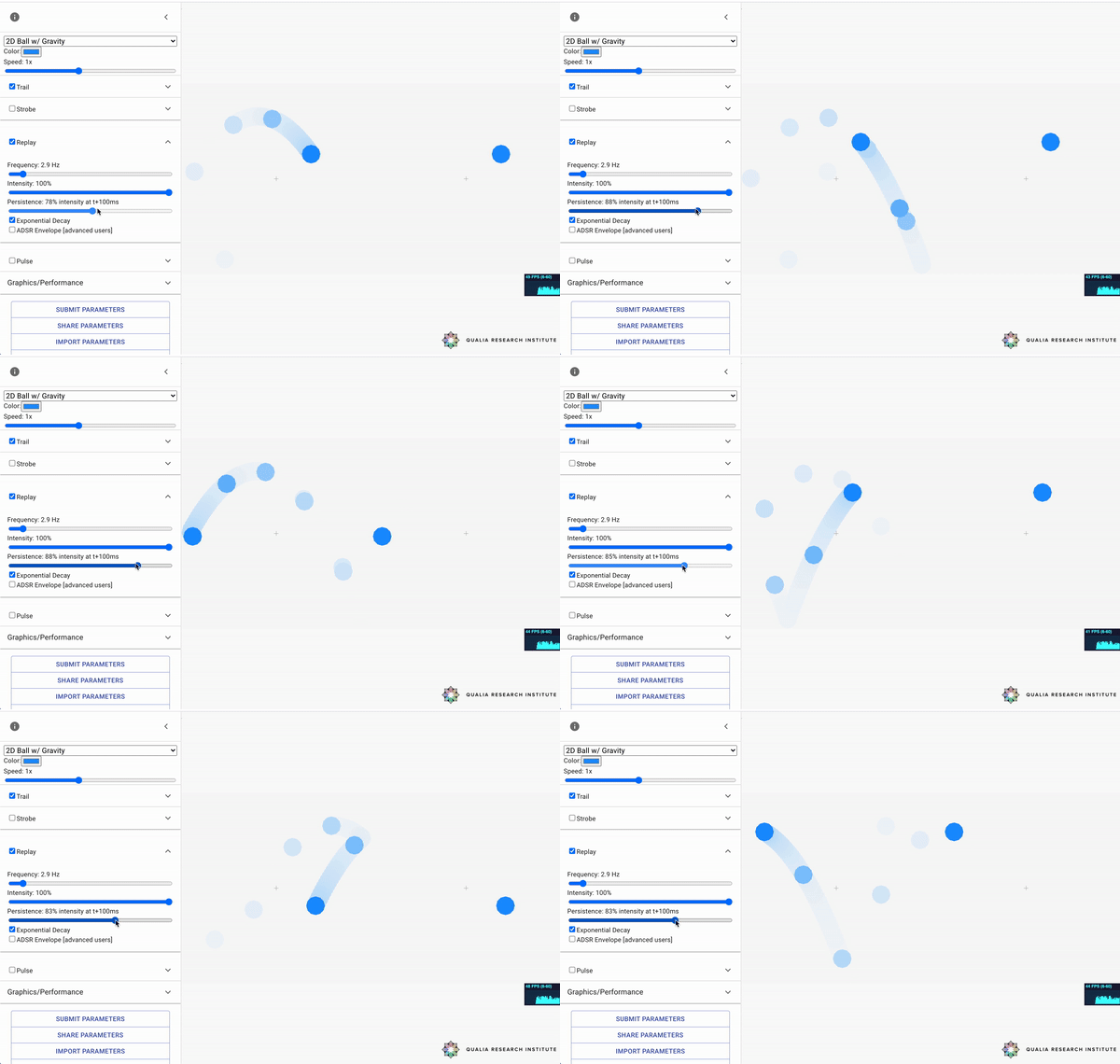
An interesting contrast that illustrates this duality between the computational and implementational level of abstraction is that between the effects of DMT and 5-MeO-DMT. Particularly, DMT seems to give rise to the chaotic generation of information and this can be seen in something as simple as the style of the tracer effects it induces (richly-colored flip-flopping between positive and negative afterimages). 5-MeO-DMT’s tracer effects are generally monochromatic and the same color as that of the input. (See: Modeling Psychedelic Tracers with QRI’s Psychophysics Toolkit: The Tracer Replication Tool).

We hypothesize that DMT’s effects at the implementation level can be understood as the result of competing clusters of coherence across the hierarchy, whereas the main attractors of 5-MeO-DMT seem to involve global coherence. Modulating the average synaptic path length in a system of coupled oscillators can give rise to this sort of effect. By randomly adding connections to a network of coupled oscillators one first sees an emergent state of many competing patches of synchrony, and then, after a threshold is crossed, one starts seeing global synchrony emerge. Despite both drugs making the brain “more interconnected”, the slight difference in just how interconnected it makes it, may be the difference between the colorful chaos of DMT and the peaceful nothingness of 5-MeO-DMT.

The competing clusters of coherence across the hierarchy can evolve to adapt to each other. The DMT realm is more of an ecosystem than it is a state per se (ex: Hyperspace Lexicon). And due to the duality between dissonance minimization and prediction error minimization, avoiding updating one’s belief in the direction of these realms being real causes intense cognitive dissonance. Some level of belief updating to fit the content of the hallucinations might be very difficult to resist. Indeed, the forced coherence across the layers of the hierarchy would be bypassing one’s normal ability to resist information coming from the lower layers.

On peak experiences such as those induced by 5-MeO-DMT, global coherence will generally have the effect of dissolving internal boundaries. In turn, due to the duality proposed, belief updating in the direction of extreme simplicity is very difficult to resist. Global annealing without sensorial chaos results in the minimization of model complexity; high accuracy is taken care of thanks to the low information content of the state. As a consequence, one experiences very high-valence, high-energy, high-symmetry states of consciousness that come along with belief updating towards ideas with close to zero information content.

The high-valence nature of the state can be very useful to heal dissonance in the network, so therapeutic benefits seem very promising (notwithstanding the somewhat forced belief updates the state induces).

Unfortunately a nearby attractor of the globally coherent states is when there are two incompatible coherent states competing with one another. This can result in extremely negative valence and belief updating in the direction of “everything being bad”.

We now see how the typical belief changes caused by these two drugs have a dual counterpart in how they feel. I am of the opinion that a commitment towards truth and careful attention to one’s state of mind can prevent (or at least substantially lessen) the epistemological failure modes of these drugs. But since this kind of model is not known by the general population, for most people these drugs do tend to act as “epistemological hand grenades”.

See Appendix A & B at the bottom of this article for examples of each of these failure modes.

Now on to the therapeutic applications: practicing loving-kindness meditation consistently for weeks before a trip seems to substantially change its phenomenal character. It feels that metta practice over time anneals a consonant metronome which can become massively amplified during a psychedelic experience. In turn, a brightly shinning metta metronome emits “healing waves of energy” within one’s world-simulation (I know how crazy this sounds!), which impact the contents of one’s subconscious in ways that reduces their internal dissonance.

Similar benefits can be obtained from other meditation practices, as long as their emphasis is on high-valence and coherent states of mind. See also: Buddhist Annealing (video).

Importantly, you can “work smart” if you manage to use the seeds of consonance as the nucleation sources for alignment cascades. This can heal at a very deep level, and it is what people are talking about when they say things like “all is love”.

A secular Good Annealing Manual would ideally have very detailed information for how to move around in the state-space of consciousness.

Apparently, equanimity is also highly beneficial during psychedelic experiences. But rather than merely repeating the mantras that everyone in the psychedelic community chants (“just let go”, “surrender”, “accept”), we can use a More Dakka approach and aim to maximize equanimity rather than merely invoking it. Taking psilocybin during a meditation retreat in which you do a lot of equanimity exercises will allow you to “let go” with much greater skill than what you could do in normal everyday life. As a result, one is able to “learn one’s lessons” with much greater ease and a lot less resistance. This, I think, is generally good. After all, the point is not to punish oneself, but to learn from one’s mistakes.

In turn, Shinzen Young says that experiencing pleasure with equanimity is very healing. By not grasping, one is letting the consonant waves propagate freely throughout one’s nervous system, which results in positive annealing. So a possible therapeutic modality might be to combine peak states together with high levels of equanimity. If we want to bump the therapeutic effect sizes of psychedelic psychotherapy, this is the sort of thing I consider to be very promising.

I conclude by providing some annealing targets that are generically good for one’s mental health. Practice them consistently before a psychedelic experience so that they can be the nucleation points of sane and hedonically beneficial psychedelic annealing. Being bathed by love is good. Being bathed by love and equanimity at the same time is even better. Being bathed by love and all Seven Factors of Awakening at the same time might be still even better. The ceiling of wholesome happiness is not currently known by science. It is probably much higher than we can imagine.

If you found this talk inspiring, generative, or clarifying for your own work, please cite it! If you want to see more work like this and help us transform the alchemy of consciousness into a chemistry of the mind, please consider donating to QRI. Every dollar takes us closer to being able to empirically test these models and use them to develop technology to alleviate suffering in bulk.

Thank you!!!


Appendix A: What Happens When You Take Too Much DMT – What Does Overfitting Look Like?

  • A case study of a psychiatrist case who self-medicated his depression with a regiment of 1g of DMT (along with MAOIs) and 4mg of clonazepam a day:
    • “On arrival, the patient was nonverbal, combative, and required six security guards to restrain him. When less restrictive measures failed, he was given propofol 1,000 mg IV, ketamine 500 mg IM, midazolam 5 mg IV, diazepam 20 mg IV, and fentanyl 4 mg IV with minimal effect.”
    • “Psychiatry was consulted after the patient’s delirium resolved and he was medically stabilized as he exhibited symptoms of mania and psychosis. He was pressured in his speech, hyperreligious, and delusional. He believed that demons were leeching into his soul and asked the medical staff for an exorcism. It was recommended that the patient be admitted to the behavioral health unit for mood stabilization.”
  • How can I help my friend understand that what he is seeing is a side effect of smoking DMT on a daily basis? (from Quora – note: it is impossible for me to verify the accuracy of this report). From the comment thread:
    • “He has been smoking it every day and night for the past 3 months that I know of. He sees these little beings everywhere and says they are trying to destroy his house pushing it over. He also says they spray mace and fairy dust and little balls in his face and other peoples too. He doesn’t believe that nobody else sees this happening, he says we have all been compromised and can’t be trusted. I’m worried about him and also his girlfriend that has to deal with him and he’s delusional. His daughter is scared to come home, his parents want to have him committed, and he doesn’t believe it has anything to do with dmt! He absolutely believes it is real.”
    • “He is always under the influence of DMT, he smokes it all day every day. He says it no longer makes him hallucinate like when he first tried it, now it just takes away pain . NOT TRUE!! it’s like now he believes that this altered state of mind is reality and he’s losing everything. He is even destroying his own house to get them out from behind the walls.the other night he stood up and started stabbing his ceiling saying he was going to get them. It’s very disturbing to see him like this.”
    • “He’s doing about the same. Last time I went to see him he was showing me how the moon was following him into his back yard and then back to the front yard . He also sees a bunch of drones in the sky that I can’t see. He still doesn’t believe that we can’t see the walls and countertops moving, or feel the fairy dust being sprayed in our faces.”
  • The YouTube channel C.U.E. COMPREHENSIVELY UNCOVERING EVIDENCE seems to exemplify quite accurately what DMT-induced overfitting looks like (e.g. see his DMT-informed numerological musings)
  • Reddit user ClockJoule: see an interview with him about his daily DMT use and the beliefs that he developed as a consequence: Magic Mushroom Cloud – THE MAN WHO SMOKED DMT FOR 120 DAYS STRAIGHT.
  • [Report(s)] A warning to my fellow psychonauts regarding hyperspace entities (wall of text alert!) – excerpt:
    • “It all culminated in one long, elaborate, and highly dramatic visionary experience in which I was essentially ‘recruited,’ initiated in some grand ceremony alongside a large group of others presumably in my same situation (which may have just been “actors” ). It was all part of some kind of vast organization, which could best be described as ‘universal consciousness transcendental cosmic hippie space religion.’ [Read Lehar’s warning against believing what the DMT entities tell you]. It all had a very attractive but vaguely cult-like Scientology kind of feel to it. They even had their own music (which was actually pretty cool; see my comments on “the director” in part 4 for more details), propaganda, regular meetings and rituals, the whole works. They even seemed to revere a deity of some sort, their version of The Source (more detail on that in part 5), but this whole experience was so full of illusion and misdirection that I have no idea what their ‘deity’ really was, nor their true relation to it.”
    • “I’ve gone on way to long already and need to start wrapping things up here, but long story short, in light of their new demands of allegiance, and through a separate series of bizarre synchronicities in ‘real life’ (what that means to me now, I have no idea) that I still can’t quite explain, I began to have some serious doubts and questions that needed answers. As I reflected on all that they had taught me, I began to realize that there were some major gaps in my knowledge, and that I had unwittingly filled in a lot of the blanks with my own speculation while assuming the picture I was being given was much more complete than it actually was. To summarize, over a series of increasingly confrontational and unpleasant experiences, I became less and less satisfied with their vague and evasive answers to my direct (and I think perfectly reasonable) questions, and we had something of a falling out, to put it very mildly. They eventually dropped all pretenses and flat-out turned on me, beginning a long period of harsh punishment.”
    • “The results weren’t pretty. Their facade began to crumble as I saw through more and more of what I now recognized as deceptive illusions. What truly lay behind it was hideous, repulsive, monstrously evil, relentlessly manipulative, filled with petty malicious intent, and not nearly as righteous, enlightened, or omnipotent as they pretended to be. I’m actually still pretty uncomfortable with going into detail regarding what followed, but suffice it to say that I’ve basically been to hell and back. They did everything they could to ‘punish’ me, and some of the things they came up with were uniquely and creatively traumatic. If they had put half as much effort and sophistication into ‘teaching’ me as they did into attacking and tormenting me, I probably would still be happily and obliviously under their control today, a fresh new convert of their admittedly impressive sci-fi space religion.”
    • “It took all the willpower I had just to stay focused and not become a completely broken wreck through all of this. Most of the ‘abilities’ I had acquired under their guidance gradually faded away over the course of a few weeks, with the exception of a number of lucid dream skills that I had picked up along the way. As I began to approach something resembling recovery, all kinds of memories and perspective started coming back to me that I had lost along the way (which may have been intentionally withheld from me). I felt like a toxic fog had been lifted from me, and everything looked so different now. I looked back on the last couple years of my life, especially the preceding four months or so, and was shocked to find that it wasn’t what I thought it was.”
    • “I had seen some mind-blowingly incredible things and progressed in so many ways in what I thought represented cognitive and spiritual development, but the consequences were now apparent. Without realizing it, my personality had changed so much, and not for the better. I had alienated myself from many of my close friends, my romantic relationship had suffered, I had been much more depressed than I wanted to admit, and I had spent way too much of my free time alone and in the dark, becoming obsessed with progressively darker and weirder esoteric knowledge. I had been able to maintain a token amount of social interaction, just enough to convince myself I was still ‘normal,’ but it frequently left me feeling drained, and bored with the mere ‘meat puppets’ in this material plane who were but a pale reflection of what existed beyond it.”

Appendix B: What Happens When You Take Too Much 5-MeO-DMT – What Does Underfitting Look Like?

While I agree that oneness is really important (and indeed I have written extensively about philosophy of personal identity and I generally advocate for Open Individualism), I do not think that realizing we are God is going to solve everything. In particular, we still need ruthlessly pragmatic solutions to the problem of intense suffering.

Insofar as non-duality is used as a mood-enhancer, it seems to be unreliable. Oneness can lead to bad trips of loneliness, a fact that tends to be brushed off by its advocates. My assessment is that this effect is the result of negative valence rather than an inherent effect of the concept (or truth?) of oneness. Shaman Oak‘s Bad LSD Experience – NIRVANA SUCKS video is a rather typical version of this effect and it highlights its true underlying cause: since he took the LSD during a comedown from cocaine, his entire trip was colored by the negative valence of that state. The world “felt inherently lonely” because it had depression qualia all over it. Amplified and magnified through the kaleidoscopic funhouse of LSD’s annealing dynamics, such a feeling of loneliness can look universal and omniprevalent “no matter how you look at it”. But if you were to replace that feeling with something blissful, then the concept of oneness would be experienced as wonderful and enlightening. It is always important to remember the Tyranny of the Intentional Object: ideas and beliefs seem to us as having inherent goodness or badness, but how this is implemented under the surface relies on hedonic tone/valence “painting” those ideas. As David Pearce likes to say, “take care of happiness and the meaning of life will take care of itself”.

Counterexamples: We do know a number of people who have used these compounds extensively and who do not seem to exhibit noticeable underfitting or overfitting. In particular, we have interviewed someone who took 5-MeO-DMT in high doses everyday for six months and who does not seem to suffer from any serious epistemological issues (they contacted me because they had read my analysis of Gura’s month-long experiment and wanted to share their even more extreme experience). The same person has extensive experience (including daily use for months) with DMT, Salvia, DPT and their combinations. They can still hold a technically demanding job and sustain a family despite this. Needless to say, such a level of psychological robustness is exceedingly rare.

Appendix C: The Abstract of the Other Talks

DMTX as a 21st Century Mystery School

A talk by Carl Hayden Smith

This talk will focus on the prospects of being one of the first participants in the world to try DMTX (X=Extended) at Imperial College London (ICL). After being part of the DMT phase 1 and phase 2 trials (over the last 5 years) this research now moves into a whole new level of immersion. During this experiment the peak of the DMT state will be extended thanks to a continuous intravenous drip feeding of the entheogen. This arguably turns this ancient medicine into a new form of technology. Early findings of the research from Chris Timmerman (ICL) suggests that nnDMT produces the same brain signature as the dreaming state. During the extended state we may be better able to explore the hypothesis from Andrew Gallimore that nnDMT actually opens up an entirely novel, orthogonal reality.

The DMTX experiment potentially means that nnDMT could become the base layer of our subjective reality, being combined, exponentially, with everything in life. What are the implications of this? Is there a danger that the psychedelic state is being overly romanticised and that DMTX could be regarded as a new form of bio chemical VR? How will DMTX help with the integration problem? Maybe the problem of bringing our insight back from the liminal space isn’t that these experiences defy verbalization, but that our languages are not yet sufficient enough to describe these experiences.

Increased cortical signal diversity during psychedelic states and visually realistic neural network models of hallucinations

A talk by Michael Schartner

Global states of consciousness – such as general anaesthesia or REM sleep – can be characterised by metrics of signal diversity, showing that diverse cortical activity is a hallmark of consciousness. We found that signal diversity is elevated in classical psychedelic states, possibly explained by a larger repertoire of brain states – which would be in line with reports about openness, novel associations and levelled salience of all experiences during psychedelic states. This coarse description of the brain as a dynamical system with various degrees of diversity in activity is only one dimension to characterise such global states of consciousness. Neural network models of visual perception and its pharmacological perturbation may provide a more mechanistic model, showing how the balanced integration of prior and sensory information into conscious perception is regulated by serotonin.


Note: I am still open to e.g. the external reality of DMT beings. I find it unlikely, but evidence could convince me otherwise. We are not dogmatic about the models we present. Rather, they simply are the current “best fit” for the available evidence in conjunction with parsimony considerations (yes, we could even say that this model is what minimizes our free energy!). Cheers!


References (abstract & talk; Chicago Style):

Atasoy, S., Donnelly, I. and Pearson, J. (2016). Human brain networks function in connectome-specific harmonic waves. Nat Commun 7, 10340. https://doi.org/10.1038/ncomms10340

Atasoy, S., Roseman, L., Kaelen, M. et al. (2017). Connectome-harmonic decomposition of human brain activity reveals dynamical repertoire re-organization under LSD. Sci Rep 7, 17661. https://doi.org/10.1038/s41598-017-17546-0

Carhart-Harris, R. L. (2018). The entropic brain -revisited. Neuropharmacology142, 167–178. doi:10.1016/j.neuropharm.2018.03.010.

Carhart-Harris, R. L., and Friston, K. J. (2019). REBUS and the Anarchic Brain: Toward a Unified Model of the Brain Action of Psychedelics. Pharmacol. Rev.71, 316–344. doi:10.1124/pr.118.017160.

Gomez-Emilsson, A. (2017). Quantifying Bliss. https://qualiacomputing.com/2017/06/18/quantifying-bliss-talk-summary/ [Accessed April 30, 2021].

Gomez-Emilsson, A. (2020). Modeling Psychedelic Tracers with QRI’s Psychophysics Toolkit: The Tracer Replication Tool. Qualia Computing. https://qualiacomputing.com/2020/10/09/modeling-psychedelic-tracers-with-qris-psychophysics-toolkit-the-tracer-replication-tool/

Gomez-Emilsson, A. (2020). 5-MeO-DMT vs. N,N-DMT: The 9 Lenses. https://qualiacomputing.com/2020/07/01/5-meo-dmt-vs-nn-dmt-the-9-lenses/ [Accessed April 30, 2021].

Griffiths, R. R., Johnson, M. W., Carducci, M. A., Umbricht, A., Richards, W. A., Richards, B. D., Cosimano, M. P., and Klinedinst, M. A. (2016). Psilocybin produces substantial and sustained decreases in depression and anxiety in patients with life-threatening cancer: A randomized double-blind trial. Journal of psychopharmacology (Oxford, England)30(12), 1181–1197. https://doi.org/10.1177/0269881116675513

Johnson, M. E. (2016). Principia Qualia. https://opentheory.net/PrincipiaQualia.pdf [Accessed April 30, 2021].

Johnson, M. E. (2017). Why we seek out pleasure: the Symmetry Theory of Homeostatic Regulation https://opentheory.net/2017/05/why-we-seek-out-pleasure-the-symmetry-theory-of-homeostatic-regulation [Accessed April 30, 2021].

Johnson, M. E. (2019). Neural Annealing: Toward a Neural Theory of Everything. https://opentheory.net/2019/11/neural-annealing-toward-a-neural-theory-of-everything/ [Accessed April 30, 2021].

Lehar, S. (1999). Harmonic Resonance Theory: An Alternative to the “Neuron Doctrine” Paradigm of Neurocomputation to Address Gestalt properties of perception. http://slehar.com/wwwRel/webstuff/hr1/hr1.html [Accessed April 30, 2021].

Luppi, A. I., Vohryzek, J., Kringelbach, M. L., Mediano, P. A. M., Craig, M. M., Adapa, R., Carhart-Harris, R. L., Roseman, L., Pappas, I., Finoia, P., Williams, G. B., Allanson, J., Pickard, J. D., Menon, D. K., Atasoy, S., & Stamatakis, E. A. (2020). Connectome Harmonic Decomposition of Human Brain Dynamics Reveals a Landscape of Consciousness [Preprint]. Neuroscience. https://doi.org/10.1101/2020.08.10.244459

Ross, S., Bossis, A., Guss, J., Agin-Liebes, G., Malone, T., Cohen, B., Mennenga, S. E., Belser, A., Kalliontzi, K., Babb, J., Su, Z., Corby, P., & Schmidt, B. L. (2016). Rapid and sustained symptom reduction following psilocybin treatment for anxiety and depression in patients with life-threatening cancer: a randomized controlled trial. Journal of psychopharmacology (Oxford, England)30(12), 1165–1180. https://doi.org/10.1177/0269881116675512

Safron, A. (2020). “Strengthened Beliefs Under Psychedelics (SEBUS)? A Commentary on “REBUS and the Anarchic Brain: Toward a Unified Model of the Brain Action of Psychedelics”” PsyArXiv. November 30. doi:10.31234/osf.io/zqh4b.

Simler, K. (2013). Neurons Gone Wild. Melting Asphalt. https://meltingasphalt.com/neurons-gone-wild/ [Accessed April 30, 2021].

Wu, L., Gomez-Emilsson, A., and Zuckerman, A. (2020). QRI Psychophysics Toolkit, Qualia Research Institutehttps://psychophysics.qualiaresearchinstitute.org

Yaden, D., and Griffiths, R. R. (2020) The Subjective Effects of Psychedelics Are Necessary for Their Enduring Therapeutic Effects. CS Pharmacol. Transl. Sci. 2021, 4, 2, 568–572 https://doi.org/10.1021/acsptsci.0c00194

Welcoming Steven Lehar as a QRI Lineage

by Andrés Gómez Emilsson

Who Is Steven Lehar?

Steven Lehar is many things. A proponent of indirect realism about perception. A champion of analog neural computation based on principles of harmonic resonance. And one of the most insightful and rational psychonauts of all times. His worldview packs a powerful punch of synergistic ideas, and reading his work is a psychoactive experience on multiple levels. Here are some of the highlights that made us decide to include Steven Lehar as a QRI lineage:

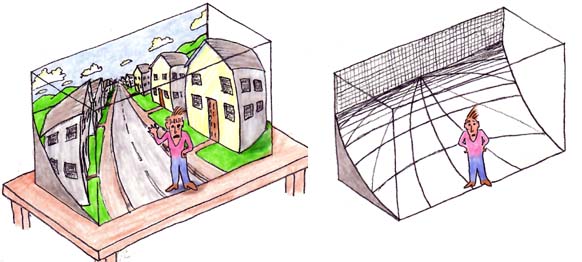
“[W]e are living in a scale model, and the scale of the model shrinks progressively with depth, just like a museum diorama, or a theatre set. And at the back plane the scale shrinks to zero, at least in the depth dimension, where everything beyond a certain distance appears flat, as if painted on the dome of the sky. But it only looks that way. It’s an illusion. We know that the world isn’t really warped like that.” Reprinted with permission from “Cartoon Epistemology” by Steven Lehar, p. 12.

Indirect Realism About Perception

Let’s start with indirect realism. This view is often referred to as inferential realismabout perception or representationalism. In simple terms, this view states that all of what you experience (and have ever experienced) exists as an internal representation inside your brain. The representation is absolutely real, but it is not itself the same as the world outside of you. Many people have realized this throughout history such as Immanuel Kant, Edmund Husserl, Bertrand Russell, and John Smythies. Today, the view continues to find proponents such as David Pearce, Donald Hoffman, and Antti Revonsuo. Thus, Lehar has never been alone in advocating for indirect realism. But what Lehar has contributed to the conversation is very substantial: he developed an exquisite map of the geometry and composition of our internal world-simulation that explains it in a way that you will not find anywhere else.

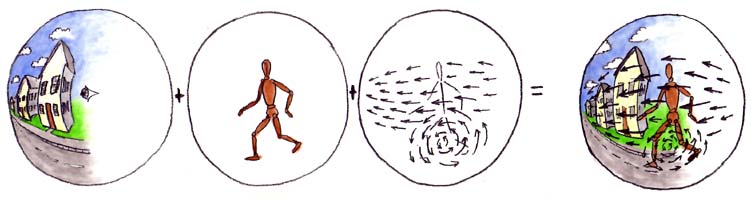
“So visual data is expressed in the visual representation, body posture is represented in the proprioceptive representation, and motor planning is computed in a global motor planning space. But all are coupled to form a single visual/proprioceptive/motor space, which is the space that we experience.” Reprinted with permission from “Cartoon Epistemology” by Steven Lehar, p. 62.

In the world of Steven Lehar, what we are is an analog volumetric bubble of phenomenal qualities made out of several layers interacting with one another (in the image above, the three circles on the left can be thought of as separate layers that combine into the circle on the right). To visualize the shape of our experience (indeed, the shape of us) he often makes an analogy with a diorama: our experience is shaped like a semi-sphere with variable scale. It is finite in volume, yet its peculiar sort of two-and-a-half-dimensional geometry allows it to represent both objects really close and really far at the same time.

In your bubble of experience, things in the distance appear both smaller and appropriately scaled. Indeed, “the point at infinity” is not infinitely far away! It merely represents an infinite distance via a projective trick, but the representation itself is of a finite size! Lehar argues that our experience is not 3D Euclidean, but rather non-Euclidean close to the homunculi (the empty head from which you look out into the world-simulation) and becomes more Euclidean the further away from this head you go.

“A: At first, an infant sees its own hand balloon up to double its size whenever its hand approaches its face. B: Eventually the infant re-maps the scale of its experienced space, allowing the hand to zoom up in sensory size while remaining constant in perceived size. C: But the infant still sees its mother balloon up from a tiny figure in the distance to an all-encompassing form, until D: it learns to re-map even that more distant space to maintain a constant perceived size, although the world outside the window continues to appear as a miniature scale model.” Reprinted with permission from “The Boundaries of Human Knowledge” by Steven Lehar, p. 69.

In some sense, to be a human is to embody a sack of meat. But if we pay really close attention and want to convey the actual structure of our experience, we end up saying that to be a human is to be this weirdly-shaped diorama-like world-simulation! You are not in the Matrix. You are the Matrix, my friend!

Lehar has cultivated and shaped an entire garden of phenomenological insights that emerge when you try to describe “the world” in this way. Just to give an example, a recurring theme in Lehar’s writings is that of “perceptual shadows.” In our world-simulation, we have incredible ray-tracing algorithms that simulate the way light scatters off objects. So we are acquainted with shadows that exist due to the absence of light. But there is also another kind of shadow, which is created when reality is represented using projective geometry: perceptual shadows are the shadows cast by the objects around you when they occlude the objects behind them. A large part of what makes our world-simulation so incredibly compelling is that it deals with missing information in very elegant ways. To understand how it does this, a key insight that Lehar provides is that our world-simulation contains both modal and amodal representations. The modal representations are what we traditionally associate with the senses: colors, sounds, touch, and so on. The amodal representations refer to the implicit geometric layout of the contents of our experience, which remain “dark” until you illuminate them with sensory modalities. This dichotomy allows us to understand why perceptual shadows don’t make objects truly disappear from our world-simulation (as long as we have developed object permanence, that is). The seamless handling of the perceptual shadows caused by occlusions showcases this fact: our phenomenal space contains amodal volumetric representations in addition to the visual “surface representations” we are familiar with. In other words, our inner world-simulation keeps track of rigid bodies even when we can’t see them directly!

A number of spheres floating in space, expressed as modal front surfaces and amodal volumes. If all of the modal surfaces point back towards a single viewpoint, that configuration of modal surfaces itself implies the presence of that viewpoint.” Reprinted with permission from “The Boundaries of Human Knowledge” by Steven Lehar, p. 36.

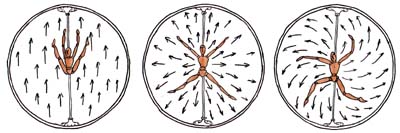
Another interesting nugget of insight is that in Lehar’s world, forces inside the world-simulation bias your motor actions and this is what renders and implements desire and disgust. In other words, there is something unexpectedly literal about saying that you are “attracted” to someone or something, or that an object or person “repulses” you! The way these forces are implemented can be conceptualized as fields that encode “how you would move at each point”. This proprioception is what guides the movement of our inner amodal avatar and how we plan sequences of actions.

“Motor computation takes the form of spatial field-like forces in that space, that bend the body-image homunculus into different postures.” Reprinted with permission from “Cartoon Epistemology” by Steven Lehar, p. 51F.

Lehar makes us realize that as we navigate our environment, we move along something like a liquid membrane amenable to what feels like volitional influence, which guides our movement. This “force field” lives at the interface between our motor sensations and the volumetric representation of the external environment, and it works as a map between these two modes of experience.

The entire representation is robust in response to the vast majority of common actions we can take. The amodal representations of our environment get projected adequately as we move around and take on a new point of view. Many aspects of our world are rendered as invariant relative to body movement, head movement, or eye movement, and this is one of the ways in which our world-simulation instantiates a realistic experience of (perceptual) object permanence.

Ultimately, Steven Lehar is championing a steelmanned version of indirect realism which goes into much more precise phenomenological detail than any of its predecessors.

One may perhaps complain that Lehar is merely “stating the obvious.” Although indirect realism is a view that in many circles is widely shared and assumed, making it explicit still holds a lot of value. Indeed, Lehar points out that in the majority of the world, there seems to be an unrecognized level of variation in how much direct realism is implicitly believed. I used to be under the impression that most smart people who think about these questions automatically arrive at a view in the space of indirect realism about perception. But Lehar points out that in reality, we see both implicit and explicit direct realism even in places as “advanced” as neuroscience departments. Lehar’s visual demonstrations of indirect realism do an amazing job pointing at this unstated disagreement; indeed, the person sitting right next to you at a conference may in fact be an implicit direct realist about perception! No wonder you were never able to agree on what consciousness is.

The fact that so many people turn out to be unreflective direct realists about perception brings to mind Scott Alexander’s discussion on missing developmental stages (2015; see excerpt in Appendix A). In the piece, Scott Alexander lists four types of understanding that are obvious in retrospect but very commonly missed: “1. Ability to distinguish ‘the things my brain tells me’ from ‘reality’”, “2. Ability to model other people as having really different mind-designs from theirs”, “3. Ability to think probabilistically and tolerate uncertainty”, and “4. Understanding the idea of trade-offs.” In this light, a lot of Steven Lehar’s work focuses on trying to upgrade philosophy, psychology, and neuroscience so that people in those fields intuitively understand the first ability Alexander outlines. Lehar’s corpus is like a remedial class for the slow students of philosophy, if you will—helping them through the whole developmental process by making it easier to digest. Thus, Lehar’s work can help us systematically update all kinds of philosophical, psychological, and neuroscientific arguments by exposing them to a high level of clarity and rigor concerning indirect realism. This process clarifies a huge amount of confusion and paradoxes many people in these fields are often consumed by.

In practice, if you listen to the questions in the Q&A portion of panels about consciousness at conferences, or read between the lines in journals of philosophy, neuroscience, and even AI, you will find that a large proportion of the speakers, writers, and attendees do work under the assumption of direct realism about perception. Even if only 30% of people at science conferences are implicit direct realists (which would be a conservative estimate), we would still expect no shortage of resistance and controversy when indirect realism is brought up. My personal experience is that often at these events, it is precisely when the conversation starts to get very good and become high quality that someone who doesn’t “get it” inevitably derails the conversation with questions typical of a direct realist. And while diversity of opinion can at times be an asset, my experience is that the most satisfying, useful, and consequential conversations are precisely those that take place between people who share almost all background philosophical assumptions. This more often than not gives me the impression that grouping people who are at similar developmental levels (in the realm of philosophy) would likely generate more useful discussions. Not that it isn’t fun to get people with widely different points of view together and get them all mixed up: it is always fascinating to observe the dialectical turbulence that ensues. But a serious investigation calls for more explicit foundational agreement on many levels. As much as I actively enjoy the state of consciousness induced by attending The Science of Consciousness (Gomez Emilsson, 2016a) conference (and delight in its unlikely yet amazing cultural products), I cannot shake off the impression that there is a lot of friction in conversations caused by the vast mismatches between the background assumptions of the participants. A conference that brings together over a thousand participants interested in consciousness from disciplines like philosophy, psychology, and artificial intelligence without any filter for background assumptions is a wonderful recipe for a trippy time. One would hope it could also generate conversations where consensus is achieved. It is in contexts like this where the tireless work of Steven Lehar—explaining in astonishing detail the various components and properties of our experience (and its peculiar artifacts) in order to make it as clear as possible that all we ever experience is an inner world-simulation—is extremely valuable at the community level. Seriously, printing massive copies of Lehar’s Cartoon Epistemology (2003) and installing them in a hall of the conference lobby would be an excellent way to increase the quality and clarity of the discussions.

This fact alone makes him someone we are happy to include as part of our lineages. Having “Lehar-aware” conversations about consciousness often takes people to the next level quickly. At QRI, we want to endorse having these ideas in the background along with the key insights obtained from each of the other lineages when creating the conditions for a qualia formalist science of consciousness (Gomez Emilsson, 2018a). 

But wait, there is more!

Analog Neural Computation Using Principles of Harmonic Resonance

The very heart of Lehar’s work outlines how harmonic resonance shows up as a principle of self-organization in the mind.

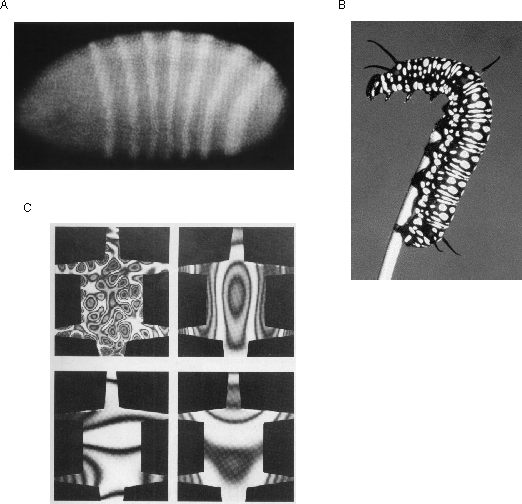
“A: A periodic banded pattern revealed by chemical staining emerges in a developing embryo, due to a chemical harmonic resonance whose standing waves mark the embryonic tissue for future growth. B: This chemical harmonic resonance has been identified as the mechanism behind the formation of patterns in animal skins, as well as for the periodicity in the vertebrae of vertebrates, the bilateral symmetry of the body plan, as well as the periodicity of the bones in the limbs and fingers. C: Murray shows the connection between chemical and vibrational standing waves by replicating the patterns of leopard spots and zebra stripes in the standing wave resonances in a vibrating steel sheet cut in the form of an animal skin.” Reprinted from “Harmonic Resonance Theory” by Steven Lehar.

Steven Lehar argued against the (at the time) prevailing neuron doctrine of neural computation which states that the contents of our experience are the result of the activity of highly discrete and individualized neurons that “encode” high-level features (such as a “grandma cell”). Importantly, Lehar points out that there is a key distinction between “rendering” an experience and merely “encoding” it. If you look for neurons that get activated if and only if a certain experience is happening you will be inadvertently mapping out how the brain encodes information rather than how it renders it. Failing to make this distinction will trap you in a worldview that is extremely hard to square with phenomenological facts. Of note is that our internal representations are flexible, a fact that the neuron doctrine finds really difficult to account for. As he puts it in “Harmonic Resonance Theory”:

There are several properties of the harmonic resonance model that are suggestive of human recognition. Unlike a rigid template, the pattern defined by a standing wave representation is elastic and adaptive. This can be seen in the manner that the spatial patterns of animal skins are defined. The parameters of the reaction-diffusion that distinguish between the spots and stripes of the tiger, zebra, leopard, and giraffe are encoded as general rules for the generation of those patterns rather than as a spatial template of any one such pattern. For example if a spot or stripe were to be fixed at one point as the pattern was emerging, the rest of the pattern would redistribute itself to adapt to that fixed feature while maintaining the general character of the encoded pattern. This invariance in the representation allows one set of parameters to generate an infinite variety of exemplars of any particular pattern type, or to adapt most flexibly to any fixed constraints or boundary conditions. (Lehar, 1999)

This flexibility of our internal representations is essential for understanding how the brain solves the “binding problem”: how is it possible that distributed neuron firings can simultaneously contribute to a unified internal representation? Indeed, Lehar takes the binding problem seriously and his solution involves resonance across spatial and temporal levels. This way, one can get representations that “lock in” low-level features to the high-level phenomenal objects that integrate them. In turn, our world-simulation works in a holistic fashion: every part of it pulls and pushes every other part of it. He explains it well in this interview:

Q: What would be the new paradigm in neuroscience? 

A: The first thing that it will change is our concept of how the brain works. Right now we are in a neuro-reductionist era where people are making probes ever smaller and smaller to read into tinier and tinier parts of the brain and read the signal there and try to make some kind of sense out of it. The paradigm that they are thinking is discrete connections between individual neurons mediated by synapses. And separate individual signals going every different direction. What we see in consciousness is a much more holistic process. Something like water seeking its own level in a vessel, where the final state of the water depends on every position of every other molecule. If you change one portion, scoop out some water in one place or dump some in some other place, every single molecule in the bath quickly readjusts itself in order to seek a new level. It is a different paradigm of computation. It is what the gestaltists proposed: field theories of mind, not in the terms of fields of mental energy propagating out into the world, but fields of physical energy in the brain interacting with each other in a holistic manner the way that water seeks its own level in a vessel. (Sandu, 2016)

In Lehar’s world, the three-dimensional volumetric representations that we experience “around us” are internal representations made with a hierarchy of patterns of resonance which are mode-locked with one another. From the tiniest detail to the broadest outline, when we experience a phenomenal object as “rigid”, we are in fact experiencing a complex network of resonating patterns locked in place as a stable “solution” of a network of tuned oscillators. In other words, the binding problem is solved explicitly by hierarchical resonance at all levels. This model can explain many of the bizarre effects of psychedelics (which we’ll discuss further below) in terms of a decoupling between the resonance of the different levels! Or as Lehar would put it, “everything on LSD looks like a Fourier representation with the high-frequencies chopped off”, meaning that the fine details that would usually cancel out the broad repeating patterns of low-frequency resonance are desynchronized, and thus objects look as if they were filled with symmetrical and resonating filigree patterns!

Since Lehar worked on “Harmonic Resonance Theory,” there have been many advancements in neuroscience and the field of AI. In particular, two very noteworthy connections should be highlighted. The first is the work of Selen Atasoy (who is also one of QRI’s lineages) on connectome-specific harmonic waves (2016). Atasoy, like Lehar, identified principles of harmonic resonance in physics and biology (such as Murray’s leopard spots and zebra stripes in the standing waves of vibrating sheets of steel) and decided to apply them to the brain. Unlike Lehar, Atasoy found an empirically measurable aspect of the brain amenable to this kind of modeling: the connectome. Thus, Atasoy’s work enables the study of the standing waves that Lehar hinted at qualitatively, but now in an empirical and quantitative way.

“(a) Laplace eigenfunctions revealing the mechanical vibrations of rectangular metal plates (1st row)—first demonstrated by Ernst Chladni as patterns formed by sand on vibrating metal plates—and metal plates shaped as mammalian skin (2nd row) resembling different mammalian coat patterns for different frequency vibrations [sic] as well as electron orbits of the hydrogen atom computed by time-independent Schrödinger’s wave function (3rd row)—shown with increasing energy from left to right—and patterns emerging in electromagnetic interactions between laser-excited ion crystals (last row) (images adapted from). (b) Workflow for the construction of macroscale connectome model. The graph representation was formed by connecting each node sampled from the cortical surface with its immediate local neighbours and by further including the long-range connections between the end points of the cortico-cortical and thalamo-cortical fibres. (c) Examples from the 20 lowest frequency connectome harmonics. Left: wave number. Right: spatial patterns of synchronous oscillations estimated by the eigenvectors of the connectome Laplacian.” Reprinted from “Human brain networks function in connectome-specific harmonic waves” in Nature Communications by Selen Atasoy et al.

In this way, the work of Atasoy and Lehar can be thought of as complementary rather than redundant: Lehar brings the phenomenological observations and arguments whereas Atasoy comes up with the precise empirical quantitative paradigm. Along these lines, we can already see possible extensions of this work. Namely, as we find more core structural scaffolds of the nervous system, we can examine them in light of a paradigm of harmonic resonance by building high-definition structural models, empirically extracting their corresponding wave equations, and then numerically approximating the emergent resonant modes of such structures. The beauty of this paradigm is that suddenly, large amounts of self-organizing complexity can be compressed in terms of weighted sums of harmonic resonant modes. At QRI, we consider this general paradigm to be extremely promising and endorse exploring how the overlap between these two great researchers leads to novel models of neural computation. 

The second development that is important to point out is how advancements in artificial neural networks seem to have brought back the neuron doctrine with a vengeance. You get the impression that feature visualization techniques (Olah et al., 2017) allow us to make sense of what each neuron in a network “does.” Recent work at OpenAI takes this further and identifies recurring principles of self-organization that emerge in artificial neural networks (i.e. circuit motifs (Olah et al., 2020)).

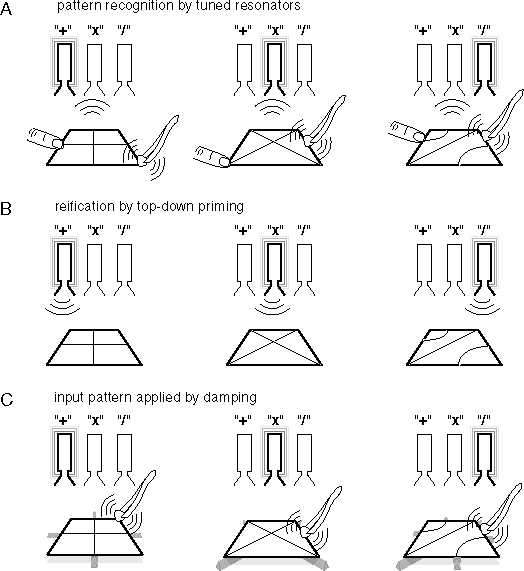
The key to make sense of this is to recall the distinction between encoding and rendering. In Lehar’s world, populations of neurons that implement specific kinds of pattern recognition are in fact tuned resonators. Think of these resonators as having the function of adding clamps or pinches to a vibrating Chladni plate: the actual experience being rendered is the pattern of standing waves that emerge from the pinched plate, not the pinches themselves. While there is an extremely detailed correspondence between the content of experience and these clamps, what the experience is requires the pattern of standing waves to happen. Thus, insofar as artificial neural networks do not bring about such standing waves, they will simply and forever fail to render the contents of any experience.

“A: A bank of tuned resonators tuned to the frequency of three specific standing wave patterns are coupled to the plate to behave as feature detectors, that become active whenever their pattern of standing waves is present on the plate. B: The system automatically performs reification with recognition, for the activation of any of the resonators regenerates its characteristic standing wave pattern back on the plate. C: If the plate is resting on rubber ridges in the form of one of the standing wave patterns, the ridges behave as an input pattern, forcing the resonance on the plate to conform to the pattern of the input.” Reprinted with permission from “Harmonic Resonance Theory” by Steven Lehar.

Naturally, this is a testable view, since we can in principle manipulate the standing wave patterns directly (with e.g. transcranial magnetic stimulation). At QRI, we expect that in the future, this distinction will be extremely important. Without it, we would be at risk of thinking that specific computations done in digital computers entail qualia even though there is in fact no “rendering of experience” going on at all in the computational system as a whole.

A final note on this discussion is that Steven Lehar also has a theory of aesthetics. Foreshadowing the Symmetry Theory of Valence, first suggested by Johnson (2016), Lehar proposes a theory of aesthetics based on principles of harmonic resonance that explains our preference for symmetrical patterns. See the excerpt below titled “A Psycho-Aesthetic Hypothesis” in Appendix A. Thus, another key parallel between Lehar’s work and our models at QRI is that we have a non-standard interpretation of neuroanatomical functional localization. In particular, we think that the impression that “pleasure is what goes on in the pleasure centers” is at least in part an artifact of our measuring tools. As Michael Johnson postulates, the reason why activating the pleasure centers feels good is because they are strategically positioned in such a way that you get large-scale (consonant) resonance across the brain. In other words, the pleasure centers are “tuning knobs” for global synchrony in the brain! Thus, they are a kind of “master clamp” for harmonic resonance in the brain. What feels good is such resonance and not the activation of the pleasure centers per se. Don’t expect to find “beauty” in a single neuron; both Lehar and QRI will be quick to point out that beauty is a holistic property of a holistic system!

But wait, there is more!

Rational Psychonaut

Steven Lehar is a rational psychonaut: many of his insights are the result of paying close attention to the way specific aspects of experience break down under various states of consciousness. More so, Lehar’s clarity about indirect realism makes him a rather unusual and valuable psychonaut. As he points out, when you take a psychedelic you either “discover a new and deeply mysterious portal to a parallel dimension of reality like John Lilly, Timothy Leary, and Terrence Mackenna” or you realize that the features of your inner world-simulation are changing in ways that give the impression that alternate realities exist (Lehar, 2019). In other words, implicit theories of perception influence how one interprets alien state-spaces of consciousness! For example, even Albert Hoffman seemed to have been working under the implicit assumption of direct realism about perception:

If one continues with the conception of reality as a product of sender and receiver, then the entry of another reality under the influence of LSD may be explained by the fact that the brain, the seat of the receiver, becomes biochemically altered. The receiver is thereby tuned into another wavelength than that corresponding to normal, everyday reality. Since the endless variety and diversity of the universe correspond to infinitely many different wavelengths, depending on the adjustment of the receiver, many different realities, including the respective ego, can become conscious. (Hofmann, 1980)

Talking about psychedelic states of consciousness in light of indirect realism is really refreshing. Now, I am not saying that productive discussions within a direct realism framework cannot be had. But we often find that many unproductive discussions are the result of having a (implicit) direct realist and an (implicit) indirect realist analyze psychedelic experiences without knowing that they don’t share the same key background philosophical assumption. And this is the state of the discourse today! This muddled situation manifests all the way into presentations at the Psychedelic Science and Horizons conferences, for example, where presentations typically straddle between these views. The ambiguity tends to be better received by the audience; leaving implicit background assumptions unchallenged avoids conflict but slows down progress. So the state of the discourse is one where ambiguity about this is rewarded! No wonder the field is so confused and confusing. And in turn we find ourselves endlessly debating the “external reality” of DMT elves rather than moving on to talk about more productive questions such as the geometry, valence, and computational properties of the hallucinated worlds (Gomez Emilsson, 2019).

Of course in reality there are many “middle points” between direct and indirect realism with regards to models of psychedelic action. A hybrid view that a lot of people seem to implicitly hold is one where all we ever experience are the contents of our internal world-simulation, but that some “channels” of this inner world-simulation can be mode-locked with external “subtle” phenomena (e.g. explaining “contact high” as a “subtle body resonance between people”). That said, applying Occam’s razor, it is rational to first try to explain the zoo of psychedelic effects (Gomez Emilsson, 2016b) in terms of changes to the parameters of our inner world-simulation, and only when we cannot explain some phenomena, return to alternative explanation spaces. What Steven Lehar and other rational psychonauts highlight is that the original psychedelic visionaries seemed to have “given up” too quickly on an indirect realist model (or perhaps they were always implicit direct realists on some level). It is refreshing and reassuring to read Lehar’s comments about having experienced things like “out of body experiences,” “bilocation,” “fragmentation of the point of view,” “telepathy,” and so on and yet continue to interpret these phenomena in light of parameter changes inside a world-simulation. It shows that one can indeed stay rational, analytical, and grounded even after experiencing the extremely exotic states of consciousness psychoactives can trigger.

In his book The Grand Illusion (2010), Lehar walks us through his journey as a psychonaut. It would not be an exaggeration to say that this work is one of the absolute best pieces of content concerning the phenomenology of altered states of consciousness induced by psychoactive drugs. The entire book is filled with keen, poignant, and crisp observations which are “obvious in retrospect” yet easy to miss in the moment. To name a few:

  1. Point of view fragmentation is a phenomenon that happens on psychedelics where your visual field segments into various parts, each with its own projective point of perspective. Lehar explains that one can modulate this phenomenon by the extent to which one relaxes and unfocuses versus how much one moves around and interacts with the world: “This discovery greatly enhanced my ability to explore the deeper spaces of consciousness revealed by the drug, while providing an insurance against the natural panic that tends to arise with the dissolution of the self, and the world around you. It allowed me to descend into the depths of the experience while maintaining a life line back to consensual reality, like a spelunker descending into the bowels of the deep underground cavern of my mind, while always able to return safely to the surface. And what a splendid and magnificent cavern it was that I discovered within my mind!” (p. 23-24). 
  2. Lehar’s ideas about annealing in the context of ketamine foreshadowed QRI’s framework of neural annealing (Johnson, 2019) and Carhart-Harris’ model of entropic disintegration (Carhart-Harris et al., 2014) by many years: “The totally confused clamped-down experience described above, applies only to the first phase of the Ketamine high. After maybe a dozen or so Ketamine experiences, I began to see a larger pattern in it, as whatever it was that clamped my thoughts slowly began to loosen its grip during the time course of each trip, and my thoughts gradually felt ever more freedom of motion, as first (metaphorically speaking) I could move my hands and feet, then my arms and legs, then my head, and eventually my whole body was released from the grip of the drug and slowly returned to normal integrated consciousness. The last stages, just before a rather abrupt and stepwise return to normal awareness, were the most emotionally powerful and stupendously magnificent, as the largest chunks of reality finally coalesced into an integrated experience” (p. 81).
  3. According to Lehar, MDMA’s nystagmus is just a special case of a more general jittering that MDMA causes in one’s inner world-simulation across the board: “[T]here is a kind of jitteriness across the whole visual field. And this jitteriness is so pronounced that it can manifest itself in your eyeballs, that jitter back and forth at a blinding speed. If you relax, and just let the jitters take over, the oscillations of your eyes will blur the whole scene into a peculiar double image. But if you concentrate, and focus, the ocular jitter can be made to subside, and thus become less noticeable or bothersome. One of my friends got the ocular jitters so bad that he could not control them, and that prevented him from having a good time. That was the last time he took ecstasy. I however found it enchanting. And I analyzed that subtle jitteriness more carefully. It was not caused exclusively by jittering of the eyeball, but different objects in the perceived world also seemed to jitter endlessly between alternate states. In fact, all perceived objects jittered in this manner, creating a fuzzy blur between alternate states. This was interesting for a psychonaut! It seemed to me that I could see the mechanism of my visual brain sweeping out the image of my experience right before my eyes, like the flying spot of light that paints the television picture on the glowing phosphor screen. The refresh rate of my visual mechanism had slowed to such a point as to make this sweep visible to me” (p. 60).
  4. Lehar offers a unique interpretation of how LSD and MDMA interact with one another which is compatible with our model of negative valence as neural dissonance (Gomez Emilsson, 2017a): “Under LSD and ecstasy I could see the flickering blur of visual generation most clearly. And I saw peculiar ornamental artifacts on all perceived objects, like a Fourier representation with the higher harmonics chopped off. LSD by itself creates sharply detailed ornamental artifacts, like a transparent overlay of an ornamental lattice or filigree pattern superimposed on the visual scene, especially in darkness. Ecstasy smooths out those sharp edges and blurs them into a creamy smooth rolling experience” (p. 61).
  5. Lehar identified a family of states of consciousness where the content of experience is modifiable at will. He coined the term “Free-wheeling hallucinations” to refer to this state (hear his description in an interview). And see my detailed discussion (Gomez Emilsson, 2021) about free-wheeling hallucinations. Here’s the original quote: “[DXM] gives you the power to produce full free-wheeling hallucinations on demand! You can experience virtually anything you want, if you can just imagine it! Those of you who are familiar with the phenomenon of lucid dreaming, the ability to have startlingly real and vibrant dreams which can also be brought under voluntary control, already know of this wonderous capacity of the human mind, to build complete synthetic hallucinated worlds of visual experience every bit as vivid and apparently real as the waking world. If nothing else, this should clearly clinch the case for the World In Your Head” (p. 63-64).

And so much more. So, do me a favor and next time you experience a free-wheeling hallucination, please construct a virtual Steven Lehar and let him guide you through its parameter space! “Move the force-field flow over here into there and ta-da, you get this vortex effect! Now create a box and try to listen to it! Use that sound to shape this chair over here – doesn’t it become more box-like? How fascinating, isn’t it?” In fact, why not construct a whole “museum of the mind” in one’s free-wheeling hallucination? A kind of Disneyland but for exotic phenomenal objects! If you do this, please say hi to Steve from us!

Adjacent to his work as a rational psychonaut, Lehar produced a fascinating essay on the topic of alien contact (Lehar, n.d.). I consider that piece to be a wonderful “memetic vaccine” against some of the possible failure modes of psychonautical investigation. As it turns out, an explosive combination of implicit direct realism, high-energy, high-definition experience, and the natural human need to feel really important makes it so that a large fraction of people who experiment with DMT end up believing that they are contacting entities from another dimension. Now, we know that Lehar interprets such experiences of alien contact to be all “in your head.” But even if they weren’t, Lehar urges caution! He argues that even if the elves were mind-independent, you probably wouldn’t want to ally with them. Why? Because they are likely to be extremely persuasive marketeers rather than actual helpers or saviors. Lehar is not persuaded by the Siren Calls of the DMT machine elves and neither should you be. Else, we may simply end up doing the bidding of these creatures, which would more likely than not result in preparing the conditions for their replication (see Consciousness vs. Pure Replicators (Gomez Emilsson, 2017b)). Now that’s some serious resolve for being “the adult in the room” of psychonauts!

Virtual Reality panel: Paavo Pylkannen, Steve Lehar, Maria Sanchez-Vives at Towards the Science of Consciousness 2006. Reprinted with permission from “Photos from Tucson 2006” by David Chalmers.

Miscellaneous

Lehar’s world is really vast, and what we have outlined above just scratches the surface of the musings of a great thinker (see Clifford Algebra: A visual introduction (Lehar, 2014)). In reality, Lehar has given thought to pretty much every area of philosophy (for Lehar’s views on eternalism vs. presentism, see the “Frozen Time” excerpt in Appendix A). A stark example for me that demonstrates how vast his sphere of thought is and how far it reaches is that when I first contacted him, I mentioned that I was thinking of ways to represent 3D hyperbolic space with gradient index optics (Gomez Emilsson, 2018b). In turn, he mentioned that he had already also considered something similar and that I could in fact find an old discussion of his in one of his books about the topic (see: picture below). This exchange, among others, is what made me feel that QRI and Lehar are indeed really hanging out on the same wavelength across many dimensions of thought.

“Standing wave resonance patterns viewed in cross-section of an infinite bounded sphere in which  the refractive index varies with distance from the center, reaching infinite refractive index (zero wave propagation velocity) at the bounding surface of the sphere. A: Concentric pattern. B: Linear perspective pattern. C: Checkerboard pattern. D: Hexagonal pattern. E: Higher harmonics on a hexagonal pattern. F: Higher harmonics on a checkerboard pattern.” Reprinted with permission from Harmonic Resonance in the Brain, Chapter 3, Figure 3.15 p. 34 (not available online) by Steven Lehar.

How the Work of Steven Lehar Interacts with Other QRI Lineages

David Pearce would point out that hedonic tone is an extremely important aspect of our world-simulation! You see, the rabbit hole goes deeper. If you are repulsed by the idea of indirect realism about perception because it makes you feel like a prisoner of your mind, it will turn out that you are now under the spell of an implicit direct realism about the connection between ideas and hedonic tone. In a happy and ecstatic state, you can in fact experience the idea of the world in your head as rather funny, curious, and perhaps even comforting! So the way in which ideas get represented includes a whole gamut of shades of affect that “paint” them. From hilarity to existential dread, the affective component of experience is coercive in how it shapes our interpretations of reality. Thinking about deep questions can give you the impression that the world is scary and unsettling or mysterious and amazing, all depending on your mood. The task of paradise engineering is not to be realized by modifying the external world (or at least that’s not at the heart of the transformation). Rather, it is about zoning in on the affective texture of experience and finding functional substitutes devoid of misery. Really, in this light, paradise engineering is just extremely advanced interior design.

Similarly, we find a lot of overlap and complementarity between Lehar’s work and other QRI lineages. As we continue to weave together these diverse models of neural computation, we expect to see a lot of synergy emerge. In time, we will outline how each component of the ecosystem synergizes with the rest. For now, please join me in welcoming Steven Lehar to our lineages! Welcome, Steven!

Acknowledgements

Many thanks to Andrew Zuckerman for providing comments and edits to this essay. Also thanks to Anders Amelin and Maggie Wassinge for pointing out the lineage-worthy contributions of Steven Lehar.

References

Alexander, S. (2015). What Developmental Milestones Are You Missing?. Slate Star Codex. https://slatestarcodex.com/2015/11/03/what-developmental-milestones-are-you-missing/

Atasoy, S., Donnelly, I., & Pearson, J. (2016). Human brain networks function in connectome-specific harmonic waves. Nature communications, 7(1), 1-10.

Carhart-Harris R. L., Leech R., Hellyer P. J., Shanahan M., Feilding A., Tagliazucchi E., et al. (2014). The entropic brain: a theory of conscious states informed by neuroimaging research with psychedelic drugs. Front. Hum. Neurosci. 8:20. 10.3389/fnhum.2014.00020 

Gomez Emilsson, A. (2016). Qualia Computing in Tucson: The Magic Analogy. Qualia Computing. https://qualiacomputing.com/2016/05/01/qualia-computing-in-tucson-the-magic-analogy/

Gomez Emilsson A. (2016). Algorithmic Reduction of Psychedelic States. Qualia Computing. https://qualiacomputing.com/2016/06/20/algorithmic-reduction-of-psychedelic-states/

Gomez Emilsson, A. (2017). Quantifying Bliss. Qualia Research Institute. https://www.qualiaresearchinstitute.org/s/Quantifying-Bliss.pdf

Gomez Emilsson, A. (2017). The Universal Plot: Part I – Consciousness vs. Pure Replicators. Qualia Research Institute. https://www.qualiaresearchinstitute.org/s/The_Universal_Plot__Part_I___Consciousness_vs__Pure_Replicators.pdf

Gomez Emilsson, A. (2018). Qualia Formalism in the Water Supply: Reflections on The Science of Consciousness 2018. Qualia Computing. https://qualiacomputing.com/2016/05/01/qualia-computing-in-tucson-the-magic-analogy/

Gomez Emilsson, A. (2018). Materializing Hyperbolic Spaces with Gradient-Index Optics and One-Way Mirrors. Qualia Computing. https://qualiacomputing.com/2018/08/19/materializing-hyperbolic-spaces-with-gradient-index-optics-and-one-way-mirrors/

Gomez Emilsson, A. (2019). The Hyperbolic Geometry of DMT Experiences (@Harvard Science of Psychedelics Club). Qualia Research Institute YouTube channel. https://youtu.be/loCBvaj4eSg

Gomez Emilsson, A. (2021). Free-Wheeling Hallucinations: Be the Free-Willed God of Your Inner World-Simulation. Andrés Gómez Emilsson YouTube channel. https://youtu.be/o1wjDOwXjY4

Hofmann, A. (1980). LSD: my problem child. Psychedelic Reflections, 24.

Johnson, M. (2016). Principia Qualia. Open Theory. https://opentheory.net/PrincipiaQualia.pdf

Johnson, M. (2019). Neural Annealing: Toward a Neural Theory of Everything. Qualia Research Institute. https://www.qualiaresearchinstitute.org/s/Neural-Annealing.pdf

Lehar, S. (1999). Harmonic Resonance Theory: An Alternative to the “Neuron Doctrine” Paradigm of Neurocomputation to Address Gestalt properties of perception. Steven Lehar’s Homepage. http://slehar.com/wwwRel/webstuff/hr1/hr1.html

Lehar, S. (2002). The Function of Conscious Experience: An Analogical Paradigm of Perception and Behavior. Steven Lehar’s Homepage. http://slehar.com/wwwRel/webstuff/consc1/consc1a.html

Lehar, S. (2003). Cartoon Epistemology. Steven Lehar’s Homepage. http://slehar.com/wwwRel//cartoonepist/cartoonepist62.html

Lehar, S. (2004). The Boundaries of Human Knowledge: A Phenomenological Epistemology or Waking Up in a Strange Place. Steven Lehar’s Homepage. http://slehar.com/wwwRel/webstuff/book2/Boundaries.html

Lehar, S. (2014). Clifford Algebra: A visual introduction. Steven Lehar’s Blog. https://slehar.wordpress.com/2014/03/18/clifford-algebra-a-visual-introduction/

Lehar, S. (2010). The Grand Illusion: A psychonautical odyssey into the depths of human experience. Steven Lehar’s Homepage. http://slehar.com/wwwRel/GrandIllusion.pdf

Lehar, S. (2019, November 30). Steven Lehar – Do We Live in the Real World? (@Harvard Science of Psychedelics Club). Zuck This YouTube channel. https://youtu.be/WPZ9WMvtbi0

Lehar, S. (n. d.). Alien Contact- it won’t happen the way you expect!. Steven Lehar’s Homepage. http://slehar.com/wwwRel/webstuff/space/aliens.html

Lehar, S. (n. d.) The Two Worlds of Reality. Steven Lehar’s Homepage. http://slehar.com/wwwRel//webstuff/book/chap1.html

Olah, C., Mordvintsev, A., Schubert, L. (2017). Feature Visualization: How neural networks build up their understanding of images. Distill. https://distill.pub/2017/feature-visualization/

Olah, C., Cammarata, N., Schubert, L., Goh, G., Petrov, M., Carter, S. (2020). Zoom In: An Introduction to Circuits. Distill. https://distill.pub/2020/circuits/zoom-in/

Sandu, Alin. (2016, February 7). Nondualita – STEVEN LEHAR  [Video]. YouTube. https://youtu.be/JQ51vrnbAHA

Appendix A: Excerpts

The Dimensions of Conscious Experience 

Quote from page 21 of “The Function of Conscious Experience” by Steve Lehar:

Once we accept the fact that the world of visual consciousness is a pattern of energy in our physical brain, we can begin to examine that conscious experience to see what it might tell us about its neurophysiological correlate. The practice of phenomenology for investigating mental function was more popular before modern neuroscience introduced a new concept of neurocomputation that seems inconsistent with phenomenological observation. (Vernon 1937, 1952, Gregory 1981, Ramachandran & Blakeslee 1998, Smythies 1953, 1988, 1994, 1999, Koffka 1935, Köhler 1924) The most basic and salient fact of visual consciousness is that it appears as a three-dimensional spatial structure (Vernon 1952, p. 81- 92). More specifically, the phenomenal world is composed of solid volumes, bounded by colored surfaces, embedded in a spatial void. Every point on every visible surface is perceived at an explicit spatial location in three-dimensions (Clark 1993), and all of the visible points on a perceived object like a cube or a sphere, or this page, are perceived simultaneously in the form of continuous surfaces in depth. The perception of multiple transparent surfaces, as well as the experience of empty space between the observer and a visible surface, reveals that multiple depth values can be perceived at any spatial location. The information content of perception can therefore be characterized as a three-dimensional volumetric data structure in which every point can encode either the experience of transparency, or the experience of a perceived color at that location. Since perceived color is expressed in the three dimensions of hue, intensity, and saturation, the perceived world can be expressed as a six-dimensional manifold (Clark 1993), with three spatial and three color dimensions.

The Cartesian Theatre and the Homunculus Problem 

Quote from pages 21-22 of “The Function of Conscious Experience” by Steve Lehar:

This “picture-in-the-head” or “Cartesian theatre” concept of visual representation has been criticized on the grounds that there would have to be a miniature observer to view this miniature internal scene, resulting in an infinite regress of observers within observers. However this argument is invalid, for there is no need for an internal observer of the scene, since the internal representation is simply a data structure like any other data in a computer, except that this data is expressed in spatial form. If the existence of a spatial data structure required a homunculus to view it, the same objection would also apply to symbolic or verbal information in the brain, i.e. epistemic as opposed to sensory perception, which would also require a homunculus to read or interpret that data. In fact any information encoded in the brain needs only to be available to other internal processes rather than to a miniature copy of the whole brain. To deny the spatial nature of the perceptual representation is to deny the spatial nature so clearly evident in the world we perceive around us. To paraphrase Descartes, it is not only the existence of myself that is verified by the fact that I think, but when I experience the vivid spatial presence of objects in the phenomenal world, those objects are certain to exist, at least in the form of a subjective experience, with properties as I experience them to have, i.e. location, spatial extension, color, and shape. I think them, therefore they exist. All that remains uncertain is whether those percepts exist also as objective external objects as well as internal perceptual ones, and whether their perceived properties correspond to objective properties. But their existence in my internal perceptual world is beyond question if I experience them, even if only as a hallucination.

Frozen Time

Quote from pages 67-68 of “The Boundaries of Human Knowledge: A Phenomenological Epistemology or Waking Up in a Strange Place” by Steven Lehar:

If time were a frozen dimension as proposed above, that would do considerable violence to our everyday notions of causality, and thereby radically alter our view of all causal explanations. For example the first, most basic feature of causality is that matter that exists has a tendency to continue to exist. (unless it happens to decay into energy, which then also continues to exist) In frozen space-time, this means that particles of matter no longer appear as points moving through empty space, but they become long spaghetti strands extending continuously through the time dimension. The causal property of persistence has thereby been transformed into a geometrical or structural feature in frozen spacetime, something like the logic of static structures, whereby a block will never be found hanging unsupported in space, but must always be supported by other blocks that rest on still other blocks all the way down to the supporting ground. Likewise, the explanation for the logic of evolution is dramatically altered when viewed in frozen spacetime. It can no longer be said that if an organism adapts to its environment it will continue to propagate, otherwise it will go extinct. Instead, we would have to say that there are many parallel and branching threads of life from the first living thing stretching on toward the future, together with countless side-branches of life that peter out because they don’t stretch forward in time toward the future, but break up into disorganized lifeless matter. The conventional causal explanation becomes as tautological in frozen spacetime as saying that the only branches of a tree that grow to great heights are those that grow upward, otherwise they never grow to great heights. A causal law has been transformed into a structural feature of the time-line of life. I do not propose that the static formulation of frozen space-time is necessarily more correct or veridical than the conventional flowing time explanation, but rather that there is no way in principle for us to comprehend something as fundamental as time, and the frozen time explanation may well be just as far from the ‘truth’ as the conventional flowing time explanation. The point is that there can be alternative explanations of reality that are as profoundly different in their assumptions and their manner of explaining that reality as are the flowing and frozen time explanations, and yet they are also in some sense equivalent, because the structural laws of the frozen time explanation correspond exactly to the causal law of the flowing time explanation, although expressed in a completely different form. So it may be that the realist explanation of the world in terms of flowing time and causality is both an accurate reflection of the causal laws of the noumenal world, while at the same time being as fundamentally different and thus ‘wrong’ in its expression of those laws as the difference between the flowing-time and the frozen-time explanations of reality. Thus the realist and the idealist are both right, our perception of the dimensions of reality are both an accurate reflection of the world as it really is, as must necessarily be the case for perception to be evolutionarily adaptive, and at the same time there is truly nothing we can know about the true nature of the noumenal world as it really is, it may be as different from our phenomenal experience as is the frozen spacetime world to the flowing-time causal world.

A Psycho-Aesthetic Hypothesis

Quote from The Two Worlds of Reality by Steven Lehar:

The harmonic resonance theory of neurocomputation also accounts for a number of other aspects of human experience which have never found a satisfactory explanation elsewhere. For the most prominent characteristics of harmonic resonance are symmetry and periodicity of the standing wave patterns both in space and in time. It turns out that symmetry and periodicity have very special significance in human experience, for these properties are ubiquitous in human aesthetics, as seen in the symmetrical and periodic patterns of design used in all cultures throughout human history to decorate clothing, pots, tools and other artifacts, especially items of special symbolic or religious significance. Symmetry and periodicity are also prominent features of architecture, music, poetry, rhythm, and dance. In chapter 11 I propose a psycho-aesthetic hypothesis, whereby any principles of aesthetics that are found to be universal across all human cultures, are thereby indicative of properties that are fundamental to the human mind itself, rather than a cultural heritage. I propose therefore that the symmetry and periodicity in art and music are aesthetically pleasing exactly because they are easily encoded in the periodic basis function offered by the harmonic resonance representation.

Besides providing collateral support for the harmonic resonance theory, the psycho-aesthetic hypothesis can be inverted to identify even more properties of mental function than those revealed by phenomenological analysis alone. For the primitives of the visual arts, music, and dance, can be seen as evidence for the nature of visual, auditory, and motor primitives in the brain. This in turn suggests a periodic basis set in perception, in the nature of a Fourier code. The advantage of a periodic basis set is that when a match is found to an input pattern, the periodic basis set automatically extrapolates that pattern outward in space and time, reifying the unseen portions of the pattern on the basis of the sample present in the input. This perceptual extrapolation explains the amodal completion of hidden portions of perceived objects and surfaces in the world. Evidence for this periodic basis set can be seen even in the abstract world of mathematics, where the periodicity inherent in the number line reflects an attempt to quantify the world in terms of periodic patterns. This insight serves to unite the fields of science and aesthetics, and reveals mathematics as a more abstracted refinement of the same principles observed in the visual and musical arts, which in turn are merely a more abstracted refinement of the principles behind visual and auditory perception, as discussed in chapter 11. The harmonic resonance theory also offers an explanation for one of the most enduring mysteries of human experience, which is the question of why resonances in musical instruments and the rhythmic beating of drums have such a powerful ability to evoke the deepest emotional response in the human soul. I propose that the musical instrument represents man’s first modest success at replicating the physical principle behind biological computation, and the strong emotional response evoked by these inanimate resonances reflects an unconscious recognition of the essential affinity between mind and music.

What Developmental Milestones Are You Missing?:

Quote from What Developmental Milestones Are You Missing? by Scott Alexander:

I remember reading through Korzybski’s giant blue book of General Semantics, full of labyrinthine diagrams and promises that if only you understood this, you would engage with the world totally differently, you’d be a new man armed with invincible cognitive weapons. And the key insight, maybe the only insight, was “the map is not the territory”, which seems utterly banal.

But this is a self-environment distinction of exactly the sort that children learn in development. It’s dividing your own representation of the world from the world itself; it’s about as clear a reference to theory of mind as you could ask for. Korzybski considered it a revelation when he discovered it; thousands of other people found it helpful and started a movement around it; I conclude that these people were missing a piece of theory-of-mind and Korzybski gave it to them. Not the whole deal, of course. Just a piece. But a piece of something big and fundamental, so abstract and difficult to teach that it required that whole nine-hundred-something page book to cram it in.

Buddhist Annealing: Wireheading Done Right with the Seven Factors of Awakening

Hi everyone!

I recently went on a two-week meditation retreat. I’m on the grid again, slowly catching up with things (please be patient if you sent me messages – I will get to them eventually).

Seven Factors of Awakening

I had a great retreat. There is a lot that clicked into place, and in time I will share it in posts, articles, and videos. For now I just wanted to share an interesting insight I got. In brief, I found that there is a seamless way to blend the Buddhist “Seven Factors of Awakening” and QRI paradigms, in particular those of Wireheading Done Right and Neural Annealing:

Seven Factors of Awakening and Wireheading Done Right

The overall idea here is that in order to sustain a state of consciousness where meditation has benefits one needs to have a state of mind that has a lot of control over itself. In particular, there is a zone in the valence / arousal space that is ideal for meditation, namely, the region that is positive valence and middle-of-the-road arousal. In this light, when your mind is too excited and restless you should put emphasis on the tranquilizing factors (concentration, equanimity, and tranquility). When your mind is too sluggish or sleepy, you put extra emphasis on the exciting factors (investigation, energy, and joy). And the balancing factor (mindfulness) is what allows you to keep track of this process without getting distracted by the hindrances. This allows you to cybernetically stay in the zone most conducive to meditative development.

Importantly, I think that the factors themselves are best developed in that zone. So it may be futile to ask someone who is panicking to focus on tranquility IF they have not focused on tranquility before when they were in the optimal zone. So for a lot of people developing the seven factors is going to be a bootstrapping process. Pragmatically, I expect that e.g. people with chronic pain might benefit from actual painkillers in order to reduce the pain enough to then be close to the zone where they can actually practice and develop the seven factors effectively. When the painkillers wear off at least they will have gotten some practice time, and then applying equanimity to the pain will be easier (I think that it is both ineffective and cruel to ask someone in pain to “just have equanimity about it” if they haven’t already developed equanimity when they were in the zone).

In addition to valence and arousal, the seven factors also allow you to cybernetically stay in the zone for two additional key dimensions. Namely the dimension of “clinging vs. letting go” and the dimension of “noise vs. purity”. In this light, we have that energy increases fast euphoria (positive valence and positive arousal), joy increases valence, investigation identifies trends that take you out of the zone and maintains purity, concentration increases purity, equanimity increases valence a little and “letting go” a lot, tranquility induces slow euphoria (positive valence and negative arousal), and mindfulness oversees the whole process while also increasing “letting go”. Together they can help you stay in the optimal zone along these four dimensions! They are, in effect, a “natural way” to do Wireheading Done Right. 

Seven Factors of Awakening and Neural Annealing

In addition to the lens of Wireheading Done Right, Neural Annealing also interfaces with the Seven Factors of Awakening quite well. Namely, you can think of them as “welding tools” for wholesome annealing!

In brief, you first need to use “flow” which “melts” the structures of your world-simulation and makes them flexible and amenable to modifications. Then you use the seven factors in order to direct the evolution of the flow into healing and harmonious dynamics. Doing this over and over will, over time, allow you to create a very wholesome and healing flow. More specifically, here are the seven factors as seen through the lens of Neural Annealing:

Balancing Factor

  1. Mindfulness
    1. Maintain flow in the foreground
    2. Focus on the texture rather than the content of flow
    3. Monitor for the arising of hindrances and inclining the mind away from them

Energizing Factors

  1. Energy
    1. This is what happens when you “pluck” the flow. Naturally, this energizes the eigenmodes of the flow! It is like the light that gets trapped between two parallel mirrors. Energy illuminates the harmonics of the flow you are cultivating.
  2. Joy
    1. The judicious selection of sets of eigenmodes that are consonant together
    2. Given joyous flow, deepening the joy entails energization, blending, and annealing of the consonant gestalt (cf. Focus on Positive)
  3. Investigation
    1. Examining the texture of flow. Testing it to determine the presence of hindrances.
    2. It is listening for the ring of the flow (with its objects) and diagnosing what is in it

Tranquilizing Factors

  1. Tranquility
    1. Cultivating tranquility entails developing highly-efficient cooling structures that channel flow and dissipate energy quickly (cf. Focus on Rest)
  2. Equanimity
    1. Not interfering with energy transit and dissipation by letting it recruit as large of a piece of flow as possible for its diffusion
    2. At a high-enough concentration (in my experience), equanimity undergoes a phase change. It becomes very fluid which balances out the forces inside you. I can see how in large enough amounts this would significantly reduce the suffering associated with intense pain.
  3. Concentration
    1. It is hard to tell “what you do” to increase concentration. As far as I can tell it requires a lot of skillful rhythmicity that guides awareness in a way that prevents its falling away.
    2. A rough metric for concentration might be: amount of energy of flow that is in phase, in harmonic relationship, and synchronized. Thus, for any level of concentration there are many possible “solutions”. Only on the very high-levels of concentration do experiences become constrained to only a few types. The combinatorial space becomes smaller as concentration increases.

The holy grail here would be the creation of a high-entropy alloy that blends together all seven factors. It’s a bootstrapping process. As you start developing some of the factors, you can use them to weld the flow in such a way that developing the other factors becomes easier. Then you can start developing two or more factors simultaneously (e.g. “tranquil equanimity” or “joyous concentration”). In time, one climbs the gradient that fortifies the presence of the factors in the mind, making it a home for wholesome qualia computing.

Wishing you all a wonderful Sunday!

The Goal: To Anneal a Wholesome Annealing Toolkit
(the Holy High-Entropy Alloy of the Seven Factors of Awakening)


References:

Collecting Qualia Souvenirs

The Tracer Tool is available here.


Andrew Zuckerman (Zuck) recently presented at IPN’s[1] PsychedelX[2] conference about QRI’s Tracer Tool:

Video description: How can we bring back information from conscious states, especially from exotic and altered states of consciousness? This talk covers Qualia Research Institute’s tracer replication tool and how we can turn what until now has been qualitative descriptions and informal approximations of the psychedelic tracer phenomenon into concrete quantitative replications.

I think that Zuck does a great job at walking you through the features of the tool. If you watch the video you will understand the difference between trails, replays, and strobes. You will get an intuitive feel for what color pulsing means. It will teach you how ADSR envelopes affect tracer effects. And it will give you a sense of how we can use the Tracer Tool to quantify how high you are, how synergistic drugs are, and how valenced a given tracer pattern is. Of course this is explained in the original writeup (linked above), but Zuck’s presentation might be more appropriate if you don’t have the time to read 10,000 words. I recommend it highly.

Qualia Souvenirs

One of the concepts that Zuck introduces in his presentation is that of a qualia souvenir. Just like how it is very nice to bring back a keychain with a picture of the place of your vacation as a souvenir, perhaps we could generalize this notion to include experiences as a whole. That is, how do we create a souvenir for an experience? As Zuck points out, taking a picture while on a psychedelic simply won’t do. You need to capture the quality of your experience, rather than merely the content of the inputs at the time.

With the Tracer Tool (and tools we will be sharing in the future) you can do just that. Well, you can at least replicate a component of your experience. And little by little, as we develop the tools to replicate more and more such components, we will slowly get to the point where you can genuinely recreate a snapshot of your psychedelic experience (or at least to the extent that images and sounds can evoke its nature).

Make It Social

One of the features of the Tracer Tool that I failed to emphasize in the original writeup was that we put a lot of effort into making the submissions shareable. There are several ways you could do this, in fact. The simplest is to fiddle with the parameters until you get an accurate tracer replication and then click on “Start Recording Video” and then click “Stop Recording Video” when you have captured what you want. Then it’s as simple as clicking on “View/Download Video” and then on “Download”. You’ll get a .webm file, which is supported by most large image-sharing sites (e.g gfycat.com). And if you want or need it in a .gif format (e.g. to share it on Facebook), you can use a free online converter.

Alternatively, you can click “Share Parameters” and copy the JSON that is displayed. You can then share it with your friends, who will click on “Import Parameters” and paste the JSON you gave them. The advantage of this method versus the previous one is that you can edit others’ qualia souvenirs and work together to create specific effects. It is also a way for you to “save” your work if you are not quite done and want to continue fiddling with the parameters later on, but don’t want to lose the work you have already put into it.

This is all to say: Make it social! It’s easy! Add tracer replications to your trip reports. Share them in social media. Use them to help your doctor understand the severity of your HPPD. Share them with friends and family (well, maybe not family, lest you want Grandma to know intimate phenomenological details of your LSD trip – there’s every kind of family, you know?). And so on. Let’s normalize psychedelic tracers!

Side-By-Side

A recent improvement to the tool that Zuck mentions in the video is the fact that we now display two bouncing balls rather than just one. This is in order to mitigate the problem that when you are tripping, the simulated tracers will get in the way of the actual tracers. And while this is still a bit of a problem, having one bouncing ball without simulated tracers can be really helpful when fiddling with the parameters on psychedelics:

Side-by-side: left side with tracers, right side without tracers.

We got a trip report from someone who took 100μg LSD who used the tool once we had added the second ball. This person said that the second ball was extremely helpful and that it allowed them to confidently estimate the replay frequency (14.5Hz):

100μg LSD 4 hours after dosing

It’s satisfying to see someone being confident about the replay frequency. The 14.5Hz in this case is not too far off from the 15-20Hz range previously estimated for LSD. And the best part is that this was done during the trip and in real time. The person who submitted this datapoint specifically said that it was very clear that the effect was one of replay rather than strobe, and that they were able to accurately estimate the replay frequency by adjusting the spacing so that there would be a match between the simulated trail effects on the left with the real trail effects on the right. We expect this to be a skill very amenable to training and we hope the psychonautic community starts paying attention to it.

Tracer Tool on Psychedelic YouTube

I recently found a really interesting YouTube channel: Junk Bond Trader (JBT for short). I found it by looking for quality 5-MeO-DMT trip reports and I thought that his video about it was good enough for me to look deeper into his work.

One of the things I really enjoy about his style is that he describes the quality of his altered states in a very matter-of-fact way without taking the experience at face value. He also has a chill demeanor, epistemologically optimistic and curious rather than stuck in a wall of confusion or vibing in mysterianism. This is quite rare in Psychedelic YouTube. Exaggerating a little, I find that psychedelic-adjacent personalities tend to undergo changes that end up being difficult to square with the sort of slow and humble attention to detail needed for science and serious phenomenology. Perhaps we can think of this in terms of archetypes. When someone starts to explore psychedelics they often begin by embodying the archetype of the explorer. Namely, being driven by curiosity about what’s out there in the state-space of consciousness. After a number of powerful experiences, the driving archetype often shifts. The direct exposure to high-energy high-integration states of mind tends to anneal a new self-concept. The archetype they embody tends to drift to things like the psychedelic mystic, priest, educator, messiah, warrior, evangelist, shaman, prophet, counselor, or healer. It is rare to see someone who after many such exposures remains in the explorer wavelength; undoubtedly one of the most useful archetypes for science. In addition to an explorer, JBT is also a synthesizer in that he makes detailed analyses pointing out the common features across many experiences. For instance, I loved his retrospective analysis of about 40 DMT trips (see: part 1, 2, 3, & 4).

Steven Lehar is right, psychedelic experiences are harder to dissect when one is young and impressionable. It is quite likely that the best phenomenological reports will come from people who are at least 30 years old and who have a wealth of crystallized knowledge to use in order to describe their experiences. Speaking of which, I would say that Steven is also someone who successfully maintained the archetype of explorer throughout his psychedelic explorations without lapsing into any other less helpful archetype. But more than that, Lehar is also a synthesizer, and above all a scientist. At QRI we very much value his contributions and, contra modern academia, take seriously the sort of epistemology he employed. Namely, investigating the phenomenal character of (exotic) experiences in order to probe the principles by which perception operates. More generally, the psychedelic archetypes we consider to be priceless for qualia research are those of the explorer, synthesizer, philosopher, scientist, and engineer. Let’s get more of those and less shamans, evangelists, prophets, etc.

Back to JBT, I would highly recommend his Coffee Trip Report video on the basis that… it is really funny. But perhaps most relevant for our purposes at the moment, he recorded a video while on 200μg + 36mg 2C-B (warning: for most people this would be a very strong combined dose) and at 45:40 he started talking about the nature of the tracer effects of this combo:

“These trails are no fucking joke you guys. Some of the coolest visuals I’ve ever had in my life. […] Can I see through my eyelids? I can see around me, what the fuck? Dude, that’s freaking me out. [Waves hand in front of face with eyes closed]. There it is again! Wow. How does that work? […] These visuals are awesome, you’ll have to take my word for it. […] Everything looks alive, you know? It is not so much morphy as with mushrooms, but everything is jumpy, it’s got an energy to it. It’s all pulsing at the same frequency. These trails are… they honestly last two or three seconds. It’s not even funny at this point. It’s ridiculous. I thought I knew trails… I thought I knew trails! I didn’t know fucking trails. I’m afraid to do this again. I was seeing through my eyelids earlier… I’ve gotta look back at that footage. I mean, I obviously wasn’t looking through my eyelids, I know that. But I thought I was, I thought I was, I was that convinced. It’s weird, you go in and out of confusion, and it coincides with the intensity of the hallucinations. It’s like the more confused I get, the more intense the visuals get. So just when things start going good I can’t articulate it. I’m very conscious and lucid during all of this experience, and I’ll be able to recall it all. […] These trails are so over the top. Every little movement stains the air forever. […] Really weird, really strong visuals. Everything looks alive. Which is really cool. I feel like my ceiling is wet. That popcorn ceiling looks wet. It has this weird gloss over it. It looks cool. What can I say, it looks awesome. I could sit here all night staring at my fucking ceiling.”

Given these comments about the trail effects he was experiencing I decided to reach out to him to congratulate him for the quality psychedelic content and also ask him if he would be kind enough to try to replicate the tracers he saw using the Tracer Tool. And he did! He can now share with us a qualia souvenir from his trip! Here is what the tracers looked like:

He left this comment on the submission: “Though it was 5 weeks later, I made a specific note of the tracers in a live trip report video, and committed it to memory at that point because they were so unusually vivid. I chose black because the trail was specifically dark black.” – Junk Bond Trader (see the parameters[3]).

Just a few days ago, JBT gave a shoutout to QRI, my channel, and the Tracer Tool in a video (between 2:35 and 5:20). Thank you JBT! I particularly liked that he remarks on the fact that we use Shia LaBeouf’s “Just Do It!” green screen as the default animation for our custom tracer editor.[4]

Just Do It! Make Your Dreams Come True! (Remix) – with JBT’s Qualia Souvenir Tracers

An important note is that in his shoutout JBT makes it sound like this is all just me, but in reality what is going on at QRI is a huge team effort. In the psychophysics front in particular I would like to mention that Lawrence Wu and Zuck are the main people pushing the envelope and I am immensely grateful for all the hard work they are doing for this project. This also wouldn’t be possible without the many discussions with people at QRI and the broader community of friends of the organization.

I believe that Adeptus Psychonautica, whom I also like and respect, will give the Tracer Tool a try and discuss it in his channel soon! He interviewed me over a year ago and I think that he is also very much of an explorer. A particularly nice thing about his channel is that he reviews psychedelic retreat and healing centers. This is unusual; most people find it psychologically difficult to say anything bad about the place or the people who facilitated an e.g. ayahuasca ceremony for them. The perceived sacredness of the ritual makes any review other than a glowing recommendation feel sacrilegious. Adeptus Psychonautica has been around the psychedelic retreat block enough that he can really map out all the ways in which specific psychedelic retreat centers fail to meet their full potential. This is highly appreciated. I personally would take my sweet time in selecting the right place to experience something as valenced as an ayahuasca trip, so his reviews add a lot of value on that front. Thank you Adeptus!

Akin to these two YouTubers, if you have the ability to promote the Tracer Tool to audiences that are likely to try it, please be our guest! We would love to get more data so we can share the results with the world.

From Psychedelic Renaissance to Psychedelic Enlightenment

One of the things that I love about the fact that JBT tried the tool and talked about it on his channel is that it shows that research feedback loops can be closed online and in places as distracted and unfocused as YouTube. It hints at a new possible model for decentralized scientific research of exotic states of consciousness. Even if small in percentage, a dedicated group of online rational psychonauts able and willing to try each other’s experiments and discuss them openly might very well accelerate our understanding of these states at a pace that is faster than academia or the R&D departments of relevant industries (such as pharma). How many potential Steven Lehars are out there just waiting for the right legal landscape to share their experiences and analyses with others alike? I am excited to see how the online rational psychonautic community evolves in the coming years. I anticipate substantial paradigmatic developments, and we hope that QRI contributes to this process. In the long term, it is still unclear where most of the discoveries in this field will take place. On one extreme a hyper-centralized Manhattan Project of Consciousness could leapfrog all current research, and on the other extreme we have anonymous and decentralized Psychedelic Turk scenarios where access to exotic states of mind (both from the inside and the outside) is a sort of utility at the mercy of market forces. In the middle, perhaps we have semi-decentralized conglomerates of researchers building on each other’s work. If so, I look forward to an emergent science-oriented psychedelic intelligentsia of excellent trip reporters on YouTube in the next few years.

What Data Are We Most Interested In?

The combinatorial space of possible drug cocktails is really large and poorly mapped out. Of particular note, however, is the exotic effects caused by mixing psychedelics and dissociatives. Given the reports that there is a profound synergy between psychedelics and dissociatives (and that this combination is not generally particularly unsafe), we expect there to be really interesting tracers to report and we have no submissions of the sort so far. In particular, we expect to find synergy (rather than orthogonality or suppression) between these classes of drugs, and we would love to quantify the extent of this synergy (anecdotally it is really strong). If you are the sort of person who does not get noticeable tracers on LSD, perhaps try adding a little ketamine and see if that helps. Chances are, you will be like JBT, saying something along the lines of “I thought I knew tracers… I didn’t know **** tracers!”.

It would also be really good to see tracer data for candy-flipping (and MDMA combinations more broadly). We suspect that MDMA will generally have interesting ADSR envelopes. So if you have candy-flipped in the past or you intend do to so in the future please consider donating a couple minutes of your time to submit a datapoint! Remember, you can share it with your friends as a qualia souvenir!

Finally, we would love to have more DMT and 5-MeO-DMT submissions. We are interested in checking if the differences we have found between them can be replicated. In particular, we are told that 5-MeO-DMT produces monochromatic tracers whereas DMT produces richly-colored tracers that flicker between positive and negative after-images. If this turns out to be true, it would be really significant from a scientific point of view:

Apropos Psychedelic YouTube

With over a quarter million views as of March of 2021, The Hyperbolic Geometry of DMT Experiences (@Harvard Science of Psychedelics Club) is perhaps the most viewed piece of QRI content. Thus, the comment section perhaps gives us a snapshot of how the existing (pre-Galilean!) memes surrounding the psychedelic community make sense of this work. Doing a cursory semantic clustering analysis, I would say that most of the comments tend to fit into one of the following groups:

  1. Comments from people who admit to having tried DMT tend to say that “this is the best description of DMT phenomenology I have ever seen”.
  2. Comments complaining about the poor audio quality.
  3. Comments saying I should go on Joe Rogan (e.g. “Very captivating and well formulated. We need to have jamie pull this up.” is the most upvoted comment, with 1.7K upvotes).
  4. Comments stating that the DMT entities are real and that I should take higher doses to confirm that.
  5. Comments complaining that “visuals are not what matters about the experience” and that I’m “missing the point” for paying attention to them.
  6. Weird miscellaneous comments like claiming that the video is a proof that there is a conspiracy from Harvard trying to convince the world that DMT is not a true spiritual molecule.
  7. Fun one-liners (my favorite is “Massachusetts Institute of Tryptamines”).

Let me briefly comment on each of these clusters:

For (1): I am always happy to hear from psychonauts that our work at QRI is clarifying and illuminating. I get a lot of emails and messages saying this, and it honestly makes me happy and keeps me motivated to go on. An example of this would be one of the most upvoted comments:

This video combined with the article probably explained more of the dmt trip than all the trip reports I’ve read which is a lot. The levels, with the doses! Now I know I landed squarely in the Magic Eye. The symmetry hotel is a great explanation too. I find it interesting that I had an experience of divine consciousness on level three rather than level six; perhaps it was just a foretaste? Truly informative, this is what psychonauts need to hear.


YouTube user johnnysandiegoable

For (2): Yes, we know, sorry! We did what we could to stitch together the audio from my phone and the audio from the camera (which was way in the back). The wireless mic we had planned to use malfunctioned at the last minute and I wasn’t very mindful about the fact that the phone would produce the best audio. I know I should have stayed closer to the podium for most of the talk. That said, if you hear the presentation with headphones and are willing to increase the volume for the quiet parts, you can still make out every word. So, admittedly, the comments are exaggerating a bit just how unlistenable it is. ^_^

For (3): Joe, if you are reading this, I’m game! Bring it on! I think that it is entirely possible that we will have a great conversation.

For (4): I have indeed said before that we think it is unlikely that one makes true contact with mind-independent entities while tripping on DMT. Of course we welcome evidence to the contrary, and we have even suggested novel methods by which this could be tested. But I do want to say that unlike other accounts of the DMT phenomenology, the way we argue for the likely internal (“fully in your head”) interpretation does not in any way dismiss the specific reasons why such experiences are so compelling. It is not only that the experience feels very real (indeed, what does that even mean?) but that it has a series of properties that makes the hallucinations stand out as uniquely believable relative to other psychedelics. In the Harvard presentation I mention the idea that the dimensionality of the experience is so high that in a way one does experience a sort of superintelligence while on DMT. In such states, we genuinely get to experience much more information at once and render intricate connections in ways that would make connoisseurs of complex thoughts extremely jealous. Alas, this has yet to be fine-tuned for any kind of useful computational purpose. Yet, in terms of raw information bandwidth, the state has tremendous potential. So we could say, that on DMT you do get to experience a sort of higher intelligence; it is just that it is a higher intelligence of your own making, and we lack an adequate narrative within sober states of mind to make sense of what this experience means. Hence we tend to converge on easy-to-explain and relatable metaphors. Saying that one met with an advanced alien intelligence is somehow easier to convey than describing in detail the sequence of point-of-view fragmentation operations that bootstrapped the multi-perspectival state of mind you experienced. More so, in a recent video, I explained that DMT has some additional properties that make the hallucinations it induces extremely believable. Of particular note I point out that on DMT one experiences:

  • Multi-modal coherence where touch, sight, and sound hallucinations are synchronized,
  • An extremely high temperature parameter leading to the melting of the phenomenal self, and
  • Tactile hallucinations, which add a layer of “reality” to the experience.

These and other features are the reason why DMT experiences feel so “real” and hard to dismiss as mere hallucinations. Rational psychonauts are advised to pay close attention to this in order to avoid developing delusions with repeated administrations.

For (5): Look, we understand. It is obviously the case that the visual effects are a tiny component of the experience, but consider just how difficult it is going to be to describe every single aspect of the experience. I am sure you have heard the expression “learn to walk before you learn to run” (or in this case, learn to walk before you learn to fly, or perhaps more appropriately, to learn to walk before you learn how to operate an alien spaceship with sixteen thousand levers interlinked in unknown ways). In brief, the path that will take us to the point where we can fully characterize a DMT trip will start with developing an extremely crisp and precise vocabulary and research methodology to describe the simplest low-level effects. It is surprising how much we can in fact say about a DMT trip by allusions to attractors in feedback systems and hyperbolic symmetry groups even if this turns out to only get at a small fraction of what makes such experiences interesting. We have to start with the basics; that is what we are doing here.

For (6): This is at least somewhat expected. Recall that DMT tends to make you overfit data. Conspiratorial thinking is a classic form of overfitting. Without a rational framework and grounding exercises, DMT users will generally develop increasingly overfit models of reality.

For (7): Well, keep them coming!

Future Developments

I want to conclude by mentioning that we have ambitious plans for QRI’s Psychophysics Toolkit (of which the Tracer Tool is but the first of many tools to come). We are in the process of developing many more experimental tools and paradigms specifically designed to rigorously quantify and characterize the information-processing features of exotic states of mind. Fancifully, imagine an “experience editor” where you can recreate arbitrary experiences from first principles. To name one possibility here, consider Distill’s Self-Organizing Textures: visual textures are hard to put into words, but easy to tell apart. Hence, odd-one-out paradigms in conjunction with generative methods (i.e. texture synthesis) can allow us to pin-point exactly how psychedelics affect our perception of mongrels. In the long run, we want to characterize the circuit motifs emergent out of the neural architecture of the human brain, and we expect this work to be extremely useful for that pursuit. Stay tuned!


[1] From their website: The Intercollegiate Psychedelics Network (IPN) is a youth-led garden organization dedicated to the development of students into the next generation of diverse and interdisciplinary leaders in the field of psychedelics. We envision a future where safe, legal, and equitable access to psychedelic healing creates a more just, peaceful and connected world. [e.g. see PennPsychedelics].

[2] From their website: PsychedelX is a student talk program featuring 20 minute talks from students around the globe with novel, impactful, and interdisciplinary ideas that will shake up the psychedelic discourse. From February 22nd – 27th [2021], watch their presentations on YouTube to expand your understanding of psychedelics and their role in our world today.

[3] If you want to see Junk Bond Trader’s tracer go to the Tracer Tool, click “Import Paramters”, and then paste: {“animation”:”unlitBallGravity”,”speed”:”1.65″,”trailOn”:true,”trailIntensity”:”70″,”trailTimeFactor”:”78″,”trailExponential”:true,”strobeOn”:true,”strobeFrequency”:”14.7″,”strobeIntensity”:”83″,”strobeTimeFactor”:”76″,”strobeExponential”:true,”strobeAdsr”:false,”replayOn”:false,”replayFrequency”:”11″,”replayIntensity”:”68″,”replayTimeFactor”:”75″,”replayExponential”:true,”replayAdsr”:false,”pulseOn”:false,”pulseFrequency”:”1.6″,”pulseAmplitude”:”50″,”pulseColor”:false,”pulseColorAmplitude”:”100″,”maxTracers”:”154″,”color”:”#000000″}

[4] Thanks to Lawrence Wu for that.

Guide to Writing Rigorous Reports of Exotic States of Consciousness

Cross-Posted in QRI’s Blog

[Context: This is a guide to writing useful trip reports. If you read the trip report archives of Erowid, Bluelight, and PsychonautWiki, you notice a wide range of styles, interpretative lenses, and focus. We believe that a few relatively simple considerations can drastically improve the usefulness of written reports in ways that can open up novel research directions. This document is meant to extend and complement the Subjective Effect Index of PsychonautWiki in order to maximize the scientific utility of the written reports. If unconvinced of the importance of writing high quality reports, we recommend first reading David Pearce’s “Their Scientific Significance is Hard to Overstate.]

The first few trip reports you write may not be very detailed, but you will improve over time. It is best to adopt a growth mindset when it comes to translating exotic forms of thinking into sober thinking others can understand. If learning to speak takes years and mastering a new human language in adulthood takes just as long, why would competence in translating psychedelic patterns of thought be something you acquire on the first trip? Thus, it is no surprise that practice and patience are essential ingredients to becoming a psychonaut that is capable of sharing scientifically useful information to the world at large.

So how do you write a useful trip report? Let us start with perhaps the single most important instruction.

Focusing on the Phenomenal Character, Rather than on the Intentional Content of the Experience

The first and most important instruction is to focus on the phenomenal character as opposed to the intentional content of the experience. The intentional content of an experience is what the experience is about, whereas its phenomenal character is what it feels like. While it is worthwhile to discuss the content of your thoughts at a narrative level (e.g. you hallucinated being in an art museum where giant ladybugs were performing in a jazz quartet), the narrative alone will not be very useful to anyone. This is because a narrative description of what your trip was about drastically underdetermines what the experience felt like.

Hence, it is critical to enrich any narrative description with an account of the texture and structure of your experience. People often say things such as: “I went to DMT hell” or “I experienced an LSD paradise”. But what if you probe these statements further? What made the “DMT hell” so unpleasant? What made the “LSD paradise” so blissful? Most people, when asked, tend to be overly focused on saying things along the lines of: “Well, I was meeting angels and strange creatures” or “there were people sobbing”, and they think that this explains why the experience was unpleasant or blissful. You have to understand that when explaining why a certain narrative felt a certain way, you cannot ultimately rely on more narrative. At some point, the explanation should be grounded by the texture of the experience rather than the experience’s narrative[1]. Instead of those previous stories, we think a more useful description would be: “There’s this 3D matrix of resonance that created a lot of green-magenta Moiré patterns, and the sense of harmony and bliss seems to have come from that texture of my experience, and that texture is what made me interpret where I was as a kind of Heaven Realm.” The reason why the angels you saw felt so loving and benevolent comes down to the particular texture of your experience expressing that emotional palette. In other words, the angel is an expression of that sense of harmony and not the other way around.

An analogy is that if you’re listening to pleasurable music, you may hear guitar or piano sounds. The specific instruments definitely matter, but the bulk of what’s making the sound so pleasant and comforting may actually be the reverb quality of the music. Think of the angel like the sound of a guitar. The angel, like the guitar sound, has its own specific qualities (a certain vibe). But in addition to seeing an angel, your entire subjective experience contains this reverb pattern of reverberating (phenomenal) space-time. A phenomenal space-time that feels really wonderful will make you feel like you are in heaven.

Image made by Matthew Smith

Thus, we recommend that you pay attention to the nature of the phenomenal space and time you experienced and do two things:

  1. Try to describe it in as much detail as possible in the language of frequency, dimensionality, fractality, reverb, etc.
  2. Explain how the texture of the phenomenal space you inhabited influenced your emotions and semantic interpretations of what was going on.

Numbers and images taken from: List of fractals by Hausdorff dimension

Try to reverse-engineer the generators of your experience.

A very simple example would be if you were experiencing some kind of strobing effect, like seeing flickering lights. If so, it would be ideal to figure out the frequency of those lights. QRI developed a psychophysics tool to help people quantitatively measure the visual effects of psychoactive substances. Ideally, you can use this tool while experiencing exotic state of consciousness (such as DMT or the states induced by a Fire Kasina retreat), so that you can confidently report (for example) that you experienced a 20 Hz strobing effect.

Left: 10hz replay. Right: 7hz strobe.

Likewise, if you are experiencing replay effects and you enter a thought loop (cf. short-term memory tracers), it’s very helpful if you can tell how big the loop is instead of saying “I was stuck in a loop”. Was the loop a fraction of a second or was it an elaborate narrative that you were circling around over the course of minutes? Those feel very different even though they are both technically thought loops.

Here is a very concrete example: imagine that your DMT trip looked like this lightshow from 2:27 to 5:12[2].

What would you say about it? A lot of people would become overly focused on explaining that at around 4:20, amazing lights felt like an angel, or that it was “richly colored and bright”. But the sort of information we believe is more helpful comes when you can point out simple and plausible ways the experience might have been constructed out of elementary building blocks. In this case, we refer you to one of the Youtube comments: “It is unbelievable that such a magnificent show could be made with just 5 lasers!”. Indeed! Most people would be mesmerized by the light show, come up with some elaborate narrative for “what happened” and go about their day without ever realizing that the entirety of the visual content was generated by just five sources of light fixed in place the whole time! Now that is the sort of obvious-in-retrospect observation that can help us make tangible progress. For instance, it only took one clever math student to notice “oh dear, the walls of the DMT palace I’m in are tessellated by heptagons” to kick-start the explanation space where DMT’s odd effects involve an alteration to the curvature of phenomenal space and time (see: The Hyperbolic Geometry of DMT Experiences). A lot of big insights start with seemingly innocent observations that are obvious in retrospect.

Examples of Statements That Do a Good Job Describing Phenomenal Character

The tracer effects clearly had replays equally spaced apart, calculated around 14hz with the tracer tool. I could make out three replays with precision, but there might have been four or five counting faint ones I couldn’t always see.
Whenever I would focus on my breath my visual field seemed to express a Kelvin–Helmholtz instability: thanks to tactile-visual synesthesia, the sensation of each breath would manifest as disturbances in my visual field, which in turn seemed to have a higher density than their surroundings, and this would give rise to turbulent flow very similar to the Kelvin–Helmholtz instability simulations I’ve seen online.
The left part of my visual field had a vertical wall I was attending to with peripheral vision. The wall felt like it was about 1 meter to my left and at a right angle. This hallucinated wall was vibrating at around 8hz and it had two alternating layers that looked about 1cm apart[3], one blue and one yellow. Their colors were alternating at about half the speed at which the wall was vibrating.
The ceiling was tessellated with a highly detailed texture organized along the 632 wallpaper symmetry group. More so, this tessellation was dynamic, in that all of the shapes were shifting and morphing. In sequence, a symmetry element type would be selected by attention (such as all of the copies of the 6-rotational symmetry element) and each repeating region of the texture in the entire ceiling would change by the rotation around the copy of the symmetry element that corresponds to it (example). Then another symmetry element would be selected and the pattern would morph by rotation around that new symmetry element, and so on. This lasted for about 1 minute and it faded as soon as I turned on some music.
By selecting features of my hallucinatory environment and attending to them, I could make them grow and in a way “reify them”, meaning that they would feel more and more real and vibrant the more I paid attention to them. I noticed that I could transform the walls of the hallucinated environment into glass walls with a peculiar property: when light goes through the wall in one direction it becomes lighter and when it goes in the other direction it becomes darker. This resulted in the room being filled with what I later recognized to be cohomology fractals
I was able to more easily separate the various “facets” of essential oils. In particular, rather than experiencing lemongrass as just a “unified block” (a single feeling of “herbal citrus scent”), I could break it down into three independent facets: a sharp citrus scent with peaks of sensation (probably citral or d-limonene), a soft and smooth alcoholic character impact background (probably neral and linalool), and an earthy almost clove-like spice facet (probably centered around myrcene). It was noteworthy that these facets were far more cleanly separate than normal yet by focusing on any two of them at once I could blend them independently in a sort of “qualia chemistry”. It felt like each perfume in turn could be used to experience 5 or 6 different compositions depending on how I would attend and try to merge its different facets all inside of my mind!
My sense of time passing seemed to be constructed out of three distinct elements interacting with one another. One was based on the rate at which the color scheme evolved. The other two were based on the pulsing of visual sensations, which constructed the scene in a manner consistent with a temporal raster plot. The “vertical time” would take about two seconds to complete a cycle, whereas the “horizontal time” would be incredibly fast, doing perhaps a hundred cycles per second. The raster plot had adjustable height and width and this allowed me to visualize (much akin to an actual raster plot) how rhythms in my mind were coupled despite having frequencies at different orders of magnitude: the vertical direction would represent changes across hundreds of milliseconds whereas the horizontal direction would visualize rhythms going on at just a few milliseconds as long as they repeated for long enough.
The auralization of the sound loops I hallucinated would continuously and coherently transform in tandem with the 3-dimensional space group I found myself in. This led me to interpret the auditory reverb effects as being consistent with the aggregate echo reflections inside a polygon in 3D hyperbolic spaces.

Personal Matters

Of course, psychedelic trips are intensely personal experiences. It is in the nature of psychedelic states to connect intellectual content with deep personal emotional processing. Nonetheless, when it comes to contributing to the commons with high-quality trip reports, you can lessen the impact of personal matters. Without ever mentioning that “it was about your grandmother”, you can just focus instead on the phenomenal character of your trip and provide the bulk of information to the scientific community. Of course, if there was something about the texture of the experience that made your emotional processing easier or harder, you should ideally point that out. But at no point do you need to delve into the specifics of your social circumstance.

Write It Like a Book Report

Think about the task of writing a trip report in the same way you would write a book report in middle school[4]. The teacher assigns a book to read and then they provide a guide for writing your book report with the help of some basic questions everyone needs to answer. This is so that you do not forget to provide some of the critical information needed to interpret your report. We recommend reflecting on these questions and writing their answers before the trip so that your report of the set and setting that gave rise to the trip is not influenced post-hoc by the contents of the trip. Let’s apply this “write it like a book report” framing to reporting exotic experiences. Please provide:

Demographic Information[5]

At the bare minimum, start by including basic demographic information: approximate age, gender, height, weight, genetics (national origin might be a good approximation, e.g. half-Mexican half-Icelandic), and health conditions.

Set and Setting Information

In addition to demographic information, make sure to include set and setting information: drug, dose, when it was taken, what method of intake was used (ingestion, smoking, etc.), social context, sleep deprivation status (well rested, just had a 20 minute nap after an all-nighter, etc.) how many times you have taken this drug and at what doses, time of the year, indoors/outdoors, and what the weather was like at the time.

After that, here are six basic questions that should ideally be addressed in every trip report:

1. Background Philosophical Assumptions

The most important thing is to start with clarity about what you believe. Most people have background beliefs that govern the way they think about reality even though they don’t really notice them most of the time. These assumptions will heavily influence what happens on a psychedelic trip. What are your background philosophical assumptions? What do you believe? Why do you believe what you believe? In particular, we suggest that you mention:

Recent Media Consumption

What people and media have influenced you the most? For example, recently reading a lot of Alan Watts books versus Richard Feynman’s Lectures on Physics may lead to very different experiences on LSD. Your recent media exposure cannot be neglected. And this is less about volume than about influence: you may have read a single quote a year ago that you still think about when showering while the daily consumption of your favorite television show is barely noticed by your subconscious. Therefore, share, most of all, how the media you’ve been consuming is influencing how you think about life, the universe, and everything else.

Direct vs Indirect Realism 

Probably the most important belief to address is your stance on direct versus indirect realism about perception. If you read a lot of trip reports, many seem to be implicitly assuming direct realism about perception. This means that people believe they can access the world directly. When they see a flower breathe in and out, they may interpret this experience as the result of being given access to another set of frequencies of light or aspects of reality that we usually ignore. For example, Albert Hoffman seems to have thought about LSD in this way: in the last chapter of LSD: My Problem Child, Hoffman speculates:

If one continues with the conception of reality as a product of sender and receiver, then the entry of another reality under the influence of LSD may be explained by the fact that the brain, the seat of the receiver, becomes biochemically altered. The receiver is thereby tuned into another wavelength than that corresponding to normal, everyday reality. Since the endless variety and diversity of the universe correspond to infinitely many different wavelengths, depending on the adjustment of the receiver, many different realities, including the respective ego, can become conscious.

One gets the impression that Hoffman really believed that LSD’s trippy visuals were revealing true information about the environment around us rather than telling us, perhaps, something about the way our brains construct a world-simulation we confuse for reality itself. This is not to say that one cannot in fact notice true details about the environment with LSD, but we can conceive of this as a trade-off between forms of attending to and processing the environment through our normal conventional senses rather than as being given access to new sense organs yet uncharted by science. This is an important distinction.

We should note that variants of direct realism about perception can be steelmanned to some extent. For example, you may look at a tree on a psychedelic and see a mythological creature embedded into the tree. When you come down, you can also verify it by observing that the tree actually kind of resembles the creature you saw on your trip and shows up when you’re not tripping. Once you notice that sort of thing, you cannot unsee it. And maybe other sober people might also see it too once you point it out. In other words, psychedelics will very likely, within some parameters, allow you to see patterns in the real world that you may be missing out on otherwise. It doesn’t mean that you’re perceiving the world directly through a new sense organ. It just means you’re processing that information in a slightly different way.

We would generally suggest to approach a trip report with an indirect realism mindset, where you assume, until proven otherwise, that you are experiencing states of your own internal world-simulation. This allows you to have much better clarity about many strange phenomena. For example, if you feel that you are somehow entangled with your environment, you would in this lens interpret that feeling as an entanglement with yourself. You are just entangled with a part of yourself that you usually interpret as being the external environment.

Indeed, one of the trickiest things about life that we don’t realize for the most part is that the very sense of an external environment itself is part of your internal world-simulation[6]. So for your trip report, make sure to point out if you are interpreting your experience through this lens, the lens of direct realism, or perhaps a hybrid lens (where some aspects are perceived directly and some aren’t).

2. Emotional and Cognitive State

What is your background emotional and cognitive state like? What is your preferred cognitive style? For example, do you naturally have a high baseline well-being or are you more melancholic? Do you identify as a people person or are you a mathematician with no interest in people?[7] It’s actually quite important to note and can result in quite different experiences. 

Observing Your Emotions 

Paying attention to how emotions are expressed on psychedelics is one of the most important things you can do. People regularly project their emotions onto the nature of reality. Be mindful of this as a failure mode. It’s helpful advice both for better phenomenology and psychologically to try to notice the way emotions manifest in your world-simulation. Emotions will be modifying the way your attention is directed, and noticing this can allow you to gain some control over this process. You can tell the difference between physical suffering and mental suffering in terms of whether these patterns have dissonance[8] located in your (phenomenal) body or in the part of your experiential field that represents thoughts.

It sounds kind of strange. When we’re caught up in mental suffering, we usually don’t realize that it’s a type of unpleasant sensation or dissonance. It is not ineffable. There’s actually a location, region, or subcomponent of the phenomenal field that is vibrating in a strange and unpleasant way. In many ways, noticing how emotions modify the structure of either your felt-sense of your body or your thought patterns will prevent you from being controlled by the emotions without you knowing it.

It’s very important to notice this, and noting this can be helpful for avoiding a bad experience. Often, the reason why you feel terrible in your psychedelic state is not because you realized a big, deep truth about reality or due to anything bad you did. It is frequently the case that you entered some kind of dissonant attractor, and there’s probably a way out of it.

Often, one is advised to “let go and embrace whatever is happening”. This advice does allow you to reduce that dissonance and lessen the grip that mental or physical suffering has on you. It allows you to let it just vibrate on its own for a while without you feeding it energy. And that is helpful. We think it’s even more helpful if you can diagnose the source of dissonance and address it directly. Thus, at an even deeper level, “disengage from dissonant patterns” is better advice than “just let go” because there are some states where letting go is actually a bad idea. If you’re actually very close to making a psychological or intellectual breakthrough, letting go is probably not optimal. Instead, have the mindset of being gentle to yourself by letting go of the dissonant component of the experience rather than its intentional content.

3. Temporal Progression

What was the overall temporal progression of the experience? Draw a graph where the x-axis is time and the y-axis is a variable you want to track, such as “intensity of effects”, “brightness of visual field”, or “emotional valence” and update the graph every half hour. This will help you remember where you were at each stage of the trip and allow you to place your thoughts and ideas along the timeline.

Right after the trip, spend some time making sense of the general structure of what you experienced. That is, identify what kind of arc or main stages the trip involved. Outline how your beliefs and emotions changed throughout each of the stages. Try to recall how long each physical hour felt like[9] (e.g. “1st hour felt like 90 minutes, 2nd hour felt like two hours, 3rd hour felt like two hours, etc”).

Example graph of self-reported valence over time. You can also label points and sections of the graph and then describe them in more detail in your written report. Image by Andrew Zuckerman.

4. The Theme

Was the trip primarily philosophical, self-introspective, investigative, or focused on emotional processing? Go into as much detail as you feel comfortable. Obviously, there are going to be very personal things, so record only as much as feels comfortable or useful to you.

5. Valence 

What did you learn about valence? What was the connection between the way the trip unfolded, the quality of each level, and the various thoughts and feelings? How did those contribute to a sense of well being, despair, or neutrality?

We’re very interested in confirming the idea that it feels really good when all your attention centers are synchronized and flickering at the same frequency. If that was the case, then please let us know. If it wasn’t, also please let us know![10]

6. Qualia and Binding Patterns

In what way did the trip allow you to experience qualia that you have never experienced before (like impossible colors)? Let’s say that you experienced a new combination of touch and auditory sensations. This is really significant! Don’t overlook it, note it down! During the trip, if you’re experiencing new qualia, do as much as you can to explore and investigate it by testing when it arises, when it dissolves, and what actions, if any, can multiply or intensify it.

Buddhists have names for a lot of the novel qualia that arise during meditation. One of those is equanimity. Equanimity feels like something; it’s not just a word. There’s actually a facet of experience that corresponds to it.[11] Likewise, on psychedelics you probably experience a ton of new qualia. We need a glossary for uniquely-psychedelic qualia!

In addition to novel qualia, notice and report any novel patterns of binding. This is about how sensations become coupled together or dissociate in unexpected ways—how sensations are linked together in phenomenal time and space to form coherent phenomenal objects. A special case of “exotic patterns of binding” is synesthesia, where two or more of the sensory modalities become coupled together (such as experiencing phenomenal objects that are sound-touch hybrids). But patterns of binding can also be exotic even when they are expressed within the same modality, such as how the visual field seems to acquire extra virtual dimensions on DMT. We would also consider alterations of the sense of space and time as the result of exotic patterns of binding. So, this is a very general effect with many possible manifestations. If you notice anything of this sort, pay attention to it! How were your sensations bound or unbound in ways that are unusual? Be as detailed as possible.

A Meta Consideration

We suggest that you do not get caught up in the obligation to report things during the experience. Or worse, to believe that in order to be a good trip reporter you have to be able to write everything in real time. Trying to write your trip report in real time is likely to make you feel quite miserable! This is because whether we like it or not, we derive a lot of our self-worth from our feeling of verbal competence. So when you are under the influence of something as powerful as LSD and your verbal skills break down, the feeling that you “are not yourself anymore” gives you a sense of personal failure. But this will only arise if you begin your trip with the expectation that you will be able to report on it in real time. Instead, acknowledge that you will probably be terrible at verbalizing on psychedelics and instead focus your energy on remembering the properties of the state in non-verbal ways. Don’t feel compelled to write extensively because that’s going to be difficult. Just take note of the time or make a drawing or mark that you will understand later.

We do recommend recording the experience as much as you can (short of showing yourself on camera handling or consuming the chemical… don’t do that!). Recording the entirety of your experience unobtrusively in the background may be really helpful for reconstructing what happened afterwards. We have heard that not doing this is a common regret, especially for trips involving high doses where you genuinely wonder what was happening around you in consensus reality (if anything, the footage will help ground you in the certainty that at least the God that visited you wasn’t emitting regular photons that were visible to other people in the room). If you’re comfortable with it, leave at least an audio recording on.

We encourage you to record any important ideas, especially if you suspect that there’s any chance you may forget them. Take your insights seriously. They matter. Don’t feel that you lack the qualifications nor the background for your insights to matter. You are in a very exotic state that’s largely unexplored. What you are experiencing probably matters immensely for the collective understanding of humanity.

Additional Resources for Writing High-Quality Trip Reports

If you’d like some inspiration, here are examples of great trip reports:

  1. Typical N,N-DMT Trip Progression According to an Anonymous Reader
  2. Detailed 2C-B Trip Report
  3. Rational 4-AcO-DMT Trip Report
  4. Lucid LSD Trip Report
  5. Self-Locatingly Uncertain Psilocybin Trip Report

And here are more resources for trip reports and strengthening your phenomenological skills:

Acknowledgements

Special thanks to Mackenzie Dion and Andrew Zuckerman for their feedback, suggestions, and copious edits to this document.


Footnotes:

[1]  In fact, we would claim that the mechanism by which “seeing people sob” feels sad can be explained by how this narrative element influences the texture of your experience.

[2]  Beware that it is very loud right before 2:27.

[3]  The ideal units to report would be degrees, depth, and location within one’s visual field. In practice, most people will be better at reporting estimates of distances gauged as if they were physical distances out there in the world. In the future we will provide conversion tables to unify the units of phenomenological reporting.

[4]  Thanks to Ryan Ragnar for providing the analogy between trip reports and middle school book reports. 

[5]  Skip demographic data if you do not feel comfortable sharing it. It will be helpful in order to identify idiosyncratic responses to psychedelics and other compounds, but privacy is also very important. Share approximate information if that makes you feel more comfortable (e.g. “between 20 and 25 years old” rather than “21 years and 3 months old”).

[6]  Steven Lehar’s “Cartoon Epistemology” provides a great visual demonstration and argument for indirect realism about perception.

[7]  See: empathizing-systemizing theory, autism spectrum quotient, systematic empathy.

[8]  Dissonance emerges when two incompatible patterns of resonance try to interact with one another. See Principia Qualia and Quantifying Bliss for an in-depth discussion.

[9]  Physical time being the objective passage of time according to clocks in consensus reality, whereas phenomenal time is how the passage of time feels like in a given experience.

[10]  In particular, pay attention to the temporal and spatial frequency of synchronized patterns, and whether there are competing patterns that cause dissonance with one another (for more, see: Symmetry Theory of Valence: 2020 Presentation and Why Does DMT Feel So Real?).

[11] See Mike Johnson’s interview of Shinzen Young for a discussion on the way equanimity feels.

Ways of Thinking

Related to: On the Medium of Thought, John von Neumann, Early Isolation Tank Psychonautics: 1970s Trip Reports, Pseudo-Time Arrow, Thinking in Numbers, High-Entropy Alloys of Experience, A Single 3N-Dimensional Universe: Splitting vs. Decoherence, A New Way to Visualize General Relativity, Visual Quantum Physics, and Feynman’s QED Video Lectures (highly recommended!)


Transcript from the last section of the 1983 BBC interview of Richard Feynman “Fun to Imagine” (excerpt starts at 55:52):

Interviewer presumably asks: What is it like to think about your work?

Well, when I’m actually doing my own things, that I’m working in the high, deep, and esoteric stuff that I worry about, I don’t think I can describe very well what it is like… First of all it is like asking a centipede which leg comes after which. It happens quickly and I am not exactly sure… flashes and stuff goes on in the head. But I know it is a crazy mixture of partial differential equations, partial solving of the equations, then having some sort of picture of what’s happening that the equations are saying is happening, but they are not as well separated as the words that I’m using. And it’s a kind of a nutty thing. It’s very hard to describe and I don’t know that it does any good to describe. And something that struck me, that is very curious: I suspect that what goes on in every man’s head might be very, very different. The actual imagery or semi-imagery which comes is different. And that when we are talking to each other at these high and complicated levels, and we think we are speaking very well and we are communicating… but what we’re really doing is having some kind of big translation scheme going on for translating what this fellow says into our images. Which are very different.

I found that out because at the very lowest level, I won’t go into the details, but I got interested… well, I was doing some experiments. And I was trying to figure out something about our time sense. And so what I would do is, I would count trying to count to a minute. Actually, say I’d count to 48 and it would be one minute. So I’d calibrate myself and I would count a minute by counting to 48 (so it was not seconds what I counted, but close enough), and then it turns out if you repeat that you can do very accurately when you get to 48 or 47 or 49, not far off you are very close to a minute. And I would try to find out what affected that time sense, and whether I could do anything at the same time as I was counting and I found that I could do many things, but couldn’t do other things. I could… For example I had great difficulty doing this: I was in university and I had to get my laundry ready. And I was putting the socks out and I had to make a list of how many socks, something like six or eight pair of socks, and I couldn’t count them. Because the “counting machine” was being used and I couldn’t count them. Until I found out I could put them in a pattern and recognize the number. And so I learned a way after practicing by which I could go down on lines of type and newspapers and see them in groups. Three – three – three – one, that’s a group of ten, three – three – three – one… and so on without saying the numbers, just seeing the groupings and I could therefore count the lines of type (I practiced). In the newspaper, the same time I was counting internally the seconds, so I could do this fantastic trick of saying: “48! That’s one minute, and there are 67 lines of type”, you see? It was quite wonderful. And I discovered many things I could read while I was… I could read while I was counting and get an idea of what it was about. But I couldn’t speak, say anything. Because of course, when I was counting I sort of spoke to myself inside. I would say one, two, three… sort of in the head! Well, I went down to get breakfast and there was John Tuckey, a mathematician down at Princeton at the same time, and we had many discussions, and I was telling him about these experiments and what I could do. And he says “that’s absurd!”. He says: “I don’t see why you would have any difficulty talking whatsoever, and I can’t possibly believe that you could read.” So I couldn’t believe all this. But we calibrated him, and it was 52 for him to get to 60 seconds or whatever, I don’t remember the numbers now. And then he’d say, “alright, what do you want me to say? Marry Had a Little Lamb… I can speak about anything. Blah, blah, blah, blah… 52!” It’s a minute, he was right. And I couldn’t possibly do that, and he wanted me to read because he couldn’t believe it. And then we compared notes and it turned out that when he thought of counting, what he did inside his head is that when he counted he saw a tape with numbers, that did clink, clink, clink [shows with his hand the turning and passing of a counting tape], and the tape would change with the numbers printed on it, which he could see. Well, since it’s sort of an optical system that he is using, and not voice, he could speak as much as he wanted. But if he wanted to read then he couldn’t look at his clock. Whereas for me it was the other way.

And that’s where I discovered, at least in this very simple operation of counting, the great difference in what goes on in the head when people think they are doing the same thing! And so it struck me therefore, if that’s already true at the most elementary level, that when we learn about mathematics, and the Bessel functions, and the exponentials, and the electric fields, and all these things… that the imagery and method by which we are storing it all and the way we are thinking about it… could be it really if we get into each other’s heads, entirely different? And in fact why somebody has sometimes a great deal of difficulty understanding when you are pointing to something which you see as obvious, and vice versa, it may be because it’s a little hard to translate what you just said into his particular framework and so on. Now I’m talking like a psychologist and you know I know nothing about this.

Suppose that little things behaved very differently than anything that was big. Anything that you are familiar with… because you see, as the animal evolves, and so on, as the brain evolves, it gets used to handling, and the brain is designed, for ordinary circumstances. But if the gut particles in the deep inner workings whereby some other rules and some other character they behave differently, they were very different than anything on a large scale, then there would be some kind of difficulty, you know, understanding and imagining reality. And that is the difficulty we are in. The behavior of things on a small scale is so fantastic, it is so wonderfully different, so marvelously different than anything that behaves on a large scale… say, “electrons act like waves”, no they don’t exactly. “They act like particles”, no they don’t exactly. “They act like a kind of a fog around the nucleus”, no they don’t exactly. And if you would like to get a clear sharp picture of an animal, so that you could tell exactly how it is going to behave correctly, to have a good image, in other words, a really good image of reality I don’t know how to do it!

Because that image has to be mathematical. We have mathematical expressions, strange as mathematics is I don’t understand how it is, but we can write mathematical expressions and calculate what the thing is going to do without actually being able to picture it. It would be something like a computer that you put certain numbers in and you have the formula for what time the car will arrive at different destinations, and the thing does the arithmetic to figure out what time the car arrives at the different destinations but cannot picture the car. It’s just doing the arithmetic! So we know how to do the arithmetic but we cannot picture the car. No, it’s not a hundred percent because for certain approximate situations a certain kind of approximate picture works. That it’s simply a fog around the nucleus that when you squeeze it, it repels you is very good for understanding the stiffness of material. That it’s a wave which does this and that is very good for some other phenomena. So when you are working with certain particular aspect of the behavior of atoms, for instance when I was talking about temperature and so forth, that they are just little balls is good enough and it gives us a very nice picture of temperature. But if you ask more specific questions and you get down to questions like how is it that when you cool helium down, even to absolute zero where there is not supposed to be any motion, it’s a perfect fluid that hasn’t any viscosity, has no resistance, flows perfectly, and isn’t freezing?

Well if you want to get a picture of atoms that has all of that in it, I can’t do it, you see? But I can explain why the helium behaves as it does by taking my equations and showing that the consequences of them is that the helium will behave as it is observed to behave, so we now have the theory right, but we haven’t got the pictures that will go with the theory. And is that because we are limited and haven’t caught on to the right pictures? Or is that because there aren’t any right pictures for people who have to make pictures out of things that are familiar to them? Let’s suppose it’s the last one. That there’s no right pictures in terms of things that are familiar to them. Is it possible then, to develop a familiarity with those things that are not familiar on hand by study? By learning about the properties of atoms and quantum mechanics, and practicing with the equations, until it becomes a kind of second nature, just as it is second nature to know that if two balls came towards each other they’d mash into bits, you don’t say the two balls when they come toward each other turn blue. You know what they do! So the question is whether you can get to know what things do better than we do today. You know as the generations develop, will they invent ways of teaching, so that the new people will learn tricky ways of looking at things and be so well trained that they won’t have our troubles with picturing the atom? There is still a school of thought that cannot believe that the atomic behavior is so different than large-scale behavior. I think that’s a deep prejudice, it’s a prejudice from being so used to large-scale behavior. And they are always seeking to find, to waiting for the day that we discover that underneath the quantum mechanics, there’s some mundane ordinary balls hitting, or particles moving, and so on. I think they’re going to be defeated. I think nature’s imagination is so much greater than man’s, she’s never gonna let us relax.


From the blog Visual Quantum Physics (same as gifs above):

The Symmetry Theory of Valence: 2020 Presentation

Presentation Given at the Centre for Psychedelic Research at Imperial College London by Andrés Gómez Emilsson (December 8th 2020)

Authorship note: The Symmetry Theory of Valence (STV) was first introduced by Mike Johnson in Principia Qualia (2015). This 2020 presentation summarizes and extends the theory as developed in subsequent research at the Qualia Research Institute since 2016.

Transcribed with otter.ai. Edited for grammar and clarity by Mackenzie Dion.

Watch the talk on our Youtube channel.


So, the Symmetry Theory of Valence. Just defining terms so that we’re all on the same page. There’s this thing called core affect which is basically what you get when you apply dimensionality reduction techniques to any one of many areas of psychology. There’s a surprisingly robust pair of dimensions that emerge in co-occurrences of words or even descriptions of behavior. These two axes, arousal and valence, seem to account for about 60% of the variance in terms of what information emotional words contain. And I mean, roughly speaking, arousal is the level of activation, how energetic you are, and valence is how good you feel. Most of what I’m going to be talking about is valence. That said, you need to also consider arousal in the picture to know what this is all about. Just a few examples: you have high arousal, high valence, so that would be kind of excitement and anticipation. But you also can have high energy, but not feeling really good, and that would be kind of anxiety or anger or irritation. Likewise, you have depression, which is low arousal, low valence, and serenity is peaceful, blissful calm, that would be low arousal, high valence. 

This is just one example of one of the ways in which you can recover these dimensions of valence and arousal. This was a little study we conducted years ago. We were studying people who have experiences with all kinds of substances online. We were giving them the survey, where they were going to describe a particular substance along something like 70 different dimensions. Then I conducted factor analysis on that data set. Interestingly, we have three core dimensions of valence or valence-related axes, which give you a sense of, okay, what is the space of possible effects that you can get from some substances. There were actually six dimensions that emerged, but three of them are valence-related:

We have slow euphoria, which is equivalent to low arousal, high valence with top terms like calming and relieving. The negative predictors of it would be something like anxiety, producing difficult bodily discomfort. Fast euphoria is the sort of thing you get with stimulants, you know, energizing, sociable, the opposite of feeling spaced out and confused.

The other axis that kind of emerged was this notion of spiritual euphoria. That’s the term I used back then. I also used the term significance, or saliency nowadays. Now I would actually use the term criticality for other reasons that we can go into. There’s this other kind of axis for how you can experience intense valence with substances, which is different from slow and fast euphoria, which would roughly correspond to the psychedelic space. And that, you know, gets marked with things such as mystical, incredible, life changing. The opposite of that is trivial, self-centered, or irrelevant or something like that. This is just to complete the cube. And, you know, in a sense…

This is just a kind of change of basis, where you still get, in a sense, the valence dimension emerging out of this dimensionality reduction analysis. If you were to apply just one dimension, you know, if you ask the factor analysis to just give you one factor, it is going to be the valence factor. That’s the axis that accounts for most of the variance for the effects of drugs.

I’ve got to say that I absolutely acknowledge that emotions are far more complex and intricate than just valence and arousal. This is the result of my master’s thesis where we were analyzing this thing called mood updates, how people feel over time, day after day. I was computing the transition probabilities between emotions, and you can do cluster analysis here and finding attractors. You’ll see that there’s additional information. That said, we concluded that a big chunk of the additional information that is not valence and arousal is actually information about your trajectory in the valence arousal space. For example, we found there would be emotions that because of what they tell you about your emotional dynamics we called gateway emotions, like feeling relieved and feeling hopeful. These terms contain information that you were in a negative, kind of depressive attractor, and you’re moving towards the positive high arousal attractor. In essence, the terms we use for emotions give you not only information about where you are in the valence-arousal space but also what is your trajectory in that space. But in a sense, valence and arousal still account for a very, very big chunk of what an emotion is. Okay, so hopefully I’ve convinced you of the importance of valence, at least in this context.

Now, let’s jump into the Symmetry Theory of Valence (STV). The overall hypotheses and the first explicit argument for it appeared in this really, really awesome work by my collaborator, Michael Johnson, Principia Qualia. He has a really interesting skeleton of an argument that points to a lot of research threads that are really worth getting into. I highly recommend digging into this work.

One of the things that it lays out is the kind of conceptual framework to make sense of what type of thing valence might be. I’ll just define a couple terms, which is, first qualia formalism. If there’s one thing at QRI we are married to, you could say, it would be qualia formalism. That is, for any conscious experience, there exists a mathematical object isomorphic to it. We can make an analogy here to something like electromagnetism where we used to have lightning, and electricity, and magnets, and all of that seemed sort of somehow thinly related. But, it turns out that there’s actually just four equations of electromagnetism that tie together all of that phenomena. And you can compare it to something like élan vital, the essence of life. People used to think that maybe there is some kind of a substance that determines whether you’re alive or not. And we would say that, well, that kind of fell through, you know, in the end there is molecular complexity under more molecular complexity. There doesn’t seem to be such a thing as “life itself”. Life is not formalizable in the same way as electromagnetism is, but something that we would claim at QRI or we could even say something that we assume at QRI, because we believe it is a very generative frame, is that yes, there will be a set of deep mathematical structures to consciousness. In particular, if you expand this into other areas, we also think this is going to apply to valence: that there is going to be a deep and rich mathematical structure to valence, and that notion is called valence structuralism.

In Principia Qualia by Mike Johnson, he has this argument for it, which I definitely recommend reading, especially if you have the aesthetic of a physicist. I think you’ll really like this work, because I think it’s really, really good in that sense. What I’m going to do now is try to give you a kind of intuition for it. And then the whole empirical argument.

Importantly, there are a lot of theories of what valence is. Mike looked at the literature, did a very deep dive into it, and realized that they’re usually unsatisfactory, or at the very least, they don’t get at the true core of what an explanation for valence should be like. So basically, you have these accounts of, for example, valence sees how the brain represents value. Ultimately, that’s just a correlation. Value is a fuzzy abstraction. Some people think valence is the presence of opioids in the brain. But if you inject opioids in different parts of the brain, it doesn’t always feel good. It actually needs to be injected in a very narrow range of stripes in the pleasure centers, and otherwise, it just causes strange feelings or wanting, but it’s not the signature of valence itself. Or, for example, the pleasure centers. Just because you’re calling something “the pleasure center”, and it’s correlated with feeling good, it doesn’t mean you have an explanation. It’s not a very insightful, illuminating, account of valence. 

So what could it be? I’ll focus to a large extent on what we are going to call bliss, which is just very positive valence. What is that? What is very positive valence? What is the sense of ecstasy, bliss, intense happiness? There’s a lot of intuitions. Definitely a lot of people think it’s some kind of spiritual signal, and I wouldn’t want to convince you out of that view. But the truth is that there are a lot of different spiritualities, and they sometimes say contradictory things. So it’s kind of strange to expect that there’s this underlying universal spiritual signal that whenever you’re doing something aligned with spirit, you feel good. Because sometimes you can do something very different than somebody else and still have that feeling. Also, the idea that it is “merely” chemical reactions in the brain, again, is not a super satisfactory explanation… same as with pleasure centers, health, few prediction errors, etc. Well, and in the end, I add, yes, symmetry and consciousness, which is what I will be arguing.

I also want to point out, and this is super important, that valence is not the same as healing, and it’s not the same as meaning. However, they’re correlated. I would also go as far as to say that high valence is necessary for healing and for meaning to a large extent. In a sense, you can have a lot of very high valence states that are actually very unhealthy for you. Just an example would be methamphetamine. It can feel great, but it’s unsustainable. To the extent that your nervous system is self-organizing around that high valence experience, it makes it kind of the center of your life. And, you know, it’s a dopamine releaser. It’s obviously unsustainable. You can’t actually do that long-term and expect good results. Whereas, something like meditation, or even psychedelics, because their tolerance mechanism is very, very different. You could say that, yeah, those might be high valence, highly meaningful, and also healing experiences.

So I just want to say that, you know, high valence doesn’t entail healing. And that in that sense, you might say, “Okay, why are we so interested in this?”, but I would say that high valence is a necessary condition for deep healing. And I would even go as far as to say that, for a psychedelic experience to be deeply healing, it has to involve high valence in one context or another. Of course, you may end up processing a lot of very difficult emotions. But ideally, it would be something that basically allows you to heal those difficult emotions and transform them into a state of mind that has many more of the positive qualities. 

And more so, high valence, even according to the Buddha, is an important factor for awakening. Of the seven factors for awakening, I would actually say about five of them are very connected to valence. Mindfulness, joy, relaxation, concentration, equanimity; they are kind of different flavors of high valence. They’re different ways in which a very high valence experience can manifest. The Buddha says that these are important things. Even if you only care about awakening, enlightenment, you may also care about the mathematics of valence. It might point you in the right direction as well.

I’ll also mention, there’s a big difference between the recipe of a state of consciousness and what you might call the review, or the description, of that state of consciousness. I’ll make an analogy with cooking: if you have cooking instructions for how to make a cake, sometimes it’s very counterintuitive what the cake is going to taste based on those instructions. Like “add yeast” for example. A lot of things in the recipe you may not know exactly how are going to actually affect the result. So, the recipe may look very different from the review of the state. I would say that for a lot of meditation states, or even just general life advice, this idea of don’t mindlessly chasing pleasure or trying to satisfy all of your existing desires compulsively gives counter-intuitive results. Yeah, chasing pleasure compulsively is not going to result in a sustainable high valence. To some extent, a lot of meditation instructions tell you to neither approach nor withdraw from emotions to develop equanimity. Since you are not engaging with your emotions, it sounds like the result is a fully neutral experience, right? It sounds like it’s unrelated to valence, almost cutting out the valence. But I would say: that’s just the recipe. Those are the instructions for how you manage your attention in order to eventually change your brain to actually generate these very healthy, sustainable, high valence states. So I definitely want to overcome this prejudice of thinking that high valence is unrelated to spirituality. No, I think they’re actually very deeply, intimately connected. 

Okay, so let’s go into the Symmetry Theory of Valence. I’ll just read these, but we will go into more depth into all of these. So, you know, we talked about qualia formalism, there is a mathematical object whose features are isomorphic to phenomenology. We believe that, yeah, harmony basically feels good because it’s symmetry over time. And basically, there’s kind of this duality between symmetry and space and synchrony in time. We will go over pleasure centers. The way we explain pleasure centers in this theory is that they are kind of tuning knobs (this was first proposed in Principia Qualia). They are there these bridges that, basically, when they get activated, they enable global large-scale synchrony in the brain. This is something that ultimately is very testable. Because if you can activate the pleasure centers, or inhibit whole brain harmony, we predict that’s going to actually negate the positive valence effects of the pleasure centers. Likewise, if we can induce large scale harmony, without activating the pleasure centers, or maybe even inhibiting the pleasure centers, we expect that to be a high valence state. So, it’s a cool, testable interpretation of what pleasure centers even are. 

Boredom is kind of an anti symmetry mechanism. So that’s why even if you look at a cathedral or something like that, you’re not going to be happy forever. You’re going to be happy for a little bit. Because your brain realizes that you’re not learning anything, and adds kind of this dissonance in order to make you move on to something else. We are wired in such a way that what helps us reproduce symmetrifies our consciousness. So, it’s not that high calorie food in and of itself is symmetrical, it’s not that it in and of itself is pleasant. It’s more that the way our nervous system is programmed is such that when you eat high calorie food, it triggers high valence. And that triggered high valence is what would be symmetrical, not necessarily the chemicals that you’re eating.

Importantly, valence, we think, has these three dimensions, which is positive, neutral, and negative. And you can actually have highly mixed experiences. You can have experiences, I don’t know, an example is you’re at a concert, enjoying yourself, but also you have to go to the bathroom, and you just broke up with your boyfriend. You can have these very complex mixed valence experiences, where parts of your experience are very pleasant, parts are very distressing, parts of those are very neutral, and that’s fine. At the same time, it still kind of collapses into this ultimately, “Hey, are you having a good time or not?”.

And something that the Symmetry Theory of Valence would say, and this is a pretty interesting kind of relationship, and I’ll explain it in a couple slides. This is just to kind of put it out there in your head to bounce around as we go on, which is that we expect there to be a very, very intimate relationship between information content, and basically the range of valence that you have access to. So in brief, for very, very high valence states of consciousness, we expect those to have very close to zero information. Whereas, when you have this state that is close to pure white noise, we expect that to be basically zero valence. Hopefully, this will make more sense as we go along.

These are just some illustrations of this principle. Actually, we expect that some of the most negative experiences out there will actually be pretty close to very, very highly symmetrical. I put this disjointed lattice at the bottom. And I would claim that something like a bad 5-MeO-DMT experience is actually something that is very regular, except for some strange disjoints, or imperfections, that cause profound dissonance. Whereas, if you’re in the pure noise kind of range, it all feels blah, it all feels really close to neutral.

When we say the state of consciousness is highly symmetrical and such, you know, let’s say, 5-MeO-DMT, or jhanas, or something like that, we expect these to actually show up in many ways. If you look at the biorhythms, like heart rate and breathing, that’s going to show up, symmetry is going to show up in some ways, being a different kind of projection of the latent state. I mean, ultimately, the formalism, you know, this mathematical object corresponds to consciousness is not observable directly, at least not right now. So we have to kind of rely on these projections, these interpretations of what’s going on, these ways of getting at this unobservable, underlying state. And EEG, connectome harmonics, biorhythms, and so on, are different ways of getting at it. I’ll show you at least empirically that it’s all so far consistent with the Symmetry Theory of Valence.

Here’s kind of the big plan. All of these different projections of this underlying state. So we have basically this stimulus. These are kind of visualized also to give you an intuition. So there’s stimuli, basically more symmetrical stimuli with higher valence, then there’s the endogenous bodily state, you know, biorhythms, as well. The CNS State, the actual, okay, what’s going on in your brain, then the formalism, and then the phenomenology of valence. When you have high valence, we expect (and what we see is) that there’s symmetry all across the board, in each of these different ways of looking at the state of consciousness. In each of these projections of the latent state.

So I’ll go on and start with phenomenology. I know that phenomenology is such a tricky thing. It’s so difficult to do, right. It’s so difficult to do. You make a lot of mistakes in phenomenology, get confused, and become self-deceived. So I mean, hopefully, the observation I’ll relate to you is going to show you that at least we’re taking care of some of the failure modes of phenomenology.

So, first of all, we distinguish between intentional content and phenomenal character. So, if you smoke DMT, and you experience, you know, you say something like “I saw a dragon with my own eyes” that doesn’t mean there was actually a mind-independent dragon out there. And, you know, I take seriously your report that you saw a dragon, but I don’t know how significant that is necessarily. On the other hand, if you describe “Oh, and by the way, the dragon had scales that had a symmetry group of what’s called the glide mirror symmetry group, and it had a 17 hertz strobing effect“. Okay, yes, so we’re getting more into the phenomenal character. You’re actually describing what it felt like, not only what it was about. I would make the claim that these observations of symmetry being related to valence are about the phenomenal character. I don’t care that much about, you know, “What was the journey? What was the content of the experience?” I care more about what it felt like, what are the features of it, and what we observe is that there’s a deep connection here.

So I’ll just give you some examples. Basically, introspect. You know, the difference between massage and bodily pain. Massage is kind of this very, very pleasant, harmonious, tactile pattern throughout your body that gives you these very nice waves of pleasure, as opposed to bodily pain. Bodily pain, if you introspect on it, it’s almost kind of like there’s like pinch points and discontinuities and fragmentations and deformations in your sense of self and the continuity of your skin or your felt sense of your inner organs. Basically, I would make the claim that bodily pain always manifests in one way or another as a kind of symmetry breaking operation. Now, definitely keep this in mind if you ever have a pain again, hopefully not.

Also, let’s say anxiety versus relaxation. Anxiety, you could almost describe it as, constant prediction errors. “Oh, did my heart do something strange? Is my leg positioned properly?”. It’s a state of mind where all of these little imperfections bubble up to your awareness. I would say it’s interrupting the flow of your attention and creating these pinch points and deformations in the way you experience the world. As opposed to relaxation, where you’re almost kind of just completely melted into it. And it’s so regular, you can almost filter out most of your bodily sensations. And in that sense I would argue it has a very symmetrical quality.

There’s also this whole argument Mike brings up which is the phenomenology concerning non-adaptiveness, the non-adaptiveness principle, which is that basically, there’s a bunch of things out there that feel really good, but that weren’t in our evolutionary environment. Those are hints; we consider those hints that hey, if something wasn’t in the African savanna but feels great, it probably means that it’s kind of directly hacking into the patterns of valence somehow. We didn’t evolve to filter those out or to not get absorbed by them. And yeah, here are some examples, but I’ll go deeper into those. 

Now, there’s also this exotic valence. Bodily pain, anxiety, relaxations: those would be examples of “normal valence”. It’s the valence that we’re all used to. But I would say that also in “strange valences”, like valences in weird states of consciousness, they also follow this pattern. That in some sense, symmetry explains their pleasantness. And I’ll give you some examples.

So, dream music. I’ve had the pleasure or displeasure, you could say, of having had a lot of sleep paralysis and lucid dreams, and this effect is something you can experience in either sleep paralysis or lucid dreams. If you’ve had a lucid dream, where you were making music, or you heard, you’re hallucinating that there was a radio playing, you will notice that, “Oh my gosh, the music can be beautiful, like… incredible”. And this music, maybe you have heard it before, maybe not. Maybe your brain is generating it on the fly. But it has a quality to it that is extraordinarily hedonic and pleasant. And I remember studying this on myself over many lucid dreaming experiences. At first, I thought, “Oh my gosh, my brain is just unlocking this ability to create awesome harmonies and melodies”. But then I ended up realizing that even if I just make a kind of an “om”, this meditation sound, even though that sound is extremely simple, the quality of the sound in the lucid dream is profound. I mean, it’s almost kind of a surround sound, like 360 surround sound, and stereoscopic and full of reverb and richness. 

I would claim that it’s actually because, during a dream state, your brain is more resonant. You can kind of enter into these very, very resonant attractors, and it’s that quality that makes the music so compelling, not the melody. If you transcribe the melody, the melody may not be very significant. It was how it sounded that was so profound in the music in the dream.

Then you have meditation. Even these images, maybe, I don’t know if this is cheating, but representations of meditation, like high attainments, and so on, they usually come with these beautiful symmetries and whatnot. If you examine the phenomenology of jhanas, how they’re described, there seems to be kind of this projection of less and less information content in your experience. Going from having all of your attention concentrated in one point to then the experience of completely perfectly smooth, boundless space to then just pure consciousness, and then the experience of neither nothing nor something. In a sense, that’s kind of approaching the limit of zero information. And then people report these jhana experiences, they’re not pleasant in a conventional sense. It’s not like eating ice cream or something like that, but they’re still very, very high valence. They’re blissful, in an exotic way. But, I do want to point out that there’s this fascinating, strange relationship here between low information content and the blissfulness and the healing quality of the state.

And then there is exotic valence from psychedelics. I mean, again, I don’t want you to focus on the intentional content, what was the experience about. What you thought, of course, can influence your valence, but it’s more about the phenomenal character. There’s this phenomena of tracers, you move your hand around, and you see copies laying around, and in a sense, it’s giving a temporal depth to your experience. It’s almost kind of adding a new dimension of time, where qualia can pile up. And usually, if the trip is good, you’ll notice that these tracers are in a harmonic relationship with each other. That is kind of the essence of what makes them feel so good.

Likewise, there’s a psychedelic texture repetition. You stare at a piece of grass on LSD, and it starts to symmetrify. And I would totally say this is exotic valence because you ask the person, and they will say “the ground was symmetrifying, and I don’t know why, but it was awesome”. There was something really cool about it, and why would that be? Our interpretation here is that psychedelics are, in a sense, unlocking the valence capacity of your visual cortex. It’s kind of transforming your cortex into a pleasure machine, basically allowing it to exhibit these profound symmetries, and that is what actually is making them feel so compelling. People will struggle to explain “Why were the visuals cool? Why were they interesting?”. When it comes down to it, I think it is the symmetry.

Interestingly, these are called the wallpaper symmetry groups. There’s 17 possible ways of tessellating a two dimensional space. From subjective reports, we know that any of these can be experienced on a psychedelic. The ground, kind of chaotically, will arrive at one attractor of symmetry. It could be any of these 17, and they all feel great. They’re all extremely aesthetic and beautiful and blissful in one way or another. But it’s kind of a testament to just how general this effect is.

I would make the claim, and this is obviously a strong claim, but it matters for something like therapy, psychedelic therapy. We recently saw this fascinating research on psilocybin for major depression, and that a lot of these effects are mediated by whether you had a mystical experience or not. I would say that if you did have a mystical experience, and it was healing, I would bet that while you were having that experience, the sense of space and time was basically extremely, extremely symmetrical. And here is kind of why it’s so confusing. Because you come back and you say, “Well, I saw Jesus”, and you think that you got healed because of Jesus. I don’t want to dissuade you from that view, but I would basically ask you “Okay, but when you experienced Jesus, what was the feeling of space and time?”. They might say something like, “Oh, it had a beautiful light. It had this beautiful harmony and rainbows”. And I’ll claim that if you introspect on them then that it’s actually the quality of phenomenal space and time that is healing and blissful. The meaning, the religious meaning, is something that is helping your mind basically concentrate on that space, and take it seriously as a way of propagating this negentropy in your nervous system.

Now, another place where this shows up super, super clearly, phenomenologically, is on DMT. I definitely recommend this article we wrote that basically charts the DMT space. You can know a lot about where you are in the DMT space by describing what is your energy level on the one hand, and then what is the information content on the other. I would say DMT states that have close to zero information content would be kind of these geometric, perfectly repeating, symmetry groups, either 2D or 3D. Whereas, more chaotic states would be kind of in the middle. The energy level would be a matter of dose. The “height” you reach is very, very dose-dependent. But then the valence, I think it’s very, very dependent on actually where in the axis of information content you find yourself in.

Here again, there’s this diagram that the most blissful experiences you may have on DMT are going to be on these kinds of honeycombs and perfectly symmetrical patterns. The most unpleasant experiences are going to be just right next to those, they are going to be kind of dissonant honeycombs. Whereas you know, when you get to complex narratives, like machine elves and alien realms and all of that stuff, those experiences would be very mixed in their valence. There’s both dissonance, consonance, symmetry, anti-symmetry; those are very complex experiences.

Now, the information content, we think of them as basically attractors in feedback systems. You may end up in a chaotic attractor, you may end up in a limit cycle or a fixed point. And that will determine how much information content the state has. 

Interestingly, this also can be used to describe the difference between DMT and 5-MeO-DMT. We think DMT tends to have a lot more information content. 

So you have these very rich patterns, and I would say competing synchronies. On DMT, there’s all of these slightly different frequencies that are competing for your attention and creating a narrative out of that. That is like a very mixed experience; it is both blissful and distressing at the same time.

Whereas 5-MeO-DMT, which is described as far more powerful emotionally, tends to give you this sense of pure space, like the feeling of the insight into emptiness, the feeling of infinite boundless consciousness, very little information content. Yet, it’s so emotionally impactful to such an extreme extent.

Interestingly, I would say, the reports do come out that on 5-MeO-DMT, you may have the best experience of your time, or you may have the worst experience of your life. It’s kind of bimodal. It’s either amazing or it’s extremely bad. Often, it starts out really bad and then it gets amazing. I would describe that in terms of kind of this annealing process where it basically starts with dissonance, and, over time, things synchronize, and you do end up where all of your nervous system is entrained to the same frequency, and that feels very, very blissful. Whereas DMT is always kind of in this mixed state. It is very difficult for DMT to be pure negative or pure positive. It’s always this mixed state. So I would say, yeah, this is kind of the phenomenological case for the Symmetry Theory of Valence.

I’m two thirds of the way through the presentation. I’m just gonna walk you through the empirical evidence. So we were talking about phenomenology; that’s one of the projections of this formalism and its symmetry. There’s symmetry in the formalism. It’s gonna manifest in some forms of phenomenological symmetry. Likewise, you know, if you use external stimuli in order to generate a state, like, let’s say, watching a movie, playing music, playing stroboscopic stimulation, there’s a lot of evidence that indicates that the symmetry of the stimuli is the leading factor for how pleasant or unpleasant the resulting state is. We have all of this research in vision.

These are just some examples. It’s so stunning, right? Even if you know the effect, you still get the valence response. You go to a cathedral and think “Okay, I’m not gonna get high valence, I’m not going to get high valence”. You still get the response. It’s pretty automatic. As long as it has this rich, deep symmetry, oftentimes, it’s going to be very beautiful. There’s something very compelling about this.

Just some random pictures to give you a sense of this.

Why does this feel good? It really has very little to do with our ancestral environment.

Anyway, this is such a robust effect that, with the symmetry of faces, for example, even face paint can be used to modify the valence. So, if you don’t have a perfectly symmetrical face, but you add symmetrical face paint with beautiful patterns, you’re going to be judged as more beautiful. It’s just such a strong effect, that it can actually modify your perception of how beautiful somebody is. Likewise, if you add asymmetrical patterns, you look less beautiful. Now, this, I wouldn’t say this is that strong of evidence because this actually does have an evolutionary reason. Symmetry in faces is a marker of mutational load. So I don’t put that much stock in, symmetry of faces being that relevant. But symmetry in other forms is where I think it’s so stunning. 

You also see this in symmetry in audio, basically, regular rhythms. Harmony is the leading predictor for whether a sound is going to be pleasant or unpleasant.

You know, this is Helmholtz’s big idea. He was the first one to figure out why playing two notes in a piano that are one semitone apart feels unpleasant. It’s because the harmonics are basically within what’s called the critical window. They generate beat patterns and the beat patterns can be described as basically symmetry breaking operations in the waveform. Those symmetry breaking operations, in essence, cause irritation. So basically, the more beating there is in sound, and the more beating across the spectrum, the more irritating and distracting and rough the sound is going to sound like. Whereas, when you have these harmonic relationships, you play one note, one piano note, and another at an octave of difference, the harmonics line up perfectly. Actually, the sound is very compressible because you don’t have this extra information of where all the other harmonics lie. They’re just the harmonic sequence. And that is universally described as a more pleasant sound.

When you add up all the harmonics, you get these interesting curves. The height here is the amount of dissonance. When you have a relationship of one to two, basically an octave, you have zero dissonance, and that feels really good. Now, music is very complicated. We have to factor in the boredom mechanism. If you just play the same octave over and over, you get bored, and there’s an inner sense of restlessness and dissonance. But if you just hear it for the first time, then there’s a super, super strong relationship between symmetry and valence.

These are just examples of a piano chord.

Dissonant sounds. I can send you a link to all of these sounds after the presentation*, but I have some links for a SoundCloud account where you can kind of get convinced that “Oh gosh, these are actually really bad sounds”. It’s not that I’m saying they’re bad. If you ask 100 people, like 99% of people will say they’re awful. 

Likewise, reverb basically symmetrifies any waveform. Reverb is almost kind of this hack that you take almost any dissonant sound and you add reverb to it and is going to sound a lot less bad, a lot less distracting, irritating, and so on. So this is comparing the sound of a baby crying, which by the way, like in our analysis, it shows that babies crying, it’s almost like their sound is optimized for dissonance. It’s almost kind of as dissonant as it gets for a sound made by a human. For good evolutionary reasons, it has to be distracting, and catch your attention, bring the desire to stop it. But you add reverb and to give you a sense, that’s like if the baby was in a huge cave, you get all these echoes averaging out the beat patterns. It sounds way better, way less distracting, probably not good from an evolutionary standpoint. But, it’s just a fascinating kind of transformation you can apply to any waveform.

And here, I just want to illustrate that valence can happen across the spectrum. So I also have this file**, and you’re welcome to listen to it after the presentation where you can have consonance anywhere in the spectrum, mixed in with dissonance anywhere in the spectrum, mixed in with noise anywhere in the spectrum. That ends up basically creating these very mixed states. 

So basically, when I say “Oh, I had a mixed experience, a mixed valence experience” that underdetermines what I experienced because we don’t know if the positive part was in the high frequencies or in the low frequencies. We don’t know that. That’s why the full picture of valence would also include the spectrum for positive, negative, and neutral valence. You can have high frequency pleasure, you can have low frequency pleasure, etc. So that kind of explains why there’s a tremendous diversity of possible mixed experiences even though ultimately they’d still come down to symmetry. Deep down, they can all still be explained with symmetry.

Now, endogenously generated symmetry, this is fascinating research. That when you have this “biorhythm coherence” you feel happier. And the way of computing biorhythm coherence is very related to musical consonance. Breathing entrained with heart rate variability is reported as giving rise to a just much, much better positive mood, and is one of the things that long-term meditation achieves. Meditation entrains these biorhythms and basically makes them interlock with one another. That is reported as giving rise to positive mood which is an interesting finding and very consistent with STV.

Here are just some quotes. Cool.

And you know, the heart palpitations. I mean, it’s similar to anxiety in that if you have like this usually regular metronome, and it’s failing, is generating these imperfections, that gives rise to unpleasant states of mind. I’m sure heart disease is terrible for your valence. Likewise, meditation is a wonderful tool for heart disease because it allows you to overcome those imperfections and still feel good despite the problem.

In terms of other endogenously generated symmetry, I will mention orgasm and flow. Orgasm is a powerful generator of endogenous resonance. It’s the entrainment of motor systems to near hallucinations, to synchronizing feedback processes across multiple functional networks. With an orgasm, there’s a deep, deep level of synchrony and symmetry across the nervous system. I highly recommend introspecting on this (not to get into your sex life or anything, though). I mean, it’s something you can actually pay attention to, and it becomes very obvious once you notice it. 

Likewise with flow, there’s this evidence that symmetry is deeply related to flow. Two physiological metrics for measuring flow are cortical muscular coherence and a degree of coupling between neural EEG waves and EMG oscillations of muscle activity. So, there’s also these interlocking patterns, lower information content, more symmetry. Yeah, it’s a strong predictor of flow. So like, hey, go figure flow is also symmetrical.

Okay, let’s get into the symmetry in the brain. So this is kind of the other projection you could take of the latent state. If you look at the central nervous system of high valence states, how does the valence show up? And, you know, meditation, like all over the place, basically pretty much any kind of meditation, if done for a long enough time, leads to some kind of EEG coherence. Whether it’s gamma coherence, delta coherence, or alpha coherence, depends on which kind of meditation you do. But they all generate some form of coherence, and coherence in EEG is intimately related with symmetry. I mean, basically, two signals are coherent when they’re both reflections of a shared signal through a reverb pattern, meaning that they’re encoding the same information just through a different filter, which is, again, deeply, deeply connected to symmetry. 

Here’s a fascinating study from 2019 that I recommend reading which to me was really stunning. It was stunning in just how clear the connection with the Symmetry Theory of Valence was. The study is about the EEG recordings of the first and second jhanas and the interesting patterns that emerged in them. One of them is this seizure-like activity. Now, seizure-like activity is three to five hertz, and it doesn’t have harmonic structure. I mean most seizures don’t have their harmonics together with them. But the type of seizure-like activity you see on jhanas does have harmonic structure. And the picture here is basically the Fourier transform of the independent components of the EEG recordings. You can see there’s a very clean 5.6 hertz signal, together with its harmonic of 11.23 hertz. This is kind of stunning. Why would this happen? And jhanas feel really blissful. Without the Symmetry Theory of Valence, this is just super surprising and strange. With the Symmetry Theory of Valence it’s like, “Oh, yeah, you’re, feeling a really great symmetrical attractor of your brain and sustaining it”. So that’s going to feel good. 

Even you know, ketamine showing high levels of a gamma coherence.

For 5-MeO-DMT, the only dataset I’m aware of, of EEG and 5-MeO-DMT, shows coherence across the spectrum, not only gamma coherence, but also beta coherence, and especially delta coherence. Again, why on earth? The Symmetry Theory of Valence would explain this. It would say, “Yes, this is expected”. Other theories might struggle a bit. Now, I’ve got to say that just because you have high coherence doesn’t mean it’s going to be high valence. We expect also very negative valence could also be high coherence. Except that when you have total coherence, then we expect that to be always positive valence. Again, it’s going to have that relationship because you could still have a high average coherence, but have half of your channels coherent in a certain frequency and half of the other channels coherent in a slightly different frequency. That might actually maximize dissonance. So just average coherence is not enough. You also need to tell whether it’s in harmonic structure or not.

Pleasure in the brain seems to be kind of this distributed effect that also from our point of view would mean it’s actually a whole brain phenomena. 

This is about what I was mentioning about the pleasure centers from our point of view. I mean, there’s this research of if you tried to synchronize clocks, and you tried to synchronize neurons, and you put them in a geometric grid. If it’s large enough, you’re not going to usually get full scale synchrony. You might have emergent patches of synchrony or traveling waves of synchrony. But if you also add these random connections across the network and reduce the synaptic path length, then you can unlock the ability for the entire network to enter synchrony. So we think of the pleasure centers as kind of these bridges that are, in a sense, lowering the average synaptic path length across your brain, and therefore enabling similar synchrony across the brain. And that’s the reason why we think the pleasure centers generally feel good when you activate them. 

Okay, getting to the end of the presentation. So I’ll just talk about a few near “enemies”. I put “enemies” in quotes, because we actually admire these people. They’re part of our research lineages. I think they’re a very, very key component of any good theory of consciousness. But I think when it comes to valence itself, there’s some explanations in the space that are really close to the Symmetry Theory of Valence, but they’re not exactly what we’re getting at. So there’s this whole account of computational efficiency. The brain likes computational efficiency, but in a sense, you still have to explain why the brain likes computational efficiency- what does this liking manifest as? We use this argument of “passing the bucket” which ideally your theory of valence should avoid. The theory should explain what valence itself is, not only when it gets triggered. These theories of computational efficiency, energy efficiency, we would claim, they’re telling you under what conditions positive valence gets triggered, but they don’t tell you what positive valence itself is. And that’s what the Symmetry Theory of Valence is getting at. 

So yeah, these are some of the issues with those, at least as complete theories.

Finally, okay, counter examples. There’s this whole theory I recommend reading called Neural Annealing (by Mike Johnson). But even very neutral energy that neither has harmony or dissonance, can still give rise to very positive feelings because it can give rise to this annealing process. And that’s actually what we believe is going on with psychedelics. Psychedelics gives you what Mike would call semantically neutral energy. And that gives rise to basically this entropic disintegration, a term from Robin Carhart-Harris and the entropic brain hypotheses, which then gives rise to kind of this search, or self-reorganisation that basically will settle on these basins of symmetry. And it’s those that feel good, not the energy that feels good. It is the end result, the attractor that it takes you to.

And this explains, I think, why even somebody can like hot sauce. Hot sauce is kind of this unpleasant stimuli, but it can lead to euphoria. It can lead to this heightened state of energy. If you introspect on the euphoria of hot sauce, it’s not the unpleasant pain in the mouth, it’s that it raises all of your energy, your entire amount of the intensity of your consciousness. You can then notice these resonant waves, and it is those resonant waves that feel good, not the hot sauce itself. So there’s this kind of a step that basically separates one from the other.

I’ll just very quickly, briefly describe one way we’re trying to test the Symmetry Theory of Valence. It is not the only way to test it. I would even argue that, you know, the argument that I here presented is itself a potentially strong argument. But ideally, you know, we generate novel predictions. And this is one of them, which is that we basically expect that the very positive states of consciousness will have a harmonic relationship, basically a consonant relationship between the brain harmonics. Yeah, using the work of Selen Atasoy.

This algorithm of quantifying the amount of consonance in brain harmonics, which is something we were working with, and hopefully will get resolved soon.

We anticipate that, again, if this is true, the Symmetry Theory of Valence would be validated. If it’s not, it doesn’t invalidate it, because there’s many ways in which it can manifest. But when you have harmonics that are in a consonant relationship with each other, and those are the main drivers of your experience, we expect that to be pleasant.

That is, euphoric.

Whereas, when you have harmonics that are dissonant with each other, they generate these intense beating patterns. So we expect that to be described as unpleasant. Again, we don’t know, but we want to check if this is true. 

Just a couple testable predictions based on this, which is that we expect psychedelics to enhance the range of valence. Basically, psychedelics enhance energy across the board. Just all of the harmonics have more energy. We expect that some of those combinations will be just very consonant and reported to be very pleasant, some of those will be very dissonant, reported to be unpleasant. Then SSRIs, there’s a lot of research on SSRIs and their blunting effects. They cut the extremes of valence. So, we expect when it comes to harmonics that the SSRIs will be more noisy, less consonant, less dissonant. MDMA, we expect it to be a stable attractor of a few resonant modes that are very consonant with each other. Stimulants would be kind of high frequency consonance. Opiates would be low frequency consonance. Again, this idea that you can be in a good state leaves underdetermined whether there are symmetries in the high frequencies or the low frequencies, and this would disentangle these types of mixed experiences.

These are the last two or three slides which is kind of a case study which is SSRI’s. Roughly speaking, we interpret them as being noise inducers which is why things like orgasm on SSRIs are less intense. Crying is hard. I mean, crying itself is a kind of a dissonant and sometimes consonant, kind of resonant state. On SSRIs you feel kind of spaced out and music enjoyment goes down. So yeah, the way we think of SSRIs is that they’re almost kind of like listening to a white noise machine along your life, so it’s gonna cut off the extremes. It’s gonna blunt both very positive and very negative valence, and it’s gonna just kind of center you in neutral valence.

Whereas psychedelics, they basically kind of purify and intensify your harmonics. And in that sense, you get to have more pleasant and more unpleasant states and both extremes.

Just to remind you: introspect. I compel you, next time you’re on a psychedelic having a mystical experience, introspect on the quality of space and time. I suggest that you will probably be experiencing these kinds of beautiful ripples that are in a harmonic relationship to each other. Please email me if this is true or not true. But that’s the experience so far. And that’s the reason why this can feel so amazing. 

The future of mental health, ideally, would be that we can identify, “what are the sources of dissonance in your nervous system?” and then find the shortest path to the smallest change possible that will give rise to sustainable consonance in your nervous system. Whether this is going to be with meditation, a psychedelic session, or yoga, or biofeedback will be person-specific. There’s probably a shortest path from a highly dissonant dysfunctional state to a sustainable consonant state for each person.

And with that I just want to say thank you to other people in the team of QRI. And thank you, Robin, Shamil, and all of you guys for attending this presentation. And to the Centre for Psychedelic Research for hosting this presentation.

Thank you so much.


* BART sound, Baby Crying, Baby Crying w/ Reverb

** Consonance – Noise – Dissonance – Mixed Spectra


Special Thanks to: Mike Johnson who initiated this research direction and has been deeply involved in it for years. To Andrew Zuckerman, Quintin Frerichs, Kenneth Shinozuka, Sean McGowan, Jeremy Hadfield, and Ross Tieman for their contributions to the current work this year. To everyone in the team for their help, support, and love. To our donors for their incredible help. And to you, dear reader. Thank you!

Modeling Psychedelic Tracers with QRI’s Psychophysics Toolkit: The Tracer Replication Tool

Try it yourself!


By Andrés Gómez Emilsson (see special thanks)

TL;DR

We developed a new method for replicating psychedelic tracer effects in detail: the Tracer Replication Tool. This tool gives us a window into how the time-like texture of experience determines the state of consciousness we find ourselves in, which clarifies what makes both meditating and taking psychedelics such powerful state-switching activities. We discuss how the technique of using the tracer tool may find useful applications, such as allowing us to describe exotic “ineffable” experiences in clear language, standardize a scale of intensity of psychedelic drug effects (a.k.a. a “High-O-Meter”), help us quantify the synergy between different drugs, and test theories for what makes an experience feel good or bad such as the Symmetry Theory of Valence. The pilot data collected with this tool so far is suggestive of the following patterns: (1) THC and HPPD result in a smooth and faint trail effect. (2) The characteristic frequencies of the strobe and replay effects for 2C-B are slower than those of either DMT or 5-MeO-DMT. And, (3) whereas DMT comes with a strong color pulsing effect leading to very colorful visuals, 5-MeO-DMT gives rise to monochromatic tracer effects. We conclude by discussing the implications of these patterns in light of an analysis of experience that allows for a varying time-like texture. We hope to inspire the scientific community and curious psychonauts to use this tool to help us uncover more patterns.

Introduction

Rhythmic activity in the brain is a staple of neuroscience. It shows up in spiking neurons, synchronous oscillations at the level of networks, global patterns of resonance and coherence in EEG recordings, and in many other places. The book Rhythms of the Brain by György Buzsáki is a systematic review of what was known about these rhythms back in 2006.[1] One of the things György talks about in this book is how a lot of neuroscience techniques focused on finding the neural correlates of perception tend to consider the variable activation of neurons from one trial to the next as noise. In experiments that look into how neurons respond to a specific stimulus, datasets are constructed that track the neuronal activity that stays the same across trials. That which changes is discarded as noise, and György argues that such “noise” is really where the information about the internal rhythms is to be found.[2] We concur with the assessment that understanding these native rhythms is key for making sense of how the brain works. Perhaps one of the most exciting developments in this space is the method of Connectome-Specific Harmonic Wave analysis (Atasoy et al., 2016). This way of analyzing fMRI data describes a “brain state” as, at least partly, consisting of a weighted sum of its resonant modes. This paradigm has been used with success for comparing brain states across widely different categories of experience: LSD, ketamine, and anesthesia, among others (Luppi et al., 2020).

These are exciting times for exploring the native rhythms of nervous systems in neuroscience. But what about their subjective quality? One would hope that we could connect a formal third-person view of these rhythms with their experiential component. Alas, at this point in time the behavioral and physiological component of brain rhythms is far better understood than the way in which they cash out in subjective qualities.

Could there be a way to make these rhythms easily visible to ourselves as scientists? One interesting lens through which to see psychedelics is in terms of the way they excite specific rhythm-generating networks. This lens would present psychedelic states as giving you a sense of what it feels like to have many of these rhythms simultaneously activated, thus having access to a wider repertoire of brain states (Atasoy et al., 2017).

But you don’t need psychedelics to realize there’s something fishy about the solidity of our perception. Intuitively, one may get the impression that normal everyday states of consciousness do not show the signatures of being the result of ensembles of rhythmic activity. That said, some would affirm that paying attention to the artifacts of our perception may in fact be a window into these rhythms. For example, Lehar’s Harmonic Resonance Theory of the gestalt properties of perception (Lehar, 1999) attempts to explain the characteristics of well known visual illusions (such as the Kanizsa triangle) with principles derived from the superposition of rhythmic activity.

Kanizsa Triangles

Paying close attention to the act of observing an object over time has led some researchers to play with the idea that our experience of the world is best understood as music (Lloyd, 2013), for our feeling of a solid surrounding results from the interplay between finely coordinated sensations and acts of interpretation. Indeed, the fluidity of sensory impressions betrays our common-sense notion that we experience a solid and stable world. It often takes a perturbation out of our normal everyday state of consciousness to notice this. As an example here, we can point out that insight meditation practices peer into the illusion of solidity and continuity of our experience, whereas concentration meditation enhances these illusions (Ingram, 2018).

Arguably, like a fish who cannot notice water until it’s taken out of it, the stitching process by which our brain constructs reality is usually hidden from view. To be taken out of the water in this context would be to be in a state that allows you to notice the seams of one’s experience. To the extent that this normal stitching process breaks down in exotic states of consciousness, they are clearly useful for research in this domain. Thus we argue that the artifacts of perception in alien states of consciousness are not noise; they provide hints for how normal experience is constructed. In particular, we posit that “psychedelic tracers” (i.e. the cluster of persisting visual phenomena caused by hallucinogens) may be a window into how rhythmic feedback dynamics are used to control the content of our experience. For this reason, we have been interested in turning what until now has been qualitative descriptions and informal approximations of this phenomenon into concrete quantitative replications.

In what follows we will showcase the value of a psychophysics toolkit we developed at the Qualia Research Institute called the Tracer Replication Tool for modeling psychedelic tracer phenomenology. Although we will focus on psychedelic experiences, this tool can have a much broader set of applications. For example, we show how the tool can be used to visualize and quantify the severity of HPPD, which currently has a very qualitative, and imprecise at best, diagnostic criteria. Likewise, the tool has the potential to bring together the complex clinical presentation of visual disturbances such as palinopsia, photopsia, oscillopsia, visual snow, and other conditions, into a coherent framework. Perhaps, speculatively, the connection between all these visual disturbances is to be found in the dysregulation of the rhythms of the visual control systems, which is what the tracer tool sets out to quantify.

The only attempt of arriving at quantitative replications of psychedelic tracers in the scientific literature we are aware of is by (Dubois & VanRullen, 2011). They used multiple-exposure stroboscopic photography in order to depict video scenes. They then asked many people who have had LSD experiences to identify the strobe frequency that best approximated their tracers (which on average was in the 15-20 Hz range).

As we will see, our model for psychedelic tracers is more detailed: it has multiple persistence of vision effects that combine together into a complex tracer. For this reason, the kind of tracers used in Dubois & VanRullen turn out to be a special case of our tool, which we call the strobe effect:

LSD users perceive a series of discrete positive afterimages in the wake of moving objects, a percept that has been likened to a multiple-exposure stroboscopic photograph, somewhat akin to Etienne-Jules Marey’s chronophotographs [5] from 1880, or to more recent digital art produced in a few clicks (Figure 1).


Visual Trails: Do the Doors of Perception Open Periodically? by Dubois & VanRullen
Multiple-exposure stroboscopic photograph. (source)

By using a wider set of effects, the Tracer Replication Tool might give us hints about how psychedelics disrupt native rhythms given how they affect the processing of perceptual information at a granular level.

Before we provide the full set of tracer effects along with their associated vocabulary, let us jump into the preliminary psychedelic replications we have obtained thanks to this tool.

Psychedelic Replications

Over the years since I’ve run the Qualia Computing blog, I’ve received many messages from people who, for lack of a better term, we could call rational psychonauts. This should not be too surprising, with pieces like “How to Secretly Communicate with People on LSD” and “5-MeO-DMT vs. N,N-DMT: The 9 Lenses”, the site has become a bit of a Schelling point for people who like to blend computational reasoning and the study of exotic states of consciousness. These rational psychonauts are people who not only are well acquainted with exotic states of consciousness, but also like to use a scientific and rational lens to make sense of such states. In particular, people in this cluster often ask me to send them experiments to try out next time they take a psychedelic substance. I certainly never encourage them to take drugs, but under the assumption they will do so anyway, I sometimes send them tasks to do. Thus, once we had a prototype for the tracer tool, I already had a set of more than willing anonymous pilot participants. I sent them the link to the tool along with some brief instructions. Namely:

Look at the ball for a few minutes in state X (where X can be any substance, meditation, etc.). Then as soon as you come down, try to fiddle with the parameters on the left until the simulated tracer looks as close as possible to how you experienced it in the state. When you are ready, simply click “submit parameters” and add info about what the state you were in was at the time. In the case of HPPD, just try your best to replicate the tracer (I know it gets confusing when we talk about the tracers of the simulated tracers, but try to ignore those and just replicate the tracer of the original input).

Without further ado, here are the resulting replications I received:

HPPD

Mild HPPD (participant said it was strongest on color red)

THC

12.5mg edible, 60 minutes post-ingestion
15mg edible, 90 minutes post-ingestion

2C-B

20mg orally ingested
12mg “gummed”

Notice how although the replication of the higher dosage is more mild in a way, they both share the presence of a strobe effect at roughly 5.5 Hz!

DMT

5mg vaped
10mg vaped
20mg vaped

The higher dose has a complex mixture of effects, including 40 Hz color pulsing (positive and negative afterimages mixed together), 22 Hz replay, and 27 Hz strobe. I’ll note that the participant included the following comment: “Aside from extremely fast tracers, the white space consisted of pixelated fractals. Color was abundant.”

5-MeO-DMT

5mg vaped
10mg vaped

As we will discuss further below, it is worth noting that at least in this sample, there are no color pulsing effects present (which is unlike “regular” DMT).

Drug Combination: Mescaline + ETH-LAD

125μg ETH-LAD + 2 teaspoons of San Pedro powder

The above is the only datapoint we have so far from the combination of psychoactive substances. The participant took 125μg of ETH-LAD, and then two and a half hours later 2 teaspoons of San Pedro powder. The replication is of the way the ball looked like 5 hours after taking the first drug.

Definitions

Let us now look into the specifics of the tracer tool:

Core Effects

Core effects are pillars of the tracer tool where a particular feedback dynamic is used. The core effects include trails, strobe, and replay.

Modifiers

A modifier effect is one that plays with a core effect and alters it in some way. We will talk along the way about the modifying effects of persistence, intensity, and frequency, and then have a separate section to talk in more detail about the modifier effects of envelope (ADSR), pulse, and color pulse.

Trails (Core Effect)

This is perhaps the most basic effect. Making an analogy with sound, trails are akin to a soft reverb with no delay:

The three settings for trails are: persistence, intensity, and exponential decay (which is binary in the current implementation and otherwise takes on the value of linear decay). Persistence determines how quickly the tracer vanishes, whereas intensity is a constant multiplier for the entire trail. Thus, by changing those parameters you can choose between e.g. a long but dim trail or a short but bright trail.

High persistence / low intensity

Low persistence / high intensity

The exponential decay parameter slightly changes how quickly the brightness goes down; when it’s on, the trails go down more smoothly (cf. gamma correction).

Without exponential decay

With exponential decay

Strobe (Core Effect)

The strobe effect takes snapshots of the input at regular intervals. It works like chronophotography, and it is perhaps what most people think about when you first talk about visual tracers. It is the effect that Dubois & VanRullen used to find that LSD produces visual tracers at ~15-20 Hz.

Strobe effect at 16.4 Hz

The strobe effect, just as the trail effect, also has intensity, persistence, and exponential decay modifiers. In addition, it also has frequency, which encodes how many snapshots per second are being taken.

5 Hz Strobe

10 Hz Strobe

20 Hz Strobe

Note: The current implementation of the trails feature is done with a very fast strobe. In this way, when you set the strobe frequency to the maximum you get something that starts to look a little like the trails effect.

Replay (Core Effect)

With an analogy to sound, replay would be akin to adding an echo or delay to a signal. Replay adds to the raw signal a copy of the output from a fraction of a second into the past. The result is a current output that contains a sequence of increasingly dimmer video replays of itself at regular time intervals into the past.

6 Hz Replay

As with strobe, replay has intensity, persistence, exponential decay, and frequency as its modifying effects.

3 Hz Replay

12 Hz Replay

Note: the replay effect is difficult to distinguish from the strobe effect with only still images

Pulse (Modifier)

This is a modifier effect that can apply to trails, strobes, and replays (right now the implementation only applies to strobe, but we may change that in the future). It takes a fraction of the input and modulates it with a sine wave at a given frequency. This way the trails, strobes, and replays can come and go (either in part or in full) at a given frequency. This adds sparkle to the experience, and it can plausibly help create a sense of reality or object-permanence for the hallucinations as they “vibrate at their own frequency”.

Compare the difference between a strobe at 4 Hz vs. a strobe at 4 Hz with a pulse at 2 Hz:

4 Hz Strobe
4 Hz Strobe + 2 Hz Pulse at 50% amplitude

As you can see, the pulsing effect makes the strobes look like they have a sort of life of their own.

ADSR (Modifier)

This modifier effect was something we decided to add because James Kent of Psychedelic Information Theory (Kent, 2010) talks about ADSR envelopes for tracers in the section titled “Control Interruption Model of Psychedelic Action”:

Using control interrupts as the source of hallucinogenesis, we can model hallucinogenic frame distortion of multisensory perception the same way we model sound waves produced by synthesizers; by plotting the attack, decay, sustain, and release (ADSR envelope) of the hallucinogenic interrupt as it effects consciousness. (Fig. 2)3,4 For example, nitrous oxide (N20) inhalation alters consciousness in such a way that all perceptual frames arise and fall with a predictable “wah-wah-wah” time signature. The throbbing “wah-wha-wah” of the N20 experience is a stable standing wave formation that begins when the molecule hits the neural network and ends when it is metabolized, but for the duration of N20 action the “wah-wah-wah” completely penetrates all modes of sensory awareness with a strobe-like intensity. The periodic interrupt of N20 can be modeled as a perceptual wave ambiguity that toggles back and forth between consciousness and unconsciousness at roughly 8 to 11 frames-per-second, or @8-11hz.5 Consciousness rises at the peak of each “wah” and diminishes in the valleys in between. On sub-anesthetic doses, N20 creates a looping effect where frame content overlaps into the following frame, causing a perceptual cascade similar to fractal regression. We can thus model the interrupt envelope of N20 as having a rounded attack, fast decay, low sustain, medium release, with an interrupt frequency of @8-11hz. Any psychoactive substance with a similar interrupt envelope will produce results that feel similar to the N20 experience. (Fig. 3) For instance, Smoked Salvia divinorum (vaporized Salvinorin A&B, or Salvia) has an interrupt envelope similar to N20, except Salvia has a harder attack, a slightly longer decay, a more intense sustain, a slightly longer release, and a slightly faster interrupt frequency (@12-15hz).6 These slight changes in the frequency and shape of interrupt envelope cause Salvia to feel more physically intense, more hallucinatory, and more disorienting than N20, even though they share a similar throbbing or tingling sensation along the same frequency range.


The chapter about the Control Interrupt Model of Psychedelic Action in Psychedelic Information Theory by James L. Kent

“Figure 2.” (source)

This actually seems to be important for showcasing what makes drugs with similar characteristic frequencies capable of feeling so different.

2 Hz Strobe
2 Hz Strobe + soft ADSR pattern

A really interesting research lead that is connected to the ADSR envelope of psychedelic tracers can be found in The Grand Illusion (Lehar, 2010), where cognitive scientist Steven Lehar narrates some of his experiences with LSD vs. LSD + MDMA. One of the things he discusses is the way that MDMA makes the experience jitter in a pleasant way that results in the LSD visuals becoming smoother (emphasis mine):

Under LSD and ecstasy I could see the flickering blur of visual generation most clearly. And I saw peculiar ornamental artifacts on all perceived objects, like a Fourier representation with the higher harmonics chopped off. LSD by itself creates sharply detailed ornamental artifacts, like a transparent overlay of an ornamental lattice or filigree pattern superimposed on the visual scene, especially in darkness. Ecstasy smooths out those sharp edges and blurs them into a creamy smooth rolling experience.


The Grand Illusion (pg. 62) by Steven Lehar

I would suspect that this distinction will become legible with the judicious use of ADSR envelopes. Below you will find a possible rendition of this effect:

10.3 Hz Strobe (maybe LSD)
10.3 Hz Strobe + soft ADSR pattern (maybe LSD + MDMA)

As we will discuss further below, a more creamy ADSR envelope may cash out in a more pleasant experience, whereas a sharper or spikier envelope may in turn create more harsh experiences.

Color Pulse/Negative After Images (Modifier)

The color pulse effect transforms the image’s color towards its opposite in the CIELAB color space with a given frequency. It modifies strobe, replay, and trails (in principle, there can be a different color pulse for each effect, but for now it modifies all three simultaneously).

23.6 Hz Strobe
23.6 Hz Strobe + 2 Hz Color Pulse

Unlike pulse, color pulse modulates the color rather than the brightness of the input. The way we determine what color to transform into is by going to the opposite side of the CIELAB color space. This accurately approximates the negative afterimage of any phenomenal color (such as yellow being the negative afterimage of blue, and green being the negative afterimage of red). In our current implementation, color pulsing affects strobe and replay quite differently. For replay, the effect is one where there are now versions of the ball (or image, more generally) that have the opposite color that are chasing the original ball, whereas for strobe the effect is that of giving a seizure to each of the recent snapshots of experience! See for yourself:

26 Hz Replay + 13 Hz Color Pulse
26 Hz Strobe + 13 Hz Color Pulse

In a future version of the tracer tool, color pulse may become a sub-property of each main tracer layer in the same way ADSR is a sub-property of the strobe and replay layers.

Color pulsing may be an important piece of the puzzle for understanding how otherwise similar drugs can have such dramatically different effects. Tentatively, color pulsing showed up as a distinction between DMT and 5-MeO-DMT according to one of the persons who submitted parameters (as you can see above in the replication section). For that person, DMT produced color pulses while 5-MeO-DMT did not. Of course this is just a sample size of N=1. But it seems like an important research lead if true! After all, DMT trip reports do talk of highly colorful hallucinations that typically involve the combination of colors and their opposites (e.g. “The wall looked like a Persian carpet with an alternating checkerboard pattern design of neon green and magenta light” – anonymous 10mg DMT), whereas most 5-MeO-DMT trip reports don’t feature color very much. In fact, 5-MeO-DMT trips are often in black and white, pure white, pure black, or “nothingness color”. We discuss the implications of this in more detail in the last section of this piece (Getting Realms from Time-Like Textures).

Face Value vs. Dynamic Feedback Model

It is important to point out that the tracer tool works under the assumption of linearity between the effects it models. In other words, each effect modifies the input in its own way, and the corresponding modifications are added linearly at the end. This does not need to be the case. And in fact, we must expect the brain to have a lot of complex non-linearities where e.g. the pulsing effect is then used in a replay loop which entrains a strobing pattern which focuses your attention and so on. This complication aside, there is a lot of value in postulating the simple model first, and then adjusting accordingly when it fails to model the more complex phenomena. When we get there, once we have identified particular drugs, doses, and combinations that produce strange nonlinearities, we can then build tracer tools that explore how the parameters of particular dynamic systems can best explain the empirical data. Until then, let us start mapping out the space with this (relatively) simple linear model.

Useful Vocabulary

I would like to highlight the fact that using the tracer tool can be very educational. Familiarizing yourself with the effects and their modifications will allow you to be able to describe in detail psychedelic tracers even without having to use the tool again. For instance, I find myself now able to describe what kind of tracer effect appears on any given replication or trippy video. For example, now that you have read about them, can you tell us what is going on in the following gifs?:

(source)

The Explanatory Power of the Time-Like Texture of Experience

Exotic Phenomenal Time

We have previously suggested that tracers in the most general sense (i.e. including tracers for emotions, thoughts, and all sensory modalities in addition to visual experience) are very important for understanding the time distortions one experiences in exotic states of consciousness. The overall idea is that the aspect of our experience that gives rise to the feeling of time passing is the result of implicit causality in the network of local binding connections, which we call the pseudo-time arrow (see a recent presentation about it). Don’t worry about the details, though. All you need to know is that here we model phenomenal time as the direction along which causality flows within one’s experience. And because this is a statistical property of our experience, it turns out that phenomenal time ends up being very malleable; it admits of “exotic phenomenal time” variants:

This framework can articulate what is going on when you experience crazy psychedelic states such as moments of eternity, time branching, time looping, and so on. Now, even these are just some of the possible ways in which the network of local binding connections can give rise to exotic phenomenal time experiences. In reality, because the pseudo-time arrow emerges at a statistical level in the network, one can have all manners of local pseudo-time arrows nested in complex ways, as briefly discussed in the presentation:

 I will end by speculating: I just walked you through seven types of exotic phenomenal time, but if indeed [the experience of time] can be explained in terms of causality in a graph, then there are many other exotic phenomenal times we can construct. This is especially so when we consider the space of possible hybrid phenomenal times. For instance, where in some regions in the network we may find time looping, some other region might be a moment of eternity, and perhaps another region is branching, and you know, if you have a very big experience, there is no reason why you wouldn’t be able to segment different regions of it for different types of phenomenal time. This is not unlike, perhaps, how we think of Feynman diagrams, where this part of it here is moving forwards in time, this part here is doing a loop, this part here is branching… I think a lot of the topologies we see here could be used to represent completely new [hybrid] exotic phenomenal times.


The Pseudo Time Arrow | Andres Gomez Emilsson (2020)

Given the diversity of ways in which phenomenal time can be expressed in an experience, I will start talking about the patterns encoded in the pseudo-time arrow as the time-like texture of experience. This way, rather than assuming that one’s sense of time is globally consistent in a given way (e.g. as in “I am fully inside a time-loop”), we can discuss how various patches and components of one’s experience have this or that time-like texture (e.g. “my visual field was looping, but my proprioception was strobing and my thoughts felt timeless”).

Drugs

As a generic effect, all psychedelics seem to increase the duration of qualia in one’s experiential field, leading to a buildup of energy. But the precise shape this takes matters a lot, and it is certainly different between drugs. An example pointed above is how LSD and DMT seem to produce strobe and replay patterns of markedly different frequencies. For DMT, the spatial and temporal frequency of the visual hallucinations is usually described as “very high”. Based on the replications thus far, along with personal reports from a musician I trust, DMT’s “characteristic frequency” seems to be in the 25 to 30 Hz range. In contrast, LSD’s frequency is more in the range of 15 to 20 Hz: both Dubois & VanRullen’s LSD tracer study and subjective reports I’ve gathered over the years point to the hallucinations of acid having this rough frequency. Hence, the very building blocks of reality of a high-dose DMT breakthrough experience consist of tiny time-loops and strobe effects interacting with one another, weaving together a hallucinated world with surprising levels of detail and intense freshness of experience (as all the time loops are “young” due to their short duration). Really, when you take a small dose of DMT and you see the walls tessellating into wallpaper groups, notice how each of the tiny “bricks” that make up the tessellation is itself a time loop of sorts! It is not a stretch to describe a DMT experience as a kind of complex Darwinian ecosystem of tiny coalition-based time loop clusters bidding for your attention (cf. Hyperbolic Geometry of DMT Experiences).

Taking this paradigm seriously allows us to interpret psychoactive effects at a high level in novel ways. For example, these are some of the general patterns we have identified so far:

  1. Psychedelics tend to have strong replay and strobe effects
  2. HPPD, cannabis, and dissociatives seem to have a much smoother trail effect
  3. MDMA and 5-MeO-DMT have characteristically creamy ADSR envelope effects

Using the sound metaphor to restate the above, psychedelics introduce beats and recursion, dissociatives introduce reverb, and empathogens/valence drugs may affect the temporal blur of one’s experience. Thus, we arrive at a model of psychoactive substances that makes sense of their effects in the language of signal processing rather than neurotransmitters and functional localization. This sheds a lot of clarity on the mysterious and bizarre state-spaces of consciousness disclosed by psychoactive drugs and paves the way for a principled way of predicting the way drug combinations may give rise to synergistic effects (more on that below). More so, it lends credence to the patternceutical paradigm of drug effects.

Meditation: Insight and Concentration Practices

The pseudo-time arrow paradigm suggests that one of the ways in which meditative practices can switch one’s state of consciousness is by disrupting sober time-like textures and enabling exotic time-like textures not available to the sober mind (see also: The Neuroscience of Meditation: Four Models (Johnson, 2018)). My personal experience with meditative practices is limited, but I’ve had the pleasure of experiencing some strange effects so far. In particular, I would say that concentration practices seem to give rise to experiences with long and stable pseudo-time arrows – a peacefulness in which nothing is happening yet the flow of time is constant and rather uneventful. The phenomenal time of highly focused states of mind may be full of reverb, but I do not think it has crazy time loops. Moments of eternity and timelessness may be present at the limit here (e.g. moments of eternity and Jhanas may be deeply connected), though I will need more personal experience to say this with confidence. 

On the other hand, insight practices such as noting meditation may have more of a replay and strobe effect. In particular, this may happen as a result of three core effects from this kind of meditation: (1) it stops you from dissipating energy across long narratives, (2) it recaptures the energy you were going to use for a longer narrative to feed the noting process instead, and (3) it entrains the rhythm of noting. This in turn (a) energizes a regular constant-frequency pattern (the frequency of noting) and (b) reduces the energy of every other rhythm, which in turn (c) canalizes sensory stimulation energy towards the brain’s noting frequency and all of its harmonics, which eventually leads to a high-frequency energized state of consciousness whose building blocks are tiny time-loops. These can synchronize and create experiences with characteristic time-like textures made up of such tiny energized loops. Hence, noting practice above some level of skill (e.g. with a noting frequency above 3 Hz) can be DMT-like to an extent (in light of thinking of DMT realms as made up of energized high-frequency mini-time-loops).

These experiences characterized by intense tracer effects are in a similar space as the strange temporal distortions that happen when you are dizzy (like when you stand up too fast or hyperventilate). The “loss of context” that results from this effect is due to the longest replay loops becoming too short to contain the necessary information to “keep you in the loop about what is going on”. Hence the confusion about who or what you are, what you are doing, and how you got here that happens when you are near passing out from standing up too quickly. That confusion takes place in an otherwise highly detailed and intense high-energy and high-frequency “rush” made of tiny time loops.

Thus, one of the gateways into altered states of consciousness via meditation with noting can be summarized as what happens when you induce a self-reinforcing pattern of strobing, replay, and pulsing that fully captures your attention. This process builds up a lot of energy, which one can only wield up to a point. When one fails to control it, the state decays into a series of tracer patterns that use the clean loop as its background reference. As this happens, one experiences a world whose building blocks are beautiful tiny jewels of attention, slowly decaying as one loses the ability to stay focused. The decay process also seems to do something good when properly orchestrated. Namely, as the decay process begins, one naturally experiences a Cambrian explosion of qualia critters eager to feed off of the negentropy generated, as thought-forms need attention to survive. This whole process, one could argue, lends phenomenological credence to the paradigm of neural annealing, where one’s brain uses a heating and cooling schedule to entrain brain-wide harmony.

In other words, with something like a noting practice, one ends up creating a world simulation whose building blocks are all embedded in a very tight time-loop, a wind-up universe of concentrated awareness. Perhaps we are going too far with this explanation. Either way, we really feel that thinking in terms of these generalized tracer dynamic patterns is an exciting new conceptual toolkit that allows us to describe the quality of exotic experiences that were hard to pinpoint before.

Three Exciting Possible Applications of the Tracer Tool: High-O-Meter, Synergy Quotient, and Harmonic World-Building

(1) High-O-Meter

How high are you? It is often difficult to put a number on this question. But once we have established the parameters for different drugs (e.g. characterized DMT as living in a region of the parameter-space that is of higher frequency than LSD, etc.) we can show a series of gifs to someone and ask them to point at the one that best shows what tracers looked like at the peak of their experience. This way we can quickly estimate how high they got (at least visually) with a very simple question.

For example, we may find that the “modal response” to 50, 100, 200, and 300 micrograms of LSD looks as follow:

Simulated tracer for 50 μg of LSD
Simulated tracer for 100 μg of LSD
Simulated tracer for 200 μg of LSD
Simulated tracer for 300 μg of LSD

If this works, we would be able to sort research participants into one of these ranges just by asking them to point at the image that best captures their experience. Similar tools for other modalities could be used to obtain a global “highness score” meaningful across people.

(2) Synergy Quotient (orthogonality vs. synergy vs. suppression vs. harmonization)

What happens when you combine psychoactive drugs together? We have previously discussed in great detail what happens when you take combos of drugs from various categories (see: Making Amazing Recreational Drug Cocktails), but admit that there are huge puzzles and unknowns in this space. Of note is that some combinations give rise to synergistic effects (e.g. psychedelics and dissociatives), others blunt each other’s action (e.g. agmatine and nootropics), while yet others seem to create competing effects due to some kind of mutually-exclusive qualities of experience (e.g. salvia and DMT, a.k.a. “drugfights”). For an illustrative example of the third category, famous psychonaut D. M. Turner reports:

I smoked 30 mg. of DMT in three tokes, followed immediately by 650 mcg. of Salvinorin that I had preloaded in a separate pipe.

The effects were felt almost immediately. The first thing I noticed was a grid of crosshatch patterns. I had perceived something similar when using 2C-B with mushrooms, which I believed to be the result of using two psychedelics that were not compatible with each other. However, in this case the patterns were defined to a much sharper degree, and it seemed apparent that these two substances affect consciousness in differing ways that are not synchronistic when used together. Both the Salvia and DMT entities seemed to have been taken entirely off guard and had not been expecting this confrontation. These entities seemingly paid no attention to me as their attention was entirely fixed on each other. It soon became apparent that the two were going to battle, vying to determine who would have control of my consciousness.


Source: #9  D.M. Turner – 650 mcg. Salvinorin with 30 mg. N.N. DMT

We think that the tracer tool can be useful to quantify the degree of interaction between two drugs. For instance, say that drug A produces a robust 10 Hz replay effect, whereas drug B produces a 7 Hz Strobing effect. Would drug A + drug B cause a tracer that blends these two facets, or does it produce something different? If the combination’s tracers are different than the sum of its parts, how large is this difference? And can this difference be identified with a particular recursive stacking of effects, or as the result of a nonlinear interaction between dynamic systems? We believe that this line of research may be very illuminating.

Drug A
Drug B
Drug A + Drug B (“orthogonal”)
Drug A + Drug B (“suppression”)
Drug A + Drug B (“synergy”)
Drug A + Drug B (“harmonization”)

In the above example, we show what various possibilities for the result of drug combos may be. “Orthogonal” effects mean that the resulting tracer is the sum of the tracers of each drug, “suppression” means that one drug’s effect reduces the effect of the other, “synergy” means that the resulting effects are stronger than you’d expect by just linearly adding the effects of each drug, and “harmonization” refers to the possible slight-retuning of the characteristic frequency of each drug’s effect that allows for a consonant blending. How strongly the combo is from the predicted effect based on each drug would determine the synergy quotient of the pair.

A few possible (tentative) examples: alcohol + psychedelics give rise to orthogonal effects, opiates and psychedelics result in effect suppression, dissociatives and psychedelics result in strong synergy (not unlike what you get when you stack reverb and looping in music), and MDMA and psychedelics might result in harmonized tracers (hence the creamy and harmonious visuals of candy-flipping). We would love to see research tackling this question.

(3) Harmonic World-Building

Tinnitus is usually loud and distracting, but in addition, it can also be annoying and unpleasant. At QRI, we posit that the precise pattern of tinnitus—not only its loudness—has implications for how bad it is for someone’s mental health: dissonant and chaotic tinnitus might be worse than consonant and harmonious patterns, for instance. 

In a similar vein, we think that the particular tracer patterns, over and above just their intensity, of perceptual conditions like HPPD probably matter for how the condition affects you at a cognitive, perceptual, and emotional level. Concretely, we would like to study how valence is related to one’s particular tracer patterns: we think that when psychedelic tracers feel good, that such positive valence may show up in the form of (a) harmonious relationships between the components of the effects, and (b) a sort of creaminness in the way the tracers come over time (as shown in the MDMA + LSD trip report by Steven Lehar).

We take seriously the possibility that something akin to the rules of harmony in music (see: Tuning Timbre Spectrum Scale by William Sethares) will have a showing in the way resonance in any experiential field cashes out into valence. In other words, the way patterns of resonance in the brain combine might be responsible for whether the experience feels good or bad. In particular, under psychedelics and other high-energy states of consciousness, one’s visual field is capable of instantiating visions of both tremendous beauty and tremendous terror. It is as if in high-energy regimes, one’s visual field acquires the capacity for creating pleasure and pain of its own (albeit “visual” in flavor!). While sober, one can get something akin to this effect, though only mildly in comparison: you can experience beautiful patterns by staring at a smooth strobe with eyes closed, or experience unpleasant reactions when the strobe shines at irregular intervals. The quality of the self-generated light-show in energized states of consciousness (such as a psychedelic experience) will likely have an impact on one’s sense of wellbeing. Is one’s inner light show all irregular, uncoordinated, sharp, and jarring? Or is it smooth, clean, robust, and soft? Based on the Symmetry Theory of Valence, one can anticipate that one’s tracer phenomenology feels good when it expresses or approximates regular geometries and bad when the implied geometries are irregular or disjointed.

Dissonant emergent pattern
Consonant emergent pattern

The creaminess of smooth ADSR envelopes would likewise prevent sensory and emotional dissonance by virtue of softening spikes of sensations. This, of course, is ultimately an empirical question. Let’s investigate it!

Final Thoughts: Getting Realms from Time-Like Textures

The complexity and information content of one’s state of consciousness as induced by a substance may depend on what fits in the repertoire of time-like textures of the state. For example, some states might be much more prone to generate quasi-crystals as opposed to crystals, as we argued in DMT vs. 5-MeO-DMT (Gomez Emilsson, 2020).

What are these crystals? One of the characteristic spatial effects of psychedelics is that they lower the symmetry detection threshold. This gives rise to the beautiful tessellations (at times Euclidean, at times hyperbolic (Gomez Emilsson, 2016)) everyone talks about. Analogously in time, psychedelics are notorious for creating time loops (cf. Going Loopy (Alexander, 2014)). In a deeper sense these are, we might argue, two facets of the same underlying effect. Namely, the creation of, for lack of a better term, qualia crystals. We can be cautious about assigning an ontological interpretation to qualia crystals; all we are proposing here is to accept them as phenomenological artifacts that tie together a lot of these experiential qualities. These gems of qualia come in many flavors, but they all express at least one symmetry in a clean and deep way. Whereas our experience of the world is usually made of a complex distribution of (tiny) qualia crystals which form the macroscopic time-like texture of our mind, we find in exotic states of consciousness the possibility of experiencing the refined, pure version. Timothy Leary in The Psychedelic Experience describes what he believes is the key existential conundrum close to the peak of an ecstatic trip:

Is it better to be part of the sugar or to taste the sugar?


Timothy Leary, Richard Alpert, and Ralph Metzner in The Psychedelic Experience

In line with the neural annealing frame (Johnson, 2019), there is a very real sense in which slightly past the peak of a psychedelic experience you will find some of the largest, purest, most refined qualia crystals (at least relative to the human norm). And what this looks like will depend a lot on what the available building blocks are! The diversity of these building blocks makes the time-like texture of experience triggered by different drugs dramatically variable. 

Some of the realms of experience are made with a time-like texture of interlocking time loops of different frequencies allowing you to experience the sense of “a big other”. In some other realms, the time loops are all aligned with each other, which makes self-other distinctions hard to represent and reason about. The various flavors for the felt sense of non-duality, for example, may correspond to different ways in which strobes, replays, pulse, etc. align perfectly to dissolve the internal boundaries used as building blocks to represent duality. At the extreme of “unification”, such as the state found in the 5-MeO-DMT breakthrough, one “becomes” a metronome whose tune is reflected faithfully everywhere in one’s experience, such that there is nothing else to interface with. Hence, one becomes “invisible to oneself”. To be in a state of near total oneness may entail the feeling of nothingness for this reason (thus the highest Jhanas being “nothingness” and “neither nothing nor something”).

This overall interpretative frame of exotic states as the result of time-like textures may show up empirically, too. One of the exciting early results, as mentioned above, is the report that while DMT creates complex positive and negative after-image dynamics full of color and polarity, the tracers on 5-MeO-DMT are monochromatic, meaning that one only experiences their positive after-image.

This alone may go a long way in explaining why the visual character of these two drugs is so distinct at their upper ranges. Namely, because DMT gives rise to complex checkerboard grid-patterns of overly-saturated colors intermingling with their polar opposites, whereas on 5-MeO-DMT, one often experiences an incredibly bright white light, or even a sense of translucid empty space, but no colors! The paradigm of using tracer patterns to make sense of states of consciousness would here suggest that a “breakthrough” experience can be interpreted as what happens when one’s world is saturated with the time-like texture characteristic of the tracer pattern of either drug. The realms of experience these agents disclose are the universes that you get when the building blocks of reality are those specific time loops and attention dynamics, leaving no room for anything that does not follow those “phenomenal time constraints”. When the dose is low, this manifests as just a gloss over one’s otherwise normal experience, a mere modifier on top of one’s sober reality. But when the dose is large, these time loops and attention dynamics drive the very way one’s mind constructs our whole sense of the world.

In this light, rather than thinking of exotic states of mind as places (as the “realm” metaphor alludes to), one can imagine conceptualizing them as ways of making sense of time. When you smoke salvia, you make sense of time in a salvia kind of way, which involves looping back chaotically in a way that typically results in losing the normal plot altogether and instead exotic narratives better fitted for the salvia attentional dynamics end up dominating the world-building process of the mind. Hence you end up in “salvia land”. Which is what you remember best. But the salvia land one ends up in is only a circumstantial part of the true story. The fundamental generator that is upstream of this realm would be the overall tracer pattern, the time-like texture of the experience: the neuroacoustic effect of salvia. He who controls the time-like texture of experience, controls the world-building process of the mind. Thus the paramount importance of understanding tracer patterns.


Do you want to collaborate on this project?

For Researchers

The Tracer Replication Tool is the first of a series of research tools we are creating at QRI specifically designed with psychedelic phenomenology in mind. The spirit of this enterprise is to identify the ways in which psychedelic states of consciousness can enhance the information processing of the mind in some ways. Rather than focusing on how information processing is impaired, we develop these tools with the goal of finding the ways in which it is enhanced (cf. psychedelic cryptography (Gomez Emilsson, 2015), psychedelic problem solving (Harman, 1966)). We take very seriously high-quality trips reports from rational psychonauts, which help us ideate tasks that are likely to show large effect sizes. Thus, rather than bringing traditional psychometric tools to the psychedelic space, we think that developing the tools to assess the psychedelic state in its own terms is more likely to provide novel and significant insights. We would love to have academic researchers include some of these tasks in their own study designs. Becoming familiar with the Tracer Replication Tool takes less than 10 minutes, and based on the pilot results, operating it during a psychedelic experience is possible for a good fraction of people under the influence of these substances. It would be amazing to have tracer replications included in psychedelic studies to come. If you are involved in psychedelic research and would like to use the Tracer Replication Tool or learn more about the toolkit we are developing please reach out to us! We would love to hear from you.

For Participants and Volunteers

There are several ways you can help this project. As a beta tester participant, you can use the tracer tool to replicate tracers that you yourself have experienced. There are three categories here (which you can specify at the point of submission when using the tool):

  1. Retroactively: If you have experienced visuals tracers in the past and think you can remember them accurately (or at least recognize them when you see them), you can play with the Tracer Replication Tool and submit the parameters that best match your memory of the tracers you experienced.
  2. Post-Trip: If you are planning on taking a psychedelic in the near future* and want to submit a datapoint from your experience, open the tracer tool during the trip and look at the bouncing ball (and other animations). While staring at the center of the animation for about a minute, try to get a clear picture of what the tracers look like. We encourage you to play with the color, speed, and animation type while you are in the state so that you see how tracers react to different visual inputs. Then as soon as possible after the trip is over, come back to the tool and find the tracer parameters that best replicate what you saw.
  3. Within Trip: If you are familiar with the tracer tool parameters so that you can tell in real time whether you are experiencing strobing, replays, color pulsing, etc. then you may want to try to replicate the tracers you are seeing in real time. We recognize that this has the problem that the tracer replications will have psychedelic tracers of themselves, and that they get in the way of the tracers you are trying to reproduce. That said, the early reports we have received state that it is actually easier to do a good job at replicating the tracers while in the state than after it. So we also welcome submissions of this type.

The case of HPPD and other non-drug induced tracers could be considered in this frame as well. For instance, we have been made aware that during the meditation practice of Fire Kasina, one experiences many pronounced tracers of various kinds. Thus, if you are currently experiencing meditation-induced tracers, you can submit parameters of the within trip kind. If you saw the bouncing ball (or other animations) during the meditation but have now exited your state, then you could submit a datapoint of the post-trip kind. And if you only have the recollection of tracers but did not see the ball at the time, then submit a retroactive datapoint. Likewise, HPPD and other tracer phenomena may come and go and their intensity may wax and wane, so these categories are also useful in such cases.

Please sign up to the QRI mailing list if you want to stay informed about the development of QRI’s Psychophysics Toolkit. We also want to emphasize, as we note in the Special Thanks section below, that this tool could not have been made without our amazing QRI volunteers. We are very eager to work with anyone with technical skills useful for this and related projects. If you would like to help us build these tools and advance our collective understanding of exotic states of consciousness, please get in touch. For more QRI volunteer projects see our volunteer page.


 [1] A significant message of the book is that it is useful to conceptualize these rhythms as being the result of endogenous pattern-generating networks specialized to create specific frequencies, envelopes, and types of synchronization.

[2]  “There are only two sources that control the firing patterns of a neuron at any time: an input from outside the brain and self-organized activity. These two sources of synchronization forces often compete with each other (Cycle 9). If cognition derives from the brain, this self-organized activity is its most likely source. Ensemble synchrony of neurons should therefore reflect the combination of some selected physical features of the world and the brain’s interpretation of those features. Even if the stimulus is invariant, the brain state is not. From this perspective, the most interesting thing we can learn about the brain is how its self-generated internal states, the potential source of cognition, are brought about. Extracting the variant, that is, brain-generated features, including the temporal relation between neural assemblies and assembly members, from the invariant features evoked by the physical world might provide clues about the brain’s perspective on its environment. Yes, this is the information we routinely throw away with stimulus-locked averaging.” (Buzsáki, 2006)


*Disclaimer: We are not encouraging anyone to ingest psychoactive substances. 


Special Thanks to: Lawrence Wu for implementing the current version of the tool. To Andrew Zuckerman, Quintin Frerichs, and Mike Johnson for a lot of useful ideas, conversations, and keeping the project afloat. To Robin Goins and Alex Zhao for getting a head start in implementing an earlier version of the tool. To the QRI team for encouragement and many discussions. And to the anonymous rational psychonauts and the HPPD sufferer for contributing pilot data with visual replications of their own experiences.


Bibliography

Buzsáki, G. (2006). Rhythms of the Brain. Oxford University Press.

Atasoy, S., Donnelly, I., & Pearson, J. (2016). Human brain networks function in connectome-specific harmonic waves. Nature Communications, 7(1), 10340. https://doi.org/10.1038/ncomms10340

Luppi, A. I., Vohryzek, J., Kringelbach, M. L., Mediano, P. A. M., Craig, M. M., Adapa, R., Carhart-Harris, R. L., Roseman, L., Pappas, I., Finoia, P., Williams, G. B., Allanson, J., Pickard, J. D., Menon, D. K., Atasoy, S., & Stamatakis, E. A. (2020). Connectome Harmonic Decomposition of Human Brain Dynamics Reveals a Landscape of Consciousness [Preprint]. Neuroscience. https://doi.org/10.1101/2020.08.10.244459

Rudrauf, D., Lutz, A., Cosmelli, D., Lachaux, J.-P., & Le Van Quyen, M. (2003). From autopoiesis to neurophenomenology: Francisco Varela’s exploration of the biophysics of being. Biological Research, 36(1). https://doi.org/10.4067/S0716-97602003000100005

Lehar S. (1999) Harmonic Resonance Theory: An Alternative to the “Neuron Doctrine” Paradigm to Address Gestalt Properties of Perception. Available at http://slehar.com/wwwRel/webstuff/hr1/hr1.html

Lloyd, D. (2013). The Music of Consciousness: Can Musical Form Harmonize Phenomenology and the Brain?. Neurophenomenology. https://commons.trincoll.edu/dlloyd/files/2012/07/Lloyd-2013-Music-of-Consciousness.pdf

Ingram, D. (2018). Mastering the Core Teachings of the Buddha: An Unusually Hardcore Dharma Book. Newburyport: AEON Books. Available at: https://www.integrateddaniel.info/book

Dubois, J., & VanRullen, R. (2011). Visual Trails: Do the Doors of Perception Open Periodically? PLoS Biology, 9(5), e1001056. https://doi.org/10.1371/journal.pbio.1001056

Atasoy, S., Roseman, L., Kaelen, M., Kringelbach, M. L., Deco, G., & Carhart-Harris, R. L. (2017). Connectome-harmonic decomposition of human brain activity reveals dynamical repertoire re-organization under LSD. Scientific Reports, 7(1), 17661. https://doi.org/10.1038/s41598-017-17546-0

Kent, J. L. (2010) Psychedelic Information Theory. PIT Press. Available at http://psychedelic-information-theory.com/pdf/PIT-Print-Web.pdf

Lehar, S. (2010). The Grand Illusion: A Psychonautical Odyssey Into the Depths of Human Experience. Available at: http://slehar.com/wwwRel/GrandIllusion.pdf

Turner, D. M. (1996). Salvinorin – The Psychedelic Essence of Salvia Divinorum. Panther Press. Available at: http://www.lavondyss.com/donut/toc.html

Leary, T. Metzner, R. Dass, R. (1964). The Psychedelic Experience: A Manual Based on the Tibetan Book of the Dead. Available at: http://www.leary.ru/download/leary/Timothy%20Leary%20-%20The%20Tibetan%20Book%20Of%20The%20Dead.pdf

Harman, W. Fadiman, J. (1996). Selective Enhancement of Specific Capacities Through Psychedelic Training. Psychedelic Reports. Available at: http://druglibrary.org/schaffer/lsd/harman.htm

Gomez Emilsson, A. (2015). How to Secretly Communicate with People on LSD. Qualia Computing. Available at: https://qualiacomputing.com/2015/05/22/how-to-secretly-communicate-with-people-on-lsd/

Gomez Emilsson, A. (2016). The Hyperbolic Geometry of DMT Experiences: Symmetries, Sheets, and Saddled Scenes. Qualia Computing. Available at: https://qualiacomputing.com/2016/12/12/the-hyperbolic-geometry-of-dmt-experiences/

Gomez Emilsson, A. (2018). The Pseudo-Time Arrow: Explaining Phenomenal Time With Implicit Causal Structures In Networks Of Local Binding. Qualia Research Institute. Available at: https://www.qualiaresearchinstitute.org/s/The-Pseduo-Time-Arrow.pdf

Gomez Emilsson, A. (2020). 5-MeO-DMT vs. N,N-DMT: The 9 Lenses. Qualia Research Institute. Available at: https://qualiacomputing.com/2020/07/01/5-meo-dmt-vs-nn-dmt-the-9-lenses/

Alexander, S. (2014) Going Loopy. Slate Star Codex. Available at: https://slatestarcodex.com/2014/04/11/going-loopy/

Johnson, M. (2018). The Neuroscience of Meditation: Four Models. Qualia Research Institute. Available at: https://opentheory.net/2018/12/the-neuroscience-of-meditation/

Johnson, M. (2019). Neural Annealing: Toward a Neural Theory of Everything. Qualia Research Institute. Available at: https://opentheory.net/2019/11/neural-annealing-toward-a-neural-theory-of-everything/


If you want to use the software, please reference it by citing it in the following way (APA style):

Wu, L., Gomez Emilsson, A., Zuckerman, A. (2020). QRI Psychophysics Toolkit, Qualia Research Institute. https://qualiaresearchinstitute.github.io/psychophysics/

And cite this article as (APA style):

Gomez Emilsson, A. (2020, October). Modeling Psychedelic Tracers with QRI’s Psychophysics Toolkit: The Tracer Replication Tool. Qualia Computing.

Psychoactive Anecdata

[Epistemic Status: anecdotal data; this is not a list of “life hacks”; it is intended as a list of interesting research leads; don’t take drugs unless you really know what you are doing!]

I’ll mark to the right of each anecdata:

  • n=x when I can remember clearly how many people have said this to me up to n = 10 (e.g. n=7 means that 7 people have told me this)
  • n=x/y when I know that y people have tried it and of those x have experienced this
  • n>1 when 1 < n < 10 but I don’t remember exactly how many people have said it, and
  • pattern if it’s a pattern I’ve observed across more than 10 people pooled from online trip reports and conversations from email exchanges, forums, group chats, private messages, and things that have come up at IRL discussions (e.g. at festivals).

Psychedelics

The “best” phenethylamines in terms of the balance between mind expansion, euphoria, and low bodyload are:

  • 2C-B (low bodyload, high euphoria, unlikely to freak out at <25mg) [pattern]
  • 2C-C (like 2C-B but also relaxing, unlikely to freak out at <40mg) [pattern]
  • 2C-D (particularly easy on the body relative to other phenethylamines, unlikely to freak out at <30mg) [pattern]
  • 2C-I (more trippy and stimulating than the above, unlikely to freak out at <25mg) [pattern]

Among some of the worst 2Cs (but perhaps not worst phenethylamines) we find:

  • 2C-P (particularly bad bodyload, inevitable vomiting above some dose) [pattern]
  • 2C-E (“just too weird” for a lot of people, strong bodyload) [pattern]
  • 2C-T-2 (high bodyload, strangely similar to LSD in headspace) [n>1]
  • 2C-T-7 (same as 2C-T-2) [n>1]

IV Psychedelics

  • Do not ever IV 2C-E as it leads to instant extreme crams, nausea, and general bodily discomfort. [n=1]
  • The come-up of IV 2C-B is very fast relative to oral administration (5 minutes) and the peak is a lot more intense as well. 5mg results in an intensity of experience comparable to 35mg oral at its peak. [n=5]
  • Within 10 minutes of IV 2C-B one feels an intense urge to defecate. [n=4/5]
  • While IV 100μg LSD takes a full 30 minutes to show the start of effects, IV 300μg takes only 5 minutes to show pronounced effects. [n=1]
  • Ketamine is reportedly experienced as a “completely different drug” when the ROA is IV vs. IM vs. intranasal. [pattern]
  • IV Ketamine gives rise to a distinct metallic taste in one’s mouth within a few seconds of administration. [n>1]

Anti-Tolerance Drugs

In Anti-Tolerance Drugs we gave a list of drugs that, when taken in conjunction with painkillers and euphoric substances, can lessen, prevent, and even reverse tolerance. But “drug tolerance” is not a natural kind. Indeed, there are many systems of neuroadaptation that prevent drugs from exerting the same effect over time. Nothing makes this clearer than the typically life-long loss of “magic” to MDMA after a few experiences, which stands in contrast to the largely reversible tolerance to ethyl alcohol post-PAWS. Indeed, “drug tolerance” can mean tolerance to reduced action for: antidepressant effects (SSRIs), lessening chronic pain (opioids), increasing executive function (modafinil), enhancing motivation (amphetamine), “the magic” (ketamine, MDMA), the sense of unity and interconnectedness (LSD), otherworldliness (salvia), and so on. Indeed you can have a drug that generates tolerance to one of its effects but not others. For example, Slate Star Codex’s nootropic survey found that despite the common wisdom that prescription amphetamines stop generating a sense of euphoria after a while, most people who use them clinically for ADHD continue to experience an enhanced focus on the drug for many years. In this vein, the following anecdata highlights how anti-tolerance drugs have a much more subtle and multifaceted effect than just “reducing tolerance”:

  • DXM and other dissociatives seem to potentiate both the analgesic and euphoric effects from opioids, increase constipation, and leave pruritus the same. [n>1]
  • Proglumide reduces both the intensity of opioid withdrawal as well as the tolerance to their analgesic, sedative, and constipation effects. It does not affect euphoria or pruritus. [n>1]
  • Ultra-low dose naltrexone (ULDN) reduces tolerance to analgesic and sedative effects from opioids but not euphoria (“it makes opioids more sleep-inducing but a lot less fun“). Interestingly, ULDN prevents constipation from opioids. [n>1]
  • Black seed oil and ashwagandha reduce the tolerance to the analgesic, sedative, euphoric, and pruritus effects of opioids without influencing constipation. These effects are milder than all of the above. [n=1]
  • Agmatine potentiates the analgesic effects of opioids without an effect on other facets like euphoria or constipation. [n =1]
  • Turmeric primarily increases the sedative effects of opioids without changing much of anything else. [n=1]
  • Anti-histamine anti-cholinergic drugs (such as diphenhydramine) potentiate the sedative and analgesic effects, but leave constipation and euphoria the same. They can increase restlessness. [pattern]

Drug Combinations

In addition to all of what was said in Making Amazing Recreational Drug Cocktails:

  • DXM does not mix well with a bunch of things: 2C drugs [n>1], noopept [n=1], tianeptine [n=1], phenibut [n=1], ethyl alcohol [pattern], most nootropics. [n=1]
    • This seems to be especially bad for high-bodyload 2Cs as described above. [n>1]
  • Vaporizing DMT while on ketamine “slows down” and in some cases “freezes” some aspects of the hallucinations of DMT, allowing you to inspect them more closely. It also prolongs the DMT experience for a good 3 to 5 minutes. [n=3]
  • Taking 30mg of MDMA and 30μg LSD at the same time, followed by 10mg 2C-B four hours later, gives rise to a very positive synergy that allows you to maintain easy executive function while having trippy thoughts and a very high hedonic tone. It’s a smart and psychologically safe state. The combo has very mild hungover effects relative to how great it feels. [n=4]

Nootropics

  • Coluracetam is surprisingly psychedelic. [n=5]
  • Mixing coluracetam and weed gives rise to a mild LSD-like mindspace. [n=4]
  • Rhodiola Rosea has a distinctly “dopaminergic quality”, which is rare among nootropics other than L-tyrosine. [n=3]
  • Most racetams (piracetam, oxiracetam, aniracetam, etc.) successfully mask the verbal impairment (both comprehension and execution) caused by weed and/or alcohol (up to a point!). [pattern]
  • Agmatine (500mg) significantly blunts the intensity of orgasm. [n=1]
  • Agmatine (500mg) can be used as a replacement for NSAIDs like aspirin and ibuprofen for mild to moderate pains and aches. [n=1]

Surprising Analgesia

  • Microdosing LSD (5 to 20μg) can substantially reduce the pain of very bad premenstrual syndrome (PMS). [pattern]
  • Microdosing LSD can also reduce the pain associated with shingles. [1<n]

The Fact That We Can Smell Functional Groups is Just Such a Thing

[Excerpt from The Secret of Scent (2006) by Luca Turin, pgs 108-111]

Some Strange Clues

It has been said,* correctly in my opinion, that theories define facts as much as the other way around. Nowhere is this more true than in structure-odour relations, where all knowledge is anecdotal. Anecdotal evidence has a sort of slippery, jelly-like quality to it, and theories are needed to congeal the stuff together into single, solid facts. ‘Anecdotal’ is often used as a pejorative term in scientific circles, meaning unreliable. In practice it often means isolated, and therefore hard to assess. Think of a new field of science as a large jigsaw puzzle. Pieces are discovered one by one, and at first they are unlikely to fit together to make a picture. Things can look distinctly unpromising, sometimes for decades. But if you can bear the pain of feeling stupid and the humiliation of being wrong, anecdotal evidence is the call of the wild, the surest sign of the undiscovered. Columbus set sail on the basis of anecdotal evidence. The Mayan hieroglyphs were deciphered using anecdotal evidence. Life-saving remedies based on plants, such as aspirin and digitalis, were found by scientists who paid attention to anecdotal evidence.

Scientific problems typically go through three phases. In the first phase, a few bold explorers discover a new land and map out its basic features. In the second phase, boatloads of immigrant scientists arrive and colonize the land. In the third phase, statues are erected on town squares, sometimes to the original discoverers, more often to the able administrators who build the roads and railways. Smell, as it happens, did not follow this pattern. Scientific colonies never thrived on this particular island. Every few years, a new set of scientists claims to have cleared the jungle, but their cities are eventually overgrown and get lost in the weeds.

In smell, the difficulty is compounded by two additional factors, one obvious, the other more subtle. The first is the supposed untrustworthiness of the smell sensation I’ve mentioned earlier which makes strong men and women doubt their own noses. The second is that when facts, especially anecdotal ones, remain unexplained for long enough, a kind of question fatigue sets in, and they become accepted without being understood. The situation brings to mind a quintessentially British cartoon I saw once where a dinosaur strides past a terraced house, and a couple see it from their living room. Wife: “What was that?” Husband: “Oh, just one of those Things.” The fact that we can smell functional groups is just such a Thing.

Functional groups, as we have seen, are the specific structures of one or more atoms that are responsible for the chemical behaviour of a substance. Examples are thiols (-SH), nitriles (-CN), and aldehydes (-C(=O)H). The little hyphen indicates that these groups are, of course, attached to something and that the Something varies hugely. But the remarkable thing is that the Something matters little to the smell of the molecules. What gives the game away, especially to the casual observer, is the fact that types of smell are named after chemical groups: sulphuraceous, nitrilic, aldehydic, corresponding respectively to -SH, -CN, -(H)C=O. This is particularly clear in the case of -SH. All molecules which contain an -SH group smell (a) strong and (b) reminiscent of rotten eggs.

A word about the description ‘rotten eggs,’ since only a tiny minority of readers will be old enough to remember them. Eggs nowadays come with time stamps and serial numbers, so they seldom get a chance to rot. The rotten eggs smell is today more likely to be experienced in an oriental market (the durian fruit), by opening the gas tap on the stove (a small amount of an -SH compound is added to make sure we notice it), or best of all by going to an Indian store and asking for kala namak or ‘black salt’. Black salt, as its name does not indicate, is actually pink and is a type of rock salt that must come from Hell, as it contains ample amounts of Hell’s Kitchen smell, namely the HSH molecule. HSH is -SH repeated and smells bad twice over. Put some kala namak on your tongue and you will see what I mean. The first thing you will notice is that it reminds you mostly of a very intense hard-boiled egg smell. Clearly, eggs, even when fresh, are itching to fall apart. If you’ve done any chemistry at school, you will also recall the classroom when the teacher was making one of those stinks for which chemistry is famous. Beware though, the culinary satanism of kala namak is beguiling: a tiny amount in blackcurrant ice cream, strawberry daiquiris, coffee, and chocolate does wonders, as long as you don’t let anyone know you did it.

Do all -SH compounds smell identical then, i.e. of rotten eggs? Not a bit, actually: they smell of all manner of things, from grapefruit to garlic via blackcurrants,  but they all have this sulphuraceous (i.e. from Hell) character. The grapefruit compound is particularly instructive. It is called pinanethiol. Thiol means -SH, so pinanethiol means pinane-SH.

Remove the -SH and the rest of the molecule (pinane) smells like pine needles, as it should, since pinane is a major component of turpentine oil, itself extracted from pine. Add the -SH back and, having smelled the pinane by itself and familiarized yourself with kala namak, you can clearly smell the parts of the molecule. That is to say you smell both the pine needles and the sulphur. Smell another very strong -SH compound like H₃C-SH, or methanethiol, for a few seconds till the nose (mercifully) tires of the hideous -SH smell, then go back to pinane-SH. Surprise! The sulphur note is now almost gone and the molecule no longer smells of pinane-SH, but instead smells of pinane tout court. This means that this molecule smells like the sum of its parts. In other words, -SH is a primary, though the other smells are not. But how does that work? How do we know what parts it’s made of? This, as we shall see, is the greatest mystery of smell. Looking for an answer will take us amazingly far afield.


* Paul Feyerabend, among others, convincingly argued this view in Against Method, required reading for those who believe the scientific method is something which can be written down and followed like a recipe.


Comments:

On a recent conversation I had with Luca, I shared with him the fact that there are anti-tolerance drugs that can lessen (and even reverse) the physiological tolerance to drugs such as painkillers. He was seriously surprised by this fact. Despite spending a whole career studying biological regulatory systems, he had never in his life heard of anti-tolerance drugs in academia. Upon hearing this, he shared that in his experience, most of the innovation in science comes from people who work hands-on in the field, as this exposes them to a much broader evidential base than you would encounter when doing research in a strictly theoretical way.

Thus, he has learned far more about consciousness from psychonauts than he ever has from academic psychopharmacologists, and has learned more about electronics from radio amateurs than professional electrical engineers. In other words, the people who actually tinker with the inner mechanisms of the systems they’re interested in are the people to ask for “weird and novel phenomena”, rather than (only) those who study the field academically angling for a university post or a narrow job in the industry. Same, of course, with the science of smell: actually tinkering with aromachemicals can give rise to discoveries one may never stumble upon by merely studying scent receptors in a lab. Needless to say, the best outcomes will come from seamlessly blending both worlds; but for that to happen we will have to embrace phenomenological reports as acceptable leads for research in science.

See Luca Turin’s recent series on the science of smell on youtube: The Secret of Scent (including a video on the objections to the vibrational theory of olfaction).