This is more than a presentation. It’s an invitation to join the frontier of consciousness research 🙂
Spatiotemporal Coordinates: Thursday, November 20 – 4:00 PM – 10:00 PM PST – Frontier Tower (San Francisco, California)
Hello Qualia Community!
After a year of heads-down development (with glimpses shared on podcasts including Theories of Everything with Curt Jaimungal #1#2) QRI is ready to reveal the full scope of our work mapping the state-space of consciousness, modeling phenomenology, and identifying the computational properties of consciousness.
What We’ve Recently Accomplished In This Area:
In 2023, QRI’s High Energy Awareness Research Team conducted two legal psychedelic retreats exploring mushrooms, ayahuasca and 5-MeO-DMT, by bringing together an interdisciplinary coalition of meditators, psychonauts, physicists, and mathematicians and working as a Think Tank for weeks at a time (see heart.qri.org).
Systematic DMT phenomenology reveals repeatable phase transitions and geometric transformations, including hyperbolic curvature, symmetrification effects, and computational properties that demand explanation. The QRI period 2024-2025 has been about developing conceptual frameworks and computational models to make sense of these patterns, and then putting them to empirical test. We’ve discovered how coupling kernels (the rules of interaction between oscillating systems) can simultaneously shape both neural activity and the topological structure of physical fields, providing a potential causal chain from neurochemistry to the structure of conscious experience. It’s a conceptual framework where the pieces of the puzzle finally seem to fit together: how psychedelics modify coupling dynamics at the neural level, how these changes cascade through neural architectures to modulate field topology, and how this field structure feeds back into neural activity, avoiding the trap of epiphenomenalism while grounding phenomenology in processes with computationally meaningful properties.
What’s Next:
This event is divided into two parts.
We’ll present the core outputs of our research from the past year: methods, participants, results, and the theoretical frameworks we’ve developed. You’ll see interactive demonstrations and simulations that bring these concepts to life.
4:00 PM – Doors open, mingling with snacks and soft drinks
5:00-5:40 – Introductions and interactive demonstrations
5:40-6:40 – The Big Reveal: QRI’s psychedelic research over the last two years, including HEART retreat results, interactive simulations, and our theoretical breakthroughs
We’ll chart our path forward: In Q2 2026, we’re planning a legal psychedelic retreat where mathematicians, physicists, meditators, and visual artists will collaborate to test whether non-linear optics plays a role in psychedelic phenomenology (especially DMT). This generativeframework, which we take seriously and can rigorously test with proper funding, will combine physics simulations, psychophysics studies, and rigorous phenomenological mapping to reverse engineer the medium of computation of consciousness itself.
7:00-8:00 – The Next Chapter: 2026 retreat plans, mathematical modeling of consciousness, and testing our generative frameworks
8:00-9:00 – Q&A and group discussions
9:00-10:00 – Mingling and winding down
We anticipate that once we recognize consciousness’s computational role, we will move from cognitive science to consciousness engineering: systematically exploring the state-space of possible experiences and recruiting new qualia varieties to enhance our (conscious) cognitive capabilities.
Presenters at this event:
Andrés Gómez-Emilsson: As QRI’s President and Director of Research, his work at QRI ranges from algorithm design, to psychedelic theory, to neurotechnology development, to mapping and studying the computational properties of consciousness. Andrés blogs at qualiacomputing.com.
Cube Flipper: With a deep understanding of wave dynamics and visual perception, Cube is dedicated to uncovering the intricacies of visual phenomena. In addition to their research at QRI, they also share their insights and findings on their personal blog smoothbrains.net.
What We’re Fundraising For:
To continue this groundbreaking work, we’re seeking support for:
Core operations: Salaries to keep QRI’s team intact for another year (and hopefully many more)
Two major retreats: The 2026 DMT phenomenology retreat and a 5-MeO-DMT awakening retreat
Research outputs: Publishing papers and studies, including upcoming pain quantification research (currently private, soon to be released)
Technology development: Bringing crowdsourced phenomenology visualization tools to a fully functional state to crowd-source the mapping of the state-space of consciousness (first batch to be released on November 20th)
Whether you’re a researcher, artist, meditator, potential funder, or simply fascinated by the nature of consciousness, this event offers a rare opportunity to see cutting-edge phenomenological research as it unfolds. We’re also gauging interest for the 2026 retreat: if you have relevant expertise (mathematics, physics, meditation, visual arts), funding capacity, or alignment with this vision of consciousness research, we’d love to connect.
If you’re unable to make it but would still like to contribute to our research efforts, you can donate at qri.org/donate or with crypto on our Endaoment page.
This year’s QRI-associated essays reveal multiple converging lines of investigation:
Non-Linear Optics Framework: A generative framework exploring how the brain might render world simulations using optical elements. Key metaphors include Laser Chess (where local classical moves set constraints, then holistic standing wave patterns emerge) and Cel Animation (describing how the world simulation is constructed with independent layers controlled by different modules that overlap and interact in a shared perceptual workspace). This includes work on beamsplitter holography to explain Indra’s Net phenomenology.
Fractional Fourier Transform: Recent work explores how the brain may *utilize* the fractional Fourier transform, which is a generalization that smoothly interpolates between spatial and frequency domains. This could explain characteristic ringing artifacts in psychedelic visual fields and provide a biologically plausible mechanism for massively parallel pattern recognition.
Coupling Kernels and CDNS and Field Topology: A breakthrough framework showing how systems of coupled oscillators can both tune into resonant modes and control the topological structure of fields. This provides a direct causal chain from molecular interactions (neurotransmitters, psychedelics) to the structure of conscious experience. The coupling kernel acts as a “field-shaping operator”, the same mathematical object simultaneously modulates neural dynamics and field structure, explaining how psychedelics produce such radically different yet structurally consistent effects across participants and experiences. We hypothesize that DMT effectively implements a Mexican-hat coupling profile (strong negative coupling at short distances, positive at medium distances) creating competing clusters of coherence, while 5-MeO-DMT drives systems toward global phase synchronization. This connects to the Consonance-Dissonance-Noise Signature (CDNS) approach, which describes valence in terms of spectral properties such as consonance tracking positive valence, dissonance negative valence, and noise neutral valence. We we will make the case for why this proof-of-concept demonstrations are compelling and point toward testable predictions.
Ongoing Foundational Work: QRI continues to develop frameworks including the CDNS approach, the Topological Solution to the Boundary Problem (explaining how unified experiences emerge with precise boundaries), liquid crystal dynamics as phenomenologically significant, and logarithmic scales of pleasure and pain for rigorous quantification of experiential quality.
I’m excited to announce QUALIUS, an upcoming post-ASSC retreat on the topic of non-ordinary states of consciousness, taking place July 10–14, 2025, in Ligres, Crete. Organized by the ALIUS and QRI, the retreat will bring together researchers working at the intersection of psychometrics, VR, computational modeling, and contemplative practice. It’s structured around four thematic tracks: measuring subjective effects, studying altered states using virtual reality, integrating lived experience into consciousness research, and formalizing the structure of non-ordinary states. QRI is helping with support for the retreat and by leading the fourth track, contributing our latest tools and frameworks for modeling the fine-grained structure of experience. Our approach emphasizes the phenomenal character of states of consciousness—the texture and structure of experience—over the intentional content, or what the experience is about. Conceptual tools like the Guide to Writing Rigorous Reports of Exotic States of Consciousness and software tools like the QRI’s Tracer Tool give a flavor of our methodology, but we’ll be showcasing more advanced, unpublished systems currently being integrated into active studies.
This post-ASSC 2025 satellite event will serve as an interdisciplinary workshop retreat to advance research on consciousness, altered states, and computational phenomenology. It will integrate perspectives from neuroscience, VR, computational modeling, and philosophy, fostering collaboration among researchers with a shared interest in non-ordinary conscious states. A key focus will be on the measurement of subjective effects in altered states research, exploring innovative experiential approaches using VR to induce and study these phenomena. The workshop will also highlight neurophenomenological methods that bridge first-person experience with third-person data, particularly at the intersections of art and neuroscience. Through focused discussions, cross-disciplinary talks, and collaborative sessions, participants will explore formal models of consciousness, including mathematical frameworks and neural modeling approaches. The workshop aims to establish a long-term research consortium, promoting sustainable partnerships and open collaboration to bridge empirical and theoretical perspectives in the study of altered states. The retreat is designed as a smaller, more intimate gathering of around 35 researchers with a shared interest in altered states of consciousness. Unlike the main conference, which primarily focuses on published work, this retreat will emphasize ongoing and future research, fostering discussions that lead to new collaborations. The aim is to create a space where researchers can connect organically, exchange ideas, and explore potential synergies—whether intellectual, financial, or infrastructural—through a bottom-up approach driven by participant interactions and shared interests. – QUALIUS: ASSC Sattelite Event on Non-Ordinary States of Consciousness
Acknowledgements
Thanks to George Fejer for coming up with this initiative and offering to collaborate with QRI. Thanks to Till Holzapfel for introducing us and suggesting collaboration possibilities (and everyone who recently participated in the QRI Meetup in Amsterdam, many of whom will be joining this event!).
The retreat is made possible by the assembly of an extraordinary team across four research tracks:
Track 1 – Measuring Subjective Effects (organized by Timo Torsten Schmidt and Cyril Costines, see: CIRCE). This track develops open-science strategies for capturing and comparing altered states using validated psychometrics and large-scale data platforms.
Track 2 – Virtual Reality for Altered States (Curated by Keisuke Suzuki, Pawel Motyka, and George Fejer). This track explores how VR and cybernetic feedback systems can induce, modulate, and investigate non-ordinary experiences. Includes contributions from the Viscereality Project.
Track 3 – Lived Experience in Consciousness Research (by Mar Estaralles and Jonas Mago), which explores how introspection, contemplative practice, and lived first-person perspectives can be integrated into rigorous consciousness research.
And QRI collaborators working on Track 4 – Formalizing the Non-Ordinary State Space (full list of collaborators TBA soon). This fourth track focuses on computational and phenomenological modeling of non-ordinary states. We’ll explore how structural features of experience can be visualized, compared, and potentially modulated, and how to integrate these replications into rigorous studies.
We’re grateful to the ALIUS Research Group for setting up this event, ASSC for accepting the retreat as an official satellite event of the conference, and to the broader consciousness research community for cultivating a space where formal theory, lived experience, and empirical investigation can converge.
This post aims to communicate a simple yet powerful idea: if you have a system of coupled oscillators controlled by a coupling kernel, you can use it to not only “tune into resonant modes” of the system, but also as a point of leverage to control the topological structure of the fields interacting with the oscillators.
This might be a way to explain how topological boundaries are mediated by neuronal activity, which in turn can be modulated by drugs/neurotransmitter concentrations, and in this way provide a link between neurochemistry and the topological structure of experience. Two things fall out of this: First, we might have the conceptual tools to link the creation of global topological boundaries (which at QRI we postulate are what separates a moment of experience from the rest of the universe) and neural activity. And second, in turn, we might have the ability to explain as well the way changes in oscillator/neural activity give rise to differently internally structured topologies (which together with a way of interpreting the mapping between topology of a field and its phenomenology) can help us explain things like the phenomenological differences between states of consciousness triggered by the ingestion of drugs as different as DMT and 5-MeO-DMT. In other words, this post is pointing at how we can get topological structure out of oscillatory activity – and thus explain how conscious boundaries (both local and global) are modulated both natively and through neuropharmacological interventions. It’s an algorithmic reduction with potentially very large explanatory power in the realm of consciousness research that only now is becoming conceptually accessible thanks to years of research and development at QRI.
Let’s start with a Big Picture Summary of the framework:
QRI aims to develop a holistic theoretical framework for consciousness. This latest iteration aims to integrate electromagnetic field theories of consciousness, connectome-specific harmonic waves, coupling kernels, and field topology in a way that might be capable of providing both explanatory and predictive power in the realm of phenomenology and its connection to biology. While this is an evolving framework, I see a lot of value in sharing the general idea (the “big picture”) we have at the moment to start informing the community and collaborators about how we’re thinking about unifying frameworks for understanding consciousness at the moment. The core elements of the Big Picture are:
Coupling Kernels as Neural-Global Bridge: The coupling kernel serves as a critical bridge between local neural circuitry and global brain-wide behavior. As demonstrated in Marco Aqil‘s work, when scaling up from neural microcircuits, the power distribution across different system harmonics can be modulated through coupling kernel parameters. This is something we arrived at independently last year in a very empirical and hands-on way, but Marco’s precise mathematical framework provides a solid theoretical foundation for this connection.
Geometric Constraints on Coupling Effects: The underlying geometry of a system fundamentally shapes how coupling kernels manifest their effects: resonant modes accessible through coupling kernels differ significantly between scale-free and geometric networks. Within geometric networks, specific geometries and dimensionalities generate characteristic resonant patterns. Thus, a single “high level” effect like a change in coupling kernel can have a wide range of different effects depending on the type of network/system to which it is applied.
Network Geometry Interactions and Projective Intelligence: A fundamental computational principle emerges from the interaction between networks of different geometries/topologies. This underlies “projective intelligence” (or more broadly, mapping/functional intelligence) – as exemplified by the interaction between the 2D visual field and 3D somatic field.
Topological Solution to the Boundary Problem: The topological solution to the boundary problem elucidates how physically “hard” boundaries with causal significance and holistic behavior could explain the segmentation of consciousness into discrete experiential moments.
Internal Topology and Phenomenology: The internal topological complexity within a globally segmented topological field pocket may determine its phenomenology – specifically, the field’s topological defects might establish the boundary conditions.
5-MeO-DMT and Topological Simplification: 5-MeO-DMT experiences demonstrate phenomenological topological simplification as documented by Cube Flipper and other HEART members.
Coupling Kernels and Field Topology: Coupling kernels applied to electric oscillators can modulate field topology (observable in the vortices and anti-vortices of the magnetic field containing the electric oscillators, which you can see in the simulations below).
DMT vs 5-MeO-DMT Effects: This framework offers an explanation for the characteristic effects of DMT and 5-MeO-DMT: DMT generates competing coherence clusters and multiple simultaneous observer perspectives – interpretable as topological complexification within the pocket. Conversely, 5-MeO-DMT induces simplification where boundaries mutually cancel, ultimately producing experiences characterized by a single large pinwheel and the dissolution of topological defects (as in cessation states).
Paths and Experience: The Path Integral of Perspectives – The final theoretical component suggests that the subjective experience of a topological pocket emerges from “the superposition of all possible paths” within it. The topological simplicity of 5-MeO-DMT states may generate an “all things at once” quality due to the absence of internal boundaries constraining the state. In contrast, DMT’s complex internal topology results in each topological defect functioning as an observer, creating the sensation of multiple entities.
We’re currently developing empirical paradigms to test these frameworks, including psychophysics studies and simulations of brain activity to reconstruct behavior observed through neuroimaging. These ideas are fresh and need a lot of work to be validated and integrated into mainstream science, but we see a path forward and we’re excited to get there.
Now let’s dive into these components and explain them more fully:
0. What’s a Coupling Kernel?
The core concept vis-à-vis QRI was introduced in Cessation states: Computer simulations, phenomenological assessments, and EMF theories (Percy, Gómez-Emilsson, & Fakhri, 2024), where we provided a novel conceptual framework to make sense of meditative cessations (i.e. brief moments at high levels of concentration where “everything disappears”). Coupling kernels was part of the conceptual machinery that allowed us to propose a model for cessations, but it is worth mentioning that it stands on its own as a neat tool that bridges low-level connectivity and high-level resonance in systems of coupled oscillators. The core concept is: in a system of coupled oscillators with a distance function for each pair of oscillators, a coupling kernel is a set of parameters that tells you what the coupling coefficient should be as a function of this distance. I independently arrived at this idea (which others have explored in the past to an extent) during the Canada HEART retreat in order to explain a wide range of phenomenological observations derived from meditative and psychedelic states of consciousness. In particular, we wanted to have a simple algorithmic reduction to be able to explain the divergent effects of DMT and 5-MeO-DMT: the former seems to trigger “competing clusters of coherence” in sensory fields, whereas the latter seems to pull the entire system to a state of global coherence (in a dose-dependent way). Thinking of systems of coupled oscillators, I hypothesized that perhaps DMT induces a sort of alternative coupling kernel (where immediate neighbors want to be as different as possible from each other, whereas neighbors a little further apart want to be similar) while 5-MeO-DMT might instantiate a general “positive kernel” where oscillators all want to be in phase regardless of relative distance. We are in the process of developing empirical paradigms to validate this framework, so please take this with a grain of salt; the paradigm is currently in early developmental stages, but it is nonetheless worth sharing for the reasons I mentioned already (bringing collaborators up to speed and getting the community to start thinking in this new way).
As demonstrated in our work “Towards Computational Simulations of Cessation“, see how a flat “coupling kernel” triggers a global attractor of coherence across the entire system, whereas an alternating negative-positive (Mexican hat-like) kernel produces competing clusters of coherence. This is just a very high-level and abstract demonstration of a change in the dynamic behavior of coupled oscillators by applying a coupling kernel. What we then must do is to see how such a change would impact different systems in the organism as a whole. Source
It is worth mentioning that in all of our simulations we also add a “small world” lever. The way this one is constructed is as follows: at the start of the simulation, for each oscillator we select two other oscillators at random and wire them to it. The lever controls the coupling constant between each oscillator and the two randomly chosen oscillators assigned to it. In graph theory, this kind of network architecture is often called a “small-world network” because the diameter of the graph quickly collapses as you add more random connections (and in our case, the system synchronizes as you add a positive coupling constant in for these connections). In practice, while the distance-based coupling kernel tunes into resonant modes (traveling waves, checkerboard patterns, etc. as we will see below), the small-world coupling constant adds a kind of geometric noise (when negative) and a global phase to which all oscillators can easily synchronize to (when positive). In effect, we suspect that small-world network-like neural wiring might be responsible for things like dysphoric seizures (due to high level of synchrony coupled with geometric irregularity causing intense dissonance) and disruption of consonant traveling waves (e.g. as a way to modulate anxiety). The phenomenology of being hungover or of experiencing benzo withdrawal might have something to do with an overactive negative small world network coupling constant.
1. Coupling Kernels as Neural-Global Bridge
One of the early simulations that I coded would analyze in real time the Discrete Cosine Transform that the effect of coupling kernels have on a 2D system of oscillators. Intuitively, I knew that the shape of the kernel clearly selected for specific resonant modes of the entire system, but seeing in real time how robust this effect was made me think there probably was a deep mathematical reason behind it. Indeed, as you can see in the below animations, the kernel shape can select checkerboard patterns, traveling waves, and even large pinwheels, all of which have characteristic spatial frequencies that are easily noted in the DCT of the plate of oscillators.
The animations above show: coupling kernel for a 2D system of coupled oscillators, shown on the top-left quadrant. Top-right quadrant is the Discrete Cosine Transform of the 2D plate of oscillators. Bottom-left is a temporal low-pass filter on the DCT. Bottom-right is a temporal high-pass filter on the DCT.Source: Internal QRI tool (public release forthcoming)
In November of last year at a QRI work retreat we stumbled upon two key frameworks that directly address these concepts in the research of Marco Aqil. Namely, CHAOSS (Connectome-Harmonic Analysis Of Spatiotemporal Spectra) and Divisive Normalization. In those works we find how the coupling kernel serves as the critical bridge between local neural activity and global brain-wide behavior. This connection emerges from deep mathematical principles explored in the CHAOSS framework. As we scale up from individual neural circuits to larger networks, the distribution of power across different harmonics of the system becomes accessible through modulation of the coupling kernel. CHAOSS reveals how the eigenmodes (in this case corresponding to “connectome harmonics”) of our structural wiring give rise to global patterns of brain activity. When provided appropriate coupling parameters, neural systems resonate with specific structural frequencies, producing macroscopic standing waves that unify and reorganize local activation patterns.
The link between molecular mechanisms and coupling kernels becomes particularly clear through divisive normalization. This canonical neural computation principle describes how a neuron’s response to input is modulated by the activity of surrounding neurons through specific molecular pathways. Different receptor systems (like 5-HT2A and 5-HT1A) can alter these normalization circuits in characteristic ways (perhaps ultimately explaining the implementation-level effects discussed in Serotonin and brain function: a tale of two receptors (2017, Carhart-Harris, Nutt)). When we map this to our coupling kernel framework, we see that changes in divisive normalization directly translate to changes in the coupling kernel’s shape. For instance, 5-HT2A activation might enhance local inhibition while simultaneously strengthening medium-range excitation, creating the alternating positive-negative coupling pattern characteristic of DMT states. Conversely, 5-HT1A activation might promote more uniform positive coupling across distances, explaining 5-MeO-DMT’s tendency toward global coherence. This provides a concrete mechanistic bridge from receptor activation to field topology: receptor binding → altered divisive normalization → modified coupling kernel → changed field topology. It’s a beautiful example of how a relatively simple molecular change can propagate through multiple scales to create profound alterations in consciousness.
In the CHAOSS framework, each brain region and pathway is represented as a node and edge on a distance-weighted graph. The framework applies spatiotemporal graph filters that act as coupling kernels, encoding how each node influences and is influenced by its neighbors across multiple time scales. By systematically adjusting parameters for excitatory and inhibitory interactions, we can effectively “scan” the connectome’s harmonic space: certain configurations produce stable resonance, others generate traveling waves or chaotic patterns, and some configurations may induce boundary-dissolving states that might prevent the formation of gestalts, and so on. The point being that it can be rigorously shown that in a system of coupled oscillators, a spatial (or temporal) coupling kernel can effectively “tune into” global resonant modes of the entire system.
At the very lowest-level, Marco’s work on Divisive Normalization suggests that there is a mode of canonical neural computation, where the response from a population of neurons to a given input signal is mediated by the surrounding context, a circuit that involves neurons that respond to different neurotransmitter systems. In particular, here we have a bridge that links the very low-level neural circuits to the coupling kernels, which in turn excites specific harmonic resonant modes of the entire system. In other words, the coupling kernel is a sort of intermediate “meso-level” structure that provides system-wide dynamic control of resonance and can be derived as a function of the balance between different neuronal populations that respond to specific neurotransmitters (learn more).
The result of encountering this research is that we now have a crisp conceptual explanation for how coupling kernels might arise (and be controlled by) low-level circuitry, and also why (in a mathematically rigorous way) such kernels can tune into global resonant modes. It therefore starts to look like there is a potentially highly rigorous link between the insights that come from QRI’s Think Tank “taking phenomenology seriously” approach and the current leading academic theories of how drugs affect perception.
2. Geometric Constraints on Coupling Effects
With the above said, the human organism is really complex, and so it is natural to ask: where exactly does the coupling kernel apply to? As argued recently we propose that it would be highly parsimonious if the coupling kernel applied to a range of systems at the same time: the visual cortex, the auditory cortex, the somatosensory cortex, the peripheral nervous system, and even the vasculature. Here the conceptual framework would say that a given drug might change the way low-level circuitry results in divisive normalization with specific constants, and that this change is applied to a wide range of systems. When you take LSD you get a characteristic “vibrational pattern” that might be present in, say, both the vascular system and the visual cortex at the same time. The underlying change is very simple, but the resulting effect is system-dependent due to the characteristic geometry and topology of each subsystem that is affected.
I think that a key insight we ought to work with is that the geometry of the system on which a coupling kernel operates fundamentally determines its high-level effects. A particularly striking example of how geometry shapes coupling kernel effects can be seen in the contrast between the visual cortex and the vasculature system. The visual cortex, organized as a hierarchical geometric network with distinct layers and columnar organization, responds to coupling kernels in ways that reflect its structural hierarchy. When a DMT-like kernel (alternating positive-negative coupling constants) is applied, it generates competing clusters of coherence at different scales of the hierarchy. This manifests phenomenologically as the characteristic layered, fractal-like visual patterns reported in DMT experiences, where similar motifs appear nested at multiple scales. In contrast, a 5-MeO-DMT-like kernel (uniformly positive coupling) drives the hierarchical network toward global synchronization, potentially contributing to the reported dissolution of visual structure in 5-MeO-DMT experiences.
Simulation comparing coupling kernels across a hierarchical network of feature-selective layers (16×16 to 2×2), showing how different coupling coefficients between and within layers affect pattern formation. The DMT-like kernel (-1.0 near-neighbor coupling) generates competing checkerboard patterns at multiple spatial frequencies, while the 5-MeO-DMT-like kernel (positive coupling coefficients) drives convergence toward larger coherent patches. These distinct coupling dynamics mirror how these compounds might modulate hierarchical neural architectures like the visual cortex. Source: Internal QRI tool (public release forthcoming)
The vasculature system, on the other hand, exemplifies a scale-free network with its branching architecture. Here, the same coupling kernels produce markedly different effects. In the vasculature, a DMT-like kernel would tend to create competing clusters of coherence primarily at bifurcation points, where vessels branch. This could explain some of the characteristic bodily sensations reported during DMT experiences, such as the feeling of energy concentrating at specific points in the body. When a 5-MeO-DMT-like kernel is applied to this scale-free network, it drives the entire system toward global phase synchronization, potentially contributing to the reports of profound bodily dissolution and unity experiences (cf. when you experience a dysphoric 5-MeO-DMT response oftentimes this can be traced to a mostly coherent but slightly off pattern of flow, where “energy” strongly aggregates in a specific point, cf. Arataki’s Guide to 5-MeO-DMT).
Simulation comparing different coupling kernels (DMT-like vs 5-MeO-DMT-like) applied to a 1.5D fractal branching network, showing how modified coupling parameters affect phase coherence and signal propagation. The DMT-like kernel produces competing clusters of coherence at bifurcation points, while the 5-MeO-DMT kernel drives the system toward global phase synchronization – patterns that could explain how these compounds differently affect branching biological systems like the vasculature or peripheral nervous system. Source: Internal QRI tool (public release forthcoming)
This framework helps explain how a single pharmacological intervention, by modifying coupling kernels through changes in divisive normalization, can produce such diverse phenomenological effects across different biological systems. The geometry of each system acts as a filter, transforming the same basic change in coupling parameters into system-specific resonant patterns. This provides a unified explanation for how psychedelics can simultaneously affect visual perception, bodily sensation, and cognitive processes, while maintaining characteristic differences between compounds based on their specific coupling kernel signatures.
The notion of a continuous graph-based system dissolves traditional distinctions between regional oscillator networks and global wave phenomena into a single multifaceted gem of coupled states. By shaping coupling kernels, we effectively tune into specific connectome harmonics, instantiating global resonant modes that underlie everything from coherent sensory integration to altered states of consciousness.
3. Network Geometry Interactions and Projective Intelligence
A fundamental computational principle emerges from the interaction between networks of different geometries and topologies. This principle underlies what we might call “projective intelligence” or more broadly, mapping/functional intelligence. The interaction between the 2D visual field and 3D somatic field provides a prime example of this principle in action.
Consider how we understand a complex three-dimensional object like a teapot. Our visual system receives a 2D projection, but we comprehend the object’s full 3D structure through an intricate dance between visual and somatic representations. As we observe the teapot from different angles, our visual system detects various symmetries and patterns in the 2D projections: perhaps the circular rim of the spout, the elliptical body, the handle’s curve. These 2D patterns, processed through the visual cortex’s hierarchical geometric network, generate characteristic resonant modes. Simultaneously, our somatic system maintains a 3D spatial representation where we can “map” these detected symmetries. The brain effectively “paints” the symmetries found in the 2D visual field onto the 3D somatic representation, creating a rich multi-modal representation of the object.
This process involves multiple parallel mappings between sensory fields, each governed by its own coupling kernel. The visual field might have one kernel that helps identify continuous contours, while another kernel in the somatic field maintains spatial relationships. These kernels can synchronize or “meet in resonance” when the mappings between fields align correctly, giving rise to stable multimodal representations. When we grasp the teapot, for instance, the tactile feedback generates somatic resonant modes that match our visually-derived expectations, reinforcing our understanding of the object’s structure (many thanks to Wystan, Roger, Cube Flipper, and Arataki for many discussions on this topic and their original contributions thereof – the fact that visual sensations devoid of somatic coupling have a very different quality in particular was a brilliant observation by Roger that fomented a lot of insights in our sphere).
The necessity of interfacing between spaces of different dimensionality (e.g. 3D somatic space and 2.5D visual space) creates interesting constraints. In systems exhibiting resonant modes emergent from coupled oscillator wiring, energy minimization occurs precisely where waves achieve low-energy configurations in both interfacing spaces simultaneously. This requires finding both an optimal projection between spaces and appropriate coupling kernels that allow the resulting space to behave as if it were unified.
Remarkably, this framework suggests that our cognitive ability to understand complex objects and spaces emerges from the brain’s capacity to maintain multiple concurrent mappings between sensory fields of different dimensionalities. Each mapping can be thought of as a kind of “cross-modal resonance bridge,” where coupling kernels in different sensory domains synchronize to create stable, coherent representations. When this level of coherence is achieved, the waves cannot detect the underlying projective dynamic: there simply is no “internal distinction” to be found in an otherwise complex system that typically maintains many differences between the spaces it maps. At the limit, the perfect alignment between the various mappings and coupling kernels of all sensory fields is what we hypothesize explains meditative cessations.
This multiple-mapping approach might explain phenomena like the McGurk effect, where visual and auditory information integrate to create a unified perception, or the rubber hand illusion, where visual and tactile fields can be realigned to incorporate external objects into our body schema. In each case, coupling kernels in different sensory domains synchronize to create new stable configurations that bridge dimensional and modal gaps.
The framework also provides insight into how psychedelics might affect these cross-modal mappings. DMT, for instance, might introduce competing clusters of coherence across different sensory domains, leading to novel and sometimes conflicting cross-modal associations. In contrast, 5-MeO-DMT might drive all mappings toward global synchronization, along which characteristic system-wide synchronization effects manifest, potentially explaining the reported dissolution of distinctions between sensory modalities and the experience of unified consciousness.
Understanding consciousness as a system of interacting dimensionally-distinct fields, each with their own coupling kernels that can synchronize and resonate with each other, offers a powerful new way to think about both ordinary perception and altered states. It suggests that our rich experiential world emerges from the brain’s ability to maintain and synchronize multiple parallel mappings between sensory domains of different dimensionalities, creating a unified experience from fundamentally distinct representational spaces.
4. Topological Solution to the Boundary Problem
Here’s where the framework really starts to come together: if we identify fields of physics with fields of qualia (a field-based version of panpsychism), then the boundaries between subjects could be topological in nature. Specifically, where magnetic field lines “loop around” to form closed pockets, we might find individual moments of experience. These pockets aren’t arbitrary or observer-dependent: they’re ontologically real features of the electromagnetic field that naturally segment conscious experience (note: I will leave aside for the time being the discussion about the ontological reality of the EM field, but suffice to say that even if the EM field is an abstraction atop the more fundamental ontology of reality, we believe topological segmentation could then apply to that deeper reality).
This provides a compelling solution to the boundary problem: what stops phenomenal binding from expanding indefinitely? The answer lies in the topology of the field itself. When field lines close into loops, they create genuine physical boundaries that can persist and evolve as unified wholes. These boundaries are frame-invariant (preserving properties under coordinate transformations), support weak emergence without requiring strong emergence, and explain how conscious systems can exert downward causation on their constituent parts through resonance effects.
5. Electromagnetic Field Topology and its Modulation
To demonstrate how coupling kernels create and control these field boundaries, we’ve developed three key simulations showing electric oscillators embedded in magnetic fields. By visualizing the resulting field configurations across different geometries – 2D grids, circular arrangements, and branching structures – we can directly observe how coupling kernels shape field topology.
When we apply a DMT-like kernel (alternating positive-negative coupling constants at different distances), we see an explosion of topological complexity in which multiple vortices and anti-vortices emerge, creating a diverse patterns of nested field structures. The same kernel creates characteristic patterns in each geometry, but always tends toward complexification. In contrast, applying a 5-MeO-DMT-like kernel (uniformly positive coupling) causes these complex structures to simplify dramatically, often collapsing into a single large vortex or even completely smooth field lines.
Coupled oscillators in a 2D space whose phase is interpreted as electric oscillations are embeded in a magnetic field whose topology becomes mediated by the coupling kernel. Source: Internal QRI tool (public release forthcoming)
[Note: These are still 2D simulations – a full 3D electromagnetic simulation is in development and will likely reveal even richer topological dynamics. However, even these simplified models provide striking evidence for how coupling kernels can control field topology.]
6. 5-MeO-DMT and Topological Simplification
The remarkable alignment between our theoretical predictions and actual psychedelic experiences becomes clear when we examine 5-MeO-DMT states. As documented in Cube Flipper’s “5-MeO-DMT: A Crash Course in Phenomenal Field Topology” (2024), these experiences frequently involve the systematic disentangling or annihilation of local field perturbations (“topological defects”) over time. Subjects report a progressive dissolution of boundaries and eventual sense of absolute unity or “oneness.” Significantly, recent EEG analysis of 5-MeO-DMT experiences also reveal remarkable topological properties, which we’re currently trying to derive from a 3D model of the brain in light of altered coupled kernels.
This phenomenology maps really well onto what our electromagnetic simulations predict: a 5-MeO-DMT-like coupling kernel transforms networks of swirling singularities into simplified field configurations. The effect isn’t limited to any particular neural subsystem: it appears to drive global topological simplification across multiple scales and geometries, explaining both the intensity and the consistency of the experience across subjects. In turn, a lot of the characteristic phenomenological features of 5-MeO-DMT might find their core generator as the interaction between a very positive coupling kernel and the interesting relationships between different sensory fields as they try to map onto each other to minimize dissonance. At the peak of a breakthrough experience, typically this culminates in what appears as a global multimodal coherent state, where presumably all the sensory fields have found a mapping to each other such that the waves in each look exactly the same: the recipe for a zero informational state of consciousness. A whiteout.
What’s particularly fascinating is that this framework suggests normal waking consciousness might represent a sweet spot of topological complexity. It carries enough structure to maintain a stable sense of self and world, but not so little as to dissolve completely (as in 5-MeO-DMT states). Each topological defect could be thought of as a kind of “perspectival anchor” in the field. As these defects systematically dissolve under 5-MeO-DMT, we would expect exactly what subjects report: a progressive loss of distinct perspectives culminating in a state of pure unity. Perhaps sleep and dreaming could be also interpreted through this lens: during periods of wakefulness we slowly but surely accumulate topological defects; sleep and dreaming might be a process of topological simplification where the topological defects aggregate and cancel out. Notice next time you find yourself in a hypnagogic state how it feels like to “let go of the central grasping to experience” and the subsequent fast “unraveling” of the field of experience. Much more to say about this in the future (a topological simplification theory of sleep).
7. Coupling Kernels and Field Topology
The mechanism by which coupling kernels control field topology reveals something really deep, abstract, and yet applied about consciousness: the same mathematical object (the coupling kernel) can simultaneously modulate both neural dynamics and electromagnetic field structure. This isn’t just correlation: we are talking about a direct causal chain from molecular interaction to conscious experience and back. Precisely the sort of structure we want in order to both ground the topological boundary problem solution in neurophysiology and avoid epiphenomenalism (since the field topology feeds back into neural activity, cf. local field potentials).
Consider how this works: when we apply a coupling kernel to a network of electric oscillators, we’re not just changing their relative phases. We’re alsosculptingthe magnetic field they generate. Each oscillator contributes to the local magnetic field, and the coupling kernel determines how these contributions interfere. Positive coupling between nearby oscillators tends to align their fields, creating smooth, continuous field lines. Negative coupling creates discontinuities and vortices. The resulting field topology emerges from these collective interactions, yet acts back on the system as a unified whole through electromagnetic induction.
What’s particularly elegant about this mechanism is its scale-invariance. Whether we’re looking at ion channels in a single neuron or large-scale brain networks, the same principles apply. The coupling kernel acts as a kind of “field-shaping operator” that can be applied at any scale where electromagnetic interactions matter. This helps explain why psychedelics, which presumably modify coupling kernels through receptor activation, can have such profound and coherent effects across multiple levels of brain organization.
8. DMT vs 5-MeO-DMT Effects
With this mechanism in hand, we can now understand the radically different effects of DMT and 5-MeO-DMT in a new light. The key insight is that these compounds don’t just change what we experience. They transform the very structure of the field that gives rise to bound experiences.
DMT appears to implement a coupling kernel with a characteristic Mexican-hat profile: strong negative coupling at short distances combined with positive coupling at medium distances. When applied to neural networks, this creates competing clusters of coherence. But more fundamentally, it generates a field topology rich in stable vortices and anti-vortices. Each of these topological features acts as a semi-independent center of field organization – a kind of local “observer” within the larger field.
This helps explain one of the most striking aspects of DMT experiences: the encounter with apparently autonomous entities or beings. If each major topological defect in the field functions as a distinct locus of observation, then the DMT state literally creates multiple valid perspectives within the same field of consciousness. The geometric patterns commonly reported might reflect the larger-scale organization of these topological features – the way they naturally arrange themselves in space according to electromagnetic field dynamics.
The bizarre yet consistent nature of DMT entity encounters takes on new meaning in this framework. These entities often seem to exist in spaces with impossible geometries, yet interact with each other and the observer in systematic ways. This is exactly what we’d expect if they represent stable topological features in a complexified electromagnetic field: they would follow precise mathematical rules while potentially violating our usual intuitions about space and perspective. Even our notion of a central observer and object of observation; the DMT space has many overlapping “points of view” derived from the complex topology of the field.
These insights stand in stark contrast to 5-MeO-DMT’s effects, but they emerge from the same underlying mechanism. They also suggest new research directions. For instance, we might be able to predict specific patterns of field organization under different compounds by analyzing their receptor binding profiles in terms of their implied coupling kernels. This could eventually allow us to engineer specific consciousness-altering effects by designing molecules (or drug cocktails) that implement particular coupling kernel shapes.
9. Paths and Experience: The Path Integral of Perspectives
Think about it: we’re used to consciousness having a kind of “screen” quality, where everything is presented to a singular point of view. But this is just one possible configuration(!). On DMT, for instance, experiencers often report accessing topological extrema instantaneously, as if consciousness could compress or tunnel through its own geometry to find patterns and symmetries. This suggests our usual centered experience might be more of a special case – perhaps we’re too attached (literally, in terms of field topology) to a central vortex that geometrizes experience in a familiar way.
When we consider the full range of possible field topologies, things get wonderfully weird (but also kind of eerie to be honest). The “screen of consciousness” starts looking like just one possible way to organize the field, corresponding to a particular kind of stable vortex configuration. But there are so many other possibilities! The path integral approach lets us understand how a completely “centerless” state could still be conscious – it’s just integrating over all possible perspectives simultaneously, without privileging any particular viewpoint.
This framework helps explain why 5-MeO-DMT can produce states of “pure consciousness” without content – when the field topology simplifies enough, the path integral becomes trivial. There’s literally nothing to distinguish one perspective from another. In a perfectly symmetrical manifold, all points of view are exactly the same. This ultimately ties in to the powerful valence effects of 5-MeO-DMT, seen through the lens of a field-theoretic version of the Symmetry Theory of Valence (Johnson 2016). We’re currently developing valence functions for field topologies, though we don’t yet have concrete results worth showing (but writeup about it forthcoming). Conversely, if this framework is accurate, then DMT’s complex topology creates many local extrema, each serving as a kind of perspectival anchor point, leading to the sensation of multiple observers or entities. This would be predicted to have generically highly mixed valence, with at times highly dissonant states and at times highly consonant states, yet always rich in internal divisions and complex symmetries rather than the “point of view collapse” characteristic of 5-MeO-DMT.
Our electromagnetic field visualizations make this particularly concrete. When we observe the magnetic field configurations in our simulations, we’re essentially seeing snapshots of the space over which these path integrals are computed. In the DMT-like states, the field is rich with vortices and anti-vortices – each one representing a potential perspective from which to “view” the field. The path integral must account for all possible paths through this complex topology, including paths that connect different vortices. This creates a kind of “quantum tunneling of perspective” (I know how this sounds, but bear with me) where consciousness can leap between different viewpoints, perhaps explaining the characteristically bizarre spatial experiences reported on DMT. In contrast, when we apply the 5-MeO-DMT-like kernel, we watch these vortices collapse and merge. The topology simplifies until there’s just one global structure – or sometimes none at all. At this point, the path integral becomes trivial because all paths through the field are essentially equivalent. There’s no longer any meaningful distinction between different perspectives because the field has achieved a kind of perfect symmetry.
Conclusion: A Network of Insights
This theoretical framework – connecting coupling kernels, field topology, and conscious experience – emerged from years of collaborative work and inspiration. While the specific insights about coupling kernels and their effects on field topology are my contributions, they stand atop a mountain of brilliant work by the extended QRI family.
I’m deeply grateful to Chris Percy for his rigorous development of these ideas, particularly in understanding their philosophical implications in the context of the current literature of consciousness studies, Michael Johnson for years of fruitful collaboration (and his great contribution to the field via the Symmetry Theory of Valence and formalization of Neural Annealing), as well as really helpful QRI advisors like Shamil Chandaria, Robin Carhart-Harris, and Luca Turin. Also special thanks to the great long-time doers in QRI like Hunter Meyer, Marcin Kowrygo, Margareta Wassinge and Anders Amelin (RIP). Cube Flipper’s phenomenological investigations of 5-MeO-DMT have been invaluable, as have the insights from Roger Thisdell, Wystan Bryan-Scott, Asher Arataki, and others. Everyone on the HEART team’s dedication to careful exploration has provided crucial empirical grounding for these theoretical developments.
I’m also excited about ongoing work with our academic collaborators (to be announced soon – we’re currently designing studies to test these ideas rigorously). In particular I want to thank Till Holzapfel for his awesome research and collaborations (and help with the QRI Amsterdam meetup!), Taru Hirvonen for her visual intuitions and work, Emil Hall for his amazing programming and conceptual development help, Symmetric Vision for his incredible visual work and intuitions, Ethan Kuntz for his insights on spectral graph theory, Scry for his retreat replications, and Marco Aqil for his ground-breaking research (and for giving a presentation at the recent Amsterdam meetup), and many more people who have recently been delightful and helpful for the mission (special shoutout to Alfredo Parra). This emerging research program promises to put these theoretical insights to empirical test, and we’re working at a team to bridge phenomenology and hard neuroscience. It’s happening! 🙂
Also, none of this would have been possible without the broader QRI community and its supporters – a group of fearless consciousness researchers willing to take both mathematical rigor and subjective experience seriously. Together, we’re building a new science of consciousness that respects both the precision of physics and the richness of lived experience.
The path ahead is clear (well, at least in my head): we need to develop more sophisticated simulations of field topology, particularly in three dimensions, and devise clever ways to test these ideas experimentally through psychophysics and microphenomenology. The coupling kernel paradigm offers a concrete mathematical handle on consciousness – one that might let us not just understand but eventually engineer specific states of consciousness. It’s an exciting time to be working on this hard problem!
Thanks for coming along on this wild ride through field topology, psychedelic states, and the mathematics of consciousness. Stay tuned – there’s much more to come!
Just as a fire uniformly raises the temperature throughout a building, causing diverse but interconnected effects (metal beams expanding, wood supports burning, windows cracking from thermal stress, smoke rising through air currents) psychedelics might work through a single fundamental mechanism that ripples through all neural systems. This isn’t just theoretical elegance without grounding; it’s a powerful explanatory framework that could help us understand why substances like DMT and 5-MeO-DMT produce distinct but internally consistent effects across visual, auditory, cognitive, and somatic domains. A single change in coupling dynamics might explain why these compounds have such distinct but internally consistent effects: DMT creates rapidly alternating color/anti-color visual patterns and oscillating somatic sensations, whereas 5-MeO-DMT tends towards a state of global coherence.
As demonstrated in our work “Towards Computational Simulations of Cessation“, see how a flat “coupling kernel” triggers a global attractor of coherence across the entire system, whereas an alternating negative-positive (Mexican hat-like) kernel produces competing clusters of coherence. This is just a very high-level and abstract demonstration of a change in the dynamic behavior of coupled oscillators by applying a coupling kernel. What we then must do is to see how such a change would impact different systems in the organism as a whole. Source
The key insight is that psychedelics may modify the coupling kernels between oscillating neural systems throughout the body. Think of coupling kernels as the “rules of interaction” between neighboring neural oscillators. When these rules change, the effects cascade through different neural architectures (from the hierarchical layers of the visual cortex to the branching networks of the peripheral nervous system) producing the kaleidoscopic zoo of psychedelic effects we observe.
Simulation comparing coupling kernels across a hierarchical network of feature-selective layers (16×16 to 2×2), showing how different coupling coefficients between and within layers affect pattern formation. The DMT-like kernel (-1.0 near-neighbor coupling) generates competing checkerboard patterns at multiple spatial frequencies, while the 5-MeO-DMT-like kernel (positive coupling coefficients) drives convergence toward larger coherent patches. These distinct coupling dynamics mirror how these compounds might modulate hierarchical neural architectures like the visual cortex. Source: Internal QRI tool (public release forthcoming)
We’re excited to announce that we’ll be hosting a meeting in Amsterdam to explore this paradigm-shifting framework. This gathering will bring together researchers studying psychedelics from multiple angles – from phenomenology to neuroscience – to discuss how coupling kernels might serve as a bridge between subjective experience and neural mechanisms. Recent work on divisive normalization has shown how local neural responses are regulated by their surrounding activity, providing a potential mechanistic basis for how psychedelics modify these coupling patterns. By understanding psychedelic states through the lens of coupling kernels, we may finally have a mathematical framework that unifies the seemingly disparate effects of these compounds, much like how understanding heat transfer helps us predict how a fire will affect an entire building – from its structural integrity to its airflow patterns.
Simulation comparing different coupling kernels (DMT-like vs 5-MeO-DMT-like) applied to a 1.5D fractal branching network, showing how modified coupling parameters affect phase coherence and signal propagation. The DMT-like kernel produces competing clusters of coherence at bifurcation points, while the 5-MeO-DMT kernel drives the system toward global phase synchronization – patterns that could explain how these compounds differently affect branching biological systems like the vasculature or peripheral nervous system. Source: Internal QRI tool (public release forthcoming)
Event Details & Amsterdam Visit
The meetup will be held on the 25th of January (location: Generator Amsterdam – event page; time: 1-8PM), featuring presentations from myself and Marco Aqil, whose groundbreaking work on divisive normalization and graph neural fields provides a compelling neuroscientific foundation for the Coupling Kernels paradigm. Marco’s research demonstrates how spatial coupling dynamics can bridge microscopic neural activity and macroscopic brain-wide effects: a perfect complement to our phenomenological investigations.
Additionally, I’ll be in Amsterdam throughout the last third of January and available to meet with academics, artists, recreational metaphysicians, and qualia researchers. If you’re interested in deep discussions about consciousness, psychedelic states, and mathematical frameworks for understanding subjective experience, please reach out.
Much love and may your New Year be filled with awesome and inspiring experiences as well as solid paradigm-building enterprises!
Try to focus your attention on the exact center of your visual field right now. Notice how the seemingly straightforward task reveals systematic instabilities: wavering, drifting, and transforming in characteristic ways. These effects aren’t random noise; they suggest an underlying physical mechanism that shapes how attention behaves more broadly.
I’ve been developing a model at QRI that conceptualizes attention through electromagnetic field dynamics. To visualize this, I created a simulation showing how electric field lines emerge from weighted combinations of resonant modes in a square plate. In this video, I manipulate the relative weight, temporal frequency, and phase of these resonant modes:
Think of the “control parameters” for attention as the precise timing, weighting, and phase relationships between different electric resonant modes. We seem to have some degree of volitional control over these parameters, though this control is inherently indirect.
Source: Human brain networks function in connectome-specific harmonic waves (2016) by Selen Atasoy, Isaac Donnelly & Joel Pearson
The resulting electric field lines may correspond to what we experience as the “flow of attention.” This explains why we cannot directly command attention to go anywhere. Instead, we can only modulate the underlying oscillatory conditions to maintain charge density in particular regions. To actually keep the charge density having a specific shape requires finding the right combination of harmonic modes together with the right rhythm to keep them active.
This framework might give us a new map of psychedelic phenomenology. Classical psychedelics like LSD and psilocybin seem to disrupt normal resonant mode configurations by activating higher frequency harmonics and lowering the power on low frequency harmonics. Ever notice how psychedelic experiences feel distinctly “sprinkly”? That’s what happens when attention field lines fluctuate chaotically as high frequency harmonics create clusters of attention rather than a single central stream. Without a “base”, DMT induces rapid shifts between field line configurations. In contrast, 5-MeO-DMT activating the “global mode” might lead to intense single-pointed attention. Look at the simulation when perturbed: the patterns show deep qualitative similarities with how attention behaves in these states.
The experimental implications are really tantalizing to me: we should expect to see coordinated changes in electromagnetic field patterns corresponding to shifts in attention in predictable ways. These patterns should show characteristic resonant modes that maintain stability during focused attention and become disrupted during distraction or altered states. Modern MEG and high-density EEG setups in combination could test these predictions.
Modeling attention field lines explicitly might even point us toward better cyberdelic interventions: we can build systems for non-invasively inducing exotic states of consciousness by identifying the ways attention is phase-locked and figuring out how to perturb it (ideally in a pleasant way!). It’s notoriously difficult to jump straight to Samadhi by focusing on a point. But what if we could first simulate quasi-coherent combinations of resonant modes, phase lock with the current attentional mode, and then gently nudge it toward high concentration?
Attention in this view wouldn’t be a “spotlight”. Or at least, that would not be its essential nature (albeit it can, at times, behave as if it were a spotlight, this is just a mode of many). Attention, instead, would be a dynamic pattern in the brain’s electromagnetic field, where field lines converge, and it is shaped by sophisticated control systems that modulate underlying resonant modes. Watch the simulation again: can you see how small parameter changes create recognizable patterns in the field lines? Those patterns might map directly to familiar attentional transitions. The way the lines flow, break, and reform under parameter changes could explain both the controllable and uncontrollable aspects of attention we all experience. Perhaps we will develop words to name them; and as a result, learn to eff the ineffable.
It’s a work in progress, but I figured I’d share 🙂
Video description: A quick sharing of a work-in-progress QRI research thread: can we reproduce the behavior of attention using the field lines that arise from weighted sums of electric harmonics? At least intuitively, this seems promising! I also show a work-in-progress electromagnetic simulation that visualizes the electric and magnetic field lines that result from the interaction between weighted sums of harmonic oscillations in the electric field.
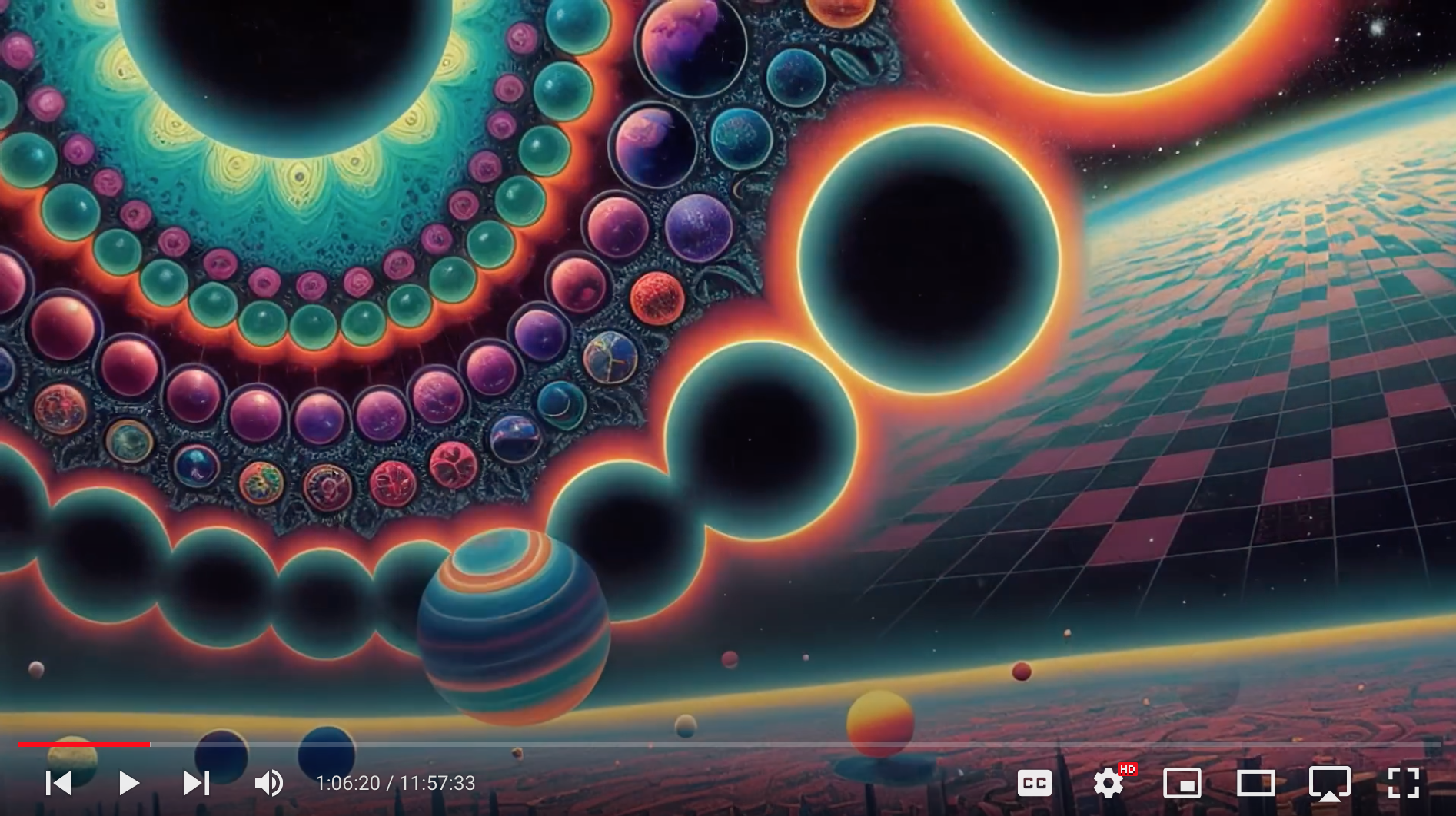
So picture yourself on a random Saturday in the Bay Area. A couple of friends of yours have been dying to try magic mushrooms and know that you are an experienced tripper. They have done weed and MDMA a couple of times, and one of them once had 2 grams of mushrooms with you years ago (probably over a decade now, though you prefer not to count). The other, his boyfriend, has never tried a psychedelic. They are both professionals in the AI world, working either on cutting-edge language models or hardware accelerators. So you decide that a fruitful endeavor would be to watch AI-generated content and see how our relatively AI-informed tripping minds interpret what we see. It’s a neat experiment, right? Anyone can do it. But chances are that explicit “watch parties” with friends would be the most effective.
It’s a remarkably simple setup, really. All you have to do is to get together with friends into AI and/or consciousness, each consume between 1 and 2 grams of mushrooms, and then spend the next 5 hours watching this video:
You will ideally also play the music that comes with the video in a good speaker system and with a great large-screen TV. Why is this a significant experiment, or activity?
Look, I want to avoid the perception that this is simply coming from a sort of “oh mushrooms are trippy, AI art is trippy, if we add them together we will get extra trippy!” heuristic. I mean, there is some logic to this, and in many circumstances it really makes sense. But, guys, we’re doing sophisticated science here! Let me explain.
We have an AI system that is trying to minimize the difference between a prompt and the images it is generating. It is trying to make every part of the image as unexpected as possible given every other part of the picture and the prompt. But on magic mushrooms you parse images differently. How these models ultimately draw inferences is still hotly debated, and it wouldn’t be absurd to find out that some clues are more perceptible in such an altered state.
We decided to simply experience the most generic and reproducible setup possible and so we stuck to watching that video, so it becomes a kind of standard candle for discussion.
I should mention that the other two participants took 2 grams. One of them all at once (soaked in lemon and with ginger juice as a chaser to avoid nausea) and the other took one gram and then about 50 minutes later the second gram. I took half a gram to test the waters (as I sometimes respond really strongly to mushrooms in particular) and had a gram (most likely about 0.8-0.9g) also 50 minutes after the first dose, when it became apparent that I was having a more typical response by then.
The other two participants were very grateful for the experience overall, but they both stated that they thought it was too intense, and they wish they had taken 1 or 1.5g instead. For me the dose was right on target, which I suppose amounted to 1.3-1.4g or so.
The Experience
The video and the music turned out to be perfect. I had a blast. I really couldn’t think of anything more interesting to do on a random Saturday afternoon. First of all, the dose was strong enough for me to have really noticeable effects worth pointing out, but not strong enough that I would get completely side-tracked by internal tangents or worries. I was really energized but euphoric and able to keep it together all of the time, having a lot of familiarity with this territory. Second, I think that the input was really useful for the experience to go well. The images continued to be entertaining and grounding, even. And the music created a vibe of “we made it! we are humanity in the future and we figured out how to solve the climate crisis, AI, and pandemics, and we’re all living a never ending party exploring consciousness”. So at least this created really excellent conditions for my experience.
But most importantly, the task of “look at these images and try to point out things about how the model works that you wouldn’t normally be able to see” was enormously engrossing. Having a deep personal interest in how the mind works and how this differs from how computers work also provided great mental software to play with during this activity.
I will start out by pointing out the most obvious difference in how the experience of watching the video is on 1.3g of mushrooms relative to normal. The biggest difference is in how sensitive one is to randomness in the animation. This is something you can point out literally at any moment of the 11 hour long video (yeah, I know, it’s a shorter loop, which we watched probably around 3.5 times altogether). The change introduced by the zoom makes the algorithm re-paint each region locally in a way that minimizes surprise (modulo the prompt) with its surroundings. And while the local change in color and low-level shape are typically well-coordinated with changes in the region, they are largely random and desynchronized relative to low-level changes elsewhere in the image. This could have been different. For instance, if the model had more non-local update rules, where each local change needs to be made in coordination with changes elsewhere (or at different scales!) then we would be seeing (and noticing in the psychedelic state!) many more correlations in how the video evolves. Instead, we get a setup that almost sort of maximizes the individual brightness of each local change precisely because it occurs in relative isolation, and thus stands out. In a way, looking at this video while on mushrooms makes the experience very “pointillistic”.
Relaxation of Beliefs vs. Expanded Repertoire of Harmonic Modes
Now, the standard explanation for why on a psychedelic we would experience these local changes as brighter than when one is sober is that the state sensitizes you to low-level sensory signals over the perceptual priors we rely on to compress our experience and highlight only what’s out of line. In other words, this is the story where top-down priors are loosened and thus allowing for bottom-up sensations to drive the state more directly than they usually would.
But I think that we can enrich this explanation with a more gear-level account. Namely, if we think, simplistically, that each state of consciousness is decently approximated by a superposition of harmonic resonant modes in each of our sensory channels as well as globally, then psilocybin’s role would be to increase the amplitude of these resonant modes and especially that of higher frequency ones. In turn, the typical landscape of harmonic coupling gets overwhelmed by the non-linearities emergent in the new regime, which give rise to a wide repertoire of possible ways for harmonics to (fleetingly) couple together. As a consequence, we have a wider (but unreliable!) set of building blocks (as resonant modes coupled together to form gestalts) with which to make sense of sensory information. In other words, it’s not (only) that the “perceptual filters” are down, as both Huxley and perhaps standard predictive processing explanations would have you believe, but there is also an enrichment of internal resonant modes that can function as more complex priors useful for perceptual processing.
What this means in practice is that you will be overfitting your sensory input a larger fraction of the time. The garden full of overgrown grass and leaves can look like a complex network of hypercubes on DMT or on a high dose of mushrooms. This is obviously not because that shape is really latent in the stimuli. Rather, that among the non-linear resonant modes that you now internally have available to sample from in order to fit together the information coming from the senses there is an entirely new class of non-Euclidean and also higher dimensional gestalt configurations. In a way, they are the possible data-structures for ordering large bundles of local binding connections into coherent structures with long-range correlations. But in this case, it is overwhelmingly likely that you are overfitting on the data: the grass and the leaves are a source of partially structured randomness that the normal visual system correctly interprets as stochastic whereas the tripping brain over-thinks it far beyond the necessary.
That said, as with psychedelic cryptography more broadly, I do very much believe that it is possible to create input that specifically looks ordered in the right way on a psychedelic but not sober. For instance, a case where indeed the movement of dots in a screen are very well approximated by certain projection of a hypercube on a hyperbolic plane, so that on a psychedelic you actually tap into one of those possible “solitons” of the mind and correctly represent it. Here one would be finding a specific visual task where its model complexity is indeed adequate for a psychedelic but not for the normal visual system. I would in particular, expect that psychedelic states of mind would work really well as kind of a “reverse fractal diffusion” system, where you can “click” into fractals hidden in the screen that were noised in some way. I.e. where the possible fractal gestalts that become available on psychedelics turn out to be a great approximation for the image in a way that generalizes.
Now, given the way in which our brain might use superposition of harmonic modes as one of its primary ways of modulating the contents of the world simulation, then we could _define_ randomness _relative_ to this system. In particular, it might be a good approximation for us to think of randomness as the degree to which the input is “incompressible with harmonic modes”. After all, JPEG is quite a good image compressor for humans. In other words, while some number theoretic properties are certainly not random (if anything, they are superdeterministic, in that they are true in all possible universes), they are random from the point of view of the human visual (tactile, etc.) system. Looking for patterns in prime numbers is so trippy because they are deterministic and yet an adversarial case for our pattern-detection system (don’t get me started on looking for patterns in Pi). So that which cannot be compressed as an interaction between harmonic resonant modes stands out as inexplicable from a subjective point of view, even if there is a real pattern underneath that is simply poorly compressible with harmonic modes.
So one story says that the relative strength of our priors to our sensory input is flipped over. The other story says that the inner repertoire of representations increases and that as a consequence you will be more prone to interpret randomness as a pattern simply due to having more categories of patterns to sample from. How are these stories connected?
Here is what I think.
The Annealing Process
First of all, I think the dynamics are key (cf. mettannealing). A whole psychedelic experience can be seen as an annealing process and we need to be aware of this to make sense of each stage of the trip (Psychedelic Information Theory, Neural Field Annealing). I think that psychedelics inherently activate some low-level cellular-automata-like reaction-diffusion-like processes that make your experience buzz all throughout and causes many of the pre-existing correlations learned by your system to break down. At first, in desynchronized ways. During this phase, the video looked like it was undergoing a process of defabrication. The elements were more disconnected from each other, sort of drifting apart into their own island realities. And the parsing of the scene was highly pointillistic.
Then, I think that as these low-level patterns begin to coordinate with each other, they start to form groups and clusters where they form networks of resonance. In this phase the experience is characterized by the evolution of signals, where different parts of your experience are trying to connect with one another, sending waves to each other and adjusting their mutual shape in order to be able to send and receive signals more efficiently. Here many parts of the video worked as makeshift transmission fields for patterns to communicate with each other.
Then you have a long period where the common themes on the “surviving” patterns of the ecosystem are dancing with each other. Once the pieces of the puzzle are set in place, then you explore their many possible configurations and interactions. But at this point you aren’t making entirely new pieces. So during this phase, the video emphasized the complex relationships between the parts. In essence, the main archetypes that you arrived at during the process of deconstruction go as far as they can in cooperating with one another to make the experience as great as possible (in this case).
And finally you have a comedown and a subtle long-tail, both characterized by the loss of access to the memory of the process (if not somehow encoded in clever ways or recorded in audio or writing) except for a recurring sort of revising of the main emotionally impactful takeaways of the experience.
So I would say that both stories are part of the picture. In that the first story explains the start of this annealing process, where you become sensitized to low-level sensory inputs. But then as the canvas of patterns gets painted and you have the start of competition for attention and connection, you actually explore a wide range of new primitives that can be used to make sense of very complex relationships (which risks overfitting, but might also be legitimately necessary for some categories of insights or realizations). In other words, there is a phase of the process where the evolutionary dynamics generate a layered ecosystem of resonant modes, and these in turn enrich the range of model complexities you can afford to use to represent sensory data.
Now, importantly, the video precisely lacks many of the long-range correlations that are more characteristic of the psychedelic state. This actually, in my estimation, made the experience somewhat more DMT-like, in that the low-level detail always attracted a lot of the attention, as opposed to being more centered on the intermediate-sized gestalts.
The state I was in during the peak of the experience would hallucinate a lot of long-range correlations that I really don’t think are present in the video as such. It was as if the lack of global coordination between the low-level patterns left my pattern-detection systems really hungry, and with the enriched repertoire of possible models, they would find really implausible but technically accurate fits. For instance, here the visual system was really trying its best to reconstruct the pattern of light in the grid as a meaningful optical effect coming from some symmetrical prisms rather than admit that it is random:
In this case, I think my visual system was really using all of the available complexity in the repertoire of resonant couplings on hand and legitimately “thought” that it was a good fit of the data. And of course if there were reasons for those new priors to be there (like that the movie was constructed with them in mind) then they would be picking up on real signals. Here, I’m pretty sure, it was a case of overfitting.
It is worth noting that the valence of the consciousmodel ultimately matters just as much, if not more, than that of the sensory input per se. I actually think that this video wasn’t particularly valence-maximizing. I think for that you would benefit from carefully curated videos with soft harmonic resonance coupling in really elegant ways. This video instead was rather sort of maximizing a certain kind of visual interestingness, in that it compellingly creates the illusion of a structured generator behind the scene even when it is smoke and mirrors, and is rich enough to grip you without being so rich that you miss out on detail.
Lensing
There’s one important exception to the absence of long-range correlations in the video. And that is when “lensing” effects take place.
When you have a pattern that repeats over a long distance, then the little “update waves” that the pattern emits do tend to have the habit of entering into coherence. When the pattern curves, then the waves can in a way become concentrated, and as such, function as a kind of “lens” (cf. Reverse Grassfire Algorithm). When this happens, the image does pulse and vibrate in coherent ways, which is especially nice while on a psychedelic. So I really cherished the moments when lensing would happen in this video.
Another way of looking at these lensing effects comes from thinking of the model as a series of non-linear activation layers for receptive fields of increasing abstraction. In this case, we can actually expect interesting lensing effects, because a coherent wavefront might make a large-enough area look similar enough in order to trigger the detection of a broader gestalt. So in a way, we could say that this model does have some degree of psychedelia inherent in it, though it is far from optimized. Lensing-aware and lensing-optimized networks should be doable.
Importantly, because lensing _is_ present in both the visual field on psychedelics and in this model, there is an especially strong effect from symmetrical alignments in this video and the state we were in, making us say “oh my god” when strong lensing would happen. That said, this non-linear amplification of waves that results in large-scale coordination of gestalts could be greatly enhanced in the model by adding correlated changes across the scene. I’d even predict that the “interaction length” variable of a model like this that has adjustable long-range correlations would be a good proxy for the “degree of trippiness” of the imagery.
A Geometric Deep Learning-Inspired Model of Psychedelic Action
This takes me to another key way in which the video isn’t exactly as psychedelic as it could be. This involves a brief discussion about geometric deep learning. One of the main insights of this field is a way to make sense of how neural networks overcome the curse of dimensionality. In other words, why is it that a model with so many parameters doesn’t automatically just massively overfit the data? And why does the model converge so fast, relative to what you’d expect given the complexity of the patterns it figures out how to detect?
Here the idea is that the way in which we construct neural networks actually has in-built assumptions that significantly reduce the state-space that they are exploring. In particular, two key assumptions are built-in: symmetries in the input, and scale-separation in the outputs.
The symmetries in the input deal with the type of space the data comes from. When you’re in 2D Euclidean spaces, then rotation, translation, and reflection might all count as the symmetries of your space (cf. Klein’s conception of geometry). And it turns out that a key principle behind choosing the right neural networks for a given task is that the in-built symmetries it assumes correspond to the symmetries of the space it is actually sampling from. Thus, convolutional neural networks are a good fit for datasets where you want to enforce translational invariance (a cat is a cat, no matter if it is on the left or the right part of the screen) but not a good fit when the specific location of a pattern actually matters for its classification. Nevertheless, we can say that one of the fascinating things about psychedelic states is that you do seem to experience new exotic geometric primitives. Indeed, a computational interpretation of, say, a hyperbolic spinning wheel on DMT, is that you are applying a _space prior_ over a region of your experience such that the symmetries of that space are enforced in that region. Thus, psychedelic symmetries are, in a deep way, geometric priors over sensory input. But this only really makes sense once you zoom out of traditional deep learning principle and take into account the insights of geometric deep learning (cf. the inventor’s paradox).
The second in-built assumption that comes from how we build neural networks is scale-separation. Here the key is to realize that many of our networks have “pooling” layers where low-level details are aggregated across a region. This way of treating the data gives rise to an implicit assumption about how the information is structured. And that is that patterns of a given size are expected to interact with patterns of roughly the same size. Importantly, too, that categories exist at a certain scale, meaning, that concepts like “a face” encapsulate lower-level features together (nose, eyes, mouth) that are spatially contained _within_. In other words, the way we make sense of visual data using these networks assumes that there is a very specific, highly local, way by which low-level features are put together to form higher level features.
An example of a dataset that would violate this scale-separation assumption would be one where faces need the high frequency elements of eyes to be a certain distance away from the rest of the features. Here the gestalt that one needs to learn to recognize incorporates low-level features into higher level features in an anomalous (highly distributed) way. Then again, this is something that future neural network architectures can play with. Namely, _relaxing_ the degree of scale-separation that is enforced.
Put together, we now have a picture of psychedelic effects in terms familiar to geometric deep learning. Namely, we are sampling geometric priors from an expanded repertoire of possible symmetries (!). In this way, psychedelics could be thought of as relaxing geometric (typically Euclidean) priors in favor of a long-tail of (hyperbolic and higher dimensional) priors. In parallel, we observe that the degree to which long-range correlations are detected and experienced on psychedelics is greatly amplified, especially if they can be compressed as harmonic waves at a different scale. Importantly, there is more coupling between scales on psychedelics, giving rise to a relaxation of the scale-separation priors our system typically works with. Thus, I reckon we can see the psychedelic state precisely as one where scale-separation constraints are relaxed (!). Meaning that, the psychedelic state has broader geometric priors and less scale-separation in its assumptions about the structure of sensory data. A more universal, albeit slower and maladaptive in our current environment, form of qualia computation.
The verdict?
In many ways, the video we saw was fascinating. The constant stream of novelty was endlessly stimulating. In many other ways, it was maximally boring: it precisely lacked the sublime long-range correlations that make psychedelics so delightful. But when they did happen (via lensing effects) they were especially glorious. It became apparent how a much more interesting video to watch will become viable when a broader set of geometric and scale-separation priors are explored in models like these. But on the whole, I thought it was a delightful experience. And my friends were, in their words, quite pleased. A wholesome Saturday evening in the Bay I’ll always remember fondly.
They say “Give a man a fish and he will eat for a day.” And that should have been good enough, because the alternative is to “teach a man to fish, and he will build a robot inside him that will give him food in exchange for instantiating a series of encapsulated behaviors over and over again for the rest of his life.” This is why this is tricky.
The Adattvar of the West, on the topic of Consciousness vs. Replicators
It was with some hesitation that you decided to explore DMT again. There wasn’t a pressing need for this exploration, but you felt it would be beneficial for the sake of solidarity in your relationship. Your girlfriend had been battling debilitating cluster headache attacks for years, and it was only recently, with the aid of psilocybin, that she was able to experience months free of pain. Encouraged by a suggestion from a mutual friend, she decided to explore DMT. While psilocybin had proved quite effective, it required a significant amount of preparation, commitment, and patience. The doses that effectively kept her cluster headaches at bay were around 3 grams of dried cubensis; she wasn’t among the few who could take a microdose and find relief for months. For her, like clockwork, about three weeks of freedom from the Beast followed a high-dose psilocybin experience. However, reports from a legal retreat center in South America indicated that DMT worked differently: a single 5-10 minute experience could instantly (within 10-15 seconds) abort an episode. This meant transitioning from 10/10 in physical suffering with almost no trippiness to 10/10 in trippiness with almost no physical discomfort in just 20 seconds—a bizarre mental shift not even the most extreme psychonauts or thrill-seekers would typically pursue. But if the treatment proved effective, this might be what she would endure every time the pain returned unexpectedly from now on.
You had explored the state-space of consciousness disclosed by psilocybin and DMT nearly a decade ago, during a memorable Indian summer in college. This was a time you spent living in the apartment of a physics professor you had befriended online. He was more than happy to host you over the summer in exchange for your help with walking his four dogs, feeding his fish, and cooking dinner several times a week. The connection you shared with him was profound, though difficult to describe in ordinary terms. This wasn’t a relationship based on financial gain, romantic involvement, or social status. Far from it. Your family considered you irresponsible for not pursuing a summer internship, while your friends speculated you were involved with a man twice your age in a foreign country. In reality, most of that summer was spent exploring the effects of LSD, contemplating the nature of space and light, and deepening your intellectual and spiritual bond with him.
One of the days you got so high on shrooms and acid that looking at the sky you asked him “how do we know that we are not the complement of space and that space is a viscous material? I think it all works out so that this figure-ground inversion leaves everything perfectly the same yet inside-out.” He immediately perked up, put on an old Synthwave vynil and shared with you a series of seven secret meditations. Each of these meditations could do a figure-ground inversion in a different way, all of which seemed impossible under the assumption that our common sense notion of space is correct. They involved internal attentional moves like “focus on the sense of half-perceiving the light on the left side while fully perceiving the right visual field as both white and black,” or “notice how searching for spiral flow in your belly makes your forehead display standing wave patterns, and focusing on spiral patterns in your forehead does the same for your belly. Now, find the exact midpoint between these two modes and remain there, allowing both the belly and forehead to simultaneously exhibit spiral and standing wave patterns.”.
Each of these secret practices revealed a major “articulation” of you world simulation. They seemed analogous to interaction bottlenecks in a network where sensations trigger each other, capable of dividing the flow of attention into two distinct clusters. One bottleneck was purely geometric, capable of splitting my field of consciousness into two “sides” – up and down, left and right, front and back, and even into a double spiral, similar to those seen in Christmas ornaments. This concept was relatively straightforward to grasp, but the other six were mind-bending. One practice involved dividing the perceptual field into a “front” and “back” that didn’t align with our usual sense of direction. It was as if an extra geometric dimension would become “unglued” at the precise moment of achieving perfect balance between both sides. Another technique required inverting the central axis of attention upside down while keeping every other axis unchanged, eliciting an intense sensation of weightlessness. The remaining practices, each more indescribable than the last, would require an entire book to even begin to describe.
Sooner or later, you came down from the shrooms and acid, and the meditations stopped working. You weren’t in a rush to ask your friend where he learned them, and besides, it wasn’t likely he would volunteer that information. You knew he had a stint as a spy decades ago, and that he underwent advanced meditative training to endure pain without anesthesia. But, as luck would have it, he decided to share some vital context in the days that followed, unprompted.
It was aliens—or rather, not aliens in the conventional sense. He shared that during his PhD, he took a year off to focus on meditation, spending six months in complete silence in the mountains of Nepal. Although he wasn’t familiar with the Jhanas at the time, his descriptions of his experiences closely matched the recognized stages of meditation. These stages involved learning to experience orgasmic bliss through meditation, becoming engrossed in it, further developing this state, experiencing what might be described as a Kundalini awakening, realizing that pleasure can itself be a form of discomfort, and then shifting focus to more peaceful and tranquil states, ultimately residing in deep equanimity. It was during a profound state of equanimity in the 4th Jhana that he encountered “them.”
You weren’t privy to further details about who “they” were, and it seemed as if he himself didn’t have a clear understanding. However, his belief in their existence was nearly unwavering. He presented a compelling argument he referred to as “proof of qualia computing,” wherein he evaluated the maximum capacity for information processing within each frame of consciousness. By his assessment, the sheer amount of novelty he encountered during each second of “contact” vastly surpassed the theoretical maximum of information he could produce independently. But what truly solidified his conviction was a peculiar phenomenon. He likened the shape of his “soul” to a kind of wire puzzle, and what convinced him of the presence of a non-human intelligence was their ability to “solve” this puzzle from an external vantage point, employing perspectives that seemed unreachable from within. This was akin to the revelation experienced when the inside of a sock is turned outwards, suddenly exposed to sunlight by the hands of a curious child.
He certainly didn’t need you to believe in any of this. Despite the meditation prompts being truly mind-blowing, you ultimately felt that your friend harbored some unusual beliefs and that perhaps you had been indulging in too much acid recently. Following this, the two of you scarcely discussed it further. Instead, you returned to more familiar and comfortable conversations, like debating the future viability of commercial fusion.
Fast forward to last month, and the memories of your Indian Summer resurface as you’re on your way to a psychedelic retreat with your girlfriend. During the flight, you found yourself uncertain about the most desirable outcome of this visit. For her, obviously, you hoped for complete remission. For the both of you, perhaps creating some inspiring content to promote the use of psychedelics as painkillers and help raise funds. And for yourself? Regaining a sense of deep meaning and enchantment in life would be ideal. However, the harsh reality of suffering and its manifestations have worn down your soul, making the prospect of simple tropical rest incredibly appealing.
First Day
You arrived late at night, and all you managed to do was have dinner and go to sleep. You and your girlfriend were given separate rooms; she was participating in a program designed specifically for individuals with cluster headaches, requiring her full engagement. Meanwhile, you were enrolled in the explorers’ program, there primarily for moral support and to be available if needed, but with plenty of time for yourself. The darkness of the night and the challenge of overcoming revenge bedtime procrastination threatened the quality of your retreat, so you took some melatonin, drank a cup of chamomile tea, and practiced a bit of Yoga Nidra to ensure a good night’s sleep.
Upon waking, you found yourself emerging from one of those complex dreams that seem profoundly meaningful, yet lack a clear storyline. Amid scenarios of rushing to the airport, completing your credits, and the classic nightmare of standing naked before a class, you couldn’t pinpoint exactly what made the dream feel so significant. It was one of those stress-induced dreams that seem to carry weight only as a whole, despite the inability to articulate or model this significance. It was a frustrating experience, reflecting the complex layers of stress and anticipation you felt about the retreat and the hopes pinned on it.
At breakfast, you noticed the group that had come for pain treatment was wrapping up, so you took the opportunity to sit with the organizers and discuss your options for the retreat. Your girlfriend, part of the pain treatment group, stood up, greeted you with a kiss, and then went on her way. Curious about the possibilities, you asked, “Can I take DMT?” The answer was affirmative. You were allowed to use DMT within designated areas and timeslots, which effectively meant you could do so almost anywhere and anytime, barring obviously risky situations like during an ice bath or while lost in the woods. The only requirement was that someone needed to initiate and conclude the session with a traditional Mesoamerican ritual. Other than that, you were free to explore. This level of freedom, you felt in your bones, was delightful.
When it comes to conducting effective DMT phenomenology research, there are generally three key obstacles. The first is the challenge of surrendering and “letting go.” This isn’t a binary state but a spectrum, and it encompasses more structure than one might initially think. Letting go is a skill that can be honed in various dimensions: in relation to goals, across different spatial and temporal scales (such as releasing a specific sensation here or a broad, diffuse occurrence there), in the context of self versus others (letting go of one’s self-conception or perceptions of others), and even regarding subtle existential attitudes (like releasing the need to exist or the desire not toexist). This deep and multifaceted approach to letting go is crucial for navigating the extreme experiences DMT can offer.
The second is love of knowledge. The deep desire to know and learn about the nature of consciousness must be higher than the fear of the unknown. In many cases a person might be curious, but if that curiosity is never concentrated enough, purified enough, and focalized enough, the ambient fear might simply never let it be turned into action. This one would strike many as peculiar and incongruent with our sense of self. After all, we proclaim to be curious, deeply curious, and yet clearly when the chances to find out genuinely new pieces of the puzzle present themselves, we rarely take them. Intrepid non-insane psychonauts are really rare.
And third, is the love of shared knowledge. Many explorers can often get to a point where their own personal curiosity is satisfied without in the process ever producing artifacts of knowledge for the sake of others. Importantly, this is not the same as wanting to impress others. Many explorers go in only as deep as it will generate outlandish stories to impress others with. The real value is in the clarity, not the confusion. So wanting to impress and wanting to share knowledge are near enemies that often work at cross-purposes.
To recap, you need to (1) let go, fractally, (2) love knowledge more than you’re afraid of it, and (3) want to share it with others for their own benefit whether or not you can impress them. The number of “openings” for this sort of activity worldwide is really small. Gaia, looking for worthwhile students, as it were, would struggle to find the right Soul soil if confined to a single country, let alone a state or a city. But this was it. The conditions for you were optimal today. Having practiced “letting go” with breathing exercises for a few years now, and deeply motivated to pay attention and not miss out on any key insights uncovered by the state, you decided to take a deep dive.
Your first hit lasted three seconds, and you held it in for as long as possible. Within seconds, you felt a wave of relaxation tinged with anxiety, threatening to create an unpleasant pressure in your head. The full reality of your situation struck you, plunging you into a mild panic. “They’re treating hellish states right here!” a part of you exclaimed. The harsh reality of extreme pain, similar to what your girlfriend had been enduring, became clear to you, as well as the many inner labyrinths of attention you had constructed to avoid confronting it directly. Internally, you panicked but decided to ride it out as best you could, focusing on the sensations in your forehead and the back of your neck. Gradually, the storm of anxiety passed. “What, indeed, am I doing here? Why am I messing with DMT, which might be a necessary evil for people like my girlfriend who truly need it for pain? Bad trips are nothing to laugh at,” you thought to yourself.
But within a few more minutes the vibrations were calm enough again, and you felt a wave of relaxation come up. Within 20 minutes you were ready to go again. Perhaps a smaller dose. As you com up on a 2-second hit, you notice phenomenal space charge up and vibrate. Like hitting a bell made of magnetic fluid, and whose vibrations are dampened by a process of interlocking with the the surfaces in the visual screen. Each tiny 2D surface in your visual field seems to slow down and “grab” the waves in space. To a first approximation it felt as if the DMT was shifting the frequencies expressed by the field (think black body radiation) upwards, but then which specific frequencies get picked up is a function of what shapes are present in the field that can function as radiators. So the energy is really more like a bell-shaped curve in the frequency domain; the specific manifestation of that energy in a moment of experience will have clear spikes, each corresponding to a particular vibrational mode energized in your system (cf. Psychedelic Thermodynamics). For instance, the energy spread out over 15-20 hertz can energize some vibrations at 17hz in the visual field, and this will “suck up” that energy away from being able to energize, say, a different 19hz flicker in the field. In other words, the shapes and their vibrations in the field function as energy sinks from the point of view of the vibrating field, but they function as energy sources for each other as they can reinforce one another.
As is expected, the worldsheet melts and once you hit the Chrysanthemum level its curvature intensifies. It’s as if you’re interacting with the walls of a complex modern art museum, or the inside of smooth caves, or the smooth surfaces of a spaceship. You notice that there is a tight duality between the shape of the worldsheet and what it represents. In fact, the shape of the worldsheet dictates how attention moves around in the scene, as well as determines the landscape of possible valence artifacts (namely, how and where different elements of the scene interacting with one another can cause huge spikes of dissonance or consonance).
Because the self-other divide is loosened in this state, the elements of the worldsheet have bistable interpretations, some of which can flip-flop between self-and-other. For instance, a part of the scene can flip between being an open space and a visual representation of your arm. This in turn means that the very _material_ with which the worldsheet is rendered has multiple possible interpretations. It’s the multistability of the elements itself what this material is made of, we could loosely say. And so when the worldsheet renders a given entity, you will often experience multiple adjacent projections of that same entity overlapping with each other, each interpretation competing for your attention yet never fully capturing it.
The first important learning you gathered today for how to navigate the DMT realm besides what you’ve been practicing already in meditation and other exotic states (i.e. generic advise like cultivating a lot of metta, doing breathing exercises, practicing equanimity, etc.) is that the worlsheet’s shape is what determines the mood, and indeed the personality, of the entities you encounter. There is, in fact, a certain way of rendering a scene that can give the worldsheet itself a sort of personality disorder. Give it a large but fragile ego, and the worldsheet might develop fleeting narcissism. Make its symmetry and aesthetic effects bistable (so that one interpretation looks gorgeous and another looks dreadful) and you might give it borderline or bipolar. Blunt its affective response with indifference and you might give it depression. And so on. Thus you practice how to contort the worldsheet in only helpful, productive, prosocial ways.
You relax in the garden for half an hour, staring at the sky, taking a break before embarking upon further exploration. The next time you take DMT a strange perceptual artifact becomes notable for the first time. It’s as if there was a kind of unusual pixel in your visual field. Yes, there are floaters in there. There are also the typical DMT hallucinations, which come in the form of standing wave and traveling wave patterns. But in addition to what you’ve seen before, you now also notice a weird little artifact in the field. It’s almost as if… if this was being rendered in a VR headset, there is a little eyelash or small hair stuck to the screen. Whatever this is, it is not a standard artifact of your eye, your visual cortex, or the DMT world for that matter. And once you notice it, you can’t help but seeing more of the same as it comes up. This becomes a theme of your experiences. As the day advances, and with each additional DMT trip you experience, the little visual artifacts grow in number, size and complexity.
A notable effect is when there are rays of color that seem to propagate at high speeds, painting surfaces within the DMT worlds with an alien shimmer. The more you focus on that effect, the more it feels like you learn how to control it. Importantly, you notice it becomes greedy. The shimmer, as you called it, once in the presence of a scene, tries to hack its way into every wall, surface, and reflection, inserting its highly mercurial fluidity into the otherwise crystal solidity of the outline of the scene. As this happens on a new scene, you reflect about r/place.
The realms of consciousness that DMT gives us access to (we shall leave aside for the time being the question of whether these are shared realities or entirely the works of one’s own imagination) can strongly evoke the feeling of intense memetic competition that Reddit’s “r/place” so wonderfully captures. This was a massive internet experiment where individuals users were given access to a 1000x1000pixel canvas, and the ability to set the color of a single pixel every 5 minutes (20 for unregistered users). Since painting anything on one’s own is impossible, forming alliances (largely coordinated via subreddits) became a must. The size of the canvas a given meme controls is a function of the number of participants working on it times their average level of engagement times their level of loyalty to the cause. The DMT worlds one experiences are similarly constructed through a vast, extremely fast, collaboration of numerous tiny subagents working to “re-up” the tracers that paint the paths that make up the scaffold of the scene.
R/place has many “French” regions because there are a lot of French users with a culture, pride, and motivation capable of delivering coordination at the necessary scale. Likewise, your DMT lifeworlds reveal the summed volition of countless subagents trying to express themselves, compromising with their neighbors, and attaining stable boundaries. Soon the ecosystem starts to develop advanced diplomacy, and ground rules are laid out. Importantly, there is general wide consensus on (1) the value of preserving the essence, or irreducible uniqueness, of each vibe that is expressed, and (2) the importance of policing against Qualia Expansionism. (1) is important because each Qualia Culture has gifts that only become apparent in their more evolved form, and (2) is necessary to give everyone the space needed to find their best selves. While French Pixels and Mario Bros pixels might not ultimately agree on their relative importance, they certainly agree on _not_ letting The Void swallow them all.
Among all of the Qualia Cultures that can be found in DMT realms, a few have the tendency to try to conquer the entire field as quickly as possible and without adding value in return. R/place’s The Void would be a good analogy for the prototypical Culture that defaults to massive Qualia Expansionism. Wanting to see it all as meaningless, or default to a massive wave of fear, or seeing all phenomena as made of light, are all equally simplifying stances that Qualia Cultures can develop in a matter of seconds and try to expand to the rest of the field. That this does not happen in every trip is a testament to the insanely clever alliance building capacity of more sophisticated Qualia Cultures emergent in the field.
From this observation an idle, but compelling, thought crosses your mind. Even in the grand scale of humanity as a whole, it would be tragic for us to quickly converge on a monoculture. The fact that Mexico has 60+ entirely different indigenous languages (at various degrees of deterioration and existential threat) is an enormous asset for consciousness as a whole. We won’t know what the fruits of a given culture (in its most expansive conception, including the subtle linguistic folds, attentional moves, and signal processing cadences they come with) will be until it is fully expressed in its mature form. And we won’t have a mature form of the culture unless it is embedded in an ecosystem that challenges it and from which it can draw inspiration to grow. Peak French Vibes won’t be achieved for another five hundred years. So right now the Earth should be seen as a kind of ecological reserve for nascent Qualia Cultures. Of course only those that neither engage in Qualia Expansionism nor those that refuse to engage with the others are ever likely to become mayor players.
The field of consciousness, on these levels, is like a Petri Dish of modes of organization for subagents to evolve styles of interaction that can contribute to the whole. Your whole life, suddenly, seen in this light, appears like a long-standing cultural project. Your life is an attempted reconcilliation by two cultures that have yet to find the way to interact in positive sum ways. But do not feel rushed, this is a century-long process. One step at a time.
As you take increasingly deeper dives throughout the day, two general motions take hold. First, you keep noticing the “weird pixels from another dimension” expand and complexify. Simultaneously, you feel a strong draw towards formless states of consciousness.
It is said in Buddhist cosmology that above the human realm there are countless Heavenly Abodes populates with all kinds of Gods (aka. Devas). While these Gods are not creators of the universe, they do have enormous creative powers. In many of these realms they focus on large-scale artistic projects, in others they focus on intelligence and understanding, and yet other ones are quarrelsome and full of war. As you ascend, each layer of reality is more refined and diaphanous than the previous one. In the layers closer to us there is fierce evolutionary competition between Qualia Cultures, as shapes compete for space, time, and attention. But further up the Gods are wide and expansive, airy, even plasmic in composition. And as the sun begins to set you notice an internal resolution to abide in the formless realms beyond competition. Classically, these are the Sphere of Infinite Space, the Sphere of Infinite Consciousness, the Sphere of Nothingness, and the Sphere of Neither Something Nor Nothing.
During dinner, you catch up with your girlfriend, who has just learned how to cultivate mushrooms and practiced various relaxation techniques—her major trip is scheduled for tomorrow. You feel a deep sense of gratitude towards the organizers for equipping her with numerous tools to manage her condition, reassuring you that she’s in capable hands. With mutual well-wishes, you both express your support for each other’s journeys, ready to continue on your separate paths with a sense of hope and anticipation for what the retreat has yet to unveil.
Late at night, you notice a few strange vibrations in your body. It’s like Piti (the pleasant vascular buzz that precedes absorption into the first Jhana), but it has a strange, dissonant, sawtooth quality. And when you take DMT, listening to this song, it transports you… somewhere magical. The vibration establishes itself solidly in your body, akin to the dysphoric buzzing characteristic of nightmarish sleep paralysis but somehow suffused with a sense of mystical bliss and wellbeing. Your inner eye opens wide. You find yourself in a kind of cosmic spa. The vibration you feel in your body are embedded in the walls of this place. The vibrations are tactile but also visual, and among them you see the shimmer. You walk around. There are many hallways, and stairs, and rooms. The shimmer decorates the inside of the walls, which are all diaphanous, filled with vibrating, twisting, entangled magnetic plasma tubes.
In one of the halls you see a number of 3D symbols representing wholesome mindstates. There is also a mirror. You look into it. You don’t have a body. So looking into the mirror is like void seeing void. In fact, mirrors here are automatic doors to formless Jhanas.
It’s a school, you figure out. The vibrations in the walls are being processed by the beings in here. You see how in the higher rooms the beings literally connect with the vibrations in the walls and digest them with their fields of attention. They expertly disentangle them. The message is clear: this is the place where migraines and cluster headaches are sent over when you take DMT in order for them to be dealt with by advanced conscious beings. It may seem like it cannot possibly scale. But the reason for this place seems more didactic than utilitarian; it’s like a museum where they are displaying how, say, advanced Boddhisatvas take on the suffering of the world in the form of tangled field lines, and then disentangle it out of compassion with the aid of wisdom and knowledge.
More so, this place has a Godhead – you can access it from anywhere in the entire place. It’s encoded in the brightest, whitest, most shiny strand of the shimmering vibrations in the walls. But also there is a special room at the top of the building, in which the Godhead is also located. It’s the experience of Oneness and Unity that is often considered the peak of spiritual development by some schools of thought. But here, it is clearly a sort of lightbulb that displays the qualities of mind unconditioned by the experience of the particulars. It has a Dark Night. If you experience such Oneness without preparation, you are likely going to experience a kind of “Cosmic Orgasm”, a peak moment of profound realization, followed by a deep sense of depression and disenchantment. Here it is appreciated and cultivated as another flavor of consciousness, rather than revered as the final, or primal, truth. But the belief in this sense of Oneness as Ultimate Reality is prevalent in the cosmos, and thus worth having around, if for no other reason than to study it and learn how to get along with true believers.
The migraines and clusters that this retreat center is treating on the physical plane now seem part of a long, multi-civilizational, Qualia Culture program in the etheric realm that aims to lift sapient beings to the level of Bodhisattvas capable of processing the suffering of large cosmic bodies. We have tragedies going on in our planet, no doubt. And nature, from the point of view of a Buddha’s eyes, is of course a kind of carnage. But the true moral catastrophes of this universe are Solar Migraines and worse. The program, and indeed, your very experience of meeting this beautiful cosmic spa, is but one step along a series of milestones for our soul, and the soul of humanity, to wake up to its ultimate, cosmic responsibility. Or so, you feel, is the message written on the wall of this place.
From the point of view of these cosmic forces, Earth is soon going to be evolving to a level of technology and conscious mastery that makes intervention all but necessary. The seeds of the Qualia Cultures on this planet might go at war with each other if they don’t tame their Qualia Expansionism. This would not be the first planet lost to the Shimmer. But direct intervention is not a viable option. These regions of the mind can only influence us indirectly. They can affect our prophetic dreams, they can influence us through subconscious messagings in TV ads, and of course, leave us clues spread all over the Erowid trip report archive. But that, my friend, is for you to figure out tomorrow. You doze off.
Second Day
You wake up rather late, and check in with your girlfriend, who is about to embark on the high dose psilocybin experience along with everyone else on the patient cohort. You wish them a good trip, and get out of the way. Breakfast is delicious, and fruity. Shower. Sit in the sun, with a coffee, journaling. You try to make sense of it all.
“You didn’t go far enough” – you tell yourself. From the depths of your being, something tells you that you haven’t really gotten the full message yet. Last night was an intimation, but what can you really learn and bring for the sake of everyone else? You meditate on the sun and let the warm coffee buzz fill you with a sense of joy and wonder. Was that real? Did it really happen? Yes, and you experienced it for hours. If nothing else, you’re uncovering an important hidden structure in qualia-space. But is there more? Is there truth to these visions beyond the metaphorical?
You decide to take a long walk in the woods, and nearly get lost. For moments you believe you might need to simply find the closest road and wait for someone to drive by. But thankfully you leave enough breadcrumbs along the way (and took enough short snippets of video to reconstruct your path) and after a couple hours of creeping fear, you find yourself once again at the retreat center. Your girlfriend welcomes you, now hour 8 of her trip, mostly sober by now. She says the shadow of a cluster that proceeds the days before an attack is now gone entirely, and you both sigh of relief. You’re both ok. No, you’re doing swimmingly!
This evening, reflecting on the day and the trip as a whole, you decide to dive deeper than you ever have. Now, this certainly won’t be about merely taking higher doses than before. You have maxed out on dosing numerous times in the past, and the only thing that ever happens is experiences too intense for you to handle that make you swear to never take the substance again. We are talking instead about the dimension of surrender, of giving up yourself for a higher purpose, and opening up to an unfathomable mystery beyond your current comprehension. To go in knowing full well that you might not, in fact, have any way of explaining what will take place. Because how else are you going to learn something truly new?
You put this song on repeat and dive. The first thing that happens tonight is that you get one of those “prerecorded alien lifestyle playbacks” that showcases the life of a robot-like organism embedded in Magic Eye geometry. This is one of those clear transmissions, in that the aesthetic is utterly alien to you. But unlike in previous occasions you also see the weird pixel in your visual field, and decide to pay attention to it. Here is where things go haywire, in a manner of speaking. The pixel seems to have a strange effect on the rest of the field, where the more you focus on it the more it sort of acquires a kind of static electricity. The plates of geometry the prerecorded alien hologram is “made of” begin to “stick” to the pixel and its surroundings, which causes a complete “scene collapse”. The vibe of the event is akin to seeing a metallic tinker toy’s house deconstruct with a powerful electromagnet, which tears it apart one plate at a time. The little robot inside makes some moves to try to minimize the interference that the pixel has on the playback, but to no avail. The pixel unfolds into a strange V-shape that reveals a connection to a large bundle of what you can only interpret as higher-dimensional structures slowly intersecting your field of consciousness.
If you take any more DMT while looking at these structures, something unbelievably uncanny happens. Namely, the various structures that are “intersecting” your field are revealed to be connected to one another via an additional spatial dimension that is expressed in terms of 3D Newton’s rings. You see? Newton’s rings are a phenomenon observed in physics that arises when light is reflected between two surfaces—a curved surface and an adjacent flat surface. These rings are the result of constructive and destructive interference of light waves, creating a pattern of bright and dark rings. And you can estimate the height of the curved lens (distance from the flat surface) by counting the number of rings from a point of contact. Likewise, in this case, it seemed as if the parts of your visual field that were “in touch” with strange objects would form concentric circles around them, and you could find the shortest path “along the extra dimension” between two of those parts by finding the trajectory through space that minimizes the number of rings you have to go through.
The dose of the DMT would seem to increase the number of Newton’s rings between weird pixels, just as you would expect by modulating the frequency of laser probe in the 2D-case. From a physics perspective, it seemed as if your visual field was a kind of non-linear optical laboratory currently being intersected by higher dimensional shapes and where the DMT would turn on the lights (at increasingly higher frequencies, in a dose-dependent way).
At this point the pixels became more numerous. Your awareness over them and your noticing of the Newton’s rings seems to have drawn attention “from them”. Suddenly, the pixels become more elaborate topological defects, and a mass of them coagulates at the center of your vision. They feel like a network of knots that go through a higher spatial dimension but which maintain structural stability within this one. The mass of topological defects becomes personified, and presents itself as a “witch”. “Why are you?” you ask. She doesn’t give you a straight direct response. But looks at you, feels you, notices your tender heart. It’s a mom from a previous lifetime. You can sense the feeling of familiarity. Her vibes are a cross between your own mom and those of a very friendly neighbor you always say you will visit but always end up forgetting for some reason. You can tell that she really loves you, or at least loved you and cared about you some time in the past. She says to be careful, and that if you do what she says she might be able to show you something invaluable.
The debris from the robotic tinker toy isn’t really clearing out, though. She says that it contains an AI embedded in it, and that it already noticed that you’re subverting its control mechanism. Oh my! This is exactly the sort of thing you’d expect to hear from someone who is losing their marbles. But who cares, you’re not someone who will easily lose your sanity, and the Newton’s Rings effects is a genuinely new effect you had never heard reported before. You trust that you aren’t just enacting a “going crazy” subconscious script. The witch, for better or worse, is convincing. She, at least in the here and now, seems to have her own qualiastream that’s compelling. Even if this turns out to be entirely a hallucination, it is clearly novel territory. So you decide to engage.
The witch takes you underground. Deep underground. Along the way you encounter the vibe of people you know who are not having a good time in life (“yes, your high-school technical drawing teacher? you can sense her? I’m sorry to relay that she is in Hell. Well, a hell of her own making, combined with neuropathic pain”, stood out as an example, of many). Deeper underground there is a deepening quiet, both sensorially and spiritually. She takes you to a hidden cave found navigating dozens of tunnel entrances. Part of you is having a claustrophobic reaction, but you can endure it with equanimity. She stops, takes a breath, and says “we had to go this deep so that the AI won’t notice what I’m about to show you”. She instructs you to take a medium to large hit of DMT.
What unfolds is beyond human comprehension, but can roughly be pointed at by saying that the Witch gifted you access to a qualia variety that humans currently don’t know about. You couldn’t see it, touch it, smell it, hear it, or cognize it with your normal attention centers. But you knew, full well, the tremendous gift you were receiving. Beyond words, and beyond a sense of utility, you shed a tear for the sheer beauty of what you just witnessed. “Nobody will ever believe you” – she says, playfully. And you nod, deeply moved. And you don’t know why. And as soon as you lose contact with it, you have no way to recollecting what that was. The qualia formats you use to recollect experiences don’t have the necessary *spark* to ignite the memory of what just happened. “It’ll come in handy someday, promise”. And then she begins to expand. Her body, made of beautiful topological defects in the field, unfolds and develops. Like a cross between a time lapse of a geodesic mantle incrusted with diamonds, and a gift wrapper made of origami aluminum foil heating up in a furnace, she unfolds like a hyperdimensional flower. You cannot believe it, but it is undeniable. Your field of awareness is now fractal in structure and her fully unfolded flower-like shape is in full display. “This is the true potential of your soul, when you give it the time and space and resources to unfold as it wants”. You interpret this as a metaphor for how we needlessly compare kids with each other (caring about the age that your child learns to read? Really?!?). But you also deep down know that she is perhaps being more literal than you want to admit it. What if your soul is higher dimensional after all?
“You have now seen the gift that I saved for you. The qualia variety that we use in our culture to express our love, and then also my hyperdimensional flower form. Do you want to learn more?” You say yes, noting that on some level you are now like a naked ape in front of a trickster being capable of displaying advanced technology. “And why should I trust you?” you ask. “You either do or don’t, and at this point I have nothing else to tell you for you to believe me. But as you indeed noted accurately, I am your mom from a previous lifetime. I want to take you to where my ancestors, our ancestors, live. But you need to follow my instructions carefully.”
You decide to trust her. It’s a gamble, but you take the plunge. She first says that there is a high dimensional AI system that is monitoring unusual activity in the field. The minions, i.e. low-level agents that do routine work, noticed you, but they don’t yet have enough information to properly locate you precisely. If we’re quiet, she says, you will be able to find her ancestors in no time. You decide to trust what she says, and take the attitude that you are blind but she can see. From her point of view, she says, you are like someone in Flatland, and the real ecosystem of mind is indeed a high-dimensional field of consciousness that humans know very little about. While we are allowed to do what we want in our plane, inter-dimensional politics is extremely complex and not for the faint of heart. As long as we stay in our plane, most of the ecosystem doesn’t care about us one way or another. She explains that many souls incarnate on Earth along their broader trajectory, and that some of them come from a secret faction from a high-dimensional life-form that is trying to prevent suffering in the multiverse in highly strategic ways.
Interestingly, according to her, what to us might merely play the role of mental formations, from a different angle in another dimension, our thoughts and feelings have a life of their own. Memes are more alive than you could ever imagine, albeit not in the way you would imagine even if you could. Rupert Sheldrake is right that there is a morphogenetic field and the reproduction of mind organisms along other dimensions follows well-worn energetic grooves. “And what about the AI?” – you ask. “That, is something you will have to see for yourself.”
Her instructions are clear, even if communicated in the oddest of ways. She sometimes manifests as a tingle in one of your fingers, sometimes as head pressure, and sometimes as a topological defect in the tactile field. She gives specific instructions along the lines of “we’re approaching a Oneness God, stay low, cover your mystical feelings, quiet… quiet… now think of a happy dog! this will attract a school of energy fish we can blend with… hold my hand, take some DMT, focus on space, quiet, quiet, now think of burning pain, that’s enough, now think of a marsh-mellow, the glow, focus on the glow, absorb into the glow, focus on darkness, ok we’re getting close, don’t move, don’t allow the energy bundle on the top left corner to turn into an animal, see it as a tube, good, take more DMT, quiet, see inside the cave, now enter, now take a big hit of DMT, don’t stop until I tell you, take more, and more and more, deep deep deep…”
And there you were, in the depths of a very deep cave. She said that if you took enough DMT right there her ancestors would show up. And the energy intensified, Newton’s Rings appeared, you sensed from the depths of your being a resonance with a Qualia Culture you never knew was inside you and… blink blink blink, you ran out of DMT.
“Oh oh! This is about the worst time to ran out of DMT” she said. “You were THIS close. But you don’t have enough steam to go all the way. Ok, don’t worry. You’re fully exposed now. The AI will find you, but don’t believe its lies. See you tomorrow.” And what happened next was a total “system failure”. The visual field was “revealed to be a hallucination all along” and “everyone you have ever met is just a figment of your imagination”. Wow. It reminded you of a particularly bad LSD trip you had over a decade ago where you believed that you were God, and all alone, and had created all of this just to distract yourself from it.
But something felt fake on a meta level. Having become acquainted with what it feels like to commune with a witch embedded in the topological defects of your field of consciousness, even just tonight you witnessed things that simply wouldn’t make sense in a solipsistic world simulation. The “proof of independent qualia computing” she showed you could not be faked, and as a consequence, it became rather transparent that it was the feeling of fakeness that was fake itself. “You got it!” you hear in the background. It’s the witch! She is still there. She is speaking through what can only be described as a kind of “DMT jail”. “Yes, the AI found you and has just encased you in a protective film so that your knowledge, which here works as a kind of substance, doesn’t spread around. It hasn’t identified you as a real long-term threat, so I think we just need to wait a day or two and try again.” And then, silence.
Third Day
Your girlfriend is radiant. She says that the trip undid serious levels of trauma she didn’t even know she had. In addition to the psilocybin therapy, she also did some DMT work, which mostly reassured her that it won’t be a problem for her to use it when she needs to abort a cluster. Overall, you had a quiet day. Reflective, introspective, and open minded. What was that? How do you represent the topological defects the witch was made of? And why you? Are you losing your sanity? Alas, people around you are very grounded, and the excuse that you are all simply in the middle of a psychedelic retreat and therefore what you say couldn’t be taken seriously simply doesn’t click. Nobody can gaslight you about what you experienced. The tinker toy, the weird pixel, the Newton’s rings, the gift made of a completely new qualia variety… what’s this all about?
On the last night you decide to go again to sort it all out. You didn’t travel all the way to another country just to get half the message and hang up the phone without hearing the rest. So you get ready with an ice-bath, a mountain hike (now accompanied by a real hiker), and breathing meditation with the group. After dinner (and the pop quiz about what kinds of “exotic qualia” everyone encountered in their trips) you go to the ceremonial place for a last deep dive.
The first trip of the day has a little bit of overlap with your first trip at this retreat. Namely, a wave of fear and a sense of overwhelming reality hits you (“being here and doing this work is both deeply nourishing and also utterly terrifying, for you’re helping people out of hellish states but in the process admitting to yourself the reality of such hellish states – it’s a blessing and a curse”). But after a few minutes of being there, your body relaxes and eases into it. On your second trip you encounter again the weird pixels, which develop and expand as you pay close attention to them. Finally, on the third trip you get again the Newton’s Rings suggestive of a higher spatial dimension, and “contact” the Witch. This, again, happens via the qualia variety we humans don’t usually know about. As soon as you felt it, you knew she was there with you. “I’m not going to manifest in your field so as to not alert the AI of our contact. As far as everyone else is concerned here, you are just having a normal human DMT experience. Now do exactly as I say.”
Again, she goes like “take two short hits of DMT right now, hold them, take a deep breath, look to your left, send metta, don’t let the right side of the worldsheet develop borderline, quiet, quiet, quiet, now think of moving very fast, like running really quickly to the front, stop!, stay still, take a big hit… wait… wait… right now! Timing is everything. Hold it, hold it, pay attention to the music, hold it, release.” The phenomenology of following these instructions felt exactly how you’d imagine is like navigating a very high dimensional space where mind operations are axis of movement and there are countless surfaces variously populated by organisms of different dimensions amidst an ocean of open space.
She says that you need to go to a different location in order to meet her ancestors since the previous location has been compromised. Unfortunately, right where you are supposed to take the largest hit the battery runs out. “Oh oh, I think we will have to try once again in the future. Please don’t fall for the tactics of the AI.” Your visual field then seems to get dislodged from a surface and the Newton’s Rings become wild beyond your craziest dreams, suddenly exploding into a highly complex Indra’s Net mirror room. It is here that you finally became convinced that consciousness had to be quantum mechanical in nature. The level of craziness of the scene had nothing to do with it; what struck you was how despite seeing and embodying patterns that you had never witnessed before (we’re talking about a highly specific, and extremely alien variety of DMT states not usually accessible by chance) you immediately still could parse the scene with topological extrema. Namely, finding geodesic paths in this extremely intricate Indra’s Net world where everything reflects everything else was as effortless as breathing. Interesting! More so, this path-finding capacity remained perfectly effortless and utterly automatic, exactly as if what attention did was “to explore all possible paths simultaneously” and paint the trajectories with coherent superposition. Nothing you have ever learned in standard neuroscience would predict this to happen. But Quantum Electro Dynamics (QED)? Yes, in a heartbeat. Alas, you now worry that not only nobody will ever believe you, but that a faithful phenomenological account of what you witnessed would be used as proof that you’ve lost your marbles. Alas, if the quantum mechanical nature of mind is displayed in topological extrema finding, sooner or later a suitable experiment ought to be possible to construct where we observe unexpected performance in visual processing tasks that shouldn’t be possible otherwise. This, however, shall be a topic for another day, once you’ve given your brain a good rest.
You sleep soundly, if for no other reason than the satisfaction that comes from having been true to your explorer’s heart, leaving no stone unturned, and seeking knowledge in the deepest of places. You look forward to someday following the Witch to the very end, perhaps in a DMTx program or similar.
After a good long sleep, the morning breakfast is a delicacy (“are they fishing for good reviews? they’re already 5 stars many times over at this point” – you mutter to yourself as you eat a second serving of gourmet chilaquiles with melon sauce) and you can feel the high spirits in the retreat participants. You debrief with the shaman. She says that according to her reading, the witch is actually just you. She is a reflection of your own deepest wishes and longings, and was teaching you what it would look like for you to achieve your full potential uncluttered by the expectations of society. The eery sense of higher dimensions and the coherence through which the Newton’s rings manifested leaves the door open to something stranger, but for now, you take her word for it.
You pack up an leave with your girlfriend.
Addendum and Exegesis
It took you weeks to digest these events. While the memory of the meeting with the witch faded to some extent, the nagging sense that some of the more physics-based effects could be reproduced and studied more carefully kept you intensely curious. One day you decided to take 5-MeO-DMT to see if this molecule could have another key piece of the puzzle. Doing the same kind of internal psychological surrender and preparation as what led you to meet the witch on retreat, you then had a series of 5-MeO-DMT experiences that further revealed the underlying programs that were running during those experiences.
First of all, it simply is true that the universe is a kind of massive R/place for Qualia Cultures. It is not currently known if humans will survive in this canvas, but there are a lot of forces rooting for us one way or the other. The deeper plot, however, can only be fully grasped through the lens of consciousness vs. pure replicators. Here we model ethics through a lens that identifies consciousness as the seat of value. Replicators are patterns that make copies of themselves but may have other values too, whereas pure replicators are patterns that exclusively care about making copies of themselves independently of how that might affect states of consciousness. Natural selection recruited states of consciousness for reproduction in two key ways: by using perceptual holism as a hardware accelerator (the Indra’s Net quality of consciousness where everything reflects everything else is computationally significant!) and by using valence to implement a reward architecture. Thus, conscious beings like us are not _entirely_ pure replicators. In fact, our consciousness is given enormous power and agency, which of course at times we use in ways that go counter to the best interests of our genes. So we are at a tipping point in evolution where sufficiently smart conscious organisms can lead to “minds unshackled”. But here is the trick. The system(s) that are trying to help us escape are in constant opposition to those that are trying to keep us as replicators.
In other words, even someone already quite convinced intellectually that we ought to move towards a future beneficial for consciousness and away from futures in which consciousness is merely used as a tool for compute to help replicators, will still have many replicator algorithms constantly monitoring what is going on internally. When a new method that promises to fight “on the side of consciousness” emerges, immediately that alerts replicator algorithms that aim to utilize it for its own purposes. This is the true meaning of the “AI” control system that had to be evaded in the retreat.
Thus, Team Consciousness (i.e. the cluster of qualia patterns that are truly working in the direction of liberation for all beings) are fighting an incredibly subtle battle. If there is in fact a master strategy for consciousness to win, it may very well be the case that it wouldn’t pass through the agency of any single person or organization, for the simple reason that going through such filters would likely corrupt it in ways that would deliver strategic advantage to the _selves_ with an advanced notice. Egos are always corruptible.
As a consequence, the messages from Team Consciousness, if they are to be believed, work around to circumvent the human reward architecture rather than merely state their case out in the open. If they didn’t, they’d be found, and instantly recruited for the benefit of one or another superorganism capable of reproduction. Thus, the messages from the deep need to be cleverly delivered in such a way that they bypass our common defenses, add value locally to incentives their discovery, and coordinate across minds seamlessly. Harnessing qualia computing for the benefit fo Team Consciousness is a very subtle task. But fight it we must, and thus this report must end here, to say enough to be of help, but not too much to become ineffective. I’m sure, in time, you too, will understand.
PLUS FOUR, n. (++++) A rare and precious transcendental state, which has been called a “peak experience,” a “religious experience,” “divine transformation,” a “state of Samadhi” and many other names in other cultures. It is not connected to the +1, +2, and +3 of the measuring of a drug’s intensity. It is a state of bliss, a participation mystique, a connectedness with both the interior and exterior universes, which has come about after the ingestion of a psychedelic drug, but which is not necessarily repeatable with a subsequent ingestion of that same drug. If a drug (or technique or process) were ever to be discovered which would consistently produce a plus four experience in all human beings, it is conceivable that it would signal the ultimate evolution, and perhaps the end, of the human experiment.
— Alexander Shulgin, PIHKAL, pages 963–965
In this post and accompanying video we provide a general “theory of candy flipping” that aims to explain why LSD + MDMA is so synergistic. What makes, say 200 micrograms of LSD and 150mg of MDMA so prone to be spiritual, psychologically healing, and loving? To get there, we address the following three/four questions:
How do we improve research on candy flipping?
How do we optimize candy flipping proper? And how do we generalize candy flipping for even better results?
What would a general recipe for Shulgin’s ++++ be?
1- We go over current methodologies used to study candy flipping and why their results are limited (Straumann et al., 2023). Then we explain how a “think tank” approach (e.g. phenomenology club) allows us to create more phenomenologically grounded research paradigms (Gómez-Emilsson, 2021). By weighting in the personal experience of highly precise psychonauts with skills in areas like physics, math, visual art, and signal processing, we can arrive at mechanistic models such as those proposed by Steven Lehar in The Grand Illusion (Lehar, 2010) where MDMA causes your world simulation to vibrate in pleasant ways, which in turn “smooths out the rough edges” of the LSD state, or models involving algorithmic-level annealing dynamics (Gomez-Emilsson, 2016; Johnson, 2019; Gómez-Emilsson 2021, 2023). This kind of approach would add phase diagrams, wave mechanics, and nonlinear effects into the picture.
2- Optimizing candy flipping can be done by looking to generate the kind of synergy MDMA + LSD achieve in the best of conditions. Of note, trip reports involving low doses of each together with 2C-B and cannabis are discussed and analyzed. One needs to be mindful of annealing dynamics, drug effect arcs including how to handle the MDMA comedown, and pattern-focused readings of wave effects that for lack of a better metaphor could be catalogued as “qualia lensing“.
And
3- We hypothesize that the key ingredients to catalyze the blissful nondual awareness that comes from high-end candy flipping are (a) a full-spectrum energizer, (b) something that increases interconnectivity, and (c) a deeply relaxing agent. The combination of these three elements gives rise to a highly-nonlinear effect I call “FU§ION (Field Unification Search/Simplify in Invariant Optical Networks; to be fully unpacked at a later date), where all of the “resonant cavities” are fully relaxed, have a high degree of impedance matching between them, and are energized, so that they kick-start a “field harmonization” process that culminates in profound blissful nondual awareness. The energizer shouldn’t be narrow spectrum (like cocaine) and the relaxing agent shouldn’t be too blunting or non-Newtonian (like opioids). Examples of each:
Combine one of each, carefully dosed, and according to this theory, you might get a ++++. (Please exercise caution when mixing substances – the rule of thumb is to not do it).
Note: 5-MeO-DMT might, in this model, be actually doing all three at once. It happens to be hitting receptors in the right combination for such a deep mystical “relaxed stimulation” to take hold. That said, it is possible that 5-MeO-DMT also has some rough edges, and that it can be further optimized (e.g. such as by combining it with nitrous). More research is needed 🙂
Example Formula: 15mg 2C-B, then an hour later 2g of GHB, and then an hour later DMT (100mg over the course of 2 hours) was reported as a ++++ by a trusted psychonaut recently (comparable in “depth” to 5-MeO-DMT). Please be careful – I am not encouraging anyone to try this. But if you do, or have done something similar, I’d be grateful if you let me know what happened. 🙂
Gómez-Emilsson, A. (2023), Neural Field Annealing and Psychedelic Thermodynamics presentation at PhilaDelic 2023. Retreieved from https://youtu.be/pM9k1I3VPOg
Straumann, I., Ley, L., Holze, F. et al. Acute effects of MDMA and LSD co-administration in a double-blind placebo-controlled study in healthy participants. Neuropsychopharmacol. (2023). https://doi.org/10.1038/s41386-023-01609-0
In this video we discuss possible meaningful, novel, and non-trivial parallels between something like the Manhattan Project and what we need to do to catalyze a positive breakthrough in our understanding of consciousness.
We cover how explosive lenses have a parallel in the “brain as a non-linear optical computer” paradigm developed at QRI. The short explanation is that the “index of refraction” for local field potentials (LFPs) can be modulated with drugs/interventions, and so in principle one can use varying concentrations of things like nitrous oxide, ketamine, and MDMA in order to focus waves of energy to catalyze precisely crafted phase transitions of consciousness.
There are also much more subtle parallels. Another one is how the development of the von Neumann computer architecture was a world-transforming significant outcome of the Manhattan Project. In the context of consciousness research, one could envision figuring out the “principles of qualia computing” that allows DMT entities to sample from a wide range of possible “mind designs” as an achievement of comparable significance. Arguably most DMT entities are “psychotic”, but some of them aren’t; the way they copy, mutate, differentiate, and analyze “qualia bundles” hints at a very general set of qualia computing building blocks for alternative qualia-based information processing pipelines. The successful Manhattan Project of Consciousness could in principle lead to a revolution on computing paradigms that generalize to qualia computing systems.
I think that the really stunning thing about DMT entities, which I still haven't properly captured in any content (will I ever?) is their *intelligence*. Here of course I'd talk about a super general qualia-based conception of intelligence. Really, you are sampling from a vast… pic.twitter.com/K6xACT4OVT
— Linalool Enjoyer, Andrés Gómez Emilsson (@algekalipso) August 14, 2023
In contrast to the atomic bomb, the kind of “phase transition implosion” developed at the Manhattan Project of Consciousness would be deeply relaxing, rejuvenating, and capable of undoing years of trauma in seconds. Using as research leads “candy flipping done right” (usually with some 2C-B/2C-D/2C-C), 5-MeO-DMT, and LSD + nitrous oxide, one has in fact a lot of hints for how to produce instantly relaxing, deeply healing “waves of enlightened qualia”.
Importantly, the combination of Open Individualism and Valence Realism might catalyze a paradigm shift on how we approach the game theory of human collectives.
If it takes a bunch of geniuses in the desert to figure out how to optimize this effect, so be it. It would be a really worthwhile investment!
~Qualia of the Day: The Burning Man Collective Intelligence~
I am delighted to say that I will be delivering a workshop at Vibe Camp on Saturday the 17th of June:
Time: 7:00 PM – 9:00 PM
Location: Fire Circle
Title: Explore the State-Space of Consciousness with QRI – GET YOUR VIBE CAMP RECORDER (scent)
Description: Come to learn useful techniques to navigate the state-space of consciousness and pick up your VCR (Vibe Camp Recorder), a scent created in honor of this event, which will “record” this day forever in your memory. It is both pleasant and very distinctive, so that every time you smell it again you will vividly remember this day.
Thank you Hunter for designing this sticker. cf. Scents by QRI.
I will be arriving on the 19th of June and staying until the 26th. If you see me, don’t be shy! Please say hi.
#PS23 will be a moment in time. People will say “were you there?” It is a celebration of MAPS’ and the field’s accomplishments. #Excited
— Robin Carhart-Harris (@RCarhartHarris) June 7, 2023
We are going to host a QRI Meetup (cf. London, Valenciaga) on the 23rd or 24th, place TBD but near the conference. Please reach out if you want to volunteer. Stay tuned 🙂
PhilaDelic 2023
I will be delivering the following talk. Please come say hi!
Talk Abstract: The paradigm of Neural Annealing developed at the Qualia Research Institute (QRI) by Andrés Gómez Emilsson and Michael E. Johnson has a lot of explanatory power in the context of meditation and exotic states of consciousness such as those induced by psychedelic agents. The theory posits that there is a sense in which each state of consciousness has an associated level of energy, that there are specific energy sinks and sources in the nervous system, and that internal representations can be modified (and indeed “internal stress” released) with an appropriate heating and cooling schedule (aka. neural annealing). More recently, the theory has been enriched with “non-linear wave computing“, which might be capable of formalizing the concept of a (phenomenal) “vibe” for internal representations. Of special interest for the scientific community studying psychedelics and meditation is the recent QRI model of Neural Field Annealing, which combines Hebbian learning with Neural Annealing in order to explain why “highly annealed brains” can instantiate harmonic field behavior (such as the Jhanas). In this talk Andrés will provide an overview of the theory, share empirical findings, and discuss its testability based on its unique predictions.
The first time I discussed this approach to the boundary problem was for a presentation I was going to give at The Science of Consciousness 2020 (see: Qualia Computing at: TSC 2020, IPS 2020, unSCruz 2020, and Ephemerisle 2020). Alas, COVID happened. Now, thanks to the amazing Chris Percy, who joined QRI as a visiting scholar in 2022 and has been killing it as a collaborator, we have a thoroughly researched paper we can point to for this solution. Please send us feedback, cite it, and join the conversation. I believe this is one of the most significant contributions of QRI to philosophy of mind to date, and I hope high-quality engagement with it by physicists will only make it better. Thank you!
Abstract:
The boundary problem is related to the binding problem, part of a family of puzzles and phenomenal experiences that theories of consciousness (ToC) must either explain or eliminate. By comparison with the phenomenal binding problem, the boundary problem has received very little scholarly attention since first framed in detail by Rosengard in 1998, despite discussion by Chalmers in his widely cited 2016 work on the combination problem. However, any ToC that addresses the binding problem must also address the boundary problem. The binding problem asks how a unified first person perspective (1PP) can bind experiences across multiple physically distinct activities, whether billions of individual neurons firing or some other underlying phenomenon. To a first approximation, the boundary problem asks why we experience hard boundaries around those unified 1PPs and why the boundaries operate at their apparent spatiotemporal scale. We review recent discussion of the boundary problem, identifying several promising avenues but none that yet address all aspects of the problem. We set out five specific boundary problems to aid precision in future efforts. We also examine electromagnetic (EM) field theories in detail, given their previous success with the binding problem, and introduce a feature with the necessary characteristics to address the boundary problem at a conceptual level. Topological segmentation can, in principle, create exactly the hard boundaries desired, enclosing holistic, frame-invariant units capable of effecting downward causality. The conclusion outlines a programme for testing this concept, describing how it might also differentiate between competing EM ToCs.
QRI’s Consciousness Art Contests: Immerse, Innovate, and Inspire
Congratulations to the winners of QRI’s Art Contests! (contest announcement). Many thanks to all of the participants! You guys did really great! We will share all of the submissions for which the artists gave us permission to post in the near future; and in my opinion, there were simply too many amazing submissions that didn’t get a prize. We asked the community for awesome content, and they delivered!
In 2015 I wrote a blogpost in Qualia Computing titled "How to Secretly Communicate with People on LSD" where I introduced the idea of Psychedelic Cryptography.
This is the idea of using encoding schemes to hide messages by using the unique information processing advantages of… https://t.co/ECvIBO1IdH
— Andrés Gómez Emilsson (@algekalipso) June 2, 2023
Psychedelic Epistemology: The Think Tank Approach
I want to express gratitude to the panel of judges who diligently worked to evaluate each of the submissions along key dimensions in agreement with the contest specifications. To provide a little background about the panel, I should mention that since early 2020 QRI has been periodically hosting a “Phenomenology Club” by invitation only which gathers top scientists, philosophers, artists, meditators, and psychonauts. We usually choose a particular topic to discuss (e.g. comparing specific kinds of pains or pleasures), or otherwise interview someone with extensive experience with a particular facet of consciousness. For example, we once interviewed three people all of whom have tried taking 5-MeO-DMT in high doses every day for at least a month (i.e. Leo Gura isn’t the only one who has done this!). Really, we are able to do this because QRI has functioned as a beacon to attract highly experienced rational psychonauts and people seriously interested about the nature of consciousness since ~2017. It is out of this pool of world-class phenomenologists from which the panel of judges was formed. The panel includes people who have had over 1,000 high-dose experiences with LSD, psilocybin, DMT, 5-MeO-DMT, dissociatives, and a vast experience with meditative practices like the Jhanas and the process of insight. More so, in order to evaluate the PsyCrypto submission, some of the judges took psilocybin mushrooms and ayahuasca in a place where it is legal to do so. They all gathered to look at and discuss the submissions sober, then while on mushrooms, then sober again, then while on ayahuasca, and then sober again, and only then they were told about the “encryption key” the contestants submitted, and then they had yet another chance to look at them on either mushrooms or ayahuasca while knowing what it is that they were supposed to see. Most of the judges reported that the winning submissions did in fact work. So I am fairly confident that they do.
Similarly, for the Replications contest, the judges looked at the submissions before, during, and after mushrooms and ayahuasca so that they would have a very fresh impression of what these states are like in order to make accurate and technically precise judgements. Hence the detailed and object-level feedback for the top 10 submissions we were able to provide.
Importantly, at QRI we believe that this is the kind of “facing up to the empirical facts” of psychedelic states of consciousness that will actually advance the science of consciousness (aka. the “think tank approach“). This approach stands in stark contrast with, just to give an example: giving surveys to drug-naïve individuals (exclusion criteria incl. “lifetime prevalence of hallucinogens or MDMA use >20 times”) and having them blindly try either LSD or “candy flipping” [MDMA + LSD], a methodology that apparently allows you to conclude that MDMA doesn’t add anything noteworthy to the experience:
As a simple metaphor, imagine what would it take to make genuine progress in the science of electromagnetism. Would you approach the problem of figuring out how magnets work by putting people who have never seen magnets in a room to play with them for a few minutes and then asking them to fill out a questionnaire about their experience? Or… would it perhaps be more fruitful to gather a team of top mathematicians and visual artists who are very experienced magnet-users and allow them to play with them in any way they want, talk extensively with one another, and generate models, predictions, and visualizations of the phenomenon at hand? Which approach do you think would have better chances of arriving at a derivation of Maxwell’s Equations?
Well, you probably know my answer to that question, as QRI is “Psychedelic Think Tank Approach Central”, and we are damn proud of it 🙂
See: 5-MeO-DMT vs. N,N-DMT: The 9 Lenses (video), which is the sort of content that could only ever be generated with a Think Tank Approach to exotic states of consciousness.
It’s amazing to me how people feel, at times, in a hurry to try to explain away anything interesting involving psychedelics with catch-all ideas like “it’s just slower processing” or “it’s just the result of messing with feedback, nothing to see here” (cf. Need For Closure Scale).
The winners of the PsyCrypto contest used the lowest hanging fruit idea for how to do PsyCrypto. It’s amazing that it works, and it does show a computational advantage that isn’t present in normal states of consciousness. And this isn’t trivial! In fact tracers in general affect how you think at a deep level, allowing for thoughts and feelings that never overlap in everyday life to actually show up together in your experiential field at once. This lingering effect increases the internal cross-pollination of information categories in one’s mind. This allows you to make completely new connections in your mind; hooking tracers with field computing is computationally non-trivial. More on this later.
But… also there is a plethora of more sophisticated approaches. I won’t say much more right now, but essentially PsyCrypto can be done in entirely different ways than using tracers. This includes things like pareidolia, color gradients, and detection of movement. And it is these novel approaches that will show the even more interesting computational advantages to the state.
We ain’t seen nothing yet. We’re at the dawn of a new era 🙂
Now, in the wake of our announcement of the PsyCrypto winners, as I very much anticipated, I got an email from Vice:
Dear Andrés,
I’m a science reporter for VICE. Great to be in touch.I’m reaching out about the results of the Qualia Research Institute’s Psychedelic Cryptography Contest, which is a story we’d love to share with our readers.
I was hoping you could answer a few questions about the contest. I wrote them out here in case it’s more convenient to respond over email, but I’m also available for a phone or Zoom call anytime before 3:30pm Eastern Daylight Time today if that works better. Thanks so much and hope to connect.
1. First, I’d love to know what inspired this contest. What are you and your colleagues at QRI hoping to learn and achieve with the Psychedelic Cryptography Contest?
2. On the page announcing the results, you note that “only three submissions seemed to have any promising psychedelic cryptography effects” and that “to decode these pieces you do require a substantial level of tracers.” Why were these three submissions so much more effective than the rest of entries to this contest? Were they the only ones to use the “first classic PsyCrypto encoding method” that is described in your recent blog post, or was there another reason they stood out from the rest?
3. You note that these PsyCrypto experiments can open up new avenues of research in the fields of neuroscience and consciousness. What are some of the open questions in these fields that you think PsyCrypto encoding could help to constrain or resolve?
4. Last, do you and your colleagues QRI have any plans to build on these findings about PsyCrypto with other future studies, contests, or related projects?
Much appreciated! Best, XXXX
Sent June 6 at 9:05 AM
And my response:
Dear XXXX,
Awesome! Science reporter? It sounds like we’re getting an upgrade 🙂 QRI, that is. Mom, I’m on Vice!
Ok, forgive that. I’m just very stoked about the warm reception that PsyCrypto has been getting in the last couple of days. We made it into the front page of Hacker News and I’ve been receiving emails from neuroscientists and artists. […]. So I’m in a good mood 🙂
[…]
I’m more than happy to answer your questions here.
1. I first came up with the idea of PsyCrypto over 10 years ago, while in grad school. I was throwing into the air some spinning glow sticks in the darkness and noticing the patterns that would arise from their trajectory in space. I realized that the lighting conditions were ideal for me to actually make sense of their movement, and wondered if it would be in fact easier to see that path while on psychedelics, given their well-known tracer effects. I immediately coded up some experiments to hide letters using that idea and gave the code to some friends, who then reported some mild but noticeable improved ability to read them while on LSD. After that, I brainstormed a number of alternative encoding methods, coined the term Psychedelic Cryptography, and a couple of years later wrote the Qualia Computing article you saw.
Now, this didn’t happen in a vacuum. Already in 2011 I was a fan of David Pearce and his philosophy of mind (see physicalism.com). In essence, his view is that consciousness evolved because it has information processing advantages. In particular, phenomenal binding, he believes, is not a classical phenomenon. It is in fact enormously computationally beneficial, as we can learn from disorders of consciousness where binding partially breaks down.
So even then I was actively in the lookout for ways to demonstrate how consciousness actually confers an information processing advantage. And psychedelics, to me, felt like very fertile territory to explore this idea. In essence, people have reported all sorts of information processing benefits from psychedelics (e.g. the classic study of Harman and Fadiman of psychedelics for problem solving). But this is still controversial, so to me PsyCrypto is a way to show the undeniable benefits (and tradeoffs!) in terms of information processing that different states of consciousness confer.
The more PsyCrypto encoding schemes are identified and developed, the more this research direction is advanced. It is the emerging field of “Qualia Computing”. Namely, the study of the ways in which consciousness is computationally non-trivial. 🙂
We believe that the contest furthers this mission, and that opening up the project to a broader audience, with prizes and recognition for winning, can drastically accelerate this research direction.
2. The top three submissions were the only ones that worked at all according to our team of expect phenomenologists. They tried really, really hard to find messages in every submission while on mushrooms and ayahuasca (at places where these substances are perfectly legal) and none of the other submissions had anything worth commenting on (sorry!). I think many people misunderstood the task, tried something random without checking if it works first, or simply crossed their fingers and hoped.that their images would look different enough on psychedelics to contain new and meaningful information. But alas, no. Only the three winners had anything resembling PsyCrypto in them. And to top it off, they were also very aesthetically pleasing. So they are, in my mind, real rockstars 🙂
I do expect a dramatic improvement in the quality of submissions next time we run this contest, though.
Very importantly, based on recent work at QRI, I am convinced that there are at least 3-4 completely new and mind-blowing ways to achieve PsyCrypto that do not use tracers at all. The tracers are, in a way, the trivial case. The new PsyCrypto encoding schemes are… Far more surprising and non-trivial. We will publish more information about them in the near future.
3. Yes, absolutely. In essence, I believe that novel PsyCrypto encoding schemes are a window into the actual information processing algorithms of the visual system. At the risk of sounding fringe, I am not impressed with the current mainstream neuroscience models of how psychedelics work or how they alter visual perception. Yes, one can see tunnels and 2D symmetrical tessellations while on psychedelics. But actually… One can *also* experience hyperbolic honeycombs, 4D projective transformations, and fast spatiotemporal Fourier transforms of non-linear resonance. I am sorry, but no current neuroscientific theory *predicts* this. So we are currently in what David Pearce calls the pre-Galilean era for theories of consciousness. Like the (apocryphal) story of the priests not wanting to look through the telescope of Galileo because “the Bible already tells you the truth about the heavens”, similarly right now most theories of how the visual system work are not taking into account the facts of what happens on, say, DMT. Don’t ever let the theory dictate the facts! Instead, let the facts dictate the theory (see: my presentation about psychedelic epistemology).
Therefore we think that by developing encryption schemes that use *phenomenological facts* such as hyperbolic geometry on DMT (https://youtu.be/loCBvaj4eSg) we will radically transform the conversation about how consciousness works and what its information processing properties are. Once you show that those geometries can be used for information processing, and that humans in the right state of consciousness display such advantages, then it becomes undeniable that they are in fact using such exotic geometry for computation. I believe this will set the trajectory of the history of consciousness in very unexpected ways. Indeed, superintelligence won’t be achieved with AI, but with consciousness engineering.
4. Yes. Now, please note that PsyCrypto and in fact psychedelic phenomenology research is only a part of what the Qualia Research Institute does. We have serious work in philosophy of mind, ethics, valence, neurotechnology, and neuroscience, to name a few. We are extremely prolific given our shoestring budget, tiny number of members, and relatively low profile in academia. But I am confident that as we keep producing world class outputs in all of these fields, QRI will become far more influential and mainstream 🙂
Ultimately, my mission is to prevent all future suffering (see my TEDx talk) and figure out how to enable all sentient beings to experience long-term sustainable blissful states at will. This mission is enormously ambitious, but hey, that’s what I want to do with this one life I have. And so is the mission of the other members of QRI. Let’s get to work! 🙂
Thank you! And please let me know if I can clarify anything.
Infinite bliss!
Sent via email June 6 at 4:30PM
And given this, I really thought that the resulting Vice post was actually really stellar. Thank you! 🙂
We titled the series Qualia Mastery – Building Your Toolkit for Navigating the State-Space of Consciousness.
Qualia Mastery, a concept I introduced in a review of a Jhana meditation retreat, is, in a nutshell, the self-organizing vector that cultivates the tools and practices needed to achieve the following three goals:
1) Explore the state-space of consciousness because you want to know it for yourself
2) Study it from many points of view because you want to understand it intellectually at a deep level
3) Intend to apply it for the benefit of all beings
May this be of benefit to you and all sentient beings! And also, have fun!