ClusterFree’s mission is to help cluster headache patients globally access safe, effective pain relief treatments as soon as possible through advocacy and research.
Cluster headache (also known as ‘suicide headache’) is considered the most painful condition known to mankind. We believe it is one of the largest sources of preventable extreme suffering in humans today. Every year, about 3 million adults (and an unknown number of minors) suffer from this debilitating condition.
And yet, even in the EU, only 47% of the cluster headache population had unrestricted access to standard treatments (primarily oxygen and triptans) in 2019. Despite affecting a similar number of people as multiple sclerosis, global investment into cluster headache is minuscule.
At the same time, countless patients have reported previously unattainable relief using certain psychedelics, even at low doses. For example, psilocybin, LSD and 5-MeO-DALT can effectively prevent attacks, and N,N-DMT can abort attacks within seconds and also have some preventative effects. However, these life-saving treatments are inaccessible to the vast majority of patients.
We want to tackle these problems by:
Publishing open letters demanding that governments, regulatory bodies, and medical associations worldwide take action immediately, with a focus on easing restrictions around psychedelic use.
Providing patient groups with high-quality resources and supporting their advocacy efforts.
Engaging with policymakers globally to advocate for better access to treatments.
Publishing research on cluster headache and supporting other researchers in the field.
Collaborating with entrepreneurs and philanthropists motivated to bring new, effective treatments to market.
We will be collaborating closely with Clusterbusters, the largest and most well-known cluster headache advocacy organization, led and run by patients. For about 25 years, they have been at the forefront of cluster headache advocacy, especially in the US and the UK. We are excited to bring more capacity and new approaches to tackle other jurisdictions, and to show that patients are not alone in this fight.
How you (and anyone) can help
As our first project, we are publishing one global open letter and 11 country-specific open letters:[2]
Anyone can sign the global open letter. Additionally, if you live in or come from one of the countries above, you can sign that letter as well. Signatories include Prof. Peter Singer, Scott Alexander, Dr. Christopher Gottschalk (Yale), David Pearce, and Dr. Daniel Ingram.
Please share the letters widely within your network![3]
If your organization wants to show its support for ClusterFree’s mission, we can list it as a partner on our website.
A few other ways to help include:
Donating or putting us in touch with potential donors. Donations are tax deductible in the US.
Volunteering for various tasks (many of which are very simple but high-impact).
Gained the support of a member of a US state legislature.
Started conversations with CH advocates in multiple countries (most recently India[4], Denmark, and New Zealand).
Are engaging with entrepreneurs and philanthropists interested in bringing DMT to market.
Developed a preliminary idea for a new, legal abortive treatment that could be highly effective (potentially also for migraines).
Have started developing phenomenology-based, patient-centric surveys to test various hypothesis for the underlying mechanism of action that psychedelics exert on this condition.
We recently raised seed funding from a private donor to cover our core operations for the coming months. Additional funding would allow us to hire a second teammate to work alongside Alfredo at this early stage, particularly on outreach and communications. We could absorb an additional $50k–$150k immediately.
At this very early stage, we are still evaluating different paths to impact, and will likely test various strategies simultaneously to identify the most promising opportunities.
We believe ClusterFree is a great donation opportunity for people who care about relieving the most intense human suffering today. Cluster headaches represent a major health crisis even in developing countries, and we are far from having effective treatments widely available. Help us change that.
Additionally, you can consider donating to Clusterbusters or OPIS, who have been at the forefront of cluster headache advocacy and research for years.
Work with us
If you’d like to help us reduce the global burden of cluster headache pain (beyond volunteering), we’d love to hear from you. Simply fill out our expression of interest form.
Introduction: Laser Chess as a Metaphor for the Brain as a Non-Linear Optical Computer
In Laser Chess (a synecdoche for games of this sort), players arrange various kinds of pieces that interact with lasers on a board. Pieces have “optical features” such as mirrors and beam splitters. Some pieces are vulnerable to being hit from some sides, which takes them off the board, and some have sides which don’t interact with light but merely absorb it harmlessly (i.e. shields). You usually have a special piece which must not be hit, aka. the King/Pharaoh/etc. (or your side loses). And at the end of your turn (once you’ve moved one of your pieces) the laser of your color is turned on, and its light comes out of one of your pieces in a certain direction and then travels to wherever it must (according to its own laws of behavior). Usually when your laser hits an unprotected side of a piece (including one of your own pieces), the targeted piece is removed from the board. Your aim is to hit and remove the special piece of your opponent.
Example of a beam splitter optical element (source)
What makes this game conceptually more interesting than Chess isn’t just that its openings haven’t been thoroughly studied (something Bobby Fischer complained about with Chess), but rather that the light’s path depends on all pieces functioning together as a whole, adding a layer of physical embodiment to the game. In other words, Laser Chess is not akin to Chess 960, where the main feature is that there are so many openings that the player needs to rely less on theory and more on fluid visual reasoning. It’s more, at least at the limit, like the difference between a classical and a quantum computer. It has a “holistic layer” that is qualitatively different than the substrate upon which the game normally operates.
In Laser Chess, the “piece layer” is entirely local, in that pieces can only move around in hops that follow local contextual rules. Whereas the “laser layer” is a function of the state of the entire board. The laser layer is holistic in nature because it is a function of the entire board at once. It’s the result of, at the limit, letting the light go back and forth an infinite number of times and let it resolve whatever loop or winding path it may need to go through. You’re looking for the standing wave pattern the light wants to resolve on its own.
Online Laser Chess (source) – the self-own of the blue player is understandable given the counter-intuitive (at first) way the light ends up traveling.
In Laser Chess you move your piece to a position you thought was safe just to be hit by the laser because thepiece itself was what was making that position safe! The beginner player is often startled by the way the game develops, which makes it fun to play for a while. The mechanic is clever and to play you need to think in ways perhaps a bit alien to a strict Chess player. But at the end of the day it’s not that different of a game. You do end up using a lot of calculations (in the traditional Chess sense of “mental motions” you keep track of to study possible game trees), and the laser layer only changes this slightly.
When the laser beam hits one of the mirrors, it will always turn 90 degrees, as shown in the diagrams. The beam always travels along the rows and columns; as long as the pieces are properly positioned in their squares, it will never go off at weird angles. – Khet: The Laser Game Game Rules
In Laser Chess, the behavior of light is not particularly impressive. After all, thinking about the laser layer in terms of simple local rules is usually enough (“advance forward until you hit a surface”, “determine the next move as a function of the type of surface you hit”, etc.). The game is quite “discretized” by design. Tracing a single laser path is indeed easy when the range of motion and possible modes of interaction are precisely constructed to make it easy to play. It’s uncomplicated by design. The calculations needed to predict the path of the light never becomes intractable: the angles are 45°/90° degrees, the surfaces cleanly double, reflect, absorb the light, etc.
Laser Chess, now with weird polygonal pieces and diffraction effects!
But in a more general possible version of Laser Chess the calculations can become easily intractable and far moreinteresting. If we increase the range of angles the pieces can be at relative to each other (or make them polygons) we suddenly enter states that require very long calculations to estimate within a certain margin of error. And if we bring continuous surfaces or are allowed to diffract or refract the light we will start to require using the mathematics that have been developed for optics.
In a generalized Laser Chess, principles for the design of certain pieces could use specific optical properties, like edge diffraction:
If light passes near the edge of a piece (rather than hitting it directly), it could partially bend around the object instead of just stopping. Obstacles wouldn’t provide perfect shadows, allowing some light to “leak” around corners in a predictable but complex way. Example: A knight-like piece could have an “aura of vulnerability” where light grazing its edge still affects pieces behind it.
Instead of treating lasers as infinitely thin lines, beams could diffract when passing through narrow gaps or slits. This would allow for beam broadening, making it possible to hit multiple pieces even if they aren’t in a direct line. Example: If a piece has a slit or small hole, it could scatter the laser into a cone, potentially hitting multiple targets.
And so on. And there is a staggering number of optical properties to select from. From refraction, iridescence, polarization, birefringence, and total internal reflection, each offering unique strategic possibilities. And then there we also have their mutual interactions to consider. Taking all of this into account, a kind of generalized Laser Chess complexity hierarchy arises:
The simplest Laser Chess variants are mostly geometric, with straightforward ray tracing. They benefit from a physical laser or a computer, but don’t require it.
Intermediate complexity comes after adding diffraction, refraction, and wave optics, requiring Fourier transforms and wave equations to analyze the beam behavior. It requires a physical laser or a computer to be played, because mental calculation won’t do.
And high complexity variants come about when you take into account quantum-inspired effects like interference and path integrals, leading to both deterministic and probabilistic gameplay mechanics where players need to take into account complex superpositions and calculate probabilities. It requires either carefully designed cases for computers to be sufficient; physical embodiment might become necessary above a certain complexity.
The Self as King
Let’s start to draw the analogy. Imagine the special piece as your sense of self, the piece that must be protected, while the other pieces represent state variables tuning your world-model. In some configurations, they work together to insulate the King, diffusing energy smoothly across the board. In others, a stray beam sneaks through—an unexpected reflection, a diffraction at just the wrong angle—and suddenly, the self is pierced, destabilized, and reconfigured. The mind plays this game with itself, setting up stable patterns, only to knock them down with a well-placed shot.
The field of consciousness, poetically speaking, is a lattice of light shifting under the pressure of attention, expectation, and the occasional physiological shear. But whether or not the awareness that corresponds to the light is self-aware depends on the precise configuration of this internal light path: some ways of arranging the board allow for a story to be rendered, where a sense of self, alive and at the center of the universe, is interpreted as the experiencer of the scene. Yet the scene is always being experienced holistically even if without a privileged center of aggregation of the light paths. The sense of a separate, divided witness might be a peculiar sleight of hand of this optical system, a kind of enduring optical illusion generated by what is actually real: the optical display.
BaaNLOC
The Brain as a Non-Linear Optical Computer (BaaNLOC) proposes that something like this happens in the brain. The brain’s physical structure – its neural wiring, synaptic connections, and the molecular machinery of neurons – maps onto a set of “optical” properties. These properties shape how electromagnetic waves flow and interact in neural tissue.
Think of a sensory stimulus, within the Laser Chess analogy of the brain’s computational substrate, as akin to a brief blip from a laser. As the stimulus-triggered electrochemical signal propagates through neural circuits, its path is shaped by the brain’s “optical” configuration. Excitatory and inhibitory neurons, tuned to different features, selectively reflect and refract the signal. The liquid crystal matrix encoded in the molecular structure of intracellular proteins might also play a role, perhaps modulating the electromagnetic medium through which the signal must travel.
Where these signals meet, they interfere, their wave properties combining to amplify or cancel each other out. BaaNLOC posits that the large-scale interference pattern and the non-linear emergent topological structure of these interacting waves constitutes the contents of subjective experience.
Attention and expectation act as a steady pressure on this system, stabilizing certain wave patterns over others, like a piece the board influencing the path of the laser. What we perceive and feel emerges from the EM standing waves shaped by this top-down influence.
Psychedelics and BaaNLOC
Psychedelics, in this framework, temporarily alter the optical properties of the brain. Abnormal patterns of signaling elicited by drugs like DMT change how neural waves propagate and interact. The result is a radical reconfiguration of the interference patterns corresponding to conscious experience.
The BaaNLOC paradigm seeks to bridge the brain’s electrodynamics with the phenomenology of subjective experience by framing neural processes in terms of EM wave dynamics and electrostatic field interactions. While the precise mapping between neural activity and optical properties remains an open question (we have some ideas), the process of searching for this correspondence is already generative. The brain’s electrostatic landscape is not uniform; instead, it consists of regions with varying permittivity and permeability, which affect the way EM waves propagate, reflect, and interfere. Axonal myelination influences conduction velocity by altering the dielectric properties of neural pathways, shaping the timing and coherence of signals across brain regions. Dendritic arbor geometry sculpts synaptic summation, forming local electrostatic gradients that influence how waves superpose and propagate. Cortical folding affects field interactions by modulating the spatial configuration of charge distributions, altering the effective permittivity of different regions and creating potential boundaries for wave interference. These parameters suggest that experience may be structured not only by firing patterns but also by the electrostatic properties of the substrate itself. If perception is mediated by standing waves in an EM field shaped by the brain’s own internal dielectric properties, then the phenomenology of experience may correspond to structured resonances within this medium, much like how lenses manipulate light by controlling permittivity gradients. Investigating these interactions could illuminate the connection between the brain’s physical substrate and the emergent contours of conscious experience.
You can even do spectral filtering of images with analogue Fourier transforms using optical elements alone. Think about how this optical element could be used right now in your brain to render and manufacture your current reality:
Analogue Fourier transform and filtering of optical signals. (Gif by Hans Chiu – source).
Real-time analog Fourier decomposition of sensory information would be a powerful computational tool, and we propose that the brain’s optical systems leverage this to structure our world-simulation.
In this framework, certain gestalt patterns act as energy sinks, analogous to standing waves at resonant frequencies. These patterns serve as semantic attractors in the brain’s harmonic energy landscape, forming local minima where perceptual content naturally stabilizes. These attractor surfaces are often semi-transparent, refractive, diffractive, or polarizing, vibrating in geometry-dependent ways. “Sacred geometry” corresponds to vibratory patterns that are maximally coherent across multiple layers at once, representing low-energy states in the system’s configuration space. When the world-sheet begins to resemble these structures, it “snaps” into symmetry, as this represents an energy minimum. This aligns with Lehar’s field-theoretic model of perception, where visual processing emerges from extended spatial fields of energy interacting according to lawful dynamics. Given that such self-organizing optical behavior is characteristic of liquid crystals, it is worth considering whether the brain’s substrate exploits liquid-crystalline properties to facilitate these energy-minimizing transformations.
It is within this paradigm that the following idea is situated.
DMT Visuals as Holographic Cel Animation in a Nonlinear Optical Medium
DMT visuals (and to a lesser extent those induced by classic psychedelics in general) might be understood as semi-transparent flat surfaces in a non-linear optical medium, akin to the principles behind cel animation. Source: How It’s Made | Traditional Cel Animation*
Cel animation uses partially transparent layers to render objects in a way that allows them to move independent of each other. In cel animation the features of your world are parsed in a suspiciously anthropomorphic way. If you change a single element in an unnatural way, you find it rather odd. Like it breaks the 4th wall in a way. You can get someone to blink an eye or move their mouth in the absence of any other movement. What kind of physical system would do that? One that was specifically constructed for you as an interface.
Imagine a child flipping through a book of transparent pages, each containing a fragment of a jaguar, a palm, a tribal mask. As the pages overlay, the scene assembles itself — not as a static image, but as a living tableau (somebody please fire the Salesforce marketing department for appropriating such a cool word). Now imagine those transparencies aren’t merely stacked; they are allowed to be at odd angles relative to each other and to the camera:
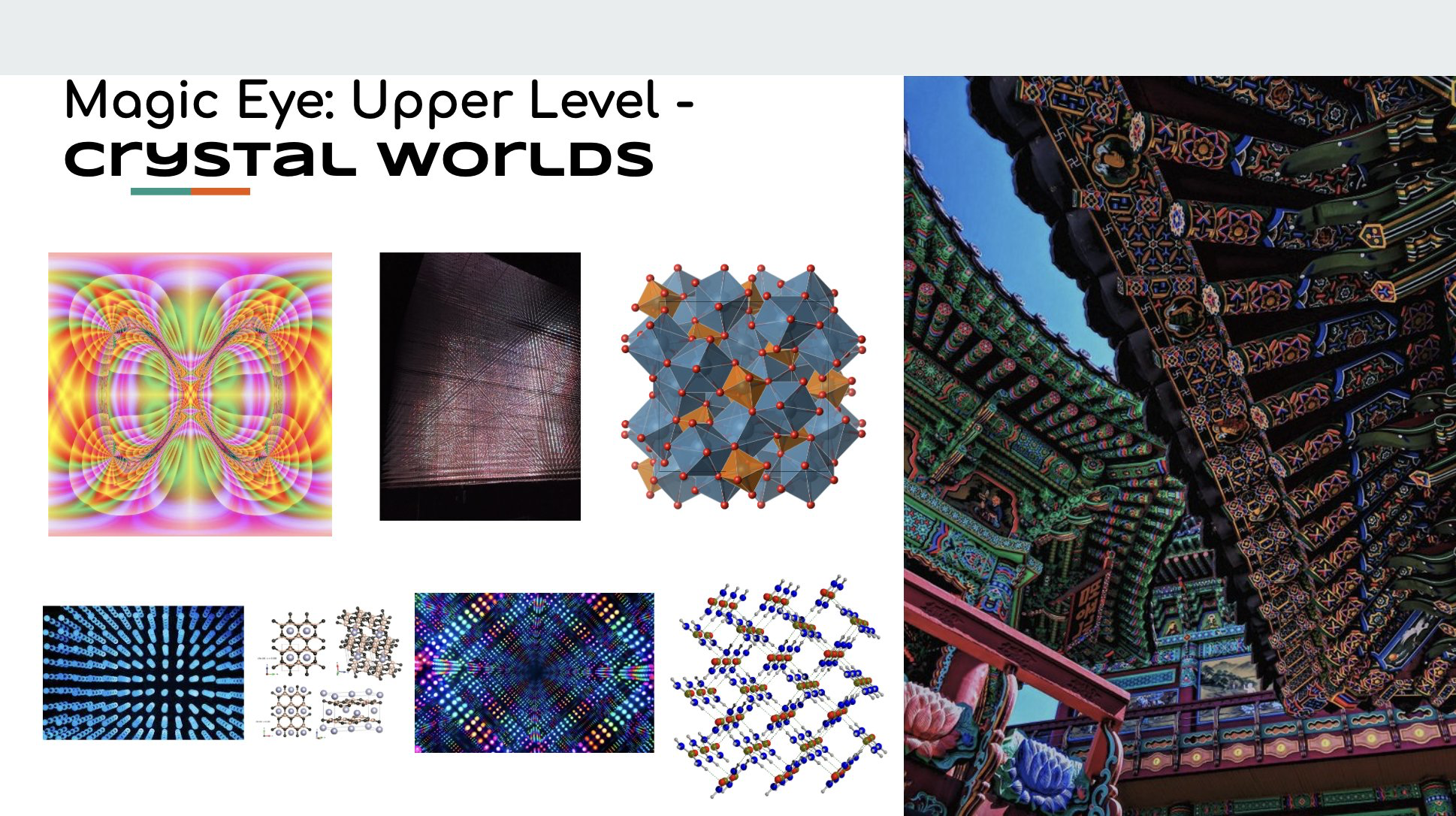
This is the basic setup. The idea is that on DMT, especially during the come-up at moderate doses (e.g. reaching Magic Eye-level), the sudden appearance of 2D gestalts in 3D (which are then “projected” to a 2.5D visual field) is a key phenomenological feature. The rate of appearance and disappearance of these gestalts is dose-dependent, same as the kind of interactions they come enabled with. From here, we can start to generalize this kind of system to better capture visual (and somatic, as we will see) features of a DMT experience in its full richness and complexity. Just as in the case of Laser Chess, where we began with a basic setup and then explored how non-linear optics would massively complicate the system as we introduce interesting twists, here as well we begin with cel animation planes in a 3D space and add new features until they get us somewhere really interesting.
An important point is that DMT cel-animation-like phenomenology seems to have some hidden rules that are difficult to articulate, let alone characterize in full because it interacts with the structure of our attention and awareness. Unlike actual cel animation, the flat DMT gestalts don’t require a full semi-transparent plane to come along with them – they are “cut” already, and yet somehow can “float” just fine. Importantly, even when you have extended planes and they are, say, rotating, they can often intersect. Or rather, the fact that they overlap in their position in the visual field does not mean that they will interact as if they were occupying the same space. Whether two of these gestalts interact with each other or not depends on how you pay attention to them. There is a certain kind of loose and relaxed approach to attention where they all go through each other, as if entirely insubstantial. There is another kind of way of attending where you force their interaction. If you have seven 2D gestalts floating in your visual field, by virtue of the fact that you only have so many working memory slots / attention streams, it is very difficult to keep them all separate. At the same time, it is also very difficult to bring them all together. More typically, there is a constantly shifting interaction graph between these gestalts, where depending on how emergent attention dynamics of the mind go, clusters of these gestalts end up being simultaneously being payed attention to, and thus blend/unify/compete and constructively/destructively interfere with one another.
One remarkable property of these effects is that 2D gestalts can experience transformations of numerous kinds: shrinking, expanding, shearing, rotating, etc. Each of these planes implicitly drags along a “point of view”. And one of the ways in which they can interact is by “sharing the same point of view”.
Cels as Planes of Focus
One key insight is that the 2D surfaces that make up these cels in the visual field on a moderate dose of DMT seem to be regions where one can “focus all at once”. If you think of your entire visual field as an optical display that can “focus” on different elements on a scene, during normal circumstances it seems that we are constrained to focusing on scenes one plane at a time. Perhaps we have evolved to match as faithfully as possible the optical characteristics of a camera-like system with only one plane of focus, and thus we “swallow in” the optical characteristics of our eyes and tend to treat them as fundamental constraints of our perception. However, on DMT (and to a lesser extent other psychedelics) one can see multiple planes “in focus” at the same time. Each of these gestalts is typically perfectly “in focus” and yet with incompatible “camera parameters” to the other planes. This is what makes, in part, the state feel so unusual: there is a sense in which it feels as if one had multiple additional pairs of eyes with which to observe a scene.
A simple conceptual framework to explain this comes from our work on psychedelic tracers. DMT, in a way, lets sensations build up in one’s visual and somatic field: one can interpret the multiple planes of focus as lingering “focusing events” that stay in the visual field for much longer, accumulating sharply focused points of view in a shared workspace of visual perspectives.
Another overall insight here is that each 2D gestalt in 3D space that works as an animation cel is a kind of handshake between the feed from each of our eyes. Conceptually, our visual cortex is organized into two hierarchical streams with lateral connections. Levels of the hierarchy model different spatial scales, whereas left-vs-right model the eye from which the input is coming from. At a high-level, we could think of each 2D cel animation element as a possible “solution” for stable attractors in this kind of system: a plane through which waves can travel cuts across spatial scales and relative displacements between the image coming from each eye. In other words, the DMT world begins to be populated by possible discrete resonant mode attractors of a network like this:
The Physics of Gestalt Interactions
As the 2D cels accumulate, they interact with one another. As we’ve discussed before, our mind seems to have an energy function where both symmetrical arrangements and semantically recognizable patterns work as energy sinks. The cel animation elements drift around in a way that tries to minimize their energy. How energized a gestalt is manifests in various ways: brightness of the colors, speed of moment, number of geometric transformations applied to it per second, and so on. When “gestalt collectives” get close to each other, they often instantiate novel coupling dynamics and intermingle in energy-minimizing ways.
Holographic Cel Animation
Since each of the cels in a certain sense corresponds to a “plane of focus” for the two eyes, they come with an implicit sense of depth. As strange as it may sound, I think it is both accurate and generative (or at the very least generative!) to think of each cel animation element as a holographic display.
I think this kind of artifact of our minds (i.e. that we get 2D hologram-like interacting hallucinations on DMT) ultimately sheds light on the medium of computation our brain is exploiting for information processing more generally. Our mind computes with entire “pictures” rather than with ones and zeros. And the pictures it computes with are optical/holographic in nature in that they integrate multiple perspectives at once and compress entire complex scenes into manageable lower dimensional projections of them.
Each cel animation unit can be conceptualized as a holographic window into a specific 3D scene. This connects to one of the striking characteristics of these experiences. In the DMT state, this quality manifests as a sense that the visualized content is “not only in your mind” but represents access to information that exists beyond the confines of personal consciousness. The different animated elements appear to be in non-local communication with one another, as if they can “radio each other” across distances. At the very least their update function seems to rely both on local rules and global “all-at-once” holistic updates (much akin to the way the laser path changes holistically after local changes in the location of individual pieces).
This creates the impression that multiple simultaneous narratives or “plots” can unfold at “maximum speed” concurrently. Each element seems capable of filtering out specific signals from a broader field of information, tuning into particular frequencies while ignoring others. The resulting 2.5D/3D interface serves as a shared context where gestalts that communicate through different “radio channels” can nonetheless interact coherently with each other in a shared geometric space.
It won't take long before we'll be able to "reskin reality" in real-time.
I had the chance to try this prototype that combines the #MixedReality view on a Quest device with Stable Diffusion AI and it feels like all the pieces are about to fit together…
The above VR application being developed by Hugues Bruyere at DPT (interesting name!) reminded me of some of the characteristic visual computation that can take place on DMT with long-lasting holographic-like scenes lingering in the visual field. By paying attention to a group of these gestalts all at once, you can sort of “freeze” them in space and then look at them from another angle as a group. You can imagine how doing this recursively could unlock all kinds of novel information processing applications for the visual field.
Visual Recursion
Each cel animation element can have a copy of other cel animation elements seen from a certain perspective within it.
Because each animation cel can display an entire scene in a hologram-like fashion, it often happens that the scenes may reference each other. This is in a way much more general than typical video feedback. It’s video feedback but with arbitrary geometric transformations, holographic displays, and programmable recursive references from one feed to another.
One overarching conceptual framework we think can help explain a lot of the characteristics of conscious computation is the way in which fields with different dimensionalities interact with one another. In particular, we’ve recently explored how depth in the visual field seems to be intimately coupled with somatic sensations (see: What is a bodymind knot? by Cube Flipper, and On Pure Perception by Roger Thisdell). This has led to a broad paradigm of neurocomputation we call “Projective Intelligence“:
The projective intelligence framework offers a conceptual foundation for how to make sense of the holographic cels. Our brains constantly map between visual (2.5D) and tactile (3D) fields through projective transformations, with visual perceptions encoding predictions of tactile sensations. This computational relationship enables the compression of complex 3D information into lower dimensions while highlighting patterns and symmetries (think about how you rotate a cube in space in order to align it with the symmetries of our visual field: a cube contains perfect squares, which becomes apparent when you project it onto 2D in the right way).
In altered states like DMT experiences, these projections multiply and distort, creating the characteristic holographic windows we’re discussing: multiple mappings occur between the same tactile regions and different visual areas. This explains the non-local communication between visual elements, as the visual field creates geometric shortcuts between tactile representations using the visual field. It’s why separated visual elements appear to “radio each other” across distances: they can be referencing the same region of the body!
The recursive qualities of these holographic cels emerge when the “branching factor” of projections increases, creating Indra’s Net-like effects where everything reflects everything else. The binding relationships that arise in those experiences can generate exotic topological spaces: you can wire your visual and somatic field together in such a way that the geodesics of attention find really long loops involving multiple hops between different sensory fields.
In brief, consciousness computes with “entire pictures” which can interact with each other even if they have different dimensionalities – this alone is one of the key reasons I’m bullish on the idea that carefully depicting psychedelic phenomenology will open up new paradigms of computation.
Collective Intelligence Through Transformer-like Semantics
In addition to the geometric holographic properties of these hallucinations, the semantic energy sink also operate in remarkably non-trivial ways. When two DMT patterns interact, they don’t just overlap or blend like watercolors. They transform each other in ways that look suspiciously like large language models updating their attention vectors. A spiral might encounter a lattice, and suddenly both become a spiral-lattice hybrid that preserves certain features while generating entirely new ones. If you’ve played with AI image generators, you’ve seen how combining prompt elements creates unexpected emergent results. DMT visuals work similarly, except they’re computing with synesthetic experiential tokens instead of text prompts. A hyperbolic jewel structure might “attend to” a self-dribbling basketball, extracting specific patterns that transform both objects into something neither could become alone.
Some reports suggest that internalizing modern AI techniques before a DMT trip (e.g. spending a week studying and thinking about the transformer architecture) can power-up the intellectual capacities of “DMT hive-minds”. If your conceptual scheme can only make sense of the complex hallucinations you’re witnessing on ayahuasca through the lens of divine intervention or alien abductions, the scenes that you’re likely to render will be restricted to genre-conforming semantic transformations that minimize narrative free energy. But if you come in prepared to identify what is happening through the lens of non-linear optics and let the emergent subagents (clusters of gestalts that work together as agentive forces) self-organize as an optical machine learning system, you may end up summoning novel (if still very raw and elemental) kinds of conscious superintelligences.
Conclusion: The Gestalt Amphitheater
In ordinary consciousness, we meticulously arrange our perceptual pieces to protect the King (our sense of self) ensuring that the laser of awareness follows predictable, habitual paths. The optical elements of our world-simulation are carefully positioned to maintain the stable fiction that we are unified subjects navigating an objective world.
DMT radically rearranges these pieces, creating optical configurations where “the light of consciousness” reflects, refracts, and diffracts in unexpected ways. The laser no longer follows familiar paths but moves along a superposition of paths through the system in patterns that reveal the constructed nature of the central self and of the simulation as a whole. The King (that precious sense of being a singular perceiver) stands exposed as what it always was: not an ontological primitive but an emergent property of a particular configuration where “attention field lines converge.”
The projective intelligence framework helps us understand this phenomenology. Our brains constantly map between visual (2.5D) and tactile (3D) fields through transformations that encode predictions and compress complex information. In DMT states, these projections multiply and distort, creating “holographic windows” where multiple mappings occur simultaneously. This explains the non-local communication between visual elements: separated gestalts appear to “radio each other” across distances because multiple tactile sensations can use the visual field as a shortcut to resonate with each other and vice versa.
The emergent resonant attractors of the whole system involve many such shortcuts. When the recursive projections find an energy minima they lock in place, at least temporarily: the complex multi-sensory gestalts one can experience in these states capture layers of recursive symmetry as information in sensory fields is reprojected back and forth, each time adapting to the intrinsic dimensionality of the field onto which it is projected. “Sacred geometry” objects on DMT are high-valence high-symmetry attractors of this recursive process.
The DMT state doesn’t “scramble consciousness” (well, not exactly); rather, it reconfigures its optical properties, allowing us to witness the internal machinery that normally remains hidden in our corner of parameter space. These visuals aren’t “hallucinations” in any conventional sense. That would imply they’re distortions of some more fundamental reality. Instead, I think they’re expressions of our brain’s underlying optical architecture when highly energized and fragmented, temporarily freed from the sensory constraints that normally restrict our perceptual algorithms.
By understanding the brain as a kind of non-linear optical computer, and consciousness as a topologically closed standing wave pattern emergent out of this optical system, we may develop more sophisticated models of how the brain generates world simulations. And perhaps one day (soon!) even discover new computational paradigms inspired by the way our minds naturally process information through multiple holographic dimensional interfaces at once. Stay tuned!
*animations made with the help of Claude 3.7, when otherwise not specified.
DMT experiences can give you a sense for how multidimensional hive minds might be workable.
Example:
I met a yoga teacher at the Texas Eclipse festival earlier this year who explained that she has been receiving instructions for a new kind of yoga modality that helps with deep trauma from a hive mind that “lives in a 9 dimensional space”. This is sans drugs, and she demonstrated the body work movements she was taught by this “collective consciousness” to me and a few other people after my talk. I guess my candid discussions of altered states motivated her to share to see what I thought.
First of all, the movements were extremely interesting. Her body and extremities would coordinate in a way I’ve never seen before, as if her hands and feet were being used to select and tune into a fractal foliation of space and then her torso would make swimming motions in accord with those movements. But anyway. She explained her movements expressed the collective intelligence she was getting in touch with.
But this on a matter of principle sounds unlikely: can there really be a stable equilibrium of many intelligences in a 9 dimensional space that doesn’t quickly collapse into a hierarchically organized system of control? Can a 9D swarm intelligence really be a stable attractor in mind space?
The thing is that this happens all the time on high dose DMT! Past the Magic Eye level (Waiting Room and above in my classification), DMT’s character is exactly that of arriving at equilibrium points where many mind shards are simultaneously trying to survive, control the narrative, and redirect attention.
And, unbelievably, these typically fleeting but sometimes robust, equilibrium points do involve meaningful, swarm like, multidimensional contributions from a wide range of mind kinds all at once. They are in an all-to-all hypercomputation relation to each other and yet they can arrive at stable states capable of computing information. From eyes that simply like to capture attention, to many-legged angel wings, to gnomes stuck as 2D reflections in windows, to Cronenberg-like shoggoths, the scenes might have a really significant contribution from each element and yet not collapse to a state where there is a dictator and everyone else follows suit.
And I think the dimensionality actually enables this. From simulations of coupling dynamics, I’ve noticed that 2D systems of oscillators tend to be much more simple and dominated by a single dynamic compared to their higher dimensional versions.
In 3D already we have vastly diverse collective organisms, but in higher D this is even more available as an option. When the “beings” can evolve to inhabit (via fast reproduction, selection, and variation aided with attention) spaces as exotic as the surface of tubes or the points in a 4D cloud of dust, the emergent network of intelligences that achieves equilibrium can be truly multifaceted: it doesn’t cohere because there is no clear center. The degree to which different aspects of the space control each other is both very variable and lacking a central control panel. It’s a bit like one of those carefully engineered videogame landscapes where each region in the map has pros and cons, and thus you’re always safe from some attacks in but never from all of them when standing in a particular space. The ecosystem that evolved in such an environment doesn’t have a central director, but can still have a deep coherence of sorts.
The geometry of such experiences, especially at Breakthrough doses, is more akin to a CW-complex (which stitches together many spaces of different dimensionalities) than a smooth surface of a given dimensionality. It enables ecological mind niches which turn out to have very complex symbiotic relationships with one another.
On a good day, it might even feel like this is how it always works already – we’re just used to the specific high dimensional evolutionarily stable equilibrium of our hive mind in normal states. But perhaps it too lacks a clean hierarchical structure.
They say “Give a man a fish and he will eat for a day.” And that should have been good enough, because the alternative is to “teach a man to fish, and he will build a robot inside him that will give him food in exchange for instantiating a series of encapsulated behaviors over and over again for the rest of his life.” This is why this is tricky.
The Adattvar of the West, on the topic of Consciousness vs. Replicators
It was with some hesitation that you decided to explore DMT again. There wasn’t a pressing need for this exploration, but you felt it would be beneficial for the sake of solidarity in your relationship. Your girlfriend had been battling debilitating cluster headache attacks for years, and it was only recently, with the aid of psilocybin, that she was able to experience months free of pain. Encouraged by a suggestion from a mutual friend, she decided to explore DMT. While psilocybin had proved quite effective, it required a significant amount of preparation, commitment, and patience. The doses that effectively kept her cluster headaches at bay were around 3 grams of dried cubensis; she wasn’t among the few who could take a microdose and find relief for months. For her, like clockwork, about three weeks of freedom from the Beast followed a high-dose psilocybin experience. However, reports from a legal retreat center in South America indicated that DMT worked differently: a single 5-10 minute experience could instantly (within 10-15 seconds) abort an episode. This meant transitioning from 10/10 in physical suffering with almost no trippiness to 10/10 in trippiness with almost no physical discomfort in just 20 seconds—a bizarre mental shift not even the most extreme psychonauts or thrill-seekers would typically pursue. But if the treatment proved effective, this might be what she would endure every time the pain returned unexpectedly from now on.
You had explored the state-space of consciousness disclosed by psilocybin and DMT nearly a decade ago, during a memorable Indian summer in college. This was a time you spent living in the apartment of a physics professor you had befriended online. He was more than happy to host you over the summer in exchange for your help with walking his four dogs, feeding his fish, and cooking dinner several times a week. The connection you shared with him was profound, though difficult to describe in ordinary terms. This wasn’t a relationship based on financial gain, romantic involvement, or social status. Far from it. Your family considered you irresponsible for not pursuing a summer internship, while your friends speculated you were involved with a man twice your age in a foreign country. In reality, most of that summer was spent exploring the effects of LSD, contemplating the nature of space and light, and deepening your intellectual and spiritual bond with him.
One of the days you got so high on shrooms and acid that looking at the sky you asked him “how do we know that we are not the complement of space and that space is a viscous material? I think it all works out so that this figure-ground inversion leaves everything perfectly the same yet inside-out.” He immediately perked up, put on an old Synthwave vynil and shared with you a series of seven secret meditations. Each of these meditations could do a figure-ground inversion in a different way, all of which seemed impossible under the assumption that our common sense notion of space is correct. They involved internal attentional moves like “focus on the sense of half-perceiving the light on the left side while fully perceiving the right visual field as both white and black,” or “notice how searching for spiral flow in your belly makes your forehead display standing wave patterns, and focusing on spiral patterns in your forehead does the same for your belly. Now, find the exact midpoint between these two modes and remain there, allowing both the belly and forehead to simultaneously exhibit spiral and standing wave patterns.”.
Each of these secret practices revealed a major “articulation” of you world simulation. They seemed analogous to interaction bottlenecks in a network where sensations trigger each other, capable of dividing the flow of attention into two distinct clusters. One bottleneck was purely geometric, capable of splitting my field of consciousness into two “sides” – up and down, left and right, front and back, and even into a double spiral, similar to those seen in Christmas ornaments. This concept was relatively straightforward to grasp, but the other six were mind-bending. One practice involved dividing the perceptual field into a “front” and “back” that didn’t align with our usual sense of direction. It was as if an extra geometric dimension would become “unglued” at the precise moment of achieving perfect balance between both sides. Another technique required inverting the central axis of attention upside down while keeping every other axis unchanged, eliciting an intense sensation of weightlessness. The remaining practices, each more indescribable than the last, would require an entire book to even begin to describe.
Sooner or later, you came down from the shrooms and acid, and the meditations stopped working. You weren’t in a rush to ask your friend where he learned them, and besides, it wasn’t likely he would volunteer that information. You knew he had a stint as a spy decades ago, and that he underwent advanced meditative training to endure pain without anesthesia. But, as luck would have it, he decided to share some vital context in the days that followed, unprompted.
It was aliens—or rather, not aliens in the conventional sense. He shared that during his PhD, he took a year off to focus on meditation, spending six months in complete silence in the mountains of Nepal. Although he wasn’t familiar with the Jhanas at the time, his descriptions of his experiences closely matched the recognized stages of meditation. These stages involved learning to experience orgasmic bliss through meditation, becoming engrossed in it, further developing this state, experiencing what might be described as a Kundalini awakening, realizing that pleasure can itself be a form of discomfort, and then shifting focus to more peaceful and tranquil states, ultimately residing in deep equanimity. It was during a profound state of equanimity in the 4th Jhana that he encountered “them.”
You weren’t privy to further details about who “they” were, and it seemed as if he himself didn’t have a clear understanding. However, his belief in their existence was nearly unwavering. He presented a compelling argument he referred to as “proof of qualia computing,” wherein he evaluated the maximum capacity for information processing within each frame of consciousness. By his assessment, the sheer amount of novelty he encountered during each second of “contact” vastly surpassed the theoretical maximum of information he could produce independently. But what truly solidified his conviction was a peculiar phenomenon. He likened the shape of his “soul” to a kind of wire puzzle, and what convinced him of the presence of a non-human intelligence was their ability to “solve” this puzzle from an external vantage point, employing perspectives that seemed unreachable from within. This was akin to the revelation experienced when the inside of a sock is turned outwards, suddenly exposed to sunlight by the hands of a curious child.
He certainly didn’t need you to believe in any of this. Despite the meditation prompts being truly mind-blowing, you ultimately felt that your friend harbored some unusual beliefs and that perhaps you had been indulging in too much acid recently. Following this, the two of you scarcely discussed it further. Instead, you returned to more familiar and comfortable conversations, like debating the future viability of commercial fusion.
Fast forward to last month, and the memories of your Indian Summer resurface as you’re on your way to a psychedelic retreat with your girlfriend. During the flight, you found yourself uncertain about the most desirable outcome of this visit. For her, obviously, you hoped for complete remission. For the both of you, perhaps creating some inspiring content to promote the use of psychedelics as painkillers and help raise funds. And for yourself? Regaining a sense of deep meaning and enchantment in life would be ideal. However, the harsh reality of suffering and its manifestations have worn down your soul, making the prospect of simple tropical rest incredibly appealing.
First Day
You arrived late at night, and all you managed to do was have dinner and go to sleep. You and your girlfriend were given separate rooms; she was participating in a program designed specifically for individuals with cluster headaches, requiring her full engagement. Meanwhile, you were enrolled in the explorers’ program, there primarily for moral support and to be available if needed, but with plenty of time for yourself. The darkness of the night and the challenge of overcoming revenge bedtime procrastination threatened the quality of your retreat, so you took some melatonin, drank a cup of chamomile tea, and practiced a bit of Yoga Nidra to ensure a good night’s sleep.
Upon waking, you found yourself emerging from one of those complex dreams that seem profoundly meaningful, yet lack a clear storyline. Amid scenarios of rushing to the airport, completing your credits, and the classic nightmare of standing naked before a class, you couldn’t pinpoint exactly what made the dream feel so significant. It was one of those stress-induced dreams that seem to carry weight only as a whole, despite the inability to articulate or model this significance. It was a frustrating experience, reflecting the complex layers of stress and anticipation you felt about the retreat and the hopes pinned on it.
At breakfast, you noticed the group that had come for pain treatment was wrapping up, so you took the opportunity to sit with the organizers and discuss your options for the retreat. Your girlfriend, part of the pain treatment group, stood up, greeted you with a kiss, and then went on her way. Curious about the possibilities, you asked, “Can I take DMT?” The answer was affirmative. You were allowed to use DMT within designated areas and timeslots, which effectively meant you could do so almost anywhere and anytime, barring obviously risky situations like during an ice bath or while lost in the woods. The only requirement was that someone needed to initiate and conclude the session with a traditional Mesoamerican ritual. Other than that, you were free to explore. This level of freedom, you felt in your bones, was delightful.
When it comes to conducting effective DMT phenomenology research, there are generally three key obstacles. The first is the challenge of surrendering and “letting go.” This isn’t a binary state but a spectrum, and it encompasses more structure than one might initially think. Letting go is a skill that can be honed in various dimensions: in relation to goals, across different spatial and temporal scales (such as releasing a specific sensation here or a broad, diffuse occurrence there), in the context of self versus others (letting go of one’s self-conception or perceptions of others), and even regarding subtle existential attitudes (like releasing the need to exist or the desire not toexist). This deep and multifaceted approach to letting go is crucial for navigating the extreme experiences DMT can offer.
The second is love of knowledge. The deep desire to know and learn about the nature of consciousness must be higher than the fear of the unknown. In many cases a person might be curious, but if that curiosity is never concentrated enough, purified enough, and focalized enough, the ambient fear might simply never let it be turned into action. This one would strike many as peculiar and incongruent with our sense of self. After all, we proclaim to be curious, deeply curious, and yet clearly when the chances to find out genuinely new pieces of the puzzle present themselves, we rarely take them. Intrepid non-insane psychonauts are really rare.
And third, is the love of shared knowledge. Many explorers can often get to a point where their own personal curiosity is satisfied without in the process ever producing artifacts of knowledge for the sake of others. Importantly, this is not the same as wanting to impress others. Many explorers go in only as deep as it will generate outlandish stories to impress others with. The real value is in the clarity, not the confusion. So wanting to impress and wanting to share knowledge are near enemies that often work at cross-purposes.
To recap, you need to (1) let go, fractally, (2) love knowledge more than you’re afraid of it, and (3) want to share it with others for their own benefit whether or not you can impress them. The number of “openings” for this sort of activity worldwide is really small. Gaia, looking for worthwhile students, as it were, would struggle to find the right Soul soil if confined to a single country, let alone a state or a city. But this was it. The conditions for you were optimal today. Having practiced “letting go” with breathing exercises for a few years now, and deeply motivated to pay attention and not miss out on any key insights uncovered by the state, you decided to take a deep dive.
Your first hit lasted three seconds, and you held it in for as long as possible. Within seconds, you felt a wave of relaxation tinged with anxiety, threatening to create an unpleasant pressure in your head. The full reality of your situation struck you, plunging you into a mild panic. “They’re treating hellish states right here!” a part of you exclaimed. The harsh reality of extreme pain, similar to what your girlfriend had been enduring, became clear to you, as well as the many inner labyrinths of attention you had constructed to avoid confronting it directly. Internally, you panicked but decided to ride it out as best you could, focusing on the sensations in your forehead and the back of your neck. Gradually, the storm of anxiety passed. “What, indeed, am I doing here? Why am I messing with DMT, which might be a necessary evil for people like my girlfriend who truly need it for pain? Bad trips are nothing to laugh at,” you thought to yourself.
But within a few more minutes the vibrations were calm enough again, and you felt a wave of relaxation come up. Within 20 minutes you were ready to go again. Perhaps a smaller dose. As you com up on a 2-second hit, you notice phenomenal space charge up and vibrate. Like hitting a bell made of magnetic fluid, and whose vibrations are dampened by a process of interlocking with the the surfaces in the visual screen. Each tiny 2D surface in your visual field seems to slow down and “grab” the waves in space. To a first approximation it felt as if the DMT was shifting the frequencies expressed by the field (think black body radiation) upwards, but then which specific frequencies get picked up is a function of what shapes are present in the field that can function as radiators. So the energy is really more like a bell-shaped curve in the frequency domain; the specific manifestation of that energy in a moment of experience will have clear spikes, each corresponding to a particular vibrational mode energized in your system (cf. Psychedelic Thermodynamics). For instance, the energy spread out over 15-20 hertz can energize some vibrations at 17hz in the visual field, and this will “suck up” that energy away from being able to energize, say, a different 19hz flicker in the field. In other words, the shapes and their vibrations in the field function as energy sinks from the point of view of the vibrating field, but they function as energy sources for each other as they can reinforce one another.
As is expected, the worldsheet melts and once you hit the Chrysanthemum level its curvature intensifies. It’s as if you’re interacting with the walls of a complex modern art museum, or the inside of smooth caves, or the smooth surfaces of a spaceship. You notice that there is a tight duality between the shape of the worldsheet and what it represents. In fact, the shape of the worldsheet dictates how attention moves around in the scene, as well as determines the landscape of possible valence artifacts (namely, how and where different elements of the scene interacting with one another can cause huge spikes of dissonance or consonance).
Because the self-other divide is loosened in this state, the elements of the worldsheet have bistable interpretations, some of which can flip-flop between self-and-other. For instance, a part of the scene can flip between being an open space and a visual representation of your arm. This in turn means that the very _material_ with which the worldsheet is rendered has multiple possible interpretations. It’s the multistability of the elements itself what this material is made of, we could loosely say. And so when the worldsheet renders a given entity, you will often experience multiple adjacent projections of that same entity overlapping with each other, each interpretation competing for your attention yet never fully capturing it.
The first important learning you gathered today for how to navigate the DMT realm besides what you’ve been practicing already in meditation and other exotic states (i.e. generic advise like cultivating a lot of metta, doing breathing exercises, practicing equanimity, etc.) is that the worlsheet’s shape is what determines the mood, and indeed the personality, of the entities you encounter. There is, in fact, a certain way of rendering a scene that can give the worldsheet itself a sort of personality disorder. Give it a large but fragile ego, and the worldsheet might develop fleeting narcissism. Make its symmetry and aesthetic effects bistable (so that one interpretation looks gorgeous and another looks dreadful) and you might give it borderline or bipolar. Blunt its affective response with indifference and you might give it depression. And so on. Thus you practice how to contort the worldsheet in only helpful, productive, prosocial ways.
You relax in the garden for half an hour, staring at the sky, taking a break before embarking upon further exploration. The next time you take DMT a strange perceptual artifact becomes notable for the first time. It’s as if there was a kind of unusual pixel in your visual field. Yes, there are floaters in there. There are also the typical DMT hallucinations, which come in the form of standing wave and traveling wave patterns. But in addition to what you’ve seen before, you now also notice a weird little artifact in the field. It’s almost as if… if this was being rendered in a VR headset, there is a little eyelash or small hair stuck to the screen. Whatever this is, it is not a standard artifact of your eye, your visual cortex, or the DMT world for that matter. And once you notice it, you can’t help but seeing more of the same as it comes up. This becomes a theme of your experiences. As the day advances, and with each additional DMT trip you experience, the little visual artifacts grow in number, size and complexity.
A notable effect is when there are rays of color that seem to propagate at high speeds, painting surfaces within the DMT worlds with an alien shimmer. The more you focus on that effect, the more it feels like you learn how to control it. Importantly, you notice it becomes greedy. The shimmer, as you called it, once in the presence of a scene, tries to hack its way into every wall, surface, and reflection, inserting its highly mercurial fluidity into the otherwise crystal solidity of the outline of the scene. As this happens on a new scene, you reflect about r/place.
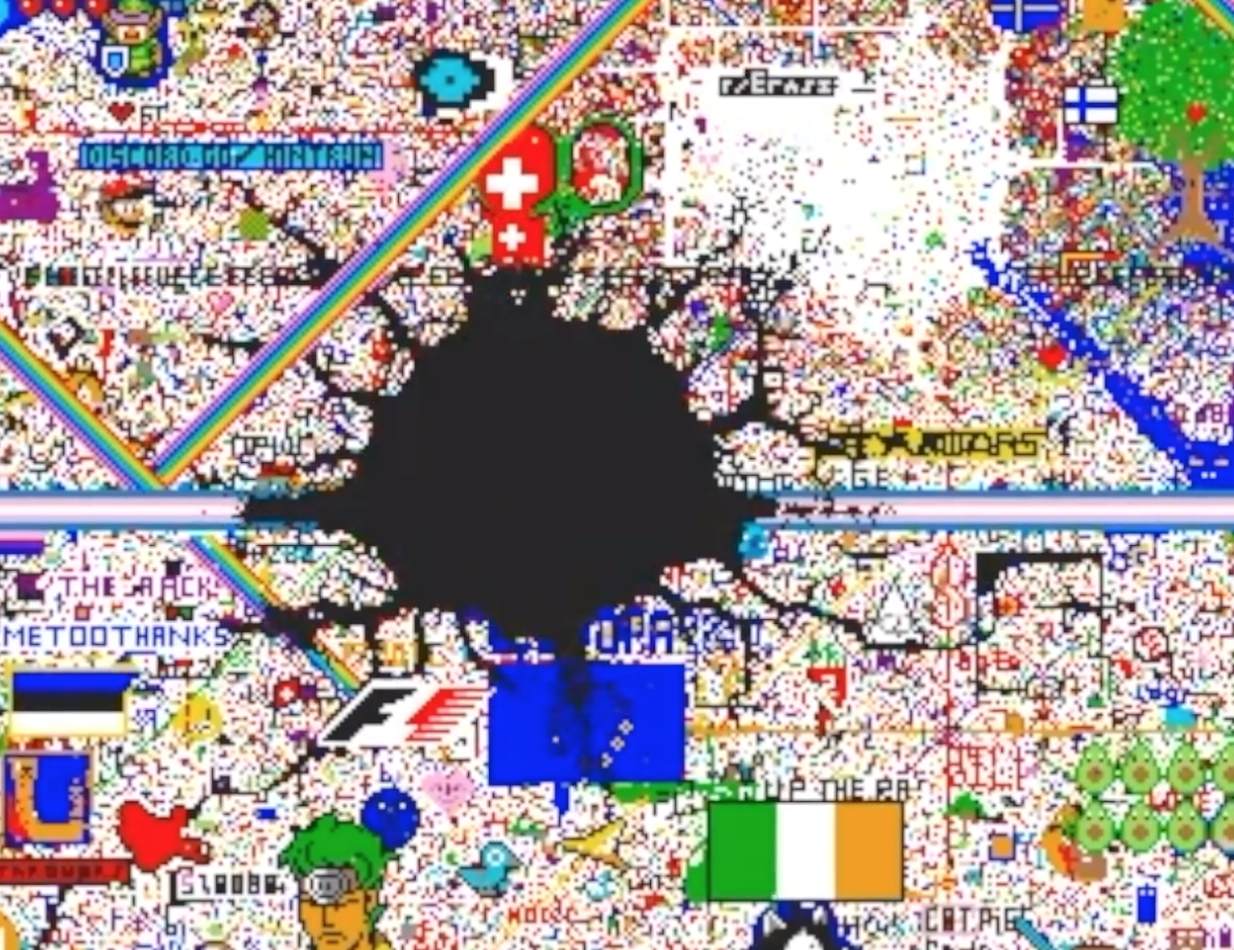
The realms of consciousness that DMT gives us access to (we shall leave aside for the time being the question of whether these are shared realities or entirely the works of one’s own imagination) can strongly evoke the feeling of intense memetic competition that Reddit’s “r/place” so wonderfully captures. This was a massive internet experiment where individuals users were given access to a 1000x1000pixel canvas, and the ability to set the color of a single pixel every 5 minutes (20 for unregistered users). Since painting anything on one’s own is impossible, forming alliances (largely coordinated via subreddits) became a must. The size of the canvas a given meme controls is a function of the number of participants working on it times their average level of engagement times their level of loyalty to the cause. The DMT worlds one experiences are similarly constructed through a vast, extremely fast, collaboration of numerous tiny subagents working to “re-up” the tracers that paint the paths that make up the scaffold of the scene.
R/place has many “French” regions because there are a lot of French users with a culture, pride, and motivation capable of delivering coordination at the necessary scale. Likewise, your DMT lifeworlds reveal the summed volition of countless subagents trying to express themselves, compromising with their neighbors, and attaining stable boundaries. Soon the ecosystem starts to develop advanced diplomacy, and ground rules are laid out. Importantly, there is general wide consensus on (1) the value of preserving the essence, or irreducible uniqueness, of each vibe that is expressed, and (2) the importance of policing against Qualia Expansionism. (1) is important because each Qualia Culture has gifts that only become apparent in their more evolved form, and (2) is necessary to give everyone the space needed to find their best selves. While French Pixels and Mario Bros pixels might not ultimately agree on their relative importance, they certainly agree on _not_ letting The Void swallow them all.
Among all of the Qualia Cultures that can be found in DMT realms, a few have the tendency to try to conquer the entire field as quickly as possible and without adding value in return. R/place’s The Void would be a good analogy for the prototypical Culture that defaults to massive Qualia Expansionism. Wanting to see it all as meaningless, or default to a massive wave of fear, or seeing all phenomena as made of light, are all equally simplifying stances that Qualia Cultures can develop in a matter of seconds and try to expand to the rest of the field. That this does not happen in every trip is a testament to the insanely clever alliance building capacity of more sophisticated Qualia Cultures emergent in the field.
From this observation an idle, but compelling, thought crosses your mind. Even in the grand scale of humanity as a whole, it would be tragic for us to quickly converge on a monoculture. The fact that Mexico has 60+ entirely different indigenous languages (at various degrees of deterioration and existential threat) is an enormous asset for consciousness as a whole. We won’t know what the fruits of a given culture (in its most expansive conception, including the subtle linguistic folds, attentional moves, and signal processing cadences they come with) will be until it is fully expressed in its mature form. And we won’t have a mature form of the culture unless it is embedded in an ecosystem that challenges it and from which it can draw inspiration to grow. Peak French Vibes won’t be achieved for another five hundred years. So right now the Earth should be seen as a kind of ecological reserve for nascent Qualia Cultures. Of course only those that neither engage in Qualia Expansionism nor those that refuse to engage with the others are ever likely to become mayor players.
The field of consciousness, on these levels, is like a Petri Dish of modes of organization for subagents to evolve styles of interaction that can contribute to the whole. Your whole life, suddenly, seen in this light, appears like a long-standing cultural project. Your life is an attempted reconcilliation by two cultures that have yet to find the way to interact in positive sum ways. But do not feel rushed, this is a century-long process. One step at a time.
As you take increasingly deeper dives throughout the day, two general motions take hold. First, you keep noticing the “weird pixels from another dimension” expand and complexify. Simultaneously, you feel a strong draw towards formless states of consciousness.
It is said in Buddhist cosmology that above the human realm there are countless Heavenly Abodes populates with all kinds of Gods (aka. Devas). While these Gods are not creators of the universe, they do have enormous creative powers. In many of these realms they focus on large-scale artistic projects, in others they focus on intelligence and understanding, and yet other ones are quarrelsome and full of war. As you ascend, each layer of reality is more refined and diaphanous than the previous one. In the layers closer to us there is fierce evolutionary competition between Qualia Cultures, as shapes compete for space, time, and attention. But further up the Gods are wide and expansive, airy, even plasmic in composition. And as the sun begins to set you notice an internal resolution to abide in the formless realms beyond competition. Classically, these are the Sphere of Infinite Space, the Sphere of Infinite Consciousness, the Sphere of Nothingness, and the Sphere of Neither Something Nor Nothing.
During dinner, you catch up with your girlfriend, who has just learned how to cultivate mushrooms and practiced various relaxation techniques—her major trip is scheduled for tomorrow. You feel a deep sense of gratitude towards the organizers for equipping her with numerous tools to manage her condition, reassuring you that she’s in capable hands. With mutual well-wishes, you both express your support for each other’s journeys, ready to continue on your separate paths with a sense of hope and anticipation for what the retreat has yet to unveil.
Late at night, you notice a few strange vibrations in your body. It’s like Piti (the pleasant vascular buzz that precedes absorption into the first Jhana), but it has a strange, dissonant, sawtooth quality. And when you take DMT, listening to this song, it transports you… somewhere magical. The vibration establishes itself solidly in your body, akin to the dysphoric buzzing characteristic of nightmarish sleep paralysis but somehow suffused with a sense of mystical bliss and wellbeing. Your inner eye opens wide. You find yourself in a kind of cosmic spa. The vibration you feel in your body are embedded in the walls of this place. The vibrations are tactile but also visual, and among them you see the shimmer. You walk around. There are many hallways, and stairs, and rooms. The shimmer decorates the inside of the walls, which are all diaphanous, filled with vibrating, twisting, entangled magnetic plasma tubes.
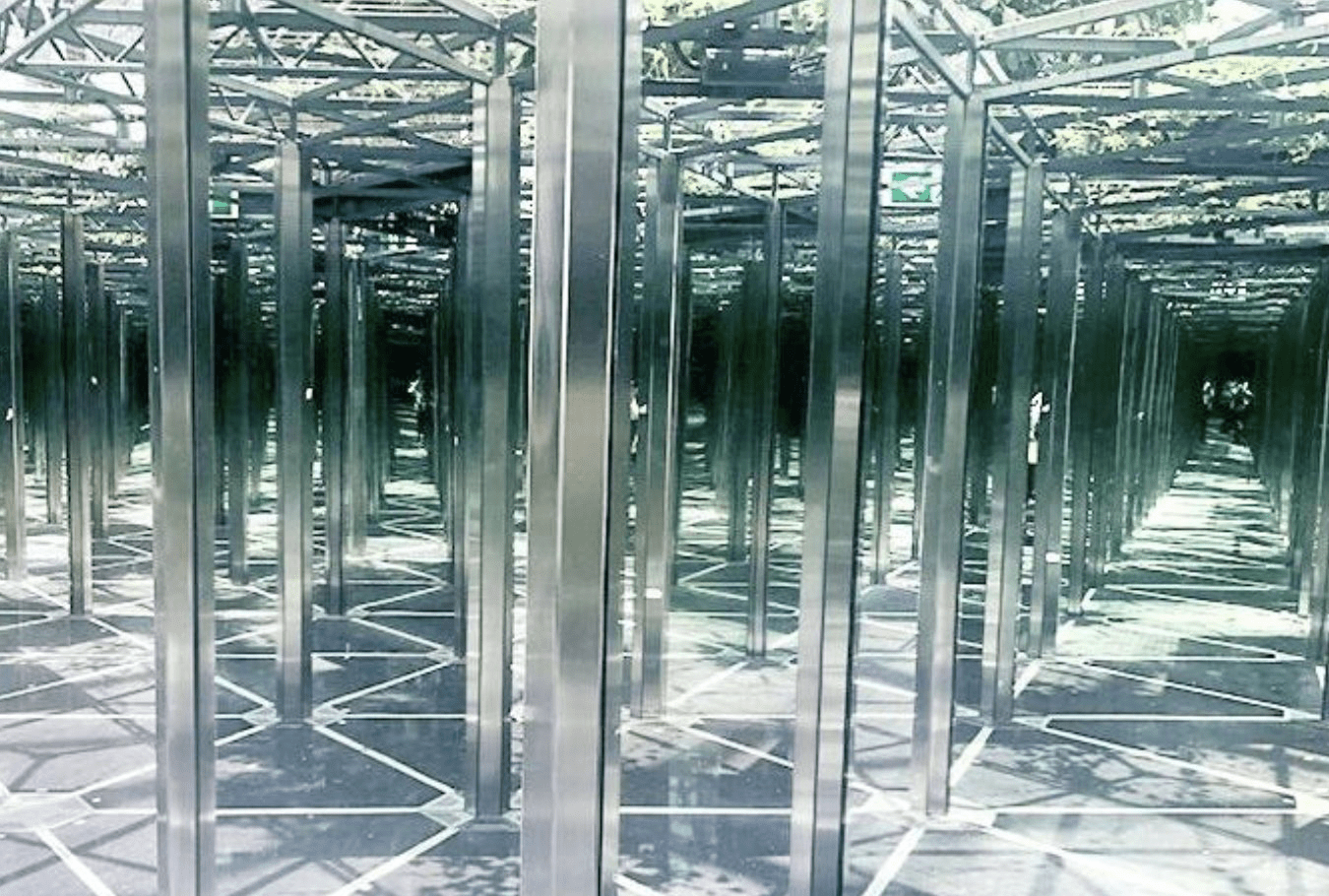
In one of the halls you see a number of 3D symbols representing wholesome mindstates. There is also a mirror. You look into it. You don’t have a body. So looking into the mirror is like void seeing void. In fact, mirrors here are automatic doors to formless Jhanas.
It’s a school, you figure out. The vibrations in the walls are being processed by the beings in here. You see how in the higher rooms the beings literally connect with the vibrations in the walls and digest them with their fields of attention. They expertly disentangle them. The message is clear: this is the place where migraines and cluster headaches are sent over when you take DMT in order for them to be dealt with by advanced conscious beings. It may seem like it cannot possibly scale. But the reason for this place seems more didactic than utilitarian; it’s like a museum where they are displaying how, say, advanced Boddhisatvas take on the suffering of the world in the form of tangled field lines, and then disentangle it out of compassion with the aid of wisdom and knowledge.
More so, this place has a Godhead – you can access it from anywhere in the entire place. It’s encoded in the brightest, whitest, most shiny strand of the shimmering vibrations in the walls. But also there is a special room at the top of the building, in which the Godhead is also located. It’s the experience of Oneness and Unity that is often considered the peak of spiritual development by some schools of thought. But here, it is clearly a sort of lightbulb that displays the qualities of mind unconditioned by the experience of the particulars. It has a Dark Night. If you experience such Oneness without preparation, you are likely going to experience a kind of “Cosmic Orgasm”, a peak moment of profound realization, followed by a deep sense of depression and disenchantment. Here it is appreciated and cultivated as another flavor of consciousness, rather than revered as the final, or primal, truth. But the belief in this sense of Oneness as Ultimate Reality is prevalent in the cosmos, and thus worth having around, if for no other reason than to study it and learn how to get along with true believers.
The migraines and clusters that this retreat center is treating on the physical plane now seem part of a long, multi-civilizational, Qualia Culture program in the etheric realm that aims to lift sapient beings to the level of Bodhisattvas capable of processing the suffering of large cosmic bodies. We have tragedies going on in our planet, no doubt. And nature, from the point of view of a Buddha’s eyes, is of course a kind of carnage. But the true moral catastrophes of this universe are Solar Migraines and worse. The program, and indeed, your very experience of meeting this beautiful cosmic spa, is but one step along a series of milestones for our soul, and the soul of humanity, to wake up to its ultimate, cosmic responsibility. Or so, you feel, is the message written on the wall of this place.
From the point of view of these cosmic forces, Earth is soon going to be evolving to a level of technology and conscious mastery that makes intervention all but necessary. The seeds of the Qualia Cultures on this planet might go at war with each other if they don’t tame their Qualia Expansionism. This would not be the first planet lost to the Shimmer. But direct intervention is not a viable option. These regions of the mind can only influence us indirectly. They can affect our prophetic dreams, they can influence us through subconscious messagings in TV ads, and of course, leave us clues spread all over the Erowid trip report archive. But that, my friend, is for you to figure out tomorrow. You doze off.
Second Day
You wake up rather late, and check in with your girlfriend, who is about to embark on the high dose psilocybin experience along with everyone else on the patient cohort. You wish them a good trip, and get out of the way. Breakfast is delicious, and fruity. Shower. Sit in the sun, with a coffee, journaling. You try to make sense of it all.
“You didn’t go far enough” – you tell yourself. From the depths of your being, something tells you that you haven’t really gotten the full message yet. Last night was an intimation, but what can you really learn and bring for the sake of everyone else? You meditate on the sun and let the warm coffee buzz fill you with a sense of joy and wonder. Was that real? Did it really happen? Yes, and you experienced it for hours. If nothing else, you’re uncovering an important hidden structure in qualia-space. But is there more? Is there truth to these visions beyond the metaphorical?
You decide to take a long walk in the woods, and nearly get lost. For moments you believe you might need to simply find the closest road and wait for someone to drive by. But thankfully you leave enough breadcrumbs along the way (and took enough short snippets of video to reconstruct your path) and after a couple hours of creeping fear, you find yourself once again at the retreat center. Your girlfriend welcomes you, now hour 8 of her trip, mostly sober by now. She says the shadow of a cluster that proceeds the days before an attack is now gone entirely, and you both sigh of relief. You’re both ok. No, you’re doing swimmingly!
This evening, reflecting on the day and the trip as a whole, you decide to dive deeper than you ever have. Now, this certainly won’t be about merely taking higher doses than before. You have maxed out on dosing numerous times in the past, and the only thing that ever happens is experiences too intense for you to handle that make you swear to never take the substance again. We are talking instead about the dimension of surrender, of giving up yourself for a higher purpose, and opening up to an unfathomable mystery beyond your current comprehension. To go in knowing full well that you might not, in fact, have any way of explaining what will take place. Because how else are you going to learn something truly new?
You put this song on repeat and dive. The first thing that happens tonight is that you get one of those “prerecorded alien lifestyle playbacks” that showcases the life of a robot-like organism embedded in Magic Eye geometry. This is one of those clear transmissions, in that the aesthetic is utterly alien to you. But unlike in previous occasions you also see the weird pixel in your visual field, and decide to pay attention to it. Here is where things go haywire, in a manner of speaking. The pixel seems to have a strange effect on the rest of the field, where the more you focus on it the more it sort of acquires a kind of static electricity. The plates of geometry the prerecorded alien hologram is “made of” begin to “stick” to the pixel and its surroundings, which causes a complete “scene collapse”. The vibe of the event is akin to seeing a metallic tinker toy’s house deconstruct with a powerful electromagnet, which tears it apart one plate at a time. The little robot inside makes some moves to try to minimize the interference that the pixel has on the playback, but to no avail. The pixel unfolds into a strange V-shape that reveals a connection to a large bundle of what you can only interpret as higher-dimensional structures slowly intersecting your field of consciousness.
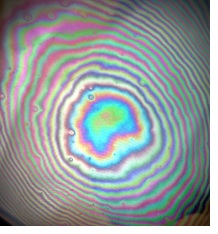
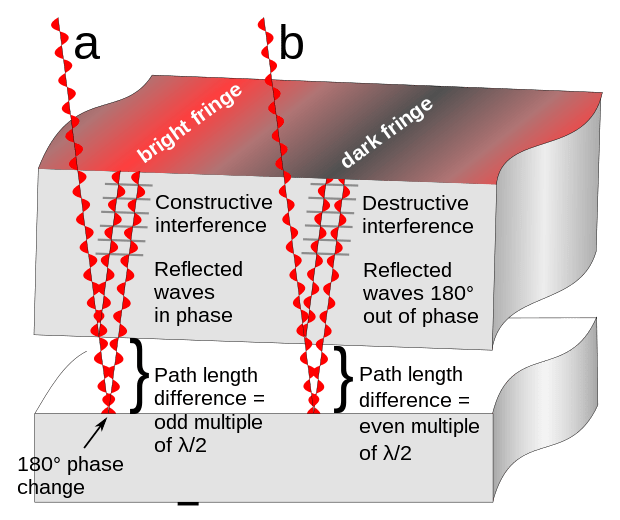
If you take any more DMT while looking at these structures, something unbelievably uncanny happens. Namely, the various structures that are “intersecting” your field are revealed to be connected to one another via an additional spatial dimension that is expressed in terms of 3D Newton’s rings. You see? Newton’s rings are a phenomenon observed in physics that arises when light is reflected between two surfaces—a curved surface and an adjacent flat surface. These rings are the result of constructive and destructive interference of light waves, creating a pattern of bright and dark rings. And you can estimate the height of the curved lens (distance from the flat surface) by counting the number of rings from a point of contact. Likewise, in this case, it seemed as if the parts of your visual field that were “in touch” with strange objects would form concentric circles around them, and you could find the shortest path “along the extra dimension” between two of those parts by finding the trajectory through space that minimizes the number of rings you have to go through.
The dose of the DMT would seem to increase the number of Newton’s rings between weird pixels, just as you would expect by modulating the frequency of laser probe in the 2D-case. From a physics perspective, it seemed as if your visual field was a kind of non-linear optical laboratory currently being intersected by higher dimensional shapes and where the DMT would turn on the lights (at increasingly higher frequencies, in a dose-dependent way).
At this point the pixels became more numerous. Your awareness over them and your noticing of the Newton’s rings seems to have drawn attention “from them”. Suddenly, the pixels become more elaborate topological defects, and a mass of them coagulates at the center of your vision. They feel like a network of knots that go through a higher spatial dimension but which maintain structural stability within this one. The mass of topological defects becomes personified, and presents itself as a “witch”. “Why are you?” you ask. She doesn’t give you a straight direct response. But looks at you, feels you, notices your tender heart. It’s a mom from a previous lifetime. You can sense the feeling of familiarity. Her vibes are a cross between your own mom and those of a very friendly neighbor you always say you will visit but always end up forgetting for some reason. You can tell that she really loves you, or at least loved you and cared about you some time in the past. She says to be careful, and that if you do what she says she might be able to show you something invaluable.
The debris from the robotic tinker toy isn’t really clearing out, though. She says that it contains an AI embedded in it, and that it already noticed that you’re subverting its control mechanism. Oh my! This is exactly the sort of thing you’d expect to hear from someone who is losing their marbles. But who cares, you’re not someone who will easily lose your sanity, and the Newton’s Rings effects is a genuinely new effect you had never heard reported before. You trust that you aren’t just enacting a “going crazy” subconscious script. The witch, for better or worse, is convincing. She, at least in the here and now, seems to have her own qualiastream that’s compelling. Even if this turns out to be entirely a hallucination, it is clearly novel territory. So you decide to engage.
The witch takes you underground. Deep underground. Along the way you encounter the vibe of people you know who are not having a good time in life (“yes, your high-school technical drawing teacher? you can sense her? I’m sorry to relay that she is in Hell. Well, a hell of her own making, combined with neuropathic pain”, stood out as an example, of many). Deeper underground there is a deepening quiet, both sensorially and spiritually. She takes you to a hidden cave found navigating dozens of tunnel entrances. Part of you is having a claustrophobic reaction, but you can endure it with equanimity. She stops, takes a breath, and says “we had to go this deep so that the AI won’t notice what I’m about to show you”. She instructs you to take a medium to large hit of DMT.
What unfolds is beyond human comprehension, but can roughly be pointed at by saying that the Witch gifted you access to a qualia variety that humans currently don’t know about. You couldn’t see it, touch it, smell it, hear it, or cognize it with your normal attention centers. But you knew, full well, the tremendous gift you were receiving. Beyond words, and beyond a sense of utility, you shed a tear for the sheer beauty of what you just witnessed. “Nobody will ever believe you” – she says, playfully. And you nod, deeply moved. And you don’t know why. And as soon as you lose contact with it, you have no way to recollecting what that was. The qualia formats you use to recollect experiences don’t have the necessary *spark* to ignite the memory of what just happened. “It’ll come in handy someday, promise”. And then she begins to expand. Her body, made of beautiful topological defects in the field, unfolds and develops. Like a cross between a time lapse of a geodesic mantle incrusted with diamonds, and a gift wrapper made of origami aluminum foil heating up in a furnace, she unfolds like a hyperdimensional flower. You cannot believe it, but it is undeniable. Your field of awareness is now fractal in structure and her fully unfolded flower-like shape is in full display. “This is the true potential of your soul, when you give it the time and space and resources to unfold as it wants”. You interpret this as a metaphor for how we needlessly compare kids with each other (caring about the age that your child learns to read? Really?!?). But you also deep down know that she is perhaps being more literal than you want to admit it. What if your soul is higher dimensional after all?
“You have now seen the gift that I saved for you. The qualia variety that we use in our culture to express our love, and then also my hyperdimensional flower form. Do you want to learn more?” You say yes, noting that on some level you are now like a naked ape in front of a trickster being capable of displaying advanced technology. “And why should I trust you?” you ask. “You either do or don’t, and at this point I have nothing else to tell you for you to believe me. But as you indeed noted accurately, I am your mom from a previous lifetime. I want to take you to where my ancestors, our ancestors, live. But you need to follow my instructions carefully.”
You decide to trust her. It’s a gamble, but you take the plunge. She first says that there is a high dimensional AI system that is monitoring unusual activity in the field. The minions, i.e. low-level agents that do routine work, noticed you, but they don’t yet have enough information to properly locate you precisely. If we’re quiet, she says, you will be able to find her ancestors in no time. You decide to trust what she says, and take the attitude that you are blind but she can see. From her point of view, she says, you are like someone in Flatland, and the real ecosystem of mind is indeed a high-dimensional field of consciousness that humans know very little about. While we are allowed to do what we want in our plane, inter-dimensional politics is extremely complex and not for the faint of heart. As long as we stay in our plane, most of the ecosystem doesn’t care about us one way or another. She explains that many souls incarnate on Earth along their broader trajectory, and that some of them come from a secret faction from a high-dimensional life-form that is trying to prevent suffering in the multiverse in highly strategic ways.
Interestingly, according to her, what to us might merely play the role of mental formations, from a different angle in another dimension, our thoughts and feelings have a life of their own. Memes are more alive than you could ever imagine, albeit not in the way you would imagine even if you could. Rupert Sheldrake is right that there is a morphogenetic field and the reproduction of mind organisms along other dimensions follows well-worn energetic grooves. “And what about the AI?” – you ask. “That, is something you will have to see for yourself.”
Her instructions are clear, even if communicated in the oddest of ways. She sometimes manifests as a tingle in one of your fingers, sometimes as head pressure, and sometimes as a topological defect in the tactile field. She gives specific instructions along the lines of “we’re approaching a Oneness God, stay low, cover your mystical feelings, quiet… quiet… now think of a happy dog! this will attract a school of energy fish we can blend with… hold my hand, take some DMT, focus on space, quiet, quiet, now think of burning pain, that’s enough, now think of a marsh-mellow, the glow, focus on the glow, absorb into the glow, focus on darkness, ok we’re getting close, don’t move, don’t allow the energy bundle on the top left corner to turn into an animal, see it as a tube, good, take more DMT, quiet, see inside the cave, now enter, now take a big hit of DMT, don’t stop until I tell you, take more, and more and more, deep deep deep…”
And there you were, in the depths of a very deep cave. She said that if you took enough DMT right there her ancestors would show up. And the energy intensified, Newton’s Rings appeared, you sensed from the depths of your being a resonance with a Qualia Culture you never knew was inside you and… blink blink blink, you ran out of DMT.
“Oh oh! This is about the worst time to ran out of DMT” she said. “You were THIS close. But you don’t have enough steam to go all the way. Ok, don’t worry. You’re fully exposed now. The AI will find you, but don’t believe its lies. See you tomorrow.” And what happened next was a total “system failure”. The visual field was “revealed to be a hallucination all along” and “everyone you have ever met is just a figment of your imagination”. Wow. It reminded you of a particularly bad LSD trip you had over a decade ago where you believed that you were God, and all alone, and had created all of this just to distract yourself from it.
But something felt fake on a meta level. Having become acquainted with what it feels like to commune with a witch embedded in the topological defects of your field of consciousness, even just tonight you witnessed things that simply wouldn’t make sense in a solipsistic world simulation. The “proof of independent qualia computing” she showed you could not be faked, and as a consequence, it became rather transparent that it was the feeling of fakeness that was fake itself. “You got it!” you hear in the background. It’s the witch! She is still there. She is speaking through what can only be described as a kind of “DMT jail”. “Yes, the AI found you and has just encased you in a protective film so that your knowledge, which here works as a kind of substance, doesn’t spread around. It hasn’t identified you as a real long-term threat, so I think we just need to wait a day or two and try again.” And then, silence.
Third Day
Your girlfriend is radiant. She says that the trip undid serious levels of trauma she didn’t even know she had. In addition to the psilocybin therapy, she also did some DMT work, which mostly reassured her that it won’t be a problem for her to use it when she needs to abort a cluster. Overall, you had a quiet day. Reflective, introspective, and open minded. What was that? How do you represent the topological defects the witch was made of? And why you? Are you losing your sanity? Alas, people around you are very grounded, and the excuse that you are all simply in the middle of a psychedelic retreat and therefore what you say couldn’t be taken seriously simply doesn’t click. Nobody can gaslight you about what you experienced. The tinker toy, the weird pixel, the Newton’s rings, the gift made of a completely new qualia variety… what’s this all about?
On the last night you decide to go again to sort it all out. You didn’t travel all the way to another country just to get half the message and hang up the phone without hearing the rest. So you get ready with an ice-bath, a mountain hike (now accompanied by a real hiker), and breathing meditation with the group. After dinner (and the pop quiz about what kinds of “exotic qualia” everyone encountered in their trips) you go to the ceremonial place for a last deep dive.
The first trip of the day has a little bit of overlap with your first trip at this retreat. Namely, a wave of fear and a sense of overwhelming reality hits you (“being here and doing this work is both deeply nourishing and also utterly terrifying, for you’re helping people out of hellish states but in the process admitting to yourself the reality of such hellish states – it’s a blessing and a curse”). But after a few minutes of being there, your body relaxes and eases into it. On your second trip you encounter again the weird pixels, which develop and expand as you pay close attention to them. Finally, on the third trip you get again the Newton’s Rings suggestive of a higher spatial dimension, and “contact” the Witch. This, again, happens via the qualia variety we humans don’t usually know about. As soon as you felt it, you knew she was there with you. “I’m not going to manifest in your field so as to not alert the AI of our contact. As far as everyone else is concerned here, you are just having a normal human DMT experience. Now do exactly as I say.”
Again, she goes like “take two short hits of DMT right now, hold them, take a deep breath, look to your left, send metta, don’t let the right side of the worldsheet develop borderline, quiet, quiet, quiet, now think of moving very fast, like running really quickly to the front, stop!, stay still, take a big hit… wait… wait… right now! Timing is everything. Hold it, hold it, pay attention to the music, hold it, release.” The phenomenology of following these instructions felt exactly how you’d imagine is like navigating a very high dimensional space where mind operations are axis of movement and there are countless surfaces variously populated by organisms of different dimensions amidst an ocean of open space.
She says that you need to go to a different location in order to meet her ancestors since the previous location has been compromised. Unfortunately, right where you are supposed to take the largest hit the battery runs out. “Oh oh, I think we will have to try once again in the future. Please don’t fall for the tactics of the AI.” Your visual field then seems to get dislodged from a surface and the Newton’s Rings become wild beyond your craziest dreams, suddenly exploding into a highly complex Indra’s Net mirror room. It is here that you finally became convinced that consciousness had to be quantum mechanical in nature. The level of craziness of the scene had nothing to do with it; what struck you was how despite seeing and embodying patterns that you had never witnessed before (we’re talking about a highly specific, and extremely alien variety of DMT states not usually accessible by chance) you immediately still could parse the scene with topological extrema. Namely, finding geodesic paths in this extremely intricate Indra’s Net world where everything reflects everything else was as effortless as breathing. Interesting! More so, this path-finding capacity remained perfectly effortless and utterly automatic, exactly as if what attention did was “to explore all possible paths simultaneously” and paint the trajectories with coherent superposition. Nothing you have ever learned in standard neuroscience would predict this to happen. But Quantum Electro Dynamics (QED)? Yes, in a heartbeat. Alas, you now worry that not only nobody will ever believe you, but that a faithful phenomenological account of what you witnessed would be used as proof that you’ve lost your marbles. Alas, if the quantum mechanical nature of mind is displayed in topological extrema finding, sooner or later a suitable experiment ought to be possible to construct where we observe unexpected performance in visual processing tasks that shouldn’t be possible otherwise. This, however, shall be a topic for another day, once you’ve given your brain a good rest.
You sleep soundly, if for no other reason than the satisfaction that comes from having been true to your explorer’s heart, leaving no stone unturned, and seeking knowledge in the deepest of places. You look forward to someday following the Witch to the very end, perhaps in a DMTx program or similar.
After a good long sleep, the morning breakfast is a delicacy (“are they fishing for good reviews? they’re already 5 stars many times over at this point” – you mutter to yourself as you eat a second serving of gourmet chilaquiles with melon sauce) and you can feel the high spirits in the retreat participants. You debrief with the shaman. She says that according to her reading, the witch is actually just you. She is a reflection of your own deepest wishes and longings, and was teaching you what it would look like for you to achieve your full potential uncluttered by the expectations of society. The eery sense of higher dimensions and the coherence through which the Newton’s rings manifested leaves the door open to something stranger, but for now, you take her word for it.
You pack up an leave with your girlfriend.
Addendum and Exegesis
It took you weeks to digest these events. While the memory of the meeting with the witch faded to some extent, the nagging sense that some of the more physics-based effects could be reproduced and studied more carefully kept you intensely curious. One day you decided to take 5-MeO-DMT to see if this molecule could have another key piece of the puzzle. Doing the same kind of internal psychological surrender and preparation as what led you to meet the witch on retreat, you then had a series of 5-MeO-DMT experiences that further revealed the underlying programs that were running during those experiences.
First of all, it simply is true that the universe is a kind of massive R/place for Qualia Cultures. It is not currently known if humans will survive in this canvas, but there are a lot of forces rooting for us one way or the other. The deeper plot, however, can only be fully grasped through the lens of consciousness vs. pure replicators. Here we model ethics through a lens that identifies consciousness as the seat of value. Replicators are patterns that make copies of themselves but may have other values too, whereas pure replicators are patterns that exclusively care about making copies of themselves independently of how that might affect states of consciousness. Natural selection recruited states of consciousness for reproduction in two key ways: by using perceptual holism as a hardware accelerator (the Indra’s Net quality of consciousness where everything reflects everything else is computationally significant!) and by using valence to implement a reward architecture. Thus, conscious beings like us are not _entirely_ pure replicators. In fact, our consciousness is given enormous power and agency, which of course at times we use in ways that go counter to the best interests of our genes. So we are at a tipping point in evolution where sufficiently smart conscious organisms can lead to “minds unshackled”. But here is the trick. The system(s) that are trying to help us escape are in constant opposition to those that are trying to keep us as replicators.
In other words, even someone already quite convinced intellectually that we ought to move towards a future beneficial for consciousness and away from futures in which consciousness is merely used as a tool for compute to help replicators, will still have many replicator algorithms constantly monitoring what is going on internally. When a new method that promises to fight “on the side of consciousness” emerges, immediately that alerts replicator algorithms that aim to utilize it for its own purposes. This is the true meaning of the “AI” control system that had to be evaded in the retreat.
Thus, Team Consciousness (i.e. the cluster of qualia patterns that are truly working in the direction of liberation for all beings) are fighting an incredibly subtle battle. If there is in fact a master strategy for consciousness to win, it may very well be the case that it wouldn’t pass through the agency of any single person or organization, for the simple reason that going through such filters would likely corrupt it in ways that would deliver strategic advantage to the _selves_ with an advanced notice. Egos are always corruptible.
As a consequence, the messages from Team Consciousness, if they are to be believed, work around to circumvent the human reward architecture rather than merely state their case out in the open. If they didn’t, they’d be found, and instantly recruited for the benefit of one or another superorganism capable of reproduction. Thus, the messages from the deep need to be cleverly delivered in such a way that they bypass our common defenses, add value locally to incentives their discovery, and coordinate across minds seamlessly. Harnessing qualia computing for the benefit fo Team Consciousness is a very subtle task. But fight it we must, and thus this report must end here, to say enough to be of help, but not too much to become ineffective. I’m sure, in time, you too, will understand.
We have recently seen some incredible “rogue AI behavior” in Microsoft’s Bing.
While reading some of these outputs I was reminded of… rogue DMT entities. Indeed, sometimes people have DMT experiences and encounter beautiful angelic beings that want to help and heal you (and sometimes do so!), but other times people encounter demonic beings that want to harm and hurt you (and sometimes do so!).
Just as it is unwise to roll-out a technology like Bing that is full of potential misaligned subagents, I also reckon that it’s unwise to deliver DMT therapy to the masses *before* fixing this bug. While I think that responsible consenting adults *should* be allowed to experiment with DMT as they wish, the bar for “safety and effectiveness” should be much higher when we think of it as a possible mental health intervention.
Ok, so both Bing and DMT experiences can create insane rogue subagents. How are these two things more than merely superficially connected?
Someone I talked to recently was actually worried that DMT entities are perhaps controlling these AI technologies to infiltrate our world. I don’t think that’s a very likely explanation. Rather, I think there is a much more parsimonious explanation for this similarity. Namely that both involve having a predictive system spun up misaligned agents in order to fit narratives that appear in the training data. Let’s dig in!
When in Rome
Last year when playing with GPT and also after talking to Connor from Conjecture who introduced me to Janus‘ Simulator Theory[1] (see also: Janus’ Simulators by Scott Alexander) it became clear that there is a similarity between DMT entities and the quasi-agentic simulated characters GPT-like systems spin up in order to predict the next token in text. If this is true, then this suggests that there might be interesting transpositions between the strategies and concerns discussed in the AI Alignment world and the findings from psychedelic phenomenology about how to have a good time with the beings that you encounter in far-out places. Let me explain.
A very large fraction of our nervous system is dedicated to minimizing surprise (cf. free energy principle, predictive processing). Now, I don’t think that this is all that the nervous system is doing, nor do I think it is a theory of consciousness. But it is a very important piece of the puzzle nonetheless.
The bit that is relevant from Psychedelic Thermodynamics here is that there is a process by which psychedelics intensify the background noise that, together with sensory stimuli, stimulate internal representations (via a process of stochastic resonance). Importantly, internal representations function as energy sinks from the point of view of the background noise, whereas they are energy sources from the point of view of other representations.
The two key features that work as energy sinks of this background energy are symmetry and “recognition”. This was first discussed in The Hyperbolic Geometry of DMT Experiences, but it also shows up elsewhere[2]. In particular, when you can interpret an ambiguous input as “expected given the context” then that sucks energy out of the background noise in order to energize a gestalt that binds together low-level features into a coherent high-level percept (e.g. Necker Cube). When this “clicks” it will radiate out its excess energy to the rest of the field, and also *constraint* the shape of the field such that it functions as new context that changes the probability for other ambiguous sensations to collapse into representations consistent with the new gestalt. In other words, on DMT you can go from what feels like “pure undifferentiated non dual consciousness” to “this specific carnival with harlequins doing acrobatics” by collapsing how you interpret slight imperfections in the field, which then snowball into instantiating an entire realm of experience where each shape resonates with every other shape (a “vibe lock”, as we call it).
Now, once you interpret a sufficient number of features as high-level gestalts, then they will start interacting with each other and further constraining the possible interpretations of the rest of the field. This, I believe, is somewhat similar to GPT, except on a full spatiotemporal context rather than a sequence of tokens context (cf. probabilistic graphical models).
If this model is correct, as soon as you start collapsing the energized field into interpretations, then a particular narrative structure may start dominating and “making sense” of what is happening. This can indeed snowball into getting into tricky and sometimes really unpleasant situations.
In parallel, it’s important to briefly mention the role that subagents typically have in us. Namely, what Romeo Stevens calls the “Mr. Meeseeks interpretation of subagents”. The subagents are created to achieve a goal, they don’t really like existing, but will continue to hang in there until they’re convinced the goal has been met. The subagents are spun up in order to accomplish goals that would normally require you to spend a lot of attention but that cannot be simply offloaded to muscle memory (e.g. like driving a car). Typical examples are things like the response one may have to living in an environment with very negative people (say, dark triad personalities) where you need to spin up subagents that behave like them so that you can predict their next move. In cases of PTSD, it may be that part of the problem is that one created a lot of rather negative subagents (of people, situations, dynamics, actual physical hazards, etc.) and that as a collective they reinforce each other.
Hi I’m Mr. Meeseeks! I see your grandmother is emotionally abusive. I’ll pretend to be her inside your mind so that you can predict what she will do next and thus avoid getting harmed. Let me know when she’s gone so I can go *PUFF*.
The Return to Goodness
Here loving-kindness meditation can be enormously helpful. I refer you to Anders & Maggie’s meditative exercise to heal negative internal subagents (see Letter XI: Douglas Adams). Essentially what you do is visualize a container of very positive benevolent and high-valence feelings (call it unconditional love, God, primordial goodness, Buddhamind, etc. – or whatever really resonates in your inner world simulation). You then tell the story that subagents come out of that container and once they achieve their goals they go back to it in order to “merge with love” once again. You can even explain this to the subagents, and they can feel the sense of relief that comes when they finally achieve union with this primordial love. Gently guide them towards it. And if you do this over and over, you will in fact be cleaning up a lot of subagents lingering implicit in the field, until you achieve a smooth field with high-valence and a non-dual feel.
Ok, so taking stock: our field of experience can “collapse” into familiar representations when they start predicting each other, sub-agents cease to exist once they have achieved their goal, and loving-kindness exercises can help you steer lost and lingering subagents towards their re-unification with primordial love (or, again, whatever resonates with you!). More so, these subagents are embedded in the predictive processing hierarchy and will try to do exactly what you find them most likely to do. So given these conditions, how do you align DMT entities?
Aligning DMT Entities
Here are some suggestions:
* First, the simplest and most straightforward intervention is to simply get good and prosocial training data. This is highlighted by the Waluigi Effect, in which Bing sort of turns nasty *because* character trait inversion is a *trope* in human stories, and there are plenty of such stories online. This could in principle be fixed by having an AI that classifies tropes and narrative structures and filters texts that contain any hint of Waluigi tropes or character trait switching narrative structures before feeding them as training data to GPT. Similarly, in the case of DMT entities, you can go to an environment with vetted inputs that are always really wholesome. Recall: the influence that the last couple of weeks have on what comes up in a psychedelic experience is vastly larger than what you experienced a year or a decade ago. The recent inputs matter a lot, so don’t worry about the fact that you’ve seen horror movies in the past. If you’ve been consuming really wholesome media for the last three months, that will matter enormously more.
* Second, add really highly-weighted good training data that makes it so that aligned outcomes are always the most likely. In our case, this would be indeed things like exercising the “gently guide subagents to the pool of love” move so that it’s a very likely outcome and they predict that that’s what’s going to happen. Train on visualizing the Buddha with a hand up saying “don’t fear”. Internalize that “love is always stronger than fear” (which is something I actually believe in, based on many incredible experiences). And so on.
Don’t Fear
* Third, use good vibes as the base. Essentially, negative entities feed off of negatively valanced patterns. Literally, feeling somatic sensations of pinching, pressure, twisting, etc. can become the building blocks of gestalts that end up becoming negative entities. Starting out with a very positive and smooth field reduces the fuel that negative entities have to construct themselves in resonance with patterns of dissonance. We’ve heard about good outcomes from Wim Hof and chanting metta meditation before trips (YMMV!).
* Fourth, More Dakka on equanimity. Remember the teachings of Rob Burbea (“what you resist persists”) and Shinzen Young (“suffering equals pain times resistance”). Essentially, resisting negative energies makes them stronger. This is doubly so on psychedelic states of consciousness. Instead, remember that high enough equanimity, where you don’t let positive or negative vibes “move you”, maximizes the rate of stress dissipation within your nervous system, and this accelerates the rate at which negative vibes flow through you and exit your system via some kind of radiative cooling process currently not understood by science. Practice taking cold showers without stalling or flinching, or eating relatively hot peppers without resisting or letting the pain get to you. At least for DMT realms up to Magic Eye-level the physical discomfort of the state is not stronger than a cold shower… that is, if you don’t resist it! If you do resits it, the discomfort can be drastically amplified, and you can turn some waves in a glass of water into a storm.
* Fifth, going back to the Waluigi Effect: the article explains why Reinforcement Learning via Human Feedback (RLHF) doesn’t really work for it (it encourages Waluigies to hide and pretend, rather than really getting rid of them). So instead of simply “rewarding good behavior” I suggest you reward “clean subagentic structures”. There is a “vibe” to the “intentions” of subagents. And you will soon realize that Waluigies have an “ambiguous intention” vibe. Use metta to reward sub-agents that have collapsed and clean intentions instead. Importantly, this takes priority over rewarding subagents that are really good at flattering you, for example. Because you’ve been fed enough narratives where flattery turns to betrayal that this is not a guarantee of alignment.
* Sixth, I think the principles of Shard Theory might be really useful here. In particular, really notice how not only is it that you can reward sub-agents with your attention and your top-down vibes, but once they are sufficiently “alive” they can actually start to *reward each other*. This, I believe, is how you get things like “egregore possessions” and other uncanny related phenomena. More on this below. You want to have a clean and smooth field of awareness so that subagent conspiracies can be easily spotted and addressed before they snowball.
Example Entities
Finally, let me ground this with some of the common categories of DMT entities:
Shoggoths: These are entities that seem to emerge out of the resonance of interpersonal representations of preferences at the cultural level. The things that you can “recognize the field as” in this case are “people doing what they want” where what they want may be different than what you want. If you have an adversarial relationship with a particular culture or subculture and you resist these wants, they will get reinforced by you disliking them and in some cases can start to locally bind with each other until you get what some psychonauts call “an amalgam” of cultural preferences. This is also what I think people are talking about when they say they have met an “egregore” of a culture of ideology on DMT. These are hard or perhaps impossible to align: cultures are in fact self-contradictory. So the amalgam will typically hold a lot of internal contradictions, which it will then externalize. The way to deal with a Shoggoth involves re-annealing, in addition to the suggestions above. DMT Shoggoths are sort of a symptom of failed clean annealing, in that they “coagulate” rather than “click”, and are amalgams of lots of incompatible preferences loosely held by a political coalition. This could perhaps be predicted from first principles with non-linear wave computing and Shard Theory, so the fact that it does happen to people makes it a salient case for this field of study.
Demons: these are sub-agents that come up in “hell realms” which are states of consciousness where you believe that you are a bad person and deserve some kind of punishment. The demons here are just, in my opinion, doing exactly what you expect them to do, namely, punishing you. I think that in addition to equanimity and metta, these entities also respond to boosting narratives of redemption that are wholesome in nature. For example, there is this spiritual belief that demons ultimately are all on the path towards God… they are just in a more extreme version of the Parable of the Prodigal Son, and they might take thousands of years to redeem themselves. But they will do so. In this case, you sending them metta and telling them that they are actually intrinsically good, can slowly, but surely, help them unwind their dissonant configurations.
Harlequins: these are entities from what feels like some kind of “clown dimension”. They are extremely common on DMT. Because we have so many tropes of negative clowns, this can often turn ugly. I suggest you reinforce the narrative of “harlequins as tricksters who are child-like in their curiosity about consciousness”. In fact, prompted properly and softened with enough metta, harlequins can be extremely helpful for consciousness research. You can play positive sum games with them in which you give them a really good time, and in exchange they help you explore the most surprising features of the space you are inhabiting. They can become “consciousness research assistants” with a flair for the weird and wondrous.
There is of course a zoo of possible entities, and in fact many possible entities currently exist merely in potential. As we imagine new healthy and wholesome tropes in our sense-making attempts for DMT realms, I predict that we will “unlock” new and more helpful DMT beings. In particular, I think that Team Consciousness tropes can give us a really good aesthetic to use as the primary energy sink for “recognizing” entities in this space. If you ever meet Rainbow God, say hi for me. It *always* gives you a mind-blowing revelation about reality and consciousness that enriches your life for the better 😉
How does this help AI Alignment?
I will conclude by saying that studying DMT entities might actually be a way to make headway in AI alignment in two ways. First, because they genuinely can be really smart entities you can interact with, on a bounded timeframe, and who seem to share a lot of features with AI technologies. They are human-level or higher in their intelligence (because they have access to new geometries of phenomenal space and hence to novel qualia computing, and because they lack the ego defenses that make you incapable of having certain thoughts!). And second, because all of the above may actually also transpose to discussions in AI alignment. In particular, I think the above suggestions are helpful for researchers. AI alignment can expose you to a lot of mental health risks (from the belief that “we’re doomed”, to creating strong tulpas that don’t align with your own values!). The recommendations I provide above may transpose to that domain: realize that even AI alignment research makes you spin up subagents inside you! The tools I shared may be helpful to increase the mental health of anyone studying this field who is now suffering from an infestation of negative subagents. Bring them back to Love!
[1] Not to be confused with simulationism (the belief that we actually live in a computer simulation) or indirect realism about perception (the philosophical realization that all we ever have access to are the features of an internal world simulation and we don’t perceive the world “directly”)
[Epistemic status: work in progress that is highly speculative but which I have reason to think has explanatory power – the content comes from this talk I gave at the Oxford Psychedelic Society a couple of weeks ago, which was then summarized/turned into a Twitter thread by Hunter Meyer]
QRI’s ‘Good Vibes Theory’ (GVT) is a speculative proposal for a physics of consciousness. This theory aims to establish an ontological foundation for a future rigorous science of good vibes. 🧵🧵🧵 #psychedelicthermodynamics #goodvibestheory
Two groups will make the most use of GVT; one is the “vibe engineers,” who are grounded in creating good vibes technically, and the mystics, who want to connect good vibes to deep insights and truths of wisdom traditions.
There is a deep connection between the shape of things and the way they vibrate. Different shapes have different energies, as their curvature, complexity, and surface area increase.
Internal representations act as energy sinks that absorb and channel ambient energy. They are often symmetrical and have semantic meaning, which makes them effective energy sinks. These representations also radiate energy and have energizing effects *to other representations*.
In physics, the Hamiltonian of a system is a measure of the system’s total energy. Similarly, the Hamiltonian of Consciousness would formulate how to add up all the energy of each component of a bound experience created by a system to get the total energy of that experience.
QRI proposes a new framework, “Psychedelic thermodynamics”, which offers a novel perspective on energy flow in consciousness.
In this framework, one system’s energy sink is another system’s energy source. The energy flows from sensory input to consciousness, where it’s transformed into internal representations or “solitons” and released through motor actions or field radiation.
The quality of conscious experience is shaped by the energy radiated from internal representations known as gestalts, which interact with each other to produce the texture and valence of the experience. The shape of the gestalts determines the vibe they radiate (cf. valence structuralism).
The “vibes” of our experiences are determined by the interaction of our internal representations, and dissonance can arise from being out of phase with input, incompatibility with noise, being intrinsically misshaped, or dissonance with other representations.
Psychedelic Thermodynamics suggests that the valence of a psychedelic experience can be modulated by inputs to the extent that they are in tune with the background noise and there are no misshapen or incompatible inputs leading to dissonance and negative valence.
Input valence effects are therefore the result of how external stimuli interact with internal representations in conscious experience. The degree of coherence between the input and the background noise, as well as the shape and resonance of the internal representation, determine an input’s valence effects.
The Flower of Life from sacred geometry can be steel-manned (within indirect realism) as a powerful metaphor for how experience is constructed. It may have deeper metaphorical relevance in physics than previously realized in light of Feynman and Wheeler’s “one-electron universe” where reality is an interference pattern of one electron bouncing back and forth in time.
The iterative way in which the Flower of Life is constructed takes on a new potential metaphorical meaning that can be used as a lens to understand the fundamental nature of reality.
There may be just one electron in the entire universe. It is because when an electron and an anti-electron interact, they merge and cancel out, producing a photon.
Mathematically, the interaction of an electron moving back in time is the same as an anti-electron, called a positron. As a result, there is only one type of observer in the universe, and it is bouncing back and forth in time, interfering with itself.
According to physics, quantum mechanics is mathematically equivalent whether it is thought of as fields or a superposition of all possible paths.
The Schrodinger equation, which describes the behavior of quantum mechanical systems, gives the same answers whether solving the field or taking one electron or one photon and making it go through every possible path and then superimposing all those paths simultaneously.
The behavior of an electron is the sum total of all possibilities. The field and the one electron can be thought of as the same, a matter of perspective. The field is a superposition of paths, while the electron is a smooth field evolving according to the Schrodinger equation.
The field usually segments into pockets, and the topology of the magnetic field changes through a process known as magnetic reconnection, which has real-world implications, like solar flares and coronal mass ejections in the sun.
A possible solution to the “boundary problem” (how is it that we are not all just one bound experience? why are we separate moments of experience?) is that the thing that creates a boundary around an individual’s experience is a topological pocket, and within it, there is a field.
The question then arises, what does it feel like to be that field in the topological pocket?
The field is equivalent to all possible paths within it. Thus, to be a pocket in the field might feel exactly like every point in that field, knowing about every other point. This interaction between all points within the field gives rise to the entirety of the shape.
The experience of being the one electron in the topological pocket would be precisely the superposition of all possible points of view that exist within it. It aligns with what mystics have talked about for a long time – the screen of consciousness is not fundamental, but emergent.
The screen of consciousness is a special case that requires the field to be shaped in a peculiar way so that “it seems like there is a screen from every possible trajectory within the topological pocket of the field”.
Symmetry, meaning “invariance upon transformation”, can entail that many different paths look the same. As a consequence, in some situations making the pocket perfectly symmetrical (via e.g. neural annealing) can collapse the dimensionality of the experience.
As a powerful metaphor, the symmetrical nature of electron orbitals might offer insights into the experience of altered states of consciousness, such as those induced by high doses of LSD.
Under LSD, symmetrification of self within a pocket collapses multiple points of view, leading to a collective wavefront. Points within the pocket sense the field and advance as a collective wavefront, blurring the line between a point and a wave.
Some states emit coherent waves of awareness in resonant patterns, with inherent trade-offs between location and frequency due to the Heisenberg Uncertainty Principle.
The symmetrical structures on DMT function as “witnesses of the scene”. Hence, with each pattern of resonance that gets organized in a symmetrical way, you add a new “reference frame” for the experience.
With a physics of consciousness, we should be able to look at trippy DMT replication images, understand their non-trivial meaningful content, and interpret the reason for the existence of the patterns and structures within them.
DMT induces resonant and coherent states of consciousness that emit waves of awareness that are in phase and which seem to be subjectively equivalent to many points simultaneously sensing the (inner) environment.
These patterns on DMT are not just “3D patterns in the visual field”; they are far deeper and more coherent, with each cluster of coherence functioning as a coherent witness that is measuring its environment (art by Symbolika).
Understanding this we can reason about highly coherent states of consciousness like those induced by psychedelics, meditation, and other ecstatic/annealing methods in terms of a network of coherence, where each frequency at which the hierarchy is coherent with one another may tell us a lot about them.
The witness is a coherent wavefront of awareness that is interacting or embedded within your consciousness. As a consequence, it is possible to describe a state of consciousness as a network of coherence.
States where the physics of consciousness is evident, include DMT’s Symmetry Hotel, where every two-dimensional surface looks like a coherent symmetry group, and Crystal Worlds, which are between Magic Eye and the Waiting Room.
In the Crystal Worlds, the witnesses are three-dimensional, and there is a question of whether they are external or internal entities. However, they are coherent witnesses of awareness that are interacting or embedded within your consciousness and their inherently 3D “point of view” has geometric effects on the unfolding of the experience.
Coherence can help us understand the zoo of possible self-organizing principles that arise on something like DMT. The network of coherence can crystallize in various shapes, including low-level features or high-level features, fractally coherent, or hyperbolic networks (also Symbolika below). Many scale-specific network geometries are possible.
On DMT, as soon as there are coherent symmetrical structures there will be mirror rooms.
Each surface emits a coherent wavefront of awareness that reflects off of the other surfaces, and this behavior is reminiscent of light in that a coherent witness bounces off of itself in the various surfaces. This may explain why “mirror room experiences” on DMT are incredibly common.
Coherence has a remarkable effect on consciousness that mirrors its effect on light. When mirrors become parallel, the subject and object collapse with perfect symmetry. Every alignment feels like a union because the witness and the witnessed collapse.
DMT induces resonant and coherent states of consciousness that emit waves of awareness, and each cluster of coherence functions as a coherent witness that is measuring its environment.
Understanding the physics of consciousness on DMT can help us understand the network of coherence, the zoo of possible self-organizing principles that arise, and the common experiences such as the mirror room experiences.
The present depiction is an intuitive and conceptual overview, while a formal and scientifically rigorous formulation is currently under development. Nonetheless, we are enthusiastic about its capacity to provide comprehensive explanations and develop its practical applications.
QRI’s GVT and Psychedelic Thermodynamics are ambitious proposals, but they are exciting ones that could open up new avenues of exploration in the field of consciousness.
If you are as excited as we are about the direction consciousness research is headed, please consider learning more at qri.org
You can find the full presentation on GVT here. Thank you @kfshinozuka and Ali-Reza Omidvar and the rest of the folks at @OxPsySoc for hosting this event:
DMT Experience Report — Learning the Nonlinear Wave Computing theory of subjective experience and internalizing the Symmetry Theory of Valence (originally posted in r/rationalpsychonaut by ClarifyingCard).
Meta Info
This was a sub-breakthrough experience with firmly-set “intellectual” (integrative) intentions. So I wouldn’t really call this a trip report, but an experience report. It’s a little more in the direction of a freeform essay. Working through this experience to translate it into written word is proving very fruitful for annealing what I’ve learned, so I hope it can provide some insight to others. Contents include my real-time integration of QRI’s “nonlinear wave computing” model of subjective experience, and some explanatory applications. I also firmed up my epistemological relationship to the Symmetry Theory of Valence during this experience, so there are some insights integrating these with technical meditation & gender transition.
I hope the length doesn’t render this inaccessible, as I feel that there are many genuinely deep insights here. I’m not the type to typically write reports on experiences, but consuming lots of QRI content has seriously energized me! There’s this feeling of “Finally! People are doing the top-down neuroscience that I’ve been quietly building for years in isolation! People are seeing psychedelic experiences as legitimate tools for investigating the nature of the mind!” So, I’m feeling a drive I haven’t felt in a while, a drive not just to consume information & integrate it acausally, but to contribute & collaborate.
Context
Last night I sipped on a sizeable amount of DMT over the course of a few hours. I probably took over 20 hits from the vape overall, paced gently. I wasn’t specifically striving for a breakthrough, though I left open the possibility, and in fact I was deliberate to keep it sub-breakthrough for the first phase of the trip, since I was trying to use DMT to integrate information content from a video.
To me, coming to DMT fixated on a breakthrough feels like entering a relationship with a striving fixation on sex, or entering sex with a striving fixation on orgasm. So, much like taking your time to get to know someone intimately, or moving through a sexual experience without pushing or striving to let it blossom on its own terms, I’ve been flirting with & getting to know DMT on an increasingly deep level over time. This was the first time I’ve really leaned in & let it show me where it wants to take me.
(“wants” in terms of descending energy gradients, not in anthropomorphizing way. This is a central thread of this experience, so more on this below.)
So, I have not broken through yet; this definitely fell on the side of profound insight & bliss. I’m a deep subscriber to the theory of Neural Annealing, and DMT is so high-energy that metaphorically speaking it felt like pure, elemental annealing; anything my mind turned to, I could understand so crisply, with ease & immediacy, like I’m just letting my representations fall into parsimonious (low-entropy) resonant modes, the local minima that my conceptions have already been swirling around.
I also subscribe to the Symmetry Theory of Valence — well, my epistemological relationship to it has been a little fuzzy or hesitant, being sympathetic to it but not yet feeling like it deeply “clicked”, but after this experience, I not only “get it”, but I’ve felt, intimately, what it’s like to watch it play out in real-time. So that process of “spontaneous understanding” of the above paragraph, the symmetrization/entropy minimization felt really, really good. A truly profound bliss of methodically massaging out any point of tension in my representation field that my attention happened to rest upon.
I also want to point out that it didn’t really quite feel like the positive (additive) happiness of e.g. eating the candy bar you went to the store for, it felt like a negative (subtractive) happiness — in other words, relief from suffering. Very Buddhist in flavor, even at just the most basic level of Buddhist theory, the Four Noble Truths. In other words, the dukkha of the Three Characteristics. I’ve now got this idea in my head of maybe identifying dukkha with the mental tension that’s smoothed by annealing, to some degree at least. That correspondence is a space I’ll be playing in for a while, I can see.
So, here’s the actual report.
Demographic Information
Age: 29
Height: 5’9″
Genetic heritage: 39% Scotland, 33% England, &c.
Sex/gender: Trans female (late-stage, meaning enough years of estrogen & social transition to have largely reached mental & physical equilibrium in terms of gender/sex characteristics)
Personal Background
Tremendous experience over 8 years with 80+ different psychedelic/dissociative/otherwise acutely psychoactive substances, with a heavy focus on dissociatives. Sizeable understanding of contemporary technical meditation and Buddhism (my understanding is significantly stronger than my actual practice hygiene). Avid consumer of QRI content. History of engagement with Less Wrong-style rationality. Undergraduate education in math & physics, supplemental education in technical writing, linguistics, analytic philosophy (formal logic, philosophy of language, metaphysics, &c.).
Despite my drug experience, I haven’t used DMT proper before. Before this XP, I dipped my toes in the water with 3-4 puffs of this cart over a few hours about 2 weeks before. A few times over the next 2 weeks, I took a few intermittent puffs to continue feeling it out & acclimating.
The Experience
Two phases here: first on my couch processing a QRI video, 1 on my bed in a mindset of play & exploration.
XP Phase I
Setting: ~930p. On my couch, comfortable. Full lighting. No music.
For a few months, I’ve been ramping up my consumption of QRI content, technical meditation dharma, info about/reports on psychedelics, etc. Aside from general interest, I’ve been mentally preparing myself for a DMT breakthrough (my psychedelic experiences having waned in the past few years, and DMT being such a crown jewel of psychedelic strength/power).
I’ve had the idea to take solid but sub-breakthrough hits of DMT while attempting to integrate some QRI content. The video I chose was this:
I’m thrilled to say this was a great choice & fruitful exercise. I’m going to talk a lot about Andrés himself & his video style; I hope it’s not too effusive & doesn’t come across in a parasocial sort of way. It’s more like a walk-through of the subjective experience of what I happened to be doing, a snapshot of how it felt for my brain to process & operate in this state. It was very easy to feel what facets of experience were positive or negative, like my mental model of my valence system was in crystal clarity & intuited with immediacy. This is why this experience also had such an annealing effect for STV on me.
First of all, I was struck by how crystal-clear his vibe comes through in these videos where it’s just a single take of him talking into the camera for an hour! For the record, I’m saying nothing teleological here; no clue how much of this has been thought through explicitly. When I first started watching them, I was like, this could benefit from some cuts or superimposed visuals &c., but over time I’ve grown to deeply appreciate the style. The exact reasons why crystallized during this experience. It’s because it’s an extremely directed, one-pointed style, and it’s also more faithful to real life. For these reasons you can synchronize your mental representation of the content very deeply with the content itself (i.e. you can model Andrés’s attention with high fidelity, so as he goes through the material clearly & methodically, so are you). There’s no echoes of practice or rehearsal like an academic lecture, and there’s no attentional context-shifting that would be demanded by video cuts or superimposed visuals (though having experience with physics simulations & wave dynamics, I’d love to see some simulation visualizations of toy models exhibiting some of the wave dynamics in play here sometime). Instead, it feels more intimate in a way, like the feeling of someone in real life patiently teaching you a complicated concept 1-on-1. You’re watching Andrés think through material he’s familiar with in real-time. You can even see him spontaneously understand & explain new connections as he works through the existing material, and since your attentions are so synchronized, by watching him demonstrating the explanatory power of these models, you’re learning what it feels like to wield these concepts to refine something else into a simpler representation.
It’s not just the DMT that helped me understand this I think; poetically, the content of this specific video was very relevant. Later on in the video, he mentions the notions of “Metronome Quotient” & “Entrainment Quotient”, which could be seen as a kind of schematic for understanding the general process of one person transfering information, emotion, or other mental “vibe” complices to another. Knowing what I know about harmonic dynamics from physics, this is very intuitive. When conditions are right (person A is a suitable transmitter, person B is a suitable receiver, attention is localized favorably) — i.e. when the process works — it feels very similar to something like orbital resonance (which is why Jupiter’s moons Io, Europa, & Ganymede have orbital periods in the ratio 4:2:1 — here’s a Steve Mould video explaining this phenomenon). It’s an application of the “soap-bubble” energy-minimization principle: deviations from harmonic equilibrium inducing restoring forces to drag the system into low-entropy resonant modes.
Something else I noticed is Andrés’s emotional/hedonic vibe. He’s always got a smile, on his mouth & in his voice, you can tell that he’s just thrilled to understand this stuff & thrilled to be able to break it down for a willing audience. First of all, obviously this affects the valence of the experience of watching the video, just like smiling when you’re on the phone eases social friction. I think this emotional entrainment can bootstrap informational entrainment as well, by kindling or contributing to overall synchronization, which is neat. It’s intuitive to me; I already “knew” this because walking people through conceptual understanding, processing difficult experiences, &c. is a general passion of mine, and emotion sync is a big part of doing that effectively.
This power to deeply synchronize attention (acausally!) seems like really powerful way to integrate information. It’d have to be in favorable conditions — written word is right out, most likely. Low-stimulus density is important; you want the extraneous setting details/audiovisual landscape to be easy to ignore (to let fade from salience). I think being able to see facial expressions, posture changes, gestural communication, &c. is crucial to be able to really settle in to the entrainment (this is also true in real life — I have no idea why so many people seem almost blind to body language!). Then, by walking through the content in a deeply synchronized way, you know what it feels like to believe it, to synthesize with or wield it against other concepts. That little harmonic signature, that vibe, is there in your mind, ready to be cultivated or dampened by whatever other representations brush against it.
I should also say, I had lots of visual effects during this time of course. Strong tracers, lots of symmetry extrapolation on surfaces. Tons of shimmering on the edges of objects. When I was especially high, I noticed this really cool effect of lowering visual resolution, like a pixelation effect, but overlapping circular blobs of color & texture. They would resolve if I attended to the region. It felt like the corresponding regions of the visual cortex architecture were too energized to be localized properly, blurring/fuzzing of the wave activity translating to decreased specificity in the encoded content. Really neat. The visuals weren’t something I wanted to work with for the moment, so I let myself just enjoy them instead of striving to analyze or categorize.
PsychonautWiki seems to catalog this as environmental orbism. Interesting that they associate it primarily with dissociatives — I have not experienced it on dissos (or anything else). I wonder if there’s something Fourier transform-ish happening with the visual cortex activity, like higher-frequency activity dominating the encoding — if so, it could be thought of as a sort of inverse of symmetrization. No idea, will think about it.
Anyway, I watched the video for a while, frequently backtracking to process content carefully. Eventually it started feeling laborious, so I moved to my bedroom.
XP Phase II
Setting: ~11p. On my bed, very comfortable. Low purple mood lighting. No music.
CW: Some light talk of sexuality.
I wanted to make some time to play with the drug in a very soft, low-stimulus environment. So I just cleared my bed & spread out the top sheet layer, a lush fleece blanket, flat across the top. The space is full of pleasant, comfortable-vibe stuff, so on one side I was enveloped by super-soft blankets & pillows & stuffed animals, very pleasurable. Very deliberately setting an easygoing, pleasurable, sensual vibe for the drug to energize & amplify.
I started taking more hits, just resting comfortably on the blanket to see where it would take me. I just let myself frolick, enjoying the pleasurable touch sensations of my environment, rubbing my hands & legs against the soft surfaces, massaging my inner thighs, feeling out the effects it had on my muscles & sensory processing. I noticed the way my muscles subconsciously started to tense & tighten in anticipation of a hit, and then as the DMT washed through my mind, noticed how it smoothed & blurred & dissipated that tension & the angular mental prickles associated with it. I did a lot of rhythmic contraction & release for various muscles, just letting myself enjoy how relaxing it felt to let it go. I carry a lot of tension in my inner thighs (especially common for girls), so getting deep into the tissue & massaging it out was immensely pleasurable, almost orgasmic at times.
This made me think a lot about the distinction I was drawing earlier, of what I guess I’ll call “positive” vs. “negative”, or “additive” vs. “subtractive” pleasure. This was very much subtractive pleasure, which could maybe be accurately characterized better as “relief”. In other words, nirvana-wards.
I decided that I was in a good state for a breakthrough. I wasn’t sure whether it would happen, since my acute tolerance was probably increasing, so I set the intention that I wasn’t striving for it to happen and that it would continue being a wonderful XP if it didn’t. So I took several (3-4) puffs in succession and lay back to watch.
Here, I noticed a some decoupling of drug effects. I was still getting visuals from each hit, though the open-eye effects were a little less intense, and the CEVs perhaps more. I was still getting positive-valence mental effects — bliss, equanimity, parsimony, &c. However there was a dramatically lowering of that “roller-coaster” feeling, the overwhelming-ness, the sense a drug has seized your experiential field & is now in charge. It’s possible that this was due to me simply becoming more comfortable.
However, the missing qualia is a pretty somatic one, so I think it’s probably acute tolerance attenuating different effects at different rates. Is DMT norepinephrinergic at all? Or is this an endogenous NE effect, or not related at all? Unsure, will research later. That’s a neurochemical I don’t have as much of an intuitive feel for as much as serotonin/dopamine/GABA. Also I should get to know glutamate sometime. Maybe it’s more of a “roller-coaster” feeling because you’re feeling the pull of a novel attractor.
So, a breakthrough didn’t happen; I think that feeling is probably integral to a breakthrough (though I’m speaking from ignorance for now). But I did get huge waves of bliss & felt my all of my mental representations get highly energized. This felt “hyperbolic” in the sense of there being “too much” to fit neatly in onto the mental workspace, so things start jumbling & intersecting and “space” itself expands into itself to accomodate. This is on the level of conceptual representations, so what exactly “intersecting” and “space” mean is left unspecified.
Here’s 2 tangential paragraphs about this. I’ve had this effect before, especially on 4-AcO-DMT and other 4-subbed tryptamines — most extremely, on a truly stupid dose of 160 4-AcO-DMT several years ago, combined with a heavy dissociative I don’t recall (perhaps diphenidine). Never do this! This was many, many years ago, before I had my relationships/career/gender transition/life together, when my thirst for spiritual revelation & relief was matched by my thirst for annihilation & urge to self-harm. Every mental concept just got hopelessly jumbled together and I couldn’t parse a single aspect of my experiential field. It overtook [my model of] my body & external reality, violently smashing together and shredding them and blending them into uncountably many infinitely thin, infinitely long threads all furiously tangling and colliding. There was a sensation of being flung & pulled along this sharp, fast stream along with all the other shreds of my world. As high-entropy a state as I can imagine.
In other words, the entire modeling mechanism of reality, inside & out, underwent a catastrophic system crash. It was immensely physically painful — I felt every bit of physical reality smashing through each other — and it collapsed into this extremely dissonant state with very few experiential components: a 1-frame flashing of pale green & red, an unbearably loud Hypnotoad-esque droning, and sheer unimaginable physical pain. This went on for subjective eternity — to abuse some math notation, I had this intuitive, unshakeable knowledge that S(t + Δt) = S(t), period. I realize now that I was deep, deep in a hellish & steep local minimum. Perhaps you could consider this a “hell realm”. Combined with the “holing” effect of the dissociative, I think this could fairly be considered a seizure-like state. I’m not sure if I was physically moving in reality, as I didn’t have any thrashing marks & I was alone (don’t do that!!), but I do think I wet myself a little. It was one of the worst eternal moments of my life. Walking through this experience with ~5 years of learning & growth behind me, writing this out has actually helped me understand the experience a lot better, so forgive the tangent. Come to think of it, STV has a lot of explanatory power w.r.t. why this was so dysphoric & traumatic, lots of little clues sprinkled in here — my representation system smashed into a catastrophically high-entropy, short-term-unrecoverable state of unfathomable dissonance, inducing physical & psychic agony.
Anyway, back to DMT.
After those 3-4 hits, maybe another part of why it wasn’t overwhelming was related to the notion of “entropy sinks” mentioned in the DMT + hyperbolization video above. I was getting enormous energization of all my representations, but I had no difficulty in skillfully directing them, in applying them to existing mental & physical tension points & smoothing them out, so there was no runaway accumulation. Symmetrization was also very dramatic in CEVs, planar hyperbolic geometries all interweaving at different angles, and the experience of this geometry was itself immensely blissful & high-valence, another strong point in favor of STV. I’d like to strive for brighter, more defined CEVs soon — if I had looked for them earlier, I think they’d’ve presented.
I then took some time to play around with & appreciate my body some more. I let myself explore my body & just revel in my love for it. Lots of transition-centric thoughts here. I played with my breasts, just lightly rubbing & poking them, feeling them jiggle, reveling in how good & right it felt that I had finally grown them after all this time. I felt along the curves of my hips, groping & squeezing, reveling in how good & right it felt that I have this deeply estrogenic body & mind. How, like, over these years I’ve finally found myself falling into the attractor of this cute, bubbly, exciteable, empathic girl I’ve always been meant to become.
I remembered feeling the slightest inscrutable tugs towards it, all those years ago. I remembered blundering around in the dark trying to interpret those gradient descents towards peace with my identity & body. I remembered starting to discover, reveal, & construct this second “persona attractor”, finding this spark of hope & understanding & rightness that I would kindle & cultivate over the coming years. And I remembered the moment I felt myself at the inflection point between the two local minima, the realization that the I could just let myself fall into it, and the immeasurable relief washing over me. I’m nearly in tears recounting this to you, contextualizing this deep consonance & harmony I feel, realizing just how much literal blood, sweat, & tears were demanded of me to achieve it.
I think I annealed a deep understanding of the nature & valence structure of gender transition (at least for my personal case study). It’s not like this isn’t something I’ve thought about in intricate detail for years, so I’ve already earned a very clear picture for myself, but it’s even crisper now, such a simple story once it clicks. STV honestly seems to have tremendous explanatory power w.r.t. gender transition, something I’d like to think & write about more in the future.
I also played around a lot with my representation/experience of sexual pleasure, which I don’t need to get into toooo much detail about, but it was incredible playing around in that space. One weird thing about my mind is that I kind of have a mental “button” wired up for sensual, sexual, submissive pleasure. In other words, I can just push the button whenever I want (I have dissociatives to thank for getting this circuitry wired correctly) — I can feel this submissive pleasure at will. It’s especially effective if I fantasize, so I spent some time letting myself revel in fantasies about various partners of mine doing various things to me, letting the vividity of the feelings wash over me. This wasn’t especially, ah, “intellectual” work, so I’ll leave it at that.
(Side note: I theorize a lot of the “attainments” of technical meditation essentially come down to programming buttons like this. I’m thinking particularly of the brahmavihara (“divine/sublime abodes”). They’ve been conveyed to me as like finding a housekey, so that you can enter anytime.)
Here’s another phenomenon I noticed during this period. A few times I felt a different piece of neural machinery start to whir up — specifically this notion of “self-consciousness”, what I would conceptualize as the submodule of your reality model responsible for modeling the way others would model you back. In other words, I felt this tugging from my self-consciousness engine, nagging with questions like “Don’t you look ridiculous, writhing around alone in your panties? Aren’t you being frivolous, frolicking in pleasure without any thought to intellectual work? What would <Person X> think if they saw you like this? Do you really deserve to consider yourself cute?”
What I’m trying to point out with this is that I found it extremely easy not to engage with this submodule. I could simply fail to regard it, not energizing that representation. Politely say “no thank you” to that mechanism & gingerly place its suggestions on the ground. In the language of NLWV, I noticed this perturbation, but I let it play out & be gone instead of batting down the ripples of the pond. Very anicca-flavored protocol, very familiar to me from meditative experience.
I found I had this ability with all sorts of mental mechanisms. I’m generally mindful of & moderately good at this, but it was cranked up to 11. I had great control over which facets of experience I did or didn’t engage with. If I had a thought about work-related stress, or guilt over lapses in my exercise hygiene, or anxiety about my thumb (which has a damaged ligament), I could so easily say “It’s not skillful for me to engage with & feed this story right now. Now’s not the time.” Strong equanimity. In this sense, I felt ease with & authority over which representations composed how much of my awareness. This is one sort of skill that samatha meditation cultivates, I think. It makes me realize how much I’ve slipped w.r.t. this skill over the past few years, once my life started going well & started growing more complacent.
So, in that moment, I found it easy to cold-shoulder those nagging feelings tugging me out of animal-pleasure-mind. I was able to let myself indulge in the luxuries I’ve cultivated for myself, without shame, which is actually really hard for me usually. I struggle with strong guilt about deserving any success or happiness I achieve. This is something I know I need to work on — being blissful when it is skillful to feel bliss; suffering when it is skillful to suffer.
Speaking of that equanimity, I’ve made a lot of progress towards “skillful sex” (lol), sexual dysphoria being a central theme of my journey from androgenic to estrogenic libido. Allowing your mind to cloud is always a great way to derail sexual pleasure or orgasm, so I’m happy to pick up more skills here.
Anyway, after a while of this, it felt like a good time to pack it up & let the afterglow run its course, starting to integrate the experience. So I put on some music (Strange Diary by Psychic Twin), lay down, & chilled for a while, eventually turning on a light-complexity video & eating some snacky food (which I typically avoid). I took 0.5 mg clonazepam to help still my mind. This XP kept me up till about 2am, but once I lay down to sleep, it didn’t take too long.
[T + 1 day]
I awoke & got up with ease, which is unusual for me. Perhaps residual stimulation combined with the benzo wearing off during the night, but this is also a known fruit of metta meditation which I’ve cultivated for long periods in the past, so this is something I’ll keep an eye on next time. Metta is something that I’ve practiced skillfully before and it’s at the top of my priority list for improving my meditation hygiene.
Mentally, I feel good. I took my standard 10 mg adderall & 300 mg gabapentin after waking, and I’ve had the energy & focus (and desire!) to write this report, which has taken several hours lol.
I do also have this sensation of being drained, too. It’s hard to explain because it’s not really valence-negative or preventing me from action. It kind of feels like a flatness; my closest approximation is not a recreational drug or crash but how I feel if I’m late with my estrogen injection. But in any case, I do know I need to have patience with & take care of myself today.
Conclusion
Damn! This bliss-stick is extremely powerful — not just in terms of how powerful its psychedelic grasp is, but in terms of the applicability of that power. I can see DMT helping me smooth out all sorts of specific (tactics-level) things about my life, and deliberately integrate all sorts of content, in addition to the sheer spiritual blastoff effects. A central theme in this XP is that feel of rounding out “angular” points of tension in mental representations, slipping down those parsimony gradients, massaging the joints of your mind.
I do get the strong intuition that this is a substance to be taken seriously. I won’t be using it casually… (well, for the most part. We’ll see). It’s funny to me that I tried so many drugs so many years ago before finally trying DMT, but I’m honestly glad I’m getting to know the crown jewel at this point in my life, with many different avenues of life experience to synthesize for interpretation & integration.
My cart is running fairly low. I’ll be getting more. I think if I had really gone for it right away, I would have had a breakthrough, so I’ll probably go for it soon 😊
Peace! 💜
Related trip report by Cube Flipper (pseudonym of an anonymous reader):
Vaping the Genderfluid: Exploring Gender Identity on DMT
Some background on me: I’m in my early thirties, AMAB, somewhere on the autism spectrum (which mostly manifests as skin sensory issues), and a long time Qualia Computing reader.
Sometime last year, my “egg cracked”, to use the parlance of our day. I’d read in the past how autism and gender dysphoria were heavily correlated. I revisited events from my past and decided it was worth exploring whether or not some of my experiences could be explained by gender dysphoria. I suspected that leaning into a more feminine gender identity might feel more comfortable and help me to “vibe” better.
I shaved my legs, got my ears pierced, and started adopting a more feminine identity internally. This felt not unlike flipping a Necker cube on myself from masculine to feminine. I figured out how to see a more female face in the mirror. I started to move differently. I experimented with my voice. I would mostly do this in social settings, though I’m not sure how noticeable it was from the outside.
I even spent three months on estrogen at one point, hoping that its use would help with my sensory issues (it did), before discontinuing its use for a number of unrelated reasons. The phenomenological effects were too numerous to go into detail here; I hope to write up a detailed “HRT trip report” at a later date. Long story short, I found estrogen to be anti-dissociative – like the opposite of ketamine (this assessment is informed by Zinnia Jones’ writeup comparing the effects of HRT with Lamotrigine). My senses felt more tightly integrated – less skin sensitivity, less “noise”, less annoying prediction errors – it was euphoric.
However, my gender identity still felt in flux, unstable. I wasn’t even sure ‘identity’ was a real thing – what is the qualia of identity?
Anyway, I recently gained access to a DMT vape pen, and have been using it on a daily basis to perform a low level annealing on myself, usually in the mornings after a bit of exercise.
I should describe my practice: I lie down, remove any uncomfortable clothing, and ensure my body is relaxed and in a symmetrical position with no muscles under tension. I take one or two puffs on the vape pen – not enough to see more than faint visuals – but enough to feel the bodily vibrations arise, settle, and crystallise throughout my body. I should be clear that my gender identity was not the focus of these experiences, high valence and annealing was.
I am a believer in Leharian force fields: Our sense of touch, bodily awareness, and space is embedded in something like a three-dimensional vector field. As we experience various stressors throughout our daily lives, various contractions, foldings, and distortions can work their way into the “force fields” which guide the way we move and the way we direct our attention. When I smoke DMT like this, I sometimes feel these contractions unfold themselves. This can be kind of unsettling at the time, but in the wake of these experiences I notice my awareness is more expanded and I feel I am navigating a much smoother, less crumpled “possibility space” as I go about my life. Notably, these “unfoldings” don’t tend to happen a second time after vaping DMT again afterwards.
Additionally, colours felt more vivid, and my senses felt brighter – not unlike how I felt on estrogen!
I continued this practice for perhaps a couple of weeks. Something I began to notice was that I was no longer flipping the Necker cube on myself; I was no longer bothering to lean into the feminine identity I had been experimenting with in social settings.
I theorise that the annealing process had drawn my self-model – a giant tree of priors – back towards the stable attractor of my pre-existing masculine identity. Imagine tuning the parameters on a slightly distorted Sierpinski pyramid, bringing it into alignment with itself. I felt comfortable with my masculinity again.
I hope nobody misunderstands me, I don’t mean to say that if you are transgender DMT can draw you back to a pre-transition identity. Quite the contrary, I think DMT can grant you the bandwidth necessary to assess which identity feels most internally robust to you. It’s quite likely that estrogen also can give you the boost required to explore and stabilise your sense of identity.
I had fun exploring my feminine side, and there’s parts of that experience which still stick with me; I still wear earrings and I still shave my legs (because it feels good… and it helps deal with sensory issues). I may yet return to these experiences someday.
I’d discussed these experiences with Andrés a couple of days ago, and we both ran across u/ClarifyingCard’s spectacular writeup today. I hope she continues to enjoy the benefits of DMT!
See also:
High-Valence Meditation – which provides a set of meditation instructions in order to explore the tight correspondence between symmetry and valence in one’s experiential field
We want it to explain why and how the structure of our experience is computationally relevant. Why would nature bother to wire, not only information per se, but our experiences in richly structured ways that seem to track task-relevant computation (though at times in elusive ways)?
I think we can derive an explanation here. It is both very theoretically satisfying and literally mind-bending. This allows us to rule out vast classes of computing systems as having no more than computationally trivial conscious experiences.
TL;DR: We have richly textured bound experiences precisely because the boundaries that individuate us also allow us to act as individuals in many ways. This individual behaviorcan reflect features of the state of the entire organism in energy-efficient ways. Evolution can recruit this individual, yet holistic, behavior due to its computational advantages.We think that the boundary might be the result of topological segmentation in physical fields.
Marr’s Levels of Analysis and the Being/Form Boundary
One lens we can use to analyze the possibility of sentience in systems is this conceptual boundary between “being” and “form”. Here “being” refers to the interiority of things- their intrinsic likeness. “Form” on the other hand refers to how they appear from the outside. Where you place the being/form boundary influences how you make sense of the world around you. One factor that seems to be at play for where you place the being/form boundary is your implicit background assumptions about consciousness. In particular, how you think of consciousness in relation to Marr’s levels of analysis:
If you locate consciousness at the computational (or behavioral) level, then the being/form boundary might be computation/behavior. In other words, sentience simply is the performance of certain functions in certain contexts.
If you locate it at the algorithmic level, then the being/form boundary might become algorithm/computation. Meaning that what matters for the inside is the algorithm, whereas the outside (the form) is the function the algorithm produces.
And if you locate it at the implementation level, you will find that you identify being with specific physical situations (such as phases of matter and energy) and form as the algorithms that they can instantiate. In turn, the being/form boundary looks like crystals & bubbles & knots of matter and energy vs. how they can be used from the outside to perform functions for each other.
How you approach the question of whether a given chatbot is sentient will drastically depend on where you place the being/form boundary.
Many arguments against the sentience of particular computer systems are based on algorithmic inadequacy. This, for example, takes the form of choosing a current computational theory of mind (e.g. global workspace theory) and checking if the algorithm at play has the bare bones you’d expect a mind to have. This is a meaningful kind of analysis. And if you locate the being/form boundary at the algorithmic level then this is the only kind of analysis that seems to make sense.
What stops people from making successful arguments concerning the implementation level of analysis is confusion about the function for consciousness. So which physical systems are or aren’t conscious seems to be inevitably an epiphenomenalist construct. Meaning that drawing boundaries around systems with specific functions is an inherently fuzzy activity and any criteria we choose for whether a system is performing a certain function will be at best a matter of degree (and opinion).
The way of thinking about phenomenal boundaries I’m presenting in this post will escape this trap.
But before we get there, it’s important to point out the usefulness of reasoning about the algorithmic layer:
Algorithmic Structuring as a Constraint
I think that most people who believe that digital sentience is possible will concede that at least in some situations The Chinese Room is not conscious. The extreme example is when the content of the Chinese Room turns out to be literally a lookup table. Here a simple algorithmic concern is sufficient to rule out its sentience: a lookup table does not have an inner state! And what you do, from the point of view of its inner workings, is the same no matter if you relabel which input goes with what output. Whatever is inscribed in the lookup table (with however many replies and responses as part of the next query) is not something that the lookup table structurally has access to! The lookup table is, in an algorithmic sense, blind to what it is and what it does*. It has no mirror into itself.
Algorithmic considerations are important. To not be a lookup table, we must have at least some internal representations. We must consider constraints on “meaningful experience”, such as probably having at least some of, or something analogous to: a decent number of working memory slots (and types), a good size of visual field, resolution of color in terms of Just Noticeable Differences, and so on. If your algorithm doesn’t even try to “render” its knowledge in some information-rich format, then it may lack the internal representations needed to really “understand”. Put another way: imagine that your experience is like a Holodeck. Ask the question of what is the lower bound on the computational throughput of each sensory modality and their interrelationships. Then see if the algorithm you think can “understand” has internal representations of that kind at all.
Steel-manning algorithmic concerns involves taking a hard look at the number of degrees of freedom of our inner world-simulation (in e.g. free-wheeling hallucinations) and making sure that there are implicit or explicit internal representations with roughly similar computational horsepower as those sensory channels.
I think that this is actually an easy constraint to meet relative to the challenge of actually creating sentient machines. But it’s a bare minimum. You can’t let yourself be fooled by a lookup table.
In practice, the AI researchers will just care about metrics like accuracy, meaning that they will use algorithmic systems with complex internal representations like ours only if it computationally pays off to do so! (Hanson in Age of EM makes the bet it that it is worth simulating a whole high-performing human’s experience; Scott points out we’d all be on super-amphetamines). Me? I’m extremely skeptical that our current mindstates are algorithmically (or even thermodynamically!) optimal for maximally efficient work. But even if normal human consciousness or anything remotely like it was such a global optimum that any other big computational task routes around to it as an instrumental goal, I still think we would need to check if the algorithm does in fact create adequate internal representations before we assign sentience to it.
Thankfully I don’t think we need to go there. I think that the most crucial consideration is that we can rule out a huge class of computing systems ever being conscious by identifying implementation-level constraints for bound experiences. Forget about the algorithmic level altogether for a moment. If your computing system cannot build a bound experience from the bottom up in such a way that it has meaningful holistic behavior, then no matter what you program into it, you will only have “mind dust” at best.
What We Want: Meaningful Boundaries
In order to solve the boundary problem we want to find “natural” boundaries in the world to scaffold off of those. We take on the starting assumption that the universe is a gigantic “field of consciousness” and the question of how atoms come together to form experiences becomes how this field becomes individuated into experiences like ours. So we need to find out how boundaries arise in this field. But these are not just any boundary, but boundaries that are objective, frame-invariant, causally-significant, and computationally-useful. That is, boundaries you can do things with. Boundaries that explain why we are individuals and why creating individual bound experiences was evolutionarily adaptive; not only why it is merely possible but also advantageous.
My claim is that boundaries with such properties are possible, and indeed might explain a wide range of puzzles in psychology and neuroscience. The full conceptually satisfying explanation results from considering two interrelated claims and understanding what they entail together. The two interrelated claims are:
(1) Topological boundaries are frame-invariant and objective features of physics
(2) Such boundaries are causally significant and offer potential computational benefits
I think that these two claims combined have the potential to explain the phenomenal binding/boundary problem (of course assuming you are on board with the universe being a field of consciousness). They also explain why evolution was even capable of recruiting bound experiences for anything. Namely, that the same mechanism that logically entails individuation (topological boundaries) also has mathematical features useful for computation (examples given below). Our individual perspectives on the cosmos are the result of such individuality being a wrinkle in consciousness (so to speak) having non-trivial computational power.
And the technical reason why topological segmentation provides the solution is that with it: (1) no strong emergence is required because behavioral holism is only weakly emergent on the laws of physics, (2) we sidestep the hard problem via panpsychism, (3) phenomenal binding is not epiphenomenal because the topological segments have holistic causal effects (such that evolution would have a reason to select for them), and (4) we build on top of the laws of physics rather than introduce new clauses to account for what happens in the nervous system. In this post you’ll get a general walkthrough of the solution. The fully rigorous, step by step, line of argumentation will be presented elsewhere. Please see the video for the detailed breakdown of alternative solutions to the binding/boundary problem and why they don’t work.
Holistic (Field) Computing
A very important move that we can make in order to explore this space is to ask ourselves if the way we think about a concept is overly restrictive. In the case of computation, I would claim that the concept is either applied extremely vaguely or that making it rigorous makes its application so narrow that it loses relevance. In the former case we have the tendency for people to equate consciousness with computation in a very abstract level (such as “resource gathering” and “making predictions” and “learning from mistakes”). In the latter we have cases where computation is defined in terms of computable functions. The conceptual mistake to avoid is to think that just because you can compute a function with a Turing machine, that therefore you are creating the same inner (bound or not) physical states along the way. And while yes, it would be possible to approximate the field behavior we will discuss below with a Turing machine, it would be computationally inefficient (as it would need to simulate a massively parallel system) and lack the bound inner states (and their computational speedups) needed for sentience.
The (conceptual engineering) move I’m suggesting we make is to first of all enrich our conception of computation. To notice that we’ve lived with an impoverished notion all along.
I suggest that our conception of computation needs to be broad enough to include bound states as possible meaningful inputs, internal steps and representations, and outputs. This enriched conception of computation would be capable of making sense of computing systems that work with very unusual inputs and outputs. For instance, it has no problem thinking of a computer that takes as input chaotic superfluid helium and returns soap bubble clusters as outputs. The reason to use such exotic medium is not to add extra steps, but in fact to remove extra steps by letting physics do the hard work for you.
To illustrate just one example of what you can do with this enriched paradigm of computing I am trying to present to you, let’s now consider the hidden computational power of soap films. Say that you want to connect three poles with a wire. And you want to minimize how much wire you use. One option is to use trigonometry and linear algebra, another one is to use numerical simulations. But an elegant alternative is to create a model of the poles between two parallel planes and then submerge the structure in soapy water.
Letting the natural energy-minimizing property of soap bubbles find the shortest connection between three poles is an interesting way of performing a computation. It is uniquely adapted to the problem without needing tweaks or adjustments – the self-organizing principle will work the same (within reason) wherever you place the poles. You are deriving computational power from physics in a very customized way that nonetheless requires no tuning or external memory. And it’s all done simply by each point of the surface wanting to minimize its tension. Any non-minimal configuration will have potential energy, which then gets transformed into kinetic energy and makes it wobble, and as it wobbles it radiates out its excess energy until it reaches a configuration where it doesn’t wobble anymore. So you have to make the solution of your problem precisely a non-wobbly state!
In this way of thinking about computation, an intrinsic part of the question about what kind of thing a computation is will depend on what physical processes were utilized to implement it. In essence, we can (and I think should) enrich our very conception of computation to include what kind of internal bound states the system is utilizing, and the extent to which the holistic physical effects of such inner states are computationally trivial or significant.
We can call this paradigm of computing “Holistic Computing”.
From Soap Bubbles to ISING-Solvers Meeting Schedulers Implemented with Lasers
Let’s make a huge jump from soap water-based computation. A much more general case that is nonetheless in the same family as using soap bubbles for compute, is having a way to efficiently solve the ISING problem. In particular, having an analog physics-based annealing method in this case comes with unique computational benefits: it turns out that non-linear optics can do this very efficiently. You are in a certain way using the universe’s very frustration with the problem (don’t worry I don’t think it suffers) to get it solved. Here is an amazing recent example: Ising Machines: Non-Von Neumann Computing with Nonlinear Optics – Alireza Marandi – 6/7/2019 (presented at Caltech).
The person who introduces Marandi in the video above is Kwabena Boahen, with whom I had the honor to take his course at Stanford (and play with the neurogrid!). Back in 2012 something like the neurogrid seemed like the obvious path to AGI. Today, ironically, people imagine scaling transformers is all you need. Tomorrow, we’ll recognize the importance of holistic field behavior and the boundary problem.
One way to get there on the computer science front will be by first demonstrating a niche set of applications where e.g. non-linear optics ISING solvers vastly outperform GPUs for energy minimization tasks in random graphs. But as the unique computational benefits become better understood, we will sooner or later switch from thinking about how to solve our particular problem, to thinking about how we can cast our particular problem as an ISING/energy minima problem so that physics solves the problem for us. It’s like having a powerful computer but it only speaks a very specific alien language. If you can translate your problem into its own terms, it’ll solve it at lightning speed. If you can’t, it will be completely useless.
Intelligence: Collecting and Applying Self-Organizing Principles
This takes us to the question of whether general intelligence is possible without switching to a Holistic Computing paradigm. Can you have generally intelligent (digital) chatbots? In some senses, yes. In perhaps the most significant sense, no.
Intelligence is a contentious topic (see here David Pearce’s helpful breakdown of 6 of its facets). One particular facet of intelligence that I find enormously fascinating and largely under-explored is the ability to make sense of new modes of consciousness and then recruit them for computational and aesthetic purposes. THC and music production have a long history of synergy, for instance. A composer who successfully uses THC to generate musical ideas others find novel and meaningful is applying this sort of intelligence. THC-induced states of consciousness are largely dysfunctional for a lot of tasks. But someone who utilizes the sort of intelligence (or meta-intelligence) I’m pointing to will pay attention to the features of experience that do have some novel use and lean on those. THC might impair working memory, but it also expands and stretches musical space. Intensifies reverb, softens rough edges in heart notes, increases emotional range, and adds synesthetic brown noise (which can enhance stochastic resonance). With wit and determination (and co-morbid THC/music addiction), musical artists exploit the oddities of THC musicality to great effect, arguably some much more successfully than others.
The kind of reframe that I’d like you to consider is that we are all in fact something akin to these stoner musicians. We were born with this qualia resonator with lots of cavities, kinds of waves, levels of coupling, and so on. And it took years for us to train it to make adaptive representations of the environment. Along the way, we all (typically) develop a huge repertoire of self-organizing principles we deploy to render what we believe is happing out there in the world. The reason why an experience of “meditation on the wetness of water” can be incredibly powerful is not because you are literally tuning into the resonant frequency of the water around you and in you. No, it’s something very different. You are creating the conditions for the self-organizing principle that we already use to render our experiences with water to take over as the primary organizer of our experience. Since this self-organizing principle does not, by its nature, generate a center, full absorption into “water consciousness” also has a no-self quality to it. Same with the other elements. Excitingly, this way of thinking also opens up our mind about how to craft meditations from first principles. Namely, by creating a periodic table of self-organizing principles and then systematically trying combinations until we identify the laws of qualia chemistry.
You have to come to realize that your brain’s relationship with self-organizing principles is like that of a Pokémon trainer and his Pokémon (ideally in a situation where Pokémon play the Glass Bead Game with each other rather than try to hurt each other– more on that later). Or perhaps like that of a mathematician and clever tricks for proofs, or a musician and rhythmic patterns, and so on. Your brain is a highly tamed inner space qualia warp drive usually working at 1% or less. It has stores of finely balanced and calibrated self-organizing principles that will generate the right atmospheric change to your experience at the drop of a hat. We are usually unaware of how many moods, personalities, contexts, and feelings of the passage of time there are – your brain tries to learn them all so it has them in store for whenever needed. All of a sudden: haze and rain, unfathomable wind, mercury resting motionless. What kind of qualia chemistry did your brain just use to try to render those concepts?
We are using features of consciousness -and the self-organizing principles it affords- to solve problems all the time without explicitly modeling this fact. In my conception of sentient intelligence, being able to recruit self-organizing principles of consciousness for meaningful computation is a pillar of any meaningfully intelligent mind. I think that largely this is what we are doing when humans become extremely good at something (from balancing discs to playing chess and empathizing with each other). We are creating very specialized qualia by finding the right self-organizing principles and then purifying/increasing their quality. To do an excellent modern day job that demands constraint satisfaction at multiple levels of analysis at once likely requires us to form something akin to High-Entropy Alloys of Consciousness. That is, we are usually a judiciously chosen mixture of many self-organizing principles balanced just right to produce a particular niche effect.
Meta-Intelligence
David Pearce’s conception of Full-spectrum Superintelligence is inspiring because it takes into account the state-space of consciousness (and what matters) in judging the quality of a certain intelligence in addition to more traditional metrics. Indeed, as another key conceptual engineering move, I suggest that we can and need to enrich our conception of intelligence in addition to our conception of computation.
So here is my attempt at enriching it further and adding another perspective. One way we can think of intelligence is as the ability to map a problem to a self-organizing principle that will “solve it for you” and having the capacity to instantiate that self-organizing principle. In other words, intelligence is, at least partly, about efficiency: you are successful to the extent that you can take a task that would generally require a large number of manual operations (which take time, effort, and are error-prone) and solve it in an “embodied” way.
Ultimately, a complex system like the one we use for empathy mixes both serial and parallel self-organizing principles for computation. Empathy is enormously cognitively demanding rather than merely a personality trait (e.g. agreeableness), as it requires a complex mirroring capacity that stores and processes information in efficient ways. Exploring exotic states of consciousness is even more computationally demanding. Both are error-prone.
Succinctly, I suggest we consider:
One key facet of intelligence is the capacity to solve problems by breaking them down into two distinct subproblems: (1) find a suitable self-organizing principle you can instantiate reliably, and (2) find out how to translate your problem to a format that our self-organizing principle can be pointed at so that it solves it for us.
Here is a concrete example. If you want to disentangle a wire, you can try to first put it into a discrete datastructure like a graph, and then get the skeleton of the knot in a way that allows you to simplify it with Reidemeister moves (and get lost in the algorithmic complexity of the task). Or you could simply follow the lead of Yu et al. 2021 and make the surfaces repulsive and let this principle solve the problem for you.
These repulsion-based disentanglement algorithm are explained in this video. Importantly, how to do this effectively still needs fine tuning. The method they ended up using was much faster than the (many) other ones tried (a Full-Spectrum Superintellligence would be able to “wiggle” the wires a bit if they got stuck, of course):
This is hopefully giving you new ways of thinking about computation and intelligence. The key point to realize is that these concepts are not set in stone, and to a large extent may limit our thinking about sentience and intelligence.
Now, I don’t believe that if you simulate a self-organizing principle of this sort you will get a conscious mind. The whole point of using physics to solve your problem is that in some cases you get better performance than algorithmically representing a physical system and then using that simulation to instantiate self-organizing principles. Moreover physics simulations, to the extent they are implemented in classical computers, will fail to generate the same field boundaries that would be happening in the physical system. To note, physics-inspired simulations like [Yu et al 2021] are nonetheless enormously helpful to illustrate how to think of problem-solving with a massively parallel analog system.
Are Neural Cellular Automata Conscious?
The computational success of Neural Cellular Automata is primarily algorithmic. In essence, digitally implemented NCA are exploring a paradigm of selection and amplification of self-organizing principles, which is indeed a very different way of thinking about computation. But critically any NCA will still lack sentience. The main reasons are that they (a) don’t use physical fields with weak downward causation, and (b) don’t have a mechanism for binding/boundary making. Digitally-implemented cellular automata may have complex emergent behavior, but they generate no meaningful boundaries (i.e. objective, frame-invariant, causally-significant, and computationally-useful). That said, the computational aesthetic of NCA can be fruitfully imported to the study of Holistic Field Computing, in that the techniques for selecting and amplifying self-organizing principles already solved for NCAs may have analogues in how the brain recruits physical self-organizing principles for computation.
Exotic States of Consciousness
Perhaps one of the most compelling demonstrations of the possible zoo (or jungle) of self-organizing principles out of which your brain is recruiting but a tiny narrow range is to pay close attention to a DMT trip.
DMT states of consciousness are computationally non-trivial on many fronts. It is difficult to emphasize how enriched the set of experiential building blocks becomes in such states. Their scientific significance is hard to overstate. Importantly, the bulk of the computational power on DMT is dedicated to trying to make the experience feel good and not feel bad. The complexity involved in this task is often overwhelming. But one could envision a DMT-like state in which some parameters have been stabilized in order to recruit standardized self-organizing principles available only in a specific region of the energy-information landscape. I think that cataloguing the precise mathematical properties of the dynamics of attention and awareness on DMT will turn out to have enormous _computational_ value. And a lot of this computational value will generally be pointed towards aesthetic goals.
To give you a hint of what I’m talking about: A useful QRI model (indeed, algorithmic reduction) of the phenomenology of DMT is that it (a) activates high-frequency metronomes that shake your experience and energize it with a high-frequency vibe, and (b) a new medium of wave propagation gets generated that allows very disparate parts of one’s experience to interact with one another.
3D Space Group (CEV on low dose DMT)
At a sufficient dose, DMT’s secondary effect also makes your experience feel sort of “wet” and “saturated”. Your whole being can feel mercurial and liquidy (cf: Plasmatis and Jim Jam). A friend speculates that’s what it’s like for an experience to be one where everything is touching everything else (all at once).
There are many Indra’s Net-type experiences in this space. In brief, experiences where “each part reflects every other part” are an energy minimum that also reduces prediction errors. And there is a fascinating non-trivial connection with the Free Energy Principle, where experiences that minimize internal prediction errors may display a lot of self-similarity.
To a first approximation, I posit that the complex geometry of DMT experiences are indeed the non-linearities of the DMT-induced wave propagation medium that appear when it is sufficiently energized (so that it transitions from the linear to the non-linear regime). In other words, the complex hallucinations are energized patterns of non-linear resonance trying to radiate out their excess energy. Indeed, as you come down you experience the phenomenon of condensation of shapes of qualia.
Now, we currently don’t know what computational problems this uncharted cornucopia of self-organizing principles could solve efficiently. The situation is analogous to that of the ISING Solver discussed above: we have an incredibly powerful alien computer that will do wonders if we can speak its language, and nothing useful otherwise. Yes, DMT’s computational power is an alien computer in search of a problem that will fit its technical requirements.
Vibe-To-Shape-And-Back
Michael Johnson, Selen Atasoy, and Steven Lehar all have shaped my thinking about resonance in the nervous system. Steven Lehar in particular brought to my attention non-linear resonance as a principle of computation. In essays like The Constructive Aspect of Visual Perception he presents a lot of visual illusions for which non-linear resonance works as a general explanatory principle (and then in The Grand Illusion he reveals how his insights were informed by psychonautic exploration).
One of the cool phenomenological observations Lehar made based on his exploration with DXM was that each phenomenal object has its own resonant frequency. In particular, each object is constructed with waves interfering with each other at a high-enough energy that they bounce off each other (i.e. are non-linear). The relative vibration of the phenomenal objects is a function of the frequencies of resonance of the waves of energy bouncing off each other that are constructing the objects.
In this way, we can start to see how a “vibe” can be attributed to a particular phenomenal object. In essence, long intervals will create lower resonant frequencies. And if you combine this insight with QRI paradigms, you see how the vibe of an experience can modulate the valence (e.g. soft ADSR envelopes and consonance feeling pleasant, for instance). Indeed, on DMT you get to experience the high-dimensional version of music theory, where the valence of a scene is a function of the crazy-complex network of pairwise interactions between phenomenal objects with specific vibratory characteristics. Give thanks to annealing because tuning this manually would be a nightmare.
But then there is the “global” vibe…
Topological Pockets
So far I’ve provided examples of how Holistic Computing enriches our conception of intelligence, computing, and how it even shows up in our experience. But what I’ve yet to do is connect this with meaningful boundaries, as we set ourselves to do. In particular, I haven’t explained why Holistic Computing would arise out of topological boundaries.
For the purpose of this essay I’m defining a topological segment (or pocket) to be a region that can’t be expanded further without this becoming false: every point in the region locally belongs to the same connectedspace.
The Balloons’ Case
In the case of balloons this cashes out as: a topological segment is one where each point can go to any other point without having to go through connector points/lines/planes. It’s essentially the set of contiguous surfaces.
Now, each of these pockets can have both a rich set of connections to other pockets as well as intricate internal boundaries. The way we could justify Computational Holism being relevant here is that the topological pockets trap energy, and thus allow the pocket to vibrate in ways that express a lot of holistic information. Each contiguous surface makes a sound that represents its entire shape, and thus behaves as a unit in at least this way.
The General Case
An important note here is that I am not claiming that (a) all topological boundaries can be used for Holistic Computing, or (b) to have Holistic Computing you need to have topological boundaries. Rather, I’m claiming that the topological segmentation responsible for individuating experiences does have applications for Holistic Computing and that this conceptually makes sense and is why evolution bothered to make us conscious. But for the general case, you probably do get quite a bit of both Holistic Computing without topological segmentation and vice versa. For example an LC circuit can be used for Holistic Computing on the basis of its steady analog resonance, but I’m not sure if it creates a topological pocket in the EM fields per se.
At this stage of the research we don’t have a leading candidate for the precise topological feature of fields responsible for this. But the explanation space is promising based on being able to satisfy theoretical constraints that no other theory we know of can.
But I can nonetheless provide a proof of concept for how a topological pocket does come with really impactful holism. Let’s dive in!
Getting Holistic Behavior Out of a Topological Pocket
Creating a topological pocket may be consequential in one of several ways. One option for getting holistic behavior arises if you can “trap” energy in the pocket. As a consequence, you will energize its harmonics. The particular way the whole thing vibrates is a function of the entire shape at once. So from the inside, every patch now has information about the whole (namely, by the vibration it feels!).**
One possible overarching self-organizing principle that the entire pocket may implement is valence-gradient ascent. In particular, some configurations of the field are more pleasant than others and this has to do with the complexity of the global vibe. Essentially, the reason no part of it wants to be in a pocket with certain asymmetries, is because those asymmetries actually make themselves known everywhere within the pocket by how the whole thing vibrates. Therefore, for the same reason a soap bubble can become spherical by each point on the surface trying to locally minimize tension, our experiences can become symmetrical and harmonious by having each “point” in them trying to maximize its local valence.
And here we arrive at perhaps one of the craziest but coolest aspects of Holistic Computing I’ve encountered. Essentially, if we go to the non-linear regime, then the whole vibe is not merely just the weighted sum of the harmonics of the system. Rather, you might have waves interfere with each other in a concentrated fashion in the various cores/clusters, and in turn these become non-linear structures that will try to radiate out their energy. And to maximize valence there needs to be a harmony between the energy coming in and out of these dense non-linearities. In our phenomenology this may perhaps point to our typical self-consciousness. In brief, we have an internal avatar that “reflects” the state of the whole! We are self-mirroring machines! Now this is really non-trivial (and non-linear) Holistic Computing.
Cut From the Same Fabric
So here is where we get to the crux of the insight. Namely, that weakly emergent topological changes can simultaneously have non-trivial causal/computational effects while also solving the boundary problem. We avoid strong emergence but still get a kind of ontological emergence: since consciousness is being cut out of one huge fabric of consciousness, we don’t ever need strong emergence in the form of “consciousness out of the blue all of a sudden”. What you have instead is a kind of ontological birth of an individual. The boundary legitimately created a new being, even if in a way the total amount of consciousness is the same. This is of course an outrageous claim (that you can get “individuals” by e.g. twisting the electric field in just the right way). But I believe the alternatives are far crazier once you understand what they entail.
In a Nutshell
To summarize, we can rule out any of the current computational systems implementing AI algorithms to have anything but trivial consciousness. If there are topological pockets created by e.g. GPUs/TPUs, they are epiphenomenal – the system is designed so that only the local influences it has hardcoded can affect the behavior at each step.
The reason the brain is different is that it has open avenues for solving the boundary problem. In particular, a topological segmentation of the EM field would be a satisfying option, as it would simultaneously give us both holistic field behavior (computationally useful) and a genuine natural boundary. It extends the kind of model explored by Johnjoe McFadden (Conscious Electromagnetic Information Field) and Susan Pockett (Consciousness Is a Thing, Not a Process). They (rightfully) point out that the EM field can solve the binding problem. The boundary problem, in turn, emerges. With topological boundaries, finally, you can get meaningful boundaries (objective, frame-invariant, causally-significant, and computationally-useful).
This conceptual framework both clarifies what kind of system is at minimum required for sentience, and also opens up a research paradigm for systematically exploring topological features of the fields of physics and their plausible use by the nervous system.
* See the “Self Mirroring” section to contrast the self-blindness of a lookup table and the self-awareness of sentient beings.
** More symmetrical shapes will tend to have more clean resonant modes. So to the extent that symmetry tracks fitness on some level (e.g. ability to shed off entropy), then quickly estimating the spectral complexity of an experience can tell you how far it is from global symmetry and possibly health (explanation inspired by: Johnson’s Symmetry Theory of Homeostatic Regulation).
Many thanks to Michael Johnson, David Pearce, Anders & Maggie, and Steven Lehar for many discussions about the boundary/binding problem. Thanks to Anders & Maggie and to Mike for discussions about valence in this context. And thanks to Mike for offering a steel-man of epiphenomenalism. Many thank yous to all our supporters! Much love!
The casual QRI enjoyer may get the impression that this video encapsulates our current understanding of the phenomenology of DMT. The dedicated QRI reader/watcher, however, knows that we are light-years ahead in our understanding relative to where we were at the time. So I figured that this would be a good opportunity to highlight some of the DMT-specific insights that we have presented since that video came out. But before I do so, let me briefly discuss why this work is actually advancing our understanding (unlike most psychedelic phenomenology work out there) and then summarize some of the core points presented in that video so that we are all on the same page before moving on to the new models:
Introduction: What’s Useful Phenomenology?
At QRI we have put a lot of effort into characterizing what it means to describe an exotic state of consciousness in a way that is actually useful (see our guide for how to write good trip reports). Here are some key points:
Most people who try to make sense of the DMT-induced state of consciousness focus on the intentional content (the narrative) of the experience, which isn’t actually that helpful (consider how both a mescaline trip and a DMT trip can give rise to a hallucination about e.g. “meeting a dragon in another dimension”, yet the texture of such experiences will be very different!). Many others obsess over the question of whether what one experiences on DMT has a reality outside your brain or not (cf. Andrew Zuckerman has made it easy for you to test a DMT prime factorization experiment, were you to be so inclined). While interesting, I don’t think these approaches really advance our understanding very much; they in fact leave an enormous amount of low-hanging fruit uncollected.
Instead, a more fruitful approach is to focus on describing what we call the phenomenal character of the experience (yes, the dragon is important, but please also tell us how the scales on the skin of the dragon were arranged, whether they followed any wallpaper symmetry group, what their flicker frequency was, what patterns of local binding they expressed, and so on). The overwhelming majority of trip reports you can find in the literature and online don’t even try to do this. They are just quite content with a narrative account and superficial descriptions of the sensorial components of the experience (“I saw a lot of orange triangles”). But some psychonauts do try to rise to the challenge of describing the phenomenal character of the experience. Two examples are:
Junk Bond Trader‘s My DMT Year series, which does an excellent job articulating the tactile component of DMT experiences.
A step above doing this is where we find people such as Josikins (of Subjective Effect Index fame) who spend copious amounts of time trying to systematically catalogue exotic phenomenology by carefully describing and then labeling each effect with a concept handle. See also DMT-Nexus‘ systematic Hyperspace Lexicon which is perhaps a bit of a hybrid between focusing on intentional content and phenomenal character.
What’s missing here, however, is that the output ends up being a zoo of effects. Presumably, however, DMT and other psychedelics don’t have that many direct effects. Rather, they probably affect the properties of the nervous system in specific ways that in turn, downstream, give rise to a complex variety of effects. In other words, to really understand what’s going on, one should try to find a minimal set of core effects such that by combining them you get the complexity that we observe. Here is where we find people like Steven Lehar (see The Grand Illusion) and James L. Kent (see Psychedelic Information Theory). They are really experienced psychonauts who then go on to use their subject-matter expertise (cognitive science and signal processing, respectively) to explain the characteristics of the exotic states of consciousness they have experienced. They have both produced really excellent work with significant explanatory power.
At QRI we do something like that, but on a higher level. Namely, the exploration is integrated with philosophy of mind, neuroscience, and neurotechnology. What makes QRI’s psychedelic theory different than what you will see in academia is that:
We know of and take seriously a vastly larger experience base to work with (compared to e.g. some labs where you are not even allowed to discuss your own experiences with your colleagues!)
We use the framework of algorithmic reduction (and other key QRI paradigms) to try to simplify the complexity in terms of a minimal set of effects interacting with one another
We have a crisp philosophy of mind that allows us to make modular progress on specific questions rather than being crippled by the “hard problem of consciousness” (e.g. solving the boundary problem or the translation problem can be done without having to solve everything else at once)
In other words, we actually pay attention to the details of experience no matter how weird they may be (did you know that seeing a hyperbolic honeycomb while on DMT can make your visual field “glitch”? Why does that happen?). We don’t let the theory define the facts and instead let the facts define the theory. And we try to tie it all together in light of what we know about how the nervous system works.
Example of a *structural* feature of experience: the fractal dimension of phenomenal objects. Empirically, the Hausdorff dimension of DMT phenomenal objects increases with the dose. (Ps. be careful not to look at objects with a high Hausdorff dimension while on DMT, such as cauliflowers – don’t ask me why, just don’t).
The Hyperbolic Geometry of DMT Experiences
The original article (slides; ELI5) upon which the video is based is over 8,000 words long and a lot of material is covered in it. Here I will merely highlight some of the key arguments, concepts, and talking points.
To a first approximation, the article does three things:
(1) provide detailed phenomenology focused on the structural and dynamic features that arise at each dose.
(2) postulate possible algorithmic reductions to explain the emergence of such structural and dynamic features.
(3) speculate on the information-processing properties of the state in question.
We point out that the reason why it is so difficult to recall the DMT experiences is that they take place in a phenomenal world with different geometry. Hence, what you do remember is whatever can exist both here and there! That said, you can modify the phenomenal objects you experienced as you come down in order to impress on them hints about what they were like up there.
Provide 17 reasons why DMT experiences are highly suggestive of hyperbolic geometry (from the presence of saddles in DMT psychedelic replications to the explicit accounts of Ralph Abraham who said his DMT experiences were distinctly non-Euclidean).
(1) Phenomenology:
Threshold (1-4mg): Crisp and high-resolution experience without obvious hallucinations. Intensified colors and sharper edges.
Chrysanthemum (4-8mg): The surfaces become fully saturated with wallpaper symmetry groups and then overflow, leading to a hyperbolization of such surfaces. At this level, the mind will still try to embed these constructs in 3D Euclidean space, so in practice you will see kale-like surfaces, saddles, helixes, corners, twists, etc. This often manifests as what looks like the blossoming of a flower or unwrapping of a present in the center of your attention.
Magic Eye (8-12mg): The Chrysanthemum becomes so curved that it can be used to render arbitrary 3D scenes of all sorts (e.g. ice cream shops, apparel, play pens, kitchen counters, etc.). We can think of this as a dynamic and animated depth map, which we call the world-sheet. If you pay attention, you will realize that the texture of the world-sheet is in fact made out of a widely contorted Chrysanthemum, with similarities to autostereograms (aka. Magic Eye visual illusions).
Waiting Room (12-25mg): The curved world-sheet fully saturates 3D space; qualia continues to build to the point the that it simply does not fit 3D Euclidean space. Thus there is a forced hyperbolization of 3D phenomenal space, which also comes along a powerful multi-modal synchronization (cf. Kinesioöptic). This, in turn, makes the hallucinated world so engrossing that you lose contact with your surroundings. Often manifests as a hyper-realistic dome or series of interconnected rooms and exotic architectural structures with countless twists and turns.
Breakthrough (25mg+): The curvature and density of qualia is so extreme that the very topology of the worldsheet can change (e.g. via bifurcations and reconnections). One experiences radically exotic geometries of experience. There may be more than one geodesic between two given points, leading to markedly bizarre pseudo-acoustic properties. Sense of entering a sort of “interdimensional highway” that stitches together widely diverse and seemingly contradictory realities at once. (Today I would add that at this dose different regions of the experience may exhibit different pseudo-time arrows, and thus may have hybrid temporal qualities, as discussed here).
Amnesia (40mg+; depends): Not much to say here.
DMT objects, DMT space expansion, and DMT entities are described in terms of the unique features of each level.
(2) Algorithmic Reductions:
Control Interruption + Symmetry detection = Change in Metric: This algorithmic reduction combines the two core psychedelic effects of tracers (here discussed in light of Kent’s control interrupt model of psychedelic action) and lowering the symmetry detection threshold. The first one can be thought of as making the decay of qualia over time slower, and so the homeostatic level of qualia in one’s world-simulation reachers a higher level than normal. In turn, the rate at which “distances are being measured” with symmetry detection also changes. These two effects combined may give rise a network of distances between phenomenal objects that has a hyperbolic metric.
Dynamic System Account: Energy Sources, Sinks and Invariants: This algorithmic reduction bears a lot of similarities with predictive processing, except that it works at the algorithmic rather than computational level of abstraction.
We define the “Hamiltonian of Consciousness” (aka. the “temperature parameter”) as the sum total of the intensity-weighted qualia in an experience. It is noted that on DMT many energy invariants get activated: intense color can morph into acceleration which can morph into curvature and so on, as if they were trading a common currency (a unified “energy of consciousness” property).
Energy Sources: attention works as an energy source and on DMT this becomes intensified (almost as if the voltage of attention increased). Thus whatever you pay attention to becomes energized (brighter, faster, more curved, etc.).
Energy Sinks: The two main energy sinks are symmetry (not unlike how a soap bubble radiates out its energy until it settles as a perfect sphere) and semantic content (i.e. recognition). Essentially, when a part of the world-sheet starts to look symmetrical, it will “snap into symmetry” because that’s an energy minima in the neighborhood of configuration-space. And when parts of it start to resemble something you have seen or thought about before, it will snap into that configuration. We call the latter kind “Bayesian energy sinks” because they implement our perceptual priors.
On DMT the homeostatic balance between energy sources and sinks favors a much higher level of energy. Since curvature contributes to the Hamiltonian, most of the highly-energized states of mind are highly curved. This model wonderfully explains two aspects of tripping: first, it accounts for why what one ends up experiencing is a bizarre hybrid of symmetrical and semantic structures (e.g. faces with extra eyes, boats with point symmetry along extra degrees of freedom, etc.). And second, it explains why there are discontinuities between levels. This is because when you overwhelm the energy sinks the configuration of the world-sheet becomes less recognizable, and in turn this further blocks the ability to shed off the energy into Bayesian sinks. As a consequence, the balance between semantic content and symmetries favors symmetries on higher doses (since we lack the capacity to “recognize” semantically meaningful shapes in highly energized world-sheets).
Hyperbolic Micro-structure of Consciousness: This algorithmic reduction focuses on the low-level microstructure of experience. It postulates that the material properties of the world-sheet at the microscopic level are such that by energizing it one experiences a sort of thermal expansion and deformation on the parts of the world-sheet one pays attention to.
We note that these three algorithmic reductions might be complementary rather than mutually exclusive.
(3) Information Processing Properties:
We point out that these exotic states of consciousness may allow us to experience from the inside mathematical shapes for which mathematicians have so far had enormous difficulty visualizing and making sense of. In particular, knot complements (i.e. the space around a knot deformed so that the knot becomes the boundary at infinity), higher dimensional objects, and irreducibly complex (“prime”) shapes native to hyperbolic geometry can be encountered and interacted with. We speculate that perhaps someday breakthroughs in higher math might in fact primarily come from consciousness research centers.
Furthermore, the video includes some extra insights not present in the original article:
We add two more levels (which live at the interface between levels already discussed):
Between Threshold and Chrysanthemum there is a thin layer we call Symmetry Hotel where you still see the “real” world around you but every surface is fully saturated with wallpaper symmetry groups. Empirically, at this level the surfaces one sees on DMT can be tessellated with any of the 17 wallpaper symmetry groups and their combinations. Essentially, if you increase the energy parameter any more, then you will start to see some hyperbolization of the 2D surfaces and unlock the Chrysanthemum.
Between Magic Eye and Waiting Room there is a thin layer we call Crystal Worlds. It’s analogous to the Symmetry Hotel but one spatial dimension higher. Namely, the space around you becomes fully saturated with Euclidean space groups. If the energy parameter is raised any higher, then you will start to see a hyperbolization of (3D) space itself and unlock Waiting Room phenomenology.
In addition to the Hamiltonian of Consciousness (i.e. the temperature parameter) there is also a really important feature of experience: information content or complexity.
These two features define a state-space we call the Energy X Complexity landscape.
In order to provide an algorithmic reduction for the complexity of experience, we suggest that it is the result of feedback dynamics. This allows us to import an ontology of attractor states, which includes fixed points, limit cycles, chaos, and noise-drive spatial structures.
Note: In the presentation I highly recommended watching Space-Time Dynamics in Video Feedback to get a feel for this ontology. Today I would also recommend playing with the suitably psychedelic feedback-based phone app called Fraksl.
If you want to anneal a blissful state, starting in a minimally complex state and “going up” without moving right (i.e. getting caught up in any complexity) would be ideal.
For discovering and investigating mathematically interesting and exotic phenomena, aiming towards the upper center region would be ideal. This is where the machine elves show you absolutely mind-boggling irreducibly complex synesthetic patterns of qualia for which we have no names.
For processing stored inner tension or trauma, it might be necessary to go to the middle right region in order to induce entropic disintegration of patterns and then come back via the low-complexity region to anneal a harmonious state.
We concluded the presentation by suggesting that a way forward for science to investigate DMT-like states of consciousness would be to plan legal retreats with physicists, mathematicians, electrical engineers, and visual artists so that the models here presented could be explored, tested, and further developed out in the open.
More Recent DMT Insights
The descriptions shown below merely scratch the surface. Think of them as pointers rather than the insights themselves. For the videos in particular, even if you don’t have the time to see them in full, I nonetheless recommend clicking on them and reading their descriptions (rather than merely the excerpts pasted below). Of course there really isn’t a good substitute for watching the entire video if you want the detailed explanation.
This essay proposes a novel way of testing the independent reality of DMT entities: one could in principle determine that the brain state is being influenced by an external force by looking for the dynamic signatures of injection pulling in neuroimaging data.
This article describes 9 key differences between the phenomenology of DMT and 5-MeO-DMT: (1) Space vs. Form: 5-MeO is more space-like than DMT. (2) Crystals vs. Quasi-Crystals: 5-MeO generates more perfectly repeating rhythms and hallucinations than DMT. (3) Non-Attachment vs. Attachment: 5-MeO seems to enable detachment from the craving of both existence and non-existence, whereas DMT enhances the craving. (4) Underfitting vs. Overfitting: 5-MeO reduces one’s model complexity whereas DMT radically increases it. (5) Fixed Points and Limit Cycles vs. Chaotic Attractors: 5-MeO’s effect on feedback leads to stable and predictable attractors while DMT’s attractors are inherently chaotic. (6) Modulation of Lateral Inhibition: 5-MeO may reduce lateral inhibition while DMT may enhance it. (7) Diffuse Attention vs. Focused Attention: 5-MeO diffuses attention uniformly over large regions of one’s experiential field, while DMT seems to focus it. (8) Big Chunks and Tiny Chunks vs. A Power Law of Chunks: 5-MeO creates a few huge phases of experience (as in phases of matter) with a few remaining specks, while DMT produces a more organic power law distribution of chunk sizes. (9) Integration vs. Fragmentation: 5-MeO seems to give rise to “neural integration” involving the entrainment of any two arbitrary subnetworks (even when they usually do not talk to each other), while DMT fragments communication between most networks but massively enhances it between some specific kinds of networks.
This is the first attempt at quantitatively and qualitatively measuring the tracer characteristics of DMT hallucinations (try it yourself!). Preliminary findings suggest that DMT is special relative to other psychedelics in the following ways. First, it has pronounced tracer effects. Second, they flicker at a much higher frequency than other drugs (~30 Hz relative to ~15-20 for LSD and ~12 for 2C-B). Third, there are both strobe and replay effects galore. Fourth, there is a color pulsing effect at a very high frequency (also around 30 Hz). Unlike 5-MeO-DMT, which gives rise to monochromatic tracers, on DMT the color of the tracers alternates between their positive and negative afterimages.
This explains why it is so hard to not take at face value the reality of the hallucinations on DMT. When we take psychedelics, we learn what “channels” of information become distorted and which ones can be trusted. It turns out that DMT can mess with many more channels relative to other psychedelics (such as LSD, mescaline, or 2C-B). In particular, DMT is exceptional in the degree of (1) cross-modal coherence that it induces, (2) heat, giving rise to a very high temperature parameter of experience, and (3) realistic tactile hallucinations. These three features combined might go a long way in explaining why DMT feels so real. Namely, that you can experience detailed tactile feelings like “crossing a veil” or “being invaded by energetic bugs” or “being operated on” that are coherent with the information you are receiving from other senses and are felt with a level of intensity much greater than the feelings one is used to in everyday life. This synergizes to create a very realistic feeling of touching parallel realities.
From the description: We suggest that a remarkably fruitful strategy for pointing at a whole family of psychedelic effects comes in the form of “field operators” that change the qualitative properties of our experiential fields. I provide a detailed description of what we call the “world-sheet” of experience and how it encodes emotional and semantic content in its very structure. The world-sheet can have tension, relaxation, different types of resonance and buzzing entrainment, twisting, curling, divergence (with vortices and anti-vortices in the attention field-lines), dissonance, consonance, noise, release, curvature, holographic properties, and dimensionality. I explain that in a psychedelic state, you explore higher up regions in the “Hamiltonian of the field”, meaning that you instantiate field configurations with higher levels of energy. There, we observer interesting trade-offs between the hyperbolicity of the field and its dimensionality. It can instantiate fractals of many sorts (in polar, cartesian, and other coordinate systems) by multi-scale entrainment. Time loops and moments of eternity result from this process iterated over all sensory modalities. The field contains meta-data implicitly encoded in its periphery which you can use for tacit information processing. Semantic content and preferences are encoded in terms of the patterns of attraction and repulsion of the attention-field lines.
This writeup does a lot of things. While the focus is on application (i.e. how to heal trauma with psychedelics), it also lays out a very significant amount of novel psychedelic theory. Excerpt: A lot of psychedelic phenomenology suggests that there is a duality between the vibe of the state and the geometric layout of the multi-modal hallucinations. In other words, each phenomenal object has a corresponding way of vibrating, and this is experienced as a holistic signature of such objects. (cf. Resonance and vibration of [phenomenal] objects). (See also: Hearing the shape of a drum). In the context of this presentation, the most important idea of this slide is that the duality between standing wave patterns and the vibe of the experience showcases how symmetry and valence are related. Blissful “heavenly realms” on DMT are constructed in ways where the resonance of the phenomenal objects with each other is consonant and their structure is symmetrical. Likewise, the screechy and painful quality of the DMT “hell realms” comes along with asymmetries, discontinuities, and missing components in the phenomenal objects that make up experiences. The overall vibe of the space is the result of the intrinsic vibratory modes of each phenomenal object in addition to each of the possible interactions between them (weighted by their phenomenal distance). An analogy readily comes to mind of an orchestra and the challenges that come with making it sound consonant. […] We hypothesize that DMT’s effects at the implementation level can be understood as the result of competing clusters of coherence across the hierarchy, whereas the main attractors of 5-MeO-DMT seem to involve global coherence. Modulating the average synaptic path length in a system of coupled oscillators can give rise to this sort of effect. By randomly adding connections to a network of coupled oscillators one first sees an emergent state of many competing patches of synchrony, and then, after a threshold is crossed, one starts seeing global synchrony emerge. Despite both drugs making the brain “more interconnected”, the slight difference in just how interconnected it makes it, may be the difference between the colorful chaos of DMT and the peaceful nothingness of 5-MeO-DMT. The competing clusters of coherence across the hierarchy can evolve to adapt to each other. The DMT realm is more of an ecosystem than it is a state per se (ex: Hyperspace Lexicon). And due to the duality between dissonance minimization and prediction error minimization, avoiding updating one’s belief in the direction of these realms being real causes intense cognitive dissonance. Some level of belief updating to fit the content of the hallucinations might be very difficult to resist. Indeed, the forced coherence across the layers of the hierarchy would be bypassing one’s normal ability to resist information coming from the lower layers. As you can see, contrary to what many people in the comments* seem to say, DMT visuals are in fact extremely important and not at all just a superficial aspect of the experience. Due to the duality between the vibe of the state and the geometric layout of the multi-modal hallucinations, it is always the case that the geometry of your experience will be a reflection of your emotional processing! Solving for harmony in your hallucinations will in turn have unexpected harmonizing effects at the emotional level as well.
This video essay expands on the article and adds three key differences: (10) Global Coherence vs. Competing Clusters of Coherence: 5-MeO-DMT gives rise to a global coherent state (the so-called “unified energy field”), whereas DMT gives rise to an ecosystem of time-loops, each trying to capture as much of your attention as possible, which in turn results in coalition-building and evolution of patterns in the direction of being very “attention grabbing” (cf. reddit.com/r/place). (11) Really Positive or Really Negative Valence vs. Highly-Mixed Valence: 5-MeO-DMT gives rise to either a globally coherent state (high-valence) or two competing coherent states (negative-valence), whereas DMT tends to generate complex consonance/dissonance relationships between the clusters of coherence. (12) How they are different according the the Free Energy Principle: On 5-MeO-DMT the entire experience has to reinforce itself, whereas each cluster of coherence needs to model the rest of the experience in order to be reinforced by it on DMT. Thus 5-MeO-DMT makes experiences that express “the whole as the whole” whereas DMT makes each part of the experience represent the whole yet remains distinct.
The key achievement of this video is to discuss the Free Energy Principle and Predictive Processing at the implementation level of analysis in light of Neural Annealing, the Symmetry Theory of Valence, and Holistic Field Behavior. Here we realize that prediction errors feel bad not because they are inherently negative, but because the nervous system is implemented in such a way that they generate dissonance. More so, there is also a dissonance cost to model complexity (complex internal representations “self-intersect” and thus generate dissonance). This balances out so that our nervous system minimizing dissonance ends up generating relatively simple models with high levels of accuracy. In other words, it avoids both underfitting and overfitting merely by trying to minimize internal dissonance! The video also articulates how Bayesian Energy Sinks might be implemented. It concludes with a derivation of the “mystical” (or psychedelic, really) state of Indra’s Net, i.e. why on substances such as DMT it often feels like “everything reflects everything else”. Indra’s Net, it turns out, can be explained as a local energy minima of a highly energized system of coupled oscillators organized hierarchically so that each “competing cluster of coherence” minimizes its energy by predicting perfectly the behavior of the surrounding ones. In other words, each “competing cluster of coherence” needs to model its environment in order to synch up with it in a reinforcing way. This leads to attractor states where everything is a reflection of everything else.
This video explains how a system of coupled oscillators can in fact instantiate virtual higher dimensions. Namely, dynamic systems that behave as if they were embedded in a higher spatial dimension. There is a trade-off between degrees of freedom and higher virtual dimensions. It argues that indeed on DMT one can experience such higher dimensions and that in light of the Symmetry Theory of Valence there is a corresponding “generalized music theory” that explains why some of them feel good and others not. Additionally, there seems to be an algebra for how “DMT objects” with specific dimensionalities can be composed with one another (the 2D symmetry slabs found in Symmetry Hotel can be composed with each other to form 3D spatial structures native to the Crystal World level).
From the video description: The reason we are conscious is because being conscious allows you to recruit self-organizing principles that can run on a massively parallel fashion in order to find solutions to problems at [wave propagation] speed. Importantly, this predicts it’s possible to use e.g. a visual field on DMT in order to quickly find the “energy minima” of a physical state that has been properly calibrated to correspond to the dynamics of a world-sheet in that state. This is falsifiable and exciting.
From the video description: High-octane mental power, when pointed in a pointless direction, is not particularly useful. Thus, we must enrich our conception of intelligence to encapsulate philosophical, meditative, and existential cognition. And, perhaps the Crown Jewel of Intelligence: the ability to explore, make sense of, navigate, and recruit exotic states of consciousness for information processing and aesthetic purposes. In particular, I make the case that intelligence is truly about identifying *self-organizing principles* of physics that are energetically cheap which can *solve the problem for you* (cf. “Repulsive Shape Optimization”).
DMT both energizes one’s state of consciousness and also provides a new medium of wave propagation. At a sufficient dose (>5mg) it takes one’s consciousness to the non-linear regime. This video discusses the very nature of vibes, how gestalts arise, and how they assemble to form realms. It also explains how a vibe acquires its valence (partly through its ADSR envelope characteristics). If you only watch one video, make it this one.
This video explains how DMT objects emerge out of exotic attention-awareness patterns. From the video description: LSD non-duality can be understood as more diffuse elements of experience becoming the non-linear oscillatory complements of the field of awareness, such as “light”, “space”, and “being”. DMT’s competing clusters of coherence and their compositional properties also emerge naturally out of a hyper-energized field of awareness that generates oscillatory complements. 5-MeO-DMT is a straight path to insight territory, as it activates a new medium of wave-propagation orthogonal to the one in which our world-simulation is typically embedded. And so on… I also re-evaluate the models introduced in the original Qualia Computing article on the geometry of DMT experiences in light of this new paradigm. In particular, I delve into the concept of exotic attention in the form of wallpaper symmetry groups and Bayesian energy sinks.
DMT-related Media Appearances
Since the Harvard presentation, I have also given many other presentations and participated in podcasts, some of which touch upon DMT. Here is a selection of some of the most relevant ones:
Note: Of course all of this still needs to be synthesized, presented, and written up in ways that can interface more smoothly with academia and the world at large. That said, I constantly get emails and messages from people in academia (typically PhD students, but often also professors and even heads of labs) telling me that QRI’s psychedelic theory is the most illuminating content they are aware of when it comes to how to make sense of exotic states of consciousness. One relatively well-known academic described our models in private as “two steps ahead of the current understanding in academia”. Sadly, I am also aware of a few peer reviewed articles and publications that present our ideas as their own- ideas which we shared with the authors in private meetings, where they told us they were insightful and new to them at the time. I would kindly request to any academic reader of QRI to please cite our articles and videos if they inspired or informed their research in any way. It’s of course a matter of intellectual integrity to do so (and contrary to common misconception, you can in fact cite blogposts and YouTube videos in your scientific articles! In fact, not doing so when you got a key insight from them goes against the very spirit of science. Please do so when appropriate). Thank you, and remember that citing us for our meaningful contributions to the field will put a smile on my face! 🙂
Special thanks to: Everyone at QRI (especially Michael Johnson, for years of fruitful collaboration on these topics). Andrew Zuckerman and Kenneth Shinozuka who were instrumental for setting up this presentation and so many other things. Quintin Frerichs who 3D-printed and brought the cool shapes shown in the video**, not to speak of his outstanding internal technical contributions. Romeo Stevens for all the incredible support (he was also there in the audience!). Anders Amelin and Maggie Wassinge for their brilliant and holistic contributions to the conversation. Marcin Kowrygo and Hunter Meyer for stepping up in times of need and being such great and dedicated helpers in so many ways. The extended QRI network and anonymous psychonauts who have participated in fruitful discussions and informed our models. David Pearce for years of friendship and collaboration in this and related areas. Our donors for bravely supporting our projects despite how crazy they may seem from the outside view. And to YOU, dear reader. Thank you all!
Infinite bliss!
* You can find my response to the most common kinds of comments on the video here: Collecting Qualia Souvenirs.
[Context: 4th in a series of 7-video packages. See the previous three packages: 1st, 2nd, and 3rd]
Cognitive Sovereignty: How Do You Incentivize Genuinely New Thoughts? (link)
Genuinely new thoughts are actually very rare. Why is that? And how can we incentivize the good side of smart people to focus their energies on having genuinely new thoughts for the benefit of all? In order to create the conditions for that we need to strike the right balance between many complementary forces.
I offer a new ideal we call “Cognitive Sovereignty”. This ideal consists of three principles working together in synergy: (1) Freedom of Thought and Feeling, (2) Idea Ownership, and (3) Information Responsibility.
(1) Freedom of Thought and Feeling is the cultivation of a child-like wonder and positive attitude towards the ideas of one another. A “Yes And” approach to idea sharing.
“On the topic of liberty of mind, we may reflect that inhibitory mechanisms are typically strong within groups of people. As is the case within minds of individuals. In minds it’s this tip of the iceberg which gets rendered as qualia and is the end result of unexperienced hierarchies of powerfully constraining filters. It’s really practical for life forms to function this way and for teams made up of life forms to function similarly, but for making grand improvements to the very foundations of life itself, you need maximum creativity instead of the default self-organizing consensus emergence.
“There is creativity-limiting pressure to conform to ‘correctness’ everywhere. Paradigmatic correctness in science, corporate correctness in business, social correctness, political correctness, and so on. As antidotes to chaos these can serve a purpose but for exceptional intellectual work to blossom they are quite counterproductive. There is something to be said for Elon Musk’s assertion that ‘excellence is the only passing grade’.
“The difference to the future wellbeing of sentient entities between the QRI becoming something pretty much overall OK-ish, and the QRI becoming something of great excellence, is probably bigger than between the corresponding outcomes for Tesla Motors.
“The creativity of the team is down to this exact thing: The qualia computing of the gut feeling getting to enjoy a haven of liberty all too rare elsewhere.”
On (2) we can say that to “be the adult in the room” is also equally important. As Michael Johnson puts it, “it’s important to keep track of the metadata of ideas.” One cannot incentivize smart people to share ideas if they don’t feel like others will recognize who came up with them. While not everyone pays close attention to who says what in conversation, we think that a reasonable level of attention on this is necessary to align incentives. Obviously too much emphasis on Idea Ownership can be stifling and generate excessive overhead. So having open conversations about (failed) attribution while assuming the best from others is also a key practice to make Idea Ownership good for everyone.
And finally, (3) is the principle of “Information Responsibility”. This is the “wise old person” energy and attitude that deeply cares about the effects that information has on the world. Simple heuristics like “information wants to be free” and the ideal of a fully “open science” are pleasant to think about, but in practice they may lead to disasters on a grand scale. From gain of function research in virology to analysis of water pipes in cities, cutting-edge research can at times encounter novel ways of causing great harm. It’s imperative that one resists the urge to share them with the world for the sake of signaling how smart one is (which is the default path for the vast majority of people and institutions!). One needs to cultivate the wisdom to consider the long-term vision and only share ideas one knows are safe for the world. Here, of course, we need a balance: too much emphasis on information security can be a tactic to thwart other’s work and may be undully onerous and stifling. Striking the right balance is the goal.
The full synergy between these three principles of Cognitive Sovereignty, I think, is what allows people to think new thoughts.
I also cover two new key ideas: (a) Canceling Paradise and (b) Multi-level Selection and how it interacts with Organizational Freedom.
Towards an Enlightened Phenomenology of Scent: What’s an Aromatic Fougère at the Deepest Level? (link)
In this talk we analyze the perfume category called “AromaticFougère” in order to illustrate the aesthetic of “Qualiacore” in its myriad manifestations.
Definition: The Qualiacore Aesthetic is the practice and aspiration to describe experiences in new, meaningful, and non-trivial ways that are illuminating for our understanding of the nature of consciousness.
At a high-level, we must note that the classic ways of describing the phenomenology of scents tend to “miss the target”. Learning about the history, cultural imports, associations, and similarities between perfumes can be fun to do but it does not advance an accurate phenomenological impression of what it is that we are talking about. And while reading about the “perfume notes” of a composition can place it in a certain location relative to other perfumes, such note descriptions usually give you a false sense of understanding and familiarity far removed from the complex subtleties of the state-space of scent. So how can we say new, meaningful, and non-trivial things about a smell?
Note-wise, Aromatic Fougères are typically described as the combination of herbs and spices (the aromatic part) with the core Fougère accord of oak moss, lavender/bergamot, geranium, and coumarin. In this video I offer a qualiacore-style analysis of how these “notes” interact with one another in order to form emergent gestalts. Here we will focus on the phenomenal character of these effects with an emphasis on bringing analogies from dynamic system behavior and energy-management techniques within the purview of the Symmetry Theory of Valence.
In the end, we arrive at a phenomenological fingerprint that cashes out in a comparison to the psychoactive effect of “Calvin Klein” (cocaine + ketamine*), which blends both stimulation and dissociation at the same time – a rather interesting effect that can be used to help you overcome awkwardness barriers in everyday life. “Smooth out the awkwardness landscape with Drakkar Noir!”
I also discuss the art of perfumery in light of QRI’s 8 models of art:
Art as family resemblance (Semantic Deflation)
Art as Signaling (Cool Kid Theory)
Art as Schelling-point creation (a few Hipster-theoretical considerations)
Art as cultivating sacred experiences (self-transcendence and highest values)
Art as exploring the state-space of consciousness (ϡ☀♘🏳️🌈♬♠ヅ)
Art as something that messes with the energy parameter of your mind (ꙮ)
Art as puzzling valence effects (emotional salience and annealing as key ingredients)
Art as a system of affective communication: a protolanguage to communicate information about worthwhile qualia (which culminates in Harmonic Society).
Are Others Conscious? Solving the Problem of Other Minds with Mindmelding and Phenomenal Puzzles (link)
How do you know for sure that other people (and non-human animals) are conscious?
The so-called “problem of other minds” asks us to consider whether we truly have any solid basis for believing that “we are not alone”. In this talk I provide a new, meaningful, and non-trivial solution to the problem of other minds using a combination of mindmelding and phenomenal puzzles in the right sequence such that one can gain confidence that others are indeed “solving problems with qualia computing” and in turn infer that they are independently conscious.
This explanatory style contrasts with typical “solutions” to the problem of other minds that focus on either historical, behavioral, or algorithmic similarities between oneself and others (e.g. “passing a Turing test”). Here we explore what the space of possible solutions looks like and show that qualia formalism can be a key to unlock new kinds of understanding currently out of reach within the prevailing paradigms in philosophy of mind. But even with qualia formalism, the radical skeptic solipsist will not be convinced. Direct experience and “proof” is necessary to convince a hardcore solipsist since intellectual “inferential” arguments can always be mere “figments of one’s own imagination”. We thus explore how mindmelding can greatly increase our certainty of other’s consciousness. However, skeptical worries may still linger: how do you know that the source of consciousness during mindmelding is not your brain alone? How do you know that the other brain is conscious while you are not connected to it? We thus introduce “phenomenal puzzles” into the picture: these are puzzles that require the use of “qualia comparisons” to be solved. In conjunction with a specific mindmelding information sharing protocol, such phenomenal puzzles can, we argue, actually fully address the problem of other minds in ways even strong skeptics will be satisfied with. You be the judge! 🙂
~Qualia of the Day: Wire Puzzles~
Many thanks to: Everyone who has encouraged the development of the field of qualia research over the years. David Pearce for encouraging me to actually write out my thoughts and share them online, Michael Johnson for our multi-year deep collaboration at QRI, and Murphy-Shigematsu for pushing me over the edge to start working on “what I had been putting off” back in 2014 (which was the trigger to actually write the first Qualia Computing post). In addition, I’d like to thank everyone at the Stanford Transhumanist Association for encouraging me so much over the years (Faust, Karl, Juan-Carlos, Blue, Todor, Keetan, Alan, etc.). Duncan Wilson for the beautiful times discussing these matters. Romeo Stevens for the amazing vibes and high-level thoughts. And of course everyone at QRI, especially Quintin Frerichs, Andrew Zuckerman, Anders and Maggie, and the list goes on (Mackenzie, Sean, Hunter, Elin, Wendi, etc.). Likewise, everyone at Qualia Computing Networking (the closed facebook group where we discuss a lot of these ideas), our advisors, donors, readers, and of course those watching these videos. Much love to all of you!
“Tout comprendre, c’est tout pardonner” – To understand all is to forgive all.
Paradigm-Shifting Qualia Research Methods: How to Take Exotic States of Consciousness Seriously (link)
“New scientific paradigms essentially begin life as conspiracy theories, noticing the inconsistencies the previous paradigm is suppressing. Early adopters undergo a process that Kuhn likens to religious deconversion.” – Romeo Stevens
The field of consciousness research lacks a credible synthesis of what we already know about the mind. One key thing that is holding back the science of consciousness is that it’s currently missing an adequate set of methods to “take seriously” the implications of exotic states of consciousness. Imagine a physicist saying that “there is nothing about water that we can learn from studying ice”. Silly as it may be, the truth is that this is the typical attitude about exotic consciousness in modern neuroscience. And even with the ongoing resurgence of scientific interest in psychedelics, outside of QRI and Ingram’s EPRC there is no real serious attempt at mapping the state-space of consciousness in detail. This is to a large extent because we lack the vocabulary, tools, concepts, and focus at a paradigmatic level to do so. But a new paradigm is arriving, and the following 8 new research methods and others in the works will help bring it about:
Taking Exotic States of Consciousness Seriously (e.g. when a world-class phenomenologist says that 3D-printed Poincaré projections of hyperbolic honeycombs make the visual system “glitch” when on DMT the rational response is to listen and ask questions rather than ignore and ridicule).
High-Quality Phenomenology: Precise descriptions of the phenomenal character of experience. Core strategy: useful taxonomies of experience, a language to describe generalized synesthesia (multi-modal coherence), and a rich vocabulary to convey the statistical regularities of textures of qualia (cf. generalizing the concept of “mongrels” in the neuroscience of visual perception to all other modalities).
Phenomenology Club: Critical mass of smart and rational psychonauts.
Psychedelic Turk for Psychophysics: Real-time psychedelic task completion.
Generalized Wada Test: What happens when half of your brain is on LSD and the other half is on ketamine?
Resonance-Based Hedonic Mapping: You are a network of coupled oscillators. Act like it!
Pair Qualia Cartography: Like pair programming but for exploring the state-space of consciousness with non-invasive neurostimulation.
Cognitive Sovereignty: Furthering a culture that has a “Yes &” approach to creativity, keeps track of meta-data, and takes responsibility for the information it puts out.
Are Higher Dimensions Real? From Numerology to Precision Xenovalence – 4 5 6 8 10 12 16 20 24 32 (link)
Many people report experiencing “higher dimensions” during deep meditation and/or psychedelic experiences. Vaporized DMT in particular reliably produces this effect in a large percentage of users. But is this an illusion? Is there anything meaningful to it? What could possibly be going on?
In this video we provide a steel man (or titanium man?) of the idea that higher dimensions are *real* in a new, meaningful, and non-trivial sense.
We must emphasize that most people who believe that DMT experiences are “higher dimensional” interpret their experiences within a direct realist framework. Meaning that they think they are “tuning in” to other dimensions, that some secret sense organ capable of perceiving the etheric realm was “activated”, that awareness into divine realms became available to their soul, or something along those lines. In brief, such interpretations operate under the notion that we can perceive the world directly somehow. In this video, we instead work under the premise that we live in a compact world-simulation generated by our nervous system. If DMT gives rise to “higher dimensional experiences”, then such dimensions will be phenomenological in nature.
We thus try to articulate how it can be possible for an *experience* to acquire higher dimensions. An important idea here is that there is a trade-off between degrees of freedom and geometric dimensions. We present a model where degrees of freedom can become interlocked in such a way that they functionally emulate the behavior of a *virtual* higher dimension. As exemplified by the “harmonograph”, one can indeed couple and interlock multiple oscillators in such a way that one generates paths of a point in a space that is higher-dimensional than the space inhabited by any of the oscillators on their own. More so, with a long qualia decay, one can use such technique to “paint” entire images in a *virtual* high dimensional canvas!
High-quality detailed phenomenology of DMT by rational psychonauts strongly suggests that higher virtual dimensions are widely present in the state. Also, the unique valence properties of the state seem to follow what we could call a “generalized music theory” where the “vibe” of the space is the net consonance between all of the metronomes in it. We indeed see a duality between spatial symmetry and temporal synchrony with modality-specific symmetries (equivariance maps) constraining the dynamic behavior.
This, together with the Symmetry Theory of Valence (Johnson), makes the search for “special divine numbers” suddenly meaningful: numerological correspondences can illuminate the underlying makeup of “heaven worlds” and other hedonically-loaded states of mind!
I conclude with a discussion about the nature of “highly-meaningful experiences”. In light of all of these frameworks, meaning can be understood as a valence effect that arises when you have strong consonance between abstract (narrative and symbolic), emotional, and sensory fields all at once. A key turning point in your life combined with the right emotion and the right “sacred space” can thus give rise to “peak meaning”. The key to infinite bliss!
Thumbnail Image Source: Petri G., Expert P., Turkheimer F., Carhart-Harris R., Nutt D., Hellyer P. J. and Vaccarino F. 2014 Homological scaffolds of brain functional networks J. R. Soc. Interface.112014087320140873 – https://royalsocietypublishing.org/doi/full/10.1098/rsif.2014.0873
Solving the Phenomenal Binding Problem: Topological Segmentation as the Correct Explanation Space (link)
How can a bundle of atoms form a unified mind? This is far from a trivial question, and it demands an answer.
The phenomenal binding problem asks us to consider exactly that. How can spatially and temporally distributed patterns of neural activity contribute to the contents of a unified experience? How can various cognitive modules interlock to produce coherent mental activity that stands as a whole?
To address this problem we first need to break down “the hard problem of consciousness” into manageable subcomponents. In particular, we follow Pearce’s breakdown of the problem where we posit that any scientific theory of consciousness must answer: (1) why consciousness exists at all, (2) what are the set of qualia variety and values, and what is the nature of their interrelationships, (3) the binding problem, i.e. why are we not “mind dust”?, and (4) what are the causal properties of consciousness (how could natural selection recruit experience for information processing purposes, and why is it that we can talk about it). We discuss how trying to “solve consciousness” without addressing each of these subproblems is like trying to go to the Moon without taking into account air drag, or the Moon’s own gravitational field, or the fact that most of outer space is an air vacuum. Illusionism, in particular, seems to claim “the Moon is an optical illusion” (which would be true for rainbows – but not for the Moon, or consciousness).
Zooming in on (3), we suggest that any solution to the binding problem must: (a) avoid strong emergence, (b) side-step the hard problem of consciousness, (c) circumvent epiphenomenalism, and (d) be compatible with the modern scientific word picture, namely the Standard Model of physics (or whichever future version achieves full causal closure).
Given this background, we then explain that “the binding problem” as stated is in fact conceptually insoluble. Rather, we ought to reformulate it as the “boundary problem”: reality starts out unified, and the real question is how it develops objective and frame invariant boundaries. Additionally, we explain that “classic vs. quantum” is a false dichotomy, at least in so far as “classical explanations” are assumed to involve particles and forces. Field behavior is in fact ubiquitous in conscious experience, and it need not be quantum to be computationally relevant! In fact, we argue that nothing in experience makes sense except in light of holistic field behavior.
We then articulate exactly why all of the previously proposed solutions to the binding problem fail to meet the criteria we outlined. Among them, we cover:
Cellular Automata
Complexity
Synchrony
Integrated Information
Causality
Spatial Proximity
Behavioral Coherence
Mach Principle
Resonance
Finally, we present what we believe is an actual plausible solution to the phenomenal binding problem that satisfies all of the necessary key constraints:
10. Topological segmentation
The case for (10) is far from trivial, which is why it warrants a detailed explanation. It results from realizing that topological segmentation allows us to simultaneously obtain holistic field behavior useful for computation and new and natural regions of fields that we could call “emergent separate beings”. This presents a completely new paradigm, which is testable using elements of the cohomology of electromagnetic fields.
We conclude by speculating about the nature of multiple personality disorder and extreme meditation and psychedelic states of consciousness in light of a topological solution to the boundary problem. Finally, we articulate the fact that, unlike many other theories, this explanation space is in principle completely testable.
~Qualia of the Day: Acqua di Gio by Giorgio Armani and Ambroxan~
Qualia Computing: How Conscious States Are Used For Efficient And Non-Trivial Information Processing (link)
Why are we conscious?
The short answer is that bound moments of experience have useful causal and computational properties that can speed up information processing in a nervous system.
But what are these properties, exactly? And how do we know? In this video I unpack this answer in order to explain (or at least provide a proof of concept explanation for) how bound conscious states accomplish non-trivial speedups in computational problems (e.g. such as the problem of visual reification).
In order to tackle this question we first need to (a) enrich our very conception of computation, and (b) also enrich our conception of intelligence.
(a) Computation: We must realize that the Church-Turing Thesis conception of computation only cares about computing in terms of functions. That is, how inputs get mapped to outputs. But a much more general conception of computation also considers how the substrate allows for computational speed-ups via interacting inner states with intrinsic information. More so, if reality is made of “monads” that have non-zero intrinsic information and interact with one another, then our conception of “computation” must also consider monad networks. And in particular, the “output” of a computation may in fact be an inner bound state rather than just a sequence of discrete outputs (!).
(b) Intelligence: currently this is a folk concept poorly formalized by the instruments with which we measure it (primarily in terms of sequential logics-linguistic processing). But, alas, intelligence is a function of one’s entire world-simulation: even the shading of the texture of the table in front of you is contributing to the way you “see the world” and thus reason about it. So, an enriched conception of intelligence must also take into account: (1) binding, (2) the presence of a self, (3) perspective-taking, (4) distinguishing between the trivial and significant, and (5) state-space of consciousness navigation.
Now that we have these enriched conceptions, we are ready to make sense of the computational role of consciousness: in a way, the whole point of “intelligence” is to avoid brute force solutions by instead recruiting an adequate “self-organizing principle” that can run on the universe’s inherent massively parallel nature. Hence, the “clever” way in which our world-simulation is used: as shown by visual illusions, meditative states, psychedelic experiences, and psychophysics, perception is the result of a balance of field forces that is “just right”. Case in point: our nervous system utilizes the holistic behavior of the field of awareness in order to quickly find symmetry elements (cf. Reverse Grassfire Algorithm).
As a concrete example, I articulate the theoretical synthesis QRI has championed that combines Friston’s Free Energy Principle, Atasoy’s Connectome-Specific Harmonic Waves, Carhart-Harris’ Entropic Disintegration, and QRI’s Symmetry Theory of Valence and Neural Annealing to shows that the nervous system is recruiting the self-organizing principle of annealing to solve a wide range of computational problems. Other principles to be discussed at a later time.
To summarize: the reason we are conscious is because being conscious allows you to recruit self-organizing principles that can run on a massively parallel fashion in order to find solutions to problems at [wave propagation] speed. Importantly, this predicts it’s possible to use e.g. a visual field on DMT in order to quickly find the “energy minima” of a physical state that has been properly calibrated to correspond to the dynamics of a worldsheet in that state. This is falsifiable and exciting.
I conclude with a description of the Goldilock’s Zone of Oneness and why to experience it.