Indra’s Net via Nonlinear Optics: DMT Phenomenology as Evidence for Beamsplitter Holography and Recursive Harmonic Compression

[Epistemic Status: Speculating on a key implementation detail within the paradigm of the Brain as a Non-Linear Optical Computer (BaaNLOC) – specifically, how the optical function of beam splitting could be used to compose the contents of a conscious simulation scene with principles of cel animation and holography. In particular, this may explain both how local phenomenal binding is implemented as well as the uncanny sense of being a multitude that are common on DMT-induced states of consciousness; featured image source]

Alternative Title: One Screen, Many Contributors: Explaining the One + Many nature of Experience with Non-Linear Optical Circuits

Background Readings – and key takeaways of each:

  • The Constructive Aspect of Visual Perception (by Steven Lehar): We learn that vision is a constructive process that uses bottom-up and top-down resonance as its generator. Of special note: a gestalt (when features become “more than the sum of their parts”) has spectral properties: it resonates in a specific way as a combination of frequencies and can click with, interface with, and even drag other gestalts. Waves inside gestalts collide with each other in a way that conveniently (and efficiently) abstracts its symmetries (e.g. how the “reverse grassfire algorithm” can be used to abstract the symmetries of shapes).
  • The Brain as a Non-Linear Optical Computer: Reflections on a 2-Week Jhana Meditation Retreat: Where I introduce the overall picture of BaaNLOC based on phenomenological observations I gathered at a Jhana retreat. The core idea is that the world simulation is rendered using optical elements (cf. Ising Machines: Non-Von Neumann Computing with Non-linear Optics). I hypothesized that there is a trade-off between how much we can experience sensations in a localized way vs. experiencing frequency-domain information. Jhana absorption is akin to pushing all of the information to the frequency domain: you’re a vibration rather than a location. We can hypothesize that the sense of simultaneity and non-locality comes from us being a standing wave pattern trapped in Total Internal Reflection (TIR) in the brain. The quality of experience, especially pertaining to each of the Jhanas, can be described in terms of an optical circuit that modulate the consonance, dissonance, and noise signature of gestalts, each of which is an optical “soliton” within the larger TIR pocket that delimits a moment of experience. Jhana meditation involves, among other things, interacting with gestalts in such a way that you harmonize them, and eventually build up to a level of coherence that allows the entire world simulation to achieve (one of several types of) global coherence.
  • The Electrostatic Brain: How a Web of Neurons Generates the World-Simulation that is You (by Fakhri, Percy, Gómez-Emilsson): “We propose that objects in your world simulation are made of patches in the neuronal lattice with distinct electrostatic parameters. The interaction of light with matter is governed by the material’s electrostatic parameters permittivity and permeability. Light propagates undisturbed through a uniform medium but reflects and refracts when these properties vary spatially, which is the principle behind how lenses manipulate light.” In other words, a theory for how “phenomenal objects” (and gestalts more broadly) acquire their solidity and individuation at the implementation level. Waves inside each gestalt behave differently than “outside” (but still within the world simulation) of them, due to literal electrical properties modulating the speed of wave propagation.
  • DMT and Hyperbolic Geometry: The core ideas to import deal with how DMT hallucinations can be explained in terms of a field of experience with an energy function: the simultaneous maximization of how “recognizable” and how “symmetrical” (both being “energy sinks”) a gestalt is. DMT energizes the world simulation, and the hallucinations we experience are downstream of the system trying to get rid of this excess energy. A psychedelic trip, therefore, is explained in terms of thermodynamics and as an annealing process that may, along the way, favor hyperbolic (and non-Euclidean, broadly) geometry. The world becoming a kind of kale surface (cf. “worldsheet“) is the result of the system “stitching together” an excess number of gestalts (that fail to dissipate quickly; cf. tracer effects). The gestalts are all trying to predict each other in a process of energy minimization that may do some useful compute along the way if we figure out how to harness it properly (cf. Cub Flipper’s recent ideas on the matter).
  • From Neural Activity to Field Computing: The key takeaway here is that we can modulate the topology of a field by parametrizing a network of coupled oscillators in such a way that you can “tune into” the resonant modes of the system and in turn interact with the field in a coherent way. If the field responds to the oscillators in a physical way (e.g. interpreting the oscillators as electrical in nature, and the field as the shape of the magnetic field, as one of many possible examples) attractors of the system of coupled oscillators may in turn instantiate specific and predictable topological structures in the field. The way this is relevant to the current post is that we see how e.g. electric oscillations (in gestalts) can create genuine boundaries in a field and allow entire regions to “behave as one” in turn.
  • Cel Animation as a Key Metaphor to Model DMT Hallucinations: This may be the most important background read – it outlines how both Laser Chess and Cel Animations can be used as system metaphors for how a wave-like non-local experience can interface (and be part of) a system with “classical” local parts. In the case of Laser Chess, we have a game where there is a local “classical” step (moving a piece) and then a non-local “holistic” state (shining the laser and seeing what standing wave pattern emerges as a result). The brain’s “slow” neural activity might be “placing” the classical optical elements as constraints at millisecond-speed, for then a “global” and “near instantaneous” interference pattern that solves the path integral of all possible trajectories within the pocket to take over as a global ultra-parallel medium of compute. In turn, Cel Animation (the way cartoons used to be made; transparent sheets that depict what is changing and leave everything else intact) can be used as a metaphor to describe how “awareness wraps around and moves around” in a field of gestalts. Our world simulation is akin to a projector that shines on a 3D diorama populated with holograms. The experience is the emergent light-field that stabilizes when light is shined on this diorama. Typically our diorama has a clear center, but depending on the kind, alignment, vibration, and symmetries of the gestalts present, more than one, or even no, “phenomenal center” might emerge: the light does not need to converge at a point, even if it usually does.
  • The Emergence of Self-Awareness: Conscious Holography as an Evolved Hardware Accelerator: Finally, this recent video explains how dimensionality reduction implemented at a physical level (with e.g. holograms a quintessential example) could be associated with moments of experience via a precise computational role of consciousness. Namely, we’re conscious because dimensionality reduction in holograms feels like something, and evolution found really good use for this physical process. That is, coordinating information in sensory fields of different dimensionalities in order to construct a coherent internal state that efficiently and accurately encodes both information types. This is reasonable because holographic compressions, at a physical implementation level, are a kind of distributed spatial knowledge that uses path integrals and superposition to encode large amounts of information. We could make the case that at the point of dimensionality reduction is when “reality can meet itself” by collapse in on itself.

Putting it all together: we have a model of moments of experience as a standing wave pattern inside a non-linear optical system. It is conceptually elegant, but still widely unspecified. We have noted how this conceptual framework would solve many philosophical problems while articulating the nature of otherwise extremely puzzling phenomenology (e.g. DMT breakthroughs). What follows is further speculation, specifically on how beam splitters could play a role in this framework. In particular, I’m going to describe and then try to explain the phenomenology of DMT’s autonomous entities as well as Indra’s Net (at the extreme) and then explain how a non-linear optical circuit with the right characteristics could give rise to these corner cases. In fact, as we will see, it makes sense to think of every experience as a kind of Indra’s Net but with significant opaque components. More on this later.

Context

I recently had the chance to talk to Michael Levin and Elan Barenholtz (thanks to Ekkolapto at University of Toronto!) on the topic of phenomenal binding and the Platonic Realm (hear also the conversation I had with Levin last year):

I recommend listening to the whole conversation, but I figured I’d share what I presented at the beginning to establish some context for further discussions. The talk was an interesting challenge for me because I was given exactly 5 minutes to present a case at the beginning of the panel. In general, I love to be challenged to deliver a specific insight or argument on a time limit. Although a fun exercise, I also realize that there is quite a bit of background needed to really get what I’m talking about. So this post will go over both the content of my presentation as well as its further implications. There will be a lot more QRI content on the topic of non-linear optical circuits in relation to consciousness coming in the future.

What Needs to be Explained

Two key phenomenological realities need to be explained. No matter how weird and absurd they may sound (they do happen, as a phenomenon), we need to take them seriously if our theory of consciousness is any good. The key idea we will circle back to is that we can explain this exotic phenomenology using non-linear optics as a substrate (at least conceptually). So, what is it that we ought to explain?

First, is the sense of autonomous entities while on DMT. While 5-MeO-DMT tends to generate a sense of global coherence that hints at Open Individualism, DMT instead tends to feel as if you’re being thrown into a deep ecosystem of rogue mindforms. More so, it is often reported that these entities not only feel like they are _not you_ but they also feel controlled by a variety of different agencies with disparate goals. It is also not the case that these agencies are in agreement about how to interact with you, as oftentimes fierce competition for attention and other cognitive or energetic resources ensues. It is for this reason we like to say DMT pushes you to a “competing clusters of coherence” attractor. More so, each of these clusters seems to have its own agenda and objective function. It often takes quite a bit of negotiating between the “parts” of the organism can “pull together” in one direction during the otherwise fragmented state of DMT intoxication.

And if that wasn’t enough of a mystery, the second is an even stranger but certainly no less real phenomenon: Indra’s Net. This is the feeling and felt sense that “everything reflects everything else”. Many people use to term to refer to an implicit quality of reality: interdependence. But when I use the term in this context, I’m pointing to a very real, very vivid, and very computationally non-trivial state of consciousness. It is _true_ that the state gives you the feeling that it has a lesson, message, implicit insight, etc. to deliver, and that it is that we’re all connected at a deep fractal level somehow, but leaving aside this impression, the immediate phenomenology of Indra’s Net is really something worth exploring and explaining in its own right.

I believe that Indra’s Net is a window into how consciousness works at a fundamental level, and in this essay you will see how we might be able to explain it in terms of non-linear optical circuits. But the deeper insight (note: don’t take a twig from the Dharma Tree, says Rob Burbea, instead go for the big flowers, the big fruits, the jewels of the path) is that perhaps “everything reflects everything else” is not a strange corner case you have to work to arrive at. But on the contrary, the sense that each part of experience has a clear identity, location, and boundary relative to every other part of experience, is itself the strange corner case – you have to twist and torque Indra’s Net just right so that its projection _looks_ like a normal everyday life type of experience. By default, consciousness is profoundly interconnected in overt and explicit ways. If so, a lot of the energy the brain is spending is on keeping the illusion that non-Indra’s Net states are the default somehow.

Another problem is that Indra’s Net sounds so outlandish and incredible that it is easy to dismiss as “recollection or confabulation after the fact”. The epistemological poverty of our predicament is further exacerbated by the fact that people tend to confuse semantic content and phenomenal character, in turn delivering fantastically confused and knotted trip reports.

So, let’s cut to the chase, what is so special about Indra’s Net and how does it actually manifest? Here is the essence of it: any gestalt on your visual/tactile field (which can be synesthetic, and typically is) can be an expression of the whole experience after a certain kind of transformation or information processing pipeline. Let me elaborate. In the classic case where Indra’s Net is expressed as a web of water droplets, then what you will see is that the content of every reflection (the light emitted by each droplet) is itself the whole scene, but transformed. Indeed, it is _what the scene looks like_ from that point of view (more or less). In turn, this is happening to every one of the elements on the scene. Each element is itself expressing what the rest of the scene looks like from its point of view. Each element is taking the whole scene, applying a transformation to it, and then expressing it back into the field for everyone else to see.

This is agnostic to the specific semantic content of the scene (though perhaps not entirely orthogonal, as content and shape are ultimately correlated). You could have an Indra’s Net experience of countless heavenly Jewels reflecting on each other in beautiful ways. Or you could have an experience of looking at hundreds of demon eyes, each one reflecting every other one. Or you could experience something much more computationally crazy, like a maze of mirrors and diffraction rays, where everything reflects everything else in highly non-trivial ways in maze paths you didn’t even know were mathematically possible. The point is that the mind seems to have this attractor state we can broadly point to with the term Indra’s Net, which corresponds to a state in which the geometric content of every gestalt reflects/and is connected to the content of every other gestalt and of the scene as a whole.

The question that naturally arises here is: why do we experience this on DMT? Seriously, why is this a common attractor state? Importantly, the feature that “the whole scene hangs together as an irreducible whole” in which “moving any part results in the whole state shifting and adjusting” is not, predicted, by current computational models of the mind (or is?). What would a theory that predicts Indra’s Net look like?

The core insight I want to share for the time being is that if we allow the whole experience to somehow “project onto itself” a transformed version of itself after underlying non-linear optical filters, then some of these features start to emerge for free.

At the limit, both DMT autonomous entities and Indra’s Net become sort of one and the same (!). In effect, it is not uncommon for the sense of the multiple entities to coalesce into a gigantic god-like hivemind that incorporates many gestalts at multiple scales and it makes it very clear that it is “one and all of them at the same time”. Indeed, one can perhaps re-interpret a lot of classic iconography (e.g. the hundreds of arms of the Hindu Gods) as perhaps a pictographic representation of the phenomenology of Indra’s Net. (See also how the improper stitching together of the holograms can result in misaligned Cronenberg-like DMT Shoggoths, too).

Both deep in a DMT experience, and also at high levels of meditative concentration (cf. hard Jhanas) Indra’s Net is really common. I want to emphasize how this is not a vague poetic metaphor. It is a concrete structure, where the phenomenological “screen” that makes up access consciousness (the part of your experience you can report on) is filled with clusters of agentic constructs (“entities”) that seem to be mutually inspecting and modifying each other. They behave like holographic cel animation layers, arranged with depth and dynamically interacting subcomponents that reflect the whole.

What we want is a conceptual framework that would make DMT autonomous entities as well as Indra’s Net a perfectly natural outcome. Indeed, perhaps even expected and obvious in retrospect. To do this, I will introduce a number of core ideas, all of them orbiting a central one: perhaps our “screen of consciousness” is being “beamed” to multiple semi-independent modules at the same time, each specialized in different aspects of information processing. In turn, these modules transform the beamed image, and then pull it together with the other post-processed images by the other modules, and projects it back onto the original screen. This is reminiscent of recurrent neural networks, non-linear optical networks, but above all, the core idea that intelligent dimensionality reduction is central to a well behaved mind. Let’s dive in!

One Screen, Many Contributors: Explaining the One + Many nature of Experience with Non-Linear Optical Circuits

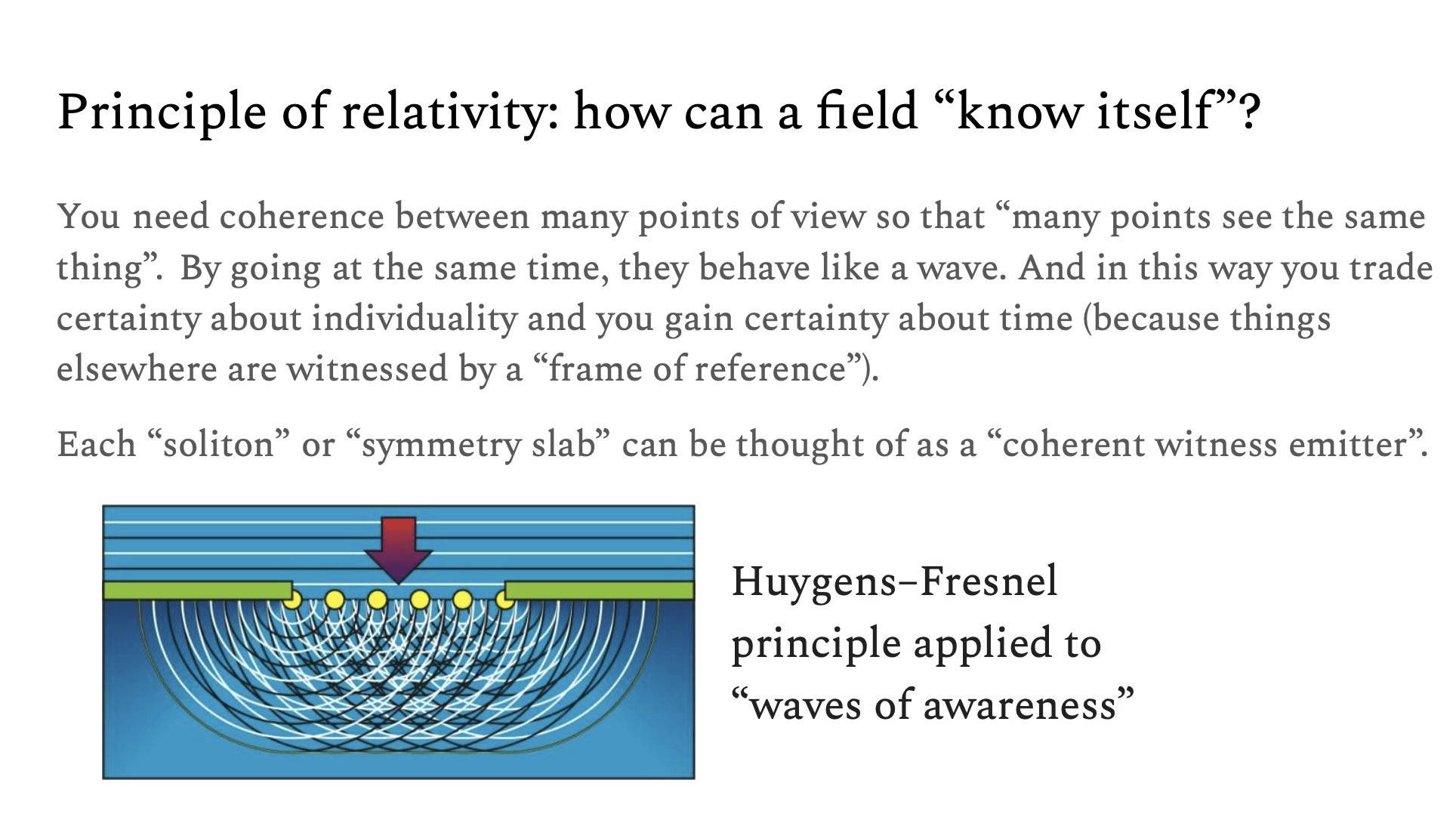
Non-Linear Optical Circuitry at the core of the current iteration of BaaNLOC. The central screen beams copies of its content to semi-independent modules. Then each module applies learned non-linear optical transformations such as birefringence, diffraction, refraction, etc. The post-processed images are then pulled together, and after a final symmetry group transform (to know how to fit it onto the screen), are re-projected back onto the original screen. The experience that emerges is the steady state standing-wave pattern of Total Internal Reflection (TIR) trapped in the loop. Key idea is that the images projected from each module back to the main screen can interact with each other in a quasi-physical way there.

I start by portraying the overall geometry of a moment of experience, as illustrated by Steven Lehar:

Source: Cartoon Epistemology by Steven Lehar

Consider this “diorama-like shape” that contains phenomenal properties we can point to and discuss. It is deeply interconnected. An experience is not “just” a 2.5D screen of pixels, because something is actively integrating and interrelated all of those pixels under a shared “umbrella”: a point of view, or subject of experience. Whatever the true mathematical object is that corresponds to a moment of experience (cf. qualia formalism), it must be able to connect variables in ways that produce the specific patterns of binding we observe. The patterns of binding must somehow allow us to reconstruct the geometry of the experience as a whole. But the patterns of binding are complex. A cup is not merely a blue object – it has intricate structures like a handle and a floor and perhaps liquid content, features which are all put together into a coherent multi-level representation for us to interact with. Indeed, we have to ultimately provide a mathematical structure rich enough to model and account for all types of phenomenal binding. Worth mentioning is QRI’s long-standing idea of modeling experiences as graphs with nodes that represent qualia values and edges that represents the flow of attention. In this case, the nodes you attend to are salient due to reasons having to do with graph centrality (cf. PageRank). Why? Because e.g. PageRank tracks the probability of landing on a given node if you are doing a kind of random walk from node to node using the directed edge weights as probability of transitioning. The nodes with high PageRank are those for which “the flow of attention” leads to lakes where it pools and concentrates.

As explained already, we suspect that the psychedelic sense that “everything is connected to everything else” may not be an anomaly, but rather a feature of experience that is always present, only rarely made explicit. This kind of PageRank of attention is always ongoing. The geometry of experience seems to be a kind of stable equilibria that results from systems observing each other and creating representations with relative distances to each other. Naturally, experience is “self-reflective” for this reason (and not only due to introspection!). But Indra’s Net is a deeper kind of structure that is still way more interconnected than e.g. PageRank would suggest. We need something new:

The core idea is that the non-linear optical circuit diagram above might capture some of the more exotic and intricate aspects of phenomenology (as mentioned: autonomous entities and Indra’s Net). The sketch you see at the start of this section (“One Screen, Many Contributors: Explaining the One + Many nature of Experience with Non-Linear Optical Circuits”), aims to capture key structural insights for the generation of moments of experience, which beam splitters, birefringence, and image-teleporting TV stones (cf. “How does Television Stone Work?“; Ulexite) feeding a recursive optical loop. This loop allows many “sub-agents” to see the same field, alter it independently, and feed their changes back into the whole in real time. The equilibrium state of this process is what we experience as a moment of consciousness.

In the recorded discussion, Michael Levin offered an elegant metaphor for how self-organizing systems can “pull” you toward them, where constraints in the medium act like attractors and make parts of the problem solve themselves once enough structure is in place. One of his example was a triangle: if the fittest shape for a given problem involves a certain triangle (e.g. a triangular alga needs to have three specific angles at its corners to succeed in certain navigation task), you evolve the first angle, then the second, and the third is automatically determined by the laws of geometry (a free gift from Euclidean geometry; or the geometry of the network of relationships between the parts, more broadly, when we talk about intrinsic geometry). This kind of regularity is an example case for how complex systems can bootstrap themselves, where knowing part of the whole lock in the rest: symmetry reduces degrees of freedom, and constraint propagation allows the global pattern to self-assemble without exhaustive search. In Levin’s framework and worldview, these “free lunches” live in pattern-space or morphogenesis space (as we’ll see), so that once your system points to the right place, the rest of the pattern ingresses “into the physical”.

Indra’s Net might be one of these patterns. The state of consciousness where everything _explicitly_ reflects everything else, from this point of view, does not have to be built in its entirety from the bottom up; once parts of it crystallize, and high-level symmetries are locked in place, the rest already knows how to relax into its attractor. It’s worth mentioning Levin also pointed out that in his work with Chris Fields he extends the logic of navigation in pattern-space, to “morphogenesis space”. That is, the configuration space in which cells navigate to build and repair anatomies. Applying least action laws (perhaps the true building blocks of reality? Or the true underlying laws of reality?) not to physical three-dimensional space (which may itself be emergent) but to the implicit geometries that shape biological growth and repair, may explain how an organism navigates its possible self-organization and converges on an energy minima that is very wholistic in nature.

In the toy model I presented, a non-linear optical circuit containing beam splitters, birefringence, and image-teleporting TV stones feeds a recursive loop that allows many “sub-agents” to see the same field, alter it independently, and feed their changes back into the whole. The equilibrium of this process corresponds to a moment of consciousness: it’s the topologically closed standing-wave pattern that emerges out of the non-linear optical circuit reaching a point of stability – and then what it is like to be it perhaps corresponding to “the superposition of all points of view” within it (see Cube Flipper’s recent efforts to describe this way of “reading off” an experience out of a physical system).

The energy function locally rewards gestalts that succeed at being explanatory, meaning they can anticipate, compress, and model the behavior of other gestalts. This generates an ecosystem in which gestalts compete and cooperate by predicting one another, and some develop the capacity to swallow the entire scene and then re-express it in transformed form. The medium where these interactions occur (the phenomenal screen) is not a passive display (common misconception) but an active site of computation, where interferences between gestalts are identified and workshopped. It also plays the role of being a “metric” or “gauge” for the other various gestalts. The screen gives gestalts a kind of “radar” so that by emitting waves they can find each other “in 3D”. From this perspective, experience involves lifting the content of the field into higher dimensions (internal states of the modules), applying transformations there, and then re-projecting it back as a coherent standing wave onto 3D (or 2.5D). In fact, several semi-independent modules doing this in parallel and then responding to each other’s transformations. The result is often deeply interdependent and “enmeshed”, irreducible-seeming, as the process transforms experiences recursively mid-flight and converges on gestalts that get along well with each other, are explanatory, and can predict sensory input.

Beam Splitters

Let’s try to imagine this more concretely. First, let’s talk about beam splitters. A beam splitter is typically a piece of glass or plastic that allows a certain percentage of the light through and reflects the rest. They’re one of the pieces in the game Khet 2.0 (a variant of Laser Chess), where the laser effectively splits in two and has more chances to do damage to the other’s Kind (or Pharaoh). This multiplies the number of beams, and at least in some arrangements, can lead to combinatorial explosions. Beam splitters, I suspect, are ubiquitous in our brain’s information processing pipeline. The ability to carbon-copy a gestalt so that you can work on it in multiple streams in parallel is extremely empowering, and no doubt a core step in any serious implementation of non-linear optical computation. Think about the phenomenology of shifting around the content of a working memory module. Doesn’t it feel like you’re copy/pasting information from one part of your field to another? Beam splitters are also, I reckon, a key optical component of our world simulation that allows for parallel processing streams to get unified into the coherent experience we mistake for a single “simple” witness.

Teleprompters allow you to have “split vision” so that you can look at the camera while you read your speech. (cf. DIY Teleprompter). They’re a kind of highly functional beam/image splitters.


In an effort to making the above more relatable, let’s talk about a really cool invention: the holographic broadcasting system. It doesn’t exist yet, but it could. It should, in fact. For aesthetic, social, and computational reasons,. What is this I’m talking about? Check this out:

The Holographic Broadcasting System

Imagine this: in front of you is a special table. A table that shows an image. There are hundreds of other tables like it and they are all connected to each other. When you place something on the table, it appears as a hologram in every other table like it. You can use this to play board games with people in other countries in real time, or for strategizing, delivering presentations, and even solving a maze as a team.

Here is the twist: the object that you place on the table can itself be an object that holds a transformed image of the table. Say, the object you place on the table is an iPad that shows what the table looks like from your point of view (e.g. your glasses have cameras that beam data to the iPad). You can even do projection mapping on the table and overlay a digitally transformed version of what it looks like on top of itself.

Projection mapping: you use a model of the 3D scene so that you can “paint it” with a projector that displays a video of the very scene it’s illuminating, after processing it with digital tools.

Each person with access to (a parallel version of) the table might specialize in a different kind of transformation: some specialize in adding edge detectors that highlight the corners and sharp angles of what’s in it. Others perhaps do color enhancement. Yet another one does shape rotation, where it overlays rotated images of the table (or a region thereof) on top of itself. The result is that the table is a live hologram that gets to be edited in real time by many different groups of people, each looking for something different, and capable of emphasizing different features of this collective work of art.

But here’s what makes this system truly extraordinary: each hologram carries its own unique spectral signature (remember how you can do analogue Fourier transforms in optical circuits!). From the point of view of the system, each gestalt/hologram is a kind of molecule with distinct “vibratory modes” that interact with other nearby gestalts that share such frequencies. When an edge detector sharpens a visual element, it doesn’t just change the shape, it also “stamps” a vibratory signature, so to speak, onto the hologram metadata for the system to work with. From the point of view of the system as a whole, may at first seem like a simple object carries rich spectral (i.e. frequency/vibration in addition to position) information. Whether holograms in the table “get along with each other” is a function of how they resonate together, as a group (with other gestalts), and as a whole (how the whole state can self-harmonize, or not, with the presence of such features). Collectively, the local and global vibrations define how the system “wants” to settle, and how each region interferes and interacts with neighboring holograms.

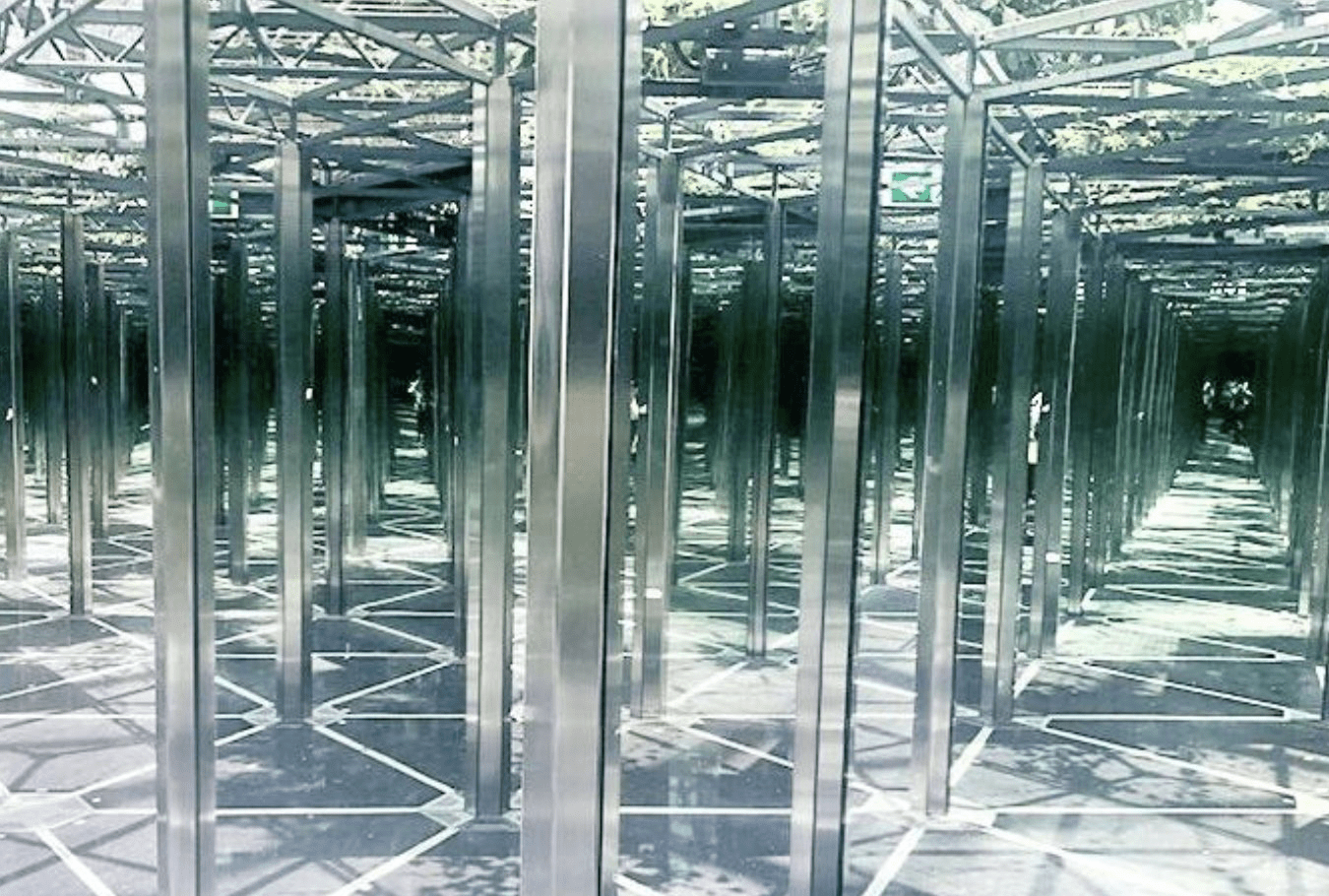
Importantly, I think this is happening all the time. What is different about high dose DMT or hard Jhanas with prominent Indra’s Net phenomenology is the extent to which individual gestalts express information about the whole experience. Consider the spectrum that goes from a completely dark and uninteresting room, to a room that is filled with parallel mirrors, beam splitters, diffraction gratings, polarizers, etc. What the room looks like doesn’t change very much as a function of lighting and head position in the first room. But in the second room, subtle changes in lighting can change the look and feel of the whole scene, as well as subtle changes in head positioning or even direction to which the eyes are pointed. In both cases the rooms are ultimately made of the same kind of “material” (atoms, physically speaking; qualia, subjectively speaking). But the second room has implicit connections and relationships that makes it highly sensitive to things like angle of lighting. The punch line, as it were, is that both physical systems are kinds of Indra’s Net, at least in a raw physical sense: every part of the dark room does indeed reflect every other part, it’s just that the information has been scrambled and largely lost. But just because the materials are not reflective or smooth doesn’t mean that on a deep physical level we don’t find a web of interdependent physical fields giving rise to the room as a whole as a “point of stability” of the system. This requires “everything reflecting everything else”. It’s just that many of these reflections aren’t very interesting or coordinated! Yet they are always there.

Likewise, even very boring and prosaic “contents of the visual field” (say, a banana, an orange… a stim toy) without any “trippiness”, I would argue, do implicitly contain the “everything reflects everything else” quality. When you see a banana contextualized by being next to an orange, the very _meaning_ of the banana changes. It becomes, in look and feel, a “banana next to an orange” rather than a “banana plain and simple”. More so, now that this contextual relationship has been established, we see the same is the case for the orange. And once more, with recursion, we find that the banana starts to look like a “banana that’s next to an orange, which is next to a banana” and so on. In principle this sounds redundant. But it is not. On DMT trips, this “transitivity of context” may in fact break down. So, for example, you might find yourself contextualizing the banana by an orange, but the orange might feel like it’s coming from a space that _is not_ contextualized by the banana. At least not directly. It’s often as if the various gestalts on DMT could exist in semi-independent geometric spaces that only with joint attention can actually interact with one another. Thus, the Indra’s Net quality of experience is in some sense much more robust in “normal everyday life” relative to the depths of an ayahuasca journey. And that is because under normal circumstances we do in fact have that our phenomenal objects properly contextualize each other in a way that achieves closure.

On high doses of DMT, it is possible for the entirety of one’s experience to be “compressed” into a triangle and then having that triangle projected onto our experience. You see how this would be a rather unusual and special kind of mathematical object, right? We’re dealing with a situation in which materializing a projection of the whole space onto a part of it radically changes the nature of the geodesics of the space. The triangle becomes a shortcut between various points that find their shortest distance by jumping into it. Now, in really exotic states, when multiple parallel streams are re-projecting the whole experience back onto itself after doing unique transformations to it (say, one “rolls up the experience into a tube”, another one “turns it into the surface of a sphere”, and yet another one “does this weird Hopf-fibration-like foliation of the space”) you have the emergence of phenomenal spaces that are extremely interconnected and will for the most part be a once-in-a-life-time encounter, as the combinatorial explosion of these feedback processes is so large we often have no hope of reconstructing specific and weird corner case.

Harmonic Simplification

Hundreds of spectral holograms can coexist in the shared screen at once. They do not need to collide directly. They are controlled by different modules, but they do “collapse” and get pushed into the same screen, which tries to reconcile/compile them into a single “point of view”. There are two steps. First the system tries to flatten all of the holograms in the main screen. Then the system lifts all of the subsystems that didn’t find a clear fit with each other into a higher-dimensional work space where the more fined-grained information is computed (and where many more kinds of rotations are available to do so). This way, the screen, in light of the multiple commenting parallel streams that “lift it”, can dynamically transform in much more general ways than what the screen itself could afford geometrically on its own. In that space their spectra interact more directly: modes beat against modes and compatible components find strange projections (along higher dimensional transformations) that allow them to click together. The screen’s own low frequency harmonics act as a constraint (they amplify the 2D and 3D symmetries found in among the gestalts as seen presented in the screen, cf. our computational model of cessation) and work as selection pressures for patterns that fit the logic of 3D space. Anything that persists must couple to, and be consistent with, the global modes of the screen (imposing familiar geometry), as well as the constraints being carried in/imported by each of the semi-independent modules.

When a stable configuration that ties together multiple other gestalts in a clean composition is found, the circuit produces a simplified gestalt that stands in for the group. In some cases it replaces it, but more typically the “summary representation” works as a kind of leader of the gestalts it’s summarizing. Alas, all gestalts are decaying, so the visible and impactful ones are only the most recent summaries. The summary gestalt also carries spectral content that matters for downstream coupling (how to “get along with the current screen as a whole”) and drops detail that would only introduce new conflicts. That surrogate then re-enters the loop as a new gestalt with its own spectral signature. The process is recursive, which makes most of experience be a strange process where summaries compose with other summaries, and the screen converges toward a coherent standing wave that is both globally coherent and locally consistent. The “infinite reflections in the eyes of beings” inside Indra’s Net e..g. “spider eyes” (eyes reflecting eyes, etc.) move in a way that is both consistent with the local geometry of the main screen (of access consciousness) as well as with the geometry of the network of connections and reflections. When you move an eye in an Indra’s Net, you move the _whole_ Net.

On ordinary mindstates gestalts have short half-lives, so the loop clears quickly and the screen doesn’t tend to have long-range temporal self-interactions. High-energy conditions such as high dose DMT or hard Jhanas extend those half-lives (cf. Tracer Effects). More gestalts remain in the screen for longer, more summaries are formed, and more couplings between gestalts become possible. The result is a scene where parts model each other and the whole and then re-express it in transformed form that interact with one another. This is the functional core of Indra’s Net phenomenology as I currently see it. And I believe we can have it come about naturally in such an optical circuit.

The Multitude Behind the Screen

We typically think the screen of consciousness is like this: you think you are just one witness looking at it. But what if it’s actually being broadcast to hundreds of different locations at once? And every one of those locations has a specialized intelligence that knows how to identify faces/mechanisms/connections on the screen and overlay that information on top of it for everyone else to see?

Neither recurrence nor resonance can solve the phenomenal binding problem, but if consciousness is a standing wave pattern trapped in a TIR pocket, then beam splitters that allow different modules to work simultaneously into a shared space just might.

From Lehar’s Cartoon Epistemology

Each of these specialized processing locations generates its own “interpretation of the scene”. Effectively, taking the shared space and applying specialized filters (try to resonate with it in a bunch of ways and see what sticks!), in turn modifying it in real time and contributing additional gestalts to the collective mix. Face recognition modules stamp facial harmonics onto visual patterns. Motion detection systems add their characteristic rhythms. Mood modules add jitter or laminar flow to attention. Memory systems contribute resonant modes that connect current perceptions to stored patterns. Emotional processing centers overlay affective spectral information that colors the entire scene (cf. citta).

The beam splitter is multimodal. The signal gets split and is sent simultaneously to somatic processing modules, auditory systems, and other sensory domains. Each domain receives the same fundamental holistic information (the _entire_ experience!) but processes it according to its own characteristic geometry, topology, and harmonic features. There’s likely a master screen that combines these three primary modalities (incl. visual, somatic, auditory) each contributing their own spectral signatures to the unified conscious experience.

Crucially, this conceptual framework might articulate the phenomenology we observer in how tactile-visual synesthesia works through spectral principles (cf. Roger Thisdell on Pure Perception). Synesthetic states can be thought of as “solitons” of the system: self-reinforcing wave packets that maintain their coherence while propagating their spectral information to the rest of the field across modalities. These solitons resonate with one another and with the broader spectral ecosystem in the screen, integrating interactions, and in turn lock together the gestalts contributed by different modules into stable multi-modal gestalts.

The sense of “Autonomous Entities”, and even more strikingly, the feeling of being a multitude on DMT might come from this mechanism becoming more “transparent”. The screen is always broadcast to many locations, but at baseline only a few have edit rights, with a strong and smart filter gating what reaches the authoritative version. On DMT many (perhaps most?) streams gain editing privileges at once, so an ecosystem of patterns grows in the shared space and coordinates through the screen without the intermediate central organizer (ego?) filtering who talks to who. This results in complex subagents interacting through the medium that can plot for and against you. Thus framework that accounts for Indra’s Net also explains Autonomous Entities: the competing clusters of coherence on DMT form hierarchical networks that bootstrap semi-parallel agency. As Steven Lehar hypothesizes (personal communication), these entities are facets of yourself: the central screen is being beamed to separate modules, each “witnesses” the whole scene, processes it, and then comments by beaming transformed gestalts back to the screen. Under normal conditions few streams are active; with DMT’s coupling kernel you may be “opening half the streams at once” (chaotically and hierarchically), creating literally “more witnesses of your experience.” Streams come together that usually don’t co-exist, and must thus negotiate how agency will be distributed among them.

A bit like the kid behind a reporter saying “mom! I’m on tv!” – many subagents can now broadcast their existence to the whole organism and seek like-minded shards to work on (artistic? political? cosmic?) projects with. Not all the shards understand each other’s communication style, so there is a lot of cross-talk that goes unrecognized by the whole yet is happening beneath the surface.

This way, the entities we encounter can be thought of as different parts of yourself gaining editing privileges on a shared space whose control room is usually locked and safeguarded. It is a multitude in the same way that you’re always already a multitude. But you’re usually following an algorithm that prevents “multiple parts talking at once”; with DMT that system is gone.

The Tracer Effect in Light of the Hologram Collective

As briefly touched upon already, on DMT (and other psychedelics/exotic states of consciousness), sensations (and gestalts) don’t decay at the same rate as normal. Every sensation you experience tends to flicker at a high frequency and linger for a while (depending on dose, could be over several seconds). These “tracers” hang around as afterimages that flicker characteristically fast at the 10-40hz range typically as they interact with one another. When the process that effectively works as a “compression engine” (gestalts summarizing pre-existing gestalts) tries to replace a cluster of gestalts with their simplified proxy, the older ones are still present and spectrally active (meaning, their vibrations still condition the screen and one another). The screen now contains both the compressed summary AND its constituent parents, so the next compression cycle captures the recursive echoes of patterns that should have vanished under normal circumstances (cf. don’t look at cauliflowers while on DMT!). It doesn’t take much imagination to see how this could lead to “fractal-like” patterns.

Overall, this creates a spectral feedback loop, where each new compression inherits more and more afterimages from previous cycles (until it reaches a dose-dependent homeostatic level). Instead of an orderly hierarchy of representations with conventional order, you get a sprawling pattern of self-referential holograms and time-loops, each quoting fragments (and partial impressions) of earlier generations, all resonating and cross-modulating each other. The compression engine, as it were, starts feeding on its own history, creating recursive patterns that reference themselves in increasingly complex ways. One of the key ingredients for the fractal quality of Indra’s Net!

Collective Harmony in Emergent Gestalts

Finally, any discussion of this process would be incomplete without at least mentioning valence. Individual holograms both float independently and they organize themselves into gestalt collectives. These collectives develop their own characteristic resonant modes, creating new spectral patterns that can influence the entire system from the top down. When you recognize a face, you are doing more than combining features such as eyes, nose, and mouth. Really, the face is a higher order gestalts: it is a collective interlocked “metagestalt” that has genuine causal power over how subsequent processing goes. The gestalts that make it up compromise a little on their own characteristic frequencies so that they can interlock as a group and genuinely form something more (and different) than the mere superposition of the parts. Importantly, each gestalt (of any order) tends to have both an intrinsic valence as well as a valence in relation to the other gestalts present. I would posit the intrinsic valence is the result of its internal consonance, dissonance, noise signature (CDNS) of the gestalt. Namely, how would this vibrate if it were the only element in the screen? Whereas valence in relation to other gestalts is the result of mutual consonance, dissonance, and noise between the gestalts.

Indra’s Net valence tends to be pretty extreme. Usually positive (or very positive), but at times negative or very negative. Yes, it is likely the case that if you want to pack as much consonance (mystical choruses, interdimensional massages, etc.) as possible in a finite volume like our screen of consciousness, probably creating a complex web of fractal connections allows you to maximize the number of pleasant relationships. Alas, be warned that fractal dissonances lurk in Indra’s Net too, and a “fractured” not quite complete Indra’s Net can be really disconcerting in some ways. It’s possible that peak positive valence resides in minimal-information-content experiences (as Michael Johnson’s Symmetry Theory of Valence posits), so high-energy high-symmetry states like 5-MeO-DMT are more likely to be leads for peak pleasure states that those catalyzed by DMT or similar. In either case, both the valence (and specifically aesthetic!) value as well as computational significance of Indra’s Net keeps it in the short list of most interesting states to study.

Discussion and Conclusions

Let’s recap. In our non-linear optical circuit, each iteration runs the same loop: the screen copies the whole scene to many modules, they transform their copies, the returns are then projected back onto the screen, and what fits with everything else stays. This iteration-by-iteration “handoff” from each of the modules and the screen as a whole gives continuity where small overlaps between iterations keep motion smooth. The system tends to a few stable objects because it keeps spectra that cooperate with each other and lets go of the rest. The screen is not (just!) a display (!), because it turns out to be where useful compute happens. Namely, where different modules can see the work of each other in real time, and negotiate together how to transform the scene in order to both fit the constraints of the screen as well as of each other.

Radical state changes affect how this loop behaves. With altered coupling dynamics, streams running at their own speed can lock to one another in the presence of strong kernel changes (e.g. when the “DMT coupling kernel” is applied indiscriminately to many systems at once). With tracers, the feedback intensifies across iterations and the negotiation becomes visible on the screen: edges, colors, textures, posture, points of view, trying to fit each with other. By default this tends towards hyperbolic geometry (as the gestalts drift into a more relaxed metric so that all of their idiosyncratic distances to one another can be embedded in some space and the gestalts get stitched together). But even more interestingly, when many modules hold the whole scene at once and write back versions that still predict it, you get Indra’s Net: each patch shows the whole through its own lens, and pulling on any part pulls on the rest too. When more streams get edit rights at the same time in tandem with the tracer effects, the modules negotiate domains of influence by both communicating through the screen and developing agent-like qualities. They all see the same broadcast, process it in their own way, and comment on it by projecting their gestalts back onto the screen. They feel alien because the usual gate that merges commentaries is relaxed, so their “signatures” stay distinct and you can watch them interact and develop new kinds of languages mid-flight.

We are in early days of BaaNLOC, but I am optimistic that it won’t take long for us to be able to code simulations of this optical circuit (and many variants) and then test whether they generate recognizably-DMT-like dynamics. From playing with toy models (to be released soon), I think we’re on track. But much remains to be done. Stay tuned 🙂

In-Flight Entertainment: Metta, SU(3), Flat Earth

[Epistemic Status: playful, informal travel log]

How I spent the 11 hour flight from London to San Francisco just now (apparently flying over Iceland and Greenland, if the map on the little screen in front of me was to be believed):

In essence, three interconnected things:

  1. Metta meditation (“unconditional love for all beings”),
  2. SU(3), and
  3. Flat Earth

First of all, doing metta on a flight is always a good idea. Radiating lovingkindness from the sky is beautiful (whether we live in a Flat Earth or Round Earth, metta still radiates spherically at the speed of light). By doing metta on a flight you get to “touch” a lot more beings (or more of “being”, from a non-dual point of view) through the sheer diversity of physical proximity you get to experience (did I mention we flew over Iceland?).

But I’ve done metta on flights in the past. What was special this time around?

I watched a lecture on “The Strong Nuclear Force as a Gauge Theory” (go Richard Behiel!) that left me thinking about how to modify Kuramoto systems to incorporate QCD features.

In practice, thinking about this, combined with the metta, meant I was essentially playing around with heart shapes in my mind & energy body for 8 of those hours.

Imagining a big heart at the center of reality. Imagining a small heart at the center of reality. Filling it with metta. Imagining a big metta-filled heart rotating clockwise. Imagining a big metta-filled heart rotating counter-clockwise. Getting smaller and larger.

And then in 3D… a heart that grows and rotates and shrinks and changes orientation, and reflects itself (and sometimes looks like the Endless Knot when it does so from a certain angle).

Now imagine a field of hearts. Each point has a 3D heart. It’s ok if it’s a symbol. Eventually it should be abstract: just the qualia of love. But for now, imagining a heart is helpful. Each point has a heart that can rotate, reflect, grow, and even “invert” itself.

Let the hearts touch each other.

By which I mean, let their phase angles become entangled with their neighbors. Create a gigantic field of hearts spinning however they want… so long as unitary and Hermitian. For the SU(3) part. We want strong hearts (by which I mean, capable of emulating the Strong Force).

I was a bit sleep deprived and overclocked (fun fact: when they ask you: “coffee or tea?” you can say “both, please!” and you’ll get two cups, one of each – must clarify: do not make a mixture of the two, or the math will get messed up), so things were a bit conceptually fuzzy and not quite coherent enough to my sober taste. But it was good qualia engineering in line with a Glass Bead Game aesthetic.

I kept thinking: Every rotation is a sequence of shears. A well-coordinated rotation feels good. Poorly done, and you get uneven sheers. Shearing is potentially scary. So shear carefully. That’s why emergent geometric transformation from the superposition of harmonic amplitudes (think degenerate eigenmodes used as a basis for rotation) is of hedonic significance. Only when you coordinate well can you avoid unnecessary shears and jump straight to a proper rotation. If asymmetrically “shearing the fabric of reality” is to be “unkind” to it, SU(3) is the way by which metta is baked in at the base level of phenomenal space.

How does Flat Earth come into play? I started the flight with the question: “how would a von Neumann type justify belief in Flat Earth?” (how I got to that question… I can’t quite remember, and it was probably a followup to a politically incorrect question I won’t touch in public anyway). And I got all kinds of beautiful recreational metaphysics confabulations during the flight. Things involving Donald Hoffman’s take on the nature of reality mixed with abstract cuts of other people’s in-flight movie-watching entertainment experiences (binging classics like Zoolander and Addams Family Values is a perfectly valid, alternative, way to spend your 11 hours, which is what my neighbors cheerfully chose to do instead of messing with SU(3)-rotating imaginary hearts). The main thing being: we could potentially come up with a model of reality that accommodates a truly Flat Earth if we take into account the multiple timelines of the multiverse as part of the geometric metric of intersubjective spacetime itself – only on a “given history of the universe” the world appears round, but that’s only something that happens to be the case from a specific subjective point of view that “glues together” enough perspectives that are consistent-enough to cause a kind of “narrative closure” on the sense of reality. Gravity and the center of mass is emergent from the many frames of reference / points of view that are integrated into a stream of consciousness. But in reality, at the base, the geometry is perfectly flat and Euclidean, like a Lattice QCD (ok, taking a poetic license here, bear with me).

The Flatness of the Field of Hearts seems to be indeed something that gives it high valence. Implementing lawful energy-preserving (for a certain notion of energy) transformations on a field of metta was especially delightful. The more detailed the imagination of this phenomenon, the stronger the seeming neural field annealing that would result of it.

I’ll leave you with a quick vibe-coded reconstruction of this in-flight meditation entertainment experience. No drugs involved (except for a coffee+tea mixture), just strong meditation and imagination.

Enjoy, and please keep sending metta while flying <3

QRI Meetup in Amsterdam on January 25th 2025: The Coupling Kernels Revolution

Dear wonderful community,

Just as a fire uniformly raises the temperature throughout a building, causing diverse but interconnected effects (metal beams expanding, wood supports burning, windows cracking from thermal stress, smoke rising through air currents) psychedelics might work through a single fundamental mechanism that ripples through all neural systems. This isn’t just theoretical elegance without grounding; it’s a powerful explanatory framework that could help us understand why substances like DMT and 5-MeO-DMT produce distinct but internally consistent effects across visual, auditory, cognitive, and somatic domains. A single change in coupling dynamics might explain why these compounds have such distinct but internally consistent effects: DMT creates rapidly alternating color/anti-color visual patterns and oscillating somatic sensations, whereas 5-MeO-DMT tends towards a state of global coherence.

As demonstrated in our work “Towards Computational Simulations of Cessation“, see how a flat “coupling kernel” triggers a global attractor of coherence across the entire system, whereas an alternating negative-positive (Mexican hat-like) kernel produces competing clusters of coherence. This is just a very high-level and abstract demonstration of a change in the dynamic behavior of coupled oscillators by applying a coupling kernel. What we then must do is to see how such a change would impact different systems in the organism as a whole.
Source

The key insight is that psychedelics may modify the coupling kernels between oscillating neural systems throughout the body. Think of coupling kernels as the “rules of interaction” between neighboring neural oscillators. When these rules change, the effects cascade through different neural architectures (from the hierarchical layers of the visual cortex to the branching networks of the peripheral nervous system) producing the kaleidoscopic zoo of psychedelic effects we observe.

DMT, for instance, appears to enhance contrast and create competing clusters of coherence (possibly through 5-HT2A activation), while 5-MeO-DMT tends toward global coherence and boundary dissolution (potentially through 5-HT1A pathways). These changes in coupling dynamics appear to tune into the brain’s natural resonant modes, as described by connectome-specific harmonic waves, modulating their spectral power distribution in predictable and reliable ways.

Simulation comparing coupling kernels across a hierarchical network of feature-selective layers (16×16 to 2×2), showing how different coupling coefficients between and within layers affect pattern formation. The DMT-like kernel (-1.0 near-neighbor coupling) generates competing checkerboard patterns at multiple spatial frequencies, while the 5-MeO-DMT-like kernel (positive coupling coefficients) drives convergence toward larger coherent patches. These distinct coupling dynamics mirror how these compounds might modulate hierarchical neural architectures like the visual cortex.
Source: Internal QRI tool (public release forthcoming)

We’re excited to announce that we’ll be hosting a meeting in Amsterdam to explore this paradigm-shifting framework. This gathering will bring together researchers studying psychedelics from multiple angles – from phenomenology to neuroscience – to discuss how coupling kernels might serve as a bridge between subjective experience and neural mechanisms. Recent work on divisive normalization has shown how local neural responses are regulated by their surrounding activity, providing a potential mechanistic basis for how psychedelics modify these coupling patterns. By understanding psychedelic states through the lens of coupling kernels, we may finally have a mathematical framework that unifies the seemingly disparate effects of these compounds, much like how understanding heat transfer helps us predict how a fire will affect an entire building – from its structural integrity to its airflow patterns.

Simulation comparing different coupling kernels (DMT-like vs 5-MeO-DMT-like) applied to a 1.5D fractal branching network, showing how modified coupling parameters affect phase coherence and signal propagation. The DMT-like kernel produces competing clusters of coherence at bifurcation points, while the 5-MeO-DMT kernel drives the system toward global phase synchronization – patterns that could explain how these compounds differently affect branching biological systems like the vasculature or peripheral nervous system.
Source: Internal QRI tool (public release forthcoming)

Event Details & Amsterdam Visit

The meetup will be held on the 25th of January (location: Generator Amsterdamevent page; time: 1-8PM), featuring presentations from myself and Marco Aqil, whose groundbreaking work on divisive normalization and graph neural fields provides a compelling neuroscientific foundation for the Coupling Kernels paradigm. Marco’s research demonstrates how spatial coupling dynamics can bridge microscopic neural activity and macroscopic brain-wide effects: a perfect complement to our phenomenological investigations.

Additionally, I’ll be in Amsterdam throughout the last third of January and available to meet with academics, artists, recreational metaphysicians, and qualia researchers. If you’re interested in deep discussions about consciousness, psychedelic states, and mathematical frameworks for understanding subjective experience, please reach out.

Much love and may your New Year be filled with awesome and inspiring experiences as well as solid paradigm-building enterprises!

~Metta~

On Attention as the Management of Electromagnetic Field Lines

Try to focus your attention on the exact center of your visual field right now. Notice how the seemingly straightforward task reveals systematic instabilities: wavering, drifting, and transforming in characteristic ways. These effects aren’t random noise; they suggest an underlying physical mechanism that shapes how attention behaves more broadly.

I’ve been developing a model at QRI that conceptualizes attention through electromagnetic field dynamics. To visualize this, I created a simulation showing how electric field lines emerge from weighted combinations of resonant modes in a square plate. In this video, I manipulate the relative weight, temporal frequency, and phase of these resonant modes:

The story of harmonic waves in the brain is getting more interesting by the day. Building on Lehar’s early insights, Atasoy’s work on connectome-specific harmonic waves (2016), Johnson’s explorations of the implications (2018), Luppi’s contrast between anesthetics and psychedelics (2022), and more, we’ve now seen stunning confirmation of these ideas in Joana Cabral’s recent work with single-slice rodent recordings. The evidence keeps pointing to harmonic resonance as a fundamental organizing principle of neural activity. So let’s take this seriously and see what it tells us about the strangeness of attention.

Think of the “control parameters” for attention as the precise timing, weighting, and phase relationships between different electric resonant modes. We seem to have some degree of volitional control over these parameters, though this control is inherently indirect.

Source: Human brain networks function in connectome-specific harmonic waves (2016) by Selen Atasoy, Isaac Donnelly & Joel Pearson 

The resulting electric field lines may correspond to what we experience as the “flow of attention.” This explains why we cannot directly command attention to go anywhere. Instead, we can only modulate the underlying oscillatory conditions to maintain charge density in particular regions. To actually keep the charge density having a specific shape requires finding the right combination of harmonic modes together with the right rhythm to keep them active.

This framework might give us a new map of psychedelic phenomenology. Classical psychedelics like LSD and psilocybin seem to disrupt normal resonant mode configurations by activating higher frequency harmonics and lowering the power on low frequency harmonics. Ever notice how psychedelic experiences feel distinctly “sprinkly”? That’s what happens when attention field lines fluctuate chaotically as high frequency harmonics create clusters of attention rather than a single central stream. Without a “base”, DMT induces rapid shifts between field line configurations. In contrast, 5-MeO-DMT activating the “global mode” might lead to intense single-pointed attention. Look at the simulation when perturbed: the patterns show deep qualitative similarities with how attention behaves in these states.

The experimental implications are really tantalizing to me: we should expect to see coordinated changes in electromagnetic field patterns corresponding to shifts in attention in predictable ways. These patterns should show characteristic resonant modes that maintain stability during focused attention and become disrupted during distraction or altered states. Modern MEG and high-density EEG setups in combination could test these predictions.

Modeling attention field lines explicitly might even point us toward better cyberdelic interventions: we can build systems for non-invasively inducing exotic states of consciousness by identifying the ways attention is phase-locked and figuring out how to perturb it (ideally in a pleasant way!). It’s notoriously difficult to jump straight to Samadhi by focusing on a point. But what if we could first simulate quasi-coherent combinations of resonant modes, phase lock with the current attentional mode, and then gently nudge it toward high concentration?

Attention in this view wouldn’t be a “spotlight”. Or at least, that would not be its essential nature (albeit it can, at times, behave as if it were a spotlight, this is just a mode of many). Attention, instead, would be a dynamic pattern in the brain’s electromagnetic field, where field lines converge, and it is shaped by sophisticated control systems that modulate underlying resonant modes. Watch the simulation again: can you see how small parameter changes create recognizable patterns in the field lines? Those patterns might map directly to familiar attentional transitions. The way the lines flow, break, and reform under parameter changes could explain both the controllable and uncontrollable aspects of attention we all experience. Perhaps we will develop words to name them; and as a result, learn to eff the ineffable.

It’s a work in progress, but I figured I’d share 🙂


Video description: A quick sharing of a work-in-progress QRI research thread: can we reproduce the behavior of attention using the field lines that arise from weighted sums of electric harmonics? At least intuitively, this seems promising! I also show a work-in-progress electromagnetic simulation that visualizes the electric and magnetic field lines that result from the interaction between weighted sums of harmonic oscillations in the electric field.


See also:

LSD Ego Death: Where Hyperbolic Pseudo-Time Arrows Meet Geometric Fixed Points

Alternative Title: LSD Ego Death – A Play in Three Voices

[Epistemic Status: Academic, Casual, and Fictional Analysis of the phenomenology of LSD Ego Death]

Academic:

In this work we advance key novel interpretative frameworks to make sense of the distinct phenomenology that arises when ingesting a high dose of LSD-25 (250μg+). It is often noted that LSD, also known as lysergic acid diethylamide, changes in qualitative character as a function of dose, with a number of phase transitions worth discussing.

Casual:

You start reading an abstract of an academic publication on the topic of LSD phenomenology. What are the chances that you will gain any sense, any inkling, the most basic of hints, of what the high-dose LSD state is like by consuming this kind of media? Perhaps it’s not zero, but in so far as the phenomenological paradigms in mainstream use in the 2020s are concerned, we can be reasonably certain that the piece of media won’t even touch the outer edges of the world of LSD-specific qualia. Right now, you can trust the publication to get right core methodological boundary conditions, like the mg/kg used, the standard deviation of people’s responses to questionnaire items, and the increase in blood pressure at the peak. But at least right now you won’t find a rigorous account of either the phenomenal character (what the experience felt like in detailed colorful phenomenology with precise reproducible parameters) or the semantic content (what the experience was about, the information it allowed you to process, the meaning computed) of the state. For that we need to blend in additional voices to complement the rigidly skeptical vibe and tone of the academic delivery method.

It’s for that reason that we will interweave a casual, matter of fact, “really trying to say what I mean in as many ways as I can even if I sound silly or dumb”, voice (namely, this one, duh!). And more so, in order to address the speculative semantic content in its own terms we shall also include a fantastical voice into the mix. 

Fantastical:

Fuck, you took too much. In many ways you knew that your new druggie friends weren’t to be trusted. Their MDMA pills were bunk, their weed was cheap, and even they pretended to drink more fancy alcohol than they could realistically afford. So it was rather natural for you to assume that their acid tabs would be weak ass. But alas, they turned out to have a really competent, niche, boutique, high-quality acid dealer. She lived only a few miles away and made her own acid, and dosed each tab at an actual, honest-to-God, 120(±10)μg. She also had a lot of cats, for some reason (why this information was relayed to you only once you sobered up was not something you really understood – especially not the part about the cats). Thus, the 2.5 tabs in total you had just taken (well, you took 1/2, then 1, then 1, spaced one hour each, and you had just taken the last dose, meaning you were still very much coming up, and coming up further by the minute) landed you squarely in the 300μg range. But you didn’t know this at the time. In fact, you suspected that the acid was hitting much more strongly than you anticipated for other reasons. You were expecting a 100-150 microgram trip, assuming each tab would be more between 40 and 60μg. But perhaps you really were quite sleep deprived. Or one of the nootropics you had sampled last week turned out to have a longer half-life than you expected and was synergistic with LSD (coluracetam? schizandrol?). Or perhaps it was the mild phenibut withdrawal you were having (you took 2g 72 hours ago, which isn’t much, but LSD amplifies subtle patterns anyway). It wasn’t until about half an hour later, when the final tab started to kick in, that you realized the intensity of the trip kept climbing up still further than you expected, and it really, absolutely, had to be that the acid was much, much stronger than you thought was possible; most likely over 250 mics, as you quickly estimated, and realized the implications.

From experience, you knew that 300 micrograms would cause ego death for sure. Of course people react differently to psychedelics. But in your case, ego death feelings start at around 150, and then even by 225-250 micrograms they would become all-consuming at least for some portion of the trip. In turn, actually taking 300 micrograms for you was ego death overkill, meaning you were most likely not only going to lose it, but be out for no less than an hour. 

What do I mean by being out? And by losing it? The subjective component of the depersonalization that LSD causes is very difficult to explain. This is what this entire document is about. But we can start by describing what it is like from the outside. 

Academic:

The behavioral markers of high dose LSD intoxication include confusion and delusions, as well as visual distortions of sufficient intensity to overcome, block, and replace sensory-activated phenomena. The depersonalization and derealization characteristic of LSD-induced states of consciousness tend to involve themes concerning religious, mystical, fantastical, and science fiction semantic landscapes. It is currently not possible to deduce the phenomenal character of these states of consciousness from within with our mainstream research tools and without compromising the epistemological integrity of our scientists (having them consume the mind-altering substance would, of course, confound the rigor of the analysis).

Casual:

Look, when you “lose it” or when you “are out” what happens from the outside is that you are an unpredictable executor of programs that seem completely random to any external observer. One moment you are quietly sitting, rocking back and forth, on the grass. The next you stand up, walk around peacefully. You sit again, now for literally half an hour without moving. Then you suddenly jump and run for 100m without stopping. And then ask the person who is there, no matter if they are a kid, a grandmother, a cop, a sanitation professional, a sex worker, or a professor, “what do you think about ___”? (where ___ ∈ {consciousness, reality, God, Time, Infinity, Eternity, …}). Of course here reality bifurcates depending on who it is that you happened to have asked this question to. A cop? You might end up arrested. Probably via a short visit to a hospital first. And overall not a great time. A kid? You could be in luck, and the kid might play along without identifying you as a threat, and most likely you continue on your journey without much problem. Or in one of the bad timelines, you end up fighting the kid. Not good. Most likely, if it was a grandmother, you might just activate random helpful programs, like helping her cross the street, and she might not even have the faintest clue (and I mean not the absolute faintest fucking clue) that you’re depersonalized on LSD thinking you’re God and that in a very real, if only phenomenological sense, it was literal Jesus / Christ Consciousness that helped her cross the street.

Under most conditions, the biggest danger that LSD poses is a bad valence reaction, which usually wears off after a few hours and is educational in some way. But when taken at high doses and unsupervised, LSD states can turn into real hazards for the individual and the people around them. Not so much because of malice, or because it triggers animal-like behaviors (it can, rarely, but it’s not why it’s dangerous). The real problem with LSD states in high doses is when you are unsupervised and then you execute random behaviors without knowing who you are, where you are, or even what it is that you are intending to achieve with the actions you are performing. It is therefore *paramount* that if you explore high doses of LSD you do it supervised.

Academic:

What constitutes a small, medium, or large dose of LSD is culture and time-dependent. In the 60s, the average tab used to be between 200 and 400 micrograms. The typical LSD experience was one that included elements of death and rebirth, mystical unions, and complete loss of contact with reality for a period of time. In the present, however, the tabs are closer to the 50-100μg range.

In “psychonaut” circles, which gather in internet forums like bluelight, reddit, and erowid, a “high dose of LSD” might be considered to be 300 micrograms. But in real world, less selected, typical contexts of use for psychedelic and empathogen drugs like dance festivals, a “high dose” might be anything above 150 micrograms. In turn, OG psychonauts like Timothy Leary and Richard Alpert would end up using doses in the 500-1000μg range routinely as part of their own investigations. In contrast, in TIHKAL, Alexander Shulgin lists LSD’s dose range as 60-200 micrograms. Clearly, there is a wide spread of opinions and practices concerning LSD dosing. It is for this reason that one needs to contextualize with historical and cultural details the demographic topos where one is discussing a “high dose of LSD”.

Fantastical:

Being out, and losing it, in your case right now would be disastrous. Why? Because you broke the cardinal sin of psychedelic exploration. You took a high dose of a full psychedelic (e.g. LSD, psilocybin, mescaline, DMT – less so 2C-B or Al-LAD, which have a lower ceiling of depersonalization[1]) without a sitter. Of course you didn’t intend to. You really just wanted to land at the comfortably manageable 100-150 microgram range. But now… now you’re deep into depersonalization-land, and alone. Who knows what you might do? Will you leave your apartment naked? Will someone call the cops? Will you end up in the hospital? You try to visualize future timelines and… something like 40% of them lead to either arrest or hospital or both. Damn it. It’s time to pull all the stops and minimize the bad timelines.

You go to your drug cabinet and decide to take a gabaergic. Here is an important lesson, and where timelines might start to diverge as well. Dosing of sedatives for psychedelic emergencies is a tricky issue. The problem is that sedatives themselves can cause confusion. So there are many stories you can find online of people who take a very large dose of alprazolam (Xanax) or similar (benzo, typically) and then end up both very confused and combative while also tripping really hard. Here interestingly, the added confusion of the sedative plus its anxiolytic effect synergize to make you even more unpredictable. On the other hand, not taking enough is also quite easy, where the LSD (or similar) anxiety and depersonalization continues to overpower the anxiolysis of the sedative.

You gather up all the “adult in the room” energy you can muster and make an educated guess: 600mg of gabapentin and 1g of phenibut. Yet, this will take a while to kick in, and you might depersonalize anytime and start wandering around. You need a plan in the meanwhile. 

Academic:

In the article The Pseudo-Time Arrow we introduced a model of phenomenal time that takes into account the following three assumptions and works out their implications:

  1. Indirect Realism About Perception
  2. Discrete Moments of Experience
  3. Qualia Structuralism

(1) is about how we live in a world-simulation and don’t access the world around us directly. (2) goes into how each moment of experience is itself a whole, and in a way, whatever feeling of space and time we may have, this must be encoded in each moment of experience itself. And (3) states that for any given experience there is a mathematical object whose mathematical features are isomorphic to the phenomenology of the experience (first introduced in Principia Qualia by Michel E. Johnson).

Together, these assumptions entail that the feeling of the passage of time must be encoded as a mathematical feature in each moment of experience. In turn, we speculated that this feature is _implicit causality_ in networks of local binding. Of course the hypothesis is highly speculative, but it was supported by the tantalizing idea that a directed graph could represent different variants of phenomenal time (aka. “exotic phenomenal time”). In particular, this model could account for “moments of eternity”, “time loops”, and even the strange “time splitting/branching”.

Casual:

In some ways, for people like me, LSD is like crack. I have what I have come to call “hyperphilosophia”. I am the kind of person who feels like a failure if I don’t come up with a radically new way of seeing reality by the end of each day. I feel deeply vulnerable, but also deeply intimate, with the nature of reality. Nature at its deepest feels like a brother or sister, basement reality feels close and in some way like a subtle reshuffling of myself. I like trippy ideas, I like to have my thoughts scrambled and then re-annealed in unexpected ways; I delight in combinatorial explosions, emergent effects, unexpected phase transitions, recursive patterns, and the computationally non-trivial. As a 6 year old I used to say that I wanted to be a “physicist mathematician and inventor” (modeling my future career plans around Einstein and Edison); I got deeply depressed for a whole year at the age of 9 when I confronted our mortality head on; and then experiencing a fantastic release at 16 on my first ego death (with weed of all drugs!) when I experienced the taste of Open Individualism; only to then feel depressed again at 20 but now about eternal life and the suffering we’re bound to experience for the rest of time; switching then to pragmatic approaches to reduce suffering and achieve paradise ala David Pearce. Of course this is just a “roll of the dice” and I’m sure I would be telling you about a different philosophical trajectory if we were to sample another timeline. But the point is that all my life I’ve expressed a really intense philosophical temperament. And it feels innate – nobody made me so philosophical – it just happened, as if driven by a force from the deep.

People like us are a certain type for sure, and I know this because out of thousands of people I’ve met I’ve had the fortune of encountering a couple dozen who are like me in these respects. Whether they turned out physicists, artists, or meditators is a matter of personal preference (admittedly the plurality of them is working on AI these days). And in general, it is usually the case that people of this type tend to have a deep interest in psychedelics, for the simple reason that they give you more of what they like than any other drug.

Yes, a powerful pleasant body buzz is appreciated (heroin mellow, meth fizz, and the ring of the Rupa Jhanas are all indeed quite pleasant and intrinsically worthwhile states of consciousness – factoring out their long-term consequences [positive for the Jhanas, negative for heroin and meth]). But that’s not what makes life worth living for people who (suffer from / enjoy their condition of) hyperphilosophia. Rather, it is the beauty of completely new perspectives that illuminate our understanding of reality one way or another that drives us. And LSD, among other tools, often really hits the nail in the head. It makes all the bad trips and nerve wracking anxiety of the state more than worth it in our minds.

One of the striking things about an LSD ego death that is incredibly stimulating from a philosophical perspective is how you handle the feeling of possible futures. Usually the way in which we navigate timelines (this is so seamless that we don’t usually realize how interesting and complex it is) is by imagining that a certain future is real and then “teleporting to it”. We of course don’t teleport to it. But we generate that feeling. And as we plan, we are in a way generating a bunch of wormholes from one future to another (one state of the world to another, chained through a series of actions). But our ability to do this is restricted by our capacity to generate definite, plausible, realistic and achievable chains of future states in our imagination.

On LSD this capacity can become severely impaired. In particular, we often realize that our sense of connection to near futures that we normally feel is in fact not grounded in reality. It’s a kind of mnemonic technique we employ for planning motor actions, but it feels from the inside as if we could control the nearby timelines. On LSD this capacity breaks down and one is forced to instead navigate possible futures via different means. In particular, something that begins to happen above 150 micrograms or so, is that when one imagines a possible future it lingers and refuses to fully collapse. You start experiencing a superposition of possible futures.

For an extreme example, see this quote (from this article) I found in r/BitcoinMarkets by Reddit user  I_DID_LSD_ON_A_PLANE in 2016:

[Trip report of taking a high dose of LSD on an airplane]: So I had what you call “sonder”, a moment of clarity where I realized that I wasn’t the center of the universe, that everyone is just as important as me, everyone has loved ones, stories of lost love etc, they’re the main character in their own movies.

That’s when shit went quantum. All these stories begun sinking in to me. It was as if I was beginning to experience their stories simultaneously. And not just their stories, I began seeing the story of everyone I had ever met in my entire life flash before my eyes. And in this quantum experience, there was a voice that said something about Karma. The voice told me that the plane will crash and that I will be reborn again until the quota of my Karma is at -+0. So, for every ill deed I have done, I would have an ill deed committed to me. For every cheap T-shirt I purchased in my previous life, I would live the life of the poor Asian sweatshop worker sewing that T-shirt. For every hooker I fucked, I would live the life of a fucked hooker.

And it was as if thousands of versions of me was experiencing this moment. It is hard to explain, but in every situation where something could happen, both things happened and I experienced both timelines simultaneously. As I opened my eyes, I noticed how smoke was coming out of the top cabins in the plane. Luggage was falling out. I experienced the airplane crashing a thousand times, and I died and accepted death a thousand times, apologizing to the Karma God for my sins. There was a flash of the brightest white light imagineable and the thousand realities in which I died began fading off. Remaining was only one reality in which the crash didn’t happen. Where I was still sitting in the plane. I could still see the smoke coming out of the plane and as a air stewardess came walking by I asked her if everything was alright. She said “Yes, is everything alright with YOU?”.

Fantastical:

It had been some years since you had done the LSD and Quantum Measurement experiment in order to decide if the feeling of timelines splitting was in any way real. Two caveats about that experiment. First, it used quantum random number generators from Sydney that were no less than 100ms old by the time they were displayed on the screen. And second, you didn’t get the phenomenology of time splitting while on acid during the tests anyway. But having conducted the experiment anyway at least provided some bounds for the phenomenon. Literal superposition of timelines, if real, would need higher doses or more fresh quantum random numbers. Either way, it reassured you somewhat that the effect wasn’t so strong that it could be detected easily.

But now you wish you had done the experiment more thoroughly. Because… the freaking feeling of timelines splitting is absolutely raging with intensity right now and you wish you could know if it’s for real or just a hallucination. And of course, even if just a hallucination, this absolutely changes your model of how phenomenal time must be encoded, because damn, if you can experience multiple timelines at once that means that the structure of experience that encodes time is much more malleable than you thought.

Academic:

A phenomenon reported on high dose LSD is the recursive stacking of internal monologues – this also leads to higher order intentionality and the cross-pollination of narrative voices due to their sudden mutual awareness…

Casual:

Uh? Interesting, I can hear a voice all of a sudden. It calls itself “Academic” and just said something about the stacking of narrative voices.

Fantastical:

It’s always fascinating how on LSD you get a kind of juxtaposition of narrative voices. And in this case, you now have an Academic, a Casual, and a Fantastical narrative stream each happening in a semi-parallel way. And at some point they started to become aware of each other. Commenting on each other. Interlacing and interweaving.

Casual:

Importantly, one of the limiting factors of the academic discourse is that it struggles to interweave detailed phenomenology into its analysis. Thankfully, with the LSD-induced narrative juxtaposition we have a chance to correct this.

Academic:

After reviewing in real time the phenomenology of how you are thinking about future timelines, I would like to posit that the phenomenal character of high dose LSD is characterized by a hyperbolic pseudo-time arrow.

This requires the combination of two paradigms discussed at the Qualia Research Institute. Namely, the pseudo-time arrow, which as we explained tries to make sense of phenomenal time in terms of a directed graph representing moments of experience. And then also the algorithmic reductions introduced in the Hyperbolic Geometry of DMT Experiences

The latter deals with the idea that the geometry of our experience is the result of the balance between various forces. Qualia comes up, gets locally bound to other qualia, then disappears. Under normal circumstances, the network that emerges out of these brief connections has a standard Euclidean geometry (or rather, works as a projection of a Euclidean space, but I digress). But DMT perturbs the balance, in part by making more qualia appear, making it last longer, making it vibrate, and making it connect more with each other, which results in a network that has a hyperbolic geometry. In turn, the felt sense of being on DMT is one of _being_ a larger phenomenal space, which is hard to put into words, but possible with the right framework.

What we want to propose now is that on LSD in particular, the characteristic feeling of “timeline splitting” and the even more general “multiple timeline superposition” effect is the result of a hyperbolic geometry, not of phenomenal space as with DMT, but of phenomenal time. In turn, this can be summarized as: LSD induces a hyperbolic curvature along the pseudo-time arrow. 

Casual:

Indeed, one of the deeply unsettling things about high dose LSD experiences is that you get the feeling that you have knowledge of multiple timelines. In fact, there is a strange sense of uncanny uncertainty about which timeline you are in. And here is where a rather scary trick is often played on us by the state.

The feeling of the multiverse feels very palpable when the garbage collector of your phenomenal motor planning scratchpad is broken and you just sort of accumulate plans without collapsing them (a kind of kinesthetic tracer effect).

Fantastical:

Ok, you need to condense your timelines. You can’t let _that_ many fall off the wagon, so to speak. You could depersonalize any moment. You decide that your best bet is to call a friend of yours. He is likely working, but lives in the city right next to yours and could probably get to your place in half an hour if you’re lucky.

> Hello! 

> Hello! I just got out of a meeting. What’s up?

> Er… ok, this is gonna sound strange. I… took too much LSD. And I think I need help.

> Are you ok? LSD is safe, right?

> Yeah, yeah. I think everything will be fine. But I need to collapse the possibility space. This is too much. I can’t deal with all of these timelines. If you come over at least we will be trimming a bunch of them and preventing me from wandering off thinking I’m God.

> Oh, wow. You don’t sound very high? That made sense, haha.

> Duuudde! I’m in a window of lucidity right now. We’re lucky you caught me in one. Please hurry, I don’t know how much longer I can hang in here. I’m about to experience ego death. What happens next is literally up to God, and I don’t know what his plans are.

Your friend says he’ll take an Uber or Lyft and be there as soon as he can. You try to relax. Reality is scolding you. Why did you take this risk? You should know better!

Casual:

One of the unsettling feelings about high dose LSD is that you get to feel how extremely precious and rare a human life is. We tend to imagine that reincarnation would simply be like, say, where you die and then 40 days later come back as a baby in India or China or the United States or Brazil or whatever, based on priors, and rarely in Iceland or tiny Caribbean Islands. But no. Humans are a luxury reincarnation. Animal? Er, yeah, even animals are pretty rare. The more common form is simply in the shape of some cosmic process or another, like intergalactic wind or superheated plasma inside a star. Any co-arising process that takes place in this Gigantic Field of Consciousness we find ourselves embedded in is a possible destination, for the simple reason that…

Academic:

The One-Electron Universe posits that there is only one particle in the entire cosmos, which is going forwards and backwards in time, interfering with itself, interweaving a pattern of path integrals that interlace with each other. If there is only one electron, then the chances of being a “human moment of experience” at a point in time are vanishingly small. The electrons whose pattern of superposition paint a moment of experience are but a tiny vanishing fraction of the four-dimensional density-mass of the one electron in the block universe entailed by quantum mechanics.

Fantastical:

When you realize that you are the one electron in the universe you often experience a complex superposition of emotions. Of course this is limited by your imagination and emotional state. But if you’re clear-headed, curious, and generally open to exploring possibilities, here is where you feel like you are at the middle point of all reality.

You can access all 6 Realms from this central point, and in a way escape the sense of identification with any one of them. Alas, this is not something that one always achieves. It is easy to get caught up in a random stream and end up in, say, the God Realm completely deluded thinking you’re God. Or in the Hell realm, thinking you’re damned forever somehow. Or the animal, seeking simple body pleasures and comfort. Or the human world, being really puzzled and craving cognitively coherent explanations. Or the Hungry Ghost dimension, where you are always looking to fill yourself up and perceive yourself as fundamentally empty and flawed. Or the Titan realm, which adds a perceptual filter where you feel that everything and everyone is in competition with you and you derive your main source of satisfaction from pride and winning.

In the ideal case, during an LSD ego death you manage to hang out right at the center of this wheel, without falling into any of the particular realms. This is where the luminous awareness happens. And it is what feels like the central hub for the multiverse of consciousness, except in a positive, empowering way.

Casual:

In many ways we could say that the scariest feeling during LSD ego death is the complete lack of control over your next rebirth.

Because if you, in a way, truly surrender to the “fact” that we’re all one and that it all happens in Eternity at the same time anyway… do you realize the ramifications that this has? Everything Everywhere All At Once is a freaking documentary.

Fantastical:

> Hello? What’s up?

> Yeah, er, are you coming over?

> Yes. I mean, you just called me… 5 minutes ago. Did you expect I’d be there already? I’m walking towards the Uber.

> Time is passing really slowly, and I’m really losing it now. Can you… please… maybe like, remind me who I am every, like, 30 seconds or so?

> Mmmm ok. I guess that’s a clear instruction. I can be helpful, sure.

[for the next 40 minutes, in the Uber headed to your place, your friend kept saying your name every 30 seconds, sometimes also his name, and sometimes reminding you where you are and why you called him – bless his soul]

Casual:

Imagine that you are God. You are walking around in the “Garden of Possibilities”. Except that we’re not talking about static possibilities. Rather, we’re talking about processes. Algorithms, really. You walk around and stumble upon a little set of instructions that, when executed, turns you into a little snowflake shape. Or perhaps turns you into a tree-like shape (cf. l-systems). When you’re lucky, it turns you into a beautiful crystalline flower. In these cases, the time that you spend embodying the process is small. Like a little popcorn reality: you encounter, consume, and move on. But every once in a while you encounter a set of instructions that could take a very long time to execute. Due to principles of computational irreducibility, it is also impossible for you to determine in advance (at least in all, most cases) how long the process will take. So every once in a while you encounter a Busy Beaver and end up taking a very, very, very long time to compute that process.

Busy beaver values for different parameters (source)

But guess what? You are God. You’re eternal. You are forever. You will always come back and continue on your walk. But oh boy, from the point of view of the experience of being what the Busy Beaver executes, you do exist for a very long time. From the point of view of God, no matter how long this process takes, it will still be a blink of an eye in the grand scheme of things. God has been countless times in Busy Beavers and will be countless times there again as well. So enjoy being a flower, or a caterpillar, or a raindrop, or even an electron, because most of the time you’re stuck being ridiculously long processes like the Busy Beaver.

Academic:

Under the assumption that the hyperbolic pseudo-time arrow idea is on the right track, we can speculate about how this might come about from a configuration of a feedback system. As we’ve seen before, an important aspect of the phenomenal character of psychedelic states of consciousness is captured by the tracer pattern. More so, as we discussed in the video about DMT and hyperbolic geometry, one of the ways in which psychedelic states can be modeled is in terms of a feedback system with a certain level of noise. Assume that LSD produces a tracer effect where, approximately, 15 times per second you get a strobe and a replay effect overlay on top of your current experience. What would this do to your representation of the passage of time and the way you parse possible futures?

FRAKSL video I made to illustrate hyperbolic pseudo-time arrows coming out of a feedback system (notice how change propagates fractally across the layers).

Casual:

I think that LSD’s characteristic “vibrational frequency” is somewhere between phenethylamines and tryptamines. 2C-B strikes me as in the 10hz range for most vibrations, whereas psilocybin is closer to 20hz. LSD might be around 15hz. And one of the high-level insights that the lens of connectome-specific harmonic modes (or more recently geometric eigenmodes) gives us is that functional localization and harmonic modulation might be intertwined. In other words, the reason why a particular part of the brain might do what it does is because it is a great tuning knob for the harmonic modes that critically hinge on that region of the brain. This overall lens was used by Michael E. Johnson in Principia Qualia to speculate that the pleasure centers are responsible for high variance in valence precisely because they are strategically positioned in a place where large-scale harmony can be easily modulated. With this sort of approach in mind (we could call it even a research aesthetic, where for every spatial pattern there is a temporal dynamic and vice versa) I reckon that partly what explains the _epistemological_ effects of LSD at high doses involves the saturation of specific frequencies for conscious compute. What do I mean by this?

Say indeed that a good approximation for a conscious state is a weighted sum of harmonic modes. This does not take into account the non-linearities (how the presence of a harmonic mode affects other ones) but it might be a great 60%-of-the-way-there kind of approximation. If so, I reckon that we use some “frequency bands” to store specific kinds of information that corresponds to the information that is naturally encoded with rhythms of specific frequencies. It turns out, in this picture, that we have a sort of collection of inner clocks that are sampling the environment to pick up on patterns that repeat at different scales. We have a slow clock that samples every hour or so, one that samples every 10 minutes, one that samples every minute, every 10 seconds, every second, and then at 10, 20, 30, 40, and even 50hz. All of these inner clocks meet with each other to interlace and interweave a “fabric of subjective time”. When we want to know at a glance how we’re doing, we sample a fragment of this “fabric of subjective time” and it contains information about how we’re doing right now, how we were doing a minute ago, an hour, a day, and even longer. Of course sometimes we need to sample the fabric for a while in order to notice more subtle patterns. But the point is that our sense of reality in time seems to be constructed out of the co-occurrence of many metronomes at different scales. 

I think that in particular the spatio-temporal resonant modes that LSD over-excites the most are actually really load-bearing for constructing our sense of our context. It’s as if when you energize too much one of these resonant modes, you actually push it to a smaller range of possible configurations (more smooth sinusoidal waves rather than intricate textures). By super-saturating the energy in some of these harmonics on LSD, you flip over to a regime where there is really no available space for information to be encoded. You can therefore feel extremely alive and real, and yet when you query the “time fabric” you notice that there are big missing components. The information that you would usually get about who you are, where you are, what you have been doing for the last couple of hours, and so on, is instead replaced by a kind of eternal-seeming feeling of always having existed exactly as you currently are.

Fantastical:

If it wasn’t because of your friend helpfully reminding you where you were and who you are, you would have certainly forgotten the nature of your context and for sure wandered off. The scene was shifting widely, and each phenomenal object or construct was composed of a never ending stream of gestalts competing for the space to take hold as the canonical representation (and yet, of course, always superseded by yet another “better fit”, constantly updating).

The feeling of the multiverse was crushing. Here is where you remembered how various pieces of media express aspects of the phenomenology of high dose LSD (warning: mild spoilers – for the movies and for reality as a whole):

  • Everything Everywhere All At Once: in the movie one tunes into other timelines in order to learn the skills that one has in those alternative lifepaths. But this comes with one side-effect, which is that you continue to be connected to the timeline from which you’re learning a skill. In other words, you form a bond across timelines that drags you down as the cost of accessing their skill. On high dose LSD you get the feeling that yes, you can learn a lot from visualizing other timelines, but you also incur the cost of loading up your sensory screen with information you can’t get rid of.
  • The Matrix: the connection is both the obvious one and a non-obvious one. First, yes, the reason this is relevant is because being inside a simulation might feel like a plausible hypothesis while on a high dose of LSD. But less intuitively, the Matrix also fits the bill when it comes to the handling of future-past interactions. The “Don’t worry about the vase” scene (which I imagine Zvi named his blog after) highlights that there is an intertwining between future and past that forges destiny. And many of the feelings about how the future and past are connected echo this theme on a high dose of LSD.
  • Rick and Morty (selected episodes):
    • Death Crystal: here the similarity is in how on LSD you feel that you can go to any given future timeline by imagining clearly a given outcome and then using it as a frame of reference to fill in the details backwards.
    • A Rickle in Time: how the timelines split but can in some ways remain aware of and affect each other.
    • Mortynight Run: In the fictional game Roy: A Life Well Lived you get to experience a whole human lifetime in what looks like minutes from the outside in order to test how you do in a different reality. 
  • Tenet: Here the premise is that you can go back in time, but only one second per second and using special gear (reversed air tanks, in their case).

Of these, perhaps the most surprising to people would be Tenet. So let me elaborate. There are two Tenet-like phenomenologies you experience as your friend is on the way to pick you up worth commenting on:

One, what we could call the “don’t go this way” phenomenology. Here you get the feeling that you make a particular choice. E.g. go to the other room to take more gabapentin and see if that helps (of course it won’t – it’s only been 15 minutes since you took it and it hasn’t even kicked in). Then you visualize briefly what that timeline feels like, and you get the feeling of living through it. Suddenly you snap back into the present moment and decide not to go there. This leaves a taste in your mouth of having gone there, of having been there, of living through the whole thing, just to decide 10 years down the line that you would rather come back and make a different choice.

At the extreme of this phenomenology you find yourself feeling like you’ve lived every possible timeline. And in a way, you “realize” that you’re, in the words of Teafaerie, a deeply jaded God looking for an escape from endless loops. So you “remember” (cf. anamnesis) that you chose to forget on purpose so that you could live as a human in peace, believing others are real, humbly accepting a simple life, lost in a narrative of your own making. The “realization” can be crushing, of course, and is often a gateway to a particular kind of depersonalization/derealization where you walk around claiming you’re God. Alas, this only happens in a sweet spot of intoxication, and since you went above even that, you’ll have a more thorough ego death.

Two, an even more unsettling Tenet-like phenomenology is the feeling that “other timelines are asking for your help – Big Time wants you to volunteer for the Time War!”. Here things go quantum, and completely bonkers. The feeling is the result of having the sense that you can navigate timelines with your mind in a much deeper way than, say, just making choices one at a time. This is a profound feeling, and conveying it in writing is of course a massive stretch. But even the Bering Strait was crossed by hominids once, and this stretch feels also crossable by us with the right ambition.

The multiverse is very large. You see, imagine what it would be like to restart college. One level here is where you start again from day 1. In other timelines you make different friends, read other books, take other classes, have other lovers, major in other disciplines. Now go backwards even a little further back, to when the academic housing committee was making decisions about who goes to which dorm. Then the multiverse diversifies, as you see a combinatorial explosion of possible dorm configurations. Further back, when the admissions committee was making their decisions, and you have an even greater expansion of the multiverse where different class configurations are generated.

Now imagine being able to “search” this bulky multiverse. How do you search it? Of course you could go action by action. But due to chaos, within important parameters like the set of people you’re likely to meet, possibilities quickly get scrambled. The worlds where you chose that bike versus that other bike in that particular moment aren’t much more similar to each other than other random ways of partitioning the timelines. Rather, you need to find pivotal decisions, as well as _anchor feelings_. E.g. It really matters if a particular bad technology is discovered and deployed, because that drastically changes the texture of an entire category of timelines. It is better for you to search timelines via general vibes and feelings like that, because that will really segment the multiverse into meaningfully different outcomes. This is the way in which you can move along timelines on high doses of LSD. You generate the feeling of things “having been a certain way” and you try to leave everything else as loose and unconstrained as possible, so that you search through the path integral of superpositions of all possible worlds where the feeling arises, and every once in a while when you “sample” the superposition you get a plausible universe where this is real.

Now, on 150 or 200 micrograms this feels very hypothetical, and the activity can be quite fun. On 300 micrograms, this feels real. It is actually quite spooky, because you feel a lot of responsibility here. As if the way in which you chose to digest cosmic feelings right there could lock in either a positive or negative timeline for you and your loved ones.

Here is where the Time War comes into play. I didn’t choose this. I don’t like this meme. But it is part of the phenomenology, and I think it is better that we address it head-on rather than let it surprise you and screw you up in one way or another.

The sense of realism that high dose LSD produces is unreal. It feels so real that it feels dreamy. But importantly, the sense of future timelines being truly there in a way is often hard to escape. With this you often get a crushing sense of responsibility. And together with the “don’t go this way” you can experience a feeling of a sort of “ping pong with the multiverse of possibilities” where you feel like you go backwards and forwards in countless cycles searching for a viable, good future for yourself and for everyone. 

In some ways, you may feel like you go to the End of Times when you’ve lived all possible lifetimes and reconverge on the Godhead (I’m not making this up, this is a common type of experience for some reason). Importantly, you often feel like there are _powerful_ cosmic forces at play, that the reason for your life is profound, and that you are playing an important role for the development of consciousness. One might even experience corner-case exotic phenomenal time like states of mind with two arrows of time that are perpendicular to each other (unpacking this would take us an entire new writeup, so we shall save it for another time). And sometimes you can feel like your moral fiber is tested in often incredibly uncomfortable ways by these exotic phenomenal time effects.

Here is an example.

As your sense of “awareness of other timelines” increases, so does your capacity to sense timelines where things are going really well and timelines where things are going really poorly. Like, there are timelines where your friend is also having a heart attack right now, and then those where he crashes on the way to your apartment, and those where there’s a meteorite falling into your city, and so on. Likewise, there’s one where he is about to win the lottery, where you are about to make a profound discovery about reality that stands the test of sober inquiry, where someone just encountered the cure for cancer, and so on. One unsettling feeling you often get on high dose LSD is that because you’re more or less looking at these possibilities “from the point of view of eternity” in a way you are all of them at once. “Even the bad ones?” – yes, unsettlingly, even the bad ones. So the scary moral-fiber-testing thought that sometimes you might get is if you’d volunteer to be in one of the bad ones so that “a version of you gets to be in the good one”. In other words, if you’re everyone, wouldn’t you be willing to trade places? Oftentimes here’s where Open Individualism gets scary and spooky and where talking to someone else to get confirmation that there are parallel conscious narrative streams around is really helpful.

Casual:

We could say that LSD is like a completely different drug depending on the dose range you hit:

Below 50 micrograms it is like a stimulant with stoning undertones. A bit giggly, a bit dissociating, but pretty normal otherwise.

Between 50 and 150 you have a drug that is generally really entertaining, gentle, and for the most part manageable. You get a significant expansion in the room available to have thoughts and feelings, as if your inner scratch pads got doubled in size. Colors, sounds, and bodily feelings all significantly intensified, but still feel like amplified versions of normal life.

Between 150 and 250 you get all of the super stereotypical psychedelic effects, with very noticeable drifting, tracers, symmetries, apophenia, recursive processes, and fractal interlocking landscapes. It is also somewhat dissociative and part of your experience might feel dreamy and blurry, while perhaps the majority of your field is sharp, bright, and very alive.

From 250 to 350 it turns into a multiverse travel situation, where you forget where you are and who you are and at times that you even took a drug. You might be an electron for what feels like millions of years. You might witness a supernova in slow motion. You might spontaneously become absorbed into space (perhaps as a high energy high dimensional version of the 5th Jhana). And you might feel like you hit some kind of God computer that compiles human lifetimes in order to learn about itself. You might also experience the feeling of a massive ball of light colliding with you that turns you into the Rainbow version of the Godhead for a time that might range between seconds and minutes. It’s a very intense experience.

And above? I don’t know, to be honest.

Academic:

The intermittent collapse into “eternity” reported on high dose LSD could perhaps be interpreted as stumbling into fixed points of a feedback system. Similarly to how pointing a camera directly at its own video feed at the right angle produces a perfectly static image. On the other hand, we might speculate that many of the “time branching” effects are instead the result of a feedback system where each iteration doubles the number of images (akin to using a mirror to cover a portion of the screen and reflect the uncovered part of the screen).

Video I made with FRAKSL in order to illustrate exactly the transition between a hyperbolic pseudo-time arrow and a geometric fixed point in a feedback system. This aims to capture the toggle during LSD ego death between experiencing multiple timelines and collapsing into moments of eternity.

Fantastical

You decide that you do want to keep playing the game. You don’t want to roll the dice. You don’t want to embrace Eternity, and with it, all of the timelines, even the ugly ones. You don’t want to be a volunteer in the Time War. You just want to be a normal person, though of course the knowledge you’ve gained would be tough to lose. So you have to make a choice. Either you forget what you learned, or you quit the game. What are you going to do?

As you start really peaking and the existential choice is presented to you, your friend finally arrives outside of your apartment. The entrance is very cinematic, as you witness it both from your phone as well as in real life, like the convergence of two parallel reality streams collapsing into a single intersubjective hologram via a parallax effect. It was intense.

Casual:

You have to admit, the juxtaposition of narrative streams with different stylistic proclivities really does enrich the human condition. In a way, this is one of the things that makes LSD so valuable: you get to experience simultaneously sets of vibes/stances/emotions/attitudes that would generally never co-exist. This is, at least in part, what might be responsible for increasing your psychological integration after the trip; you experience a kind of multi-context harmonization (cf. gestalt annealing). It’s why it’s hard to “hide from yourself on acid” – because the mechanism that usually keeps our incoherent parts compartmentalized breaks down under intense generalized tracers that maintain interweaving, semi-paralel, narrative streams. Importantly, the juxtaposition of narrative voices is computationally non-trivial. It expands the experiential base in a way that allows for fruitful cross-pollination between academic ways of thinking and our immediate phenomenology. Perhaps this is important from a scientific point of view.

Fantastical

With your friend in the apartment taking care of you – or rather, more precisely, reducing possibility-space to a manageable narrative smear, and an acceptable degree of leakage into bad timelines – you can finally relax. More so, the sedatives finally kick in, and the psychedelic effects reduce by maybe 20-25% in the span of an hour or so. You end up having an absolutely great time, and choose to keep playing the game. You forget you’re God, and decide to push the question of whether to fall into Nirvana for good till the next trip.


[1] LSD has a rather peculiar dose-response curve. It is not a “light” psychedelic, although it can certainly be used to have light experiences. Drugs like AL-LAD are sometimes described as relatively shallow in that they don’t produce the full depth of richness LSD does. Or 2C-B/2C-I, which tend to come with a more grounded sense of reality relative to the intensity of the sensory amplification. Or DMT, which despite its extreme reality-replacing effects, tends to nonetheless give you a sense of rhythm and timing that keeps the sense of self intact along some dimensions. LSD is a full psychedelic in that at higher doses it really deeply challenges one’s sense of reality. I have never heard of someone take 2C-B at, say, 30mg and freak out so badly that they believe that reality is about to end or that they are God and wish they didn’t know it. But on 200-400 micrograms of LSD this is routine. Of course you may not externalize it, but the “egocidal” effects of acid are powerful and hard to miss, and they are in some ways much deeper and transformative than the colorful show of DMT or the love of MDMA because it is ruthless in its insistence, methodical in its approach, and patient like water (which over decades can carve deep into rocks). As Christopher Bach says in LSD and the Mind of the Universe: “An LSD session grinds slow but it grinds fine. It gives us time to be engaged and changed by the realities we are encountering. I think this polishing influences both the eventual clarity of our perception in these states and what we are able to bring back from them, both in terms of healing and understanding”. There’s a real sense in which part of the power of LSD comes from its capacity to make you see something for long periods of time that under normal circumstances would have us flinch in a snap.

The View From My Topological Pocket: An Introduction to Field Topology for Solving the Boundary Problem

[Epistemic Status: informal and conversational, this piece provides an off-the-cuff discussion around the topological solution to the boundary problem. Please note that this isn’t intended to serve as a bulletproof argument; rather, it’s a guide through an intuitive explanation. While there might be errors, possibly even in reasoning, I believe they won’t fundamentally alter the overarching conceptual solution.]

This post is an informal and intuitive explanation for why we are looking into topology as a tentative solution to the phenomenal binding (or boundary) problem. In particular, this solutions identifies moments of experience with topological pockets of fields of physics. We recently published a paper where we dive deeper into this explanation space, and concretely hypothesize that the key macroscopic boundary between subjects of experience is the result of topological segmentation in the electromagnetic field (see explainer video / author’s presentation at the Active Inference Institute).

The short explanation for why this is promising is that topological boundaries are objective and frame-invariant features of “basement reality” that have causal effects and thus can be recruited by natural selection for information-processing tasks. If the fields of physics are fields of qualia, topological boundaries of the fields corresponding to phenomenal boundaries between subjects would be an elegant way for a theory of consciousness to “carve nature at its joints”. This solution is very significant if true, because it entails, among other things, that classical digital computers are incapable of creating causally significant experiences: the experiences that emerge out of them are by default something akin to mind dust, and at best, if significant binding happens, they are epiphenomenal from the “point of view” of the computation being realized.

The route to develop an intuition about this topic that this post takes is to deconstruct the idea of a “point of view” as a “natural kind” and instead advocate for topological pockets being the place where information can non-trivially aggregate. This idea, once seen, is hard to unsee; it reframes how we think about what systems are, and even the nature of information itself.


One of the beautiful things about life is that you sometimes have the opportunity to experience a reality plot twist. We might believe one narrative has always been unfolding, only to realize that the true story was different all along. As they say, the rug can be pulled from under your feet.

The QRI memeplex is full of these reality plot twists. You thought that the “plot” of the universe was a battle between good and evil? Well, it turns out it is the struggle between consciousness and replicators instead. Or that what you want is particular states of the environment? Well, it turns out you’ve been pursuing particular configurations of your world simulation all along. You thought that pleasure and pain follow a linear scale? Well, it turns out the scales are closer to logarithmic in nature, with the ends of the distribution being orders of magnitude more intense than the lower ends. I think that along these lines, grasping how “points of view” and “moments of experience” are connected requires a significant reframe of how you conceptualize reality. Let’s dig in!

One of the motivations for this post is that I recently had a wonderful chat with Nir Lahav, who last year published an article that steelmans the view that consciousness is relativistic (see one of his presentations). I will likely discuss his work in more detail in the future. Importantly, talking to him reminded me that ever since the foundation of QRI, we have taken for granted the view that consciousness is frame-invariant, and worked from there. It felt self-evident to us that if something depends on the frame of reference from which you see it, it doesn’t have inherent existence. Our experiences (in particular, each discrete moment of experience), have inherent existence, and thus cannot be frame-dependent. Every experience is self-intimating, self-disclosing, and absolute. So how could it depend on a frame of reference? Alas, I know this is a rather loaded way of putting it and risks confusing a lot of people (for one, Buddhists might retort that experience is inherently “interdependent” and has no inherent existence, to which I would replay “we are talking about different things here”). So I am motivated to present a more fleshed out, yet intuitive, explanation for why we should expect consciousness to be frame-invariant and how, in our view, our solution to the boundary problem is in fact up to this challenge.

The main idea here is to show how frames of reference cannot boostrap phenomenal binding. Indeed, “a point of view” that provides a frame of reference is more of a convenient abstraction that relies on us to bind, interpret, and coalesce pieces of information, than something with a solid ontological status that exists out there in the world. Rather, I will try to show how we are borrowing from our very own capacity for having unified information in order to put together the data that creates the construct of a “point of view”; importantly, this unity is not bootstrapped from other “points of view”, but draws from the texture of the fabric of reality itself. Namely, the field topology.


A scientific theory of consciousness must be able to explain the existence of consciousness, the nature and cause for the diverse array of qualia values and varieties (the palette problem), how consciousness is causally efficacious (avoid epiphenomenalism), and explain how the information content of each moment of experience is presented “all at once” (namely, the binding problem). I’ve talked extensively about these constraints in writings, videos, and interviews, but what I want to emphasize here is that these problems need to be addressed head on for a theory of consciousness to work at all. Keep these constraints in mind as we deconstruct the apparent solidity of frames of reference and the difficulty that arises in order to bootstrap causal and computational effects in connection to phenomenal binding out of a relativistic frame.

At a very high level, a fuzzy (but perhaps sufficient) intuition for what’s problematic when a theory of consciousness doesn’t seek frame-invariance is that you are trying to create something concrete with real and non-trivial causal effects and information content, out of fundamentally “fuzzy” parts.

In brief, ask yourself, can something fuzzy “observe” something fuzzy? How can fuzzyness be used to boostrap something non-fuzzy?

In a world of atoms and forces, “systems” or “things” or “objects” or “algorithms” or “experiences” or “computations” don’t exist intrinsically because there are no objective, frame-invariant, and causally significant ways to draw boundaries around them!

I hope to convince you that any sense of unity or coherence that you get from this picture of reality (a relativistic system with atoms and forces) is in fact a projection from your mind, that inhabits your mind, and is not out there in the world. You are looking at the system, and you are making connections between the parts, and indeed you are creating a hierarchy of interlocking gestalts to represent this entire conception of reality. But that is all in your mind! It’s a sort of map and territory confusion to believe that two fuzzy “systems” interacting with each other can somehow bootstrap a non-fuzzy ontological object (aka. a requirement for a moment of experience). 

I reckon that these vague explanations are in fact sufficient for some people to understand where I’m going. But some of you are probably clueless about what the problem is, and for good reason. This is never discussed in detail, and this is largely, I think, because people who think a lot about the problem don’t usually end up with a convincing solution. And in some cases, the result is that thinkers bite the bullet that there are only fuzzy patterns in reality.

How Many Fuzzy Computations Are There in a System?

Indeed, thinking of the universe as being made of particles and forces implies that computational processes are fuzzy (leaky, porous, open to interpretation, etc.). Now imagine thinking that *you* are one of such fuzzy computations. Having this as an unexamined background assumption gives rise to countless intractable paradoxes. The notion of a point of view, or a frame of reference, does not have real meaning here as the way to aggregate information doesn’t ultimately allow you to identify objective boundaries around packets of information (at least not boundaries that are more than merely-conventional in nature).

From this point of view (about points of view!), you realize that indeed there is no principled and objective way to find real individuals. You end up in the fuzzy world of fuzzy individuals of Brian Tomasik, as helpfully illustrated by this diagram:

Source: Fuzzy, Nested Minds Problematize Utilitarian Aggregation by Brian Tomasik

Brian Tomasik indeed identifies the problem of finding real boundaries between individuals as crucial for utilitarian calculations. And then, incredibly, also admits that his ontological frameworks gives him no principled way of doing so (cf. Michael E. Johnson’s Against Functionalism for a detailed response). Indeed, according to Brian (from the same essay):

Eric Schwitzgebel argues that “If Materialism Is True, the United States Is Probably Conscious“. But if the USA as a whole is conscious, how about each state? Each city? Each street? Each household? Each family? When a new government department is formed, does this create a new conscious entity? Do corporate mergers reduce the number of conscious entities? These seem like silly questions—and indeed, they are! But they arise when we try to individuate the world into separate, discrete minds. Ultimately, “we are all connected”, as they say. Individuation boundaries are artificial and don’t track anything ontologically or phenomenally fundamental (except maybe at the level of fundamental physical particles and structures). The distinction between an agent and its environment is just an edge that we draw around a clump of physics when it’s convenient to do so for certain purposes.

My own view is that every subsystem of the universe can be seen as conscious to some degree and in some way (functionalist panpsychism). In this case, the question of which systems count as individuals for aggregation becomes maximally problematic, since it seems we might need to count all the subsystems in the universe.”

Are you confused now? I hope so. Otherwise I’d worry about you.

Banana For Scale

A frame of reference is like a “banana for scale” but for both time and space. If you assume that the banana isn’t morphing, you can use how long it takes for waves emitted from different points in the banana to bounce back and return in order to infer the distance and location of physical objects around it. Your technologically equipped banana can play the role of a frame of reference in all but the most extreme of conditions (it probably won’t work as you approach a black hole, for very non-trivial reasons involving severe tidal forces, but it’ll work fine otherwise).

Now the question that I want to ask is: how does the banana “know itself”? Seriously, if you are using points in the banana as your frame of reference, you are, in fact, the one who is capable of interpreting the data coming from the banana to paint a picture of your environment. But the banana isn’t doing that. It is you! The banana is merely an instrument that takes measurements. Its unity is assumed rather than demonstrated. 


In fact, for the upper half of the banana to “comprehend” the shape of the other half (as well as its own), it must also rely on a presumed fixed frame of reference. However, it’s important to note that such information truly becomes meaningful only when interpreted by a human mind. In the realm of an atom-and-force-based ontology, the banana doesn’t precisely exist as a tangible entity. Your perception of it as a solid unit, providing direction and scale, is a practical assumption rather than an ontological certainty.

In fact, the moment we try to get a “frame of reference to know itself” you end up in an infinite regress, where smaller and smaller regions of the object are used as frames of reference to measure the rest. And yet, at no point does the information of these frames of reference “come together all at once”, except… of course… in your mind.

Are there ways to boostrap a *something* that aggregates and simultaneously expresses the information gathered across the banana (used as a frame of reference)? If you build a camera to take a snapshot of the, say, information displayed at each coordinate of the banana, the picture you take will have spatial extension and suffer from the same problem. If you think that the point at the aperture can itself capture all of the information at once, you will encounter two problems. If you are thinking of an idealized point-sized aperture, then we run into the problem that points don’t have parts, and therefore can’t contain multiple pieces of information at once. And if you are talking about a real, physical type of aperture, you will find that it cannot be smaller than the diffraction limit. So now you have the problem of how to integrate all of the information *across the whole area of the aperture* when it cannot shrink further without losing critical information. In either case, you still don’t have anything, anywhere, that is capable of simultaneously expressing all of the information of the frame of reference you chose. Namely, the coordinates you measure using a banana.

Let’s dig deeper. We are talking of a banana as a frame of reference. But what if we try to internalize the frame of reference. A lot of people like to think of themselves as the frame of reference that matters. But I ask you: what are your boundaries and how do the parts within those boundaries agree on what is happening?

Let’s say your brain is the frame of reference. Intuitively, one might feel like “this object is real to itself”. But here is where the magic comes. Make the effort to carefully trace how signals or measurements propagate in an object such as the brain. Is it fundamentally different than what happens with a banana? There might be more shortcuts (e.g. long axons) and the wiring could have complex geometry, but neither of these properties can ultimately express information “all at once”. The principle of uniformity says that every part of the universe follows the same universal physical laws. The brain is not an exception. In a way, the brain is itself a possible *expression* of the laws of physics. And in this way, it is no different than a banana.

Sorry, your brain is not going to be a better “ground” for your frame of reference than a banana. And that is because the same infinite recursion that happened with the banana when we tried to use it to ground our frame of reference into something concrete happens with your brain. And also, the same problem happens when we try to “take a snapshot of the state of the brain”, i.e. that the information also doesn’t aggregate in a natural way even in a high-resolution picture of the brain. It still has spatial extension and lacks objective boundaries of any causal significance.

Every single point in your brain has a different view. The universe won’t say “There is a brain here! A self-intimating self-defining object! It is a natural boundary to use to ground a frame of reference!” There is nobody to do that! Are you starting to feel the groundlessness? The bizarre feeling that, hey, there is no rational way to actually set a frame of reference without it falling apart into a gazillion different pieces, all of which have the exact same problem? I’ve been there. For years. But there is a way out. Sort of. Keep reading.

The question that should be bubbling up to the surface right now is: who, or what, is in charge of aggregating points of view? And the answer is: this does not exist and is impossible for it to exist if you start out in an ontology that has as the core building blocks relativistic particles and forces. There is no principled way to aggregate information across space and time that would result in the richness of simultaneous presentation of information that a typical human experience displays. If there is integration of information, and a sort of “all at once” presentation, the only kind of (principled) entity that this ontology would accept is the entire spacetime continuum as a gigantic object! But that’s not what we are. We are definite experiences with specific qualia and binding structures. We are not, as far as I can tell, the entire spacetime continuum all at once. (Or are we?).

If instead we focus on the fine structure of the field, we can look at mathematical features in it that would perhaps draw boundaries that are frame-invariant. Here is where a key insight becomes significant: the topology of a vector field is Lorentz invariant! Meaning, a Lorentz transformation will merely squeeze and sheer, but never change topology on its own. Ok, I admit I am not 100% sure that this holds for all of the topological features of the electromagnetic field (Creon Levit recently raised some interesting technical points that might make some EM topological features frame-dependent; I’ve yet to fully understand his argument but look forward to engaging with it). But what we are really pointing at is the explanation space. A moment ago we were desperate to find a way to ground, say, the reality of a banana in order to use it as a frame of reference. We saw that the banana conceptualized as a collection of atoms and forces does not have this capacity. But we didn’t inquire into other possible physical (though perhaps not *atomistic*) features of the banana. Perhaps, and this is sheer speculation, the potassium ions in the banana peel form a tight electromagnetic mesh that creates a protective Faraday cage for this delicious fruit. In that case, well, the boundaries of that protecting sheet would, interestingly, be frame invariant. A ground!

The 4th Dimension

There is a bit of a sleight of hand here, because I am not taking into account temporal depth, and so it is not entirely clear how large the banana, as a topological structure defined by the potassium ions protective sheer really is (again, this is totally made up! for illustration purposes only). The trick here is to realize that, at least in so far as experiences go, we also have a temporal boundary. Relativistically, there shouldn’t be a hard distinction between temporal and spatial boundaries of a topological pocket of the field. In practice, of course one will typically overwhelm the other, unless you approach the brain you are studying at close to the speed of light (not ideal laboratory conditions, I should add). In our paper, and for many years at QRI (iirc an insight by Michael Johnson in 2016 or so), we’ve talked about experiences having “temporal depth”. David Pearce posits that each fleeting macroscopic state of quantum coherence spanning the entire brain (the physical correlate of consciousness in his model) can last as little as a couple of femtoseconds. This does not seem to worry him: there is no reason why the contents of our experience would give us any explicit hint about our real temporal depth. I intuit that each moment of experience lasts much, much longer. I highly doubt that it can last longer than a hundred milliseconds, but I’m willing to entertain “pocket durations” of, say, a few dozens of milliseconds. Just long enough for 40hz gamma oscillations to bring disparate cortical micropockets into coherence, and importantly, topological union, and have this new new emergent object resonate (where waves bounce back and forth) and thus do wave computing worthwhile enough to pay the energetic cost of carefully modulating this binding operation. Now, this is the sort of “physical correlate of consciousness” I tend to entertain the most. Experiences are fleeting (but not vanishingly so) pockets of the field that come together for computational and causal purposes worthwhile enough to pay the price of making them.

An important clarification here is that now that we have this way of seeing frames of reference we can reconceptualize our previous confusion. We realize that simply labeling parts of reality with coordinates does not magically bring together the information content that can be obtained by integrating the signals read at each of those coordinates. But we suddenly have something that might be way better and more conceptually satisfying. Namely, literal topological objects with boundaries embedded in the spacetime continuum that contribute to the causal unfolding of the reality and are absolute in their existence. These are the objective and real frames of reference we’ve been looking for!

What’s So Special About Field Topology?

Two key points:

  1. Topology is frame-invariant
  2. Topology is causally significant

As already mentioned, the Lorentz Transform can squish and distort, but it doesn’t change topology. The topology of the field is absolute, not relativistic.

The Lorentz Transform can squish and distort, but it doesn’t change topology (image source).

And field topology is also causally significant. There are _many_ examples of this, but let me just mention a very startling one: magnetic reconnection. This happens when the magnetic field lines change how they are connected. I mention this example because when one hears about “topological changes to the fields of physics” one may get the impression that such a thing happens only in extremely carefully controlled situations and at minuscule scales. Similar to the concerns for why quantum coherence is unlikely to play a significant role in the brain, one can get the impression that “the scales are simply off”. Significant quantum coherence typically happens in extremely small distances, for very short periods of time, and involving very few particles at a time, and thus, the argument goes, quantum coherence must be largely inconsequential at scales that could plausibly matter for the brain. But the case of field topology isn’t so delicate. Magnetic reconnection, in particular, takes place at extremely large scales, involving enormous amount of matter and energy, with extremely consequential effects.

You know about solar flairs? Solar flairs are the strange phenomenon in the sun in which plasma is heated up to millions of degrees Kelvin and charged particles are accelerated to near the speed of light, leading to the emission of gigantic amounts of electromagnetic radiation, which in turn can ionize the lower levels of the Earth’s ionosphere, and thus disrupt radio communication (cf. radio blackouts). These extraordinary events are the result of the release of magnetic energy stored in the Sun’s corona via a topological change to the magnetic field! Namely, magnetic reconnection.

So here we have a real and tangible effect happening at a planetary (and stellar!) scale over the course of minutes to hours, involving enormous amounts of matter and energy, coming about from a non-trivial change to the topology of the fields of physics.

(example of magnetic reconnection; source)

Relatedly, coronal mass ejections (CMEs) also dependent on changes to the topology of the EM field. My layman understanding of CMEs is that they are caused by the build-up of magnetic stress in the sun’s atmosphere, which can be triggered by a variety of factors, including uneven spinning and plasma convection currents. When this stress becomes too great, it can cause the magnetic field to twist and trap plasma in solar filaments, which can then be released into interplanetary space through magnetic reconnection. These events are truly enormous in scope (trillions of kilograms of mass ejected) and speed (traveling at thousands of kilometers per second).

CME captured by NASA (source)

It’s worth noting that this process is quite complex/not fully understood, and new research findings continue to illuminate the details of this process. But the fact that topological effects are involved is well established. Here’s a video which I thought was… stellar. Personally, I think a program where people get familiar with the electromagnetic changes that happen in the sun by seeing them in simulations and with the sun visualized in many ways, might help us both predict better solar storms, and then also help people empathize with the sun (or the topological pockets that it harbors!).

The model showed differential rotation causes the sun’s magnetic fields to stretch and spread at different rates. The researchers demonstrated this constant process generates enough energy to form stealth coronal mass ejections over the course of roughly two weeks. The sun’s rotation increasingly stresses magnetic field lines over time, eventually warping them into a strained coil of energy. When enough tension builds, the coil expands and pinches off into a massive bubble of twisted magnetic fields — and without warning — the stealth coronal mass ejection quietly leaves the sun.” (source)

Solar flares and CMEs are just two rather spectacular macroscopic phenomena where field topology has non-trivial causal effects. But in fact there is a whole zoo of distinct non-trivial topological effects with causal implications, such as: how the topology of the Möbius strip can constrain optical resonant modes, twisted topological defects in nematic liquid crystal make some images impossible, the topology of eddy currents can be recruited for shock absorption aka. “magnetic breaking”, Meissner–Ochsenfeld effect and flux pinning enabling magnetic levitation, Skyrmion bundles having potential applications for storing information in spinotropic devices, and so on.

(source)

In brief, topological structures in the fields of physics can pave the way for us to identify the natural units that correspond to “moments of experience”. They are frame-invariant and casually significant, and as such they “carve nature at its joints” while being useful from the point of view of natural selection.

Can a Topological Pocket “Know Itself”?

Now the most interesting question arises. How does a topological pocket “know itself”? How can it act as a frame of reference for itself? How can it represent information about its environment if it does not have direct access to it? Well, this is in fact a very interesting area of research. Namely, how do you get the inside of a system with a clear and definite boundary to model its environment despite having only information accessible at its boundary and the resources contained within its boundary? This is a problem that evolution has dealt with for over a billion years (last time I checked). And fascinatingly, is also the subject of study of Active Inference and the Free Energy Principle, whose math, I believe, can be imported to the domain of *topological* boundaries in fields (cf. Markov Boundary).

Here is where qualia computing, attention and awareness, non-linear waves, self-organizing principles, and even optics become extremely relevant. Namely, we are talking about how the *interior shape* of a field could be used in the context of life. Of course the cell walls of even primitive cells are functionally (albeit perhaps not ontologically) a kind of objective and causally significant boundary where this applies. It is enormously adaptive for the cell to use its interior, somehow, to represent its environment (or at least relevant features thereof) in order to navigate, find food, avoid danger, and reproduce.

The situation becomes significantly more intricate when considering highly complex and “evolved” animals such as humans, which encompass numerous additional layers. A single moment of experience cannot be directly equated to a cell, as it does not function as a persistent topological boundary tasked with overseeing the replication of the entire organism. Instead, a moment of experience assumes a considerably more specific role. It acts as an exceptionally specialized topological niche within a vast network of transient, interconnected topological niches—often intricately nested and interwoven. Together, they form an immense structure equipped with the capability to replicate itself. Consequently, the Darwinian evolutionary dynamics of experiences operate on multiple levels. At the most fundamental level, experiences must be selected for their ability to competitively thrive in their immediate micro-environment. Simultaneously, at the broadest level, they must contribute valuable information processing functions that ultimately enhance the inclusive fitness of the entire organism. All the while, our experiences must seamlessly align and “fit well” across all the intermediary levels.

Visual metaphor for how myriad topological pockets in the brain could briefly fuse and become a single one, and then dissolve back into a multitude.

The way this is accomplished is by, in a way, “convincing the experience that it is the organism”. I know this sounds crazy. But ask yourself. Are you a person or an experience? Or neither? Think deeply about Empty Individualism and come back to this question. I reckon that you will find that when you identify with a moment of experience, it turns out that you are an experience *shaped* in the form of the necessary survival needs and reproductive opportunities that a very long-lived organism requires. The organism is fleetingly creating *you* for computational purposes. It’s weird, isn’t it?

The situation is complicated by the fact that it seems that the computational properties of topological pockets of qualia involve topological operations, such as fusion, fission, and the use of all kinds of internal boundaries. More so, the content of a particular experience leaves an imprint in the organism which can be picked up by the next experience. So what happens here is that when you pay really close attention, and you whisper to your mind, “who am I?”, the direct experiential answer will in fact be a slightly distorted version of the truth. And that is because you (a) are always changing and (b) can only use the shape of the previous experience(s) to fill the intentional content of your current experience. Hence, you cannot, at least not under normal circumstances, *really* turn awareness to itself and *be* a topological pocket that “knows itself”. For once, there is a finite speed of information propagation across the many topological pockets that ultimately feed to the central one. So, at any given point in time, there are regions of your experience of which you are *aware* but which you are not attending to.

This brings us to the special case. Can an experience be shaped in such a way that it attends to itself fully, rather than attend to parts of itself which contain information about the state of predecessor topological pockets? I don’t know, but I have a strong hunch that the answer is yes and that this is what a meditative cessation does. Namely, it is a particular configuration of the field where attention is perfectly, homogeneously, distributed throughout in such a way that absolutely nothing breaks the symmetry and the experience “knows itself fully” but lacks any room left to pass it on to the successor pockets. It is a bittersweet situation, really. But I also think that cessations, and indeed moments of very homogeneously distributed attention, are healing for the organism, and even, shall we say, for the soul. And that is because they are moments of complete relief from the discomfort of symmetry breaking of any sort. They teach you about how our world simulation is put together. And intellectually, they are especially fascinating because they may be the one special case in which the referent of an experience is exactly, directly, itself.

To be continued…


Acknowledgements

I am deeply grateful and extend my thanks to Chris Percy for his remarkable contributions and steadfast dedication to this field. His exceptional work has been instrumental in advancing QRI’s ideas within the academic realm. I also want to express my sincere appreciation to Michael Johnson and David Pearce for our enriching philosophical journey together. Our countless discussions on the causal properties of phenomenal binding and the temporal depth of experience have been truly illuminating. A special shout-out to Cube Flipper, Atai Barkai, Dan Girshovic, Nir Lahav, Creon Levit, and Bijan Fakhri for their recent insightful discussions and collaborative efforts in this area. Hunter, Maggie, Anders (RIP), and Marcin, for your exceptional help. Huge gratitude to our donors. And, of course, a big thank you to the vibrant “qualia community” for your unwavering support, kindness, and encouragement in pursuing this and other crucial research endeavors. Your love and care have been a constant source of motivation. Thank you so much!!!

Candy Flipping Optimized: Why LSD + MDMA Points to Blissful Nondual Awareness and How to Maximize It

PLUS FOUR, n. (++++) A rare and precious transcendental state, which has been called a “peak experience,” a “religious experience,” “divine transformation,” a “state of Samadhi” and many other names in other cultures. It is not connected to the +1, +2, and +3 of the measuring of a drug’s intensity. It is a state of bliss, a participation mystique, a connectedness with both the interior and exterior universes, which has come about after the ingestion of a psychedelic drug, but which is not necessarily repeatable with a subsequent ingestion of that same drug. If a drug (or technique or process) were ever to be discovered which would consistently produce a plus four experience in all human beings, it is conceivable that it would signal the ultimate evolution, and perhaps the end, of the human experiment.

— Alexander Shulgin, PIHKAL, pages 963–965

In this post and accompanying video we provide a general “theory of candy flipping” that aims to explain why LSD + MDMA is so synergistic. What makes, say 200 micrograms of LSD and 150mg of MDMA so prone to be spiritual, psychologically healing, and loving? To get there, we address the following three/four questions:

  1. How do we improve research on candy flipping?
  2. How do we optimize candy flipping proper? And how do we generalize candy flipping for even better results?
  3. What would a general recipe for Shulgin’s ++++ be?

1- We go over current methodologies used to study candy flipping and why their results are limited (Straumann et al., 2023). Then we explain how a “think tank” approach (e.g. phenomenology club) allows us to create more phenomenologically grounded research paradigms (Gómez-Emilsson, 2021). By weighting in the personal experience of highly precise psychonauts with skills in areas like physics, math, visual art, and signal processing, we can arrive at mechanistic models such as those proposed by Steven Lehar in The Grand Illusion (Lehar, 2010) where MDMA causes your world simulation to vibrate in pleasant ways, which in turn “smooths out the rough edges” of the LSD state, or models involving algorithmic-level annealing dynamics (Gomez-Emilsson, 2016; Johnson, 2019; Gómez-Emilsson 2021, 2023). This kind of approach would add phase diagrams, wave mechanics, and nonlinear effects into the picture.

2- Optimizing candy flipping can be done by looking to generate the kind of synergy MDMA + LSD achieve in the best of conditions. Of note, trip reports involving low doses of each together with 2C-B and cannabis are discussed and analyzed. One needs to be mindful of annealing dynamics, drug effect arcs including how to handle the MDMA comedown, and pattern-focused readings of wave effects that for lack of a better metaphor could be catalogued as “qualia lensing“.

And

3- We hypothesize that the key ingredients to catalyze the blissful nondual awareness that comes from high-end candy flipping are (a) a full-spectrum energizer, (b) something that increases interconnectivity, and (c) a deeply relaxing agent. The combination of these three elements gives rise to a highly-nonlinear effect I call “FU§ION (Field Unification Search/Simplify in Invariant Optical Networks; to be fully unpacked at a later date), where all of the “resonant cavities” are fully relaxed, have a high degree of impedance matching between them, and are energized, so that they kick-start a “field harmonization” process that culminates in profound blissful nondual awareness. The energizer shouldn’t be narrow spectrum (like cocaine) and the relaxing agent shouldn’t be too blunting or non-Newtonian (like opioids). Examples of each:

a- LSD, DMT, Mescaline, Psilocybin, 2C-B, 2C-C, etc.
b- Cannabis/cannabinoids, 2C-B
c- MDMA, pregabalin, nitrous, ketamine, GHB

Combine one of each, carefully dosed, and according to this theory, you might get a ++++. (Please exercise caution when mixing substances – the rule of thumb is to not do it).

Note: 5-MeO-DMT might, in this model, be actually doing all three at once. It happens to be hitting receptors in the right combination for such a deep mystical “relaxed stimulation” to take hold. That said, it is possible that 5-MeO-DMT also has some rough edges, and that it can be further optimized (e.g. such as by combining it with nitrous). More research is needed 🙂


Example Formula: 15mg 2C-B, then an hour later 2g of GHB, and then an hour later DMT (100mg over the course of 2 hours) was reported as a ++++ by a trusted psychonaut recently (comparable in “depth” to 5-MeO-DMT). Please be careful – I am not encouraging anyone to try this. But if you do, or have done something similar, I’d be grateful if you let me know what happened. 🙂

Featured image by Cube Flipper.


References:

Lehar, S. (2010) The Grand Illusion. Excerpt “The Phenomenal Character of LSD + MDMA (Candy-Flipping) According to Cognitive Scientist Steve Lehar”. Retrieved from https://qualiacomputing.com/2018/12/12/the-phenomenal-character-of-lsd-mdma-candy-flipping-according-to-cognitive-scientist-steve-lehar/

Gomez-Emilsson, A. (2016) Peaceful Qualia: The Manhattan Project of Consciousness. Retrieved from https://qualiacomputing.com/2016/03/29/peaceful-qualia-the-manhattan-project-of-consciousness/

Johnson, M. (2019) Neural Annealing. Retrieved from https://opentheory.net/2019/11/neural-annealing-toward-a-neural-theory-of-everything/

Gómez-Emilsson, A. (2021) Healing Trauma With Neural Annealing. Retrieved from https://www.qri.org/blog/Neural-Annealing

Gómez-Emilsson, A. (2023), Neural Field Annealing and Psychedelic Thermodynamics presentation at PhilaDelic 2023. Retreieved from https://youtu.be/pM9k1I3VPOg

Straumann, I., Ley, L., Holze, F. et al. Acute effects of MDMA and LSD co-administration in a double-blind placebo-controlled study in healthy participants. Neuropsychopharmacol. (2023). https://doi.org/10.1038/s41386-023-01609-0

QRI/Qualia Computing at: Vibe Camp 2023, Psychedelic Science 2023, PhilaDelic 2023, Front Page of Vice and HackerNews, Solution to the Boundary Problem, and Qualia Mastery Series

I am keeping busy this summer. Proximally, I will be attending:

In other QRI news:

Let’s dig in!

Vibe Camp 2023

I am delighted to say that I will be delivering a workshop at Vibe Camp on Saturday the 17th of June:

Time: 7:00 PM – 9:00 PM

Location: Fire Circle

Title: Explore the State-Space of Consciousness with QRI – GET YOUR VIBE CAMP RECORDER (scent)

Description: Come to learn useful techniques to navigate the state-space of consciousness and pick up your VCR (Vibe Camp Recorder), a scent created in honor of this event, which will “record” this day forever in your memory. It is both pleasant and very distinctive, so that every time you smell it again you will vividly remember this day.

Thank you Hunter for designing this sticker. cf. Scents by QRI.

Psychedelic Science 2023

I had an absolute blast at the 2017 edition of this conference, and I can’t agree with RCH any more: this year will be incredible.

I will be arriving on the 19th of June and staying until the 26th. If you see me, don’t be shy! Please say hi.

We are going to host a QRI Meetup (cf. London, Valenciaga) on the 23rd or 24th, place TBD but near the conference. Please reach out if you want to volunteer. Stay tuned 🙂
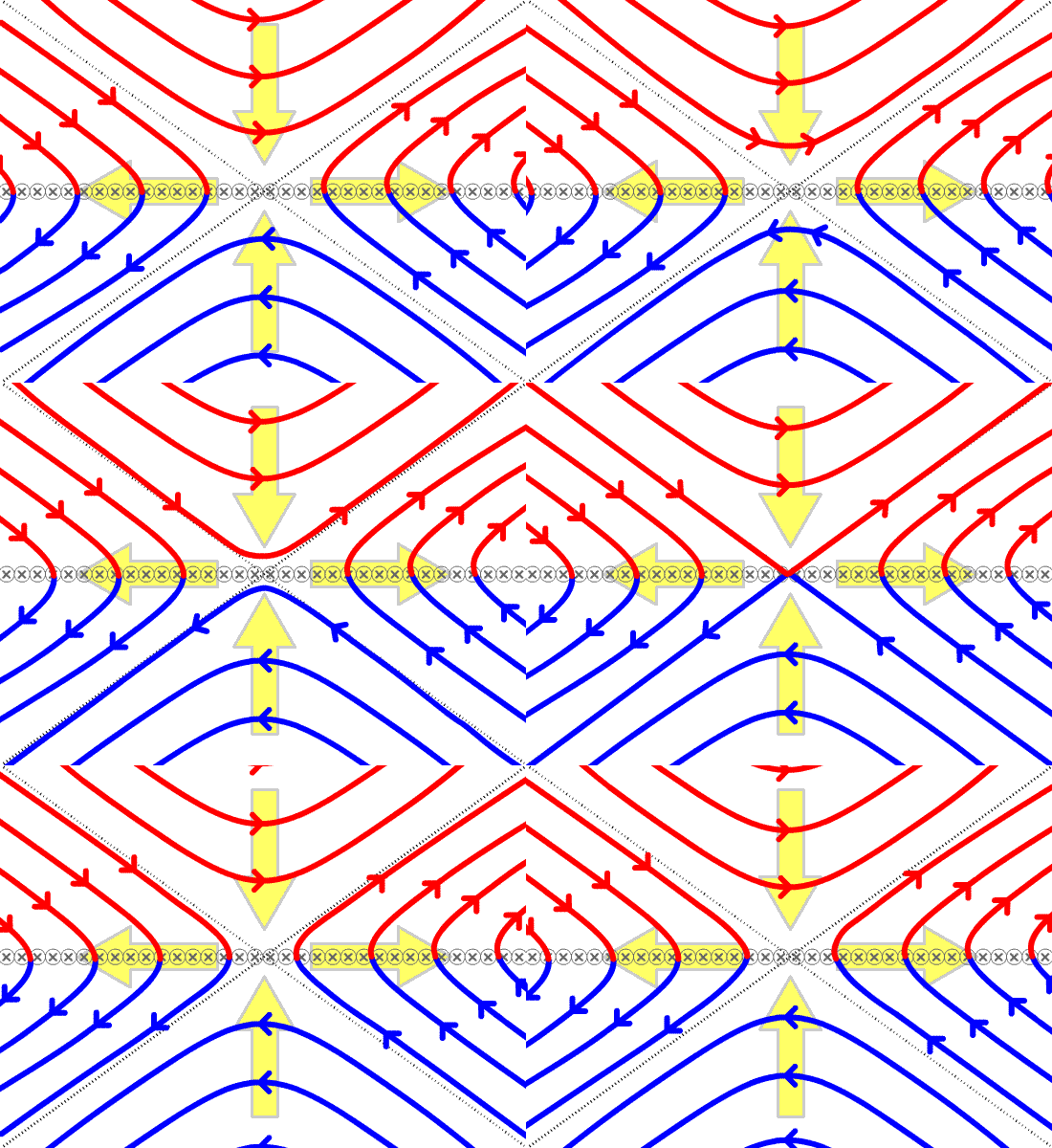
PhilaDelic 2023

I will be delivering the following talk. Please come say hi!

Talk Title: Neural-Field Annealing and Psychedelic Thermodynamics

Talk Abstract: The paradigm of Neural Annealing developed at the Qualia Research Institute (QRI) by Andrés Gómez Emilsson and Michael E. Johnson has a lot of explanatory power in the context of meditation and exotic states of consciousness such as those induced by psychedelic agents. The theory posits that there is a sense in which each state of consciousness has an associated level of energy, that there are specific energy sinks and sources in the nervous system, and that internal representations can be modified (and indeed “internal stress” released) with an appropriate heating and cooling schedule (aka. neural annealing). More recently, the theory has been enriched with “non-linear wave computing“, which might be capable of formalizing the concept of a (phenomenal) “vibe” for internal representations. Of special interest for the scientific community studying psychedelics and meditation is the recent QRI model of Neural Field Annealing, which combines Hebbian learning with Neural Annealing in order to explain why “highly annealed brains” can instantiate harmonic field behavior (such as the Jhanas). In this talk Andrés will provide an overview of the theory, share empirical findings, and discuss its testability based on its unique predictions.

Relevant links: Overview of the Theory presented at The Stoa, Neural Annealing (Johnson, 2019), Application of the Theory for Healing Trauma (Gomez-Emilsson, 2021), and a fun video by Anders (RIP) and Maggie with a conceptual demonstration based on the harmonic modes of a cold-worked metal before and after undergoing annealing.

Also recent in this space:


Solution to the Boundary Problem

The first time I discussed this approach to the boundary problem was for a presentation I was going to give at The Science of Consciousness 2020 (see: Qualia Computing at: TSC 2020, IPS 2020, unSCruz 2020, and Ephemerisle 2020). Alas, COVID happened. Now, thanks to the amazing Chris Percy, who joined QRI as a visiting scholar in 2022 and has been killing it as a collaborator, we have a thoroughly researched paper we can point to for this solution. Please send us feedback, cite it, and join the conversation. I believe this is one of the most significant contributions of QRI to philosophy of mind to date, and I hope high-quality engagement with it by physicists will only make it better. Thank you!

Abstract:

The boundary problem is related to the binding problem, part of a family of puzzles and phenomenal experiences that theories of consciousness (ToC) must either explain or eliminate. By comparison with the phenomenal binding problem, the boundary problem has received very little scholarly attention since first framed in detail by Rosengard in 1998, despite discussion by Chalmers in his widely cited 2016 work on the combination problem. However, any ToC that addresses the binding problem must also address the boundary problem. The binding problem asks how a unified first person perspective (1PP) can bind experiences across multiple physically distinct activities, whether billions of individual neurons firing or some other underlying phenomenon. To a first approximation, the boundary problem asks why we experience hard boundaries around those unified 1PPs and why the boundaries operate at their apparent spatiotemporal scale. We review recent discussion of the boundary problem, identifying several promising avenues but none that yet address all aspects of the problem. We set out five specific boundary problems to aid precision in future efforts. We also examine electromagnetic (EM) field theories in detail, given their previous success with the binding problem, and introduce a feature with the necessary characteristics to address the boundary problem at a conceptual level. Topological segmentation can, in principle, create exactly the hard boundaries desired, enclosing holistic, frame-invariant units capable of effecting downward causality. The conclusion outlines a programme for testing this concept, describing how it might also differentiate between competing EM ToCs.


QRI’s Consciousness Art Contests: Immerse, Innovate, and Inspire

Congratulations to the winners of QRI’s Art Contests! (contest announcement). Many thanks to all of the participants! You guys did really great! We will share all of the submissions for which the artists gave us permission to post in the near future; and in my opinion, there were simply too many amazing submissions that didn’t get a prize. We asked the community for awesome content, and they delivered!

Psychedelic Epistemology: The Think Tank Approach

I want to express gratitude to the panel of judges who diligently worked to evaluate each of the submissions along key dimensions in agreement with the contest specifications. To provide a little background about the panel, I should mention that since early 2020 QRI has been periodically hosting a “Phenomenology Club” by invitation only which gathers top scientists, philosophers, artists, meditators, and psychonauts. We usually choose a particular topic to discuss (e.g. comparing specific kinds of pains or pleasures), or otherwise interview someone with extensive experience with a particular facet of consciousness. For example, we once interviewed three people all of whom have tried taking 5-MeO-DMT in high doses every day for at least a month (i.e. Leo Gura isn’t the only one who has done this!). Really, we are able to do this because QRI has functioned as a beacon to attract highly experienced rational psychonauts and people seriously interested about the nature of consciousness since ~2017. It is out of this pool of world-class phenomenologists from which the panel of judges was formed. The panel includes people who have had over 1,000 high-dose experiences with LSD, psilocybin, DMT, 5-MeO-DMT, dissociatives, and a vast experience with meditative practices like the Jhanas and the process of insight. More so, in order to evaluate the PsyCrypto submission, some of the judges took psilocybin mushrooms and ayahuasca in a place where it is legal to do so. They all gathered to look at and discuss the submissions sober, then while on mushrooms, then sober again, then while on ayahuasca, and then sober again, and only then they were told about the “encryption key” the contestants submitted, and then they had yet another chance to look at them on either mushrooms or ayahuasca while knowing what it is that they were supposed to see. Most of the judges reported that the winning submissions did in fact work. So I am fairly confident that they do.

Similarly, for the Replications contest, the judges looked at the submissions before, during, and after mushrooms and ayahuasca so that they would have a very fresh impression of what these states are like in order to make accurate and technically precise judgements. Hence the detailed and object-level feedback for the top 10 submissions we were able to provide.

Importantly, at QRI we believe that this is the kind of “facing up to the empirical facts” of psychedelic states of consciousness that will actually advance the science of consciousness (aka. the “think tank approach“). This approach stands in stark contrast with, just to give an example: giving surveys to drug-naïve individuals (exclusion criteria incl. “lifetime prevalence of hallucinogens or MDMA use >20 times”) and having them blindly try either LSD or “candy flipping” [MDMA + LSD], a methodology that apparently allows you to conclude that MDMA doesn’t add anything noteworthy to the experience:

Source: Acute effects of MDMA and LSD co-administration in a double-blind placebo-controlled study in healthy participants (2023, just published in Nature)

As a simple metaphor, imagine what would it take to make genuine progress in the science of electromagnetism. Would you approach the problem of figuring out how magnets work by putting people who have never seen magnets in a room to play with them for a few minutes and then asking them to fill out a questionnaire about their experience? Or… would it perhaps be more fruitful to gather a team of top mathematicians and visual artists who are very experienced magnet-users and allow them to play with them in any way they want, talk extensively with one another, and generate models, predictions, and visualizations of the phenomenon at hand? Which approach do you think would have better chances of arriving at a derivation of Maxwell’s Equations?

Well, you probably know my answer to that question, as QRI is “Psychedelic Think Tank Approach Central”, and we are damn proud of it 🙂

See: 5-MeO-DMT vs. N,N-DMT: The 9 Lenses (video), which is the sort of content that could only ever be generated with a Think Tank Approach to exotic states of consciousness.


QRI in the Front Page of HackerNews

See: Messages that can only be understood under the influence of psychedelics (qri.org)

On HN’s top comments:

It’s amazing to me how people feel, at times, in a hurry to try to explain away anything interesting involving psychedelics with catch-all ideas like “it’s just slower processing” or “it’s just the result of messing with feedback, nothing to see here” (cf. Need For Closure Scale).

The winners of the PsyCrypto contest used the lowest hanging fruit idea for how to do PsyCrypto. It’s amazing that it works, and it does show a computational advantage that isn’t present in normal states of consciousness. And this isn’t trivial! In fact tracers in general affect how you think at a deep level, allowing for thoughts and feelings that never overlap in everyday life to actually show up together in your experiential field at once. This lingering effect increases the internal cross-pollination of information categories in one’s mind. This allows you to make completely new connections in your mind; hooking tracers with field computing is computationally non-trivial. More on this later.

But… also there is a plethora of more sophisticated approaches. I won’t say much more right now, but essentially PsyCrypto can be done in entirely different ways than using tracers. This includes things like pareidolia, color gradients, and detection of movement. And it is these novel approaches that will show the even more interesting computational advantages to the state.

We ain’t seen nothing yet. We’re at the dawn of a new era 🙂


QRI in the Front Page of Vice.com

See: These ‘Psychedelic Cryptography’ Videos Have Hidden Messages Designed to Be Seen While Tripping

Some of you might have seen the recent coverage of the Qualia Research Institute by Vice (Silicon Valley’s Latest Fascination is Exploring ‘DMT Hyperspace’). I was contacted by the journalist, who saw my lecture on the Hyperbolic Geometry of DMT Experiences and wanted to learn more. We had really fruitful conversations and a couple of email exchanges. And content-wise, the article turned out pretty good. But I was a bit surprised that, at least on the surface, the article went for the “Silicon Valley people are funding this thing, I wonder why?” sort of angle – which of course, if you ask me, has close to zero chances of actually making sense of the QRI phenomenon. Instead, the sort of explanatory framework you will need to understand how QRI is even possible requires a more radical openness about the nature of reality, including the realization that consciousness having mathematical underpinnings has ethical implications, that good actors would be motivated to learn about such properties to reduce suffering, a conception of Open Individualism as a rationally defensible viewpoint smart people can hold in reflective equilibrium, and the existence of exotic states of consciousness of extreme computational and valence significance such as the phenomenology of “Rainbow God“. Ultimately, I am very grateful for the coverage (and of Vice’s coverage of psychedelics more broadly), and simply chalk up the angle the story took to the following:

Now, in the wake of our announcement of the PsyCrypto winners, as I very much anticipated, I got an email from Vice:

Dear Andrés,

I’m a science reporter for VICE. Great to be in touch.I’m reaching out about the results of the Qualia Research Institute’s Psychedelic Cryptography Contest, which is a story we’d love to share with our readers. 

I was hoping you could answer a few questions about the contest. I wrote them out here in case it’s more convenient to respond over email, but I’m also available for a phone or Zoom call anytime before 3:30pm Eastern Daylight Time today if that works better. Thanks so much and hope to connect.

1. First, I’d love to know what inspired this contest. What are you and your colleagues at QRI hoping to learn and achieve with the Psychedelic Cryptography Contest?

2. On the page announcing the results, you note that “only three submissions seemed to have any promising psychedelic cryptography effects” and that “to decode these pieces you do require a substantial level of tracers.” Why were these three submissions so much more effective than the rest of entries to this contest? Were they the only ones to use the “first classic PsyCrypto encoding method” that is described in your recent blog post, or was there another reason they stood out from the rest?

3. You note that these PsyCrypto experiments can open up new avenues of research in the fields of neuroscience and consciousness. What are some of the open questions in these fields that you think PsyCrypto encoding could help to constrain or resolve?

4. Last, do you and your colleagues QRI have any plans to build on these findings about PsyCrypto with other future studies, contests, or related projects?

Much appreciated! Best,
XXXX

Sent June 6 at 9:05 AM

And my response:

Dear XXXX,

Awesome! Science reporter? It sounds like we’re getting an upgrade 🙂 QRI, that is. Mom, I’m on Vice!

Ok, forgive that. I’m just very stoked about the warm reception that PsyCrypto has been getting in the last couple of days. We made it into the front page of Hacker News and I’ve been receiving emails from neuroscientists and artists. […]. So I’m in a good mood 🙂

[…]

I’m more than happy to answer your questions here.

1. I first came up with the idea of PsyCrypto over 10 years ago, while in grad school. I was throwing into the air some spinning glow sticks in the darkness and noticing the patterns that would arise from their trajectory in space. I realized that the lighting conditions were ideal for me to actually make sense of their movement, and wondered if it would be in fact easier to see that path while on psychedelics, given their well-known tracer effects. I immediately coded up some experiments to hide letters using that idea and gave the code to some friends, who then reported some mild but noticeable improved ability to read them while on LSD. After that, I brainstormed a number of alternative encoding methods, coined the term Psychedelic Cryptography, and a couple of years later wrote the Qualia Computing article you saw.

Now, this didn’t happen in a vacuum. Already in 2011 I was a fan of David Pearce and his philosophy of mind (see physicalism.com). In essence, his view is that consciousness evolved because it has information processing advantages. In particular, phenomenal binding, he believes, is not a classical phenomenon. It is in fact enormously computationally beneficial, as we can learn from disorders of consciousness where binding partially breaks down.

So even then I was actively in the lookout for ways to demonstrate how consciousness actually confers an information processing advantage. And psychedelics, to me, felt like very fertile territory to explore this idea. In essence, people have reported all sorts of information processing benefits from psychedelics (e.g. the classic study of Harman and Fadiman of psychedelics for problem solving). But this is still controversial, so to me PsyCrypto is a way to show the undeniable benefits (and tradeoffs!) in terms of information processing that different states of consciousness confer.

The more PsyCrypto encoding schemes are identified and developed, the more this research direction is advanced. It is the emerging field of “Qualia Computing”. Namely, the study of the ways in which consciousness is computationally non-trivial. 🙂

We believe that the contest furthers this mission, and that opening up the project to a broader audience, with prizes and recognition for winning, can drastically accelerate this research direction.

2. The top three submissions were the only ones that worked at all according to our team of expect phenomenologists. They tried really, really hard to find messages in every submission while on mushrooms and ayahuasca (at places where these substances are perfectly legal) and none of the other submissions had anything worth commenting on (sorry!). I think many people misunderstood the task, tried something random without checking if it works first, or simply crossed their fingers and hoped.that their images would look different enough on psychedelics to contain new and meaningful information. But alas, no. Only the three winners had anything resembling PsyCrypto in them. And to top it off, they were also very aesthetically pleasing. So they are, in my mind, real rockstars 🙂

I do expect a dramatic improvement in the quality of submissions next time we run this contest, though.

Very importantly, based on recent work at QRI, I am convinced that there are at least 3-4 completely new and mind-blowing ways to achieve PsyCrypto that do not use tracers at all. The tracers are, in a way, the trivial case. The new PsyCrypto encoding schemes are… Far more surprising and non-trivial. We will publish more information about them in the near future.

3. Yes, absolutely. In essence, I believe that novel PsyCrypto encoding schemes are a window into the actual information processing algorithms of the visual system. At the risk of sounding fringe, I am not impressed with the current mainstream neuroscience models of how psychedelics work or how they alter visual perception. Yes, one can see tunnels and 2D symmetrical tessellations while on psychedelics. But actually… One can *also* experience hyperbolic honeycombs, 4D projective transformations, and fast spatiotemporal Fourier transforms of non-linear resonance. I am sorry, but no current neuroscientific theory *predicts* this. So we are currently in what David Pearce calls the pre-Galilean era for theories of consciousness. Like the (apocryphal) story of the priests not wanting to look through the telescope of Galileo because “the Bible already tells you the truth about the heavens”, similarly right now most theories of how the visual system work are not taking into account the facts of what happens on, say, DMT. Don’t ever let the theory dictate the facts! Instead, let the facts dictate the theory (see: my presentation about psychedelic epistemology).

Therefore we think that by developing encryption schemes that use *phenomenological facts* such as hyperbolic geometry on DMT (https://youtu.be/loCBvaj4eSg) we will radically transform the conversation about how consciousness works and what its information processing properties are. Once you show that those geometries can be used for information processing, and that humans in the right state of consciousness display such advantages, then it becomes undeniable that they are in fact using such exotic geometry for computation. I believe this will set the trajectory of the history of consciousness in very unexpected ways. Indeed, superintelligence won’t be achieved with AI, but with consciousness engineering.

4. Yes. Now, please note that PsyCrypto and in fact psychedelic phenomenology research is only a part of what the Qualia Research Institute does. We have serious work in philosophy of mind, ethics, valence, neurotechnology, and neuroscience, to name a few. We are extremely prolific given our shoestring budget, tiny number of members, and relatively low profile in academia. But I am confident that as we keep producing world class outputs in all of these fields, QRI will become far more influential and mainstream 🙂

Ultimately, my mission is to prevent all future suffering (see my TEDx talk) and figure out how to enable all sentient beings to experience long-term sustainable blissful states at will. This mission is enormously ambitious, but hey, that’s what I want to do with this one life I have. And so is the mission of the other members of QRI. Let’s get to work! 🙂

Thank you! And please let me know if I can clarify anything.

Infinite bliss!

Sent via email June 6 at 4:30PM

And given this, I really thought that the resulting Vice post was actually really stellar. Thank you! 🙂


Qualia Mastery Series

Finally, this guided meditation series is aiming to make accessible QRI paradigms to a wider audience at a direct, experiential level.

We titled the series Qualia Mastery – Building Your Toolkit for Navigating the State-Space of Consciousness.

Qualia Mastery, a concept I introduced in a review of a Jhana meditation retreat, is, in a nutshell, the self-organizing vector that cultivates the tools and practices needed to achieve the following three goals:

1) Explore the state-space of consciousness because you want to know it for yourself

2) Study it from many points of view because you want to understand it intellectually at a deep level

3) Intend to apply it for the benefit of all beings

May this be of benefit to you and all sentient beings! And also, have fun!

Infinite bliss!

Andrés 🙂

Good Vibe Theory

[Epistemic status: work in progress that is highly speculative but which I have reason to think has explanatory power – the content comes from this talk I gave at the Oxford Psychedelic Society a couple of weeks ago, which was then summarized/turned into a Twitter thread by Hunter Meyer]


QRI’s ‘Good Vibes Theory’ (GVT) is a speculative proposal for a physics of consciousness. This theory aims to establish an ontological foundation for a future rigorous science of good vibes. 🧵🧵🧵 #psychedelicthermodynamics #goodvibestheory

Two groups will make the most use of GVT; one is the “vibe engineers,” who are grounded in creating good vibes technically, and the mystics, who want to connect good vibes to deep insights and truths of wisdom traditions.

There is a deep connection between the shape of things and the way they vibrate. Different shapes have different energies, as their curvature, complexity, and surface area increase.

Internal representations act as energy sinks that absorb and channel ambient energy. They are often symmetrical and have semantic meaning, which makes them effective energy sinks. These representations also radiate energy and have energizing effects *to other representations*.

In physics, the Hamiltonian of a system is a measure of the system’s total energy. Similarly, the Hamiltonian of Consciousness would formulate how to add up all the energy of each component of a bound experience created by a system to get the total energy of that experience.

QRI proposes a new framework, “Psychedelic thermodynamics”, which offers a novel perspective on energy flow in consciousness.

In this framework, one system’s energy sink is another system’s energy source. The energy flows from sensory input to consciousness, where it’s transformed into internal representations or “solitons” and released through motor actions or field radiation.

The quality of conscious experience is shaped by the energy radiated from internal representations known as gestalts, which interact with each other to produce the texture and valence of the experience. The shape of the gestalts determines the vibe they radiate (cf. valence structuralism).

The “vibes” of our experiences are determined by the interaction of our internal representations, and dissonance can arise from being out of phase with input, incompatibility with noise, being intrinsically misshaped, or dissonance with other representations.

Psychedelic Thermodynamics suggests that the valence of a psychedelic experience can be modulated by inputs to the extent that they are in tune with the background noise and there are no misshapen or incompatible inputs leading to dissonance and negative valence.

Input valence effects are therefore the result of how external stimuli interact with internal representations in conscious experience. The degree of coherence between the input and the background noise, as well as the shape and resonance of the internal representation, determine an input’s valence effects.

The Flower of Life from sacred geometry can be steel-manned (within indirect realism) as a powerful metaphor for how experience is constructed. It may have deeper metaphorical relevance in physics than previously realized in light of Feynman and Wheeler’s “one-electron universe” where reality is an interference pattern of one electron bouncing back and forth in time.

The iterative way in which the Flower of Life is constructed takes on a new potential metaphorical meaning that can be used as a lens to understand the fundamental nature of reality.

There may be just one electron in the entire universe. It is because when an electron and an anti-electron interact, they merge and cancel out, producing a photon.

Mathematically, the interaction of an electron moving back in time is the same as an anti-electron, called a positron. As a result, there is only one type of observer in the universe, and it is bouncing back and forth in time, interfering with itself.

According to physics, quantum mechanics is mathematically equivalent whether it is thought of as fields or a superposition of all possible paths.

The Schrodinger equation, which describes the behavior of quantum mechanical systems, gives the same answers whether solving the field or taking one electron or one photon and making it go through every possible path and then superimposing all those paths simultaneously.

The behavior of an electron is the sum total of all possibilities. The field and the one electron can be thought of as the same, a matter of perspective. The field is a superposition of paths, while the electron is a smooth field evolving according to the Schrodinger equation.

The field usually segments into pockets, and the topology of the magnetic field changes through a process known as magnetic reconnection, which has real-world implications, like solar flares and coronal mass ejections in the sun.

A possible solution to the “boundary problem” (how is it that we are not all just one bound experience? why are we separate moments of experience?) is that the thing that creates a boundary around an individual’s experience is a topological pocket, and within it, there is a field.

The question then arises, what does it feel like to be that field in the topological pocket?

The field is equivalent to all possible paths within it. Thus, to be a pocket in the field might feel exactly like every point in that field, knowing about every other point. This interaction between all points within the field gives rise to the entirety of the shape.

The experience of being the one electron in the topological pocket would be precisely the superposition of all possible points of view that exist within it. It aligns with what mystics have talked about for a long time – the screen of consciousness is not fundamental, but emergent.

The screen of consciousness is a special case that requires the field to be shaped in a peculiar way so that “it seems like there is a screen from every possible trajectory within the topological pocket of the field”.

Symmetry, meaning “invariance upon transformation”, can entail that many different paths look the same. As a consequence, in some situations making the pocket perfectly symmetrical (via e.g. neural annealing) can collapse the dimensionality of the experience.

As a powerful metaphor, the symmetrical nature of electron orbitals might offer insights into the experience of altered states of consciousness, such as those induced by high doses of LSD.

Under LSD, symmetrification of self within a pocket collapses multiple points of view, leading to a collective wavefront. Points within the pocket sense the field and advance as a collective wavefront, blurring the line between a point and a wave.

Some states emit coherent waves of awareness in resonant patterns, with inherent trade-offs between location and frequency due to the Heisenberg Uncertainty Principle.

The symmetrical structures on DMT function as “witnesses of the scene”. Hence, with each pattern of resonance that gets organized in a symmetrical way, you add a new “reference frame” for the experience.

With a physics of consciousness, we should be able to look at trippy DMT replication images, understand their non-trivial meaningful content, and interpret the reason for the existence of the patterns and structures within them.

DMT induces resonant and coherent states of consciousness that emit waves of awareness that are in phase and which seem to be subjectively equivalent to many points simultaneously sensing the (inner) environment.

These patterns on DMT are not just “3D patterns in the visual field”; they are far deeper and more coherent, with each cluster of coherence functioning as a coherent witness that is measuring its environment (art by Symbolika).

Understanding this we can reason about highly coherent states of consciousness like those induced by psychedelics, meditation, and other ecstatic/annealing methods in terms of a network of coherence, where each frequency at which the hierarchy is coherent with one another may tell us a lot about them.

The witness is a coherent wavefront of awareness that is interacting or embedded within your consciousness. As a consequence, it is possible to describe a state of consciousness as a network of coherence.

States where the physics of consciousness is evident, include DMT’s Symmetry Hotel, where every two-dimensional surface looks like a coherent symmetry group, and Crystal Worlds, which are between Magic Eye and the Waiting Room.

In the Crystal Worlds, the witnesses are three-dimensional, and there is a question of whether they are external or internal entities. However, they are coherent witnesses of awareness that are interacting or embedded within your consciousness and their inherently 3D “point of view” has geometric effects on the unfolding of the experience.

Coherence can help us understand the zoo of possible self-organizing principles that arise on something like DMT. The network of coherence can crystallize in various shapes, including low-level features or high-level features, fractally coherent, or hyperbolic networks (also Symbolika below). Many scale-specific network geometries are possible.

On DMT, as soon as there are coherent symmetrical structures there will be mirror rooms.

Each surface emits a coherent wavefront of awareness that reflects off of the other surfaces, and this behavior is reminiscent of light in that a coherent witness bounces off of itself in the various surfaces. This may explain why “mirror room experiences” on DMT are incredibly common.

Coherence has a remarkable effect on consciousness that mirrors its effect on light. When mirrors become parallel, the subject and object collapse with perfect symmetry. Every alignment feels like a union because the witness and the witnessed collapse.

DMT induces resonant and coherent states of consciousness that emit waves of awareness, and each cluster of coherence functions as a coherent witness that is measuring its environment.

Understanding the physics of consciousness on DMT can help us understand the network of coherence, the zoo of possible self-organizing principles that arise, and the common experiences such as the mirror room experiences.

The present depiction is an intuitive and conceptual overview, while a formal and scientifically rigorous formulation is currently under development. Nonetheless, we are enthusiastic about its capacity to provide comprehensive explanations and develop its practical applications.

QRI’s GVT and Psychedelic Thermodynamics are ambitious proposals, but they are exciting ones that could open up new avenues of exploration in the field of consciousness.

If you are as excited as we are about the direction consciousness research is headed, please consider learning more at qri.org

You can find the full presentation on GVT here. Thank you @kfshinozuka and Ali-Reza Omidvar and the rest of the folks at @OxPsySoc for hosting this event:

Thank you for reading!

Infinite bliss!

QRI: A Year in Review – 2022

We are deeply grateful to have you with us on our expedition through the state-space of consciousness. It’s been an exciting and productive year and we’re thrilled to share all of our updates and accomplishments. None of this would have been possible without support from sentient beings like you.


1+ Million Views

First of all, we are thrilled to announce that our presentation on DMT & Hyperbolic Geometry has reached an amazing milestone of 1+ million views this year. We highly appreciate the support and engagement of the community. This presentation has also helped to catalyze some incredible collaborations.

Check Out QRI’s Latest DMT Research


“I interpret QRI as coming at the problem from the opposite direction as everyone else: normal neuroscience starts with normal brain behavior and tries to build on it until they can one day explain crazy things like jhana; QRI starts with crazy things like jhana and tries to build down until they can explain ordinary behavior. This is naturally going to be shakier and harder to research – but somebody should be trying it.”

– Scott Alexander, Astral Codex Ten¹


Peer-Reviewed Research Publication Pipeline

Our Slicing Problem paper, which provides a novel critique of computational theories of consciousness, has been accepted to the journal Open Philosophy.

We’ve also recently submitted a paper on our Heavy-Tailed Valence Hypothesis (read the preprint), which is the latest iteration of our Logarithmic Scales of Pleasure and Pain – a key foundational piece for the field of valence research.

QRI has been working on building this field since 2015. We are proud to continue pushing the boundaries of knowledge in valence research. We are just getting started!

Up next: QRI’s solution to the Boundary Problem of Consciousness and a hypothesis piece for the Symmetry Theory of Valence and how it might be tested!


Tyringham Initiative

In addition to our research efforts, we’ve had the opportunity to connect with others in the research community. Our Director of Research, Andrés Gómez Emilsson, presented at the Tyringham Initiative, and we held a meet-and-greet in London with approximately 40 attendees, including some of QRI’s earliest supporters. We are thrilled to see such a strong interest in building a worldwide “qualia research community”, and we look forward to hosting more meetups in the future.


QRI now has an unofficial Discord server which has already gathered over 1000 members and has fostered engaging discussions related to QRI, attracting notable figures in the field like Roger Thisdell and the founders of PsychonautWiki.

Join


QRI Summer Event

One of the highlights of the year for us was getting to host a QRI event in the San Francisco Bay Area, attended by over 200 people. It was a great opportunity for us to showcase some of our latest tangible innovations, such as our scents and a demo of our Light-Sound-Vibration system. We also had a speech about the Future of Consciousness, which generated some thought-provoking conversations.


TEDx Talk

QRI’s first TEDx Talk got published, which discusses interventions that will have as much, if not more, impact in reducing suffering as anesthesia. The most innovative part of the talk was about anti-tolerance drugs. We believe that we are the only organization in the entire world talking about anti-tolerance drugs as a dedicated field of study with enormous implications rather than as a mere biochemical oddity.


QRI Articles

Just Look At The Thing!

A thorough explanation of how the science of consciousness and valence structuralism inform ethics and what the Effective Altruism movement is missing.

Digital Sentience

Digital computers will remain unconscious until they recruit physical fields for holistic computing using well-defined topological boundaries.


QRI Media

The Ontological Dinner Party

w/ Daniel Ingram, Andrés Gómez Emilsson, Frank Yang, & Ryan Ferris

Reflections on a 2-Week Jhāna Meditation Retreat

A deep phenomenological reflection on Pīti and the 1st Jhāna through a QRI-theoretic lens.

Harmonic Gestalt

Steven Lehar provides an overview of the core insights of his life’s work.

Exploratory Haptic Research

Valence, Arousal, Phenomenal Complexity, and Loving-Kindness

The History of HedWeb

Andrés Gómez Emilsson interviews QRI Board of Advisor and author of the Hedonistic Imperative, David Pearce.

The Aesthetic of the Meta-Aesthetic – On the Stoa

This talk explores modeling the generator of each aesthetic in order to create a network of “compatibility between aesthetics” that minimizes dissonance between them while emphasizing their synergies as well as their unique and valuable contributions.

Andrés Gómez Emilsson & Roger Thisdell – WystanTBS

Discussion on indirect realism, phenomenal time, qualia formalism, exotic phenomenal spacetime in psychedelic and meditative phenomenology, the effects of persistent subject-object nonduality on phenomenal spacetime and hedonic valence, and more!

Stephen Snyder & Andrés Gómez Emilsson – WystanTBS

A wide-ranging discussion and sharing of perspectives covering jhāna, Brahmavihārās, comparisons with psychedelic states, and the journey to and from the Absolute.

Leigh Brasington & Andrés Gómez Emilsson – WystanTBS

AI, Sentience & the Binding Problem of Consciousness – Adam Ford’s Science, Technology & the Future

Is Google’s LaMDA sentient? The phenomenal binding problem asks us to consider, ‘how can a huge set of discrete neurons form a unified mind?’ Is topological binding a requirement for AI to be sentient?

The Future of Consciousness – Adam Ford’s Science, Technology & the Future

A positive vision of the future that is both viable given what we know, and also utterly radical in its implications.

Psychedelic Qualia – Martin W. Ball

A discussion on psychedelic qualia, philosophy of mind, phenomenology, salvia divinorum, DMT, 5-MeO-DMT, MDMA, and more!


Listen to QRI on the Go!

You can now listen to QRI material on the go, while driving, doing exercise, in the sauna, or any other healthy annealing rituals!


Supporting QRI

Purchase a scent pack from QRI’s new scent line “Magical Creatures”. This line of scents explores the complex and often puzzling interactions that exist in the state-space of olfaction, highlighting the exotic and unique qualities that can emerge in this space.

Purchase QRI’s Magical Creatures

Please feel free to donate to QRI independent of our Magical Creatures campaign.


Thank you!

We want to thank everyone who has helped QRI in any way, including our current and past collaborators, donors, readers, video watchers, and event attendees. Special thanks to Hunter, Anders & Maggie, Marcin, Chris, Winslow, Olaf, Crystal, Libor, and David who really stepped up this year to help QRI in an incredible way. Our efforts wouldn’t matter or be possible without all of you! May you all be prosperous, energized, and access the full-state of consciousness for the benefit of all beings! Thank you!


¹ Additional QRI references by Scott Alexander on Astral Codex Ten this year:

Copyright (C) 2022 Qualia Research Institute. All rights reserved.