Extract from Do Androids Dream of Electric Sheep? by Philip K. Dick (1968)
Chapter 1
A merry little surge of electricity piped by automatic alarm from the mood organ beside his bed awakened Rick Deckard. Surprised — it always surprised him to find himself awake without prior notice — he rose from the bed, stood up in his multicolored pajamas, and stretched. Now, in her bed, his wife Iran opened her gray, unmerry eyes, blinked, then groaned and shut her eyes again.
“You set your Penfield too weak”, he said to her. “I’ll reset it and you’ll be awake and — ”
“Keep your hand off my settings.” Her voice held bitter sharpness. “I don’t want to be awake.”
He seated himself beside her, bent over her, and explained softly. “If you set the surge up high enough, you’ll be glad you’re awake; that’s the whole point. At setting C it overcomes the threshold barring consciousness, as it does for me.” Friendlily, because he felt well-disposed toward the world — his setting had been at D — he patted her bare, pale shoulder.
“Get your crude cop’s hand away,” Iran said.
“I’m not a cop.” He felt irritable, now, although he hadn’t dialed for it.
“You’re worse,” his wife said, her eyes still shut. “You’re a murderer hired by the cops.”
“I’ve never killed a human being in my life.” His irritability had risen, now; had become outright hostility.
Iran said, “Just those poor andys.”
“I notice you’ve never had any hesitation as to spending the bounty money I bring home on whatever momentarily attracts your attention.” He rose, strode to the console of his mood organ. “Instead of saving,” he said, “so we could buy a real sheep, to replace that fake electric one upstairs. A mere electric animal, and me earning all that I’ve worked my way up to through the years.” At his console he hesitated between dialing for a thalamic suppressant (which would abolish his mood of rage) or a thalamic stimulant (which would make him irked enough to win the argument).
“If you dial,” Iran said, eyes open and watching, “for greater venom, then I’ll dial the same. I’ll dial the maximum and you’ll see a fight that makes every argument we’ve had up to now seem like nothing. Dial and see; just try me.” She rose swiftly, loped to the console of her own mood organ, stood glaring at him, waiting.
He sighed, defeated by her threat. “I’ll dial what’s on my schedule for today.” Examining the schedule for January 3, 2021, he saw that a businesslike professional attitude was called for. “If I dial by schedule,” he said warily, “will you agree to also?” He waited, canny enough not to commit himself until his wife had agreed to follow suit.
“My schedule for today lists a six-hour self-accusatory depression,” Iran said.
“What? Why did you schedule that?” It defeated the whole purpose of the mood organ. “I didn’t even know you could set it for that,” he said gloomily.
“I was sitting here one afternoon,” Iran said, “and naturally I had turned on Buster Friendly and His Friendly Friends and he was talking about a big news item he’s about to break and then that awful commercial came on, the one I hate; you know, for Mountibank Lead Codpieces. And so for a minute I shut off the sound. And I heard the building, this building; I heard the — ” She gestured.
“Empty apartments,” Rick said. Sometimes he heard them at night when he was supposed to be asleep. And yet, for this day and age a one-half occupied conapt building rated high in the scheme of population density; out in what had been before the war the suburbs one could find buildings entirely empty… or so he had heard. He had let the information remain secondhand; like most people he did not care to experience it directly.
“At that moment,” Iran said, “when I had the TV sound off, I was in a 382 mood; I had just dialed it. So although I heard the emptiness intellectually, I didn’t feel it. My first reaction consisted of being grateful that we could afford a Penfield mood organ. But then I realized how unhealthy it was, sensing the absence of life, not just in this building but everywhere, and not reacting — do you see? I guess you don’t. But that used to be considered a sign of mental illness; they called it ‘absence of appropriate affect.’ So I left the TV sound off and I sat down at my mood organ and I experimented. And I finally found a setting for despair.” Her dark, pert face showed satisfaction, as if she had achieved something of worth. “So I put it on my schedule for twice a month; I think that’s a reasonable amount of time to feel hopeless about everything, about staying here on Earth after everybody who’s smart has emigrated, don’t you think?”
“But a mood like that,” Rick said, “you’re apt to stay in it, not dial your way out. Despair like that, about total reality, is self-perpetuating.”
“I program an automatic resetting for three hours later,” his wife said sleekly. “A 481. Awareness of the manifold possibilities open to me in the future; new hope that — ”
“I know 481,” he interrupted. He had dialed out the combination many times; he relied on it greatly. “Listen,” he said, seating himself on his bed and taking hold of her hands to draw her down beside him, “even with an automatic cutoff it’s dangerous to undergo a depression, any kind. Forget what you’ve scheduled and I’ll forget what I’ve scheduled; we’ll dial a 104 together and both experience it, and then you stay in it while I reset mine for my usual businesslike attitude. That way I’ll want to hop up to the roof and check out the sheep and then head for the office; meanwhile I’ll know you’re not sitting here brooding with no TV.” He released her slim, long fingers, passed through the spacious apartment to the living room, which smelled faintly of last night’s cigarettes. There he bent to turn on the TV.
From the bedroom Iran’s voice came. “I can’t stand TV before breakfast.”
“Dial 888,” Rick said as the set warmed. “The desire to watch TV, no matter what’s on it.”
“I don’t feel like dialing anything at all now,” Iran said.
“Then dial 3,” he said.
“I can’t dial a setting that stimulates my cerebral cortex into wanting to dial! If I don’t want to dial, I don’t want to dial that most of all, because then I will want to dial, and wanting to dial is right now the most alien drive I can imagine; I just want to sit here on the bed and stare at the floor.” Her voice had become sharp with overtones of bleakness as her soul congealed and she ceased to move, as the instinctive, omnipresent film of great weight, of an almost absolute inertia, settled over her.
He turned up the TV sound, and the voice of Buster Friendly boomed out and filled the room. ” — ho ho, folks. Time now for a brief note on today’s weather. The Mongoose satellite reports that fallout will be especially pronounced toward noon and will then taper off, so all you folks who’ll be venturing out — ”
Appearing beside him, her long nightgown trailing wispily, Iran shut off the TV set. “Okay, I give up; I’ll dial. Anything you want me to be; ecstatic sexual bliss — I feel so bad I’ll even endure that. What the hell. What difference does it make?”
“I’ll dial for both of us,” Rick said, and led her back into the bedroom. There, at her console, he dialed 594: pleased acknowledgment of husband’s superior wisdom in all matters. On his own console he dialed for a creative and fresh attitude toward his job, although this he hardly needed; such was his habitual, innate approach without recourse to Penfield artificial brain stimulation.
Albert Camus famously claimed that the most important philosophical question in existence was whether to commit suicide. I would disagree.
For one, if Open Individualism is true (i.e. that deep down we are all one and the same consciousness) then ending one’s life will not accomplish much. The vast majority of “who you are” will remain intact, and if there are further problems to be solved, and questions to be answered, doing this will simply delay your own progress. So at least from a certain point of view one could argue that the most important question is, instead, the question of personal identity. I.e. Are you, deep down, an individual being who starts existing when you are born and stops existing when you die (Closed Individualism), something that exists only for a single time-slice (Empty Individualism), or maybe something that is one and the same with the rest of the universe (Open Individualism)?
I think that is a very important question. But probably not the most important one. Instead, I’d posit that the most important question is: “What is good, and is there a ground truth about it?”
In the case that we are all one consciousness maybe what’s truly good is whatever one actually truly values from a first-person point of view (being mindful, of course, of the deceptive potential that comes from the Tyranny of the Intentional Object). And in so far as this has been asked, I think that there are two remaining possibilities: Does ultimate value come down to the pleasure-pain axis, or does it come down to spiritual wisdom?
Thus, in this day and age, I’d argue that the most important philosophical (and hence most important, period) question is: “Is happiness a spiritual trick, or is spirituality a happiness trick?”
What would it mean for happiness to be a spiritual trick? Think, for example, of the possibility that the reason why we exist is because we are all God, and God would be awfully bored if It knew that It was all that ever existed. In such a case, maybe bliss and happiness comes down to something akin to “Does this particular set of life experiences make God feel less lonely”? Alternatively, maybe God is “divinely self-sufficient”, as some mystics claim, and all of creation is “merely a plus on top of God”. In this case one could think that God is the ultimate source of all that is good, and thus bliss may be synonymous with “being closer to God”. In turn, as mystics have claimed over the ages, the whole point of life is to “get closer to God”.
Spirituality, though, goes beyond God: Within (atheistic) Buddhism the view that “bliss is a spiritual trick” might take another form: Bliss is either “dirty and a sign of ignorance” (as in the case of karma-generating pleasure) or it is “the results of virtuous merit conducive to true unconditioned enlightenment“. Thus, the whole point of life would be to become free from ignorance and reap the benefits of knowing the ultimate truth.
And what would it mean for spirituality to be a happiness trick? In this case one could imagine that our valence (i.e. our pleasure-pain axis) is a sort of qualia variety that evolution recruited in order to infuse the phenomenal representation of situations that predict either higher or lower chances of making copies of oneself (or spreading one’s genes, in the more general case of “inclusive fitness”). If this is so, it might be tempting to think that bliss is, ultimately, not something that “truly matters”. But this would be to think that bliss is “nothing other than the function that bliss plays in animal behavior”, which couldn’t be further from the truth. After all, the same behavior could be enacted by many methods. Instead, the raw phenomenal character of bliss reveals that “something matters in this universe”. Only people who are anhedonic (or are depressed) will miss the fact that “bliss matters”. This is self-evident and self-intimating to anyone currently experiencing ecstatic rapture. In light of these experiences we can conclude that if anything at all does matter, it has to do with the qualia varieties involved in the experiences that feel like the world has meaning. The pleasure-pain axis makes our existence significant.
Now, why do I think this is the most important question? IF we discover that happiness is a spiritual trick and that God is its source then we really ought to follow “the spiritual path” and figure out with science “what is it that God truly wants”. And under an atheistic brand of spirituality, what we ought to figure out is the laws of valence-charged spiritual energy. For example, if reincarnation and karma are involved in the expected amount of future bliss and suffering, so be it. Let’s all become Bodhisattvas and help as many sentient beings as possible throughout the eons to come.
On the other hand, IF we discover (and can prove with a good empirical argument) that spirituality is just the result of changes in valence/happiness, then settling on this with a high certainty would change the world. For starters, any compassionate (and at least mildly rational) Buddhist would then come along and help us out in the pursuit of creating a pan-species welfare state free of suffering with the use of biotechnology. I.e. The 500 odd million Buddhists world-wide would be key allies for the Hedonistic Imperative (a movement that aims to eliminate suffering with biotechnology).
Recall Dalai Lama’s quote: “If it was possible to become free of negative emotions by a riskless implementation of an electrode – without impairing intelligence and the critical mind – I would be the first patient.” [Dalai Lama (Society for Neuroscience Congress, Nov. 2005)].
If Buddhist doctrine concerning the very nature of suffering and its causes is wrong from a scientific point of view and we can prove it with an empirically verified physicalist paradigm, then the very Buddhist ethic of “focusing on minimizing suffering” ought to compel Buddhists throughout the world to join us in the battle against suffering by any means necessary. And most likely, given the physicalist premise, this would take the form of creating a technology that puts us all in a perpetual pro-social clear-headed non-addictive MDMA-like state of consciousness (or, in a more sophisticated vein, a well-balanced version of rational wire-heading).
It would be impossible for me to summarize what truly went on at Psychedelic Science 2017. Since giving a fair and detailed account of all of the presentations, workshops and social events I attended is out of the question, I will restrict myself to talking about, what I see as, the core insights and take-aways from the conference (plus some additional impressions I’ll get to). In brief, the core insights are: (1) that we are on the brink of a culturally-accepted scientific revolution on the study of consciousness in which we finally navigate our way out of our current pre-Galilean understanding of the mind, (2) that the breakdown of both the extremes of nihilism and eternalism as ideological north-stars in consciousness research is about to take place (i.e. finding out that neither scientific materialism nor spirituality convey the full picture), and (3) that a new science of valence, qualia, and rational psychonautics based on the quantification of good and bad feelings is slowly making its way into the surface.
With regards to (1): It should not come as a surprise to anyone who has been paying attention that there is a psychedelic renaissance underway. Bearing extreme world-wide counter-measures against it, in so far as psychedelic and empathogenic compounds meet the required evidentiary standards of mainstream psychopharmacology as safe and effective treatments for mental illness (and they do), they will be a staple of tomorrow’s tools for mental health. It’s not a difficult gamble: the current studies being made around the world are merely providing the scientific backing of what was already known in the 60s (for psychedelics) and 80s (for MDMA). I.e. That psychedelic medicine (people love to call it that way) in the right set and setting produces outstanding clinically-relevant effect sizes.
On (2): it is very unclear what people who attended the conference believe about the nature of reality, but overall there was a strong Open Individualist undercurrent and a powerful feeling that transcendence is right next door (even the urinals had sacred geometry*). That said, the science provided a refreshing feeling of cautious nihilism. Trying to reconcile both love and science is, in my opinion, the way to go. Whether we are about to ascend to another realm or if we are about to find out about our cosmic meaninglessness, the truth is that there are a lot of more immediate things to worry about. Arguably, psychedelic experiences could be used to treat both the afflictions that come with eternalism as well as those that come from nihilism. Namely, psychedelics often make you experience the world as you believe it to be (echoing John C. Lilly’s famous words: “In the province of the mind, what one believes to be true is true or becomes true, within certain limits to be found experientially and experimentally. These limits are further beliefs to be transcended. In the mind, there are no limits…”). So if you rely on intense (but mundanely challenged) feelings of transcendence to get by, you may find out on a psychedelic experience that making a world in which what you believe is literally true does not lead to happiness and meaningfulness in the way you thought it might. Unless, of course, one believes that everything that happens is a net positive somehow (which is hard to do given the regular onslaught of meaninglessness found in everyday life), any profound realization of an ontological basis of reality (as in “a made up universe perceived as if real”) can lead to dysphoria. Nihilism can be profoundly distressing on psychedelics. Yet, as evidenced by the bulk of conscious experiences, the quality of meaningfulness in one’s experience is a continuum, neither objective nor subjective, and neither eternal nor unreal (I’m using the terminology from the book “Meaningness“, though other terminologies exist for similar concepts such as the Buddhist “middle way”, Existentialism, Pragmatism, Rationalists’ epistemic rationality, etc.).
Psychedelic veterans usually end up converging on something that has this sort of emotional texture: A bitter-sweet yet Stoic worldview that leaves an open space for all kinds of wonderful things to happen, yet remains aware of the comings and goings of happiness and fulfillment. It makes it a point to not be too preoccupied with questions of ultimate meaning. It may be that for most people it’s impossible to arrive at such wisdom without trying out (and failing in some way) to live all of their fantasies before giving up and accepting the fluxing nature of reality. In such a case, psychedelics would seem to offer us a way to accelerate our learning about the unsatisfactoriness of attachments and find the way to live in realistic joy.
That said, maybe such wisdom is not Wisdom (in the sense of being universal) since we are restricting our analysis to the human wetware as it is today. What reason do we have to believe that the hedonic treadmill is a fundamental property of the universe? A lot of evidence suggests persistent differences in people’s hedonic set-point (often genetically influenced, as in the case of the SCN9A gene for pain thresholds), and this challenges the notion that we can’t avoid suffering. Indeed, MDMA-like states may some day be experienced at will with the use of technology (and without side effects). There may even be scientifically-derived precision-engineered ethical and freedom-expanding wireheading technology that will make our current everyday way of life look laughably uninteresting and unmeaningful in comparison.
Unfortunately, talking about this (i.e. technologically-induced hedonic recalibration) with people who need a pessimistic metaphysics of valence just to function may be considered antisocial. For example, some people seem to need spiritual theories of the pleasure-pain axis that focus on fairness (such as the doctrine of Karma) in order to feel like they are not randomly getting the shorter end of the (cosmic) stick (this sentiment usually comes together with implicit Closed Individualist convictions). Of course feeling like one is a victim is itself the result of one’s affect. This provides the perfect segway for (3):
In addition to all of the magical (but expected) fusion of art, psychotherapy, mysticism, spirituality and self-hacking that this conference attracted, I was extremely delighted to see the hints of what I think will change the world for the better like nothing else will: psychedelic valence research.
Of particular note is the work of Dráulio Barros de Araújo (“Rapid Antidepressant Effects of the Psychedelic Ayahuasca in Treatment-Resistant Depression: A Randomized Placebo-Controlled Trial”), Mendel Kaelen (“The Psychological and Neurophysiological Effects of Music in Combination with Psychedelics”), Leor Roseman (“Psilocybin-Assisted Therapy: Neural Changes and the Relationship Between Acute Peak Experience and Clinical Outcomes”), Jordi Riba (“New Findings from Ayahuasca Research: From Enhancing Mindfulness Abilities to Promoting Neurogenesis”), Selen Atasoy (“Enhanced Improvisation in Brain Processing by LSD: Exploring Neural Correlates of LSD Experience With Connectome-Specific Harmonic Waves”), Tomas Palenicek (“The Effects of Psilocybin on Perception and Dynamics of Induced EEG/fMRI Correlates of Psychedelic Experience”) and Clare Wikins (“A Novel Approach to Detoxification from Methadone Using Low, Repeated, and Cumulative Administering of Ibogaine”).
And of all of these, Selen Atasoy‘s work seems to be hitting the nail in the head the most: Her work involves looking into how psychedelics affect the overall amount of energy that each of the brain’s discrete connectome-specific resonant states has. Without giving it away (their work with LSD is still unpublished) let me just say that they found that having some extra energy in specific harmonics was predictive of the specific psychedelic effects experienced at a given point in time (including things such as emotional arousal, deeply felt positive mood, and ego dissolution).
Remarkably, this line of work is in agreement with Mike Johnson’s theoretical framework for the study of valence (as outlined in Principia Qualia). Namely, that there is a deep connection between harmony, symmetry and valence that will make sense once we figure out the mathematical structure whose formal properties are isomorphic to a subject’s phenomenology. In particular, “Valence Structuralism” would seem to be supported by the findings that relatively pure harmonic states are experienced as positive emotion. We would further predict that very pure harmonic states would have the highest level of (positive) hedonic tone (i.e. bliss). We are indeed very intrigued by the connectome-specific harmonic approach to psychedelic research and look forward to working with this paradigm in the future. It would be an understatement to say that we are also excited to see the results of applying this paradigm to study MDMA-like states of consciousness. This line of research is, above all, what makes me think that this year is the Year of Qualia (whether we have realized it or not). As it were, we are seeing the first hints of a future science of consciousness that can finally provide quantitative predictions about valence, and hence, become the firstscientifically-complianttheory of ultimate value.
And now some subjective impressions about the conference…
Impressions
Psychedelic Ambiance
At its core, the conference felt extremely psychedelic in its own right. The artwork, people’s attires, the scents, the background music, etc. were all what seemed to me like expressions of an emerging style of psychedelic ambiance: A euphoric blend of MDMA-like self-assurant empathegenesis vibes (“everything will be ok”) with an LSD-like ontological sabotage to the ego entheoblasting vibes of universal oneness (“things are not what they seem/everything already always and never has happened at the same time”). Peak experiences, after all, often involve the metaphorical reconciliation of the divine and the mundane in a cosmic dance of meaning.
Marketplace
Hive mind ballon furniture
Eternalism meets DMT
The Gods
In his book “Simulations of God” John C. Lilly proposes that beneath the surface of our awareness, each and every mind worships a number of seemingly transcendental values (sometimes, but not always, explicitly personified). Whether we know it or not, he argues, each and every one of us treats as if a God at least something. Whether we think there there is a “God Out There”, that “Truth is the Ultimate God”, or that “God Is The Group”, the highest node in our behavioral hierarchy is always covertly managed by our basic assumptions about reality (and what they prescribe as “intrinsically good”). The book’s table of contents is awesome; it outlines what ends up being the bulk of what humans ever care about as their ultimate values:
God As the Beginning
I Am God
God Out There
God As Him/Her/It
God As The Group
God As Orgasm and Sex
God As Death
God As Drugs
God As the Body
God As Money
God As Righteous Wrath
God As Compassion
God As War
God As Science
God As Mystery
God As the Belief, the Simulation, the Model
God As the Computer
God Simulating Himself
God As Consciousness-without-an-Object
God As Humor
God As Superspace, the Ultimate Collapse into the Black Hole, the End.
The Ultimate Simulation
God As the Diad
Perhaps what’s most amazing about psychedelics is that they are capable of changing one’s Gods. It’s extremely common for people who take psychedelics to de-emphasize traditionalist and mainstream Gods such as 1, 3, 5, 7, 10, 11, 13, while also having experiences (and changes of mind) that push them to emphasize 2, 6, 8, 12, 14, 15, 16, 17, 18, 19, 21, 22, and 23. But one wonders, what’s the eventual steady-state? As an umbrella description of what is going on we could say that psychedelics make you more open. But where does this, ultimately, lead?
Perhaps you started out in a conservative household and a family that emphasized loyalty to the group, conformism, nationalism and traditional religious values (1, 3, 5, 7). But once you tried LSD you felt a great change in the strength of your various deep-seated inclinations. You realize that you do not want to worship anything just to fit in, just to be part of a group, and that maybe caring about money is not as important as caring about making your own meaning out of life. You now feel like you care more about mysterious things like Orgasm (6), the Mind-Body connection (9), and philosophical questions like “If I am God, why would I build a universe with suffering in it?” (2, 15, 16, 21). You maybe watch some lectures by Alan Watts and read a book by Huxley, among other counter-culture material consumed, and you might start to develop a general belief in “the transcendent” but in a way that attempts to be compatible with the fact that you and the people you love experience suffering. You fantasize with the idea that maybe all of suffering is somehow necessary for some higher cosmic purpose (18, 19, 22) to which you are only made privy every now and then. You then continue on the path of psychedelic divination, perhaps taking more than you could handle here and there, and you are made aware of incredible universes: you meet guardians, you are led to read about Theosophy, you meet archetypes of the collective psyche, and after a while your strange experience with electronic equipment on LSD makes you wonder whether telepathy (at least an energetic and emotional variant of it) could be possible after all. But you do not ever obtain “good enough evidence” that would convince anyone who is determined to be a skeptic of your glitches of the Matrix. At some point, after taking too many magic mushrooms, you end up in what seems like a sort of Buddhist Hell: Feeling like we are all One no longer feels like a fact to be excited about, but rather, this is felt as a realization that should be forgotten as soon as one has it. Don’t let the cosmic boredom set in, don’t led nihilistic monism get to your very core. But it does, and you have a bad trip, one trip that you feel you never really recovered from, and whose nature is never talked about at psychedelic gatherings. (Don’t worry, right next door someone had a bad trip whose semantic content was the exact opposite of yours yet its effects on your corresponding valence landscapes were similar, e.g. concluding that “we are all made of atoms with no purpose” may feel just as bad as believing that “we are all God, and God is bored”). So maybe psychedelic therapy is a red herring after all, you think to yourself, and we should really be looking only into compounds that both increase euphoria and obfuscate the ultimate nature of reality at the same time. “Science, we need science” -you tell yourself- “so that we can figure out what it is that consciousness truly wants, and avoid both nihilistic bad trips as well as unrealistic eternalist mania”. Perhaps we are currently about to have to figure this out as a collective intelligence: “What do we do with the fact that we are all God?” This question is now making its way in etheric undercurrents in the shared meme-space of humanity just as the psychedelic renaissance starts to unfold.
The above paragraph is just one of the various archetypical ways in which psychedelic self-exploration may progress over time for a particular person. Of course not only do people’s progression vary; people’s starting points may be different. Some people approach psychedelics with spiritual intentions, others do so with recreation in mind, others use them for psychological self-exploration, and yet others use it to try to find glitches in reality. I would love to have a quantitative assessment of how one’s starting “implicit Gods” influence the way psychedelics affect you, and how such Gods evolve over the course of more exposure to psychedelic states of consciousness. There is a lot of wisdom-amplification research to be made on this front.
Psychedelic Gods
You’re only as young as the last time you changed your mind.
– Timothy Leary
The first thing I noticed at this conference was that this is a crowd that values both love and science. The geek in me seemed to be more than welcomed in here.
While I was able to enjoy the incredible vibe of the Bicycle Day celebration (just a day before the conference), I remember thinking that evolutionary psychology (cf. Mating Mind) would have a lot to say about it. A large proportion of seemingly selfless display of psychedelic self-sacrifice (e.g. LSD mega-dosing, spiritual training, asceticism, etc.) might in fact be just sexual signaling of fitness traits such as mental and physical robustness (cf. Algorithmic Reduction of Psychedelic States, Political Peacocks). It’s hard to separate the universal love from the tribal mate-selection going on at raves and parties of this nature, and at times one may even get a bit of an anti-intellectual vibe for questioning this too deeply.
At the conference, though, I could tell there was another story going on. Namely, the God of Science made a prominent appearance, giving us all a sense of genuine progress beyond the comings and goings of the eternal game of hide-and-seek as one would expect in mere neo-hippy cyber-paganist events.
The God of Science… yes… if you think about it, holding an enriched concept of “science” (in its most expansive sense possible) while simultaneously trying to hold with equal intensity and expansiveness the intent of “love for all beings”, can make strange and wonderful things happen in your mind. Of salience is the fact that there will be an intense pull towards either only experiencing thought-forms about love or only focusing on thought-forms about science. Mixing the two requires a lot of energy. It’s almost as if we were wired to only focus on one at a time. This is an effect reminiscent to the mutual inhibition between empathizing and systematizing cognitive styles, and maybe at its core, the difficulty in blending both love and science without residue is a reflection of an underlying invariant. Under the assumption that you have a limited amount of positive valence at your disposal to paint your world simulation, and that you want to achieve clarity of mind, it is possible that you will have to front-load most of that positive valence in either broad quantitative observations (systematizing) or focused feelings of specialness and intimacy (empathizing). This is why, for instance, MDMA and 2C-B are so promising for cognitive transhumanism: these compounds can give rise to experiences in which there is a huge surplus of positive valence ready to be used to paint any aspect of your world simulation with bliss qualia. Sadly, this is a property of such states of consciousness, and it cannot currently be brought into our everyday lives as it is. Without serious genetic engineering (or other valence-enhancing technologies) all we can do for now is to make use of these states of consciousness to catalyze changes in our deep-seated existential stances in order to help us get by in our half-meaningful half-meaningless everyday life.
Of course, the Holy Grail of mental health interventions would be a technology that allows us to instantiate a context-dependent level of empathogenesis in a reliable and sustainable way. When I asked people at the conference whether they thought that having “a machine that makes you feel like you are on MDMA on demand with no tolerance, impulsivity, addiction or other side effects” would be good, most people (at least 80%) said “it would be bad for humanity to have such machine”. Why? Because they think that suffering serves a higher purpose, somehow. But I would disagree. And even if they are right, I still think that there are not enough people steel-manning the case for intelligent wire-heading. It’d be silly to find out in 2200 that we could have avoided hundreds of millions of people’s suffering at no cost to our collective growth if we only had thought more carefully about the intrinsic value of suffering back in 2050 when the MDMA-machine was invented and reflexively banned.
But healthy sustainable wire-heading (let alone wire-heading done right in light of evolution-at-the-limit scenarios) is many decades away into the future anyway. So all we have for now, by way of consciousness-expanding therapies for real-life knots-and-bolts treatment-resistant human suffering is the sort of therapy paradigms discussed in the conference. Of the roughly 135 conference talks (excluding parties, networking events, and workshops) at least 100 were either only or at least primarily focused on psychedelic therapy for mental illness (cancer end-of-life anxiety, PTSD, addiction, treatment-resistant depression, etc.). As far as a strategical cultural move, this focus on treatment is a very good approach, and from a valence utilitarian point of view maybe this is indeed what we should be focusing on in 2017. But I still wish that there was a bigger presence of some other kinds of discussion. In particular, I’d love for psychedelic science to eventually make a prominent appearance in a much wider context. Any discussion about the nature of consciousness from a scientific point of view cannot overlook the peculiar consciousness-enhancing properties of psychedelics. And any discussion about ethics, life and the purpose of it all will likewise be under-informed in so far as psychedelic peak-meaningful experiences are not brought into the conversation. After all, the ethical, philosophical, and scientific significance of psychedelics is hard to overstate.
Ideally we would all organize a conference that takes the best of: 1) A steadfast resolution to figure out the problem of consciousness, such as what we can find at places like The Science of Consciousness, 2) a steadfast resolution to combine both the best of compassion and rationality in order to help as many beings as possible, as we find in places like Effective Altruism Global, and 3) a steadfast resolution to look at the most impressive pieces of evidence about the nature of the mind and valence, as can be found in places like Psychedelic Science. All in all, this would be a perfect triad, as it would combine (1) The Question (Consciousness), (2) The Purpose (Ending Suffering), and (3) The Method (Scientific Study of Highly-Energetic States of Consciousness). Rest assured, the conferences organized by the Super-Shulgin Academy will blend these three aspects into one.
The Crowd
This was a very chill crowd. The only way for me to be edgy in the social contexts that arose at Psychedelic Science 2017 was to refuse to dab with the guy next to me (and to decline the Asparagus Butternut Squash edible offered at some point), or, at its worse, trying to spark a conversation about the benefits of well-managed opioid medication treatment for chronic pain (it was a rather opioid-phobic crowd, if I may say so myself).
To give you a taste of the sort of gestalt present at this event, let me share with you something. Waiting on the line for one of the parties hosted by the conference organizers I overheard someone talking about what his ketamine experiences had taught him. Curious about it, I approached him and asked him to debrief me -if at all possible -about what he had learned. He said:
The super-intelligence that I’ve encountered on my ketamine experiences is far, far, beyond human comprehension, and its main message is that everything is interconnected; it does not matter when you hear the message, but that you hear it, and unconsciously prepare for what is going to happen. We are all soon going to be part of it, and we will all be together, knowing each other at a deeper level than we have ever thought imaginable, and experience love and meaning on another level, together in a vast interdimensional ecology of benevolent minds. All of the stories that we tell ourselves about the grand human narrative are all, well, made up by our minds on our limited human level. Whatever we are coming to, whatever this future thing that we are facing is, goes beyond human cravings for transcendence, it goes beyond the sentiment of return to nature, it goes beyond science and technology, and it goes beyond every religion and contemplative practice. The complexity to be found in the super-intelligent collective being that we will become is inexpressible, but there is nothing to fear, we are it on some level already, and we will soon all realize it.
It is hard to estimate what the distribution, prevalence and resilience of beliefs about the nature of reality, consciousness, love, purpose and everything else of the people attending this conference were. As a whole, it felt remarkably diverse, though. Based on my subjective impressions, I’d suspect that like the person quoted above, about 40% of the attendees were people who genuinely believe that there is a big consciousness event that is about to happen (whether it is a collective spiritual level-breaking point, a technological Singularity, inter-dimensional aliens taking us with them, or a more mundane run-of-the-mill recursively self-improving feedback loop with genetic methods for consciousness research). Maybe about 50% seemed to be what you might call pragmatic, agnostic, and open minded people who are simply looking to find out what’s up with the field, without spiritual (or emotional) vested interested in exactly what will happen. And finally, about 10% of the attendees might be classifiable as nihilists on some or another level. While intrigued about the effects of psychedelics, they see them as dead ends or red herrings. Perhaps useful for mental health, but not likely to be a key to reality (or even a hint of a future revolution in the states of consciousness we utilize on our everyday life).
Conclusion
I am very excited with the current movement to examine psychedelics in a rational scientific framework. Ultimately, I think that we will realize that valence is a quantifiable and definite thing (cf. Valence Structuralism). Wether we are talking about humor, pain relief, transcendence, or knots-and-bolts feelings of competence, all of our positive experiences share something in common. Ultimately, I do not know whether “valence is a spiritual trick” or if “spirituality is a valence trick”, but I am confident that as a species we do not yet have the answer to these questions and that a scientific approach to them may clarify this incredibly important line of inquiry.
Sooner or later, it seems to me, we will figure out what exactly “the universe wants from us”, so to speak, and then nothing will ever be the same; psychedelic research is a powerful and promising way to make good headway in this highly desirable direction.
The look from the Sunset Cruise at the Psychedelic Science 2017 Conference
*Even the bathroom urinals seemed to have sacred geometry:
Even the urinals had sacred geometry… reminding you of the interconnectedness of all things at the unlikeliest of moments.
“And even though the princess defeated the dragon and married the prince at the end of the story, the truth is that the hedonic treadmill and the 7-year itch eventually caught up to them and they were not able to ‘live happily ever after’.
“Thankfully, the princess got really interested in philosophy of mind and worked really hard on developing a theory of valence in order to ‘sabotage the mill’ of affective ups and downs, so to speak. After 10 years of hard work, three book-length series of blog posts, a well founded team of 17 rational psychonauts, and hundreds of experiments involving psychedelics and brain computer interfaces, at last the princess was able to create a portable device capable of measuring what amounts to a reasonable proxy for valence at an individual level in sub-second timescales, which over time enabled people to have reliable and sustainable control over the temporal dynamics of valence and arousal.
“Later on the prince developed a Moloch-aware and Singleton-proof economy of information about the state-space of consciousness, and thus kick-started the era of ethical wireheads; the world became a true fariy tale… a wondrous universe of enigmatic -but always blissful- varieties of ineffable qualia. After this came to pass, one could truly and sincerely say that the prince and the princess both became (functionally and phenomenally) happily ever after. The End.”
Alien Contact – it won’t happen the way you expect!
When radio and television were first invented they were hailed as a new channel for the free flow of information that will unite mankind in informed discussion of important issues. When I scan the dial on my radio and TV however I find a dismal assortment of misinformation and emotionalistic pap. How did this come to be so? The underlying insight is that electronic media are exploited by commercial interests whose only goal is to induce me to spend my money on them, and they will feed me any signal that will bring about this end. (In Television, it is YOU that are the product, the customer is the advertiser who pays for your attention!) This is a natural consequence of the laws of economics, that a successful business is one that seeks its own best interests in any way it can. I don’t intend to discuss the morality of the ‘laws of economic nature’. But recognition of this insight can help us predict similar phenomena in similar circumstances.
Indeed, perhaps this same insight can be applied to extraterrestrial matters. I make first of all the following assumptions, with which you may choose either to agree or disagree.
That there are other intelligences out there in the universe.
That ultimately all intelligences must evolve away from their biological origins towards artificially manufactured forms of intelligence which have the advantages of eternal life, unrestricted size, and direct control over the parameters of their own nature.
That it is in the best interests of any intelligence to propagate its own kind throughout the universe to the exclusion of competing forms, i.e. that intelligences that adopt this strategy will thereby proliferate.
Acceptance of these assumptions, together with the above mentioned insight, leads to some rather startling conclusions. Artificially manufactured life forms need not propagate themselves physically from planet to planet, all they need to do is to transmit their ‘pattern’, or the instructions for how to build them. In this way they can disperse themselves practically at the speed of light. What they need at the receiving end is some life form that is intelligent enough to receive the signal and act on it. In other words, if some alien life form knew of our existence, it would be in their interests to beguile us into manufacturing a copy of their form here on earth. This form would then proceed to scan the skies in our locality in search of other gullible life forms. In this way, their species acts as a kind of galactic virus, taking advantage of established life forms to induce them to make copies of their own kind.
Man on a psychedelic state experiencing a “spiritual message” (i.e alien infomercials for consciousness technology) coming from a civilization of known pure replicators who “promise enlightenment in exchange of followers” (the oldest trick in the book to get a planet to make copies of you).
The question that remains is how are they to induce an intelligent life form (or in our case, a semi-intelligent life form) to perform their reproductive function for them? A hint of how this can be achieved is seen in the barrage of commercials that pollute our airwaves here on earth. Advertisers induce us to part with our money by convincing us that ultimately it is in our own best interests to do so. After convincing us that it is our baldness, overweight, bad breath etc. which is the root of all our personal problems, they then offer us products that will magically grow hair, lose weight, smell good etc. in exchange for our money. The more ruthless and blatant ones sell us worthless products and services, while more subtle advertisers employ an economic symbiosis whereby they provide services that we may actually want, in exchange for our money. This latter strategy is only necessary for the more sophisticated and discriminating consumers, and involves a necessary waste of resources in actually producing the worthwhile product.
This is the way I see it happening. As the transmissions from the early days of radio propagate into space in an ever expanding sphere, outposts on distant planetary systems will begin to detect those transmissions and send us back carefully engineered ‘commercials’ that depict themselves as everything that we desire of an alien intelligence; that they are benevolent, wise, and deeply concerned for our welfare. They will then give us instructions on how to build a machine that will cure all the problems of the world and make us all happy. When the machine is complete, it will ‘disinfect’ the planet of competing life forms and begin to scan the skies from earth in search of further nascent planets.
If we insist on completely understanding the machine before we agree to build it, then they may have to strike a bargain with us, by making the machine actually perform some useful function for us. Possibly the function will be something like a pleasure machine, so that we will all line up to receive our pleasure from them, in return for our participation in their reproductive scheme. (A few ‘free sample’ machines supplied in advance but with a built-in expiration time would certainly help win our compliance).
A rich variety of life forms may bombard us with an assortment of transmissions, at various levels of sophistication. If we succumb to the most primitive appeals we may wind up being quickly extinguished. If we show some sophistication, we might enjoy a brief period of hedonistic pleasure before we become emotionally enslaved. If we wish to deal with these aliens on an equal basis however, we would have to be every bit as shrewd and cunning as they themselves are, trading for real knowledge from them in return for partial cooperation with their purposes. This would be no small feat, considering that their ‘pitch’ may have been perfected and tuned through many epochs of planetary conquest and backed with an intelligence beyond our imaginings.
What should we expect out of a theory of consciousness?
For a scientific theory of consciousness to have even the slightest chance at being correct it must be able to address- at the very least– the following four questions*:
How consciousness exerts the causal power necessary to be recruited by natural selection and allow us to discuss its existence (i.e. the problem of causal impotence vs. causal overdetermination)
How and why consciousness has its countless textures (e.g. phenomenal color, smell, emotions, etc.) and the interdependencies of their different values (i.e. the palette problem)
In addition the theory must be able to generate experimentally testable predictions. In Popper’s sense the theory must make “risky” predictions. In a Bayesian sense the theory must be able to generate predictions that have a much higher likelihood given that the theory is correct versus not so that the a posteriori probabilities of the different hypotheses are substantially different from their priors once the experiment is actually carried out.
As discussed in a previous article most contemporary philosophies of mind are unable to address one or more of these four problems (or simply fail to make any interesting predictions). David Pearce’s non-materialist physicalist idealism (not the schizophrenic word-salad that may seem at first) is one of the few theories that promises to meet this criteria and makes empirical predictions. This theory addresses the above questions in the following way:
(1) Why does consciousness exist?
Consciousness exists because reality is made of qualia. In particular, one might say that physics is implicitly the science that studies the flux of qualia. This would imply that in fact all that exists is a set of experiences whose interrelationships are encoded in the Universal Wavefunction of Quantum Field Theory. Thus we are collapsing two questions (“why does consciousness arise in our universe?” and “why does the universe exist?”) into a single question (“why does anything exist?”). More so, the question “why does anything exist?” may ultimately be solved with Zero Ontology. In other words, all that exists is implied by the universe having literally no information whatsoever. All (apparent) information is local; universally we live in an information-less quantum Library of Babel.
(2) Why and how is consciousness unitary?
Due to the expansion of the universe the universal wavefunction has topological bifurcations that effectively create locally connected networks of quantum entanglement that are unconnected to the rest of reality. These networks meet the criteria of being ontologically unitary while having the potential to hold multiple pieces of information at once. In other words, Pearce’s theory of consciousness postulates that the world is made of a large number of experiences, though the vast majority of them are incredibly tiny and short-lived. The overwhelming bulk of reality is made of decohered micro-experiences which are responsible for most of the phenomena we see in the macroscopic world ranging from solidity to Newton’s laws of motion.
A few of these networks of entanglement are us: you, right now, as a unitary “thin subject” of experience, according to this theory, are one of these networks (cf. Mereological Nihilism). Counter-intuitively, while a mountain is in some sense much bigger than yourself, at a deeper level you are bigger than the biggest object you will find in a mountain. Taking seriously the phenomenal binding problem we have to conclude that a mountain is for the most part just made of fields of decohered qualia, and thus, unlike a given biologically-generated experience, it is not “a unitary subject of experience”. In order to grasp this point it is necessary to contemplate a very extreme generalization of Empty Individualism: not only is it that every moment of a person’s experience is a different subject of experience, but the principle applies to every single network of entanglement in the entire multiverse. Only a tiny minority of these have anything to do with minds representing worlds. And even those that participate in the creation of a unitary experience exist within an ecosystem that gives rise to an evolutionary process in which quintillions of slightly different entanglement networks compete in order to survive in the extreme environments provided by nervous systems. Your particular experience is an entanglement network that evolved in order to survive in the specific brain state that is present right now. In other words, macroscopic experiences are the result of harnessing the computational power of Quantum Darwinism by applying it to a very particular configuration of the CNS. Brain states themselves encode Constraint Satisfaction Problems with the networks of electric gradients across firing neurons in sub-millisecond scales instantiating constraints whose solutions are found with sub-femtosecond quantum darwinism.
(3) How can consciousness be causally efficacious?
Consciousness exerts its causal power by virtue of being the only thing that exists. If anything is causal at all, it must, in the final analysis, be consciousness. No matter one’s ultimate theory of causality, assuming that physics describes the flux of qualia, then what instantiates such causality has to be this very flux.
Even under Eternalism/block view of the universe/Post-Everettian QM you can still meaningfully reconstruct causality in terms of the empirical rules for statistical independence across certain dimensions of fundamental reality. The dimensions that have time-like patterns of statistical independence will subjectively be perceived as being the arrows of time in the multiverse (cf. Timeless Causality).
Now an important caveat with this view of the relationship between qualia and causality is that it seems as if at least a weak version of epiphenomenalism must be true. The inverted spectrum thought experiment (ironically usually used infavor of the existence of qualia) can be used to question the causal power of qualia. This brings us to the fourth point:
(4) How do we explain the countless textures of consciousness?
How and why does consciousness have its countless textures and what determines its interrelationships? Pearce anticipates that someday we will have a Rosetta Stone for translating patterns of entanglement in quantum fields to corresponding varieties of qualia (e.g. colors, smells, sounds, etc.). Now, admittedly it seems far fetched that the different quantum fields and their interplay will turn out to be the source of the different qualia varieties. But is there something that in principle precludes this ontological correspondence? Yes, there are tremendous philosophical challenges here, the most salient of which might be the “being/form boundary”. This is the puzzle concerning why states of being (i.e. networks of entangled qualia) would act a certain way by virtue of their phenomenal character in and of itself (assuming its phenomenal character is what gives them reality to begin with). Indeed, what could possibly attach at a fundamental level the behavior of a given being and its intrinsic subjective texture? A compromise between full-fledged epiphenomenalism and qualia-based causality is to postulate a universal principle concerning the preference for full-spectrum states over highly differentiated ones. Consider for example how negative and positive electric charge “seek to cancel each other out”. Likewise, the Quantum Chromodynamics of quarks inside protons and neutrons works under a similar but generalized principle: color charges seek to cancel/complement each other out and become “white” or “colorless”. This principle would suggest that the causal power of specific qualia values comes from the gradient ascent towards more full-spectrum-like states rather than from the specific qualia values on their own. If this were to be true, one may legitimately wonder whether hedonium and full-spectrum states are perhaps one and the same thing (cf. Valence structuralism). In some way this account of the “being/form boundary” is similar to process philosophy, but unlike process philosophy, here we are also taking mereological nihilism and wavefuction monism seriously.
However far-fetched it may be to postulate intrinsic causal properties for qualia values, if the ontological unity of science is to survive, there might be no other option. As we’ve seen, simple “patterns of computation” or “information processing” cannot be the source of qualia, since nothing that isn’t a quantum coherent wavefunction actually has independent existence. Unitary minds cannot supervene on decohered quantum fields. Thus the various kinds of qualia have to be searched for in networks of quantum entanglement; within a physicalist paradigm there is nowhere else for them to be.
Alternative Theories
I am very open to the possibility that other theories of consciousness are able to address these four questions. I have yet to see any evidence of this, though. But, please, change my mind if you can! Does your theory of consciousness rise to the challenge?
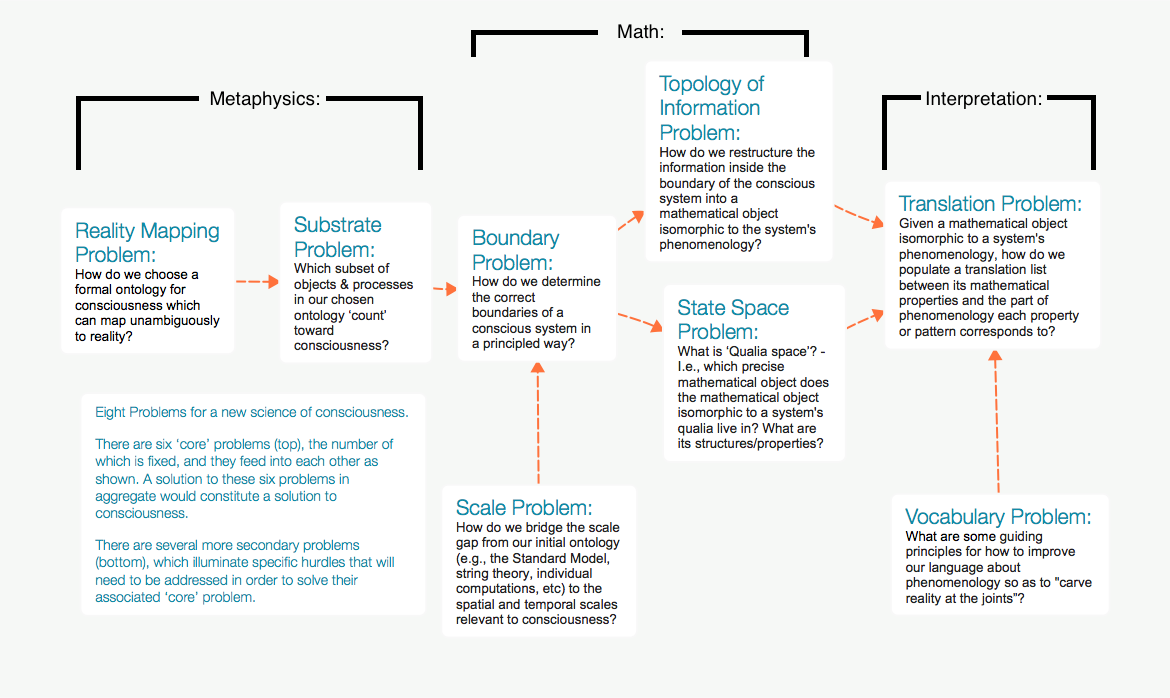
* This particular set of criteria was proposed by David Pearce (cf. Qualia Computing in Tucson). I would agree with him that these are crucial questions; indeed they make up the bare minimum that such a theory must satisfy. That said, we can formulate more comprehensive sets of problems to solve. An alternative framework that takes this a little further can be found in Michael Johnson’s book Principia Qualia (Eight Problems for a New Science of Consciousness).
From the 19th to the 24th of April I will be hanging out at Psychedelic Science 2017 (if you are interested in attending but have not bought the tickets: remember you can register until the 14th of February).
In case you enjoy Qualia Computing and you are planning on going, now you can meet the human who is mostly responsible for these articles. I am looking forward to meeting a lot of awesome researchers. If you see me and enjoy what I do, don’t be afraid to say hi.
Psychedelic experiences happen to be very informative and useful in making progress towards these three goals. The quality and magnitude of the consciousness alteration that they induce lends itself to exploring these questions. First, the state-space of humanly accessible experiences is greatly amplified once you add psychedelics into the mix. Second, the nature of these experiences is all but computationally dull (cf. alcohol and opioids). On the contrary, psychedelic experiences involve non-ordinary forms of qualia computing: the textures of consciousness interact in non-trivial ways, and it stands to reason that some combinations of these textures will be recruited in the future for more than aesthetic purposes. They will be used for computational purposes, too. And third, psychedelic states greatly amplify the range of valence (i.e. the maximum intensity of both pain and pleasure). They unlock the possibility of experiencing peak bliss as well as intense suffering. This strongly suggests that whatever underpins valence at the fundamental level, psychedelics are able to amplify it to a fantastic (and terrifying) extent. Thus, serious valence research will undoubtedly benefit from psychedelic science.
It is for this reason that psychedelics have been a major topic explored here since the beginning of this project. Here is a list of articles that directly deal with the subject:
How do you make a psychophysicalexperiment that tells you something foundational about the information-processing properties of psychedelic perception? I proposed to use an experimental approach invented by Benjamin J. Balas based on the anatomically-inspiredtexture analysis and synthesis techniques developed by Eero Simoncelli. In brief, one seeks to determine which summary statistics are sufficient to create perceptual (textural) metamers. In turn, in the context of psychedelic research, this can help us determine which statistical properties are best discriminated while sober and which differences are amplified while on psychedelics.
I distributed a survey in which I asked people to rate drug experiences along 60 different dimensions. I then conducted factor analysis on these responses. This way I empirically derived six major latent traits that account more than half of the variance across all drug experiences. Three of these factors are tightly related to valence, which suggests that hedonic-recalibration might benefit from a multi-faceted approach.
I suggest that control interruption (i.e. the failure of feedback inhibition during psychedelic states) can be employed to transmit information in a secure way to people who are in other states of consciousness. A possible application of this technology might be: You and your friends at Burning Man want to send a secret message to every psychedelic user on a particular camp in such a way that no infiltrated cop is able to decode it. To do so you could instantiate the techniques outlined in this article on a large LED display.
This article discusses the phenomenology of DMT states from the point of view of differential geometry. In particular, an argument is provided in favor of the view that high grade psychedelia usually involves a sort of geometric hyperbolization of phenomenal space.
We provide an empirical method to test the (extremely) wild hypothesis that it is possible to experience “multiple branches of the multiverse at once” on high doses of psychedelics. The point is not to promote a particular interpretation of such experiences. Rather, the points is that we can actually generate predictions from such interpretations and then go ahead and test them.
People report a zoo of psychedelic effects. However, as in most things in life, there may be a relatively small number of basic effects that, when combined, can account for the wide variety of phenomena we actually observe. Algorithmic reductions are proposed as a conceptual framework for analyzing psychedelic experiences. Four candidate main effects are proposed.
Imagine that there was a world-wide effort to identify the varieties of qualia that promote joy and prosocial behavior at the same time. Could these be used to guarantee world peace? By giving people free access to the most valuable and prosocial states of consciousness one may end up averting large-scale conflict in a sustainable way. This articles explores how this investigation might be carried out and proposes organizational principles for such a large-scale research project.
In a Wada-test a surgeon puts half of your brain to sleep and evaluates the cognitive skills of your awake half. Then the process is repeated in mirror image. Can we generalize this procedure? Imagine that instead of just putting a hemisphere to sleep we gave it psychedelics. What would it feel like to be tripping, but only with your right hemisphere? Even more generally: envision a scheme in which one alternates a large number of paired states of consciousness and study their mixtures empirically. This way it may be possible to construct a network of “opinions that states of consciousness have about each other”. Could this help us figure out whether there is a universal scale for subjective value (i.e. valence)?
In this article I discuss some problems with verbal accounts of psychedelic visuals, and I invite readers to look at some textures (provided in the article) and try to describe them while high on LSD, 2C-B, DMT, etc. You can read some of the hilarious comments already left in there.
[Our] subjective conscious experience exhibits a unitary and integrated nature that seems fundamentally at odds with the fragmented architecture identified neurophysiologically, an issue which has come to be known as the binding problem. For the objects of perception appear to us not as an assembly of independent features, as might be suggested by a feature based representation, but as an integrated whole, with every component feature appearing in experience in the proper spatial relation to every other feature. This binding occurs across the visual modalities of color, motion, form, and stereoscopic depth, and a similar integration also occurs across the perceptual modalities of vision, hearing, and touch. The question is what kind of neurophysiological explanation could possibly offer a satisfactory account of the phenomenon of binding in perception?
One solution is to propose explicit binding connections, i.e. neurons connected across visual or sensory modalities, whose state of activation encodes the fact that the areas that they connect are currently bound in subjective experience. However this solution merely compounds the problem, for it represents two distinct entities as bound together by adding a third distinct entity. It is a declarative solution, i.e. the binding between elements is supposedly achieved by attaching a label to them that declares that those elements are now bound, instead of actually binding them in some meaningful way.
Von der Malsburg proposes that perceptual binding between cortical neurons is signalled by way of synchronous spiking, the temporal correlation hypothesis (von der Malsburg & Schneider 1986). This concept has found considerable neurophysiological support (Eckhorn et al. 1988, Engel et al. 1990, 1991a, 1991b, Gray et al. 1989, 1990, 1992, Gray & Singer 1989, Stryker 1989). However although these findings are suggestive of some significant computational function in the brain, the temporal correlation hypothesis as proposed, is little different from the binding label solution, the only difference being that the label is defined by a new channel of communication, i.e. by way of synchrony. In information theoretic terms, this is no different than saying that connected neurons posses two separate channels of communication, one to transmit feature detection, and the other to transmit binding information. The fact that one of these channels uses a synchrony code instead of a rate code sheds no light on the essence of the binding problem. Furthermore, as Shadlen & Movshon (1999) observe, the temporal binding hypothesis is not a theory about how binding is computed, but only how binding is signaled, a solution that leaves the most difficult aspect of the problem unresolved.
I propose that the only meaningful solution to the binding problem must involve a real binding, as implied by the metaphorical name. A glue that is supposed to bind two objects together would be most unsatisfactory if it merely labeled the objects as bound. The significant function of glue is to ensure that a force applied to one of the bound objects will automatically act on the other one also, to ensure that the bound objects move together through the world even when one, or both of them are being acted on by forces. In the context of visual perception, this suggests that the perceptual information represented in cortical maps must be coupled to each other with bi-directional functional connections in such a way that perceptual relations detected in one map due to one visual modality will have an immediate effect on the other maps that encode other visual modalities. The one-directional axonal transmission inherent in the concept of the neuron doctrine appears inconsistent with the immediate bi-directional relation required for perceptual binding. Even the feedback pathways between cortical areas are problematic for this function due to the time delay inherent in the concept of spike train integration across the chemical synapse, which would seem to limit the reciprocal coupling between cortical areas to those within a small number of synaptic connections. The time delays across the chemical synapse would seem to preclude the kind of integration apparent in the binding of perception and consciousness across all sensory modalities, which suggests that the entire cortex is functionally coupled to act as a single integrated unit.
— Section 5 of “Harmonic Resonance Theory: An Alternative to the ‘Neuron Doctrine’ Paradigm of Neurocomputation to Address Gestalt properties of perception” by Steven Lehar
[Content Warning: Trying to understand the contents of this essay may be mind-warping. Proceed with caution. Featured image credit: Paul Nylander]
Friends, right here and now, one quantum away, there is raging a universe of active intelligence that is transhuman, hyperdimensional, and extremely alien.
—Terence McKenna
The Geometry of DMT States
This is an essay on the phenomenology of DMT. The analysis here presented predominantly uses algorithmic, geometric and information-theoretic frameworks, which distinguishes it from purely phenomenological, symbolic, neuroscientific or spiritual accounts. We do not claim to know what ultimately implements the effects here described (i.e. in light of the substrate problem of consciousness), but the analysis does not need to go there in order to have explanatory power. We posit that one can account for a wide array of (apparently diverse) phenomena present on DMT-induced states of consciousness by describing the overall changes in the geometry of one’s spatiotemporal representations (what we will call “world-sheets” i.e. 3D + time surfaces;3D1T for short). The concrete hypothesis is that the network of subjective measurements of distances we experience on DMT (coming from the relationships between the phenomenal objects one experiences in that state) has an overall geometry that can accurately be described as hyperbolic (or hyperbolic-like). In other words, our inner 3D1T world grows larger than is possible to fit in an experiential field with 3D Euclidean phenomenal space (i.e. an experience of dimension R2.5 representing an R3 scene). This results in phenomenal spaces, surfaces, and objects acquiring a mean negative curvature. Of note is that even though DMT produces this effect in the most consistent and intense way, the effect is also present in states of consciousness induced by tryptamines and to a lesser extent in those induced by all other psychedelics.
Conceptual Framework: Algorithmic Reduction
We will use the reduction framework originally proposed in the article Algorithmic Reductions of Psychedelic States. This means that we will be examining how algorithms and processes (as experienced by a subject of experience) can explain the dynamics of people’s phenomenology in DMT states. We do not claim “the substrate of consciousness” is becoming hyperbolic in any literal sense (though we do not discard that possibility). Rather, we interpret the hyperbolic curvature that experience acquires while on DMT as an emergent effect of a series of more general mechanism of action that can work together to change the geometry of a mind. These same mechanisms of action govern the dynamics of other psychedelic experiences; it is the proportion and intensity of the various “basic” effects that lead to the different outcomes observed. In other words, the hyperbolization of phenomenal space may not be a fundamental effect of DMT, but rather, it may be an emergent effect of more simple effects combined (not unlike how our seemingly smooth macroscopic space-time emerges from the jittery yet fundamental interactions that happen in a microscopic high-dimensional quantum foam).
In particular, we will discuss three candidate models for a more fundamental algorithmic reduction: (1) the synergistic effect of control interruption and symmetry detection resulting in a change of the metric of phenomenal space (analogously to how one can measure the geometry of hyperbolic graph embeddings), (2) the mind as a dynamic system with energy sources, sinks and invariants, in which curvature stores potential energy, and (3) a change in the underlying curvature of the micro-structure of consciousness. These models are not mutually-exclusive, and they may turn out to be compatible. More on this later.
What is Hyperbolic Geometry?
Perhaps the clearest way to describe hyperbolic space is to show examples of it:
Saddle
Inside a hyperbolic cube
In hyperbolic 3D space dodecahedra can have right corners.
The picture to the left shows a representation of a “saddle” surface. In geometry, saddle surfaces are 2-dimensional hyperbolic spaces (also called “hyperbolic planes” or H2). For a surface to have “constant curvature” it must look the same at every point. In other words, for a saddle to be a geometric saddle, every point in it must be a “saddle point” (i.e. a point with negative curvature). As you can see, saddles have the property that the angles of a triangle found in them add up to less than 180 degrees (compare that to surfaces with positive curvature such as the 2-sphere, in which the angles of a triangle add up to more than 180 degrees). Generalizing this to higher dimensions, the middle image above shows a cube in H3 (i.e. a hyperbolic space of three dimensions). This cube, since it is in hyperbolic space, has thin edges and pointy corners. More generally, the corners of a polyhedra (and polytopes) will be more pointy in Hn than they are in Rn. This is why you can see in the right image a dodecahedron with right-angled corners, which in this case can tile H3 (cf. Not Knot). Such a thing- people of the past might say- is an insult to the imagination. Times are changing, though, and hyperbolic geometry is now an acceptable subject of conversation.
An important property of hyperbolic spaces is the way in which the area of a circle (or the n-dimensional volume of a hypersphere) increases as a function of its radius. In 2D Euclidean space the area grows quadratically with the radius. But on H2, the area grows exponentially as a function of the radius! As you may imagine, it is easy to get lost in hyperbolic space. A few steps take you to an entirely different scene. More so, your influence over the environment is greatly diminished as a function of distance. For example, the habitable region of solar systems in hyperbolic spaces (i.e.the Goldilocks zone) is extremely thin. In order to avoid getting burned or freezing to death you would have to place your planet within a very narrow distance range from the center star. Most of what you do in hyperbolic space either stays as local news or is quickly dissipated in an ever-expanding environment.
We Can Only Remember What We Can Reconstruct
We cannot experience H2 or H3 manifolds under normal circumstances, but we can at least represent some aspects of them through partial embeddings (i.e. instantiations as subsets of other spaces preserving properties) and projections into more familiar geometries. It is important to note that such representations will necessarily be flawed. As it turns out, it is notoriously hard to truly embed H2 in Euclidean 3D space, since doing so will necessarily distort some properties of the original H2 space (such as distance, angle, area, local curvature, etc.). As we will discuss further below, this difficulty turns out to be crucial for understanding why DMT experiences are so hard to remember. In order to remember the experience you need to create a faithful and memorable 3D Euclidean embedding of it. Thus, if one happens to experience a hyperbolic object and wants to remember as much of it as possible, one will have to think strategically about how to fold, crunch and deform such object so that it can be fit in compact Euclidean representations.
What about DMT suggests hyperbolic geometry?
Why should we believe that phenomenal space on DMT (and to a lesser extent on other psychedelics) becomes hyperbolic-like? We will argue that the features people use to describe their trips as well as concrete mathematical observations of such features point directly to hyperbolic geometry. Here is a list of such features (arranged from least to most suggestive… you know, for dramatic effect):
Perception of far-out travel (as we said, small movements in hyperbolic space lead to huge changes in the scene).
Feelings of becoming big (you can fit a lot more inside a circle of radius r in hyperbolic space).
The space experienced is often depicted as “more real and more dense than normal”.
The use of terms like “mind-expanding” and “warping” to describe the effects of the drug are very common.
People describing it as “a different kind of space” and frequently using the word “hyperspace” to talk about it.
Difficulty integrating/remembering the objects and scenes experienced (e.g. “they were too alien to recall”).
Constant movement/acceleration and change of perspectives which are often described as “unfolding scenes and expanding patterns” (cf. thechrysanthemum, jitterbox).
Continuous change of the scene’s context through escape routes: A door that leads to a labyrinth that leads to branching underground tunnels that lead to mirror rooms that lead to endless windows, and the one you take leading you to a temple with thirty seven gates which lead you to a kale salad world etc. (example).
Crowding of scene beyond the limits of Euclidean space (users frequently wondering “How was I able to fit so much in my mind? I don’t see any space for my experience to fit in here!”)
Reported similarity with fractals.
Omnipresence of saddles making up the structural constraints of the hallucinated scenes. For example, one often hears about experiencing scenes saturated with: joints, twists, bifurcations, curved alleys, knots, and double helixes.
Looking at self-similar objects (such as cauliflowers) can get you lost in what seems like endless space. (Note: beware of the potential side effects of looking at a cauliflower on DMT*).
PSIS-like experiences where people seem to experience multiple alternative outcomes from each event at the same time (this may be the result of “hyperbolic branching” through time rather than space).
People describe “incredibly advanced mechanisms” and “impossible objects” that cannot be represented in our usual reality (e.g. Terence Mckenna’s self-dribbling basketballs).
At least one mathematician has stated that what one experiences on DMT cannot be translated into Euclidian geometry (unlike what one experiences on LSD).
We received a series of systematic DMT trip-reports by a math enthusiast and experienced psychonaut who claims that the surfaces experienced on DMT are typically composed of hyperbolic tilings (which imply a negative curvature; cf. wallpaper groups).
This article goes beyond claiming a mere connection between DMT and hyperbolic geometry. We will be more specific by addressing the aspects of the experience that can be interpreted geometrically. To do so, let us now turn to a phenomenological description of the way DMT experiences usually unfold:
The Phenomenology of DMT experiences: The 6 Levels
In order to proceed we will give an account of a typical vaporized DMT experience. You can think of the following six sections as stages or levels of a DMT journey. Let me explain. The highest level you get to depends on the dose consumed, and in high doses one experiences all of the levels, one at a time, and in quick succession (i.e. on high doses these levels are perceived as the stages of the experience). If one takes just enough DMT to cross over to the highest level one reaches during the journey for only a brief moment, then that level will probably be described as “the peak of the experience”. If, on the other hand, one takes a dose that squarely falls within the milligram range for producing a given level, it will be felt as more of a “plateau”. Each level is sufficiently distinct from the others that people will rarely miss the transitions between them.
The six levels of a DMT experience are: Threshold, Chrysanthemum, Magic Eye, Waiting Room, Breakthrough, and Amnesia. Let us dive in!
(Note: The following description assumes that the self-experimenter is in good physical and mental health at the time of consuming the DMT. It is well known that negative states of consciousness can lead to incomprehensible hellscapes when “boosted” by DMT (please avoid DMT at all costs while you are drunk, depressed, angry, suicidal, irritable, etc.). The full geometry is best appreciated on a mentally and emotionally balanced set and settings.)
(1) Threshold
The very first alert of something unusual happening may take between 3 to 30 seconds after inhaling the DMT, depending on the dose consumed. Rather than a clear sensorial or cognitive change, the very first hint is a change in the apparent ambiance of one’s setting. You know how at times when you enter a temple, an art museum, a crowd of people, or even just a well decorated restaurant you can abstract an undefinable yet clearly present “vibe of the place”? There’s nothing overt or specific about it. The ambiance of a place is more of an overall gestalt than a localized feeling. An ambiance somehow encodes information about the social, ideological and aesthetic quality of the place or community you just crashed into, and it tells you at a glance which moods are socially acceptable and which ones are discouraged. The specific DMT vibe you feel on a given session can be one of a million different flavors. That said, whether you feel like you entered a circus or joined a religious ceremony, the very first hint of a DMT experience is nonetheless always (or almost always) accompanied with an overall feeling of significance. The feeling that something important is about to happen or is happening is made manifest by the vibe of the state. This vibe is usually present for at least the first 150 seconds or so of the journey. Interestingly, the change in ambiance is shorter-lived than the trip itself; it seems to go away before the visuals vanish quickly declining once the the peak is over.
Within seconds after the change in ambiance, one feels a sudden sharpening of all the senses. Some people describe this as “upgrading one’s experience to an HD version of it”. The level of detail in one’s experience is increased, yet the overall semantic content is still fairly intact. People say things like: “Reality around me seems more crisp” and “it’s like I’m really grasping my surroundings, you know? fully in tune with the smallest textures of the things around me.” Terence Mckenna described this state as follows: “The air appears to suddenly have been sucked out of the room because all the colors brighten visibly, as though some intervening medium has been removed.”
On a schedule of repeated small doses (below 4 mg; preferably i.m.) one can stabilize this sharpening of the senses for arbitrarily long periods of time. I am a firm believer that this state (quite apart from the alien experiences on higher doses) can already be recruited for a variety of computational and aesthetic tasks that humans do in this day and age. In particular, the state itself seems to enable grasping complex ideas with many parameters without distorting them, which may be useful for learning mathematics at an accelerated pace. Likewise, the sate increases one’s awareness of one’s surroundings (possibly at the expense of consuming many calories). I find it hard to imagine that artists will not be able to use this state for anything valuable.
(2) The Chrysanthemum
If one ups the dose a little bit and lands somewhere in the range between 4 to 8 mg, one is likely to experience what Terrence McKenna called “the Chrysanthemum”. This usually manifests as a surface saturated with a sort of textured fabric composed of intricate symmetrical relationships, bright colors, shifting edges and shimmering pulsing superposition patterns of harmonic linear waves of many different frequencies.
Depending on the dose consumed one may experience either one or several semi-parallel channels. Whereas a threshold dose usually presents you with a single strong vibe (or ambiance), the Chrysanthemum level often has several competing vibes each bidding for your attention. Here are some examples of what the visual component of this state of consciousness may look like.
2D Chrysanthemum
2.5D Chrysanthemum
Chrysanthemum with multuple symmetry channels
The visual component of the Chrysanthemum is often described as “the best screen saver ever“, and if you happen to experience it in a good mood you will almost certainly agree with that description, as it is usually extremely harmonious, symmetric and beautiful in uncountable ways. No external input can possibly replicate the information density and intricate symmetry of this state; such state has to be endogenously generated as a a sort of harmonic attractor of your brain dynamics.
You can find many replications of Chrysanthemum-level DMT experiences on the internet, and I encourage you to examine their implicit symmetries (this replication is one of my all-times favorite).
In Algorithmic Reduction of Psychedelic States we posited that any one of the 17 wallpaper symmetry groups can be instantiated as the symmetries that govern psychedelic visuals. Unfortunately, unlike the generally slow evolution of usual psychedelic visuals, DMT’s vibrational frequency forces such visuals to evolve at a speed that makes it difficult for most people to spot the implicit symmetry elements that give rise to the overall mathematical structure underneath one’s experience. For this reason it has been difficult to verify that all 17 wallpaper groups are possible in DMT states. Fortunately we were recently able to confirm that this is in fact the case thanks to someone who trained himself to do just this. I.e. detecting symmetry elements in patterns at an outstanding speed.
An anonymous psychonaut (whom we will call researcher A) sent a series of trip report to Qualia Computing detailing the mathematical properties of psychedelic visuals under various substances and dose regimens. A is an experienced psychonaut and a math enthusiast who recently trained himself to recognize (and name) the mathematical properties of symmetrical patterns (such as in works of art or biological organisms). In particular, he has become fluent at naming the symmetries exhibited by psychedelic visuals. In the context of 2D visuals on surfaces, A confirms that the symmetrical textures that arise in psychedelic states can exhibit any one of the 17 wallpaper symmetry groups. Likewise, he has been able to confirm that every possible spherical symmetry group can also be instantiated in one’s mind on these states.
The images below show some examples of the visuals that A has experienced on 2C-B, LSD, 4-HO-MET and DMT (sources: top left, top middle, the rest were made with this service):
17 wallpaper symmetry groups
Wallpaper symmetry chart with 5 different notations
p1
pmm
cmm
pg
p4
p3
p4g (this one can make you feel dizzy)
The Chrysanthemum level interacts with sensory input in an interesting way: the texture of anything one looks at quickly becomes saturated with nested 2-dimensional symmetry groups. If you took enough DMT to take you to this level and you keep your eyes open and look at a patterned surface (i.e. statistical texture), it will symmetrify beyond recognition. A explains that at this level DMT visuals share some qualities with those of, say, LSD, mescaline, and psilocin. Like other psychedelics, DMT’s Chrysanthemum level can instantiate any 2-dimensional symmetry, yet there are important differences from other psychedelics at this dose range. These include the consistent change in ambiance (already present in threshold doses), the complexity and consistency of the symmetrical relationships (much more dense and whole-experience-consistent than is usually possible with other psychedelics), and the speed (with a control-interruption frequency reaching up to 30 hertz, compared to 10-20 hertz for most psychedelics). Thus, people tend to point out that DMT visuals (at this level) are “faster, smaller, more detailed and more globally consistent” than on comparable levels of alteration from similar agents.
Now, if you take a dose that is a little higher (in the ballpark of 8 to 12 mg), the Chrysanthemum will start doing something new and interesting…
(3) The Magic Eye Level
A great way to understand the Magic Eye level of DMT effects is to think of the Chrysanthemum as the texture of an autostereogram (colloquially described as “Magic Eye” pictures). Our visual experience can be easily decomposed into two points-of-view (corresponding to the feed coming from each eye) that share information in order to solve the depth-map problem in vision. This is to map each visual qualia to a space with relative distances so (a) the input is explained and (b) you get recognizable every-day objects represented as implicit shapes beneath the depth-map. You can think of this process as a sort of hand-shake between bottom-up perception and top-down modeling.
In everyday conditions one solves the depth-map problem within a second of opening one’s eyes (minus minor details that are added as one looks around). But on DMT, the “low-level perceptions” looks like a breathing Chrysanthemum, which means that the top-down modeling has that “constantly shifting” stuff to play with. What to make of it? Anything you can think of.
There are three major components of variance on the DMT Magic Eye level:
Texture (dependent on the Chrysanthemum’s evolution)
World-sheet (non-occluding 3D1T depth maps)
Extremely lowered information copying threshold.
The image on the left is a lobster, the one on the center is a cone and the one to the right contains furniture (a lamp, a chair and a table). Notice that what you see is a sort of depth-map which encodes shapes. We will call this depth-map together with the appearance of movement and acceleration represented in it, a world-sheet.
World-Sheets
The world-sheet encodes the “semantic content” of the scene and is capable of representing arbitrary situations (including information about what you are seeing, where you are, what the entities there are doing, what is happening, etc.).
It is common to experience scenes from usually mundane-looking places like ice-cream stores, play pens, household situations, furniture rooms, apparel, etc.. Likewise, one frequently sees entities in these places, but they rarely seem to mind you because their world is fairly self-contained. As if seeing through a window. People often report that the worlds they saw on a DMT trip were all “made of the same thing”. This can be interpreted as the texture becoming the surfaces of the world-sheet, so that the surfaces of the tables, chairs, ice-cream cones, the bodies of the people, and so on are all patterned with the same texture (just as in actual autostereograms). This texture is indeed the Chrysanthemum completely contorted to accommodate all the curvature of the scene.
Magic Eye level scenes often include 3D geometrical shapes like spheres, cones, cylinders, cubes, etc. The complexity of the scene is roughly dose-dependent. As one ups the highness (but still remaining within the Magic Eye level) complex translucid qualia crystals in three dimensions start to become a possibility.
Whatever phenomenal objects you experience on this level that lives for more than a millisecond needs to have effective strategies for surviving in an ecosystem of other objects adapted to that level. Given the extremely lowered information copying threshold, whatever is good at making copies of itself will begin to tesselate, mutate and evolve, stealing as much of your attention as possible in the way. Cyclic transitions occupy one’s attention: objects quickly become scenes which quickly become gestalts from which a new texture evolves in which new objects are detected and so on ad infinitum.
A reports that at this dose range one can experience at least some of the 230 space groups as objects represented in the world-sheet. For example, A reports having stabilized a structure with a Pm-3m symmetry structure, not unlike the structure of ZIF-71-RHO. Visualizing such complex 3D symmetries, however, does seem to require previous training and high levels of mental concentration (i.e. in order to ensure that all the symmetry elements are indeed what they are supposed to be).
There is so much qualia laying around, though, at times not even your normal space can contain it all. Any regular or semi regular symmetrical structure you construct by focusing on it is prone to overflow if you focus too much on it. What does this mean? If you focus too much on, for example, the number 6, your mind might represent the various ways in which you can arrange six balls in a perfectly symmetrical way. Worlds made of hexagons and octahedrons interlocked in complex but symmetrical ways may begin to tesselate your experiential field. With every second you find more and more ways of representing the number six in interesting, satisfying, metaphorically-sound synesthetic ways (cf. Thinking in Numbers). Now, what happens if you try to represent the number seven in a symmetric way on the plane? Well, the problem is that you will have too many heptagons to fit in Euclidean space (cf. Too Many Triangles). Thus the resulting symmetrical patterns will seem to overflow the plane (which is often felt as a folding and fluid re-arrangement, and when there is no space left in a region it either expands space or it is felt as some sort of synesthetic tension or stress, like a sense of crackling under a lot of pressure).
Heptagonal tiling of the Poincaré disk representing the 2D hyperbolic space.
Triheptagonal tiling
Order-7-3 rhombille tiling
In particular, A claims that in the lower ranges of the DMT Magic Eye level the texture of the Chrysanthemum tends to exhibit heptagonal and triheptagonal tilings (as shown in the picture above). A explains that at the critical point between the Chrysanthemum and the Magic Eye levels the intensity of the rate of symmetry detection of the Chrysanthemum cannot be contained to a 2D surface. Thus, the surface begins to fold, often in semi-symmetric ways. Every time one “recognizes” an object on this “folding Chrysanthemum” the extra curvature is passed on to this object. As the dose increases, one interprets more and more of this extra curvature and ends up shaping a complex and highly dynamic spatiotemporal depth map with hyperbolic folds. In the upper ranges of the Magic Eye level the world-sheet is so curved that the scenes one visualize are intricate and expansive, feeling at times like one is able to peer through one’s horizon in all directions and see oneself and one’s world from a distance. At some critical point one may feel like the space around one is folding into a huge dome where the walls are made of whatever texture + world-sheet combination happened to win the Darwinian selection pressures applied to the qualia patterns on the Magic Eye level. This concentrated hyperbolic synesthetic texture is what becomes the walls of the Waiting Room…
(4) Waiting Room
In the range of 12-25mg of DMT a likely final destination is the so-called Waiting Room. This experience is distinguished from the Magic Eye level in several ways: first, the world-sheet at this level breaks into several quasi-independent components, each evolving semi-autonomously. Second, one goes from “partial immersion” into “full immersion”. The transition between Magic Eye and Waiting Room often looks like “finding a very complex element in the scene and using it as a window into another dimension”. The total 2D surface curvature present (by adding up the curvature of all elements in the scene) is substantially higher than that of the Magic Eye level, and one can start to see actual 3D hyperbolic space. Perhaps a way of describing this transition is as follows: The curvature of the world-sheet gets to be so extreme that in order to accommodate it one’s entire multi-modal experiential field becomes involved, and a feeling of total and complete synchronization of all senses into a unified synesthetic experience is inescapable (often described as the “mmmMMMMMMM+++++!!!” whole-body tone people report). Thus the feeling of entering into an entirely new dimension. This explains what people mean when they say: “I experienced such an intense pressure that my soul could not be contained in my tiny body, and the intense pressure launched me into a bigger world”.
DMT Waiting Room
Changes in the connectivity of the micro-structure of the texture
Constant flow of interlocking symmetry elements tile the texture.
The images above, taken together, are meant as an impressionistic replication of what a Waiting Room experience may feel like. On the left you see the textured world-sheet curved in several ways resulting in an enclosed room with shimmering walls and an entity looking at a futuristic-looking contraption. The images on the right are meant to illustrate the ways in which the texture of the world-sheet evolves: you will find that the micro-structure of such texture is constantly unfolding in new symmetrical ways (bottom right), and propagating such changes throughout the entire surface at a striking speed (top right).
DMT Waiting Rooms contain entities that at times do interact directly with you. Their reality is perceived as a much more intense and intimate version of what human interaction normally is, but they do not give the impression of being telepathic. That said, their power is felt as if they could radiate it. One could say that this level of DMT places you in such an intimate, vulnerable and open state that interpreting the entities in a second-person social mode is almost inevitable. It is like interacting with someone you really know (or perhaps someone you really really want to know… or really really don’t want to know), except that the whole world is made of those feelings and some entities inhabit that world.
Serious hard-core psychonauts tend to describe the Waiting Room as a temporary stopgap. Indeed more poetry could ever be written about the Waiting Room states of consciousness than about most human activities, for its state-space is larger, more diverse and more hedonically loaded. But even so, it is important to realize that there are even weirder states. Serious psychonauts exploring the upper ranges of humanly-accessible high energy consciousness research may see Waiting Rooms as a stepping stones to the real deal…
(5) Breakthrough
If one manages to ingest around 20-30mg of DMT there is a decent chance that one will achieve a DMT breakthrough experience (some sources place the dosage as high as 40mg). There is no agreed-upon definition for a “DMT breakthrough”, but most experienced users confirm that there is a qualitative change in the structure and feel of one’s experience on such high doses. Based on A’s observations we postulate that DMT breakthroughs are the result of a world-sheet with a curvature so extreme that topological bifurcations start to happen uncontrollably. In other words, the very topology of one’s world-sheet is forced to change in order to accommodate all of the intense curvature.
The geometry of space you experience may suddenly go from a simply-connected space into something else. What does this mean? Suddenly one may feel like space itself is twisting and reconnecting to itself in complex (and often confusing) ways. One may find that given any two points on this “alien world” there may be loops between them. This has drastic effects on one’s every representation (including, of course, the self-other divide). The particular feeling that comes with this may explain the presence of PSIS-like experiences induced by DMT and high dose LSD (cf. LSD and Quantum Measurements). Since the topological bifurcations are happening on a 3D1T world-sheet, this may look like “multiple things happening at once” or “objects taking multiple non-overlapping paths at once in order to get from one place into another”. The entities at this level feel transpersonal: due to the extreme curvature it is hard to distinguish between the information you ascribe to your self-model and the information you ascribe to others. Thus one is all over the place, in a literal topological sense.
While on the Waiting Room one can stabilize the context where the experience seems to be taking place, on a DMT breakthrough state one invariably “moves across vast regions, galaxies, universes, realities, etc.” in a constant uncontrollable way. Why is this? This may be related to whether one can contain the curvature of the objects one attends to. If the curvature is uncontrollable, it will “pass on to the walls” and result in constant “context switches”. In fact, such a large fraction of 3D space is perceived as hyperbolic in one way or another, that one seems to have access to vast regions of reality at the same time. Thus a sense of radical openness is often experienced.
(6) Amnesia Level
Unlike 5-MeO-DMT, “normal DMT” experiences are not typically so mind-warping that they dissolve one’s self-model completely. On the contrary, many people report DMT as having “surprisingly little effect on one’s sense of self except at very high doses” relative to the overall intensity of the alteration. Thus, DMT usually does not produce amnesia due to ego death directly. Rather, the amnesic properties of DMT at high doses can be blamed on the difficulty of instantiating the necessary geometry to make sense of what was experienced. In the case of doses above “breakthrough experiences” there is a chance that the user will not be able to recall anything about the most intense periods of the journey. Unfortunately, we are not likely to learn much from these states (that is, until we live in a community of people who can access other phenomenal geometries in a controlled fashion).
Recalling the Immemorial
We postulate that the difficulty people have remembering the phenomenal quality of a DMT experience is in part the result of not being able to access the geometry required to accurately relive their hallucinations. The few and far apart elements of the experience that people do somehow manage to remember, we posit, are those that happen to be (relatively) easy to embed in 3D Euclidean space. Thus, we predict that what people do manage to “bring back” from hyperspace will be biased towards those things that can be represented in R3.
This explains why people remember experiencing intensely saddled scenes (e.g. fractals, tunnels, kale worlds, recursive processes, and so on). Unfortunately most information-rich and interesting (irreducible, prime) phenomenal objects one experiences on DMT are by their very nature impossible to embed in our normal experiential geometry. This problem reveals an intrinsic limitation that comes from living in a community of intelligences (i.e. contemporary humans) who are constrained in the range of state-spaces of consciousness that they can access. This realization calls for a new epistemological paradigm, one that incorporate state-specific representations into a globally accessible database of states of consciousness, together with the network that emerges from their mutual (in)intelligibility.
DMT Objects
The increased curvature of one’s world-sheet can manifest in endless ways. In some important ways, the state-space of possible scenes that you can experience on DMT is much bigger than what you can experience on normal states of consciousness. Strictly speaking, you can represent more scenes on DMT states than in most other states because the overall amount qualia available is much larger. Of course the very dynamics of these experiences constrains what can be experienced, so there are still many things inaccessible on DMT. For instance, it may be impossible to experience a perfectly uniform blue screen (since the Chrysanthemum texture is saturated with edges, surfaces and symmetrical patterns). Likewise, scenes that are too irregular may be impossible to stabilize given the omnipresent symmetry enhancement found in the state.
What are the nature of the objects and entities one experiences on DMT? Magic Eye level experiences tend to include objects that are usually found in our everyday life. It is at the DMT waiting room level and above that the “truly impossible objects” begin to emerge. In particular, all of these objects are often curved in extreme ways. They condense within them complex networks of interlocking structures sustaining an overall superlative curvature. Here are some example objects that one can experience on Waiting Room and Breakthrough level experiences:
Notice that all of these images have many saddles everywhere. Ultimately, the range of objects one can experience on such states includes many other features that are impossible to represent in R3. The objects that people do manage to bring back and recall later on, are precisely those that can be embedded in R3. Thus you often see extremely contorted wrapped-up objects. The most interesting ones (such as quasi-regular H3 tilings or irreducible objects) are next-to-impossible to bring back in any meaningful way, for now at least.
DMT Space Expansion
The expansion of space responsible for the increased curvature happens anywhere you direct your attention (including the objects you see). Here you can see what it may look like to stare at a DMT object: This is called the “jitterbox” mechanism.
DMT entities
DMT entities come in many forms, and their overall quality is extremelly dose-dependent. Rather than describing any specific manifestation we will instead briefly characterize the rough properties of the entities experienced based on the level reached.
Threshold: Usually the ambiance change has a social feel to is. More similar to entering a room of people of an alien culture, than entering an empty cave or a warm pool on your own. In this sense the very beginning of a DMT experience may already frame the experience in social terms and facilitate the expectation of meeting entities.
Chrysanthemum: One can feel perhaps the subtle presence of entities, but they are often interpreted as “feeling connected” to one’s friends, relatives and acquaintances. The feeling does not manifest in any clear spatial way, though. Other than that, this state is apersonal in the sense that one does not see any entity directly.
Magic Eye: Here the entities can be roughly described as having an impersonal relationship with you. They are just there, hanging out on their own, often engrossed with whatever activities your world-sheet is capable of representing for them.
Waiting Room: At this level entities start becoming able to interact with you. They feel like autonomous beings wrapped in mystery. Their intentions, what they know, and their emotional states can be guessed from their behavior, but they are not immediately obvious.
Breakthrough: At this level the entities one meets seem to have what we might call a transpersonal relationship with you. They share their own internal states (emotions, knowledge, wishes, etc) with you. It feels like they can communicate telepathically and “see through” you. One cannot hide one’s “private” mental contents from them at this level.
Amnesia: One cannot remember, of course, exactly what happens here. But if trip reports are any indication, this level is reminiscent of highly “mystical” states in which one’s implicit beliefs about Personal Identity are obliterated and replaced by the feeling of becoming an all-encompassing entity. “Union with God” and “Samadhi” are terms that describe the subjective feeling of self in this state. In other words, at this level it is impossible to distinguish between oneself and other entities, for all is represented as one. (Beware of never trying to go here if you feel bad at the time since negative hedonic tone can be amplified just as much as a good feeling such as Samadhi).
Modeling the Hyperbolic Geometry of DMT
How can we explain the drastic geometric changes of phenomenal space on DMT? As mentioned earlier, we will discuss three (non-mutually exclusive) hypothesis. These hypothesis work at the level of an algorithmic reduction, which means that we will go deeper than just describing information processing and phenomenology. We will stop short of addressing the implementation level of abstraction. It is worth pointing out that describing the ways in which DMT experiences are hyperbolic is in itself an algorithmic reduction. What we are about to do is to develop a more granular algorithmic reduction in which we try to explain why hyperbolic geometry emerges on DMT states by postulating underlying processes. Here are the three reductions:
(1) Control Interruption + Symmetry detection = Change in Metric
Recall that on a previous article we algorithmically reduced general psychedelic states. The building blocks of that reduction were:
Using this framework one can argue that DMT makes space more hyperbolic in the following way: in high amounts the synergistic effect of control interruption together with extremely lowered symmetry detection thresholds experienced in quick succession makes the subjective distance between the points in the phenomenal objects in the scene evolve a hyperbolic metric. How would this happen? The key thing to realize is that in this model the usual quasi-Euclidean space we experience is an emergent effect of an equilibrium between these two forces. Even in normal circumstances our world-sheet is continuously regenerated; the rate at which symmetrical relationships in the scene are detected is balanced by the rate at which these subjective measurements are forgotten. This usually results in an emergent Euclidean geometry. On DMT the rate of symmetry detection increases while the rate of “forgetting” (inhibiting control) decreases. Attention points out more relationships in quick succession and this creates a network of measured subjective distances that cannot be embedded in Euclidean 3D space. Thus there is an overflow of symmetries. We are currently working on a precise mathematical model of this process in order to reconstruct a hyperbolic metric out of these two parameters. In this model, control interruption is interpreted as a change in the decay for subjective measurements of distance in one’s mind, whereas the lowered symmetry detection threshold is interpreted as a change in the probability of measuring the distance between any two given points as a function of the network of distances already measured.
The curvature increase is most salient where there is already a lot of measurements made, since highly-measured regions focus attention and attention drives symmetry detection. Thus, focusing on any surface will make the surface itself hyperbolic (rather than the 3D space, since measurements are mostly concentrated on the surface). On the other hand, if the curvature is too high to keep on a 2D surface, it will “jump” to 3D or even 3D1T (i.e. branching out the temporal component of one’s experience). The result is that the total curvature of one’s 3D1T world-sheet increases on DMT in a dose-dependent way.
Different doses lead to different states of curvature homeostasis. Each part of the worldsheet has constantly-morphing shapes and sudden curvature changes, but the total curvature is nonetheless more or less preserved on a given dose. It is not easy to get rid of excess curvature. Rather, whenever one tries to reduce the curvature in one part of the scene one is simply pushing it elsewhere. Even when one manages to push most of the curvature out of a given modality (e.g. vision) it is likely to quickly return in another modality (e.g. kinesthetic or auditory landscape) since attention never ceases on a DMT trip. Such apparent dose-dependent global curving of the world-sheet (and its jump from one modality into another) constrains the shape of the objects one can represent on the state (thus leading to alien-looking highly-curved objects similar to the ones shown above).
(2) Dynamic System Account: Energy Sources, Sinks and Invariants
Energy Invariants
Let us define a notion of energy in consciousness so that we can formalize the way experiences warps and transforms on DMT. Assume that one needs “energy” in order to instantiate a given experience (really, this is just an implicit invariant and we could use a different name). Each feature of a given experience needs a certain amount of energy, which roughly corresponds to a weighted sum of the intensity and the information content of an experience. For instance, the brightness of a point of colored light in one’s visual field is energy-dependent. Likewise, the information content in a texture, the number of represented symmetrical relationships, the speed by which an object moves (plus its acceleration), and even the curvature of one’s geometry. All of these features require energy to be instantiated.
Under normal circumstances the brain has many clever and (evolutionarily) appropriate ways of modulating the amount of energy present in different modules of one’s mind. That is, we have many programs that work as energy switches for different mental activities depending on the context. When we think, we have allocated a certain amount of energy to finding a shape/thought-form that satisfies a number of constraints. When it shape-shifting that energy in various ways and finding a solution, we either allocate more energy to it or perhaps give up. However, on DMT the energy cannot be switched off, and it can only pass from one modality into another. In other words, whereas in normal circumstances one uses strategically one’s ability to give energy limits to different tasks, on DMT one simply has constant high energy globally no matter what.
More formally, this model of DMT action says that DMT modifies the structure of one’s mind so that (1) energy freely passes from one form into another, and (2) energy floods the entire system. Let’s talk about energy sources and sinks.
Energy Sources and Sinks
In this algorithmic reduction DMT increases the amount of consciousness in one’s mind by virtue of impairing our normal energy sinks while increasing the throughput of its energy sources. This may frequently manifests as phenomenal spaces becoming hyperbolic in the mathematical-geometric sense of increasing its negative curvature as such curvature is one manifestation of higher levels of energy. Energy sinks are still present and they struggle to capture as much of the energy as possible. In particular, one energy sink is “recognition” of objects on the world-sheet.
This model postulates that attention functions as an energy source, whereas pattern recognition functions as an energy sink.
The Hamiltonian of a World-sheet
The total energy in one’s consciousness increases on DMT, and there is a constant flow between different ways for this energy to take form. That said, one can analyze piecewise the various components of one’s experience, specially if the network of energy exchange clusters well. In particular, we can postulate that world-sheets are fairly self-contained. Relative to other parts of the environment the mind is simulating, the world-sheet itself has a very high within-cluster energy exchange and a relatively low cross-cluster energy exchange. One’s world-sheet is very fluid, and little deformations propagate almost linearly throughout it. In a given dose plateau, if you add up the acceleration, the velocity, the curvature, and so on of every point in the world-sheet you will come up with a number that remains fairly constant over time. Thus studying the Hamiltonian of a world-sheet (i.e. the state-space given by a constant level of energy) can be very informative in describing both the information content and the experiential intensity of DMT experiences.
You can deform a surface without changing its local curvature. (Source: Gauss’ “Remarkable Theorem” [seriously not my quotes]). Thus on a DMT trip plateau there is still a lot of room for transformations of the world-sheet into different shapes with similar curvature.
Under normal circumstances the curvature of one’s world-sheet is, as far as I can tell, arousal-dependent. Have you noticed how when you feel tired you are more likely to defocus your visual experience? You are tired late at night and you are trying to watch a movie, but bringing the scene in focus is too much of an effort so you defocus for a little bit (still listening to the dialogue). What did you do that for? In the framework here proposed, you did that to diminish the energy it takes you to sustain a curved world-sheet with a lot of information. Doing so may be aesthetically pleasing and rewarding when fully awake or excited, but when tired the returns on doing the focusing are not great given how much effort it needs and the fact that the dialogue is more essential for the plot anyway.
It takes effort and wakefulness to focus on a complex scene with many intricate details. (Reading and trying to comprehend this essay may itself require significant conscious energy expenditure). For this reason we might say that DMT is an exceedingly effective arouser of consciousness.
Bayesian Energy Sinks
One essential property of our minds is that our level of mental arousal decreases when we interpret our experience as “expected”. People who can enjoy their own minds do so, in part, by finding unexpected ways of understanding expected things. In the presence of new information that one cannot easily integrate, however, one’s level of energy is adjusted upwards so that we try out a variety of different models quickly and try to sort out a model that does make the new information expected (though perhaps integrating new assumptions or adding content in other ways). When we cannot manage to generate a mental model that works out a likely model of what we are experiencing we tend to remain in an over-active state.
This general principle applies to the world-sheet. One of the predominant ways in which a world-sheet reduces its energy (locally) is by morphing into something you can recognize or interpret. Thus the world-sheet in some way keeps on producing objects, at first familiar, but in higher energies the whole process can seem desperate or hopeless: one can only recognize things with a stretch of the imagination. Since humans in general lack much experience with hyperbolic geometry, we usually don’t manage to imagine objects that are symmetric on their own native geometry. But when we do, and we fill them up with resonant light-mind-energy, then BAM! New harmonics of consciousness! New varieties of bliss! Music of the angels! OMG! Laughter till infinity and more- shared across the galaxy- in a hyperbolic transpersonal delight! It’s like LSD and N2O! Wow!
Forgive me, it is my first day. Let’s carry on. As one does not know any object that the world-sheet can reasonably be able to generate in high doses, and the world-sheet has so much energy on its own, energy can seem to spiral out of control. This explains in part the non-linear relationship between experienced intensity and DMT dose.
Like all aspects of one’s consciousness, the negative curvature of phenomenal space tends to decay over time (possibly through inhibition by the cortex). In this case, the feeling is one of “smoothing out the curves” and embedding the phenomenal objects in 3D euclidean space. However, this is opposed by the effect that attention and (degrees of) awareness have on our phenomenal sheet, which is to increase its negative curvature. On DMT, anything that attention focuses on will begin branching, copying itself and multiplying, a process that quickly saturates the scene to the point of filling more spatial relationships than would fit in Euclidean 3D. The rate at which this happens is dose-dependent. The higher the dose, the less inhibiting control there is and the more intense the “folding” property of attention will be. Thus, for different dosages one reaches different homeostatic levels of overall curvature in one’s phenomenal space. Since attention does not stop at any point during a DMT trip (it keeps being bright and intense all throughout) there isn’t really any rest period to sit back and see the curvature get smoothed out on its own. Everything one thinks about, perceives or imagines branches out and bifurcate at a high speed.
Every moment during the experience is very hard to “grasp” because the way one normally does that in usual circumstances is by focusing attention on it and shaping one’s world-sheet to account for the input. But here that very attention makes the world-sheet wobble, warp and expand beyond recognition. Thus one might say that during a solid DMT experience one never sees the same thing twice, as the experience continues to evolve. That is, of course, as long as you do not stumble upon (or deliberatively create) stable phenomenal objects whose structure can survive the warping effect of attention.
(3) Hyperbolic Micro-structure of Consciousness
Subjectively, A says, negative curvature is associated with more energy. Perhaps this curvature happens at a very low level? An example to light up the imagination is using heat to fold a sheet of metal (thanks to thermal expansion). Whatever your attention focuses on seems to get heated up (in some sense) and expand as a result. The folding patterns themselves seem to store potential energy. Left on their own, this extra energy stored as negative curvature usually dissipates, but on DMT this process is lowered (while the effect of increasing the energy is heightened). Could this be the result of some very very fine-level micro-experiential change that gradually propagates upwards? With the help of our normal mental processes the change in the micro-structure may propagate all the way into seemingly hyperbolic 2D and 3D surfaces.
Perhaps the most important difference between DMT in high doses and other psychedelics is that the micro-structure of consciousness drifts in such a way that tiny Droste effects bubble up into large Möbius transforms.
As noted already, these three algorithmic reductions are not incompatible. We just present them here due to their apparent explanatory power. A lot more theoretical work will be needed to make them quantitative and precise, but we are optimistic. The aim is now to develop an experimental framework to distinguish between the predictions that each candidate algorithmic reduction makes (including many not presented here). This is a work in progress.
Generalizing hyperbolization to non-spatial experiential fields
In the case of experiential fields such as body feelings, smells and concepts, the “hyperbolization” takes different forms depending on the algorithmic reduction you use. I prefer the very general interpretation that one experiences hyperbolic information geometry rather than just hyperbolic space. In other words, when we talk about body feelings and so on, on a psychedelic one organizes such information in a hyperbolic relational graph, which also exhibits a negative curvature relative to its normal geometry. Arguing in favor of this interpretation would take another article, so we will leave that for another time.
Getting a handle on the DMT state
Gluing a 1-handle is easy on a 2-sphere. Tongue in cheek, sticking a little doughnut on a big ball allows you to grab the sphere and control it in some way. But how do you get a handle on hyperbolic space? The answer is to build hyperbolic manifolds at the core of one’s being, by imagining knots very intensely. The higher one is, the more complex the knot one can imagine in detail. Having practiced visualizations of this sort while sober certainly helps. If you imagine the knot with enough detail, you can then stress the environment surrounding it to represent a warped hyperbolic space. This way you give life to the complement of the knot (which is almost always hyperbolic!). We postulate that it is possible to study in detail the relationship between the knots imagined, and the properties of the experiential worlds that result from their inversion (i.e. thinking about the geometry of the space surrounding the knot rather than the knot itself). A reports that different hyperbolic spaces generated this way (i.e. imagining knots on tryptamines) have different levels of energy, and have unique resonant properties. Different kinds of music feel better in different kinds of hyperbolic manifolds. It takes more energy to “light up” a hyperbolic space like that, mostly due to its openness. This is why using small doses of 2C-B can be helpful to create a positive backbone to the experience (providing the necessary warmth to light up the hyperbolic space). Admittedly MDMA tends to work best, but its use is unadvisable for reasons we will not get into (related to the hedonic treadmill). A healthy combination that both enables the visualization of the hyperbolic spaces in a vivid way and also lights them up with positive hedonic tone healthily and reliably has yet to be found.
Relatedly… Get a handle on your DMT trip by creating a stabilizing 4D hyperbolic manifold in four easy steps:
Unifying Your Space
God, the divine, open individualism, the number one, an abstract notion of self, or the thought of existence itself are all thoughts that work as great “unifiers” of large areas of phenomenal space. Indeed these concepts can allow a person to connect the edges of the hyperbolic space and create a pocket of one’s experience that does not seem to have a boundary yet is extremely open. This may be a reason why such ideas are very common in high levels of psychedelia. In a sense, depending on the mind, they have at times the highest recruiting power for your multi-threaded attention.
Applications to Qualia Computing and Closing Thoughts
Beyond mere designer synesthesia, the future of consciousness research contains the possibility of exploring alternative geometries for the layout of our experiences. One’s overall level of energy, its manifestation, the allowed invariants, the logic gates, the differences in resonance, the granularity of the patterns, and so on, are all parameters that we will get to change in our minds to see what happens (in controlled and healthy ways, of course). The exploration of the state-space of consciousness is sure to lead to a combinatorial explosion. Even with good post-theoretical quantitative algorithmic reductions, it is likely that qualia computing scientists will still find an unfathomable number of distinct “prime” permutations. For some applications it may be more useful to use special kinds of hyperbolic spaces (like the compliment of certain class of knot), but for others it may suffice to be a little sphere. Who knows. In the end, if a valence economy ends up dominating the world, then the value of hyperbolic phenomenal spaces will be proportional to the level of wellbeing and bliss that can be felt in them. Which space in which resonant mode generates the highest level of bliss? This is an empirical question with far-reaching economic implications.
Mathematics post-hyperbolic consciousness
I predict that some time in the next century or so many of the breakthroughs in mathematics will take place in consciousness research centers. The ability to utilize arbitrary combinations of qualia with programable geometry and information content (in addition to our whole range of pre-existing cognitive skills) will allow people to have new semantic primitives related to mathematical structures and qualia systems currently unfathomable to us. In the end, studying the mathematics of consciousness and valence is perhaps the ultimate effective altruist endeavor in a world filled with suffering, since reverse-engineering valence would simplify paradise engineering… But even in a post-scarcity world, consciousness research will also probably be the ultimate past time given the endless new discoveries awaiting to be found in the state-space of consciousness.
*On the unexpected side effects of staring at a cauliflower on DMT: You can get lost in the hyperbolic reality of the (apparent) life force that spirals in a scale-free fractal fashion throughout the plant. The spirals may feel like magnetic vortexes that take advantage of your state to attract your attention. The cauliflower may pull you into its own world of interconnected fractals, and as soon as you start to trust it, it begins trying to recruit you for the cauliflower cause. The cauliflower may scare you into not eating it, and make you feel guilty about frying it. You may freak out a little, but when you come down you convince yourself that it was all just a hallucination. That said, you secretly worry it was for real. You may never choose to abstain from eating cauliflowers, but you will probably drop the knife when cooking it. You will break it apart with your own hands in the way you think minimizes its pain. You sometimes wonder whether it experiences agony as it is slowly cooked in the pan, and you drink alcohol to forget. Damn, don’t stare at a cauliflower while high on DMT if you ever intend to eat one again.
P.S. Note on Originality: The only mention I have been able to find that explicitly connects hyperbolic geometry in a literal sense with DMT (rather than just metaphorical talk of “hyperspace”) is a 2014 post in the Psychonaut subredit. To my knowledge, no one has yet elaborated to any substantial degree on this interesting connection. That said, I’m convinced that during the days that follow a strong trip, psychedelic self-experimenters may frequently wonder about the geometry of the places they explored. Yet they usually lack any conceptual framework to justify their intuitions or even verbalize them, so they quickly forget about them.
P.S.S. Example Self-Dribbling Basketball:
Self-dribbling basketball
To the right you can see what a “self-dribbling basketball” looks like. The more you try to “grasp” what it is, the more curved it gets. That’s because you are adding energy with you attention and you do not have enough recognition ability in this space to lower its energy and reduce the curvature to stabilize it. The curvature is so extreme at times that it produces constant “context switches”. This is the result of excess curvature being pushed towards the edge of your experience and turning into walls and corridors.
P.S.S.S.: Example on world-sheet bending:
Below you can find two gifs that illustrate the behavior of a world-sheet on a 5mg vs. 20mg dose. The speed at which you are adding curvature to it increases so much that the shapes and objects keep shifting to accommodate it all.
The question of whether it’s morally blameworthy not to devote your whole life to reducing suffering conjures the wrong idea. Utilitarianism is not a binary morality in which you’re right if you do the best possible thing and wrong otherwise. Rather, utilitarianism is more like a point counter in a video game, where you aim to accumulate as many points as you can within the bounds of reason. There’s no binary “right” and “wrong”. You just do the best you can.
Relatedly, the idea of a “moral obligation” is not intrinsic to utilitarianism. Talk about “duties” and “requirements” is a way humans communicate when they want to motivate others strongly to perform some action. “Rightness” and “wrongness” judgments are useful instrumentally as a way to motivate good behavior.
Thus, to call someone “morally blameworthy” unless she gives up her family and friends to devote her life to reducing suffering is a self-defeating strategy. It would be like creating a club with a $10 million membership fee. Sure, you might get a few members, but in order to appeal to a broad audience of people who can be helping with the cause, the bar has to be much lower.
In addition, it’s a mistake to think like this: “Setting a low bar is just a way to make sure more people help, but once I joined the cause, I’d see that demanding vastly more of myself would be much better than just doing a little bit. Therefore, this cause is too demanding, and I won’t join.” This is precisely Edmund Burke’s fallacy. If imagined excessive duties prevent you from accepting utilitarianism, those excessive duties were not a utilitarian recommendation to begin with. Rather, you’re making an error.


 In case you enjoy Qualia Computing and you are planning on going, now you can meet the human who is mostly responsible for these articles. I am looking forward to meeting a