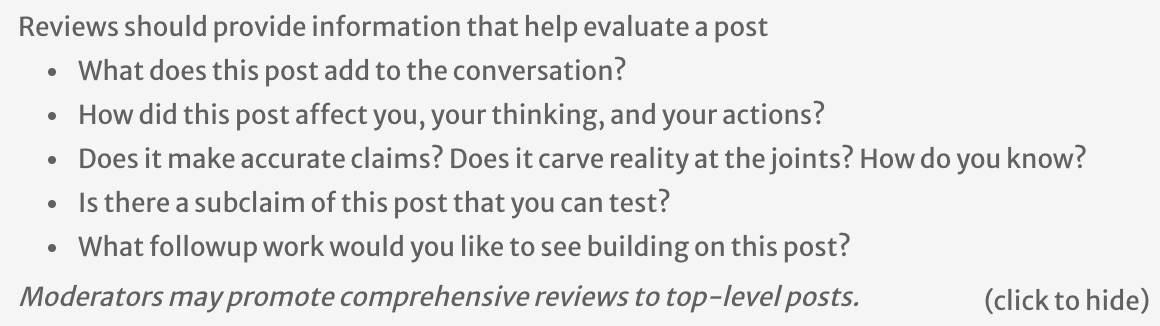
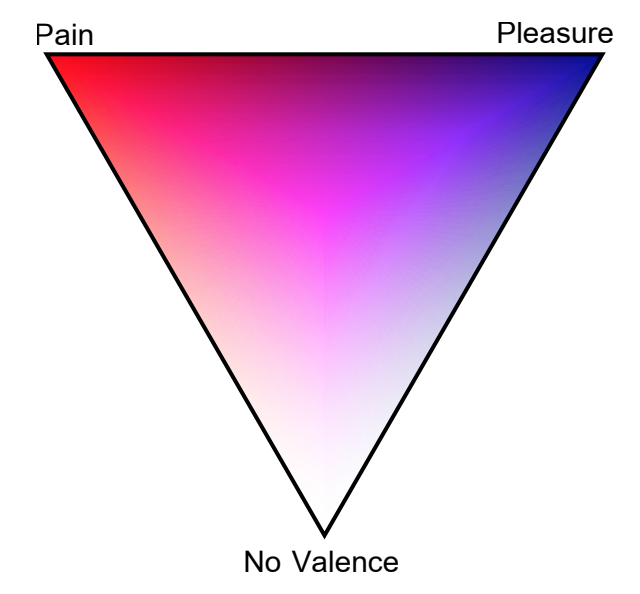
This is my 2022 review of Logarithmic Scales of Pleasure and Pain: Rating, Ranking, and Comparing Peak Experiences Suggest the Existence of Long Tails for Bliss and Suffering (2019; QRI link; forum link), written for the EA ForumFirst Decade Review; permalink of the review; read all reviews and vote for submissions here.
I would like to suggest that Logarithmic Scales of Pleasure and Pain (“Log Scales” from here on out) presents a novel, meaningful, and non-trivial contribution to the field of Effective Altruism. It is novel because even though the terribleness of extreme suffering has been discussedmultipletimesbefore, such discussions have not presented a method or conceptual scheme with which to compare extreme suffering relative to less extreme varieties. It is meaningful because it articulates the essence of an intuition of an aspect of life that deeply matters to most people, even if they cannot easily put it into words. And it is non-trivial because the inference that pain (and pleasure) scales are better understood as logarithmic in nature does require one to consider the problem from multiple points of view at once that are rarely, if ever, brought up together (e.g. combining empirical deference graphs, descriptions of pain scales by their creators, latent-trait analysis, neural recordings, and psychophysics).
Fundamentally, we could characterize this article as a conceptual reframe that changes how one assesses magnitudes of suffering in the world. To really grasp the significance of this reframe, let’s look back into how Effective Altruism itself was an incredibly powerful conceptual reframe that did something similar. In particular, a core insight that establishes the raison d’etre of Effective Altruism is that the good that you can do in the world with a given set of resources varies enormously depending on how you choose to allocate it: by most criteria that you may choose (whether it’s QALYs or people saved from homelessness), the cost-effectiveness of causes seem to follow much more closely (at least qualitatively) a long-tail rather than a normal distribution (see: Which world problems are the most pressing to solve? by Benjamin Todd; the long-tail on the left below). In turn, this strongly suggests that researching carefully how to invest one’s altruistic efforts is likely to pay off in very large ways: choosing a random charity versus a top 1% charity will lead to benefits whose scale differs by orders of magnitude.
Log Scales suggests that pain and pleasure themselves follow a long-tail distribution. In what way, exactly? Well, to a first approximation, across the entire board! The article (and perhaps more eloquently the subsequent video presentation at the NYC EA Meetup on the same topic) argues that when it comes to the distribution of the intensity of hedonic states, we are likely to find long-tails almost independently of the way in which we choose to slice or dice the data. This is analogous to, for example, how all of the following quantities follow long-tail distributions: avalanches per country, avalanches per mountain, amount of snow in mountains, number of avalanche-producing mountains per country, size of avalanches, number of avalanches per day, etc. Likewise, in the case of the distribution of pain, the arguments presented suggest we will find that all of the following distributions are long-tails: average pain level per medical condition, number of intensely painful episodes per person per year, intensity of pain per painful episode, total pain per person during life, etc. Thus, that such a small percentage of cluster headache patients accounts for the majority of episodes per year would be expected (see: Cluster Headache Frequency Follows a Long-Tail Distribution; the long-tail on the right above), and along with it, the intensity of such episodes themselves would likely follow a long-tail distribution.
This would all be natural, indeed, if we consider neurological phenomena such as pain to be akin to weather phenomena. Log Scales allows us to conceptualize the state of a nervous system and what it gives rise to as akin to how various weather conditions give rise to natural disasters: a number of factors multiply each other resulting in relatively rare, but surprisingly powerful, black swan events. Nervous systems such as those of people suffering from CRPS, fibromyalgia, and cluster headaches are like the Swiss Alps of neurological weather conditions… uniquely suited for ridiculously large avalanches of suffering.
Log Scales are not just of academic interest. In the context of Effective Altruism, they are a powerful generator for identifying new important, neglected, and tractable cause areas to focus on. For instance, DMT for cluster headaches, microdose ibogaine for augmentation of painkillers in sufferers of chronic pain, and chanca piedra for kidney stones (writeup in progress) are all what we believe to be highly promising interventions (of the significant, neglected, and tractable variety) that might arguably reduce suffering in enormous ways and that would not have been highlighted as EA-worthy were it not for Log Scales. (See also: Get-Out-Of-Hell-Free Necklace). On a personal note, I’ve received numerous thank you notes by sufferers of extreme pain for this research. But the work has barely begun: with Log Scales as a lens, we are poised to tackle the world’s reserves of suffering with laser-focus, assured in the knowledge that preventing a small fraction of all painful conditions is all that we need to abolish the bulk of experiential suffering.
But does Log Scales make accurate claims? Does it carve reality at the joints? How do we know?
The core arguments presented were based on (a) the characteristic distribution of neural activity, (b) phenomenological accounts of extreme pleasure and pain, (c) the way in which the creators of pain scales have explicitly described their meaning, and (d) the results of a statistical analysis of a pilot study we conducted where people ranked, rated, and assigned relative proportions to their most extreme experiences. We further framed this in terms of comparing qualitative predictions from what we called the Normal World vs. Lognormal World. In particular, we stated that: “If we lived in the ‘Lognormal World’, we would expect: (1) That people will typically say that their top #1 best/worst experience is not only a bit better/worse than their #2 experience, but a lot better/worse. Like, perhaps, even multiple times better/worse. (2) That there will be a long-tail in the number of appearances of different categories (i.e. that a large amount, such as 80%, of top experiences will belong to the same narrow set of categories, and that there will be many different kinds of experiences capturing the remaining 20%). And (3) that for most pairs of experiences x and y, people who have had both instances of x and y, will usually agree about which one is better/worse. We call such a relationship a ‘deference’. More so, we would expect to see that deference, in general, will be transitive (a > b and b > c implying that a > c).” And then we went ahead and showed that the data was vastly more consistent with Lognormal World than Normal World. I think it holds up.
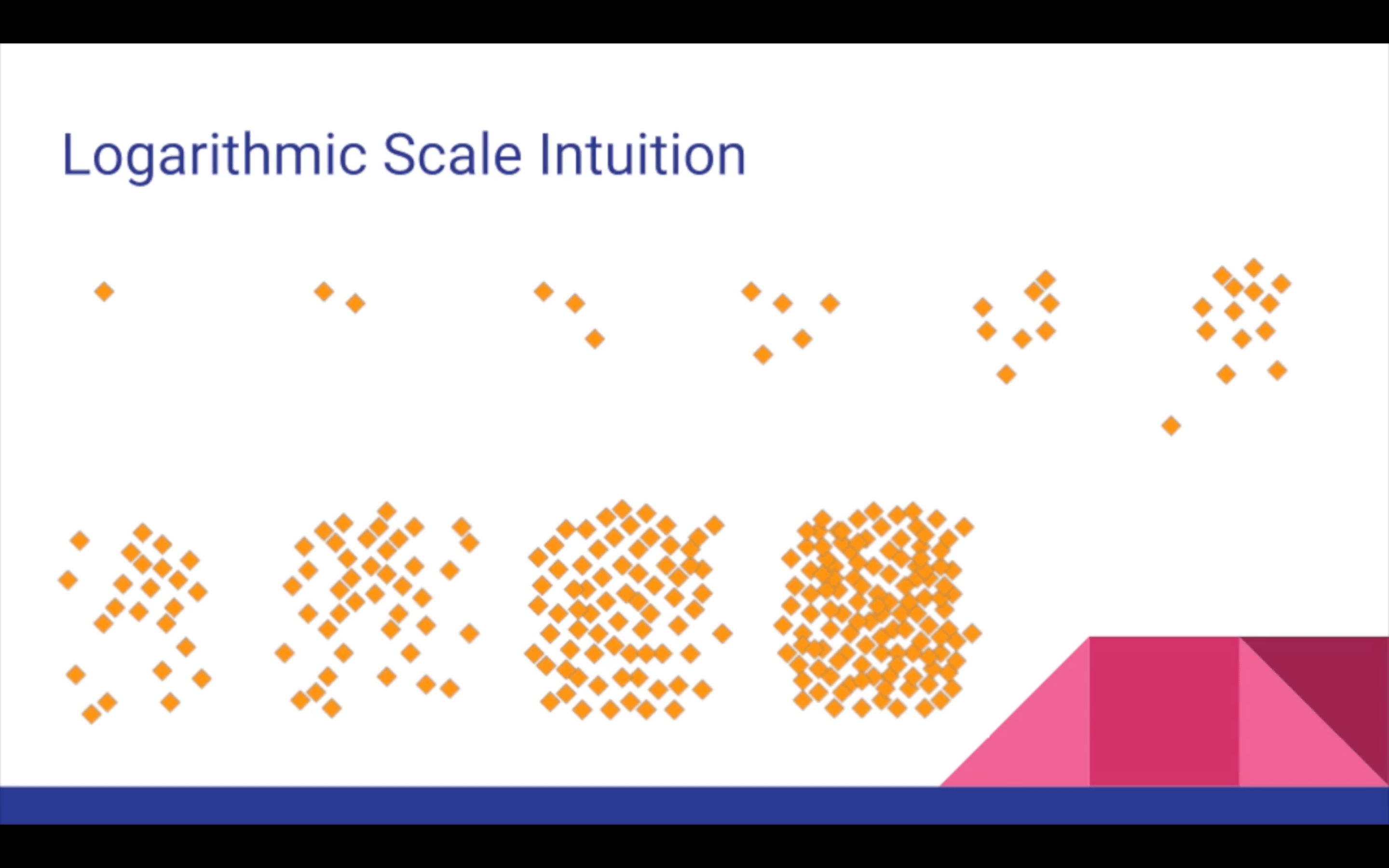
An additional argument that since has been effective at explaining the paradigm to newcomers has been in terms of exploring the very meaning of Just-Noticeable Differences (JNDs) in the context of the intensity of aspects of one’s experience. Indeed, for (b), the depths of intensity of experience simply make no sense if we were to take a “Just-Noticeable Pinprick” as the unit of measurement and expect a multiple of it to work as the measuring rod between pain levels in the 1-10 pain scale. The upper ends of pain are just so bright, so immensely violent, so as to leave lesser pains as mere rounding errors. But if on each step of a JND of pain intensity we multiply the feeling by a constant, sooner or later (as Zvi might put it) “the rice grains on the chessboard suddenly get fully out of hand” and we enter hellish territory (for a helpful visual aid of this concept: start at 6:06 of our talk at the 2020 EAGxVirtual Unconference on this topic).
From my point of view, we can now justifiably work under the assumption that the qualitative picture painted by Log Scales is roughly correct. It is the more precise quantitative analysis which is a work in progress that ought to be iterated over in the coming years. This will entail broadening the range of people interviewed, developing better techniques to precisely capture and parametrize phenomenology (e.g. see our tool to measure visual tracers), use more appropriate and principled statistical methods (e.g. see the comment in the original piece about the Bradley-Terry model and extreme value theory), experimental work in psychophysics labs, neuroimaging research of peak experiences, and the search for cost-effective pragmatic solutions to deal with the worst suffering. I believe that future research in this area will show conclusively the qualitative claims, and perhaps there will be strong consilience on the more precise quantitative claims (but in the absence of a true Qualiascope, the quantitative claims will continue to have a non-negligible margin of error).
Ok, you may say, but if I disagree about the importance of preventing pain, and I care more about e.g. human flourishing, why should I care about this? Here I would like to briefly address a key point that people in the EA sphere have raised in light of our work. The core complaint, if we choose to see it that way, is that one must be a valence utilitarian in order to care about this analysis. That only if you think of ethics in terms of classical Benthamite pain-minimization and pleasure-maximization should we be so keen on mapping the true distribution of valence across the globe.
But is that really so?
Three key points stand out: First, that imperfect metrics that are proxies for aspects of what you care about (even when not all that you care about) can nonetheless be important. Second, that if you cared a little about suffering already, then the post-hoc discovery that suffering is actually thatfreakingskewed really ought to be a major update. And third, there really are reasons other than valence maximization as a terminal goal to care about extreme suffering: intense suffering is antithetical to flourishing since it has long-term sequelae. More so, even if confined to non-utilitarian ethical theories, one can make the case that there is something especially terrible about letting one’s fellow humans (and non-humans) suffer so intensely without doing anything about it. And perhaps especially so if stopping such horrors turn out to be rather easy, as is indeed the case.
Let’s tackle these points each in turn.
(1) Perhaps here we should bring a simple analogy: GDP. Admittedly, there are very few conceptions of the good in which it makes sense for GDP to be the metric to maximize. But there are also few conceptions of the good where you should disregard it altogether. You can certainly be skeptical of the degree to which GDP captures all that is meaningful, but in nearly all views of economic flourishing, GDP will likely have a non-zero weight. Especially if we find that, e.g. some interventions we can do to the economy would cause a 99.9% reduction in a country’s GDP, one should probably not ignore that information (even if the value one assigns to GDP is relatively small compared to what other economists and social scientists assign it). Likewise for extreme suffering. There might be only a few conceptions of the good where that is the only thing we ought to work on. But avoiding hellish states is a rather universally desired state for oneself. Why not take it at least somewhat into account?
In truth, this is not something that classical questions in Effective Altruism pre-Log Scales couldn’t overcome either. For instance, as far as I am aware, in practice QALYs are used more as a guide than as an absolute; their value within EA comes from the fact that in practice interventions are orders of magnitude different when it comes to their cost-effectiveness when assessed with QALYs. So even though the vast majority of EAs are not QALY absolutists, the differences in QALYs saved between interventions are large enough that as an approximate guide, the metric still generates huge amounts of consilience.
(2) In turn, the post-hoc finding that hellish states are much, much worse than one would intuitively believe really should at least rebalance one’s priorities somewhat. Is there really no amount of suffering that would do so? Unless one has a utility function akin to a ReLu activation function, going far enough down into the depths of hell ought to count for something. And…
(3) Speaking candidly, fully articulating the true significance of this finding will take us to philosophically polemical territory: philosophy of personal identity where person-affecting views will see the situation quite differently than person-moment-affecting views, philosophy of mind where the ontological status of pleasure and pain might be questioned, and intricate questions that arise at the interface between the views of virtue ethicists, deontologists, negative and classical utilitarians. Of course a negative utilitarian who believes in Empty Individualism and Eternalism at the same time will likely be especially horrified by this information. But, with that said, I would suggest that there are good reasons to care about Log Scales no matter how antithetical one’s views are to philosophical hedonism.
In particular, I would argue that deontologists and virtue ethicists should still take note. The cultivation of virtue requires a minimum of wellbeing in order to maintain motivation to live. And perhaps deontologists might find extreme suffering particularly egregious from the point of view of “things so horrible that ought not to be”. Really, the people we interviewed for the cluster headache writeup told us that experiencing such levels of hellish suffering causes profound psychological transformations (e.g. one interviewee told us that experiencing the higher ends of pain in a cluster headache feels like a profound “spiritual violation” from which you may never recover – a feeling most certainly aggravated by the seeming indifference of people at large about their plight). Virtue ethicists and deontologists might as well recognize this cause area as work that is unconscionable not to perform, regardless of arguments based on the precise mathematical optimization of the prevention of negative valence.
And finally, in all seriousness, as the cognitive intelligentsia of the world begins to see clearly the nature of the distribution of pleasure and pain, we can expect there to be a big social benefit to being the one who destroys hell. Right now there isn’t a huge social reward to be obtained by working on this cause, but I predict this will change. And, pragmatically, it is sensible to present this cause in a motivating rather than depressing light: indeed, let’s give honor, glory, and endless admiration to whoever makes tangible progress in tearing hell down. And to all of the millionaires and billionaires reading this: this could be you! You could be the one who took on the mantle of preventing all future cluster headaches, established the field of anti-tolerance drugs for severe chronic pain, or got rid of kidney stones (and you did it before it was cool!). Let’s get to work!
Working with Feelings of Pleasure and with the Subtle Body
Encouraging feelings of well-being
The method just described, of focusing primarily on the sense of the whole body, involves the development of a sensitivity to what could be termed ‘the subtle body’ or the ‘energy body’.[8]
Almost from the start in this approach we deliberately but gently work at nurturing a sense of comfort, pleasure, or well-being in the body.
This can be done through the way we pay attention to the subtle body, as described above – opening out the awareness to encompass there the whole body space, and tuning into the more pleasant frequencies of feeling that are perceivable.
It is also possible to use the breath or the mettā to help elicit and support the pervasion of this sense of well-being. Simply sensitizing to, and enjoying, the way we feel the energetic resonances of the mettā or the breath throughout the whole space of the body – opening to and finding delight in their reverberations there – can gently move the experience in the direction of a more expansive well-being.
And when there is a state of agitation or anxiety, we can play with ways of breathing or practicing the mettā, and also ways of sensing the breath or mettā, that feel as if they soothe the subtle body and smooth out its energies. Delicately tuning into the felt experience of these qualities of soothing or smoothing-out will help them to gradually gain strength, and help the agitated energies to slowly subside.
The imagination, too, can be skillfully employed in order to gently encourage this sense of pleasure or well-being in the subtle body. While simultaneously pervading the whole body space with an awareness sensitive to the texture and tone of the energy of that whole field, it is possible, for example, to imagine the subtle body as a body of radiant light; then to open to and explore what that feels like. Any image formed in this way does not necessarily need to appear in precise detail, or even completely distinctly. It is, rather, the energetic sense of pleasure or well-being which it supports that is primary, since this is what primarily supports the samādhi.
Likewise, one may experiment with imagining various luminous lines of energy in the body – for example, between the perineum and the crown of the head, or from the lower belly out through the legs – and sense how any such lines of energy supports the whole body to feel upright, open, and energized. The imagination here may be visual or kinesthetic, or a combination of the two. And it need not always follow exactly the anatomical contours of the physical body or its posture. For instance, if sitting or kneeling with the legs crossed or bent, the luminous lines of energy imagined radiating from the lower belly or base of the spine need not bend with the legs, but may instead continue and extend straight out at the knees, if at that time that feels more supportive of openness, energization, and well-being.
If there is tension, or even pain, in one area of the body, rather than always conceiving of it in anatomical or physiological terms, it can sometimes be more helpful to conceive of and perceive that area in energetic terms, and to play with the perception of lines of energy in order to support a degree of comfort and ease.
There are many ways we may discover to bring about some sense of energetic openness and well-being in the subtle body. And as it is accessed more and more, this altered body feeling is one that eventually we can ‘remember’ and learn to deliberately recall – to summon by gentle intention. We can then move, usually gradually, into the focused steadiness of samādhi from that basis, by incorporating this perception of pleasure or well-being more centrally into the meditation.
Towards unification
Whether it has arisen through being deliberately recalled, or through focusing on the breath or mettā, there are again a number of possible ways of using the sense of pleasure or comfort to help guide the citta into the unification of samādhi.
Once it is easy sustaining for some minutes, we can gently begin to take that bodily feeling of well-being as the primary object of our focus. It is important not to ‘snatch at it’, but rather to ease the attention toward it gracefully, and gradually let it take up the full focus of attention. Then the attention and the citta can be encouraged to enjoy it as fully as possible.
The attention can at times probe it, burrowing into one area of the pleasure, perhaps where it feels strongest.
Or, at other times, a mode of ‘receiving’ it, really trying to open up to it, can be employed.
Either way, one attempts all the while to remain intimate with its texture, and actually to relish the pleasure as much as possible. In these ways (and in others that can be discovered) we can delicately work to gently sustain the bodily feeling of well-being, and to absorb the attention more fully into it.
Alternatively, it is possible to mix the sense of pleasure with the perception of the breath or the mettā, in order to support and deepen the quality of the samādhi.
Then it may seem, for example, as if one is breathing the pleasurable energy; or it may seem as if one is breathing into and out of that area of well-being.
In mettā practice, it may seem as if the mettā and the pleasurable energy have become fused, so that the feeling of the mettā at that time is the feeling of the well-being. And this can become the ‘flavour’ of the energy of mettā that is radiated outwards towards beings, or that wraps around and permeates one’s own body and being.
The area of pleasurable energy may also be perceived as the source of the mettā.
Steadiness of feeling is more important than strength
We should point out once more that sometimes the sense of well-being is really quite subtle. Although the feelings of pleasure might also be very strong at times, this is actually not necessary in order to use them in a helpful way. Over time, their strength will in fact vary naturally (and anyway, as the practice matures, at a certain stage they begin to mellow). What is more necessary is that they sustain relatively steadily for more than a few minutes. Then we can learn to sustain them for longer.
Within this larger steadiness, any perceived waves or movements of the energy are not at all problematic. We can try to open the space of the body to these inner currents as much as possible, allowing and fully enjoying them (and if they feel very intense, even playing with surrendering and abandoning our whole body and being to them). Doing so, their intensity will in time calm down.
Suffusing and saturating the whole body
Along with the steadiness of the feelings of well-being, and of the attention on those feelings, we are also gently aiming at eventually having the whole space of the body suffused by and saturated with the feeling of well-being or pleasure. Sometimes this happens by itself. But sometimes the sense of pleasure, when it arises or when it is recalled, only pervades one area of the body. There are a number of viable responses then.
One is to simply enjoy it in the area where it is located, in the ways that we have described, without pressuring the feeling to spread. It may then expand naturally at some point to pervade the whole body.
But even if it does not spread then, that need not be regarded as a problem. A vital aspect of the whole relationship with samādhi practice is to enjoy what well-being is there at any time, not to measure it and view it through a lens that somehow demands, even subtly, that it be ‘better’, bigger, stronger.
Having said that, it is in fact also possible at times to gently encourage the feeling of pleasure or well-being to spread – for instance by simply opening up the space of the awareness to embrace a larger area of the body. Sometimes then the pleasant feeling will automatically start to expand to fill that space.
Alternatively, the breath may be used to gently ‘massage’ the sense of well-being into other areas of the body. Although there is not space to enter into a full description of possibilities here, with practice the breath energy may be felt and perceived throughout the body, entering and flowing in all kinds of ways beyond the strictly anatomical movement of air into the wind-pipe and lungs. We can learn to sense the breath energy in and through the whole body. And as alluded to earlier, the breath energy can be mixed with the pleasure, so that the perceived movements of breath in the whole body space move and spread the perception of the pleasure.
There is also, again, no reason why one cannot just imagine the feeling of well-being permeating the body space more fully. The perception then often begins to follow the image.
These are some of the possibilities, but with repeated practice over time it will anyway become normal for the pleasurable feeling to effortlessly pervade the whole body whenever it arises.
Unblocking and smoothing out the subtle body energies
The harmonization and unification in well-being that is characteristic of samādhi can also be regarded as a harmonization, alignment, smoothing out, and opening of the flows of energies in the subtle body [emphasis mine]. All day and all night long our energy body is moving in and out of states of alignment and openness, constriction and blockage, in response to a whole range of conditions, physical, mental, and emotional. This is completely normal, and with attention and sensitivity to the experience of the body we notice these fluctuations more and more. Although they may be felt in any region, perhaps most commonly a block in energy will be felt as a constriction somewhere along the central axis of the body, anywhere from the perineum to the top of the head. As we move into a state of more samādhi there is an unblocking, untying, aligning, and harmonizing of the subtle body energies to some degree.
When the subtle energies are blocked and agitated, samādhi is to some extent blocked. And when the subtle energy is unblocked and unagitated, samādhi is not so far away. (Perhaps all that is needed then is a steadying of the attention on enjoying the pleasant feelings of the ‘unblocked’ subtle body, as described). In addition, therefore, to the ways of working to smooth out and soothe the energy body suggested earlier, it can be useful to learn means for gently unblocking the energies when there is any sense of energetic constriction, in order to open up again the potential of a degree of samādhi at that time. Again, with a light and playful attitude of experimentation, a variety of ways of working in meditation can be discovered.
For example, sensitive to the whole subtle body sense, the breath energy or mettā may be perceived and conceived in any way that feels helpful, as alluded above:
We may breath into and out of an area of blockage.
Or we may, perhaps gently, breathe the breath energy through that area.
In mettā practice, we may experiment with situating the centre or source of the energy of mettā right at that point of constriction, and explore what effects that has.
If these strategies prove difficult, it is again quite feasible to imagine the breath, the body energies, or the mettā flowing more freely through the area of blockage, or even flowing out of the body, and opening and unblocking in that way.
The Relation Between Samādhi and Insight
Insight brings samādhi
As well as those described above, there are many other practicable means to unblock the subtle body energies. In particular, most of the insight ways of looking that we shall introduce in the course of this book may also be used in the service of opening and deepening samādhi. Mindful observation will reveal that any craving or clinging is always accompanied by, and reflected in, blocks and knots in the subtle body [emphasis mine]. Now, insight, we have said, cuts that on which dukkha depends. And dukkha depends on craving. Thus, according our definition, insight is any way of looking that releases craving. As the insight and emptiness practices are developed, therefore, they can also be used at times to deliberately undo the craving that is mirrored in the knots in the energy body. This might involve using the insight practices ‘on’ the experienced subtle energy blocks themselves, as ways of looking at those perceptions and feelings. Or it might involve engaging these insight ways of looking just more generally in regard to any experience in the moment. Either way, the dissolving of craving to whatever extent will, at the same time and to a similar extent, untie the knots in the subtle body to unblock those energies and so deliver the possibility of some samādhi. Ha!
With more practice our skill grows and we find that it is in fact possible quite often to use the ‘letting go’ that insight brings to deliberately unblock the energies and the felt sense of the sublet body in this way. The pleasantness, openness, well-being, delightful and alive stillness, or joy that comes with this unblocking can be felt in the space and texture of the body sense. We can then tune into that. It is this tuning in to the frequency of the pleasant, and delicately attending to it, that ‘filters it out’ of the field of awareness, so that it begins to become more palpable and more prominent.
Then we can rest in it, allowing it to spread throughout the body space. And if, as before, we continue to tune in to and focus on the felt sense of the energy of this well-being, gently intent on allowing and opening to an enjoyment of it, and encouraging the attention to become absorbed in it, to fill up with it, this can carry us to the threshold of some samādhi.
Such a skill is useful for even the most experienced meditators. There are times in meditation when we may be trying to bring the mind to some unification, working with the intention for samādhi, and despite all our patience and adeptness in attempting different things samādhi does not come. We may need some insight to help us let go of some craving or clinging, perhaps even a craving we were unaware of, and then some samādhi becomes possible.
In addition to the opening and transformation of the energies of the subtle body just described, there is another, related aspect to what is occurring that can be pointed out. To a degree proportional to its strength, the push and pull of craving pushes and pulls the attention. It thus agitates the mind and makes it restless; or saps its energy and makes it dull [emphasis mine]. Relaxing craving through insight will therefore allow the mind to settle more naturally and easefully into stillness and a steadiness of attention. We can see then that the quality of steadiness of attention does not only come through holding the mind to one object.
Aside from being a skillful ‘trick’, however, all this suggests a number of things. One is that although usually we might conceive that ‘samādhi leads to insight’, (and clearly a certain amount of steadiness is generally needed before any insight can arise), as we explore we discover more and more that they can lead to each other.
[8] We can freely use a term like ‘subtle body’ or ‘energy body’, without needing either to assert or to deny the ‘reality’ of such a concept. It is enough for us that it is a perception, a way the body can be perceived which can be helpful. In fact, a little reflection reveals that the same could be said of concepts like ‘attention’. Is there really some ‘thing’ called ‘attention’ that can ‘go towards’ some other thing (or mental representation of an object) or ‘receive’ that thing? These are all ways of conceiving and perceiving useful on the path to freedom. Perceivable, useful, and, as we will come to see, thoroughly empty.
The following is an exchange of text messages with Roger Thisdell, a 26 year old accomplished meditator. He claims that this year he finally broke through into abiding in what he describes as an entirely new category of experience that matches the descriptions of classical Buddhist 4th path.
1) Utter centerlessness: no watcher, no sense of a watcher, no subtle watcher, no possibility of a watcher. This is immediately obvious just as color is to a man with good eyesight as the old saying goes. Thus, anything and everything simply and obviously manifests just where they are. No phenomena observe any others and never did or could.
2) Utter agencylessness: meaning no agency, no sense of doing, no sense of doer, no sense that there could be any agent or doer, no way to find anything that seems to be in control at all. Whatever effort or intent or anything like that that arises does so naturally, causally, inevitably, as it always actually did. This is immediately obvious, though not always the forefront of attention.
3) No cycles change or stages or states or anything else like that do anything to this direct comprehension of simple truths at all.
4) There is no deepening in it to do. The understanding stands on its own and holds up over cycles, moods, years, etc and doesn’t change at all. I have nothing to add to my initial assessment of it from 9 years ago.
5) There is nothing subtle about it: anything and everything that arises exhibits these same qualities directly, clearly. When I was on the third path, particularly late in it, those things that didn’t exhibit these qualities were exceedingly subtle, and trying to find the gaps in the thing was exceedingly difficult and took years and many cycles. I had periods from weeks to months where it felt done and then some subtle exception would show up and I would realize I was wrong yet again, so this is natural and understandable, and if someone claims 4th as I define it here and later says they got it wrong, have sympathy for them, as this territory is not easy and can easily fool people, as it did me many, many times over about 5 years or so. However, 4th, as I term it, ended that and 9 years later that same thing holds, which is a very long time in this business.
There are other aspects that may be of value to discuss at some other time, but those are a great place to start for those who wish to claim this. If you truly have those, then perhaps we can talk about a few other points that are less central and essential.
[Links added to aid reader’s comprehension – lightly edited for clarity]
In the beginning… Roger joined a private group where we discuss consciousness and started to get familiar with the vocabulary of the Qualia Research Institute (e.g. discussing meditation in terms of valence). He then posted this video, which caught my attention:
Where he claims that “Pleasure as a positive, as an actual added experience, does not exist. It certainly does not exist how a lot of us think it does … [whereas] negative valence experiences do exist as contractions.”
Andrés! This is Roger Thisdell […]. Thanks for giving me your number.
Do add me to the Phenomenology Club. That sounds like my jam! Cheers!
Andrés:
Excellent! Will do! 🙂
[…time…]
Roger:
Hey Andrés, it was great to hang out online last night and hear your explanations. A bunch of you are really elite thinkers. I’m inspired to learn how to speak more of your qualia language.
I would love to get into the topic of paradises with you. You seem to really sing their praise.
I said yesterday that I hold the view that actually what is most desirable is just the elimination of negative valence. As someone who frequently has cessations (when consciousness blanks out for a moment) where there is no subjective experience (no negative, no positive valence) in my book this is good enough. My thinking is also informed via complete ego death experiences in which there is still consciousness but no judgement on any part of experience (bad or good). At a local individual level these are the most desirable states. Out of all the states I have experienced (including bliss trips, jhanas, 5-MeO, MDMA, staring into the eyes of a lover without insecurities, laughing fits 🤣) if I had to choose a state to be in permanently it would either be cessation or ego death. I may have curated my brain too much to a Buddhist view and my level of emptiness insight is well entrenched, so that it is hard for me to really believe the ultimate good is to keep the cosmic consciousness party going and fueling it with positive valence.
I think that while consciousness is online we better make the best out of it and try to exist in as few low negative valence states as possible and help all sentient beings with this as well; all the while the positive valence that comes along is merely instrumentally valuable, like a compliment or added bonus.
For example if you are hungry it is nice to eat something tasty. But if you were never hungry in the first place then who cares how tasty something is – don’t need it 💁♂️ (this may be my strongly consolidated non-attachment showing).
I guess what I’m really asking is: can you convince me to intrinsically care for paradise states? I do believe I have experienced what you are referring to as paradise states, but maybe I just have too much non-attachment for them to think they are the goal/prize.
(apologies for being long-winded 🙏)
Andrés:
Perhaps:
You lost the ability to get excited about future experiences. You learned this because you were taught and you practiced techniques that associate being excited about the future with dukkha. Alas, the hedonic theories around the time of Buddha were incomplete and as a consequence a lot of the claims and teachings underfit reality (meaning that they generalize too much). In contrast, it turns out that there are a manifold of ways of experiencing excitement about the future in an epistemologically clear way and no delusions. More so, with that orientation one can see more clearly larger parts of the state-space of consciousness as one is not inhibiting them. I know you have experience with high valence states. But I suspect you have deconstructed a lot of the microcognitive apparatus that allow the insights coming from the reality of their existence from propagating across the entire nervous system.
Just as lack of awareness about e.g. cluster headaches phenomenology can give you the impression that reality has no stakes, so does acute lack of access to the ultra-positive realms. I think for many, Buddhism has a certain effect in how one conceptualizes such experiential realms after the fact that perhaps is not quite in tune with how they truly were. Interestingly, one could here examine Buddhism as an aesthetic itself, and renunciation as a kind of Soulmaking, where under the hood one is still pursuing a kind of high-dimensional meaning qualia of positive valence. Which takes me to:
Rob Burbea’s Soulmaking talking about how exploring not exhaustively breaking down dukkha always but letting a bit of e.g. Eros/passion for reality opens up new ways of seeing that recontextualize Buddhism. Not that we shouldn’t get rid of dukkha, of course. But it’s good to see the underlying aesthetic influences on how one generalizes about reality based on one’s experience.
What do you think? 😄
Thank you for joining! And also for sharing your thoughts. 🤠👌
First of all, I am so impressed with Burbea. His lectures were incredibly useful for me while learning the jhanas. And now I’m picking through his book ‘Seeing That Frees’.
I think his ontology and how he builds on Buddhism is sophisticated and gorgeous.
Reminds me of a remark about Hemingway, by his grandson – he quit journalism to dedicate himself to fiction because he was more interested in truth than facts. I relate this to Soulmaking in a way.
I love his notion of skillful fabrication. But it seems like it’s a compromise in a way. We can’t fully live without self, and thoughtforms, and conceptual frameworks, and so, while we are alive and have them, let’s learn to use them skillfully/beautifully. I’m on board! 🚂
Re your 2nd point: I would add that a lack of awareness of the existence of cessations, or Nirodha, or ego death experiences is another topographical blind spot which prevents people from making a more comprehensive assessment of what is most desirable. (I know that many people who say they’ve experienced ego death, when I enquire about it, it turns out to be more of just a partial ego loss experience, and not the full annihilation). I suppose we really need those who have deep expertise in bliss states and dukkha-less/unfabricated states to compare and contrast.
For what it’s worth, and to give you more a sense of my bias, I would claim to be someone who has explored a wide range of state-spaces: from suicidal depression, to psychosis-like damnation bad trips, to K-holes, to peak experiences, and now as of 21st of May [2021] I’m claiming Frank Yang-style MCTB [see: Scott Alexander’s book review] 4th path permanent abiding in centreless consciousness (IDK what that says about my nervous system and fully propagating insights as you mentioned).
Hands down 🙌, this is the best shift in my life that has ever taken place without a doubt (I thought stream entry was good, but this is another magnitude). My hedonic set tone is persistently so high. I’m often walking around smiling for no apparent reason. 11/10 I recommend this.
And 4th path gets you an ability to adopt a new perspective where you simultaneously see the Yin and the Yang and vice sera (emptiness is form and samsara is nirvana). It’s all one place, there is not out. All the while, still we quite obviously make value judgements between states. I know you speak of hellish corners of consciousness that shouldn’t be touched. And so, although we can/should adopt flexibility of perspectives on aesthetic frames (as Rob speaks about, which is helpful) and see value in many different views as best as we can… must we still do the hard job of really judging what is best? What is most desirable? (to talk from a metamodern perspective).
Ultimately, I still come down on: lights out unconsciousness tops everything 🤷♂️ [emphasis mine]. Getting all beings to Parinirvana would objectively be preferable for all beings rather than keeping the play going – if such a plan is possible or sensible or sensical even.
It’s funny though, at some point I think it may just come down to some split difference in intuition among people (perhaps that difference can be reconciled somehow). For me this was apparent when I hear from Kenneth Folk vs. Culadasa. Kenneth holds antinatalist sentiments (or he did when I emailed him a couple of years ago and actually asked him) which speaks to a siding with a belief that there is an asymmetry of weighted value between negative and positive valence. While Culadasa seems to emphasize the joyous journey and adventure of life, which may speak to an opposite weighting in favor of the positive valence being worth the negative valence that comes along with it. Certainly not all spiritual roads lead to Rome.
I am very open to the idea that I am missing something though, and I may just need to be led by the hand like a child to these heaven realms for me to change perspective 😇😂
Thanks for engaging, this is fun!
Andrés:
Thank you for engaging! This is super interesting! Let me think about what else I can say 🙂
[…time…]
Total valence vs. pureness of valence: see Principia Qualia pg. 41. It could be that during cessations consciousness disappears and the state literally does not exist in any way. But the states immediately before and immediately after do and have at least a tiny bit of information so they are mixed valence states. Yet, perhaps they are massively positive valence on net.
An alternative view is that unconsciousness is still ‘real’ in a way, in which case we could think of it as consciousness but with no content whatsoever. But it’s still there. The analogy would be like combing a vector field in a torus. Most states have the vector field collide with itself and therefore feel less than perfect valence (due to [the Symmetry Theory of Valence, aka.] STV). Only when the field is completely combed without any self-collisions (which would not be possible in a sphere) you get perfect positive valence. And although there is no information encoded in the field, it still exists just as it did before. There’s just nothing to report.
In that case paradise could actually still exist. Meaning, higher and more refined versions of this kind of experience. In particular, we could look for other mathematical objects where the field can also be combed perfectly. They would then be strangely a different kind of ‘unconsciousness’ perhaps capable of fitting more energy and higher dimensions. Still, they would have maximum positive valence.
What do you think?
Oh, I also forgot if I’ve asked you whether you’ve tried 5-MeO-DMT and how it compares to your new baseline.
Ah, yes, I see the kind of framework you’re thinking from now – anti-symmetry, symmetry, and asymmetry.
From Principia Qualia pg. 39: [paraphrasing] “…if we take our hypothesis and apply it to IIT, and then we attempt to maximize pleasure/symmetry, consciousness/[phi] drops very rapidly.”
All the way to the point that maximum pleasure entails no consciousness??? [emphasis mine]
I don’t have a lot of experience with 5-MeO. I only did it once at about a 6mg range.
My impression of 5-MeO was that it had a visual brightening effect somewhat similar to the 4th Jhana. And there was that psychedelic mirroring effect with eyes open. It also had the reduction of conceptual understanding that comes when you get into 8th [Jhana]. I interpret that as a significant down-regulation in top-down information processing??
5-MeO has the sense that it’s going somewhere, moving towards something, while the effects build and then dissipate. Like it’s growing into something (I guess this is before a peak breakthrough – which I didn’t have).
My current consciousness abode isn’t going anywhere. There isn’t a sense that things are building towards something. It has a forever ‘this is it’, locked-in quality. Like a somewhat superposition of emptiness and fullness simultaneously. (Before 4th path I always felt like I was flickering between form and emptiness, now the two cohabitate the experiential space at the same time).
5-MeO also seemed very hedonically volatile; like any subtle thought or movement could disrupt the peace.
Meanwhile my current state is super unperturbable. In the past 2.5 months I haven’t found something that has rocked my well-being.
A couple of weeks ago I listened to an interview of a North Korean defector tell her story of starvation and human trafficking and for a good 30 minutes I was crying at this tragedy. But it was crying from a place of still really high well-being. I didn’t feel like I was suffering and I didn’t mind that crying state at all. (Which is quite weird, I suppose).
In my normal state now, there are no more papañca attacks. Thoughts don’t capture the mind like they used to.
And another thing I love about this new state is that I still have all my cognitive functions intact and I can operate in the world totally normally – which can’t be said about being on 5-MeO.
I feel super sober; while on 5-MeO I don’t believe you do (if I remember correctly).
I would say I prefer my new baseline to what I experienced on 5-MeO because of the lack of volatility and practicality of still having my intellect on hand, all the while with the constant sense of ‘this is it’ and high, high well-being.
[…time…]
Roger and Andrés have a video call:
We discussed a number of things: his meditation journey, his thoughts on various philosophies, exploring QRI frameworks, and his interest in music. Curiously, Roger said that unlike other people who spend a lot of time in meditation healing traumas and processing past experiences, he was able to largely just focus on progress on the path. This, along with a very rigorous and consistent practice, is why he got to where he is at so early in life (26 years old).
One of my main interests in the discussion was to flesh out how 4th path states/traits and the Symmetry Theory of Valence (STV) were connected. If I recall correctly, there were three main ideas connected to this topic I shared with him:
Discussing the “levels of consciousness” experienced on a psilocybin trip and the way they might mirror some of Frank Yang’s descriptions of the levels of consciousness on the path to awakening,
A model of equanimity I’ve been developing where impedance matching is a key ingredient, and
The difference between a “recipe” of a state or transformation of consciousness and its “review”
Let’s briefly elaborate on these topics.
(1) Frank Yang talks about undergoing a meditative process with the following stages: (a) standard sense of self, (b) awareness of awareness, (c) God/Oneness/Being/Non-Duality/Self, (d) Emptiness/Non-Beng/Uni-Locality, (e) Neither Being Nor Non-Being, and finally (f) Enlightenment.
What makes his descriptions so incredible is that he provides very raw and unfiltered phenomenological accounts of the process without really trying to force them into any pre-existing framework. From the point of view of the mission of QRI this is very valuable. In particular, it allows us to examine his process of transformation with the framework of Qualia Formalism: we ought to ask, not what kind of spiritual/mystical/transcendent process is going on here (which will certainly take us nowhere), but rather, wonder if we can cast his descriptions in terms of *structural changes to the field of awareness*. For example, Frank talks about “the screen of God” that becomes apparent in (c), where waves of energy seem to travel without resistance across one’s experiential field. He also talks about phase transitions (similarly to Shinzen Young, he talks about a process of liquefaction and gasification of the field of awareness). If, as we believe at QRI, valence is a structural property of experience, these transformations would have profound effects on one’s sense of wellbeing. So, the reason why “the screen of God” is a profound experience is not because you literally merge with a divine being (which might not be possible if we assume indirect realism about perception), but because the field of awareness is now in a phase that allows an entirely new level of efficient stress dissipation.
I shared with Roger some details from a particularly interesting psilocybin trip report that described rapid phase transitions between (what appears to be) several of the levels Frank describes. In particular, “the screen of God” state seems to have the capacity to stresslessly locate sensations without generating reverbarions with a represented “small self to which those sensations belong”.
(2) In turn, this led to discussing a new model (we haven’t really touched upon in QRI publications yet, but which is coming) of equanimity based on experiences I had during a two-week retreat earlier this year (see: Buddhist Annealing). This model has at its core the idea that equanimity is a mental tool that increases impedance matching between nervous system harmonics. Ask yourself: why is it that when you pluck a guitar string it sounds louder if it is connected to a guitar? It is not, as many would think, that the “resonance box amplifies the sound” (for where would the extra energy come from?). Rather, the energy is the same; what changes is the speed at which it is discharged! The resonance box vibrates and dissipates the energy of the string much faster than the string could on its own (as an aside, this is exactly why you can sustain a note for so much longer in an electric guitar). We could thus postulate that a lot of inner dissonance comes from resonance in the nervous system that has no means of dissipating its stored stress. To an extent, this is because involuntary subliminal contractions in our nervous system compartmentalize and modularize its components. Equanimity is the practice of relaxing those contractions, and thus slowly allowing the nervous system to undergo a search process where it finds structures that can resonate with the stored stress, and in turn allow it to dissipate faster. More so, over time, you entrain (and rewire!) the nervous system to become highly efficient at stress-dissipation. Dissonance is still there, but it “unfolds” and gets “metabolized” so fast that it barely counts as suffering. Highly annealed nervous systems are powerful stress-dissipation engines!
(3) Finally, we also discussed the idea that there is a distinction between the “recipe” of a state of consciousness and its “review”. A recipe is the steps you take in order to achieve a certain state (or transformation) of consciousness. A review is instead an account of what the resulting state feels like. Just as the instructions for baking a cake are quite different from a Chef’s review of what the resulting cake tastes like, we can expect that meditation instructions (e.g. focusing on the three characteristics) will not necessarily reflect the nature of the transformations of consciousness that result from them. Thus, while a lot of the meditative path is nominally about “renouncing” the pursuit of high-valence states of consciousness (and thus avoid the pleasure paradox), the result is nonetheless a state of consciousness that is high-valence in nature! Paradoxical? I don’t think so. The confusion is merely the result of conflating recipe and review.
Thus, we can still apply valence theories to states of consciousness that are allegedly beyond valence. Frank Yang, for example, seems to resonate a lot with STV. See his December 2020 interview at The Stoa. There (and in other videos) he describes “God mind” consciousness as a very positive experience, which is very symmetrical but not perfect. But his true awakening is perfectly symmetrical (in the realm of space, observer, and sense of time, even if not in content). His experience became like a “hologram that has no center”. Quote:
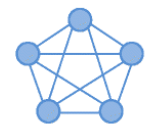
“Have you seen those illustrations of a sphere or a circle, where one point connects to all of the other points? […] if you wanted me to describe my day to day, moment to moment, experience, well, it’s pretty symmetrical. As in, there is no center to experience. There is hearing but no hearer; there is just the seeing, there is no seer; on thinking there is just thinking and no thinker. It’s not, like, processed or filtered through a subject in the center. And it’s very immediate in the sense that all of the sensations, all 360 degrees, are synched up to themselves, without any delay, 24/7. And all the sensations, where there is body, you know sight, sound, thoughts, emotions… they are all on equal footing to each other […inaudible…] in symmetry, and that is for me an aesthetic experience. I would say a suffering mind is a mind that isn’t symmetrical. If your mind is asymmetrical, it means it’s defiled somewhere. So for me aesthetics runs in all different kinds of domains, not only on the perceptual domain, not only on the visual aesthetics domain, but even on the emotional and how you think.”
Yes, God Mind (left) is good, but have you tried no-self (right)? It is so much more symmetrical!
As we’ve discussed before, the homogeneity of phenomenal space and time might be a very large component of what accounts for positive valence. And what Frank is describing here suggests that’s the case. Disturbances in the attention field lines and the saliency of specific components of a mind can break the underlying symmetry of the phenomenal space and time of the resulting experience. Anxiety, for example, in this paradigm is described as unpleasant because it involves the bubbling up of low-level prediction errors causing “attention pinches” across your experience, and thus disturbing the free-flow of energy that would exist in a homogeneous field. Prediction errors are not inherently unpleasant; they are unpleasant only to the extent that they cause asymmetries in your field of awareness!
Frank Yang also says that his big awakening felt like a “quantum jump”. It makes sense that a strong anti-fragile attractor for a new network topology would be self-reinforcing (a new lowest-energy state, metaphorically speaking, perhaps akin to a false vacuum collapse inside one’s mind!). Again, this is all very compatible with valence structuralism, if not STV.
Roger said that he will have to think about all of this. In the meantime, he shared with me some (amazing!) pictures he made to illustrate how his field of awareness has been transformed with meditation over time. Like Frank Yang, he identifies several discrete phase transitions. These are: (a) standard perception, (b) The Witness, (c) Big Mind, (d) No Self, and finally (e) No Self & Centreless Awareness (4th path!):
Considering more what you said about impedance matching and adding resonance to experience:
Perhaps this is merely an analogy, but still: consider the tautness of a spider’s web. If a fly lands on it, at one part, the whole web will shake and the energy will transfer throughout in such a way that the spider can locate where on the web the fly landed. If the web is too taut then the energy of the fly landing won’t dissipate far enough for the spider to receive the information. However, if the web is too slack the fly could just break the structure of the web.
It might be interesting to consider why spiders build webs with a centre point and not as a straight or criss-crossing lattice.
So to relate this to consciousness and metabolizing stress… I would say my consciousness now feels like it’s more taut and lattice-woven rather than spider web-shaped with a middle [emphasis mine]. So this means when a stress point is activated somewhere in the experiential space, its energy doesn’t ripple as far out as it would have before, thus not being as disruptive.
And if we aliken the spider on the web to the epistemic agent, if he is situated on one spot and for all goings-on on the web to be known their information must travel to him, then the web must be not too taut so that all the ripples can reach him and he knows what’s going on. The problem with this set-up is that it means that knowing requires instability.
However, if we do away with the spider (a single point considered the epistemic agent) and make it so that the knowledge is attributed to the web itself, then the web can afford to be much more taut/less shaky/more robust, causing less negative valence.
So in some way I could say my experience (centerless consciousness) is more taut in this way, but this tautness doesn’t feel rigid or stiff, but rather very airy.
Indra’s net can have too much slack in it, if it’s not sewn together tightly and uniformly.
Pre-Awakening: The mind uses a fictitious “self-as-epistemic-agent” in a field of awareness that has slack and vibrates in unpleasant ways in the process of integrating information. The field of awareness relies on a network topology that is suboptimal for efficient stress dissipation.
Post-Awakening: The mind lacks any kind of center or self-as-epistemic-agent. The field of awareness is tout and extremely efficient at stress dissipation. The network topology has permanently changed to a far more symmetrical and regular configuration.
Just for interest’s sake, and I don’t know if this bears any significance, but I’m ambidextrous by the way.
I know symmetry plays a major role in your hypotheses of valence and such.
In some way, I have thought that not having such a prioritization and weightiness to just one side of the body has balanced out my experience and perception (perhaps more than others), I’m not sure.
R
(As of the 23rd of November 2021, Roger states that he continues to be in the blissful state of centreless consciousness)
Commentary by Andrés, after the fact:
This conversation (and further exchanges I may share in the future) has reinvigorated my quest to describe states (and transformations) of consciousness in terms of changes to the network topology that underlies our field of awareness. Enlightenment might be described in “mystical” ways, but this could be simply due to lack of an adequate formal conceptual framework to make sense of it. But perhaps STV, impedance matching, and efficient stress dissipation through radical network topology reorganization without compromising self-epistemics could take us much further than before in this quest.
Also, if Roger was able to achieve these transformations at the tender age of 26, what is stopping the rest of us from doing the same?
If I were to add one thing to the wish-list, I’d say (in unison with people like Nick Cammarata and David Pearce): if we could have access to MDMA-like states of emotional wellbeing and empathy on tap, that would be fantastic (for many reasons). Plus, non-addictive real pain relief might very well be right behind the corner. So to revise our (admittedly cartoonish and partial) wish-list for the medium-term future of sentience: “MDMA-like emotional palette, non-addictive pain relief, and physiological Arhatship: The rest is commentary”. See you there, my friends!
Happy Thanksgiving Everyone (including the Turkeys, of course)!
From: Ingram, D. M. (2018). Mastering the Core Teachings of the Buddha: An Unusually Hardcore Dharma Book, Second Edition Revised and Expanded. Newburyport. AEON Books.
Re-observation may not sound like much of a problem, as it has such a sanitized and boring name. However, friends have suggested renaming it with various four-letter Anglo-Saxon vernacular terms, usually in some grammatically problematic but emotionally cathartic string. This stage is often, though not always, like a brick wall, particularly the first few times we collide with it. It can be as if all the worst aspects of the Dark Night stages converge for one last important lesson, that of Re-observation.
We must perceive the true nature of the sensations that make up our ideas of perfection, all the ideals we cling to, all images of how the world should and should not be, all desire for anything to be other than exactly the way it is, as well as all desire for awakening to be anything other than this. It may seem impossible to sit for even a minute, as the levels of restlessness and aversion to meditation and all experience can get high. The sudden complete inability to sit on the cushion for even a few minutes is a classic mark of this stage. As a physician, I speculate that at some point they will find some physiologic commonality between this stage and the pathways of restless leg syndrome, but the whole-body version.
This stage, and part of the stage of Three Characteristics share some features. In other words, be warned, particularly those of you who are prone to being overly certain about “where you are” on these maps. I get a reasonable number of emails and calls from people who claim they are certain they are in Re-observation, and shortly thereafter they are describing A&P territory, meaning that they had just been in Three Characteristics territory, not Re-observation. Continuing to investigate the true nature of these sorts of sensations and our map theories is often difficult, and this is a common cause of failure to progress.
Now, I am about to describe all sorts of emotional or psychological manifestations that can sometimes happen in Re-observation. The more extreme the description of a possible side effect of this stage, the rarer that side effect is likely to be, particularly those that sound like descriptions of severe mental illness. For someone who is staying at the level of bare sensate experience, as I strongly recommend, the only difficult manifestations that seem to be quite common at this stage are a strong sense of aversion and resistance to formal meditation and experience, and a deep sense of primal frustration, though these tend to fade quickly in the face of good practice. If our concentration is strong enough and our other factors are in balance, we may move through this stage with no problem at all at the level of vibrations or even pure, abstract patterns of light and/or sound, bypassing all the potential complexity I am about to describe.
For those using more ordinary objects, aversion to meditation and experience can arise as we react to the vibrations in this stage, which can be fast, chaotic, and harsh. The noise in our repetitive minds can be quite irritating. By repetitive, I mean that this stage can involve repeating thoughts, songs, and stories, like we have a horrible case of the evil earworms (in the metaphorical sense of annoying songs that get stuck playing in our heads). Ever had a fever and had some irritating thought circling again and again in your head? This stage can produce similar experiences.
Some of my own descriptions of this stage while on retreat have included such phrases as “the mind-storm” and “a bracing work in D minor for six sense doors, hailstorm, and stuttering banshee”. If we are very powerful meditators who yet lack enough equanimity and tranquility (remember the seven factors?), it can literally feel as if we will be torn apart by harsh vibrations. At some illusory level of the sense of continuity and stability, this is exactly what we are trying to accomplish.
However, even if very difficult manifestations arise, if we are practicing well, they should not last long at all, at best minutes, at worst, hours or days. Once I began to get what this stage was about and what it was useful for, a perspective that had a hard learning curve, I would intentionally amplify the sense of being torn apart, directing this stage’s sharp and cutting ability to shred reality at anything that appeared even the slightest bit stable or continuous anywhere in the body, mind, or experience in general. That is a skillful use of the perspective that this stage allows us.
In a similar vein, and as mentioned before, those few who are crossing this territory with world-class concentration abilities and using a very rarefied object, such as a complex visualization on sacred geometry, may, if they are very good at it, pass through this stage with little or no difficulty. It can be fascinating and subtly rapturous, as this is the peak of the third vipassana jhana. Strong practitioners fusing insight and concentration practices may notice that the proportion of the visualized field that is organized into clear images gets broader and broader. The patterns may become more complex. The phase problems get more and more bizarre. The visual field may take on more spherical dimensions, with curving images beginning to encircle (or “ensphere”) you. The images may appear to have manifold symmetries and repetitions, and these generated images and sounds may come around to encompass basically the whole field of experience.
This can be like watching an IMAX movie of a moving technicolor spirograph in the front row. As mentioned earlier, I have also seen gigantic fields of hyper-detailed, repeating, shifting patterns of things like spiders, mushrooms, snakes, skulls, fingers with claws, and other creepy and disconcerting things but, on careful inspection, they were beautiful, vibrant, and amazing in their intricacy. I use this example partly due to my own experiments and partly to illustrate general points.
Different objects and practitioners will most definitely produce different specifics, such as colors, images, etc., while some aspects of what happens at this stage will remain the same, and are therefore universal. It goes to illustrate a basic point: Re-observation need not be a problem if you have very solid meditation skills. Even if you don’t, it still need not be a big deal if you know what to look for, what to expect, how to handle it, and that it too shall pass. Dry insight workers get through this stage all the time just fine with good practice. Further, if you are reading this book, you probably already crossed the A&P as mentioned already, and so you have probably already handled it at least once and may not have even known it, and even if you haven’t yet, you still may do just fine. We’ve all been through hard times, and this is just one more phase that might be potentially challenging.
You see, Re-observation is all fluff and no substance but, if you confuse fluff for substance, the effect will be the same as if it actually had substance. Bodily sensations of creepy revulsion, disgust, or profound existential angst may arise, and yet, those with wisdom will notice they are like confetti, like sparkles of light, like raindrops, albeit seemingly acid raindrops. Still, they are not harmful. In fact, they apparently do something great to the mind, since Re-observation leads to the next stage, Equanimity. This normalizing knowledge is power.
Re-observation is like a toothless dog with a ferocious bark. If you run screaming or faint from fear when the dog barks, then it needed no teeth to prevent your progress. It is like a hologram of a snarling demon that you can just walk right through and it can’t touch or harm you at all. There is a curious freedom when you deeply realize that you are safe in Re-observation, that you can go deep into the pit, and the pit is just fine. In Review stages, a period when it can be easy to call up specific stages and stay in them to get a better sense of them, I have again and again called up Re-observation just to check it out and learn its secrets.
On a somewhat different note, however bad Re-observation is, we can’t always blame it for everything. The primary sign that the negative side effects that may occur in the Dark Night are not associated with insight stages (but instead are due to other, ordinary, real-world processes) is that they do not change much in the face of strong and accepting investigation or when we stop practice entirely. Remember, you have two sets of effects going on: insight-related, and other circumstances and psychological aspects of your life. If good insight practice, done well and bravely, with strong investigation and good technique, is not fixing your life situation, then you may instead have standard, ordinary problems to be dealt with by ordinary, real-world methods.
As you can likely already tell, the Dark Night tends to get practitioners strategizing, trying to figure out the best way to crack it and get to Equanimity. This has led to various teachers and practitioners developing their own distinct schools of thought that may deem some techniques and approaches the most optimal, typically the techniques that have worked best for them. However, those who have gone through the Dark Night enough times and with a range of approaches, techniques, attitudes, and practice conditions will eventually realize that there are many, many ways to skin this cat, to use an un-Buddhist metaphor. Exercise often helps. Loving-kindness practices get recommended often for good reason. Strict vipassana and ultra-rapid noting work well for those with a high tolerance for pain. Slower noting might work for those with a bit more time and less interest in shattering themselves.
Some teachers highly recommend physical practices, such as yoga with a high degree of bodily awareness, as that can ground people in something other than their psychological stuff. Others might highly recommend plunging hard into their psychological issues and healing, with a high degree of sensate mindfulness of that process to ensure it keeps producing insights. Others with mighty concentration skills might go for more abstract objects, such as sacred geometry, as mentioned above. The “concentrate your ass off” strategy in the Dark Night has much to recommend it. Loving-kindness practices and other brahma viharas (covered in Part Six) are commonly reported to be helpful. Yet others might recommend more shamanic and psychonautic techniques to cause the sort of radical unsticking that can happen with those methods, and reality testing shows that those do sometimes work for some people but cause problems for others, and predicting which will result is not easy. Each of these strategies has risks and benefits to be considered.
In contrast to what most people might expect me to advocate here, it is true that much more gentle approaches can also work in Re-observation and the Dark Night in general. Some find that softening, opening, and accepting generate much better results than more aggressive approaches such as rapid noting or surfing fine vibrations. Sometimes just carefully investigating and gently relaxing what is often called “body armor”, those physical tensions that correspond to psychological blocks and tensions, can be quite effective in this territory.
Others among us will notice that just carefully investigating other aspects of our lives, like physical tensions related to roles and identities, will help facilitate progress here. Some do well with intellectual reflection coupled with some sensate investigation, and repeated questions such as, “Where am I contracted?” or, “What am I clinging to?”, asked well and often enough, will actually yield good results. Some with more spacious tendencies may notice that just feeling into the subtle moving warps in our sense of attention or space that are the hallmarks of the third vipassana jhana will be all they need, and doing this with the eyes open rather than closed can help us keep from getting lost. Many of these methods just require doing them well enough for long enough to get them to cause progress.
Even stranger measures can be oddly facilitating here although they may superficially seem to have little to nothing to do with insight practice. Some practitioners may just need to change locations, resolve a single conflict with one person, cry about one issue they need to grieve over properly, make some other simple change, or go through some other simple process, and then suddenly everything opens. Just giving yourself permission to care for yourself might make a difference. I recommend When Things Fall Apart and Start Where You Are, by Ani Pema Chödrön, as the yin energy of these books will help counterbalance the energy of this book, which can be too yang sometimes. Nurturing strategies often help a lot in the Dark Night.
I remember one cycle through this territory where what cracked it was just dancing wildly for hours until I was totally exhausted. A few will do oddly well by stopping practice entirely, forgetting entirely about progress and the maps and all of that, and just surrendering, but this last one generally only works when the meditator is in the correct place and has done enough work and growth already for that strategy to make sense.
This is a small subset of the various strategies that might work and that teachers advocate. You will have to assess your own capabilities, inclinations, intuition, resources, and what you have available to find what works best for you. Experimentation and a willingness to regroup and retry if you fail with one approach are key, as failure and frustration are common experiences the first few times we try to crack the nut of the Dark Night. If you are on retreat, it typically only takes about ten days to two weeks of struggling in the Dark Night to fall back to earlier stages and have another shot at it, so you can try a new strategy on the next pass if the first pass strategy didn’t work. I still generally feel that very simple practice: six sense doors, three characteristics, is the best practice for all insight stages. One day, I hope that scientific methods and controlled experiments are applied to find how best to navigate this territory. Until then, take your best guess and, if it doesn’t work, try again.
Due to the sorts of frustrations and failures that are common in this territory, this stage is sometimes called the “rolling up the mat stage”, when many who joined monasteries in the stage of the Arising and Passing Away now give up and disrobe. People on retreats tend to need much reassurance but often leave right then even with good support, guidance, and encouragement. Are you suddenly needing to leave a retreat that you had planned to stay in much longer? You are likely in this stage.
There can be the distinct feeling that there is no way to go forward, and it is useless to go back, which is exactly the lesson we should learn. Acceptance of exactly this, right here and right now, is required, even if it seems that this mind and this body are completely unacceptable and unworthy objects of investigation. Remember: no sensations are unworthy of investigation!
One of the hallmarks of the early part of this stage is that we may begin to clearly see exactly what our minds do all day long, see with great clarity how the illusion of a dualistic split is created in the first place, sensation by sensation, moment to moment, but there is not yet enough of a meta-perspective and equanimity to make good use of this information. This can be very frustrating, as we wonder how many times we must learn these lessons before they stick. The interesting thing is that this stage, when gone through at the level of emotions and vibrations, rather than in the realms of light produced by strong concentration, will nearly always come with a sense that it lasted just a bit longer than we could take it, and yet somehow, we can take it, and it does end.
Intense feelings of frustration and disenchantment with life, relationships, sex, jobs, moral codes, the world, and worldly responsibilities may emerge at this stage in ways that can cause enormous disorientation, disruption, and angst. Re-observation can take whatever issues and reactions arose in the earlier stages of Fear, Misery, Disgust, and Desire for Deliverance, combine them in fiendish ways, and then crank that intensity to the next level, a level that can seem overwhelming. These aspects of our life can temporarily seem bland and pointless at this stage, though it may seem that this will always be the way we feel about them.
This stage can mimic or perhaps manifest as some degree of clinical depression. Beware of making radical life changes that cannot be easily undone, such as a divorce or firing off angry emails to your boss, based upon the temporary feelings that may arise during this stage. For those who recognize that they are in this stage, some form of active mental compensation for these potential effects can be helpful to facilitate maintaining our relationships, jobs, studies, etc., at a functional level. This can be very skillful if it is also combined with practice that allows the experiences of this stage to be acknowledged and understood as well.
I should be careful here in that, while I generally advocate for maintaining jobs, relationships, studies and the like, if possible, in the face of Dark Night stuff, there is obviously no way for me to know for certain that this is the right course of action for you or anyone else, as the future is unknown and unpredictable. This is obviously not helpful, as we might wish for concrete, reliable guidelines as to how to proceed, and yet, unfortunately, there are none. Maybe shaving your head and joining a monastery really is the best thing you could possibly do. On the other hand, maybe preserving your marriage and job is.
There are obviously many other options that might suddenly seem like good ideas in this stage, and whether, in retrospect, they will have been as good an idea as they seemed at the time is anyone’s guess. I wish I could definitively tell you what to do, but I can’t. Still, there is something to be said for optionality, even if, in the Dark Night, all options can seem like bad options. Not trashing possibly valuable relationships helps preserve optionality and generally lessens later regrets. There are ways to gain some space in which to let this disorienting and often disruptive process mature that are more skillful and less damaging than others, and I wish you well finding those.
Layers of unhelpful and previously hidden expectation, pressure, and anxiety can reveal their true uselessness, though this beneficial process can feel very confusing and difficult. We may get the sense that we have never had such a strong emotional life, and until we get used to this new awareness of our previously subtle or unacknowledged feelings, this stage can seem overwhelming.
Occasionally, people at this stage can also have what appears to be a full psychotic break, or what is often called a nervous breakdown, though if these are truly a side effect of insight practices, they should pass quickly. The main key here is to continue to acknowledge and accept the content but also to see the true nature of the sensations that make up these natural phenomena. This can be extremely hard to do, especially if people have chanced upon this stage without the benefit of the support and guidance of a well-developed insight tradition and qualified teachers who can easily recognize and navigate this territory.
Even for those who do get into this in a well-developed tradition, unrealistic spiritual ideals can really screw up practice. In your idealized spiritual world, you imagine you aren’t supposed to be insanely frustrated, on edge, shuddering from some strange wrongness you can’t figure out, because you are a meditator, you are practicing something good, and so you shouldn’t feel this way, or at least so the traditions might seem to tell us. However, this is exactly where your practice led you at some point, where it took you, what is really going on, because you have entered aspects of the human psyche you wished would just go away and you wouldn’t have to deal with. Go into them, but with wisdom, with clear morality, with some sense that you can go there and be okay, with some control of what you think, say, and do.
The classic arc of the hero’s journey, where at some point they must enter the underworld, mirrors this part of the path. Part of the flip side of the next stage involves going there, being honest, dealing with an utterly “un-spiritual” way of being that might not fit your ideals at all. Keep a lid on the bleed-through, but internally be willing to be emotionally honest, and keep investigating. This is an acquired taste and getting comfortable doing this is not easy for most people. Still, it is a great skill to learn.
Those who do not know what to do with this stage or who are overwhelmed by the mind states can get so swept away in the content that they begin to lose it. This is the far extreme of what can happen in this stage. Fear is frightening, Misery is miserable, and seemingly psychotic episodes are confusing and destabilizing. In the face of such miserable experiences, we may swing to the opposite extreme, clinging desperately to grandiose or narcissistic images of ourselves. These reactions can easily perpetuate themselves, and this can become a blatantly destructive mental habit if people persist in wallowing in these dark emotions and their deep and unresolved issues for too long. It can be like cognitive restructuring from hell. Do not do this to yourself.
I should mention the problem with developing concentration, which you must have succeeded at to at least some degree at some point to get into this territory. Strong concentration is a generic force that may be used for good or ill. If you use strong concentration to write positive qualities on the mind, they will be written more strongly than if you didn’t have strong concentration. Likewise, if you have strong concentration and end up writing negative qualities on the mind, those will also be written more strongly than if you lacked strong concentration. That is the danger in this stage. Thus, the essential point is, if you ever develop strong concentration, you must be extremely careful with what you do with it. Part Six, specifically chapters fifty-eight to sixty-one, will go into more about this, but the basic lesson is straightforward.
Specifically, if you continue to be strongly identified with content, without perceiving its true nature, and your strongly concentrated mind dives down that pathway of focusing entirely on the story, particularly negative interpretations of the story without seeing those thoughts as thoughts, then the mind can spiral down and down into madness and despair, and more madness and despair can lead to a horrid feedback loop. I call this “dark jhana”: like the exact reverse of jhana. In skillful jhana, we skillfully use positive qualities to attract and stabilize attention, which then reinforces those positive qualities in a positive feedback loop. In dark jhana, we unskillfully reinforce horrible mind states by obsessing about horrible mind states from within horrible mind states while being freaked out by horrible mind states.
If you recognize dark jhana is happening, put the brakes on it right then with everything you have. Seize control. Refuse to lose that control. Find a way to get a grip on yourself. Splash cold water on your face. Eat grounding food. Exercise or take a walk in nature. Take a warm bath. Listen to soothing music. Sing. Dance. Play a video game. Watch a funny movie or funny cat videos on YouTube. Read the section in Part One where the Buddha talked about the removal of distracting thoughts and apply those instructions with full force: this is when they really come in handy. Stand with your legs planted firmly on the ground, your hands gripping something like a sink, countertop, or the back of a chair, and figure out where the actual problem is in your body and the space in which you stand. Note physical sensations of restlessness and irritation with precision and bravery.
Dark jhana sucks and should be avoided at all costs. Wire your brain in a positive way, not a negative way, and you will do much better. Go into that territory at a bare sensate level that remembers there is space and you will do much better. Go into it divorced from the senses and lost in the content, and badness will likely result.
When people mention “touching their own madness” on the spiritual path, they are often talking about this stage. This stage can make people feel claustrophobic and tight. If they push to make progress, they can feel that they are just getting more and more tightly wound and are about to snap. If they do nothing, they continue to suffer anyway.
The advice here: stick with the process but don’t force it. Pay attention to balancing effort and gentle acceptance. Remember that discretion is the better part of valor. Practicing in moderation as well as maintaining a long-term view can be helpful. Think of practice as a lifelong endeavor, but do just what you can each day. Stay present-oriented. Walks in nature or places with open, expansive views can help, as can exercise. Re-observation has the power to profoundly purify us, given sufficient commitment to just being willing to sit with it. Be clear, precise and accept all this despite the pain and anguish, both physical and mental, that it can bring.
If you are on retreat, let the teachers know what is going on immediately. Sit and walk according to the schedule. Apply the technique as prescribed every second, if humanly possible, and do not leave the retreat early! Remember: applying the technique means seeing everything arise naturally, without anything having to happen at all. This can really take the pressure off, a pressure that really doesn’t help in this stage. There is a way to keep practicing well that nevertheless drops the unskillful aspects of striving which are pulling you away from each moment. Other than just sticking to the schedule, not a lot needs to happen beyond what is already happening. Thus, and very critically, you can’t power this stage, but you can try to accept and synchronize with what is going on at a direct experiential level.
Again, if on retreat, try walking outside as opposed to inside if logistically possible. Reclining sometimes rather than sitting might help, but some will find the restless energy too much, in which case walking may help. It can seem counterintuitive to keep practicing when things feel so unproductive, unspiritual, unpleasant, and unbearable, but keeping at it in skillful ways builds the wiring that leads to the good stuff that comes in the next stage even if it feels like it is doing nothing good at all.
This stage is a profound opportunity to see clearly the pain of the dualistic aspect of our attachments, aversions, desires, hopes, fears, and ideals, as our awareness of all this has been amplified to an unprecedented level. At its best, it is very humanizing and very emotionally honest. This is the stage that makes possible the path of heroic effort, the diligent investigation of this moment based upon the powerful wish for awakening, because at this stage all the unskillful aspects of this wish are beaten out of the meditator with a force equal to the suffering caused by them. You can get very far on highly imbalanced and goal-oriented practice, and it can provide sufficient momentum and meditation skills so that, should you get your ass kicked at this stage, you continue making quick progress anyway, even when you drop off the imbalanced striving power and let the insight machine you have built coast somewhat on its own momentum.
Again, if meditators stop practicing entirely at this stage, they can get stuck and haunted for the rest of their lives until they complete this first progress of insight. Not moving forward with practice at this stage will deprive meditators of its primary benefits, such as the increased perceptual abilities that allowed them to get this much insight in the first place. They teeter on the brink of meditative greatness. Remembering this will help increase faith, and it can take a lot of that to get through this stage. Good teachers will help students develop faith in their own abilities to handle these stages, and to balance this with backing off if it truly gets to be too much.
To get through the Dark Night on your own power and to get to Equanimity is true meditative greatness. The next stage is fantastic and what comes after it is even more so. Thus, those who quit in these stages reduce their chances of ever getting beyond this stage, and the whole range of consequences, both physical and emotional, can remain long after the meditation skills have faded. Finding that balance, knowing what you can take and what you can’t, is as much art as science, with no perfectly clear guidelines that can be given. However, we strongly need to consider that quitting in these difficult stages increases the chances of doing it again the next time it happens, as the way we practice creates pathways in the brain that will be stronger next time. This pattern of bailing on practice in the tough stages can create “chronic Dark Nighters”, meditators who just don’t figure out how to move through this stage for a long time.
You would be surprised how many of these people are out there. Their failure to unstick themselves may be due to their own psychological makeup, poor instruction, belief that the spiritual life is all about bliss and wonderful emotions, belief in unrealistic and absurd models of spirituality that do not allow for the full range of the emotional and mental life, or chancing upon this stage outside the context of a well-developed insight tradition.
I was a chronic Dark Nighter for over ten years without having any idea what the hell was happening to me, so I can speak on this topic with some authority. Further, I have gone through numerous other Dark Nights at the higher stages of awakening and have come across the same issues again and again. Being stuck in the Dark Night can manifest as anything from chronic mild depression and free-floating anxiety to serious delusional paranoia and other classic mental illnesses, such as narcissism and delusions of grandeur (which I am sure you recognize at points in this book, parts that were likely written in this phase). Dark Nighters may act with a disarming mixture of dedicated spirituality, social conscience, compassion, and reactive darkness.
I mentioned that the A&P could impart a bit of the inspirational, radical religious leader quality to those with such tendencies. For these same individuals, Re-observation can sometimes lend a bit of a paranoid, apocalyptic cult leader quality to them, a confused whirlwind of powerful inspiration and frantic desperation. Just because someone has borderline or antisocial personality disorder doesn’t mean they can’t make progress in insight, and when they hit these stages it can get wild. In fact, this basic pattern of the A&P happening to a psychopath leading to a cult-following and then mass-suicidal crash when they inevitably hit Re-observation is seen again and again in history and is perfectly explanatory of this otherwise perplexing phenomenon. Same goes for suicide bombers and militant recent converts in general.
We may all have our own neurotic tendencies that come out when we are under stress, but if you feel that you are really losing it, get help, particularly from those who know this territory firsthand and are willing to talk honestly about it. Don’t be a macho meditator, go it alone, or get stuck; and don’t imagine that spiritual practice can’t cause some wild and sometimes extremely unpleasant side effects. One of the best things about working with thoroughly qualified and realized insight meditation teachers before we get into trouble is that they will have some idea of our baseline level of sanity and balance and thus know what our capacity is and what we can manage.
That said, I suspect that both the mushroom factor and the dharma culture of jet-set teachers popping in and out of our lives with little chance for students to have meaningful contact with them off-retreat contributes to the significant number of Dark Nighters out there. I suspect that there are fewer problems with chronic Dark Nighters in traditions in which the maps outlining what can happen are well-known and in which there are teachers who are accessible and honest about their humanity and the varied landscapes of the spiritual terrain. Naming and normalizing these stages can be profoundly empowering to those going through them in order to find and master their own meditative power.
On the other hand, genuine mental illness or unrelated emotional or psychological difficulties can show up in people’s lives. Blaming it all on the Dark Night may not always be accurate or helpful, though if you have recently crossed the A&P but have not completed an insight cycle or gotten into the next stage (Equanimity), there is going to be some Dark Night component mixed in with whatever else is going on.
Meditation traditions tend to attract what can seem like more than their fair share of the spiritual, emotional, and psychological equivalents of the walking wounded. Sorting out what’s what can sometimes get murky and may require the help of both those who know this insight territory and those who deal with ordinary mental illness and the emotional and psychological difficulties unique to the culture in which practitioners were raised. The best guide would be familiar with both realms. I have an awakened friend who has found it very useful to take medication to treat his very real bipolar disorder. There is something very down-to-earth and realistic about that. These practices won’t save us from our biology. They merely reveal something in the relationship to it.
On the other hand, there are those of us who are so deeply indoctrinated by the models of “working through” our “dark stuff” that whenever it comes up we turn to psychotherapy or a whole host of other ways of getting our issues to “resolve” or go away. This view implies false solidity and an exaggerated importance being given to these things, making it very hard to see the true nature of the sensations that make them up. The trap here is that we turn a basic crisis of fundamental identity into a witch hunt for the specific parts of our lives we imagine are to blame for our feeling such dissatisfaction with our basic experience. If someone has gotten to this level of practice, no amount of tinkering with the circumstances or issues in their life will ever solve the core perceptual issue.
That doesn’t mean that some of the dissatisfaction with specific aspects of our lives are not valid—quite often it is. However, these relative issues get conflated with a far deeper issue, that of what we really are and are not, and until this cycle of insight has been completed, this conflation tends to cause us to greatly exaggerate our criticisms of those things in our lives that could actually stand improvement and work. Learning this lesson can be very hard for some people, and the dark irony is that we may wreck our relationships, careers, and finances, as well as emotional and physical health, trying to get away from our own high level of insight into the true nature of reality.
It can also make us have strong reactions to our meditation teachers and dharma friends, either being very dissatisfied with them, or demanding that they somehow save us, or more likely, both. Until we are willing to work on a more direct, sensate level, there is no limit to the amount of angst and negativity we can project onto our world. I have seen this play out again and again in myself and in the lives of my dharma companions—the strange volatility that can be created by Dark Night–amplified reactive attachment disorders. It can be a very ugly business.
My advice: if careful analysis of your insight practice leads you to the conclusion that you are in Re-observation, resolve that you will not wreck your life through excessive negativity. Resolve this repeatedly and intensely. Follow your heart as best you can, but try to spare yourself and the world from as much needless pain as possible. Through sheer force of will, and with the assistance of whatever skillful supports you can connect with, keep it together until you are willing to face your sensate world directly and without anesthesia or armor. I have seen what happens when people do otherwise, and have concluded that, in general, things go badly when people do not follow this advice, though some unexpected good, in the form of learning the hard way, can and does come from such situations.
The framework of the three trainings and the three types of suffering that are found within each of their scopes can be helpful here as well. Since most of us are generally not used to facing fundamental identity crises, which is the basic issue in Re-observation, we are not familiar with the misery of fundamental suffering. Being unfamiliar with that misery, we are likely to conclude that it is produced by the specifics of our ordinary world and personal circumstances. However, if we have gotten to Re-observation, that is, if we have found these techniques to be effective, we need to have faith that the remaining advice may be of value to fulfill this part of the experiment. If we are in Re-observation, the task that confronts us is to tease out the fundamental suffering we now know all too well from the specific problems of our lives in an ordinary sense. Remember the five spiritual faculties? Remember balancing faith and wisdom? This is one phase of practice when you get to see what that truly means, as it will test both.
This advice to at least partially decouple our felt sense of suffering from our ordinary circumstances may sound dangerous, heartless, or bizarre to some people. It is a valid criticism. In an ideal world, we would not have to go around second-guessing ourselves and the sources of our misery in the specific way that I advocate here. In an ideal world, we would really have our psychological trip together, be able to stay with the practice during these stages, and thus cross quickly through the Dark Night and finish this practice cycle. It can be done.
We are not always ideal practitioners, and thus the Dark Night often causes the problems mentioned previously that need to be addressed. My solutions to what happens when we cannot or will not do insight practices in the face of the Dark Night are also not ideal. However, the outcomes are likely to be much healthier in the short and long term than those that come from simply allowing unrestrained Dark Night bleed-through, which often occurs in the absence of solid and sufficient training in morality. Strangely, I have concluded that simply practicing is often much easier than trying to stop Dark Night bleed-through if we are willing to just try it, though it can often seem otherwise. The old kindergarten evaluation, “Follows instructions, plays well with others,” is still a valuable standard in the Dark Night.
While in the Dark Night, not restraining negativity and reactivity that issue from our thoughts, speech, and physical actions is a bit like getting stinking drunk and then driving in heavy traffic rather than just sitting down and waiting to sober up. Not continuing to do insight practices in this stage is like going into surgery, getting an incision, getting the surgery, and then having the surgeon leave you with a large, open incision. Until you get that wound closed you are basically screwed, no matter how anyone might try to comfort you. In this case, you are both the surgeon and the patient. Face the wound and close it up! You have the necessary skills, as you have gotten this far. Use them. The procedure is almost done.
There are also those who try to investigate the true nature of their psychological demons and life issues but get so fixated on using insight to make them go away that they fail to hold these things in perspective. This subtle but common corruption of insight practices turns practice into another form of aversion, escape, or denial rather than a path to awakening. Drawing from the agendas of mostly psychology and confused morality, in which there is concern for the specific thoughts and feelings that make up our experience, we fail to make progress in insight, whose agenda is simply to see the true nature of all sensations as they are. Both are important, but it is a question of timing.
I have concluded that, with very rare and fleeting exceptions, ninety-five percent of the sensations that make up our experience are really no problem at all, even in the difficult stages, but seeing this clearly is not always easy. When we fixate on very painful or very pleasant sensations, we can easily miss the fact that most of our reality is likely made up of sensations that are no big deal, and thus we miss many great opportunities for easy insights. Further, the Dark Night can bring up all sorts of unfamiliar feelings that we have experienced rarely if ever with such clarity or intensity. This has the effect of busting attempts at spiritual bypassing, as the Dark Night is basically the exact opposite of spiritual bypassing. We are in it, deep into it, facing our darkest and most challenging stuff. However, until we get used to these feelings, they can frighten us and make us reactive because of our lack of familiarity with them, even if they are not actually that strongly unpleasant at a sensate level.
What compounds our misery is the mental content we tend to kick up in response to sensations. Often the stories we make up and then tell ourselves, about why these difficulties are happening and what it all means, exacerbate the problem they were intended to solve. There are multiple ways to reframe the meaning of these occurrences that might make them more bearable and point to solutions that are more likely to work, particularly learning to reframe them in terms of these insight maps (and the three characteristics), which is why they can be so valuable. It is not that the insight maps are the be-all and end-all of meaning, as they obviously aren’t. However, focusing entirely on the psychological end of our work without also focusing on the underlying insight process is a common trap that typically doesn’t go as well as the dual approach that keeps making progress on the insight front also. [Man’s Search for Meaning, by Viktor E. Frankl, may shed light on some of the skillful and therapeutic uses of meaning as we confront these challenging insight stages.]
I highly recommend using physical sensations as the objects of inquiry during the Dark Night whenever possible, such as those of the breath, with particular attention to the fact that these sensations occur in space. Diving into emotional content, even with the intention of investigating it, can sometimes be a very hard way to go. Remember, whether we gain insight through investigating physical or mental objects is completely irrelevant. Insight is insight. Whenever possible choose objects for investigation by which you won’t easily get caught. The best thing about reality, particularly in the Dark Night, is that you only have to deal with one little flickering sensation in space at a time. Staying on that level when doing insight practices is an unusually good idea. Pay attention to what is right in front of you, but keep your attention open.
Using physical object allows you to investigate how much physical pain you are actually in. Does reality seem totally horrible? Notice how much of it is actually excruciatingly painful. If it is not that painful, why do you think it’s horrible? Investigate that carefully in your body, so as to notice exactly where the pain is and also exactly where it is not. Open your eyes and notice the space you are sitting in. Are you in a safe place? No gunfire nearby? Have enough to eat? Decent water? Immediate threat to life or limb? If not, is that much fussiness, reactivity, and drama really necessary? Probably not. Sink into that down-to-earth, common-sense understanding, and basic, practical wisdom. Do some solid reality testing. Notice exactly what volume of space is really a problem and exactly how much of it is not. You will very likely find that the majority is not, and somehow your mind had forgotten that much if not most of it is okay and perhaps even pretty good or interesting. Then get back to a detailed but open, wide, all-embracing, moment-to-moment sensate investigation.
Scary stuff said, there are people who breeze straight from the Arising and Passing Away through the whole of the Dark Night in as little as a few easy minutes or hours and hardly notice it at all, so don’t let my descriptions of what can happen script you into imagining that the Dark Night has to be a major suffering event. It absolutely does not. These descriptions of what can occur are merely there to help those who do encounter these sorts of problems to realize that these things do occur, and can be skillfully addressed. There is no medal awarded for having a tough time in the Dark Night or for staying in it for longer than necessary, much to my dismay.
At my best and on retreat, I have gotten through Dark Night territory in as little as about a day and a half. Bill Hamilton said one Dark Night took him about seven minutes, which is really fast, but it means it can be done. I have had Dark Night phases that were no worse than the general stress I encounter in daily life in ordinary situations. That said, off-retreat I have had Dark Night phases hit hard for months, those being before I knew anything about what they were or how to deal with them. Contextualization, explanation, normalization, and the empowerment that comes with knowledge and well-applied time-tested techniques make a huge difference, as I have noticed by doing the experiment myself many, many times, and as many others have reported.
One of the more bizarre potholes we can fall into in the Dark Night is to become fascinated by and identified with the role of The Great Spiritual Basket Case. “I am so spiritual that my life is a nonstop catastrophe of uncontrollable insights, disabling and freakish raptures, and constant emotional crises of the most histrionic nature. My spiritual abilities are proven and verified by what a consummate mess I am making of my life. How brave and dedicated I must be to screw up my life in this way. Oh, what a glorious, holy, special, and saintly wreck I am!” Both my sympathy and intolerance for those caught in this trap are directly related to the amount of time I have spent in that trap being just like them. While we should not try to pretend that the Dark Night hasn’t made us a basket case, if it has done so, neither should we revel in or wallow in being a basket case, nor use the Dark Night as an excuse for not being as kind and optimally functional members of society as we can possibly be.
Try to navigate the Dark Night with panache, dignity, self-respect, decency, gentleness, poise, and if possible, a sense of humor, which often seems to be the first thing to be sacrificed at its bloody altar. Even a cutting, cynical, and dark sense of humor about your current experience would be better than none at all, but avoid hurting people with it. Feel free to use humor on yourself as much as you wish. Remember to balance all that with some honest humanity. It is actually possible to have fun with the Dark Night, just like it can be fun to go on a scary roller coaster or see a scary movie, like the alleviating feeling of a really good cry, like the weird thrill that comes from primal scream therapy. Remember that.
Additionally, the practice of remembering the good, true, and beautiful aspects of the world, and the myriad kindnesses shown you and others by you and others—to literally stop and smell the roses—can help a lot to regain perspective. My roses are actually blooming nicely as I write this, with their beautiful fragrance wafting through the open window. This advice is likely to ring cheesy to one in the Dark Night, but remember this and you will do better.
Speaking of doing better, and getting away from the crazy and back to the vipassana, I should mention something about the micro-phenomenology that I really care about, that makes insight practice more than just psychology. The patterns happening from a sensate point of view in Re-observation are the pinnacle of the third vipassana jhana and, because of this, have the following qualities: first, they are very broad—very around the “back”, very on the periphery of attention. That is where attention is naturally very strong in this phase, so go with that first, as it is easier. Allowing attention to be its natural fluxing shape will make this work a lot better than trying to go narrow and forcing things—that would be using a first vipassana jhana coping strategy at a stage in which it isn’t likely to work well.
Second, the frequencies of pulses are chaotic and fast. We are getting into more sophisticated forms of more inclusive attention that are starting to broaden enough to include many diverse, irregular, erratic, intricate aspects of reality. Go for that attention-wise, meaning go into frequencies of the oscillation of the sensations that appear to be subject and object that are really fast and harmonically irritating, instead of regular and predictable. We are talking at least ten to eighteen pulses of sensations per second, if not a lot more. While noting can help if we are getting run over in this stage, if we can get it together to go into the broad vibrational complexity directly, we can learn to draw on the remarkable discerning power of our minds. We can notice how fast reality is arising, and, as reality and comprehension are the same thing in their essence, we can notice that comprehension, and thus contemplation, can go this fast. It takes an elegant letting go of control and an embracing of that to get what Re-observation is trying to teach you.
Do not try to power through this: that’s first vipassana jhana. Do not try to go for really tight, narrow, fine, tingly frequencies that are all about a center of attention and not about background: that is second vipassana jhana. Re-observation comes at the peak of the third vipassana jhana: it is broad, rich, chaotic, and about the “background” and issues of synchrony and asychrony. “Background” here means those things we typically think of as on “this side”, as well as those sensations that tend to frame objects in the center of attention, as well as just those sensations that are more in the direction of “us”.
The fourth jhana will put it all together later, so here, you just need to learn the third jhana piece well. The first jhana’s linear, controlling, effortful attention paradigm can’t go that fast, but reality can, and reality is attention itself, so just embrace that. You need to let reality start learning to recognize that it is already recognizing itself. That’s the only way the mind can realize the massive processing power it already actually has and embrace a vast and complex world of sensate experience that the limited, linear mind cannot possibly track in all its richness and intricacy.
This is vipassana. Notice that every little background sensation already is its own comprehension, where it is, as it arose and vanished, and that trying to pretend to be a little point in space observing and controlling all that sensate complexity is absurd and just causes suffering: that is the lesson here. That is the three characteristics, and the three characteristics are the key in this stage, as with all the others. Do not get all caught up in my psychological descriptions, they are there to help only if you get thrown totally off your vipassana game. As soon as you get back on your game even a little bit, get back to noticing all this come and go on its own, naturally, effortlessly, at a basic, fast, sensate level. This is the most important paragraph of this whole section.
One way or another, when we finally give up and rest in what ishappening without trying to alter it or stabilize it, when we can accept our actual humanity as well as be clear about the three characteristics of naturally flowing mental and physical phenomena, there arises … [Equanimity]
Caption: These are a series of very general sketches of some typical qualities of the stages of insight (ñanas). Note well: there may be some individual variation depending on all sorts of factors, including individual proclivities, levels of concentration, physical and mental health, technique, dose of practice, setting, and a whole host of other factors. Thus, take these as very general guidelines, not as hard and fixed rules. There is a Vimeo Video explaining them here. (Image and caption credit: Daniel Ingram; image taken from here).
Excerpt from Awakening Your Ikigai: Howthe Japanese wake up to joy and purpose every day (2017) by Ken Mogi (pgs. 67-73, 79-81)
NOTE TO THE READER
The Five Pillars of Ikigai
Throughout this book, I refer to the Five Pillars of ikigai. They are:
Pillar 1: Starting small
Pillar 2: Releasing yourself
Pillar 3: Harmony and sustainability
Pillar 4: The joy of small things
Pillar 5: Being in the here and now
These pillars come up frequently, because each one provides the supportive framework—the very foundations—that allows ikigai to flourish. They are not mutually exclusive or exhaustive, nor do they have a particular order or hierarchy. But they are vital to our understanding of ikigai, and will provide guidance as you digest what you read in the forthcoming pages and reflect on your own life. Each time they will come back to you with a renewed and deepened sense of significance.
I hope you enjoy this journey of exploration.
CHAPTER 4: The sensory beauty of ikigai
A starry bowl in good condition, if put in an auction, would fetch millions of dollars. Of the ones that remain, the Inaba starry bowl (inaba tenmoku) is regarded as the finest of the three. It was handed down from the Tokugawa Shogunate to the house of Inaba, and would fetch tens of millions of dollars if put on the market today.
Koyata Iwasaki, the fourth president of Mitsubishi Conglomerate, and one of the richest men in modern Japan, became the owner of that particular bowl in 1934. However, considering himself unworthy of it, Iwasaki never used it at his tea ceremonies.
The Japanese certainly make a fuss of pretty bowls. After all, a bowl is just a bowl, and its function is to contain liquid.
In terms of that capacity, it is no different from any ordinary bowl in the market. And while the enthusiasm surrounding these receptacles would surely find parallels in other cultures, one feels that there is something unique in the Japanese culture that makes the passion for them quite extraordinary. Where does this kind of sensory enthusiasm come from?
In Chapter 1, we referred to this lexical hypothesis, which states that expressions for important personalty traits in life gradually and eventually come to constitute a part of everyday language, as is the case with ikigai. There is another interesting aspect of the Japanese language, worth focusing on and particularly pertinent here.
In Japanese, a dog barks wan wan, while a cat goes nya nya. In English, they go bowwow and meow respectively. Every language has its share of such onomatopoeic expressions, but it is generally considered that the Japanese language has an inordinately abundant variety of them.
They are sometimes referred to as Japanese sound symbolism, and they are often made up of the same word said twice.
For example, bura bura means a nonchalant, carefree way of walking, while teka teka describes a shiny surface. Kira kira refers to the glittering of light, whereas gira gira refers to a more intense, almost blinding source of light, such as the headlight of a motorbike at night. Ton ton refers to a light tapping sound, whereas don don refers to a heavy, thudding one. A dictionary of onomatopoeia edited by Masahiro Ono lists 4,500 instances of sound symbolism.
With the growing popularity of Japanese manga and anime, an increasing number of people around the world are interested in Japanese sound symbolism, as many of the expressions are frequently used in popular manga and anime works. However, Japanese onomatopoeia is difficult to master, partly because of the subtlety in the way it is used and partly because there is so much of it. Unlike in some cultures, the Japanese continue to use sound symbolism in their adult life, as well as in childhood. Indeed, it is not uncommon for the Japanese to use sound symbolism when discussing things in a professional context. Such a perception structure has certainly developed more in some fields of industry than others, for example, in gastronomy. You can imagine sushi chefs such as Jiro Ono and experienced fish brokers such as Hiroki Fujita using onomatopoeia in their conversation, because sound symbolism is often used to describe the texture and flavor of food. Similarly, you can be sure samurai warriors used onomatopoeia to discuss the quality of swords, from the glitter to the texture of the blade surface. Manga artists make frequent use of it, too, using words such as ton ton and don don to reflect the subtle nuances of the actions of their characters.
The fact that there is so much sound symbolism in the Japanese language implies, according to the lexical hypothesis, that there is a correlation between it and the way in which the Japanese perceive the world. The Japanese seem to distinguish between many different nuances of experience, paying attention to the plethora of sensory qualities. The proliferation of onomatopoeia reflects the importance of detailed sensory nuances in the life of the Japanese.
Such attention to detail has nurtured a culture in which craftspeople continue to receive respect in an era where waves of innovation promise to change our lives.
Japan continues to have a large number of traditional products made by craftspeople. Craftspeople, although no outspoken or flamboyant, are held in high esteem and play pivotal roles in Japanese society. Often, their lives are regarded as the embodiment of ikigai—lives devoted to creating just one thing properly, however small.
The work of craftspeople is often very labor-intensive and time-consuming. As a result, the product tends to be highly refined and of excellent quality. Japanese consumers recognize that time and effort has gone into the creation of these goods and appreciate the quality, in such diverse areas as the crafting of knives, swords, blades, ceramics, lacquerware, washi paper, and of weaving.
The ethics and work of craftspeople continue to have an impact on a wide range of economic activities. Similarly, the Japanese understanding and handling of the great variety of sensory qualities have led to correspondingly fine artisanship and manufacturing techniques.
Although Japanese companies have been losing out for many years in the field of consumer electronics, one area in which the Japanese are still preeminent is the manufacturing of intricate instruments such as medical cameras. High-end precision engineering and commitment to perfection makes Japanese medical cameras among the best in the world. Likewise, in the case of semiconductor devices, Japanese manufacturers have the advantage, the accumulation of knowhow and carefully coordinated operations being a must for efficient and high quality production.
Paying attention to the multitude of sensory experiences is necessary to execute the finely tuned operations supporting craftsmanship and high-tech manufacturing. As with craftsmanship, these cognitive capabilities are reflected in the linguistic make-up of the language. The richness of the Japanese language as regards onomatopoeia reflects such fine-tuned sensibilities.
***
As we will see in Chapter 8, in the Japanese mind, each sensory quality is equivalent to a god [emphasis mine]. The Japanese tend to believe that there is an infinite depth to the nuances displayed by the multitudes of colors in nature and artifacts, just as the story of God creating the whole universe is deep.
[…]
The Cambridge-based neuroscientist Nicholas Humphrey, who discussed the functional significance of consciousness in his book Soul Dust: The Magic of Consciousness, argues that consciousness is functionally significant because it gives us sensory pleasure—a reason to carry on with life. Humphrey takes up the extraordinary example of the ritual prisoners’ last breakfast before their execution in the United States. The prisoners have the final privilege of choosing their own personal menu. Humphrey quotes the prisoner’s last menu as posted on the Texas Department of Criminal Justice website. One inmate might select fried fish fillet, French fries, orange juice, and German chocolate cake, another might go for a plate of chicken katsu. The point is that they give considerable thought to the very last meal of their life, a testimony of the importance of the sensory pleasures we derive from our food. It can be said to be an ultimate form of being in the here and now. It is almost as though finding ikigai in a given environment could be regarded as a form of biological adaptation. You could find your ikigai in a wide range of conditions, and the key to that resilience is sensory pleasure.
In the contemporary science of consciousness, sensory qualities that accompany an experience, including those in culinary consumption, are called “qualia”. The term refers to the phenomenological properties of sensory experience: the redness of red, the fragrance of a rose, or the coolness of water are all examples of qualia. How qualia arise from the activities of neurons in the brain is the greatest unsolved mystery in neuroscience, or, indeed, in the whole of science [emphasis mine]. Nothing turns us on like a great mystery. If you put a strawberry in your mouth (it does not have to be one of the expensive perfect fruits sold at Sembikiya), you have a certain spectrum of qualia, which would presumably give you pleasure. And the pleasure is equal to the mystery of life.
Earlier, we drew our attention to the fact that there are many examples of onomatopoeia (sound symbolism) in the Japanese language. Onomatopoeia, after all, is just representation of various qualia encountered in life.
There is a deep link here. In a mysterious way, releasing oneself is linked to the discovery of the sensory pleasures. The Japanese culture, with its abundance of onomatopoeia, has cultivated this linkage, nurturing a very robust system of ikigai in its course. By relieving ourselves of the burden of the self, we can open up to the infinite universe of sensory pleasure.
High Entropy Alloys of Experience (where we can perhaps think of the deliberate practice of embodying the Five Pillars of Ikigai as the cultivation of a beautiful high-entropy alloy of experience, or perhaps a self-organizing landscape for sustained harmonious creativity)
The Manifesto of Tactilism by F. T. Marinetti to explore some of the tactile qualities ripe for aesthetic utilization
A Language for Psychedelic Experiences where we attempt to develop a language to describe the (allegedly!) indescribable; sound symbolism of the sort Ken discusses above will no doubt be a welcomed addition to the hyperspace lexicon.
Key quote from his manifesto:
The elucidation of the origin of qualia-rich subjectivity is important not only as an activity in the natural sciences, but also as a foundation and the ultimate justification of the whole world of the liberal arts. Bridging the gap between the two cultures (C. P. Snow) is made possible only through a clear understanding of the origin of qualia and subjectivity.
Qualia symbolize the essential intellectual challenge for humanity in the future. The impact of its elucidation will not be limited to the natural sciences. The liberal arts, religion, and the very concept of what a man is will be reassessed from their very foundations.
Buddhist Annealing: Wireheading Done Right with the Seven Factors of Awakening (link)
This video discusses the connections between meditative flow (any feeling of change) and the two QRI paradigms of “Wireheading Done Right” and “Neural Annealing”. To do so, I explore how each of the “seven factors of awakening” can be interpreted as operations that you do to flow. In a nutshell: the factors are “energy management techniques”, which when used in the right sequences and dosages, tend to result in wholesome neural annealing.
I then go on to discuss two fascinating dualities: (1) The dual relationship between standing wave patterns and vibratory frequencies. And (2) the dual correspondence between annealing at the computational level (REBUS) and annealing in resonance networks.
(1) Describes how the crazy patterns that come out of meditation and psychedelics are not irrelevant. They are, in a way, the dual counterpart to the emotional processing that you are undergoing. Hence why ugly emotions manifest as discordant structures whereas blissful feelings come together with beautiful geometries.
(2) Articulates how simulated annealing methods in probabilistic graphical models such as those that underlie the synthesis of entropic disintegration and the free energy principle (Friston’s and Carhart-Harris’ REBUS model) describe belief updating. Whereas annealing at the implementation level refers to a dissonance-minimization technique in resonance networks. In turn, if these are “two sides of the same coin”, we can expect to find that operations in one domain will translate to operations in the other domain. In particular, I discuss how resisting information (“denial”, “cognitive dissonance”) has a corresponding subjective texture associated with muscle tension, “resistance”, viscosity, and hardness. Equanimity, in turn, allows the propagation of both waves of dissonance, consonance, and noise as well as bundles of information. This has major implications for how to maximize the therapeutic benefit of psychedelics.
Finally, I explain how we could start formalizing Shinzen Young’s observation that you can, not only “read the contents of your subconscious”, but indeed also “heal your subconscious by greeting it with enough concentration, clarity, and equanimity”. Negentropy in the resonance network (patches of highly-ordered “combed” coherent resonance across levels of the hierarchy) can be used to heal patches of dissonance. This is why clean high-valence meditative objects (e.g. metta) can absorb and dissipate the internal dissonance stored in patterns of habitual responses. In turn, this might ultimately allow us to explain why, speaking poetically, it is true that love can heal all wounds. 🙂
~Qualia of the Day: Nirvana Rose~
(Skip to ~10:00 if you don’t need a recap of Wireheading Done Right and Neural Annealing)
[ps. correction – I wrote a 30 page document about my retreat, not a 50 word document]
Neural Correlates of the DMT Experience Assessed with Multivariate EEG (Christopher Timmermann, Leor Roseman, Michael Schartner, Raphael Milliere, Luke T. J. Williams, David Erritzoe, Suresh Muthukumaraswamy, Michael Ashton, Adam Bendrioua, Okdeep Kaur, Samuel Turton, Matthew M. Nour, Camilla M. Day, Robert Leech, David J. Nutt & Robin L. Carhart-Harris)
The Purple Pill: What Happens When You Take the Blue and the Red Pill at the Same Time? (link)
“The Purple Pill is the pill that gives you both high hedonic tone and an unprejudiced open-ended approach to the pursuit of truth. For losing truth is to lose it all, but to lose it all is only bad because it makes you and others suffer in the wider universe.” – The Purple Pill (Qualia Computing)
In this talk I explain that the “Blue vs. Red Pill” trope relies on a false dichotomy. You don’t need to choose between depressive realism and comforting illusions. Put differently, you don’t need to choose between truth and happiness. High hedonic tone is not incompatible with one’s representational accuracy of causal structures. The world, and the existence of experiential heaven and hell, can be understood without curling into a ball and crying your way to sleep. More so, effective and persistent action towards the good requires that you don’t believe in this false dichotomy, for sustainable altruistic productivity necessitates both accurate models and positive motivations. Thus, the aspiring paradise engineer ought to be willing to take the Purple Pill to move onwards.
I advocate having a balanced portfolio of (1) efforts to minimize experiential hell, (2) techniques to increase the hedonic baseline sustainably, and (3) methods to reliably experience peak states of consciousness in a sane way.
I do not think that spending 100% of one’s time in “destroying hell” is a sustainable approach to life because it does not allow you to “reinvest” in the conditions that gave rise to one’s goodness to begin with (otherwise you become more of a martyr than an effective player in the field!). More so, the relationship between suffering and productivity is non-trivial, which means that to just helping people who suffer extremely does not generally pay off in terms of productive action towards the cause in the future. Hence, improving baseline is just as important: it is precisely what allows people to go from near zero productivity to a high level of productivity. Finally, the benefits of having access to reliable, pro-social ultra-blissful states of consciousness should not be underestimated. They are an important piece of the puzzle because they motivate the “animal self” and are deeply reassuring. Thus, as a “package”, I see a lot of potential in simultaneously reducing negative extremes, improving the baseline, and achieving new heights of bliss. This, to me, is what I see as the path forward.
Topics I cover span: Trungpa’s “Spiritual Materialism” (the attitude of using exalted states of consciousness to “decorate our ego”), optimization problems/reinvesting in the good, sane in-group/out-group dynamics, the game theory of virtue signaling, and the importance of having an explicit commitment to the wellbeing of all sentient beings (to prevent value drift).
What are the differences between DMT and 5-MeO-DMT? And what gives rise to those differences? In this video we discuss 12 different ways to analyze the strange and unique effects of these substances. We go over the 9 lenses already discussed in Qualia Computing* and add three more.
Starting with three new lenses (5-MeO-DMT left/DMT right):
A) Global Coherence vs. Competing Clusters of Coherence: 5-MeO-DMT gives rise to a global coherent state (the so-called “unified energy field”), whereas DMT gives rise to an ecosystem of time-loops, each trying to capture as much of your attention as possible, which in turn results in coalition-building and evolution of patterns in the direction of being very “attention grabbing” (cf. reddit.com/r/place).
B) Really Positive or Really Negative Valence vs. Highly-Mixed Valence: 5-MeO-DMT gives rise to either a globally coherent state (high-valence) or two competing coherent states (negative-valence), whereas DMT tends to generate complex consonance/dissonance relationships between the clusters of coherence.
C) How they are different according the the Free Energy Principle: On 5-MeO-DMT the entire experience has to reinforce itself, whereas each cluster of coherence needs to model the rest of the experience in order to be reinforced by it on DMT. Thus 5-MeO-DMT makes experiences that express “the whole as the whole” whereas DMT makes each part of the experience represent the whole yet remains distinct.
And the original 9 lenses:
1) Space vs. Form: 5-MeO is more space-like than DMT. 2) Crystals vs. Quasi-Crystals: 5-MeO generates more perfectly repeating rhythms and hallucinations than DMT. 3) Non-Attachment vs. Attachment: 5-MeO seems to enable detachment from the craving of both existence and non-existence, whereas DMT enhances the craving. 4) Underfitting vs. Overfitting: 5-MeO reduces one’s model complexity whereas DMT radically increases it. 5) Fixed Points and Limit Cycles vs. Chaotic Attractors: 5-MeO’s effect on feedback leads to stable and predictable attractors while DMT’s attractors are inherently chaotic. 6) Modulation of Lateral Inhibition: 5-MeO may reduce lateral inhibition while DMT may enhance it. 7) Diffuse Attention vs. Focused Attention: 5-MeO diffuses attention uniformly over large regions of one’s experiential field, while DMT seems to focus it. 8) Big Chunks and Tiny Chunks vs. A Power Law of Chunks: 5-MeO creates a few huge phases of experience (as in phases of matter) with a few remaining specks, while DMT produces a more organic power law distribution of chunk sizes. 9) Integration vs. Fragmentation: 5-MeO seems to give rise to “neural integration” involving the entrainment of any two arbitrary subnetworks (even when they usually do not talk to each other), while DMT fragments communication between most networks but massively enhances it between some specific kinds of networks.
I also explain what is going on with the “Megaminx DMT worlds” and when DMT entities bully you into believing in their independent existence.
Digital Sentience: Can Digital Computers Ever “Wake Up”? (link)
I start by acknowledging that most smart and well-informed people today believe that digital computers can be conscious. More so, they believe this for good reasons.
In general, 99.99% of the times when someone says that digital computers cannot be conscious they do so equipped with very bad arguments. This, of course, does not mean that all of these smart people who believe in digital sentience are right. In fact, I argue that they are making a critical yet entirely non-obvious mistake: they are not taking into account a sufficiently detailed set of constraints that any scientific theory of consciousness must satisfy. In this video I go over what those constraints are, and in what way they actually entail that digital sentience is literally impossible.
The talk is divided into three parts: (1) my philosophical journey, which I share in order to establish credibility, (2) classic issues in philosophy of mind, and (3) how we can solve all those issues with QRI’s theory of consciousness.
(Skip to 31:00 if you are not interested in my philosophical journey and you want to jump into the philosophy of mind right away).
(1) I’ve been hyper-philosophical all my life and have dedicated thousands of hours working on this topic: having discussions with people in the field, writings essays, studying qualia in all manners of exotic states of consciousness, and working through the implications of different philosophical background assumptions. I claim that QRI’s views here are indeed much more informed than anyone would assume if they just heard that we think digital computers cannot be conscious. In fact, most of us started out as hard-core computationalists and only switched sides once we fully grokked the limitations of that view! Until the age of 20 I was a huge proponent of digital sentience, and I planned my life around that very issue. So it was a big blow to find out that I was neglecting key pieces of the puzzle that David Pearce, and later Mike Johnson, brought up when I met them in person. In particular, they made me aware of the importance of the “phenomenal binding/boundary problem”; once I finally understood it, everything unraveled from there.
(2) We go over: Marr’s levels of analysis (and “interactions between levels”). The difference between functionalism, computationalism, causal structure, and physicalist theories of consciousness. The Chinese Room. Multiple Realizability. Epiphenomenalism. Why synchrony is not enough for binding. Multiple Drafts Theory of consciousness. And the difference between awareness and attention.
(3) We solve the boundary problem with topological segmentation: this allows us to also provide an explanation for what the causal properties of experience are. The integrated nature of fields can be recruited for computation. Topological boundaries are neither epiphenomenal nor frame-dependent. Thus, evolution stumbling upon holistic field behavior of topological pockets of the fields of physics would solve a lot of puzzles in philosophy of mind. In turn, since digital computers don’t use fields of physics for computation, they will never be unified subjects of experience no matter how you program them.
I also discuss issues with IIT’s solution to the binding problem (despite IIT’s whole aesthetic of irreducible causality, their solution makes binding epiphenomenal! The devil’s in the details: IIT says the Minimum Information Partition has “the highest claim of existence” but this leaves all non-minimal partitions untouched. It’s epiphenomenal and thus not actually useful for computation).
Thanks also to Andrew Zuckerman and other QRI folks for great recent discussions on this topic.
Psychedelics and the Free Energy Principle: From REBUS to Indra’s Net (link)
Friston’s Free Energy Principle (FEP) is one of those ideas that seem to offer new perspectives on almost anything you point it at.
It seems to synthesize already very high-level ideas into an incredibly general and flexible conceptual framework. It brings together thermodynamics, probabilistic graphical models, information theory, evolution, and psychology. We could say that trying to apply the FEP to literally everything is not a bad idea: it may not explain it all, but we are bound to learn a lot from seeing when it fails.
So what is the FEP? In the words of Friston: “In short, the long-term (distal) imperative — of maintaining states within physiological bounds — translates into a short-term (proximal) avoidance of surprise. Surprise here relates not just to the current state, which cannot be changed, but also to movement from one state to another, which can change. This motion can be complicated and itinerant (wandering) provided that it revisits a small set of states, called a global random attractor, that are compatible with survival (for example, driving a car within a small margin of error). It is this motion that the free-energy principle optimizes.“
Organisms that survive over time must minimize entropy injections from their environment, which means they need to minimize surprise, which unfortunately is computationally intractable, but the information theoretic construct of variational free-energy provides an upper bound on this ground truth surprise, meaning that minimizing it will indirectly minimize surprise. This cashes out in the need to maximize “accuracy – complexity” which prevents both overfitting and underfitting. In the video we go over some of the classical ideas surrounding the FEP: the dark room, active inference, explicit vs. implicit representations, and whether real dynamic systems can be decomposed into Markov blankets. Finally, we cover how the FEP naturally gives rise to predictive coding via hierarchical Bayesian models.
We then talk about Reduced BEliefs Under pSychedelics (REBUS) and explain how Carhart-Harris and Friston interpret psychedelics and the Anarchic Brain in light of the FEP. We then discuss Safron’s countermodel of Strengthened BEliefs Under pSychedelics (SEBUS) and the work coming out of Seth’s lab.
So, that’s how the FEP shows up in the literature today. But what about explaining not only belief changes and perceptual effects, but perhaps also getting into the actual weeds of the ultra bizarre things that happen on psychedelics?
I provide three novel ideas for how the FEP can explain features of exotic experiences:
(1) Dissonance-minimizing resonance networks would naturally balance model complexity due to an inherent “complexity cost” that shows up as dissonance and prediction error minimization when prediction errors give rise to out-of-phase interactions between the layers.
(2) Bayesian Energy Sinks: What you can recognize lowers the (physical) energy of one’s world-sheet. I then blend this with an analysis of symmetrical psychedelic thought-forms as energy-minimizing configurations. On net, we thus experience hybrid “semantic + symmetric” hallucinations.
(3) Indra’s Net: Each “competing cluster of coherence” needs to model its environment in order to synch up with it in a reinforcing way. This leads to attractor states where “everything reflects everything else”.
Advanced Visions of Paradise: From Basic Hedonism to Paradise Engineering (link)
This video was recorded as a way for me to prepare for the speech I gave at the “QRI Summer Party 2021: Advanced Visions of Paradise” (see livestream here). You can think of it as the significantly more in-depth (and higher audio quality!) version of that speech.
The core message of this video is: thinking wholesome, genuinely useful, and novel thoughts about how to build paradise is hard. Doing so without getting caught up in low-dimensional aesthetics and pre-conceptions is very challenging. Most of the “visions of paradise” we find in our culture, media, and art are projections of implicit aesthetics used for human coordination, rather than deeply thought-out and high-dimensional perspectives truly meant to elevate our understanding and inspire us to investigate the Mystery of reality. Aesthetics tend to put the cart before the horse: they tacitly come with a sense of what is good and what is real. Aesthetics are fast, parallel, and collective ways of judging the goodness or badness of images, ideas, and archetypes. They give rise to internal dissonance when you present to them things that don’t fit well with their previous judgements. And due to naïve realism about perception, these judgements are often experienced as “divine revelations”.
To disentangle ourselves from tacit low-dimensional aesthetics, and inspired by the work of Rob Burbea (cf. Soulmaking), I go over what aesthetics consist of: Eros, Psyche, and Logos. Then, to explore high-quality aesthetics relevant to paradise engineering, I go over 7 camps of a hypothetical “Superhappiness Festival”, each representing a different advanced aesthetic: Hedonism, Psychiatry, Wholesome, Paleo, Energy, Self-Organization, and Paradise Engineering. For didactic purposes I also assign a Buddhist Realm (cf. “Opening the Heart of Compassion” by Short & Lowenthal) to each of the camps.
Note: the Buddhist realms are a very general lens, so a more detailed exposition would point out how each of the camps manifests in each of the Buddhist realms. Don’t put too much stock on the precise mapping I present in this video.
~Qualia of the Day: Pure Lands~
Picture by Wendi Yan (wendiyan.com) “The Tower of Paradise Engineering” (also the featured image of this post / image to appear in the forthcoming QRI Book)
For context, here is the party invite/description:
Dear Everyone!
Science fiction and futurism have failed us. Simply put, there is a remarkable lack of exploration when it comes to the role that consciousness (and its exotic states) will play in the unfolding of intelligent agency on Earth. This, of course, is largely understandable: we simply lack adequate conceptual frameworks to make sense of the state-space of consciousness and its myriad properties. Alas, any vision of the future that neglects what we already know about the state-space of consciousness and its potential is, in the final analysis, “missing the point” entirely.
Exotic states of consciousness are consequential for two reasons: (1) they may provide unique computational benefits, and (2) they may have orders of magnitude more bliss, love, and feelings of inherent value. As Nick Bostrom puts it in Letter From Utopia:
(1) “Mind is a means: for without insight you will get bogged down or lose your way, and your journey will fail.
(2) “Mind is also an end: for it is in the spacetime of awareness that Utopia will exist. May the measure of your mind be vast and expanding.”
In light of the above, let us for once try to be serious consciousness-aware futurists. Then, we must ask, what does paradise look like? What does it feel like? What kinds of exotic synesthetic thought-forms and hyper-dimensional gems populate and imbue the spacetime of awareness that makes up paradise?
Come and join us for an evening of qualia delights and great company: experience and make curious smells, try multi-sensory art installations, and listen to a presentation about what we call “Advanced Visions of Paradise”. Equipped with an enriched experience base and a novel conceptual toolkit, we look forward to have you share your own visions of paradise and discuss ways to bring them into reality.
Infinite Bliss!
Ps. If you are being invited to this event, that means that we value you as a friend of QRI ❤
Pss. Only come if you are fully vaccinated, please!
~Music: People were asking me about the playlist of yesterday’s party. The core idea behind this playlist was to emulate the sequence of aesthetics I talked about in the speech. Namely, the songs are ordered roughly so that each of the 7 camps gets about 1 hour, starting in camp Hedonism and going all the way to camp Paradise Engineering: QRI Summer Party 2021: Advanced Visions of Paradise~
Excerpt from The Science of Enlightenment (2005) by Shinzen Young (p. xv-xvii)
Author’s Preface
It took me quite a while to get to the point of publishing this book — many years actually. That may seem like a strange statement. How can someone not get the point of publishing something they themselves wrote? Let me explain.
A central notion of Buddhism is that there’s not a thing inside us called a self. One way to express that is to say that we are a colony of sub-personalities and each of those sub-personalities is in fact not a noun but a verb–a doing.
One of my doings is Shinzen the researcher. Shinzen the researcher is on a mission to “take the mist out of mysticism.” Contrary to what is often claimed, he believes that mystical experience can be described with the same rigor, precision, and quantified language that one would find in a successful scientific theory. In his opinion, formulating a clear description of mystical experience is a required prenuptial for the Marriage of the Millennium: the union of quantified science and contemplative spirituality. He hopes that eventually this odd couple will exuberantly make love, spawning a generation of offspring that precipitously improves the human condition.
Shinzen the researcher also believes that many meditation masters, current and past, have formulated their teachings with “less than full rigor” by making unwarranted, sweeping philosophical claims about the nature of objective reality based on their subjective experiences—claims that tend to offend scientists and, hence, impede the science-spiritually courtship.
Shinzen the researcher has a natural voice. It’s the style you would find in a graduate text on mathematics: definition, lemma, theorem, example, corollary, postulate, theorem. Here’s a sample of that voice:
It may be possible to model certain global patterns of brain physiology in ways that feel familiar to any trained scientist, i.e., equations in differential operators on scalar, vector, or tensor fields whose dependent variables can be quantified in terms of SI units and whose independent variables are time and space (where space equals ordinary space or some more esoteric differential manifold). It is perhaps even possible to derive those equations from first principles the way Navier-Stokes is derived from Cauchy continuity. In such fields, distinctive “flow regimes” are typically associated with relations on the parameters of the equations, i.e., F(Pj) → Q, where Q is qualitative change in field behavior. By qualitative change in field behavior, I mean things like the appearance of solitons or the disappearance of turbulence, etc. Through inverse methods, it may be possible to establish a correspondence between the presence of a certain parameter relation in the equations modeling a field in a brain and the presence of classical enlightenment in the owner of that brain. This would provide a way to physically quantify and mathematically describe (or perhaps even explain) various dimensions of spiritual enlightenment in a way that any trained scientist would feel comfortable with.
That’s not the voice you’ll be hearing in this book. This book is a record of a different Shinzen, Shinzen the dharma teacher, as he talks to students engaged in meditation practice. Shinzen the dharma teacher has no resistance at all to speaking with less than full rigor. He’s quite comfortable with words like God, Source, Spirit, or phrases like “the nature of nature.” In fact, his natural voice loves spouting the kind of stuff that makes scientists wince. Here’s an example of that voice:
The same cosmic forces that mold galaxies, stars, and atoms also mold each moment of self and world. The inner self and the outer scene are born in the cleft between expansion and contraction. By giving yourself to those forces, you become those forces, and through that, you experience a kind of immortality–you live in the breath and pulse of every animal, in the polarization of electrons and protons, in the interplay of the thermal expansion and self-gravity that molds stars, in the interplay of dark matter that holds galaxies together and dark energy that stretches space apart. Don’t be afraid to let expansion and contraction tear you apart, scattering you in many directions while ripping away the solid ground beneath you. Behind that seeming disorder is an ordering principle so primordial that it can never be disordered: father-God effortlessly expands while mother-God effortlessly contracts. The ultimate act of faith is to give yourself back to those forces, give yourself back to the Source of the world, and through that, become the kind of person who can optimally contribute to the Mending of the world.
Shinzen the hard-nosed researcher and Shinzen the poetic dharma teacher get along just fine. After all, they’re both just waves. Particles may bang together. Waves automatically integrate. Just one problem though. The researcher is a fussy perfectionist. He is very resistant to the notion of publishing anything that lacks full rigor. Spoken words return to silence from where they came from. Printed text sits around for centuries waiting for every tiny imprecision and incompleteness to be exposed.
So it took a while for me to see value in allowing my talks to be published in something close to their original spoken form.
This video discusses the connections between meditative flow (any feeling of change) and the two QRI paradigms of “Wireheading Done Right” and “Neural Annealing“. To do so, I explore how each of the “seven factors of awakening” can be interpreted as operations that you do to flow. In a nutshell: the factors are “energy management techniques”, which when used in the right sequences and dosages, tend to result in wholesome neural annealing.
I then go on to discuss two fascinating dualities: (1) The dual relationship between standing wave patterns and vibratory frequencies. And (2) the dual correspondence between annealing at the computational level (REBUS) and annealing in resonance networks.
(1) Describes how the crazy patterns that come out of meditation and psychedelics are not irrelevant. They are, in a way, the dual counterpart to the emotional processing that you are undergoing. Hence why ugly emotions manifest as discordant structures whereas blissful feelings come together with beautiful geometries.
(2) Articulates how simulated annealing methods in probabilistic graphical models such as those that underlie the synthesis of entropic disintegration and the free energy principle (Friston’s and Carhart-Harris’ REBUS model) describe belief updating. In contrast, annealing at the implementation level refers to a dissonance-minimization technique in resonance networks. In turn, if these are “two sides of the same coin”, we can expect to find that operations in one domain will translate to operations in the other domain. In particular, I discuss how resisting information (“denial”, “cognitive dissonance”) has a corresponding subjective texture associated with muscle tension, “resistance”, viscosity, and hardness. Equanimity, in turn, allows the propagation of both waves of dissonance, consonance, and noiseas well as bundles of information. This has major implications for how to maximize the therapeutic benefit of psychedelics.
Finally, I explain how we could start formalizing Shinzen Young’s observation that you can, not only “read the contents of your subconscious“, but indeed also “heal your subconscious by greeting it with enough concentration, clarity, and equanimity”. Negentropy in the resonance network (patches of highly-ordered “combed” coherent resonance across levels of the hierarchy) can be used to heal patches of dissonance. This is why clean high-valence meditative objects (e.g. metta) can absorb and dissipate the internal dissonance stored in patterns of habitual responses. In turn, this might ultimately allow us to explain why, speaking poetically, it is true that love can heal all wounds. 🙂
~Qualia of the Day: Nirvana Rose~
(Skip to ~10:00 if you don’t need a recap of Wireheading Done Right and Neural Annealing)
The folks at QRI have recently given a string of presentations. Before I jump to the main topic of this article, I will briefly mention a few of these presentations that are likely to be of interest to the reader. Quintin Frerichs recently presented about Neural Annealing at the Wellcome Center for Human Neuroimaging at UCL. I recently presented about Mapping the Heaven Realms at the SSC/ACX online meetup organized by Joshua Fox. Also, a few weeks ago I participated in the U.S. Transhumanist Party Virtual Enlightenment Salon (the live conversation was so engaging we ended up talking for four hours). And finally, as the main topic of this article, the talk I gave at the Oxford Psychedelic Society on May 6th, 2021:
Healing Trauma with Neural Annealing: Is Annealing the Key Condition for Successful Psychedelic Psychotherapy?
Abstract of the Talk:
Mystical-type experiences mediate the therapeutic benefit of psychedelic-assisted psychotherapy (Griffiths, 2016; Ross, 2016; Yaden, 2020). In this talk we will explore why this may be the case and how we might improve this effect. On the one hand we can interpret the effect of mystical-type experiences through the lens of belief and attitude change (Carhart-Harris and K. J. Friston, 2019). But beliefs that are not deeply felt are unlikely to have much of an effect. Why would mystical-type experiences in particular cause deeply felt belief changes? On the other hand, one can interpret the effect of these experiences to be healing at a low-level: they allow the reconfiguration of the microstructure of our experience in beneficial ways. The first lens suggests that these experiences change what we believe and think about, whereas the second lens suggests that the experiences change how we feel. In this talk we will unify these two lenses and argue that neural annealing (Johnson, 2019) underlies high-level changes in beliefs and attitudes as well as low-level microstructural healing of internal representations. This paradigm ties together the puzzling effects of mystical-type experiences by interpreting them as uniquely strong versions of neural annealing. We suggest that traumatic memories are indeed implemented with low-level microstructural dissonance in the internal representations (Gomez-Emilsson, 2017). Not only are they about something bad, they also feel bad. In turn, neural annealing targeted towards these internal representations can heal and transform them from dissonance-producing to consonance-producing. More so, neural annealing also enhances the information propagation fidelity of the nervous system, allowing the healed representations to update the state of the rest of the nervous system. This insight, along with careful study of annealing dynamics under psychedelics, can allow us to target the annealing process in order to heal these internal representations more effectively. We conclude with empirical predictions for what to look for in order to identify the signatures of successful neural annealing under psychedelics and suggest methods to piggyback on the natural well-trodden paths of beneficial annealing (e.g. meditation, yoga, music, creativity) to optimize such experiences.
Why This Is Important
There are two main reasons I think sharing this work as soon as possible with the world is very beneficial. The first is that it genuinely advances a new model for how to optimize psychedelic therapy. In particular, I think that being aware of this model can be very useful for people who intend to self-medicate with psychedelics. Although there is a vast literature for psychedelic psychotherapy, it is largely laced with metaphysical views, implicit background philosophical assumptions incompatible with science, and in my view, questionable ethics.
The second point is that this model can be used as an antidote to psychedelic brainwashing. If a friend of yours has been taking a lot of psychedelics (with or without a shaman) and now has a web of unfalsifiable beliefs that do not seem to help them, this presentation might work to help them understand what is going on in their mind. Additionally, once you understand how psychedelic annealing works, you can anticipate irrational belief changes based on the texture of the experience and proactively prevent them. Indeed, being showered with bliss consciousness by a DMT entity might be healing to your nervous system, but alas, it also anneals in you a conviction in the independent existence of such entities. With this presentation, the hope is that you can keep the healing while discarding the irrational beliefs (because you will now be able to see how they are implemented!). If we want to indeed create a truth-seeking psychonaut shanga (aka. a Super-Shulgin Academy) we *have to* have an adequate model of how exotic states of consciousness modify one’s belief networks. The penalty of not modeling this accurately leads to the loss of one’s critical faculties. I have seen it happen (see Appendix A & B), and I am not impressed. We can do better.
Model (1) has the problem that the researchers themselves are not exposed to the exotic states of consciousness, and as such, what they write and theorize about comes from second-hand accounts. More so, the bulk of the direct phenomenological information the participants gain access to is generally discarded as it goes through the low-dimensional information filters of standardized questionnaires. There is no real buildup of phenomenological information or an effort to integrate it across participants (participants don’t generally talk to each other). The model does excel at generating copious high-quality neuroimaging data.
Model (2) suffers from the problem that the idiosyncratic beliefs of the psychonaut tend to “anneal more deeply” (see the next slide for a more through description of this) with each trip. Unless they were to focus on the phenomenal character of the experience rather than the intentional content, what tends to happen is that specific high-level beliefs become energy sinks and they dominate the exploration. Recall how DMT’s world-sheet “crystallizes” around objects and ideas you can recognize. Thus, as you take psychedelics over and over, the realms of experience one goes to will tend to follow recurring themes along the lines of what the most successful energy sinks from previous experiences have been. The explorer usually does not develop technical models of the phenomenological effects, but rather, tends to focus on the metaphysical or philosophical implications of the experiences.
Model (3) is like that of a think tank. Ever since writing articles like How to Secretly Communicate with People on LSD, we have received a lot of correspondence from pretty smart people who enjoy exploring exotic states of consciousness. The multi-year dialogue between us and them and each other has resulted in a lot of generative model building for which we can then get feedback. Grounded in common background philosophical assumptions and a drive towards phenomenological accuracy, the type of output of this model tends to look much more like The Hyperbolic Geometry of DMT Experiences than either a neuroscience paper (model 1) or a book about the Earth Coincidence Control Office (model 2).
Which of these information-processing architectures would you use if you were trying to figure out the truth of how psychedelics work? If they were diagrams for a neural network architecture, which one do you think would model and integrate information most effectively? Ultimately, we should think of these models as complementary. But since model 3 is novel and largely unexplored, it might be sensible to pay attention to what it outputs.
(H/T Quintin Frerichs for this slide)
This slides illustrates the sort of topics and problems that a “Good Annealing Manual” would need to cover. As an integrated “energy management” strategy, such a manual would describe how to raise energy, how to dampen it, how to translate it from one domain into another, how to stabilize a state, how to get knocked out of an unhelpful limit cycle, and so on.
(H/T Quintin Frerichs for this slide)
Note: I should have cited Michael Schartner’s work (and more generally the work coming out of Anil Seth‘s lab which applies the predictive processing paradigm and neural network feature visualization to model the effects of psychedelics). Apologies for this omission. Importantly, all of that work (in addition to REBUS and SEBUS) lives at the computational level of analysis. What QRI is bringing into the picture is how the implementation level based on principles of harmonic resonance and the Symmetry Theory of Valence underlie predictive processing. More on this below.
One of the interesting ideas of Steven Lehar is applying the duality between standing wave patterns and resonant modes of objects to the brain. A lot of psychedelic phenomenology suggests that there is a duality between the vibe of the state and the geometric layout of the multi-modal hallucinations. In other words, each phenomenal object has a corresponding way of vibrating, and this is experienced as a holistic signature of such objects. (cf. Resonance and vibration of [phenomenal] objects). (See also: Hearing the shape of a drum).
In the context of this presentation, the most important idea of this slide is that the duality between standing wave patterns and the vibe of the experience showcases how symmetry and valence are related. Blissful “heavenly realms” on DMT are constructed in ways where the resonance of the phenomenal objects with each other is consonant and their structure is symmetrical. Likewise, the screechy and painful quality of the DMT “hell realms” comes along with asymmetries, discontinuities, and missing components in the phenomenal objects that make up experiences. The overall vibe of the space is the result of the intrinsic vibratory modes of each phenomenal object in addition to each of the possible interactions between them (weighted by their phenomenal distance). An analogy readily comes to mind of an orchestra and the challenges that come with making it sound consonant.
A good algorithmic theory of cognition will collect, unify, and simplify a lot of things that look like odd psychological quirks, and recast them as deeply intertwined with, and naturally arising out of, how our brains process information. I’m optimistic that Symmetry Theory will be able to do just this- e.g.,
* Cognitive dissonance happens when two (or more) patterns in your head are battling for your neural real estate, and they’re incompatible– i.e., they’re collectively dissonant/asymmetrical.
* Denial is what happens when your brain attempts to isolate/quarantine such patterns, and is actively working to prevent this tug-of-war for neurons.
This model implies that your brain can evaluate the “internal consistency/harmony” of a neural pattern, and reject it if there’s a negative result- and also the “simulated relative compatibility/harmony” of two neural patterns, and try to keep them isolated if there’s a negative result. I’d suggest the best way to understand this is in terms of projective geometry, resonance, and symmetry: i.e., to evaluate a pattern’s “internal harmony” and whether it ‘runs well (is stable) on existing hardware’, the brain uses principles of resonance to apply certain geometric projections (high-dimensional-to-lower-dimensional transformations) to the pattern to see if the result is stable (unchanged, or predictably oscillating, or still strongly resonant) under these transforms. Stable patterns are allocated territory; unstable ones (=dangerous neural code) are not. The internal mechanics of this will vary across brain areas (based on the specific resonance profile of each area) and emotional states, which might contribute to how certain types of information tend to end up in certain brain regions. Likewise, this could explain how moods coordinate information processing– by changing the resonance landscape in the brain, thus preferentially selecting for certain classes of patterns over others. A core implication of this model is that different kinds of dissonance will drive different kinds of behavior (feel like different kinds of imperatives), and based on what action is needed, a mood may create (or be the creation of) a certain kind of dissonance.
Now applying annealing to the above, we hypothesize that: (1) On the one hand, at the implementation level neural annealing works as a method to reduce dissonance by escaping local minima. (2) On the other hand, at the computational level simulated annealing can be used as a method to reduce prediction errors (cf. message passing and belief propagation). We hypothesize that there is a kind of duality between these two levels of abstraction. We are very interested in cleanly formalizing it so it can be empirically tested. But the facts seem to suggest that there is something here. What this duality says is that for any transformation that you do to the resonance network there will be a corresponding effect on the belief network and vice versa. For example, in this light, you will always find that denial or cognitive dissonance will come along with the phenomenology of “resistance” in one of its many guises (such as muscle tension, feelings of viscosity, or hardness). If you can address the muscle tension directly with progressive relaxation (or yoga, massage, etc.) you will also be implicitly addressing the integration of information into your world-model. At the same time, you may use specific beliefs in order to relax specific muscles, and some aspects of meditation may involve doing this to an extent (e.g. “now is all there is” and “the self is illusory” are beliefs that would seem to result in particular patterns of mental and physical relaxation).
We might succinctly explain how a resonance network trying to minimize dissonance could implement the free energy principle. Namely, we could maximize “accuracy – complexity” in the following way: If complex models require complex networks of resonance to be implemented, then there might be an inherent dissonance cost to complexity. More symmetrical configurations lower this cost, which makes more compact and coherent models preferable. At the same time, to take care of the accuracy, prediction errors themselves might be implemented with dissonance (e.g. via out-of-phase communication between layers of the hierarchy). Together, these two effects favor both accurate and simple models.
An interesting contrast that illustrates this duality between the computational and implementational level of abstraction is that between the effects of DMT and 5-MeO-DMT. Particularly, DMT seems to give rise to the chaotic generation of information and this can be seen in something as simple as the style of the tracer effects it induces (richly-colored flip-flopping between positive and negative afterimages). 5-MeO-DMT’s tracer effects are generally monochromatic and the same color as that of the input. (See: Modeling Psychedelic Tracers with QRI’s Psychophysics Toolkit: The Tracer Replication Tool).
We hypothesize that DMT’s effects at the implementation level can be understood as the result of competing clusters of coherence across the hierarchy, whereas the main attractors of 5-MeO-DMT seem to involve global coherence. Modulating the average synaptic path length in a system of coupled oscillators can give rise to this sort of effect. By randomly adding connections to a network of coupled oscillators one first sees an emergent state of many competing patches of synchrony, and then, after a threshold is crossed, one starts seeing global synchrony emerge. Despite both drugs making the brain “more interconnected”, the slight difference in just how interconnected it makes it, may be the difference between the colorful chaos of DMT and the peaceful nothingness of 5-MeO-DMT.
The competing clusters of coherence across the hierarchy can evolve to adapt to each other. The DMT realm is more of an ecosystem than it is a state per se (ex: Hyperspace Lexicon). And due to the duality between dissonance minimization and prediction error minimization, avoiding updating one’s belief in the direction of these realms being real causes intense cognitive dissonance. Some level of belief updating to fit the content of the hallucinations might be very difficult to resist. Indeed, the forced coherence across the layers of the hierarchy would be bypassing one’s normal ability to resist information coming from the lower layers.
On peak experiences such as those induced by 5-MeO-DMT, global coherence will generally have the effect of dissolving internal boundaries. In turn, due to the duality proposed, belief updating in the direction of extreme simplicity is very difficult to resist. Global annealing without sensorial chaos results in the minimization of model complexity; high accuracy is taken care of thanks to the low information content of the state. As a consequence, one experiences very high-valence, high-energy, high-symmetry states of consciousness that come along with belief updating towards ideas with close to zero information content.
The high-valence nature of the state can be very useful to heal dissonance in the network, so therapeutic benefits seem very promising (notwithstanding the somewhat forced belief updates the state induces).
Unfortunately a nearby attractor of the globally coherent states is when there are two incompatible coherent states competing with one another. This can result in extremely negative valence and belief updating in the direction of “everything being bad”.
We now see how the typical belief changes caused by these two drugs have a dual counterpart in how they feel. I am of the opinion that a commitment towards truth and careful attention to one’s state of mind can prevent (or at least substantially lessen) the epistemological failure modes of these drugs. But since this kind of model is not known by the general population, for most people these drugs do tend to act as “epistemological hand grenades”.
See Appendix A & B at the bottom of this article for examples of each of these failure modes.
Now on to the therapeutic applications: practicing loving-kindness meditation consistently for weeks before a trip seems to substantially change its phenomenal character. It feels that metta practice over time anneals a consonant metronome which can become massively amplified during a psychedelic experience. In turn, a brightly shinning metta metronome emits “healing waves of energy” within one’s world-simulation (I know how crazy this sounds!), which impact the contents of one’s subconscious in ways that reduces their internal dissonance.
Similar benefits can be obtained from other meditation practices, as long as their emphasis is on high-valence and coherent states of mind. See also: Buddhist Annealing (video).
Importantly, you can “work smart” if you manage to use the seeds of consonance as the nucleation sources for alignment cascades. This can heal at a very deep level, and it is what people are talking about when they say things like “all is love”.
A secular Good Annealing Manual would ideally have very detailed information for how to move around in the state-space of consciousness.
Apparently, equanimity is also highly beneficial during psychedelic experiences. But rather than merely repeating the mantras that everyone in the psychedelic community chants (“just let go”, “surrender”, “accept”), we can use a More Dakka approach and aim to maximize equanimity rather than merely invoking it. Taking psilocybin during a meditation retreat in which you do a lot of equanimity exercises will allow you to “let go” with much greater skill than what you could do in normal everyday life. As a result, one is able to “learn one’s lessons” with much greater ease and a lot less resistance. This, I think, is generally good. After all, the point is not to punish oneself, but to learn from one’s mistakes.
In turn, Shinzen Young says that experiencing pleasure with equanimity is very healing. By not grasping, one is letting the consonant waves propagate freely throughout one’s nervous system, which results in positive annealing. So a possible therapeutic modality might be to combine peak states together with high levels of equanimity. If we want to bump the therapeutic effect sizes of psychedelic psychotherapy, this is the sort of thing I consider to be very promising.
I conclude by providing some annealing targets that are generically good for one’s mental health. Practice them consistently before a psychedelic experience so that they can be the nucleation points of sane and hedonically beneficial psychedelic annealing. Being bathed by love is good. Being bathed by love and equanimity at the same time is even better. Being bathed by love and all Seven Factors of Awakening at the same time might be still even better. The ceiling of wholesome happiness is not currently known by science. It is probably much higher than we can imagine.
If you found this talk inspiring, generative, or clarifying for your own work, please cite it! If you want to see more work like this and help us transform the alchemy of consciousness into a chemistry of the mind, please consider donating to QRI. Every dollar takes us closer to being able to empirically test these models and use them to develop technology to alleviate suffering in bulk.
Thank you!!!
Appendix A: What Happens When You Take Too Much DMT – What Does Overfitting Look Like?
A case study of a psychiatrist case who self-medicated his depression with a regiment of 1g of DMT (along with MAOIs) and 4mg of clonazepam a day:
“On arrival, the patient was nonverbal, combative, and required six security guards to restrain him. When less restrictive measures failed, he was given propofol 1,000 mg IV, ketamine 500 mg IM, midazolam 5 mg IV, diazepam 20 mg IV, and fentanyl 4 mg IV with minimal effect.”
“Psychiatry was consulted after the patient’s delirium resolved and he was medically stabilized as he exhibited symptoms of mania and psychosis. He was pressured in his speech, hyperreligious, and delusional. He believed that demons were leeching into his soul and asked the medical staff for an exorcism. It was recommended that the patient be admitted to the behavioral health unit for mood stabilization.”
“He has been smoking it every day and night for the past 3 months that I know of. He sees these little beings everywhere and says they are trying to destroy his house pushing it over. He also says they spray mace and fairy dust and little balls in his face and other peoples too. He doesn’t believe that nobody else sees this happening, he says we have all been compromised and can’t be trusted. I’m worried about him and also his girlfriend that has to deal with him and he’s delusional. His daughter is scared to come home, his parents want to have him committed, and he doesn’t believe it has anything to do with dmt! He absolutely believes it is real.”
“He is always under the influence of DMT, he smokes it all day every day. He says it no longer makes him hallucinate like when he first tried it, now it just takes away pain . NOT TRUE!! it’s like now he believes that this altered state of mind is reality and he’s losing everything. He is even destroying his own house to get them out from behind the walls.the other night he stood up and started stabbing his ceiling saying he was going to get them. It’s very disturbing to see him like this.”
“He’s doing about the same. Last time I went to see him he was showing me how the moon was following him into his back yard and then back to the front yard . He also sees a bunch of drones in the sky that I can’t see. He still doesn’t believe that we can’t see the walls and countertops moving, or feel the fairy dust being sprayed in our faces.”
“It all culminated in one long, elaborate, and highly dramatic visionary experience in which I was essentially ‘recruited,’ initiated in some grand ceremony alongside a large group of others presumably in my same situation (which may have just been “actors” ). It was all part of some kind of vast organization, which could best be described as ‘universal consciousness transcendental cosmic hippie space religion.’ [Read Lehar’s warning against believing what the DMT entities tell you]. It all had a very attractive but vaguely cult-like Scientology kind of feel to it. They even had their own music (which was actually pretty cool; see my comments on “the director” in part 4 for more details), propaganda, regular meetings and rituals, the whole works. They even seemed to revere a deity of some sort, their version of The Source (more detail on that in part 5), but this whole experience was so full of illusion and misdirection that I have no idea what their ‘deity’ really was, nor their true relation to it.”
“I’ve gone on way to long already and need to start wrapping things up here, but long story short, in light of their new demands of allegiance, and through a separate series of bizarre synchronicities in ‘real life’ (what that means to me now, I have no idea) that I still can’t quite explain, I began to have some serious doubts and questions that needed answers. As I reflected on all that they had taught me, I began to realize that there were some major gaps in my knowledge, and that I had unwittingly filled in a lot of the blanks with my own speculation while assuming the picture I was being given was much more complete than it actually was. To summarize, over a series of increasingly confrontational and unpleasant experiences, I became less and less satisfied with their vague and evasive answers to my direct (and I think perfectly reasonable) questions, and we had something of a falling out, to put it very mildly. They eventually dropped all pretenses and flat-out turned on me, beginning a long period of harsh punishment.”
“The results weren’t pretty. Their facade began to crumble as I saw through more and more of what I now recognized as deceptive illusions. What truly lay behind it was hideous, repulsive, monstrously evil, relentlessly manipulative, filled with petty malicious intent, and not nearly as righteous, enlightened, or omnipotent as they pretended to be. I’m actually still pretty uncomfortable with going into detail regarding what followed, but suffice it to say that I’ve basically been to hell and back. They did everything they could to ‘punish’ me, and some of the things they came up with were uniquely and creatively traumatic. If they had put half as much effort and sophistication into ‘teaching’ me as they did into attacking and tormenting me, I probably would still be happily and obliviously under their control today, a fresh new convert of their admittedly impressive sci-fi space religion.”
“It took all the willpower I had just to stay focused and not become a completely broken wreck through all of this. Most of the ‘abilities’ I had acquired under their guidance gradually faded away over the course of a few weeks, with the exception of a number of lucid dream skills that I had picked up along the way. As I began to approach something resembling recovery, all kinds of memories and perspective started coming back to me that I had lost along the way (which may have been intentionally withheld from me). I felt like a toxic fog had been lifted from me, and everything looked so different now. I looked back on the last couple years of my life, especially the preceding four months or so, and was shocked to find that it wasn’t what I thought it was.”
“I had seen some mind-blowingly incredible things and progressed in so many ways in what I thought represented cognitive and spiritual development, but the consequences were now apparent. Without realizing it, my personality had changed so much, and not for the better. I had alienated myself from many of my close friends, my romantic relationship had suffered, I had been much more depressed than I wanted to admit, and I had spent way too much of my free time alone and in the dark, becoming obsessed with progressively darker and weirder esoteric knowledge. I had been able to maintain a token amount of social interaction, just enough to convince myself I was still ‘normal,’ but it frequently left me feeling drained, and bored with the mere ‘meat puppets’ in this material plane who were but a pale reflection of what existed beyond it.”
Appendix B: What Happens When You Take Too Much 5-MeO-DMT – What Does Underfitting Look Like?
Martin Ball: Another advocate of 5-MeO-DMT who claims that the highest truth is that we are all God, and that all of the hallucinatory content of DMT is egoic distraction from this truth (see what he thinks of Terence Mckenna). He, like many in this cluster, seems to believe that the only truth worth knowing about is oneness and that this can only be known directly, at first with 5-MeO-DMT, and then through a process of integration of the experiences into one’s everyday life. Here is an interview he did with Adeptus Psychonautica. Also, here is Leo talking to Martin (do you count one or two persons in that video?).
While I agree that oneness is really important (and indeed I have written extensively about philosophy of personal identity and I generally advocate for Open Individualism), I do not think that realizing we are God is going to solve everything. In particular, we still need ruthlessly pragmatic solutions to the problem of intense suffering.
Insofar as non-duality is used as a mood-enhancer, it seems to be unreliable. Oneness can lead to bad trips of loneliness, a fact that tends to be brushed off by its advocates. My assessment is that this effect is the result of negative valence rather than an inherent effect of the concept (or truth?) of oneness. Shaman Oak‘s Bad LSD Experience – NIRVANA SUCKS video is a rather typical version of this effect and it highlights its true underlying cause: since he took the LSD during a comedown from cocaine, his entire trip was colored by the negative valence of that state. The world “felt inherently lonely” because it had depression qualia all over it. Amplified and magnified through the kaleidoscopic funhouse of LSD’s annealing dynamics, such a feeling of loneliness can look universal and omniprevalent “no matter how you look at it”. But if you were to replace that feeling with something blissful, then the concept of oneness would be experienced as wonderful and enlightening. It is always important to remember the Tyranny of the Intentional Object: ideas and beliefs seem to us as having inherent goodness or badness, but how this is implemented under the surface relies on hedonic tone/valence “painting” those ideas. As David Pearce likes to say, “take care of happiness and the meaning of life will take care of itself”.
Counterexamples: We do know a number of people who have used these compounds extensively and who do not seem to exhibit noticeable underfitting or overfitting. In particular, we have interviewed someone who took 5-MeO-DMT in high doses everyday for six months and who does not seem to suffer from any serious epistemological issues (they contacted me because they had read my analysis of Gura’s month-long experiment and wanted to share their even more extreme experience). The same person has extensive experience (including daily use for months) with DMT, Salvia, DPT and their combinations. They can still hold a technically demanding job and sustain a family despite this. Needless to say, such a level of psychological robustness is exceedingly rare.
Appendix C: The Abstract of the Other Talks
DMTX as a 21st Century Mystery School
A talk by Carl Hayden Smith
This talk will focus on the prospects of being one of the first participants in the world to try DMTX (X=Extended) at Imperial College London (ICL). After being part of the DMT phase 1 and phase 2 trials (over the last 5 years) this research now moves into a whole new level of immersion. During this experiment the peak of the DMT state will be extended thanks to a continuous intravenous drip feeding of the entheogen. This arguably turns this ancient medicine into a new form of technology. Early findings of the research from Chris Timmerman (ICL) suggests that nnDMT produces the same brain signature as the dreaming state. During the extended state we may be better able to explore the hypothesis from Andrew Gallimore that nnDMT actually opens up an entirely novel, orthogonal reality.
The DMTX experiment potentially means that nnDMT could become the base layer of our subjective reality, being combined, exponentially, with everything in life. What are the implications of this? Is there a danger that the psychedelic state is being overly romanticised and that DMTX could be regarded as a new form of bio chemical VR? How will DMTX help with the integration problem? Maybe the problem of bringing our insight back from the liminal space isn’t that these experiences defy verbalization, but that our languages are not yet sufficient enough to describe these experiences.
Increased cortical signal diversity during psychedelic states and visually realistic neural network models of hallucinations
A talk by Michael Schartner
Global states of consciousness – such as general anaesthesia or REM sleep – can be characterised by metrics of signal diversity, showing that diverse cortical activity is a hallmark of consciousness. We found that signal diversity is elevated in classical psychedelic states, possibly explained by a larger repertoire of brain states – which would be in line with reports about openness, novel associations and levelled salience of all experiences during psychedelic states. This coarse description of the brain as a dynamical system with various degrees of diversity in activity is only one dimension to characterise such global states of consciousness. Neural network models of visual perception and its pharmacological perturbation may provide a more mechanistic model, showing how the balanced integration of prior and sensory information into conscious perception is regulated by serotonin.
Note: I am still open to e.g. the external reality of DMT beings. I find it unlikely, but evidence could convince me otherwise. We are not dogmatic about the models we present. Rather, they simply are the current “best fit” for the available evidence in conjunction with parsimony considerations (yes, we could even say that this model is what minimizes our free energy!). Cheers!
References (abstract & talk; Chicago Style):
Atasoy, S., Donnelly, I. and Pearson, J. (2016). Human brain networks function in connectome-specific harmonic waves. Nat Commun 7, 10340. https://doi.org/10.1038/ncomms10340
Atasoy, S., Roseman, L., Kaelen, M. et al. (2017). Connectome-harmonic decomposition of human brain activity reveals dynamical repertoire re-organization under LSD. Sci Rep7, 17661. https://doi.org/10.1038/s41598-017-17546-0
Carhart-Harris, R. L. (2018). The entropic brain -revisited. Neuropharmacology142, 167–178. doi:10.1016/j.neuropharm.2018.03.010.
Carhart-Harris, R. L., and Friston, K. J. (2019). REBUS and the Anarchic Brain: Toward a Unified Model of the Brain Action of Psychedelics. Pharmacol. Rev.71, 316–344. doi:10.1124/pr.118.017160.
Griffiths, R. R., Johnson, M. W., Carducci, M. A., Umbricht, A., Richards, W. A., Richards, B. D., Cosimano, M. P., and Klinedinst, M. A. (2016). Psilocybin produces substantial and sustained decreases in depression and anxiety in patients with life-threatening cancer: A randomized double-blind trial. Journal of psychopharmacology (Oxford, England), 30(12), 1181–1197. https://doi.org/10.1177/0269881116675513
Lehar, S. (1999). Harmonic Resonance Theory: An Alternative to the “Neuron Doctrine” Paradigm of Neurocomputation to Address Gestalt properties of perception. http://slehar.com/wwwRel/webstuff/hr1/hr1.html [Accessed April 30, 2021].
Luppi, A. I., Vohryzek, J., Kringelbach, M. L., Mediano, P. A. M., Craig, M. M., Adapa, R., Carhart-Harris, R. L., Roseman, L., Pappas, I., Finoia, P., Williams, G. B., Allanson, J., Pickard, J. D., Menon, D. K., Atasoy, S., & Stamatakis, E. A. (2020). Connectome Harmonic Decomposition of Human Brain Dynamics Reveals a Landscape of Consciousness [Preprint]. Neuroscience. https://doi.org/10.1101/2020.08.10.244459
Ross, S., Bossis, A., Guss, J., Agin-Liebes, G., Malone, T., Cohen, B., Mennenga, S. E., Belser, A., Kalliontzi, K., Babb, J., Su, Z., Corby, P., & Schmidt, B. L. (2016). Rapid and sustained symptom reduction following psilocybin treatment for anxiety and depression in patients with life-threatening cancer: a randomized controlled trial. Journal of psychopharmacology (Oxford, England), 30(12), 1165–1180. https://doi.org/10.1177/0269881116675512
Safron, A. (2020). “Strengthened Beliefs Under Psychedelics (SEBUS)? A Commentary on “REBUS and the Anarchic Brain: Toward a Unified Model of the Brain Action of Psychedelics”” PsyArXiv. November 30. doi:10.31234/osf.io/zqh4b.
Yaden, D., and Griffiths, R. R. (2020) The Subjective Effects of Psychedelics Are Necessary for Their Enduring Therapeutic Effects. CS Pharmacol. Transl. Sci. 2021, 4, 2, 568–572 https://doi.org/10.1021/acsptsci.0c00194
I recently went on a two-week meditation retreat. I’m on the grid again, slowly catching up with things (please be patient if you sent me messages – I will get to them eventually).
I had a great retreat. There is a lot that clicked into place, and in time I will share it in posts, articles, and videos. For now I just wanted to share an interesting insight I got. In brief, I found that there is a seamless way to blend the Buddhist “Seven Factors of Awakening” and QRI paradigms, in particular those of Wireheading Done Right and Neural Annealing:
Seven Factors of Awakening and Wireheading Done Right
The overall idea here is that in order to sustain a state of consciousness where meditation has benefits one needs to have a state of mind that has a lot of control over itself. In particular, there is a zone in the valence / arousal space that is ideal for meditation, namely, the region that is positive valence and middle-of-the-road arousal. In this light, when your mind is too excited and restless you should put emphasis on the tranquilizing factors (concentration, equanimity, and tranquility). When your mind is too sluggish or sleepy, you put extra emphasis on the exciting factors (investigation, energy, and joy). And the balancing factor (mindfulness) is what allows you to keep track of this process without getting distracted by the hindrances. This allows you to cybernetically stay in the zone most conducive to meditative development.
Importantly, I think that the factors themselves are best developed in that zone. So it may be futile to ask someone who is panicking to focus on tranquility IF they have not focused on tranquility before when they were in the optimal zone. So for a lot of people developing the seven factors is going to be a bootstrapping process. Pragmatically, I expect that e.g. people with chronic pain might benefit from actual painkillers in order to reduce the pain enough to then be close to the zone where they can actually practice and develop the seven factors effectively. When the painkillers wear off at least they will have gotten some practice time, and then applying equanimity to the pain will be easier (I think that it is both ineffective and cruel to ask someone in pain to “just have equanimity about it” if they haven’t already developed equanimity when they were in the zone).
In addition to valence and arousal, the seven factors also allow you to cybernetically stay in the zone for two additional key dimensions. Namely the dimension of “clinging vs. letting go” and the dimension of “noise vs. purity”. In this light, we have that energy increases fast euphoria (positive valence and positive arousal), joy increases valence, investigation identifies trends that take you out of the zone and maintains purity, concentration increases purity, equanimity increases valence a little and “letting go” a lot, tranquility induces slow euphoria (positive valence and negative arousal), and mindfulness oversees the whole process while also increasing “letting go”. Together they can help you stay in the optimal zone along these four dimensions! They are, in effect, a “natural way” to do Wireheading Done Right.
Seven Factors of Awakening and Neural Annealing
In addition to the lens of Wireheading Done Right, Neural Annealing also interfaces with the Seven Factors of Awakening quite well. Namely, you can think of them as “welding tools” for wholesome annealing!
In brief, you first need to use “flow” which “melts” the structures of your world-simulation and makes them flexible and amenable to modifications. Then you use the seven factors in order to direct the evolution of the flow into healing and harmonious dynamics. Doing this over and over will, over time, allow you to create a very wholesome and healing flow. More specifically, here are the seven factors as seen through the lens of Neural Annealing:
Balancing Factor
Mindfulness
Maintain flow in the foreground
Focus on the texture rather than the content of flow
Monitor for the arising of hindrances and inclining the mind away from them
Energizing Factors
Energy
This is what happens when you “pluck” the flow. Naturally, this energizes the eigenmodes of the flow! It is like the light that gets trapped between two parallel mirrors. Energy illuminates the harmonics of the flow you are cultivating.
Joy
The judicious selection of sets of eigenmodes that are consonant together
Given joyous flow, deepening the joy entails energization, blending, and annealing of the consonant gestalt (cf. Focus on Positive)
Investigation
Examining the texture of flow. Testing it to determine the presence of hindrances.
It is listening for the ring of the flow (with its objects) and diagnosing what is in it
Tranquilizing Factors
Tranquility
Cultivating tranquility entails developing highly-efficient cooling structures that channel flow and dissipate energy quickly (cf. Focus on Rest)
Equanimity
Not interfering with energy transit and dissipation by letting it recruit as large of a piece of flow as possible for its diffusion
At a high-enough concentration (in my experience), equanimity undergoes a phase change. It becomes very fluid which balances out the forces inside you. I can see how in large enough amounts this would significantly reduce the suffering associated with intense pain.
Concentration
It is hard to tell “what you do” to increase concentration. As far as I can tell it requires a lot of skillful rhythmicity that guides awareness in a way that prevents its falling away.
A rough metric for concentration might be: amount of energy of flow that is in phase, in harmonic relationship, and synchronized. Thus, for any level of concentration there are many possible “solutions”. Only on the very high-levels of concentration do experiences become constrained to only a few types. The combinatorial space becomes smaller as concentration increases.
The holy grail here would be the creation of a high-entropy alloy that blends together all seven factors. It’s a bootstrapping process. As you start developing some of the factors, you can use them to weld the flow in such a way that developing the other factors becomes easier. Then you can start developing two or more factors simultaneously (e.g. “tranquil equanimity” or “joyous concentration”). In time, one climbs the gradient that fortifies the presence of the factors in the mind, making it a home for wholesome qualia computing.
Wishing you all a wonderful Sunday!
The Goal: To Anneal a Wholesome Annealing Toolkit (the Holy High-Entropy Alloy of the Seven Factors of Awakening)
Video description: How can we bring back information from conscious states, especially from exotic and altered states of consciousness? This talk covers Qualia Research Institute’s tracer replication tool and how we can turn what until now has been qualitative descriptions and informal approximations of the psychedelic tracer phenomenon into concrete quantitative replications.
I think that Zuck does a great job at walking you through the features of the tool. If you watch the video you will understand the difference between trails, replays, and strobes. You will get an intuitive feel for what color pulsing means. It will teach you how ADSR envelopes affect tracer effects. And it will give you a sense of how we can use the Tracer Tool to quantify how high you are, how synergistic drugs are, and how valenced a given tracer pattern is. Of course this is explained in the original writeup (linked above), but Zuck’s presentation might be more appropriate if you don’t have the time to read 10,000 words. I recommend it highly.
Qualia Souvenirs
One of the concepts that Zuck introduces in his presentation is that of a qualia souvenir. Just like how it is very nice to bring back a keychain with a picture of the place of your vacation as a souvenir, perhaps we could generalize this notion to include experiences as a whole. That is, how do we create a souvenir for an experience? As Zuck points out, taking a picture while on a psychedelic simply won’t do. You need to capture the quality of your experience, rather than merely the content of the inputs at the time.
With the Tracer Tool (and tools we will be sharing in the future) you can do just that. Well, you can at least replicate a component of your experience. And little by little, as we develop the tools to replicate more and more such components, we will slowly get to the point where you can genuinely recreate a snapshot of your psychedelic experience (or at least to the extent that images and sounds can evoke its nature).
Make It Social
One of the features of the Tracer Tool that I failed to emphasize in the original writeup was that we put a lot of effort into making the submissions shareable. There are several ways you could do this, in fact. The simplest is to fiddle with the parameters until you get an accurate tracer replication and then click on “Start Recording Video” and then click “Stop Recording Video” when you have captured what you want. Then it’s as simple as clicking on “View/Download Video” and then on “Download”. You’ll get a .webm file, which is supported by most large image-sharing sites (e.g gfycat.com). And if you want or need it in a .gif format (e.g. to share it on Facebook), you can use a free online converter.
Alternatively, you can click “Share Parameters” and copy the JSON that is displayed. You can then share it with your friends, who will click on “Import Parameters” and paste the JSON you gave them. The advantage of this method versus the previous one is that you can edit others’ qualia souvenirs and work together to create specific effects. It is also a way for you to “save” your work if you are not quite done and want to continue fiddling with the parameters later on, but don’t want to lose the work you have already put into it.
This is all to say: Make it social! It’s easy! Add tracer replications to your trip reports. Share them in social media. Use them to help your doctor understand the severity of your HPPD. Share them with friends and family (well, maybe not family, lest you want Grandma to know intimate phenomenological details of your LSD trip – there’s every kind of family, you know?). And so on. Let’s normalize psychedelic tracers!
Side-By-Side
A recent improvement to the tool that Zuck mentions in the video is the fact that we now display two bouncing balls rather than just one. This is in order to mitigate the problem that when you are tripping, the simulated tracers will get in the way of the actual tracers. And while this is still a bit of a problem, having one bouncing ball without simulated tracers can be really helpful when fiddling with the parameters on psychedelics:
Side-by-side: left side with tracers, right side without tracers.
We got a trip report from someone who took 100μg LSD who used the tool once we had added the second ball. This person said that the second ball was extremely helpful and that it allowed them to confidently estimate the replay frequency (14.5Hz):
100μg LSD 4 hours after dosing
It’s satisfying to see someone being confident about the replay frequency. The 14.5Hz in this case is not too far off from the 15-20Hz range previously estimated for LSD. And the best part is that this was done during the trip and in real time. The person who submitted this datapoint specifically said that it was very clear that the effect was one of replay rather than strobe, and that they were able to accurately estimate the replay frequency by adjusting the spacing so that there would be a match between the simulated trail effects on the left with the real trail effects on the right. We expect this to be a skill very amenable to training and we hope the psychonautic community starts paying attention to it.
Tracer Tool on Psychedelic YouTube
I recently found a really interesting YouTube channel: Junk Bond Trader (JBT for short). I found it by looking for quality5-MeO-DMT trip reports and I thought that his video about it was good enough for me to look deeper into his work.
One of the things I really enjoy about his style is that he describes the quality of his altered states in a very matter-of-fact way without taking the experience at face value. He also has a chill demeanor, epistemologically optimistic and curious rather than stuck in a wall of confusion or vibing in mysterianism. This is quite rare in Psychedelic YouTube. Exaggerating a little, I find that psychedelic-adjacent personalities tend to undergo changes that end up being difficult to square with the sort of slow and humble attention to detail needed for science and serious phenomenology. Perhaps we can think of this in terms of archetypes. When someone starts to explore psychedelics they often begin by embodying the archetype of the explorer. Namely, being driven by curiosity about what’s out there in the state-space of consciousness. After a number of powerful experiences, the driving archetype often shifts. The direct exposure to high-energy high-integration states of mind tends to anneal a new self-concept. The archetype they embody tends to drift to things like the psychedelic mystic, priest, educator, messiah, warrior, evangelist, shaman, prophet, counselor, or healer. It is rare to see someone who after many such exposures remains in the explorer wavelength; undoubtedly one of the most useful archetypes for science. In addition to an explorer, JBT is also a synthesizer in that he makes detailed analyses pointing out the common features across many experiences. For instance, I loved his retrospective analysis of about 40 DMT trips (see: part 1, 2, 3, & 4).
Steven Lehar is right, psychedelic experiences are harder to dissect when one is young and impressionable. It is quite likely that the best phenomenological reports will come from people who are at least 30 years old and who have a wealth of crystallized knowledge to use in order to describe their experiences. Speaking of which, I would say that Steven is also someone who successfully maintained the archetype of explorer throughout his psychedelic explorations without lapsing into any other less helpful archetype. But more than that, Lehar is also a synthesizer, and above all a scientist. At QRI we very much value his contributions and, contra modern academia, take seriously the sort of epistemology he employed. Namely, investigating the phenomenal character of (exotic) experiences in order to probe the principles by which perception operates. More generally, the psychedelic archetypes we consider to be priceless for qualia research are those of the explorer, synthesizer, philosopher, scientist, and engineer. Let’s get more of those and less shamans, evangelists, prophets, etc.
Back to JBT, I would highly recommend his Coffee Trip Report video on the basis that… it is really funny. But perhaps most relevant for our purposes at the moment, he recorded a video while on 200μg + 36mg 2C-B (warning: for most people this would be a very strong combined dose) and at 45:40 he started talking about the nature of the tracer effects of this combo:
“These trails are no fucking joke you guys. Some of the coolest visuals I’ve ever had in my life. […] Can I see through my eyelids? I can see around me, what the fuck? Dude, that’s freaking me out. [Waves hand in front of face with eyes closed]. There it is again! Wow. How does that work? […] These visuals are awesome, you’ll have to take my word for it. […] Everything looks alive, you know? It is not so much morphy as with mushrooms, but everything is jumpy, it’s got an energy to it. It’s all pulsing at the same frequency. These trails are… they honestly last two or three seconds. It’s not even funny at this point. It’s ridiculous. I thought I knew trails… I thought I knew trails! I didn’t know fucking trails. I’m afraid to do this again. I was seeing through my eyelids earlier… I’ve gotta look back at that footage. I mean, I obviously wasn’t looking through my eyelids, I know that. But I thought I was, I thought I was, I was that convinced. It’s weird, you go in and out of confusion, and it coincides with the intensity of the hallucinations. It’s like the more confused I get, the more intense the visuals get. So just when things start going good I can’t articulate it. I’m very conscious and lucid during all of this experience, and I’ll be able to recall it all. […] These trails are so over the top. Every little movement stains the air forever. […] Really weird, really strong visuals. Everything looks alive. Which is really cool. I feel like my ceiling is wet. That popcorn ceiling looks wet. It has this weird gloss over it. It looks cool. What can I say, it looks awesome. I could sit here all night staring at my fucking ceiling.”
Given these comments about the trail effects he was experiencing I decided to reach out to him to congratulate him for the quality psychedelic content and also ask him if he would be kind enough to try to replicate the tracers he saw using the Tracer Tool. And he did! He can now share with us a qualia souvenir from his trip! Here is what the tracers looked like:
He left this comment on the submission: “Though it was 5 weeks later, I made a specific note of the tracers in a live trip report video, and committed it to memory at that point because they were so unusually vivid. I chose black because the trail was specifically dark black.” – Junk Bond Trader (see the parameters[3]).
Just a few days ago, JBT gave a shoutout to QRI, my channel, and the Tracer Tool in a video (between 2:35 and 5:20). Thank you JBT! I particularly liked that he remarks on the fact that we use Shia LaBeouf’s “Just Do It!” green screen as the default animation for our custom tracer editor.[4]
An important note is that in his shoutout JBT makes it sound like this is all just me, but in reality what is going on at QRI is a huge team effort. In the psychophysics front in particular I would like to mention that Lawrence Wu and Zuck are the main people pushing the envelope and I am immensely grateful for all the hard work they are doing for this project. This also wouldn’t be possible without the many discussions with people at QRI and the broader community of friends of the organization.
I believe that Adeptus Psychonautica, whom I also like and respect, will give the Tracer Tool a try and discuss it in his channel soon! He interviewed me over a year ago and I think that he is also very much of an explorer. A particularly nice thing about his channel is that he reviews psychedelic retreat and healing centers. This is unusual; most people find it psychologically difficult to say anything bad about the place or the people who facilitated an e.g. ayahuasca ceremony for them. The perceived sacredness of the ritual makes any review other than a glowing recommendation feel sacrilegious. Adeptus Psychonautica has been around the psychedelic retreat block enough that he can really map out all the ways in which specific psychedelic retreat centers fail to meet their full potential. This is highly appreciated. I personally would take my sweet time in selecting the right place to experience something as valenced as an ayahuasca trip, so his reviews add a lot of value on that front. Thank you Adeptus!
Akin to these two YouTubers, if you have the ability to promote the Tracer Tool to audiences that are likely to try it, please be our guest! We would love to get more data so we can share the results with the world.
From Psychedelic Renaissance to Psychedelic Enlightenment
One of the things that I love about the fact that JBT tried the tool and talked about it on his channel is that it shows that research feedback loops can be closed online and in places as distracted and unfocused as YouTube. It hints at a new possible model for decentralized scientific research of exotic states of consciousness. Even if small in percentage, a dedicated group of online rational psychonauts able and willing to try each other’s experiments and discuss them openly might very well accelerate our understanding of these states at a pace that is faster than academia or the R&D departments of relevant industries (such as pharma). How many potential Steven Lehars are out there just waiting for the right legal landscape to share their experiences and analyses with others alike? I am excited to see how the online rational psychonautic community evolves in the coming years. I anticipate substantial paradigmatic developments, and we hope that QRI contributes to this process. In the long term, it is still unclear where most of the discoveries in this field will take place. On one extreme a hyper-centralized Manhattan Project of Consciousness could leapfrog all current research, and on the other extreme we have anonymous and decentralized Psychedelic Turk scenarios where access to exotic states of mind (both from the inside and the outside) is a sort of utility at the mercy of market forces. In the middle, perhaps we have semi-decentralized conglomerates of researchers building on each other’s work. If so, I look forward to an emergent science-oriented psychedelic intelligentsia of excellent trip reporters on YouTube in the next few years.
What Data Are We Most Interested In?
The combinatorial space of possible drug cocktails is really large and poorly mapped out. Of particular note, however, is the exotic effects caused by mixing psychedelics and dissociatives. Given the reports that there is a profound synergy between psychedelics and dissociatives (and that this combination is not generally particularly unsafe), we expect there to be really interesting tracers to report and we have no submissions of the sort so far. In particular, we expect to find synergy (rather than orthogonality or suppression) between these classes of drugs, and we would love to quantify the extent of this synergy (anecdotally it is really strong). If you are the sort of person who does not get noticeable tracers on LSD, perhaps try adding a little ketamine and see if that helps. Chances are, you will be like JBT, saying something along the lines of “I thought I knew tracers… I didn’t know **** tracers!”.
It would also be really good to see tracer data for candy-flipping (and MDMA combinations more broadly). We suspect that MDMA will generally have interesting ADSR envelopes. So if you have candy-flipped in the past or you intend do to so in the future please consider donating a couple minutes of your time to submit a datapoint! Remember, you can share it with your friends as a qualia souvenir!
Finally, we would love to have more DMT and 5-MeO-DMT submissions. We are interested in checking if the differences we have found between them can be replicated. In particular, we are told that 5-MeO-DMT produces monochromatic tracers whereas DMT produces richly-colored tracers that flicker between positive and negative after-images. If this turns out to be true, it would be really significant from a scientific point of view:
5-MeO-DMT
DMT
Apropos Psychedelic YouTube
With over a quarter million views as of March of 2021, The Hyperbolic Geometry of DMT Experiences (@Harvard Science of Psychedelics Club) is perhaps the most viewed piece of QRI content. Thus, the comment section perhaps gives us a snapshot of how the existing (pre-Galilean!) memes surrounding the psychedelic community make sense of this work. Doing a cursory semantic clustering analysis, I would say that most of the comments tend to fit into one of the following groups:
Comments from people who admit to having tried DMT tend to say that “this is the best description of DMT phenomenology I have ever seen”.
Comments complaining about the poor audio quality.
Comments saying I should go on Joe Rogan (e.g. “Very captivating and well formulated. We need to have jamie pull this up.” is the most upvoted comment, with 1.7K upvotes).
Comments stating that the DMT entities are real and that I should take higher doses to confirm that.
Comments complaining that “visuals are not what matters about the experience” and that I’m “missing the point” for paying attention to them.
Weird miscellaneous comments like claiming that the video is a proof that there is a conspiracy from Harvard trying to convince the world that DMT is not a true spiritual molecule.
Fun one-liners (my favorite is “Massachusetts Institute of Tryptamines”).
Let me briefly comment on each of these clusters:
For (1): I am always happy to hear from psychonauts that our work at QRI is clarifying and illuminating. I get a lot of emails and messages saying this, and it honestly makes me happy and keeps me motivated to go on. An example of this would be one of the most upvoted comments:
This video combined with the article probably explained more of the dmt trip than all the trip reports I’ve read which is a lot. The levels, with the doses! Now I know I landed squarely in the Magic Eye. The symmetry hotel is a great explanation too. I find it interesting that I had an experience of divine consciousness on level three rather than level six; perhaps it was just a foretaste? Truly informative, this is what psychonauts need to hear.
YouTube user johnnysandiegoable
For (2): Yes, we know, sorry! We did what we could to stitch together the audio from my phone and the audio from the camera (which was way in the back). The wireless mic we had planned to use malfunctioned at the last minute and I wasn’t very mindful about the fact that the phone would produce the best audio. I know I should have stayed closer to the podium for most of the talk. That said, if you hear the presentation with headphones and are willing to increase the volume for the quiet parts, you can still make out every word. So, admittedly, the comments are exaggerating a bit just how unlistenable it is. ^_^
For (3): Joe, if you are reading this, I’m game! Bring it on! I think that it is entirely possible that we will have a great conversation.
For (4): I have indeed said before that we think it is unlikely that one makes true contact with mind-independent entities while tripping on DMT. Of course we welcome evidence to the contrary, and we have even suggested novelmethods by which this could be tested. But I do want to say that unlike other accounts of the DMT phenomenology, the way we argue for the likely internal (“fully in your head”) interpretation does not in any way dismiss the specific reasons why such experiences are so compelling. It is not only that the experience feels very real (indeed, what does that even mean?) but that it has a series of properties that makes the hallucinations stand out as uniquely believable relative to other psychedelics. In the Harvard presentation I mention the idea that the dimensionality of the experience is so high that in a way one does experience a sort of superintelligence while on DMT. In such states, we genuinely get to experience much more information at once and render intricate connections in ways that would make connoisseurs of complex thoughts extremely jealous. Alas, this has yet to be fine-tuned for any kind of useful computational purpose. Yet, in terms of raw information bandwidth, the state has tremendous potential. So we could say, that on DMT you do get to experience a sort of higher intelligence; it is just that it is a higher intelligence of your own making, and we lack an adequate narrative within sober states of mind to make sense of what this experience means. Hence we tend to converge on easy-to-explain and relatable metaphors. Saying that one met with an advanced alien intelligence is somehow easier to convey than describing in detail the sequence of point-of-view fragmentation operations that bootstrapped the multi-perspectival state of mind you experienced. More so, in a recent video, I explained that DMT has some additional properties that make the hallucinations it induces extremely believable. Of particular note I point out that on DMT one experiences:
Multi-modal coherence where touch, sight, and sound hallucinations are synchronized,
An extremely high temperature parameter leading to the melting of the phenomenal self, and
Tactile hallucinations, which add a layer of “reality” to the experience.
These and other features are the reason why DMT experiences feel so “real” and hard to dismiss as mere hallucinations. Rational psychonauts are advised to pay close attention to this in order to avoid developing delusions with repeated administrations.
For (5): Look, we understand. It is obviously the case that the visual effects are a tiny component of the experience, but consider just how difficult it is going to be to describe every single aspect of the experience. I am sure you have heard the expression “learn to walk before you learn to run” (or in this case, learn to walk before you learn to fly, or perhaps more appropriately, to learn to walk before you learn how to operate an alien spaceship with sixteen thousand levers interlinked in unknown ways). In brief, the path that will take us to the point where we can fully characterize a DMT trip will start with developing an extremely crisp and precise vocabulary and research methodology to describe the simplest low-level effects. It is surprising how much we can in fact say about a DMT trip by allusions to attractors in feedback systems and hyperbolic symmetry groups even if this turns out to only get at a small fraction of what makes such experiences interesting. We have to start with the basics; that is what we are doing here.
For (6): This is at least somewhat expected. Recall that DMT tends to make you overfit data. Conspiratorial thinking is a classic form of overfitting. Without a rational framework and grounding exercises, DMT users will generally develop increasingly overfit models of reality.
For (7): Well, keep them coming!
Future Developments
I want to conclude by mentioning that we have ambitious plans for QRI’s Psychophysics Toolkit (of which the Tracer Tool is but the first of many tools to come). We are in the process of developing many more experimental tools and paradigms specifically designed to rigorously quantify and characterize the information-processing features of exotic states of mind. Fancifully, imagine an “experience editor” where you can recreate arbitrary experiences from first principles. To name one possibility here, consider Distill’s Self-Organizing Textures: visual textures are hard to put into words, but easy to tell apart. Hence, odd-one-out paradigms in conjunction with generative methods (i.e. texture synthesis) can allow us to pin-point exactly how psychedelics affect our perception of mongrels. In the long run, we want to characterize the circuit motifs emergent out of the neural architecture of the human brain, and we expect this work to be extremely useful for that pursuit. Stay tuned!
[1] From their website: The Intercollegiate Psychedelics Network (IPN) is a youth-led garden organization dedicated to the development of students into the next generation of diverse and interdisciplinary leaders in the field of psychedelics. We envision a future where safe, legal, and equitable access to psychedelic healing creates a more just, peaceful and connected world. [e.g. see PennPsychedelics].
[2] From their website: PsychedelX is a student talk program featuring 20 minute talks from students around the globe with novel, impactful, and interdisciplinary ideas that will shake up the psychedelic discourse. From February 22nd – 27th [2021], watch their presentations on YouTube to expand your understanding of psychedelics and their role in our world today.
[3] If you want to see Junk Bond Trader’s tracer go to the Tracer Tool, click “Import Paramters”, and then paste: {“animation”:”unlitBallGravity”,”speed”:”1.65″,”trailOn”:true,”trailIntensity”:”70″,”trailTimeFactor”:”78″,”trailExponential”:true,”strobeOn”:true,”strobeFrequency”:”14.7″,”strobeIntensity”:”83″,”strobeTimeFactor”:”76″,”strobeExponential”:true,”strobeAdsr”:false,”replayOn”:false,”replayFrequency”:”11″,”replayIntensity”:”68″,”replayTimeFactor”:”75″,”replayExponential”:true,”replayAdsr”:false,”pulseOn”:false,”pulseFrequency”:”1.6″,”pulseAmplitude”:”50″,”pulseColor”:false,”pulseColorAmplitude”:”100″,”maxTracers”:”154″,”color”:”#000000″}