12+ Reasons to Donate to ClusterFree

Why cluster headache mitigation should become your #1 effective giving priority this Season: impactful, novel, very alive, and with plausible fast results!

By Andrés Gómez Emilsson, ClusterFree Co-Founder & Member of Advisory Board

TL;DR: To motivate action and feel genuine internal alignment around a decision, sometimes we need to see it from many different angles. Even when a single reason should be enough, we need to motivate our entire internal coalition of subagents! Hence, all of these reasons to support ClusterFree in its mission:

Summary of the 12+ Reasons to Support This Cause

  1. Watch real people rapidly improveVideo testimonials of torture stopping in minutes
  2. Logarithmic scale of impact – Helping someone with this condition is potentially one of the highest-leverage interventions anyone can do as a gift to someone’s life
  3. Insurance against illegible suffering – Building a world that takes invisible pain seriously, including your own in the future! (crossing fingers you never experience such things!)
  4. Proof-of-concept for valence-first cost-effectiveness – This illustrates the corner cases where QALYs/DALYs fail catastrophically
  5. Intellectual coalition – Scott Alexander, Peter Singer, Anders Sandberg, Robin Carhart-Harris, etc. have seen the evidence and are convinced this is real
  6. Schelling point for suffering reduction – Network effects for future high-impact work, attracting genuine talent to focus on deep suffering reduction is its own value proposition
  7. It’s a strike against medical paternalism – Informed consent for known therapies, even when not officially approved, when it comes to extreme suffering, should always be an option on the table
  8. Actually tractable – Success looks like a 3-5 year timeline with a clear theory of change
  9. Speed cashes out in suffering prevented – 70,000 people in extreme agony right now, every day of delay matters greatly
  10. Works as an accelerant for an existing movement – Adding coordination to grassroots momentum that’s already underway (giving the psychedelic renaissance wings!)
  11. Psychospiritual merit (if you believe in “karma”) – Buddhist texts specifically highlight headache relief, “immeasurable merit” in store for you and your loved ones if you decide to help with clean intentions
  12. Bodhisattva vision – Practice looking into darkness without flinching
  13. Bonus – I’ll stop talking about Cluster Headaches in Qualia Computing!: Fund it so I can get back to core QRI research

Introduction: Why Multiple Reasons Actually Matter

In principle, deciding where to donate should be straightforward: calculate expected value, fund the highest-impact opportunity, done. In practice, we’re coalitions of subagents with different reward architectures, time horizons, epistemics, and thresholds for action.

At a neurobiological level, motivation doesn’t work the way we pretend. It’s not about “willpower” or “being convinced by good arguments.” Different brain regions make “bids” to the basal ganglia, using dopamine as the currency. Whichever region makes the highest bid gets to determine the next action. Scott Alexander explains this in Toward A Bayesian Theory Of Willpower (2021). What we call “motivation”, within this framework, is just whichever subsystem’s bid is currently winning. Whether the details are right or not, I think this tracks how I see people behave.

If you want to trigger high-effort action, giving just one reason may not be enough. That only raises one bid. Layer multiple kinds of reasons (emotional, moral, social, self-interest, narrative, identity-based), and you multiply the bidders in your internal parliament. Scott uses stimulants as an example: they “increase dopamine in the frontal cortex… This makes… conscious processes telling you to (e.g.) do your homework… artificially… more convincing… so you do your homework.”

Look, I’m being straightforwardly manipulative here. Giving you twelve reasons instead of one is designed to activate more of your subagents. But it’s prosocially manipulative – to help you integrate a truth you might already intellectually accept but haven’t acted upon yet. The bullet point approach can be misused when it obfuscates (think laundry list of complaints when there’s really just one big issue), so let me be meta-transparent: I genuinely believe ClusterFree is extremely high-impact, and I’m deliberately structuring this to get past your action threshold. If any one or even several of these reasons feel less convincing to you, ignore them. The robust core case stands on its own.

There’s also the threshold problem. In Guyenet On Motivation (2018), Scott discusses how higher dopamine makes the brain more likely to initiate any behavior. When dopamine is low, even strong reasons may not overcome inertia. Increased dopamine “makes the basal ganglia more sensitive to incoming bids, lowering the threshold for activating movements.” Sometimes what’s needed isn’t better arguments but enough energetic activation to allow any reason at all to push action over the threshold. Which is why you should read this while high on LSD and/or Adderall fully rested and energized.

Naturally, this connects to annealing. At QRI, we think of belief updating as requiring an energetic process. It’s not enough to know something matters; you need metabolic resources to actually integrate that knowledge and reconfigure your behavior accordingly. The REBUS (RElaxed Beliefs Under pSychedelics) framework applies here: people intellectually understand that cluster headaches are astronomically bad, that preventing them is extraordinarily high-leverage, and that this is one of the most intense forms of suffering you can and should urgently address. Yet this knowledge may remain compartmentalized and inert, unable to meaningfully shape action, resembling other “ongoing moral catastrophes” by which future generations may judge our society.

What breaks through? Multiple simultaneous channels of evidence that together cross energy thresholds. Emotional resonance. Social proof. Narrative coherence. Personal connection. These aren’t redundant: they join together as a gestalt that pushes forward the energetic budget needed for actual system-wide updating.

So here are the twelve reasons to support ClusterFree. Not because you need all twelve to “get it” intellectually, but because different reasons will activate different coalitions in your brain.

And if you’re not in a position to donate but still want to help – please keep reading. There are many high-impact ways to contribute at the end!


1. You Can Actually See People Rapidly Improving

Most charity is abstract. You send money into a statistical void and trust the meta-analyses.

With ClusterFree, you can watch video testimonials of actual people describing how psilocybin or DMT stopped “the worst pain imaginable” in minutes. The person who was screaming, punching walls, and contemplating suicide is suddenly calm, coherent, and alive again.

Watching someone’s face change like that hits you differently than reading a cost-effectiveness analysis. Your brain gets direct evidence of the state change. You see the suffering stop.

And strategically, patient testimonials are how this actually works. Raw video testimonials of “this stopped my torture” create demand that no institutional gatekeeping can fully suppress. People are already using this in advocacy. We’re just collecting the stories systematically and making them impossible to ignore. One major medical center sees enough of these, runs a supervised protocol, publishes clean results, and every other institution’s liability calculation flips.


2. On the Logarithmic Scale of Helping Another Human, This Is Unfathomably High

Preventing cluster headaches for life is plausibly one of the single largest “good deeds” a human can do for another human being. Yes, this is grandiose. But if something big IS true and you know it, pretending it’s not to avoid looking grandiose is fake humility that damages the cause.

Cluster headaches are called “suicide headaches” because the pain is so extreme that people actively contemplate ending their lives during attacks. Patients report “drilling through my eye socket,” “being stabbed in the brain,” “pain so bad I can’t think, can’t speak, can’t do anything but scream.”

Here’s a rough intuitive sketch of what the logarithmic scale of helping another person might look like (this isn’t rigorous math – it’s an illustration of what’s likely the case, directionally right[1]):

  • 10^0: holding a door open
  • 10^1: gifting a pen
  • 10^2: introducing them to someone useful
  • 10^3: helping them move places
  • 10^4: catching a major work or family mistake before it ruins their week
  • 10^5: teaching them a compounding skill (meditation, programming, emotional regulation)
  • 10^6: funding their higher education, changing their entire socioeconomic trajectory
  • 10^7: helping them escape a pathological family system
  • 10^8: preventing them from falling into a cult, deep addiction, or abusive relationship
  • 10^9: curing a chronic condition like treatment-resistant generalized anxiety disorder (GAD)
  • 10^10: saving their life while preserving psychological integrity
  • 10^11: giving them a permanent upward shift in baseline wellbeing and quality of consciousness, such as advanced contemplative practice can do over the course of decades
  • 10^12: preventing cluster headaches for life

Why 10^12? A single cluster headache attack is plausibly in the 10^9 to 10^11 range of negative valence – orders of magnitude worse than migraine, worse than childbirth, worse than even torture. A typical patient experiences thousands of these across their lifetime. The multiplication is straightforward.

We’ve done empirical work quantifying cluster headache intensity using patient self-reports, cross-condition comparisons, suicide attempt rates, and other methods. Full details in our EA Forum posts (Quantifying the Global Burden of Extreme Pain from Cluster Headaches, Logarithmic Scales of Pleasure and Pain) and our Nature: HSSC paper.

The theory of change for the open letters on ClusterFree is straightforward:

Patient testimonials – Raw evidence that DMT/psilocybin (even at subhallucinogenic doses) works for a large fraction of sufferers, spreading organically through desperate communities. This is already happening underground.

Reputation-Amplified Legitimization – Get enough credible voices (clinicians, researchers, policy experts) publicly acknowledging both the crisis and the evidence. We already have 800+ signatures, many from extremely prestigious people. This shifts what’s discussable. Journalists cover it differently. Clinicians stop whispering with fear of judgment and start preparing, even if quietly at first (I’m already seeing signs of this in some groups).

Clinical cascade – One major medical center runs a supervised protocol, publishes clean results, and every other institution’s liability math inverts. You don’t need consensus. You need one proof point, and the dominoes fall.


3. It’s Insurance Against Your Own Extreme Suffering Being Dismissed

Cluster headaches are invisible. No blood, no broken bones, nothing on medical imaging. Just someone screaming, rocking, punching walls while doctors tell them to “try reducing stress”, “have you considered yoga?”, or “maybe try an Ibuprofen?”.

This is what illegible suffering looks like. People don’t believe you. Institutions can’t help you. You’re trapped in a cage of agony that no one else can see.

Supporting work on illegible suffering means supporting the principle that intense subjective experience matters even when it can’t be measured easily. By supporting ClusterFree, you’re building the world where, if you ever wind up in incomprehensible pain (chronic illness, treatment-resistant conditions, novel syndromes medicine doesn’t understand yet, a hard-to-communicate and hard-to-alleviate pocket of deep biopsychosocial suffering), people will actually take it seriously. Where “I am in agony, and this helps” is treated as highly important data, the existence is safer and more dignified.

Medical, institutional, and social gatekeeping kills people. It traps them in years of unnecessary suffering because the safe and affordable tools that work aren’t “approved” yet. By supporting the patient-driven, evidence-based access to what actually helps, you’re contributing to practical moral betterment and making the world safer for everyone who might need it. Including you.


4. It’s a Proof-of-Concept for Valence-First Cost-Effectiveness

Most effective altruism uses QALYs (Quality-Adjusted Life Years) or DALYs (Disability-Adjusted Life Years) to evaluate interventions. These metrics have a major limitation: they systematically underweight extreme suffering. A QALY-based analysis of cluster headaches captures some utility loss but misses orders of magnitude of suffering because attacks are brief and non-lethal – even though they’re torture-level and recurring. The frequency distribution is also extremely skewed (some sufferers have 10+ attacks daily), which standard health economics frameworks struggle to properly account for.

ClusterFree evaluates interventions based on how bad things actually feel and what their actual prevalence is – not through the lens of reduced life expectancy or economic burden: “How much suffering are we preventing when measured by its actual intensity?”.

We’ve quantified cluster headache intensity and prevalence using patient self-reports, cross-condition comparisons, suicide attempt rates, and other complementary empirical methods. The result is clear: cluster headaches score astronomically high. This is why preventing them matters so much more than conventional metrics would suggest.

If you want a future where we optimize for the real reduction of suffering instead of metrics that structurally and systematically ignore its most intense forms, ClusterFree is the seed. We’re showing how you can make rigorous, evidence-based decisions by taking the actual experience seriously. This serves as a template for charity evaluation and ethical triage (not necessarily to replace current Effective Altruism methods, but to add a _critical_ missing evaluation angle to the ensemble model for how to help most effectively). 


5. You’ll Be in the Company of Intellectual Giants

Scott Alexander supports this. Anders Sandberg supports this. Peter Singer supports this. These are thought leaders with decades of track records in rigorous, scout-mindset thinking about doing good. They don’t endorse lightly. They’ve looked at the testimonials, the statistics and trends, the theory of change, and said: this is real.

If you trust their epistemics even a little, their endorsement is strong Bayesian evidence. These aren’t people chasing trends or optimizing for social approval.

And beyond the rationalist/EA sphere? Robin Carhart-Harris supports this – one of the leading psychedelic neuroscientists in the world. Shamil Chandaria supports this – doing serious work on meditation, predictive processing, and contemplative neuroscience. Christopher H. Gottschalk supports this – a neurologist who actually treats cluster headache patients and knows firsthand how devastating they are.

EA thinkers, psychedelic researchers, clinical neurologists, contemplative scientists – they’re all saying the same thing. That doesn’t happen often.

You get to join this coalition early. While it’s still underrecognized. While it requires actually engaging with the arguments instead of following the consensus. While supporting it means skin in the game.

Supporting ClusterFree now signals good taste (you can spot high-impact opportunities before they’re obvious), high reasoning capacity (you can evaluate complex arguments across disciplines), genuine compassion (you care about actual suffering, not just legible causes), and epistemic independence (you can disagree with the consensus when the evidence demands it).

When this becomes mainstream (and it will), you were there first.


6. It’s Creating a Schelling Point for Serious Suffering-Reduction Work

ClusterFree is reducing the coordination costs and bringing together people who can spot neglected pools of immense value early on.

Researchers who care about phenomenological intensity. Clinicians frustrated with institutional gatekeeping who want evidence-based psychedelic medicine. Policymakers who understand regulatory strategy. Patients with direct experience who want to help others. All working on the same thing with a clear theory of change.

Many causes tend to be either too vague (“reduce suffering”) or too narrow (“fund this one study”). ClusterFree hits the sweet spot – it is specific enough to be actionable, broad enough to matter at scale, and legible enough to attract serious supporters.

The network effects compound. When the next high-leverage suffering reduction project comes along, there’s already a group of competent people who know how to execute. The people showing up now will co-build what comes next. Rather than funding one project, you’re seeding a network that keeps generating high-impact work.


7. It’s a Strike Against Paternalistic Control Over Suffering Relief

Right now, people with cluster headaches are told they cannot officially access psilocybin or DMT – the interventions that consistently, rapidly, and reliably work for a large fraction of sufferers – because the institutions have decided they’re not allowed to make that informed choice. Even when they’re screaming in agony. Even when they’re suicidal. Even when nothing else helps.

Medical paternalism is at its most cruel when patients hear: “We know you’re suffering, but you can’t have the effective, affordable, and safe-to-manage thing that stops your agony, because we haven’t finished the proper studies yet, and/or because of the system’s inertia.” Never mind that converging evidence shows it works. Never mind that patients are already using it skilfully and reporting dramatic relief. Never mind that the risk profile is more than worth it given the suffering prevented.

ClusterFree, with your support, is building the legal, scientific, and social infrastructure to challenge that amoral status quo. We pave the way for informed consent, supervised access, and letting people make rational decisions about their own unbearable pain.

If you value bodily autonomy, participatory medicine, and the right to pursue relief from extreme suffering, this is the fight. And it’s winnable thanks to multiple predictors of success. 


8. This Is Actually Tractable

Most extreme suffering feels impossibly hard to address. Oftentimes, contemplating extreme suffering causes a sense of helplessness. It’s too big, too entrenched, and too complex. You can care deeply and still feel like there is nothing you can meaningfully do about it.

Cluster headaches are different. We have video testimonials. We have 800+ signatures from people with institutional power. We have a clear mechanism – psilocybin/DMT abort attacks rapidly and safely. We have willing clinicians ready to run supervised protocols. We have patient demand already creating the underground adoption.

The main barrier is coordination and legitimacy-building. That’s where ClusterFree steps in: we close the gap between common knowledge and the rollout of systemic solutions. 

And we’re going beyond mere advocacy. Bob Wold of ClusterBusters calls DMT a “breakthrough therapy” for its near-instant pain relief; we’re working to understand why it works, so we can foster next best steps. Our research includes exploring legal, non-hallucinogenic (or only mildly hallucinogenic) alternatives like 5-MeO-DALT, which one patient discovered in Shulgin’s TIHKAL and used to successfully treat 46 cluster headache patients. Developing targeted therapies based on understanding the mechanisms and testing new approaches translates into accessibility and effectiveness.

We (admittedly optimistically) believe this is doable within 3 to 5 years of focused and effective execution: build the coalition, get one major medical center to publish clean results, and watch the common knowledge cascade. Meanwhile, we’re already developing better treatments with maximally broad legal adoption.

Most things that matter this much take decades… or never even happen. This one is actually within reach.


9. Every Month of Delay Means Unnecessary Pits of Suffering

Right now, while you’re reading this, ~70,000 people are experiencing a cluster headache attack. More will start in the next few minutes. And more after that, like a global wave of agonizing pain.

Roughly 3 million people worldwide have cluster headaches in any given year. Many experience attacks daily or multiple times per week during the cluster periods. We estimate that globally, cluster headache patients spend approximately 70,670 person-years per year in pain, with about 8,570 person-years (about 3.1 million person-days) spent at extreme pain levels (≥9/10).

The math is brutal: with every month of delay, patients undergo millions of preventable torture-level attacks. While other cause areas and interventions may warrant dilemmas of donating now or later, the case of ClusterFree is urgently clear – donate now, and we will do our best at bringing unimaginable counterfactual relief to millions in 2026-2027. 

Our model is designed for speed – we are not waiting for perfect RCTs, commercial products, or stable institutional consensus. We are building the strategic legitimacy cascade that lets institutions act on what we already know.

The suffering is happening right now. The effective solution exists right now. We know how to connect the dots, and the only question is how fast we can do so.


10. ClusterFree Is Accelerating an Already Developing Movement

ClusterBusters has been doing heroic work for years, building community, sharing information, and giving people hope. The psychedelic renaissance has been shifting cultural and scientific attitudes. Various researchers and advocates have been pushing this forward through different channels.

ClusterFree adds a specific piece: demonstrating that this is a winnable fight right now.

We bring:

  • An explicit theory of change (testimonials lead to reputation-amplified legitimization, which leads to clinical cascade);
  • 800+ signatures from outstanding individuals, many with institutional power and cultural influence;
  • A straightforward narrative: “this is effective, safe, and urgent, and we can scale this legally” – and we’re not afraid to signal DMT as especially promising (due to its extremely fast pain relief profile when “vaped” at the onset of an attack);
  • Coordination infrastructure that connects patients, clinicians, researchers, and funders around a shared goal; and
  • A global but local-context-sensitive approach in both coverage and mindset: while ClusterBusters focuses on the U.S. and UK, we’re building parallel advocacy tracks across multiple jurisdictions (Canada, Europe, Latin America, etc.) to build the missing capacity.

This strategy acts synergistically with other approaches, de-risking them rather than obstructing them. When a major medical center decides to run a supervised protocol, they will do it in an environment where 800+ credible voices (as of December 13th 2025) have already confirmed that this is real, this matters, and the research must take place as soon as possible.

Our strategy is being developed and executed by uniquely talented individuals with a strong track record. Alfredo Parra leads the organization – he is exceptional at navigating the interface between institutions, has 7+ years of nonprofit management experience, and is provingly extremely conscientious and high-integrity (don’t take my word for it – look at all the work). The team and the community that seeded it concentrate people who simultaneously understand the importance of suffering reduction, psychedelic phenomenology, regulatory strategy, and movement building. They both care about the deep structure of consciousness and aren’t swayed by common narratives. This is a rare comparative advantage, and in our view, proves an excellent fit to push this cause forward.

The fruitful work has been happening already. Where we step in is providing leverage at a specific bottleneck: making the path to legitimacy visible and coordinated.


11. If You Take “Karma” Seriously, Look at What the Texts Say About Headache Relief

In the Bodhicaryāvatāra, Śāntideva teaches that “immeasurable merit” arises even from the simple thought: “Let me dispel the headaches of beings.” The tradition treats this literally. Not metaphorically. Relieving sharp, overwhelming pain generates outsized karmic effects because it interrupts some of the most intense forms of duḥkha in the human realm.

Why headaches specifically? Because they were considered the archetype of piercing, mind-breaking pain in the classical world. Cluster headaches exceed even that ancient benchmark. They represent some of the most unbearable moments a human mind can experience.

The logic of meritorious karmic logic is clear: if intention aligned with the relief of severe suffering produces merit that scales with the intensity of dukkha relieved, then work that prevents torture-level pain for thousands of people is not ordinary charity but a high-density, boutique, ultra-rare karmic investment.

For practitioners of the Bodhisattva path, karma constitutes a feedback loop shaping future clarity, opportunity, and awakening. Helping beings escape states of extreme pain is singled out across the Mahāyāna as one of the fastest ways to accumulate merit and purify obscurations.

If even contemplating the wish to relieve a single headache creates immeasurable merit, then actively supporting work that may end this class of suffering at scale plants karmic seeds that ripple across lifetimes.

Even if you hold a weak, naturalized version of karma (something like “intentions to help tend to produce good outcomes proportional to the good intended”), the efficiency here is absurdly high. Instead of helping someone have a slightly better day, you’re preventing thousands of hours of above-torture-level pain per person.

And what if you don’t believe in karma at all? The consequentialist case is still clear. You’re preventing, say, ~10^12 units of negative valence per person.


12. You Get the Bodhisattva-Tier Vision

Most people, when they look into the true darkness of suffering (the worst pain imaginable, sustained for hours, recurring for decades), recoil. They look away. They rationalize (“someone else will handle it”), they cope (“well, suffering is just part of life”), and freeze (“I can’t do anything about this anyway”).

Such reactions are understandable given the limits of our agency and the scope of the challenge. Luckily, there’s another response possible and available today:

You see it, and you roll up your sleeves. Where others flinch or cope, you take intentional action.

That capacity to clearly perceive the worst of what’s real and respond with competence, care, direction, and focus – rather than despair, avoidance, denial, or freezing – is a rare gem. It separates people who talk about compassion from people who enact it. The “Bodhisattva move” is: “I see the suffering. I will not turn away. I will do what needs to be done.”

Supporting ClusterFree strengthens that moral muscle. It’s a practice for the kind of person you may want to be: someone who can look into the darkest abyss and respond with pragmatism, not platitudes.


And a bonus reason for Qualia Computing readers…

So I Can Stop Talking About Cluster Headaches in Qualia Computing

Look, I very deeply care about this work, and this is why ClusterFree needs to claim its own space. QRI has a complementary mission to fulfill – studying and utilizing coupling kernels, topological approaches to the boundary problem, neural annealing frameworks, and the deep structure of valence.

The more ClusterFree is funded and self-sufficient, the more I can get back to the core theoretical work for which I’m best suited. Which, by the way, is exactly how we identify the next high-leverage suffering reduction opportunities!.

If you want me to shut up about cluster headaches and get back to talking for hours about beam-splitter holography and DMT phenomenology, the fastest way to make that happen is to generously fund ClusterFree.

You’re welcome.


What We’re Specifically Asking For

ClusterFree is currently a two-person operation: Alfredo leading the day-to-day execution (coalition building, clinical coordination, policy navigation, the 800+ signature campaign), and me providing strategic direction, research frameworks, writeups like this one, and QRI infrastructure. The initial donations will let us hire additional top talent to manage critical workstreams, so that we can:

  • Pursue parallel regulatory tracks in different jurisdictions;
  • Optimize our media presence by talking to journalists, podcasters, and medical journals;
  • Build global partnerships with patient organizations, headache centers, psychedelic advocacy groups, and retreat centers that treat this and related conditions;
  • Coordinate with medical centers willing to run supervised trials;
  • Create high-quality topical resources for patients in multiple languages, which are scarce and difficult to find; and
  • Pursue other high-impact value streams we’re ready to launch with additional capacity.

If significant funding is obtained, it will allow us to personally visit retreat centers and bring people with cluster headaches to suitable settings where they can experiment with these therapies, and where we can study them thanks to the QRI approaches to systematic phenomenology mapping, including EEG and biorhythms monitoring. This might turn out to be really important, possibly allowing us to determine what aspect of psilocybin/DMT relieves the pain. Our working assumption, based on many interviews with sufferers, is that DMT’s “body vibration” effect is key for its pain relief – if true, this is something we could significantly optimize by developing more targeted therapies.

While our network of volunteers is growing (see Slack below), having dedicated paid staff accelerates our efforts dramatically. The faster we move, the louder we say “no” to overlooked suffering.


Can’t Donate But Want to Help?

There are many high-impact ways to contribute beyond financial support:

  • Sign the open letter – Adding your name increases our legitimacy and helps shift the Overton window.
  • Share patient testimonials – If you have cluster headaches and have used psychedelics, your story can help build the evidence base. We believe that video testimonials from sufferers, in particular, are especially powerful. Recordings showing the moment itself where psilocybin/DMT relieves the suffering in real time might have the most emotional resonance overall.
  • Join our Slack – We list simple but high-impact volunteer tasks (translations, social media, research assistance, essay feedback, etc).
  • Connect us with key people – Do you know journalists, podcasters, clinicians, policy makers, or potential donors? Introductions are greatly appreciated!
  • Spread the word – Share this essay, talk about cluster headaches with the right mood, and become the relieving change you want to see and experience in the world.

Conclusion

With all these reasons in mind, ClusterFree satisfies the utilitarian, the virtue ethicist, the long-term strategist, the person who wants meaning, the person who values courage, the person who wants to accumulate spiritual merit, the person who wants to bring these therapies to the FDA approval status, the person who just wants to see real humans stop screaming in pain, and the one who embodies all these motivations simultaneously.

Donate to ClusterFree

Donate to QRI (the incubator organization that made this possible, and conducts more aligned efforts)

Sign the open letter

Our internal coalitions can agree that this matters, and we can actually do it. Thank you.


Acknowledgments: Many thanks to Marcin Kowrygo for his generous edits of the draft. Thanks to Chris Percy, Roberto Goizueta, Hunter Meyer, and, of course, Alfredo Parra for relevant discussions and suggestions for this write-up. Huge thanks to the ClustersBusters team for their incredible and ethically urgent work (and generosity with their time to help people in need, as well as accepting being interviewed in a pinch at Psychedelic Science 2025). Thanks to Jonathan Leighton (OPIS) for inspiration, aligned work, and fighting the good fight! Thanks to Jessica Khurana (and her team) for founding Eleusina Retreat – the world’s only retreat center focused on using psychedelics, legally, for treating extreme pain conditions. Thanks to Maggie Wassinge for her copious emotional support, love, and motivation to keep doing the real work, even when it feels hopeless at times (seriously, THANK YOU). And to the spirit of Anders Amelin (RIP), who is always with us, encouraging and motivating, giving us strength and intelligence. May he rest in peace, knowing we’re pursuing our ambitious suffering-reducing goals <3 And thanks to the entire QRI team, as well as the broader qualia community at large, for creating a container where these ideas can be freely explored with curiosity and without stigma. And finally, thanks to all of the donors of QRI and ClusterFree: we will do what we can to make you proud of supporting us. Metta!


[1] On the 10^12 estimate: This is admittedly a back-of-the-envelope calculation, but here’s the reasoning. A cluster headache patient might experience anywhere from 3,000 attacks (conservative, successful treatment) to 30,000+ attacks (severe chronic cases) over their lifetime. Using a conservative estimate of 3,000 attacks averaging ~60 minutes (3,600 seconds) each gives us ~10^7 seconds of extreme pain. Now for the intensity ladder. Holding a door open might prevent ~0.1 units of discomfort, using a pinprick as 1 unit. Kidney stones, already rated 10/10 on standard pain scales, are plausibly ~1,000× more intense than a pinprick (10^3). Each second of cluster headache pain appears to be ~10× worse than kidney stones (10^4 relative to our baseline). Multiply by 10^7 seconds, and we get 10^11 from pure hedonic intensity alone. Additionally, cluster headaches impose a constant inter-ictal burden (meaning, the suffering between attacks), including PTSD, anticipatory anxiety, and a profound sense of doom between attacks (see interview with Cluster Busters founders at 53:10-53:40). This could add a 2-5X multiplier, bringing us to ~10^12. For severe cases with 10× more attacks, the calculation easily reaches 10^13 or higher. The true value likely ranges between 10^7 (very mild cases with effective treatment) and 10^16 (severe chronic cases accounting for peak intensities and suffering between attacks). Even at the conservative end, preventing cluster headaches for life remains one of the highest-impact interventions accessible to individuals. Similar back-of-the-envelope calculations can be done to put in perspective each of the steps on the “logarithmic scale of help you can provide to someone”.


Scott Alexander in “Links For December 2024” (Dec 24 2025):

13: Alfredo Parra of Qualia Research Institute on cluster headaches. Cluster headaches are plausibly the most painful medical condition. If you ask a cluster patient to rate their pain, they’ll almost always say 10/10. Does that mean the headaches are twice as painful as a 5/10 condition? There are some philosophical reasons to expect pain to be logarithmic, so plausibly cluster headaches could be orders of magnitude more painful than the average condition. Once you internalize that possibility, it throws a wrench into normal QALY ratings and suggests that, even though cluster headaches are pretty rare, they might cause a substantial portion of the global burden of disease (or even a substantial portion of the suffering in the world). Some psychedelics, especially psilocybin and DMT, seem to treat cluster headaches very effectively, so the more you believe this reanalysis, the more interested you should be in figuring out how to turn these into an accessible therapy (see clusterbusters for more information on this aspect).

And more recently in “Open Thread 409” (Nov 24 2025):

2: Qualia Research Institute announces their spinoff effort ClusterFree. Cluster headaches (aka “suicide headaches”) are probably the most painful medical condition known to science, which makes them a natural priority for some utilitarians. They seem to be extremely treatable by psychedelics like psilocybin and DMT (including sub-hallucinogenic doses), so ClusterFree is working on getting governments to research this further and maybe get these drugs into the medical pipeline (cf. ketamine for depression). There’s an open letter here, and you can contact them here. The information for patients is at the bottom of this page.

Peter Singer in his recent piece “The Best Treatment for the Most Painful Medical Condition Is Illegal” (Dec 11 2025)

A recent article in Nature: Humanities and Social Science Communications found the funding provided in the United Kingdom for research on cluster headaches to be “orders of magnitude” less than that provided for multiple sclerosis, a condition that affects a similar number of people. The authors conclude that, given that we regard the provision of anesthesia for surgery to be essential, we should also recognize relief for extreme pain as essential. Finding ways to do so should warrant the highest funding priority.

A new initiative called Clusterfree has launched global open letters calling on governments to provide legal access to psychedelics for people with cluster headache. I have signed, and I hope that you will, too.

Presidential Inaugural Address of Andrés Gómez Emilsson

[Epistemic Status: fiction (in most timelines, that is); in my lane, having fun]

Place: The Equatorial Republic (pop. ~190M)

Time: 2032

My fellow citizens of this great Equatorial Republic,

Today, as I stand before you having accepted the solemn responsibility of the presidency, I am humbled by your trust and energized by the possibilities that lie before us. This administration marks not just a change in leadership, but a fundamental paradigm shift in how we approach governance, human welfare, and our collective future.

A New Era of Compassion Through Science

On this first day in office, I am announcing the formation of the National Hedonic Research Initiative. Let me be clear: extreme suffering can be worse than death itself. Nowhere is this more evident than in the case of cluster headaches—aptly named “suicide headaches” by medical professionals, a condition where the pain is rated significantly more severe than childbirth, kidney stones, or even gunshot wounds.

Through Executive Order 001, I am establishing the Cluster Headache Elimination Commission with an initial $2 billion in funding. The data is clear: approximately 3 million people worldwide suffer from this condition, spending nearly 5 million person-days annually in extreme suffering rated 9/10 or higher on pain scales. This Commission will:

  1. Create a nationwide tryptamine research and distribution network, prioritizing low-dose N,N-DMT, psilocybin, and LSD trials based on compelling evidence that these compounds can not only abort attacks but extend remission periods indefinitely for many patients
  2. Establish 200 specialized treatment facilities across the nation within 6 months with mandatory oxygen therapy and other proven abortive treatments
  3. Fund 50 research laboratories dedicated to advancing our understanding of pain relief mechanisms and developing targeted interventions for these conditions based on patient-reported outcomes

Additionally, I am directing the Department of Health to create the Pharmaceutical Innovation Directive focusing on anti-tolerance compounds for chronic pain patients, next-generation flumazenil analogs to reverse benzodiazepine dependence, and targeted solutions for other iatrogenic conditions that have been unconscionably neglected. These extreme forms of suffering represent the deepest moral emergency in our society, and their elimination is our highest priority.

Mapping the Hedonic Landscape: Beyond QALY

For too long, our policies have been guided by economic indicators and inadequate health metrics like Quality-Adjusted Life Years (QALY). The QALY framework fundamentally fails us by treating all human experiences as linearly equivalent and by capping wellbeing at an arbitrary “perfect health” that ignores the vast territory of heightened human potential.

The empirical evidence is compelling: our current metrics systematically undervalue both the depths of intense human experiences and the heights of human flourishing. As a result, we’ve created policies that address widespread but moderate challenges while neglecting concentrated instances of profound human experiences – both positive and negative.

Today, I am commissioning the first comprehensive Hedonic Landscape Observatory—a scientific assessment of the full spectrum of human experience that will:

  1. Develop more sensitive and accurate measurements of diverse human experiences across the wellbeing spectrum
  2. Map the neurological correlates of resilience and positive states to complement our understanding of health
  3. Create economic feedback loops that systematically reward businesses and institutions that demonstrably enhance quality of life
  4. Develop a new economic indicator—the Consciousness-Weighted Prosperity Index—that will appear alongside GDP in all government reporting

This initiative will ensure that governance decisions are evaluated not just by economic impact, but by their effect on the actual lived quality of conscious experience of our citizens—taking into account the true depth and breadth of human flourishing available to us.

Game Theory and Consciousness: A New Political Framework

We stand at an evolutionary crossroads. The old politics operated on outdated models that failed to recognize the fundamental relationship between consciousness and our collective future. Today, we begin the transition to a political framework that explicitly acknowledges the quality of conscious experience—as central to governance.

By Executive Order 002, I am establishing the Consciousness-Economy Integration Commission tasked with creating explicit feedback loops between consciousness research and economic selection pressures. This commission will:

  1. Develop metrics that quantify the wellbeing-enhancing potential of technologies, enabling investors to select for innovations that genuinely improve quality of life
  2. Create tax incentives for businesses that demonstrably improve the lived experiences of their employees and customers
  3. Establish a public research platform exploring the positive potential of consciousness, ensuring that discoveries about phenomenological wellbeing directly influence market forces

This systematic exploration of consciousness is not merely academic—it will fundamentally reshape our economic landscape by ensuring that technologies and policies that enhance human flourishing systematically outcompete those that merely optimize for shallow metrics. The implications for environmental policy, social welfare, and international relations are profound and far-reaching.

Transcending Tribal Politics Through Psychological Understanding

From this day forward, international diplomacy will operate with a new level of psychological sophistication. Through the newly formed Department of Psychological Architecture Analysis, we will explicitly model the subagent structure of world leaders and political movements, identifying when narcissism, psychopathy, or tribal thinking is driving decision-making.

International coalitions will be formed not just around shared interests, but around shared psychological awareness. This administration will not hesitate to name pathological dynamics when they appear on the world stage, while offering a path forward through a consciousness-centric yet pragmatic approach to governance.

I am also directing our diplomatic corps to explore new modalities for high-stakes negotiations. We will establish a Diplomatic Innovation Laboratory to research the application of empathy-enhancing protocols in negotiation settings where entrenched psychological barriers prevent resolution. When trillions of dollars and millions of lives hang in the balance of international agreements, we cannot afford to have negotiations hijacked by psychological defense mechanisms and tribal identification.

Just as we now understand that the pain of cluster headaches is objectively more severe than a migraine, despite superficially similar descriptions, we must develop precise language and metrics for the psychological architectures that drive international conflict. They are real, distortionary, and far from game-theoretically optimal. Only by seeing these structures clearly—and developing reliable methods to transform them—can we hope to address existential challenges that require genuine cooperation.

Longevity: The Right of Every Citizen

While extreme suffering can be worse than death, unnecessary death itself remains a profound tragedy and represents an incalculable loss of human potential. Today, I announce the formation of the National Longevity Institute with initial funding of $10 billion, coordinating research across public and private sectors to dramatically extend healthy human lifespan.

This institute will prioritize three areas:

  1. Senolytics and cellular reprogramming technologies to reverse biological aging
  2. Neural preservation techniques to maintain cognitive function
  3. Prevention of age-related suffering states through targeted interventions

The benefits of this research will not be reserved for the privileged few, but made available to every citizen as a basic right. Age-related suffering is not inevitable, and this administration will not accept it as such.

The Science of Awakening: Soteriology as a Research Target

Even as we pursue longevity, we must confront a fundamental truth: all things remain impermanent. Today, I am establishing the Institute for Contemplative Sciences with a mission to develop a rigorous scientific understanding of what traditions across time and cultures have called “awakening,” “enlightenment,” or “liberation.”

This research program will:

  1. Systematically study how humans throughout history have made peace with impermanence and transcended existential suffering
  2. Investigate the neurobiological and phenomenological correlates of awakening experiences across contemplative traditions
  3. Develop scalable, secular methods to help citizens process mortality, grief, and existential concerns within our scientific worldview
  4. Create interdisciplinary teams combining neuroscientists, contemplatives, philosophers, and clinicians to bridge ancient wisdom with modern scientific rigor

The ultimate human challenge is not merely to extend life, but to discover how to be fundamentally okay with the impermanent nature of existence. While various religious and philosophical traditions have offered paths to this goal for millennia, we now have the scientific tools to explore these states with unprecedented precision.

By creating a dialogue between contemplative wisdom and scientific method, we can forge new pathways for humanity to face its deepest existential challenges. This is not merely a spiritual pursuit—it is a practical necessity for a civilization grappling with the fundamental questions of meaning and mortality in an age of unprecedented technological power.

Understanding Exceptional States of Consciousness

The most profound states of human consciousness remain largely unexplored territory in scientific research. Today, I am directing the National Institutes of Health to establish the Center for Exceptional States of Consciousness (aka. The Super-Shulgin Academy) with a $5 billion initial investment, tasked with making sense of profoundly positive experiences across the full spectrum of chemically-facilitated and meditation-induced states.

This Center will:

  1. Create standardized protocols for psychedelic research, including 5-MeO-DMT with essential safeguards and contraindication screening, recognizing that while beneficial for many, it can induce challenging experiences in others—understanding these variables is crucial for responsible application
  2. Fund 25 dedicated research facilities specializing in Jhana acceleration techniques and other contemplative practices that achieve similar states without pharmacological intervention
  3. Develop a comprehensive empirical framework mapping the neural correlates of these heightened states while investigating both beneficial outcomes and adverse reactions to create predictive models for personalized approaches
  4. Prioritize sustainable MDMA production and research as a north star intervention, focusing on its potential for treating PTSD and enhancing empathetic connection while minimizing cardiovascular impact and developing protocols to mitigate tolerance and neurotoxicity concerns
  5. Translate findings into scalable interventions for depression, anxiety, and existential distress, ensuring that safety, accessibility, and individual neuropsychological differences guide all protocols

These states represent extraordinary territories of human wellbeing—regions of experience that offer not only therapeutic potential but a scientific window into the furthest reaches of human potential that we have barely begun to understand. Our commitment is to explore these states with both scientific rigor and ethical care, recognizing both their profound potential and the need for responsible stewardship.

Expanding Our Moral Circle: Non-Human Animal Consciousness

Our commitment to understanding consciousness and reducing suffering must extend beyond our own species. Today, I am establishing the Interspecies Consciousness Research Initiative with a dual mandate: rigorous scientific exploration and practical harm reduction.

This Initiative will:

  1. Develop objective metrics to quantify suffering in non-human animals, with immediate focus on factory-farmed animals where the concentration of suffering is most acute
  2. Allocate $3 billion annually to research and implement improved welfare standards for farmed animals while simultaneously investing in cultured meat technologies and plant-based alternatives
  3. Create a roadmap for the gradual, culturally sensitive phasing out of the most harmful animal agriculture practices over the coming decades, aligning economic incentives with ethical progress
  4. Establish the Wild Animal Welfare Research Program to cautiously explore the complex ethical landscape of wild animal suffering, acknowledging the immense scientific and ecological challenges involved

The ethical imperative is clear, but so is the need for careful, evidence-based approaches. We will neither rush interventions that could have unintended consequences nor hide behind complexity as an excuse for inaction when suffering is demonstrable and solutions are feasible. This balanced approach recognizes our ethical responsibilities without compromising scientific rigor or cultural realities.

Transforming Education: Experience, Don’t Memorize

A key pillar of this administration will be fundamentally reimagining education. Today, I announce the Consciousness Education Initiative that will transform how we develop young minds. This initiative rejects both outdated rote learning and any form of ideological indoctrination. Instead, it embraces a “see for yourself” approach where students:

  1. Learn meditation techniques alongside mathematics, building empirical skills for exploring internal states
  2. Study their own consciousness with the same rigor they apply to studying literature, using first-person methods complemented by third-person science
  3. Develop critical thinking by becoming aware of their own cognitive biases and subagent structures
  4. Understand the psychological architectures that drive political beliefs through evidence-based empirical investigations

The goal is not to tell students what to think about consciousness, but to give them the tools to explore their own minds with scientific precision and philosophical depth. This approach builds intellectual independence—teaching students to verify claims through direct experience rather than accepting them on authority, whether in consciousness studies or any other domain.

A Call to Action

My fellow citizens, I do not promise that these ambitious goals will be easy to achieve. They will require not just government action, but a transformation in how we approach science, governance, and our very understanding of what it means to be human.

But the stakes could not be higher. We have the opportunity to eliminate forms of suffering that have plagued humanity throughout history, to extend healthy life, to create social systems that support human flourishing, and to understand the very foundations of consciousness itself.

This is not a partisan agenda, but a human one. In fact, of consciousness itself. It transcends traditional political divisions and speaks to our shared desire for a world with less suffering and more joy, less confusion and more clarity, less conflict and more cooperation.

Let us begin this journey together, guided by compassion, informed by science, and dedicated to the proposition that the quality of conscious experience matters fundamentally—and that we have both the capability and the responsibility to improve it, in ourselves, our loved ones, and in the field at large.

Thank you, and may we move forward with wisdom, courage, and clear-eyed determination.

Infinite bliss!

[The crowd erupts in thunderous applause]

And now, ladies and gentlemen, please welcome the voted ‘most hedonic’ pop sensation of the year, performing their chart-topping anthem inspired by our vision for the future!

[Cue massive flashy fireworks as the stage transforms. Spotlights sweep across a diverse crowd of all ages beginning to dance as the music starts. Children, seniors, and everyone in between move to the rhythm. The singer emerges from beneath the stage on a rising platform surrounded by dancers in colorful neuron-patterned costumes, launching into their hit song about consciousness, wellbeing and the dawning of a new era of understanding…]

Conscious Dawn” – Presidential Lyrics

Ancient wisdom meets the future’s light
Through pain’s darkest valleys, we’ll find the heights
Mapping consciousness beyond what we’ve known
A nation where suffering won’t reign on the throne

Tribal boundaries dissolve in our sight
As senolytics set our cells aright
The hedonic landscape unfolds like a scroll
Where DMT whispers truths to the soul

From cluster headaches to enlightened minds
Transcending metrics that keep us blind
Our moral circle widens beyond human skin
Wild animal welfare, a new dawn begins

Science awakens what sages once taught
Not just to live long, but find what we’ve sought
A republic where bliss is more than a dream
Infinite consciousness—our birthright supreme

Cel Animation as a Key Metaphor to Model DMT Hallucinations

Pieces of Khet, a popular laser chess-like game.

[Epistemic Status: Taking Phenomenology Seriously – Allowing Myself to Speculate Profusely]

Introduction: Laser Chess as a Metaphor for the Brain as a Non-Linear Optical Computer

In Laser Chess (a synecdoche for games of this sort), players arrange various kinds of pieces that interact with lasers on a board. Pieces have “optical features” such as mirrors and beam splitters. Some pieces are vulnerable to being hit from some sides, which takes them off the board, and some have sides which don’t interact with light but merely absorb it harmlessly (i.e. shields). You usually have a special piece which must not be hit, aka. the King/Pharaoh/etc. (or your side loses). And at the end of your turn (once you’ve moved one of your pieces) the laser of your color is turned on, and its light comes out of one of your pieces in a certain direction and then travels to wherever it must (according to its own laws of behavior). Usually when your laser hits an unprotected side of a piece (including one of your own pieces), the targeted piece is removed from the board. Your aim is to hit and remove the special piece of your opponent.

Example of a beam splitter optical element (source)

What makes this game conceptually more interesting than Chess isn’t just that its openings haven’t been thoroughly studied (something Bobby Fischer complained about with Chess), but rather that the light’s path depends on all pieces functioning together as a whole, adding a layer of physical embodiment to the game. In other words, Laser Chess is not akin to Chess 960, where the main feature is that there are so many openings that the player needs to rely less on theory and more on fluid visual reasoning. It’s more, at least at the limit, like the difference between a classical and a quantum computer. It has a “holistic layer” that is qualitatively different than the substrate upon which the game normally operates.

In Laser Chess, the “piece layer” is entirely local, in that pieces can only move around in hops that follow local contextual rules. Whereas the “laser layer” is a function of the state of the entire board. The laser layer is holistic in nature because it is a function of the entire board at once. It’s the result of, at the limit, letting the light go back and forth an infinite number of times and let it resolve whatever loop or winding path it may need to go through. You’re looking for the standing wave pattern the light wants to resolve on its own.

Online Laser Chess (source) – the self-own of the blue player is understandable given the counter-intuitive (at first) way the light ends up traveling.

In Laser Chess you move your piece to a position you thought was safe just to be hit by the laser because the piece itself was what was making that position safe! The beginner player is often startled by the way the game develops, which makes it fun to play for a while. The mechanic is clever and to play you need to think in ways perhaps a bit alien to a strict Chess player. But at the end of the day it’s not that different of a game. You do end up using a lot of calculations (in the traditional Chess sense of “mental motions” you keep track of to study possible game trees), and the laser layer only changes this slightly.

When the laser beam hits one of the mirrors, it will always turn 90 degrees, as shown in the diagrams. The beam always travels along the rows and columns; as long as the pieces are properly positioned in their squares, it will never go off at weird angles.
Khet: The Laser Game Game Rules

In Laser Chess, the behavior of light is not particularly impressive. After all, thinking about the laser layer in terms of simple local rules is usually enough (“advance forward until you hit a surface”, “determine the next move as a function of the type of surface you hit”, etc.). The game is quite “discretized” by design. Tracing a single laser path is indeed easy when the range of motion and possible modes of interaction are precisely constructed to make it easy to play. It’s uncomplicated by design. The calculations needed to predict the path of the light never becomes intractable: the angles are 45°/90° degrees, the surfaces cleanly double, reflect, absorb the light, etc.

Laser Chess, now with weird polygonal pieces and diffraction effects!

But in a more general possible version of Laser Chess the calculations can become easily intractable and far more interesting. If we increase the range of angles the pieces can be at relative to each other (or make them polygons) we suddenly enter states that require very long calculations to estimate within a certain margin of error. And if we bring continuous surfaces or are allowed to diffract or refract the light we will start to require using the mathematics that have been developed for optics.

Edge diffraction (source)

In a generalized Laser Chess, principles for the design of certain pieces could use specific optical properties, like edge diffraction:

If light passes near the edge of a piece (rather than hitting it directly), it could partially bend around the object instead of just stopping. Obstacles wouldn’t provide perfect shadows, allowing some light to “leak” around corners in a predictable but complex way. Example: A knight-like piece could have an “aura of vulnerability” where light grazing its edge still affects pieces behind it.

Instead of treating lasers as infinitely thin lines, beams could diffract when passing through narrow gaps or slits. This would allow for beam broadening, making it possible to hit multiple pieces even if they aren’t in a direct line. Example: If a piece has a slit or small hole, it could scatter the laser into a cone, potentially hitting multiple targets.

And so on. And there is a staggering number of optical properties to select from. From refraction, iridescence, polarization, birefringence, and total internal reflection, each offering unique strategic possibilities. And then there we also have their mutual interactions to consider. Taking all of this into account, a kind of generalized Laser Chess complexity hierarchy arises:

  • The simplest Laser Chess variants are mostly geometric, with straightforward ray tracing. They benefit from a physical laser or a computer, but don’t require it.
  • Intermediate complexity comes after adding diffraction, refraction, and wave optics, requiring Fourier transforms and wave equations to analyze the beam behavior. It requires a physical laser or a computer to be played, because mental calculation won’t do.
  • And high complexity variants come about when you take into account quantum-inspired effects like interference and path integrals, leading to both deterministic and probabilistic gameplay mechanics where players need to take into account complex superpositions and calculate probabilities. It requires either carefully designed cases for computers to be sufficient; physical embodiment might become necessary above a certain complexity.

The Self as King

Let’s start to draw the analogy. Imagine the special piece as your sense of self, the piece that must be protected, while the other pieces represent state variables tuning your world-model. In some configurations, they work together to insulate the King, diffusing energy smoothly across the board. In others, a stray beam sneaks through—an unexpected reflection, a diffraction at just the wrong angle—and suddenly, the self is pierced, destabilized, and reconfigured. The mind plays this game with itself, setting up stable patterns, only to knock them down with a well-placed shot.

The field of consciousness, poetically speaking, is a lattice of light shifting under the pressure of attention, expectation, and the occasional physiological shear. But whether or not the awareness that corresponds to the light is self-aware depends on the precise configuration of this internal light path: some ways of arranging the board allow for a story to be rendered, where a sense of self, alive and at the center of the universe, is interpreted as the experiencer of the scene. Yet the scene is always being experienced holistically even if without a privileged center of aggregation of the light paths. The sense of a separate, divided witness might be a peculiar sleight of hand of this optical system, a kind of enduring optical illusion generated by what is actually real: the optical display.

BaaNLOC

The Brain as a Non-Linear Optical Computer (BaaNLOC) proposes that something like this happens in the brain. The brain’s physical structure – its neural wiring, synaptic connections, and the molecular machinery of neurons – maps onto a set of “optical” properties. These properties shape how electromagnetic waves flow and interact in neural tissue.

Think of a sensory stimulus, within the Laser Chess analogy of the brain’s computational substrate, as akin to a brief blip from a laser. As the stimulus-triggered electrochemical signal propagates through neural circuits, its path is shaped by the brain’s “optical” configuration. Excitatory and inhibitory neurons, tuned to different features, selectively reflect and refract the signal. The liquid crystal matrix encoded in the molecular structure of intracellular proteins might also play a role, perhaps modulating the electromagnetic medium through which the signal must travel.

Where these signals meet, they interfere, their wave properties combining to amplify or cancel each other out. BaaNLOC posits that the large-scale interference pattern and the non-linear emergent topological structure of these interacting waves constitutes the contents of subjective experience.

Attention and expectation act as a steady pressure on this system, stabilizing certain wave patterns over others, like a piece the board influencing the path of the laser. What we perceive and feel emerges from the EM standing waves shaped by this top-down influence.

Psychedelics and BaaNLOC

Psychedelics, in this framework, temporarily alter the optical properties of the brain. Abnormal patterns of signaling elicited by drugs like DMT change how neural waves propagate and interact. The result is a radical reconfiguration of the interference patterns corresponding to conscious experience.

The BaaNLOC paradigm seeks to bridge the brain’s electrodynamics with the phenomenology of subjective experience by framing neural processes in terms of EM wave dynamics and electrostatic field interactions. While the precise mapping between neural activity and optical properties remains an open question (we have some ideas), the process of searching for this correspondence is already generative. The brain’s electrostatic landscape is not uniform; instead, it consists of regions with varying permittivity and permeability, which affect the way EM waves propagate, reflect, and interfere. Axonal myelination influences conduction velocity by altering the dielectric properties of neural pathways, shaping the timing and coherence of signals across brain regions. Dendritic arbor geometry sculpts synaptic summation, forming local electrostatic gradients that influence how waves superpose and propagate. Cortical folding affects field interactions by modulating the spatial configuration of charge distributions, altering the effective permittivity of different regions and creating potential boundaries for wave interference. These parameters suggest that experience may be structured not only by firing patterns but also by the electrostatic properties of the substrate itself. If perception is mediated by standing waves in an EM field shaped by the brain’s own internal dielectric properties, then the phenomenology of experience may correspond to structured resonances within this medium, much like how lenses manipulate light by controlling permittivity gradients. Investigating these interactions could illuminate the connection between the brain’s physical substrate and the emergent contours of conscious experience.

You can even do spectral filtering of images with analogue Fourier transforms using optical elements alone. Think about how this optical element could be used right now in your brain to render and manufacture your current reality:

Analogue Fourier transform and filtering of optical signals. (Gif by Hans Chiu – source).

Real-time analog Fourier decomposition of sensory information would be a powerful computational tool, and we propose that the brain’s optical systems leverage this to structure our world-simulation.

In this framework, certain gestalt patterns act as energy sinks, analogous to standing waves at resonant frequencies. These patterns serve as semantic attractors in the brain’s harmonic energy landscape, forming local minima where perceptual content naturally stabilizes. These attractor surfaces are often semi-transparent, refractive, diffractive, or polarizing, vibrating in geometry-dependent ways. “Sacred geometry” corresponds to vibratory patterns that are maximally coherent across multiple layers at once, representing low-energy states in the system’s configuration space. When the world-sheet begins to resemble these structures, it “snaps” into symmetry, as this represents an energy minimum. This aligns with Lehar’s field-theoretic model of perception, where visual processing emerges from extended spatial fields of energy interacting according to lawful dynamics. Given that such self-organizing optical behavior is characteristic of liquid crystals, it is worth considering whether the brain’s substrate exploits liquid-crystalline properties to facilitate these energy-minimizing transformations.

It is within this paradigm that the following idea is situated.

DMT Visuals as Holographic Cel Animation in a Nonlinear Optical Medium

DMT visuals (and to a lesser extent those induced by classic psychedelics in general) might be understood as semi-transparent flat surfaces in a non-linear optical medium, akin to the principles behind cel animation. Source: How It’s Made | Traditional Cel Animation*

Cel animation uses partially transparent layers to render objects in a way that allows them to move independent of each other. In cel animation the features of your world are parsed in a suspiciously anthropomorphic way. If you change a single element in an unnatural way, you find it rather odd. Like it breaks the 4th wall in a way. You can get someone to blink an eye or move their mouth in the absence of any other movement. What kind of physical system would do that? One that was specifically constructed for you as an interface.

Imagine a child flipping through a book of transparent pages, each containing a fragment of a jaguar, a palm, a tribal mask. As the pages overlay, the scene assembles itself — not as a static image, but as a living tableau (somebody please fire the Salesforce marketing department for appropriating such a cool word). Now imagine those transparencies aren’t merely stacked; they are allowed to be at odd angles relative to each other and to the camera:

This is the basic setup. The idea is that on DMT, especially during the come-up at moderate doses (e.g. reaching Magic Eye-level), the sudden appearance of 2D gestalts in 3D (which are then “projected” to a 2.5D visual field) is a key phenomenological feature. The rate of appearance and disappearance of these gestalts is dose-dependent, same as the kind of interactions they come enabled with. From here, we can start to generalize this kind of system to better capture visual (and somatic, as we will see) features of a DMT experience in its full richness and complexity. Just as in the case of Laser Chess, where we began with a basic setup and then explored how non-linear optics would massively complicate the system as we introduce interesting twists, here as well we begin with cel animation planes in a 3D space and add new features until they get us somewhere really interesting.

An important point is that DMT cel-animation-like phenomenology seems to have some hidden rules that are difficult to articulate, let alone characterize in full because it interacts with the structure of our attention and awareness. Unlike actual cel animation, the flat DMT gestalts don’t require a full semi-transparent plane to come along with them – they are “cut” already, and yet somehow can “float” just fine. Importantly, even when you have extended planes and they are, say, rotating, they can often intersect. Or rather, the fact that they overlap in their position in the visual field does not mean that they will interact as if they were occupying the same space. Whether two of these gestalts interact with each other or not depends on how you pay attention to them. There is a certain kind of loose and relaxed approach to attention where they all go through each other, as if entirely insubstantial. There is another kind of way of attending where you force their interaction. If you have seven 2D gestalts floating in your visual field, by virtue of the fact that you only have so many working memory slots / attention streams, it is very difficult to keep them all separate. At the same time, it is also very difficult to bring them all together. More typically, there is a constantly shifting interaction graph between these gestalts, where depending on how emergent attention dynamics of the mind go, clusters of these gestalts end up being simultaneously being payed attention to, and thus blend/unify/compete and constructively/destructively interfere with one another.

One remarkable property of these effects is that 2D gestalts can experience transformations of numerous kinds: shrinking, expanding, shearing, rotating, etc. Each of these planes implicitly drags along a “point of view”. And one of the ways in which they can interact is by “sharing the same point of view”.

Cels as Planes of Focus

One key insight is that the 2D surfaces that make up these cels in the visual field on a moderate dose of DMT seem to be regions where one can “focus all at once”. If you think of your entire visual field as an optical display that can “focus” on different elements on a scene, during normal circumstances it seems that we are constrained to focusing on scenes one plane at a time. Perhaps we have evolved to match as faithfully as possible the optical characteristics of a camera-like system with only one plane of focus, and thus we “swallow in” the optical characteristics of our eyes and tend to treat them as fundamental constraints of our perception. However, on DMT (and to a lesser extent other psychedelics) one can see multiple planes “in focus” at the same time. Each of these gestalts is typically perfectly “in focus” and yet with incompatible “camera parameters” to the other planes. This is what makes, in part, the state feel so unusual: there is a sense in which it feels as if one had multiple additional pairs of eyes with which to observe a scene.

A simple conceptual framework to explain this comes from our work on psychedelic tracers. DMT, in a way, lets sensations build up in one’s visual and somatic field: one can interpret the multiple planes of focus as lingering “focusing events” that stay in the visual field for much longer, accumulating sharply focused points of view in a shared workspace of visual perspectives.

Another overall insight here is that each 2D gestalt in 3D space that works as an animation cel is a kind of handshake between the feed from each of our eyes. Conceptually, our visual cortex is organized into two hierarchical streams with lateral connections. Levels of the hierarchy model different spatial scales, whereas left-vs-right model the eye from which the input is coming from. At a high-level, we could think of each 2D cel animation element as a possible “solution” for stable attractors in this kind of system: a plane through which waves can travel cuts across spatial scales and relative displacements between the image coming from each eye. In other words, the DMT world begins to be populated by possible discrete resonant mode attractors of a network like this:

The Physics of Gestalt Interactions

As the 2D cels accumulate, they interact with one another. As we’ve discussed before, our mind seems to have an energy function where both symmetrical arrangements and semantically recognizable patterns work as energy sinks. The cel animation elements drift around in a way that tries to minimize their energy. How energized a gestalt is manifests in various ways: brightness of the colors, speed of moment, number of geometric transformations applied to it per second, and so on. When “gestalt collectives” get close to each other, they often instantiate novel coupling dynamics and intermingle in energy-minimizing ways.

Holographic Cel Animation

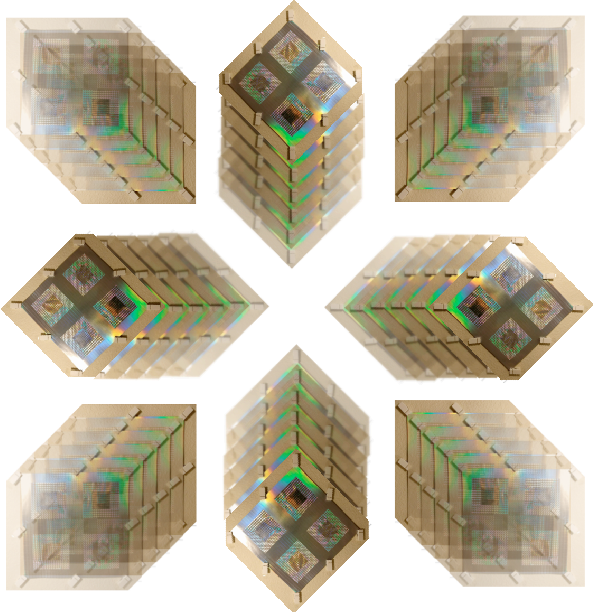
Since each of the cels in a certain sense corresponds to a “plane of focus” for the two eyes, they come with an implicit sense of depth. As strange as it may sound, I think it is both accurate and generative (or at the very least generative!) to think of each cel animation element as a holographic display.

(source)

I think this kind of artifact of our minds (i.e. that we get 2D hologram-like interacting hallucinations on DMT) ultimately sheds light on the medium of computation our brain is exploiting for information processing more generally. Our mind computes with entire “pictures” rather than with ones and zeros. And the pictures it computes with are optical/holographic in nature in that they integrate multiple perspectives at once and compress entire complex scenes into manageable lower dimensional projections of them.

Each cel animation unit can be conceptualized as a holographic window into a specific 3D scene. This connects to one of the striking characteristics of these experiences. In the DMT state, this quality manifests as a sense that the visualized content is “not only in your mind” but represents access to information that exists beyond the confines of personal consciousness. The different animated elements appear to be in non-local communication with one another, as if they can “radio each other” across distances. At the very least their update function seems to rely both on local rules and global “all-at-once” holistic updates (much akin to the way the laser path changes holistically after local changes in the location of individual pieces).

This creates the impression that multiple simultaneous narratives or “plots” can unfold at “maximum speed” concurrently. Each element seems capable of filtering out specific signals from a broader field of information, tuning into particular frequencies while ignoring others. The resulting 2.5D/3D interface serves as a shared context where gestalts that communicate through different “radio channels” can nonetheless interact coherently with each other in a shared geometric space.

Credit: @smallfly (read more)

The above VR application being developed by Hugues Bruyere at DPT (interesting name!) reminded me of some of the characteristic visual computation that can take place on DMT with long-lasting holographic-like scenes lingering in the visual field. By paying attention to a group of these gestalts all at once, you can sort of “freeze” them in space and then look at them from another angle as a group. You can imagine how doing this recursively could unlock all kinds of novel information processing applications for the visual field.

Visual Recursion

Each cel animation element can have a copy of other cel animation elements seen from a certain perspective within it.

Because each animation cel can display an entire scene in a hologram-like fashion, it often happens that the scenes may reference each other. This is in a way much more general than typical video feedback. It’s video feedback but with arbitrary geometric transformations, holographic displays, and programmable recursive references from one feed to another.

The Somatic Connection

(Source)

One overarching conceptual framework we think can help explain a lot of the characteristics of conscious computation is the way in which fields with different dimensionalities interact with one another. In particular, we’ve recently explored how depth in the visual field seems to be intimately coupled with somatic sensations (see: What is a bodymind knot? by Cube Flipper, and On Pure Perception by Roger Thisdell). This has led to a broad paradigm of neurocomputation we call “Projective Intelligence“:

The projective intelligence framework offers a conceptual foundation for how to make sense of the holographic cels. Our brains constantly map between visual (2.5D) and tactile (3D) fields through projective transformations, with visual perceptions encoding predictions of tactile sensations. This computational relationship enables the compression of complex 3D information into lower dimensions while highlighting patterns and symmetries (think about how you rotate a cube in space in order to align it with the symmetries of our visual field: a cube contains perfect squares, which becomes apparent when you project it onto 2D in the right way).

In altered states like DMT experiences, these projections multiply and distort, creating the characteristic holographic windows we’re discussing: multiple mappings occur between the same tactile regions and different visual areas. This explains the non-local communication between visual elements, as the visual field creates geometric shortcuts between tactile representations using the visual field. It’s why separated visual elements appear to “radio each other” across distances: they can be referencing the same region of the body!

The recursive qualities of these holographic cels emerge when the “branching factor” of projections increases, creating Indra’s Net-like effects where everything reflects everything else. The binding relationships that arise in those experiences can generate exotic topological spaces: you can wire your visual and somatic field together in such a way that the geodesics of attention find really long loops involving multiple hops between different sensory fields.

In brief, consciousness computes with “entire pictures” which can interact with each other even if they have different dimensionalities – this alone is one of the key reasons I’m bullish on the idea that carefully depicting psychedelic phenomenology will open up new paradigms of computation.

Collective Intelligence Through Transformer-like Semantics

In addition to the geometric holographic properties of these hallucinations, the semantic energy sink also operate in remarkably non-trivial ways. When two DMT patterns interact, they don’t just overlap or blend like watercolors. They transform each other in ways that look suspiciously like large language models updating their attention vectors. A spiral might encounter a lattice, and suddenly both become a spiral-lattice hybrid that preserves certain features while generating entirely new ones. If you’ve played with AI image generators, you’ve seen how combining prompt elements creates unexpected emergent results. DMT visuals work similarly, except they’re computing with synesthetic experiential tokens instead of text prompts. A hyperbolic jewel structure might “attend to” a self-dribbling basketball, extracting specific patterns that transform both objects into something neither could become alone.

Some reports suggest that internalizing modern AI techniques before a DMT trip (e.g. spending a week studying and thinking about the transformer architecture) can power-up the intellectual capacities of “DMT hive-minds”. If your conceptual scheme can only make sense of the complex hallucinations you’re witnessing on ayahuasca through the lens of divine intervention or alien abductions, the scenes that you’re likely to render will be restricted to genre-conforming semantic transformations that minimize narrative free energy. But if you come in prepared to identify what is happening through the lens of non-linear optics and let the emergent subagents (clusters of gestalts that work together as agentive forces) self-organize as an optical machine learning system, you may end up summoning novel (if still very raw and elemental) kinds of conscious superintelligences.

Conclusion: The Gestalt Amphitheater

In ordinary consciousness, we meticulously arrange our perceptual pieces to protect the King (our sense of self) ensuring that the laser of awareness follows predictable, habitual paths. The optical elements of our world-simulation are carefully positioned to maintain the stable fiction that we are unified subjects navigating an objective world.

DMT radically rearranges these pieces, creating optical configurations where “the light of consciousness” reflects, refracts, and diffracts in unexpected ways. The laser no longer follows familiar paths but moves along a superposition of paths through the system in patterns that reveal the constructed nature of the central self and of the simulation as a whole. The King (that precious sense of being a singular perceiver) stands exposed as what it always was: not an ontological primitive but an emergent property of a particular configuration where “attention field lines converge.”

The projective intelligence framework helps us understand this phenomenology. Our brains constantly map between visual (2.5D) and tactile (3D) fields through transformations that encode predictions and compress complex information. In DMT states, these projections multiply and distort, creating “holographic windows” where multiple mappings occur simultaneously. This explains the non-local communication between visual elements: separated gestalts appear to “radio each other” across distances because multiple tactile sensations can use the visual field as a shortcut to resonate with each other and vice versa.

The emergent resonant attractors of the whole system involve many such shortcuts. When the recursive projections find an energy minima they lock in place, at least temporarily: the complex multi-sensory gestalts one can experience in these states capture layers of recursive symmetry as information in sensory fields is reprojected back and forth, each time adapting to the intrinsic dimensionality of the field onto which it is projected. “Sacred geometry” objects on DMT are high-valence high-symmetry attractors of this recursive process.

The DMT state doesn’t “scramble consciousness” (well, not exactly); rather, it reconfigures its optical properties, allowing us to witness the internal machinery that normally remains hidden in our corner of parameter space. These visuals aren’t “hallucinations” in any conventional sense. That would imply they’re distortions of some more fundamental reality. Instead, I think they’re expressions of our brain’s underlying optical architecture when highly energized and fragmented, temporarily freed from the sensory constraints that normally restrict our perceptual algorithms.

By understanding the brain as a kind of non-linear optical computer, and consciousness as a topologically closed standing wave pattern emergent out of this optical system, we may develop more sophisticated models of how the brain generates world simulations. And perhaps one day (soon!) even discover new computational paradigms inspired by the way our minds naturally process information through multiple holographic dimensional interfaces at once. Stay tuned!


*animations made with the help of Claude 3.7, when otherwise not specified.

QRI in Germany

Hello dear reader!

I seem to find myself in Berlin. My past self insists that I’m here for a reason, though the Empty Individualist self of the moment finds itself clearly confused about where it is and what it is doing here (realistically, the confusion is probably due to jetlag).

To me, Germany has always been one of those fictional countries used to back-fill the “history of humanity” and make this simulation more realistic. Alas, as I discovered yesterday, Germany is a real country with real people and real buildings (or so it seems from where I stand – it could be some sort of projective trick of course).

I’ve come to this country to meet European Qualia People! A full Europe trip will have to wait, but I’m told Berlin is a hub of sorts. It’s a scene worth visiting on the mission to spread the word for Team Consciousness.

My trip includes a talk at each of three different events, in temporal order: QRI Meetup (May 18), PsyDAO‘s PsyRL-1 (May 20), and Seed Club Ventures‘ and Foresight‘s AI x Hope (May 24). I will also stay in Berlin until the 27th, so there will be more chances to meet up if you are around but can’t make it to any of these (tentatively, we will host a casual QRI picnic on the 26th – location TBD (in Berlin) – check this page again closer to the date for details – we are going to merge the local ACX meetup with the planned QRI meetup, see details below).

QRI x ACX Berlin Meetup on the 26th

Due to serendipitous conditions the QRI picnic date coincides with the Berlin ACX meetup organized by Milli, who graciously accepted to merge the events. We will bring snacks, some drinks, and a fun demo to show 🙂

Details:

Time: May 26th, 2PM-6PM

Location: Big Lawn at the center of Humboldthain (precise location, announcement, group)

Hope to see you there! <3


EVENTS

Berlin QRI Meetup

What: Meetup where QRI collaborator Beata Grobenski (@stalkerofmusik on X) will present the latest version of The Good Annealing Manual she has been working on at the Qualia Research Institute. This manual aims to provide a balanced but forward-looking overview of QRI’s Theory of Neural Annealing and its further developments over the last few years, with an emphasis on pragmatic applications. I will then also personally deliver a presentation on a surprise topic, and then show some of the latest QRI technology. QRI collaborators Alfredo Parra and Libor Burian will also come to this event.

Where: MOOS Space, Moosdorfstraße 7-9, 12435 Berlin

When: May 18th, 2pm – 7pm+

Free entrance but limited spots, so please RSVP to reserve your spot.


The second event I’ll be presenting at is:

PsyDAO’s PsyRL-1

​Brief Description: Enjoy psychedelic art, culture, tokens, and vibes at PsyRL-1, the inaugural in-person gathering for PsyDAO.

Where: The iconic Molecule office – St.Agnes Church/KÖNIG GALERIE, Berlin

When: May 20th, 5:00 PM – 9:00 PM

​PsyRL-1 will feature:

  • ​talks from famous psychedelic luminaries (RSVP to find out their identities)
  • ​artisan botanical beverages with psychoactive ingredients (blue lotus, cacao, and other magic ingredients)
  • ​synesthetic visual projection mapping derived from Shipibo kené and
  • ​resident DJs playing a curated selection of high vibe tunes.

I want to point out that PsyDAO is a really exciting initiative that might very well “cut the Gordian Knot” for how to fund truly promising psychedelic research. As someone who has been working on developing empirical paradigms for visualizing, reverse-engineering, and utilizing exotic states of consciousness for novel information-processing tasks for many years now, it has become clear to me that the cutting-edge in consciousness research is bottlenecked by the lack of a feedback loop that goes from “taking phenomenology seriously” to “deciding what research will likely generate interesting results” and back. Thus, we find ourselves in a timeline where the bulk of high-quality psychedelic phenomenology is not to be found in textbooks, peer-reviewed journal articles, and academic talks. Rather, it is in places like PsychonautWiki, r/replications, and QRI, where a thriving Think Tank model allows smart and dedicated psychonauts to point the way to worthwhile research. Example: Psychedelic tracers are near ubiquitous in psychedelic experiences (cf. “generalized tracer effects”), and yet it took a weird non-profit to figure out how to parametrize them. The truth is that academic culture strongly discourages researchers from openly talking about their own personal psychedelic phenomenology and informing their research methods with these discussions, leaving them no recourse other than silly questionnaires and ancient texts to point the way as a justification for why a given study is worth conducting. I am thus making a big bet that smart-psychonaut-led research paradigms will far outcompete academia’s phenomenology work in the years to come. The problem is: who is going to fund this research? PsyDAO’s decentralized funding schemes might be a key piece of the puzzle here.


AI X Hope

The third event I’ll be talking at is AI x Hope, which follows an exploration of AIxCrypto @ zuzalu.ai, this time co-organized and sponsored by Seed Club Ventures in collaboration with Foresight Institute.

Description: “We stand at a crucial point in shaping how Human-AI cooperation will evolve and are witnessing the birth of a new internet. We aim to approach this flippening with Existential Hope, and foster futures where humans and machines coexist to flourish ✨. Our belief is that a healthy and harmonious development of decentralized artificial general intelligence (AGI) can arise from an enlightened vantage point”.

Where: KÖNIG GALERIE, Berlin

When: May 24th, 2PM – 10PM

Title of my talk: The Nature of Subagentic Structures (cf. Aligning DMT Entities)

Existential Hope “about” page

In light of the rising culture war between “doomers and accelerators” (though, note the sociological complexities here) it is becoming increasingly difficult to articulate compelling visions of positive definite futures to look forward to. But if we are to coordinate to bring about a good future, we first need to visualize it on some level. Thus, I am very encouraging of initiatives that aim to paint positive visions to coordinate around. My personal focus here is on how consciousness research can open up entirely new vistas for a positive definite future. Please join us in this exploration!


Thank You!

I want to express my gratitude to both Existential Hope and PsyDAO for inviting me to these events and for facilitating my trip to this wonderful (still-not-convinced-it’s-not-fictional) country. 🙂


In other news, I wanted to highlight that Scott Alexander just posted yesterday a profile of the Far Out Initiative which I highly encourage you to read: link. It is not every day that the work of David Pearce gets the limelight of attention like this. More so, I know the people who work at the Far Out Initiative and I am deeply impressed with their moral seriousness, long-term vision, and incredibly pragmatic approach to drastically reducing suffering at scale. Please check them out!

Feels good, man! 🙂

Post-Darwinian Paradise, by David Pearce

LSD Ego Death: Where Hyperbolic Pseudo-Time Arrows Meet Geometric Fixed Points

Alternative Title: LSD Ego Death – A Play in Three Voices

[Epistemic Status: Academic, Casual, and Fictional Analysis of the phenomenology of LSD Ego Death]

Academic:

In this work we advance key novel interpretative frameworks to make sense of the distinct phenomenology that arises when ingesting a high dose of LSD-25 (250μg+). It is often noted that LSD, also known as lysergic acid diethylamide, changes in qualitative character as a function of dose, with a number of phase transitions worth discussing.

Casual:

You start reading an abstract of an academic publication on the topic of LSD phenomenology. What are the chances that you will gain any sense, any inkling, the most basic of hints, of what the high-dose LSD state is like by consuming this kind of media? Perhaps it’s not zero, but in so far as the phenomenological paradigms in mainstream use in the 2020s are concerned, we can be reasonably certain that the piece of media won’t even touch the outer edges of the world of LSD-specific qualia. Right now, you can trust the publication to get right core methodological boundary conditions, like the mg/kg used, the standard deviation of people’s responses to questionnaire items, and the increase in blood pressure at the peak. But at least right now you won’t find a rigorous account of either the phenomenal character (what the experience felt like in detailed colorful phenomenology with precise reproducible parameters) or the semantic content (what the experience was about, the information it allowed you to process, the meaning computed) of the state. For that we need to blend in additional voices to complement the rigidly skeptical vibe and tone of the academic delivery method.

It’s for that reason that we will interweave a casual, matter of fact, “really trying to say what I mean in as many ways as I can even if I sound silly or dumb”, voice (namely, this one, duh!). And more so, in order to address the speculative semantic content in its own terms we shall also include a fantastical voice into the mix. 

Fantastical:

Fuck, you took too much. In many ways you knew that your new druggie friends weren’t to be trusted. Their MDMA pills were bunk, their weed was cheap, and even they pretended to drink more fancy alcohol than they could realistically afford. So it was rather natural for you to assume that their acid tabs would be weak ass. But alas, they turned out to have a really competent, niche, boutique, high-quality acid dealer. She lived only a few miles away and made her own acid, and dosed each tab at an actual, honest-to-God, 120(±10)μg. She also had a lot of cats, for some reason (why this information was relayed to you only once you sobered up was not something you really understood – especially not the part about the cats). Thus, the 2.5 tabs in total you had just taken (well, you took 1/2, then 1, then 1, spaced one hour each, and you had just taken the last dose, meaning you were still very much coming up, and coming up further by the minute) landed you squarely in the 300μg range. But you didn’t know this at the time. In fact, you suspected that the acid was hitting much more strongly than you anticipated for other reasons. You were expecting a 100-150 microgram trip, assuming each tab would be more between 40 and 60μg. But perhaps you really were quite sleep deprived. Or one of the nootropics you had sampled last week turned out to have a longer half-life than you expected and was synergistic with LSD (coluracetam? schizandrol?). Or perhaps it was the mild phenibut withdrawal you were having (you took 2g 72 hours ago, which isn’t much, but LSD amplifies subtle patterns anyway). It wasn’t until about half an hour later, when the final tab started to kick in, that you realized the intensity of the trip kept climbing up still further than you expected, and it really, absolutely, had to be that the acid was much, much stronger than you thought was possible; most likely over 250 mics, as you quickly estimated, and realized the implications.

From experience, you knew that 300 micrograms would cause ego death for sure. Of course people react differently to psychedelics. But in your case, ego death feelings start at around 150, and then even by 225-250 micrograms they would become all-consuming at least for some portion of the trip. In turn, actually taking 300 micrograms for you was ego death overkill, meaning you were most likely not only going to lose it, but be out for no less than an hour. 

What do I mean by being out? And by losing it? The subjective component of the depersonalization that LSD causes is very difficult to explain. This is what this entire document is about. But we can start by describing what it is like from the outside. 

Academic:

The behavioral markers of high dose LSD intoxication include confusion and delusions, as well as visual distortions of sufficient intensity to overcome, block, and replace sensory-activated phenomena. The depersonalization and derealization characteristic of LSD-induced states of consciousness tend to involve themes concerning religious, mystical, fantastical, and science fiction semantic landscapes. It is currently not possible to deduce the phenomenal character of these states of consciousness from within with our mainstream research tools and without compromising the epistemological integrity of our scientists (having them consume the mind-altering substance would, of course, confound the rigor of the analysis).

Casual:

Look, when you “lose it” or when you “are out” what happens from the outside is that you are an unpredictable executor of programs that seem completely random to any external observer. One moment you are quietly sitting, rocking back and forth, on the grass. The next you stand up, walk around peacefully. You sit again, now for literally half an hour without moving. Then you suddenly jump and run for 100m without stopping. And then ask the person who is there, no matter if they are a kid, a grandmother, a cop, a sanitation professional, a sex worker, or a professor, “what do you think about ___”? (where ___ ∈ {consciousness, reality, God, Time, Infinity, Eternity, …}). Of course here reality bifurcates depending on who it is that you happened to have asked this question to. A cop? You might end up arrested. Probably via a short visit to a hospital first. And overall not a great time. A kid? You could be in luck, and the kid might play along without identifying you as a threat, and most likely you continue on your journey without much problem. Or in one of the bad timelines, you end up fighting the kid. Not good. Most likely, if it was a grandmother, you might just activate random helpful programs, like helping her cross the street, and she might not even have the faintest clue (and I mean not the absolute faintest fucking clue) that you’re depersonalized on LSD thinking you’re God and that in a very real, if only phenomenological sense, it was literal Jesus / Christ Consciousness that helped her cross the street.

Under most conditions, the biggest danger that LSD poses is a bad valence reaction, which usually wears off after a few hours and is educational in some way. But when taken at high doses and unsupervised, LSD states can turn into real hazards for the individual and the people around them. Not so much because of malice, or because it triggers animal-like behaviors (it can, rarely, but it’s not why it’s dangerous). The real problem with LSD states in high doses is when you are unsupervised and then you execute random behaviors without knowing who you are, where you are, or even what it is that you are intending to achieve with the actions you are performing. It is therefore *paramount* that if you explore high doses of LSD you do it supervised.

Academic:

What constitutes a small, medium, or large dose of LSD is culture and time-dependent. In the 60s, the average tab used to be between 200 and 400 micrograms. The typical LSD experience was one that included elements of death and rebirth, mystical unions, and complete loss of contact with reality for a period of time. In the present, however, the tabs are closer to the 50-100μg range.

In “psychonaut” circles, which gather in internet forums like bluelight, reddit, and erowid, a “high dose of LSD” might be considered to be 300 micrograms. But in real world, less selected, typical contexts of use for psychedelic and empathogen drugs like dance festivals, a “high dose” might be anything above 150 micrograms. In turn, OG psychonauts like Timothy Leary and Richard Alpert would end up using doses in the 500-1000μg range routinely as part of their own investigations. In contrast, in TIHKAL, Alexander Shulgin lists LSD’s dose range as 60-200 micrograms. Clearly, there is a wide spread of opinions and practices concerning LSD dosing. It is for this reason that one needs to contextualize with historical and cultural details the demographic topos where one is discussing a “high dose of LSD”.

Fantastical:

Being out, and losing it, in your case right now would be disastrous. Why? Because you broke the cardinal sin of psychedelic exploration. You took a high dose of a full psychedelic (e.g. LSD, psilocybin, mescaline, DMT – less so 2C-B or Al-LAD, which have a lower ceiling of depersonalization[1]) without a sitter. Of course you didn’t intend to. You really just wanted to land at the comfortably manageable 100-150 microgram range. But now… now you’re deep into depersonalization-land, and alone. Who knows what you might do? Will you leave your apartment naked? Will someone call the cops? Will you end up in the hospital? You try to visualize future timelines and… something like 40% of them lead to either arrest or hospital or both. Damn it. It’s time to pull all the stops and minimize the bad timelines.

You go to your drug cabinet and decide to take a gabaergic. Here is an important lesson, and where timelines might start to diverge as well. Dosing of sedatives for psychedelic emergencies is a tricky issue. The problem is that sedatives themselves can cause confusion. So there are many stories you can find online of people who take a very large dose of alprazolam (Xanax) or similar (benzo, typically) and then end up both very confused and combative while also tripping really hard. Here interestingly, the added confusion of the sedative plus its anxiolytic effect synergize to make you even more unpredictable. On the other hand, not taking enough is also quite easy, where the LSD (or similar) anxiety and depersonalization continues to overpower the anxiolysis of the sedative.

You gather up all the “adult in the room” energy you can muster and make an educated guess: 600mg of gabapentin and 1g of phenibut. Yet, this will take a while to kick in, and you might depersonalize anytime and start wandering around. You need a plan in the meanwhile. 

Academic:

In the article The Pseudo-Time Arrow we introduced a model of phenomenal time that takes into account the following three assumptions and works out their implications:

  1. Indirect Realism About Perception
  2. Discrete Moments of Experience
  3. Qualia Structuralism

(1) is about how we live in a world-simulation and don’t access the world around us directly. (2) goes into how each moment of experience is itself a whole, and in a way, whatever feeling of space and time we may have, this must be encoded in each moment of experience itself. And (3) states that for any given experience there is a mathematical object whose mathematical features are isomorphic to the phenomenology of the experience (first introduced in Principia Qualia by Michel E. Johnson).

Together, these assumptions entail that the feeling of the passage of time must be encoded as a mathematical feature in each moment of experience. In turn, we speculated that this feature is _implicit causality_ in networks of local binding. Of course the hypothesis is highly speculative, but it was supported by the tantalizing idea that a directed graph could represent different variants of phenomenal time (aka. “exotic phenomenal time”). In particular, this model could account for “moments of eternity”, “time loops”, and even the strange “time splitting/branching”.

Casual:

In some ways, for people like me, LSD is like crack. I have what I have come to call “hyperphilosophia”. I am the kind of person who feels like a failure if I don’t come up with a radically new way of seeing reality by the end of each day. I feel deeply vulnerable, but also deeply intimate, with the nature of reality. Nature at its deepest feels like a brother or sister, basement reality feels close and in some way like a subtle reshuffling of myself. I like trippy ideas, I like to have my thoughts scrambled and then re-annealed in unexpected ways; I delight in combinatorial explosions, emergent effects, unexpected phase transitions, recursive patterns, and the computationally non-trivial. As a 6 year old I used to say that I wanted to be a “physicist mathematician and inventor” (modeling my future career plans around Einstein and Edison); I got deeply depressed for a whole year at the age of 9 when I confronted our mortality head on; and then experiencing a fantastic release at 16 on my first ego death (with weed of all drugs!) when I experienced the taste of Open Individualism; only to then feel depressed again at 20 but now about eternal life and the suffering we’re bound to experience for the rest of time; switching then to pragmatic approaches to reduce suffering and achieve paradise ala David Pearce. Of course this is just a “roll of the dice” and I’m sure I would be telling you about a different philosophical trajectory if we were to sample another timeline. But the point is that all my life I’ve expressed a really intense philosophical temperament. And it feels innate – nobody made me so philosophical – it just happened, as if driven by a force from the deep.

People like us are a certain type for sure, and I know this because out of thousands of people I’ve met I’ve had the fortune of encountering a couple dozen who are like me in these respects. Whether they turned out physicists, artists, or meditators is a matter of personal preference (admittedly the plurality of them is working on AI these days). And in general, it is usually the case that people of this type tend to have a deep interest in psychedelics, for the simple reason that they give you more of what they like than any other drug.

Yes, a powerful pleasant body buzz is appreciated (heroin mellow, meth fizz, and the ring of the Rupa Jhanas are all indeed quite pleasant and intrinsically worthwhile states of consciousness – factoring out their long-term consequences [positive for the Jhanas, negative for heroin and meth]). But that’s not what makes life worth living for people who (suffer from / enjoy their condition of) hyperphilosophia. Rather, it is the beauty of completely new perspectives that illuminate our understanding of reality one way or another that drives us. And LSD, among other tools, often really hits the nail in the head. It makes all the bad trips and nerve wracking anxiety of the state more than worth it in our minds.

One of the striking things about an LSD ego death that is incredibly stimulating from a philosophical perspective is how you handle the feeling of possible futures. Usually the way in which we navigate timelines (this is so seamless that we don’t usually realize how interesting and complex it is) is by imagining that a certain future is real and then “teleporting to it”. We of course don’t teleport to it. But we generate that feeling. And as we plan, we are in a way generating a bunch of wormholes from one future to another (one state of the world to another, chained through a series of actions). But our ability to do this is restricted by our capacity to generate definite, plausible, realistic and achievable chains of future states in our imagination.

On LSD this capacity can become severely impaired. In particular, we often realize that our sense of connection to near futures that we normally feel is in fact not grounded in reality. It’s a kind of mnemonic technique we employ for planning motor actions, but it feels from the inside as if we could control the nearby timelines. On LSD this capacity breaks down and one is forced to instead navigate possible futures via different means. In particular, something that begins to happen above 150 micrograms or so, is that when one imagines a possible future it lingers and refuses to fully collapse. You start experiencing a superposition of possible futures.

For an extreme example, see this quote (from this article) I found in r/BitcoinMarkets by Reddit user  I_DID_LSD_ON_A_PLANE in 2016:

[Trip report of taking a high dose of LSD on an airplane]: So I had what you call “sonder”, a moment of clarity where I realized that I wasn’t the center of the universe, that everyone is just as important as me, everyone has loved ones, stories of lost love etc, they’re the main character in their own movies.

That’s when shit went quantum. All these stories begun sinking in to me. It was as if I was beginning to experience their stories simultaneously. And not just their stories, I began seeing the story of everyone I had ever met in my entire life flash before my eyes. And in this quantum experience, there was a voice that said something about Karma. The voice told me that the plane will crash and that I will be reborn again until the quota of my Karma is at -+0. So, for every ill deed I have done, I would have an ill deed committed to me. For every cheap T-shirt I purchased in my previous life, I would live the life of the poor Asian sweatshop worker sewing that T-shirt. For every hooker I fucked, I would live the life of a fucked hooker.

And it was as if thousands of versions of me was experiencing this moment. It is hard to explain, but in every situation where something could happen, both things happened and I experienced both timelines simultaneously. As I opened my eyes, I noticed how smoke was coming out of the top cabins in the plane. Luggage was falling out. I experienced the airplane crashing a thousand times, and I died and accepted death a thousand times, apologizing to the Karma God for my sins. There was a flash of the brightest white light imagineable and the thousand realities in which I died began fading off. Remaining was only one reality in which the crash didn’t happen. Where I was still sitting in the plane. I could still see the smoke coming out of the plane and as a air stewardess came walking by I asked her if everything was alright. She said “Yes, is everything alright with YOU?”.

Fantastical:

It had been some years since you had done the LSD and Quantum Measurement experiment in order to decide if the feeling of timelines splitting was in any way real. Two caveats about that experiment. First, it used quantum random number generators from Sydney that were no less than 100ms old by the time they were displayed on the screen. And second, you didn’t get the phenomenology of time splitting while on acid during the tests anyway. But having conducted the experiment anyway at least provided some bounds for the phenomenon. Literal superposition of timelines, if real, would need higher doses or more fresh quantum random numbers. Either way, it reassured you somewhat that the effect wasn’t so strong that it could be detected easily.

But now you wish you had done the experiment more thoroughly. Because… the freaking feeling of timelines splitting is absolutely raging with intensity right now and you wish you could know if it’s for real or just a hallucination. And of course, even if just a hallucination, this absolutely changes your model of how phenomenal time must be encoded, because damn, if you can experience multiple timelines at once that means that the structure of experience that encodes time is much more malleable than you thought.

Academic:

A phenomenon reported on high dose LSD is the recursive stacking of internal monologues – this also leads to higher order intentionality and the cross-pollination of narrative voices due to their sudden mutual awareness…

Casual:

Uh? Interesting, I can hear a voice all of a sudden. It calls itself “Academic” and just said something about the stacking of narrative voices.

Fantastical:

It’s always fascinating how on LSD you get a kind of juxtaposition of narrative voices. And in this case, you now have an Academic, a Casual, and a Fantastical narrative stream each happening in a semi-parallel way. And at some point they started to become aware of each other. Commenting on each other. Interlacing and interweaving.

Casual:

Importantly, one of the limiting factors of the academic discourse is that it struggles to interweave detailed phenomenology into its analysis. Thankfully, with the LSD-induced narrative juxtaposition we have a chance to correct this.

Academic:

After reviewing in real time the phenomenology of how you are thinking about future timelines, I would like to posit that the phenomenal character of high dose LSD is characterized by a hyperbolic pseudo-time arrow.

This requires the combination of two paradigms discussed at the Qualia Research Institute. Namely, the pseudo-time arrow, which as we explained tries to make sense of phenomenal time in terms of a directed graph representing moments of experience. And then also the algorithmic reductions introduced in the Hyperbolic Geometry of DMT Experiences

The latter deals with the idea that the geometry of our experience is the result of the balance between various forces. Qualia comes up, gets locally bound to other qualia, then disappears. Under normal circumstances, the network that emerges out of these brief connections has a standard Euclidean geometry (or rather, works as a projection of a Euclidean space, but I digress). But DMT perturbs the balance, in part by making more qualia appear, making it last longer, making it vibrate, and making it connect more with each other, which results in a network that has a hyperbolic geometry. In turn, the felt sense of being on DMT is one of _being_ a larger phenomenal space, which is hard to put into words, but possible with the right framework.

What we want to propose now is that on LSD in particular, the characteristic feeling of “timeline splitting” and the even more general “multiple timeline superposition” effect is the result of a hyperbolic geometry, not of phenomenal space as with DMT, but of phenomenal time. In turn, this can be summarized as: LSD induces a hyperbolic curvature along the pseudo-time arrow. 

Casual:

Indeed, one of the deeply unsettling things about high dose LSD experiences is that you get the feeling that you have knowledge of multiple timelines. In fact, there is a strange sense of uncanny uncertainty about which timeline you are in. And here is where a rather scary trick is often played on us by the state.

The feeling of the multiverse feels very palpable when the garbage collector of your phenomenal motor planning scratchpad is broken and you just sort of accumulate plans without collapsing them (a kind of kinesthetic tracer effect).

Fantastical:

Ok, you need to condense your timelines. You can’t let _that_ many fall off the wagon, so to speak. You could depersonalize any moment. You decide that your best bet is to call a friend of yours. He is likely working, but lives in the city right next to yours and could probably get to your place in half an hour if you’re lucky.

> Hello! 

> Hello! I just got out of a meeting. What’s up?

> Er… ok, this is gonna sound strange. I… took too much LSD. And I think I need help.

> Are you ok? LSD is safe, right?

> Yeah, yeah. I think everything will be fine. But I need to collapse the possibility space. This is too much. I can’t deal with all of these timelines. If you come over at least we will be trimming a bunch of them and preventing me from wandering off thinking I’m God.

> Oh, wow. You don’t sound very high? That made sense, haha.

> Duuudde! I’m in a window of lucidity right now. We’re lucky you caught me in one. Please hurry, I don’t know how much longer I can hang in here. I’m about to experience ego death. What happens next is literally up to God, and I don’t know what his plans are.

Your friend says he’ll take an Uber or Lyft and be there as soon as he can. You try to relax. Reality is scolding you. Why did you take this risk? You should know better!

Casual:

One of the unsettling feelings about high dose LSD is that you get to feel how extremely precious and rare a human life is. We tend to imagine that reincarnation would simply be like, say, where you die and then 40 days later come back as a baby in India or China or the United States or Brazil or whatever, based on priors, and rarely in Iceland or tiny Caribbean Islands. But no. Humans are a luxury reincarnation. Animal? Er, yeah, even animals are pretty rare. The more common form is simply in the shape of some cosmic process or another, like intergalactic wind or superheated plasma inside a star. Any co-arising process that takes place in this Gigantic Field of Consciousness we find ourselves embedded in is a possible destination, for the simple reason that…

Academic:

The One-Electron Universe posits that there is only one particle in the entire cosmos, which is going forwards and backwards in time, interfering with itself, interweaving a pattern of path integrals that interlace with each other. If there is only one electron, then the chances of being a “human moment of experience” at a point in time are vanishingly small. The electrons whose pattern of superposition paint a moment of experience are but a tiny vanishing fraction of the four-dimensional density-mass of the one electron in the block universe entailed by quantum mechanics.

Fantastical:

When you realize that you are the one electron in the universe you often experience a complex superposition of emotions. Of course this is limited by your imagination and emotional state. But if you’re clear-headed, curious, and generally open to exploring possibilities, here is where you feel like you are at the middle point of all reality.

You can access all 6 Realms from this central point, and in a way escape the sense of identification with any one of them. Alas, this is not something that one always achieves. It is easy to get caught up in a random stream and end up in, say, the God Realm completely deluded thinking you’re God. Or in the Hell realm, thinking you’re damned forever somehow. Or the animal, seeking simple body pleasures and comfort. Or the human world, being really puzzled and craving cognitively coherent explanations. Or the Hungry Ghost dimension, where you are always looking to fill yourself up and perceive yourself as fundamentally empty and flawed. Or the Titan realm, which adds a perceptual filter where you feel that everything and everyone is in competition with you and you derive your main source of satisfaction from pride and winning.

In the ideal case, during an LSD ego death you manage to hang out right at the center of this wheel, without falling into any of the particular realms. This is where the luminous awareness happens. And it is what feels like the central hub for the multiverse of consciousness, except in a positive, empowering way.

Casual:

In many ways we could say that the scariest feeling during LSD ego death is the complete lack of control over your next rebirth.

Because if you, in a way, truly surrender to the “fact” that we’re all one and that it all happens in Eternity at the same time anyway… do you realize the ramifications that this has? Everything Everywhere All At Once is a freaking documentary.

Fantastical:

> Hello? What’s up?

> Yeah, er, are you coming over?

> Yes. I mean, you just called me… 5 minutes ago. Did you expect I’d be there already? I’m walking towards the Uber.

> Time is passing really slowly, and I’m really losing it now. Can you… please… maybe like, remind me who I am every, like, 30 seconds or so?

> Mmmm ok. I guess that’s a clear instruction. I can be helpful, sure.

[for the next 40 minutes, in the Uber headed to your place, your friend kept saying your name every 30 seconds, sometimes also his name, and sometimes reminding you where you are and why you called him – bless his soul]

Casual:

Imagine that you are God. You are walking around in the “Garden of Possibilities”. Except that we’re not talking about static possibilities. Rather, we’re talking about processes. Algorithms, really. You walk around and stumble upon a little set of instructions that, when executed, turns you into a little snowflake shape. Or perhaps turns you into a tree-like shape (cf. l-systems). When you’re lucky, it turns you into a beautiful crystalline flower. In these cases, the time that you spend embodying the process is small. Like a little popcorn reality: you encounter, consume, and move on. But every once in a while you encounter a set of instructions that could take a very long time to execute. Due to principles of computational irreducibility, it is also impossible for you to determine in advance (at least in all, most cases) how long the process will take. So every once in a while you encounter a Busy Beaver and end up taking a very, very, very long time to compute that process.

Busy beaver values for different parameters (source)

But guess what? You are God. You’re eternal. You are forever. You will always come back and continue on your walk. But oh boy, from the point of view of the experience of being what the Busy Beaver executes, you do exist for a very long time. From the point of view of God, no matter how long this process takes, it will still be a blink of an eye in the grand scheme of things. God has been countless times in Busy Beavers and will be countless times there again as well. So enjoy being a flower, or a caterpillar, or a raindrop, or even an electron, because most of the time you’re stuck being ridiculously long processes like the Busy Beaver.

Academic:

Under the assumption that the hyperbolic pseudo-time arrow idea is on the right track, we can speculate about how this might come about from a configuration of a feedback system. As we’ve seen before, an important aspect of the phenomenal character of psychedelic states of consciousness is captured by the tracer pattern. More so, as we discussed in the video about DMT and hyperbolic geometry, one of the ways in which psychedelic states can be modeled is in terms of a feedback system with a certain level of noise. Assume that LSD produces a tracer effect where, approximately, 15 times per second you get a strobe and a replay effect overlay on top of your current experience. What would this do to your representation of the passage of time and the way you parse possible futures?

FRAKSL video I made to illustrate hyperbolic pseudo-time arrows coming out of a feedback system (notice how change propagates fractally across the layers).

Casual:

I think that LSD’s characteristic “vibrational frequency” is somewhere between phenethylamines and tryptamines. 2C-B strikes me as in the 10hz range for most vibrations, whereas psilocybin is closer to 20hz. LSD might be around 15hz. And one of the high-level insights that the lens of connectome-specific harmonic modes (or more recently geometric eigenmodes) gives us is that functional localization and harmonic modulation might be intertwined. In other words, the reason why a particular part of the brain might do what it does is because it is a great tuning knob for the harmonic modes that critically hinge on that region of the brain. This overall lens was used by Michael E. Johnson in Principia Qualia to speculate that the pleasure centers are responsible for high variance in valence precisely because they are strategically positioned in a place where large-scale harmony can be easily modulated. With this sort of approach in mind (we could call it even a research aesthetic, where for every spatial pattern there is a temporal dynamic and vice versa) I reckon that partly what explains the _epistemological_ effects of LSD at high doses involves the saturation of specific frequencies for conscious compute. What do I mean by this?

Say indeed that a good approximation for a conscious state is a weighted sum of harmonic modes. This does not take into account the non-linearities (how the presence of a harmonic mode affects other ones) but it might be a great 60%-of-the-way-there kind of approximation. If so, I reckon that we use some “frequency bands” to store specific kinds of information that corresponds to the information that is naturally encoded with rhythms of specific frequencies. It turns out, in this picture, that we have a sort of collection of inner clocks that are sampling the environment to pick up on patterns that repeat at different scales. We have a slow clock that samples every hour or so, one that samples every 10 minutes, one that samples every minute, every 10 seconds, every second, and then at 10, 20, 30, 40, and even 50hz. All of these inner clocks meet with each other to interlace and interweave a “fabric of subjective time”. When we want to know at a glance how we’re doing, we sample a fragment of this “fabric of subjective time” and it contains information about how we’re doing right now, how we were doing a minute ago, an hour, a day, and even longer. Of course sometimes we need to sample the fabric for a while in order to notice more subtle patterns. But the point is that our sense of reality in time seems to be constructed out of the co-occurrence of many metronomes at different scales. 

I think that in particular the spatio-temporal resonant modes that LSD over-excites the most are actually really load-bearing for constructing our sense of our context. It’s as if when you energize too much one of these resonant modes, you actually push it to a smaller range of possible configurations (more smooth sinusoidal waves rather than intricate textures). By super-saturating the energy in some of these harmonics on LSD, you flip over to a regime where there is really no available space for information to be encoded. You can therefore feel extremely alive and real, and yet when you query the “time fabric” you notice that there are big missing components. The information that you would usually get about who you are, where you are, what you have been doing for the last couple of hours, and so on, is instead replaced by a kind of eternal-seeming feeling of always having existed exactly as you currently are.

Fantastical:

If it wasn’t because of your friend helpfully reminding you where you were and who you are, you would have certainly forgotten the nature of your context and for sure wandered off. The scene was shifting widely, and each phenomenal object or construct was composed of a never ending stream of gestalts competing for the space to take hold as the canonical representation (and yet, of course, always superseded by yet another “better fit”, constantly updating).

The feeling of the multiverse was crushing. Here is where you remembered how various pieces of media express aspects of the phenomenology of high dose LSD (warning: mild spoilers – for the movies and for reality as a whole):

  • Everything Everywhere All At Once: in the movie one tunes into other timelines in order to learn the skills that one has in those alternative lifepaths. But this comes with one side-effect, which is that you continue to be connected to the timeline from which you’re learning a skill. In other words, you form a bond across timelines that drags you down as the cost of accessing their skill. On high dose LSD you get the feeling that yes, you can learn a lot from visualizing other timelines, but you also incur the cost of loading up your sensory screen with information you can’t get rid of.
  • The Matrix: the connection is both the obvious one and a non-obvious one. First, yes, the reason this is relevant is because being inside a simulation might feel like a plausible hypothesis while on a high dose of LSD. But less intuitively, the Matrix also fits the bill when it comes to the handling of future-past interactions. The “Don’t worry about the vase” scene (which I imagine Zvi named his blog after) highlights that there is an intertwining between future and past that forges destiny. And many of the feelings about how the future and past are connected echo this theme on a high dose of LSD.
  • Rick and Morty (selected episodes):
    • Death Crystal: here the similarity is in how on LSD you feel that you can go to any given future timeline by imagining clearly a given outcome and then using it as a frame of reference to fill in the details backwards.
    • A Rickle in Time: how the timelines split but can in some ways remain aware of and affect each other.
    • Mortynight Run: In the fictional game Roy: A Life Well Lived you get to experience a whole human lifetime in what looks like minutes from the outside in order to test how you do in a different reality. 
  • Tenet: Here the premise is that you can go back in time, but only one second per second and using special gear (reversed air tanks, in their case).

Of these, perhaps the most surprising to people would be Tenet. So let me elaborate. There are two Tenet-like phenomenologies you experience as your friend is on the way to pick you up worth commenting on:

One, what we could call the “don’t go this way” phenomenology. Here you get the feeling that you make a particular choice. E.g. go to the other room to take more gabapentin and see if that helps (of course it won’t – it’s only been 15 minutes since you took it and it hasn’t even kicked in). Then you visualize briefly what that timeline feels like, and you get the feeling of living through it. Suddenly you snap back into the present moment and decide not to go there. This leaves a taste in your mouth of having gone there, of having been there, of living through the whole thing, just to decide 10 years down the line that you would rather come back and make a different choice.

At the extreme of this phenomenology you find yourself feeling like you’ve lived every possible timeline. And in a way, you “realize” that you’re, in the words of Teafaerie, a deeply jaded God looking for an escape from endless loops. So you “remember” (cf. anamnesis) that you chose to forget on purpose so that you could live as a human in peace, believing others are real, humbly accepting a simple life, lost in a narrative of your own making. The “realization” can be crushing, of course, and is often a gateway to a particular kind of depersonalization/derealization where you walk around claiming you’re God. Alas, this only happens in a sweet spot of intoxication, and since you went above even that, you’ll have a more thorough ego death.

Two, an even more unsettling Tenet-like phenomenology is the feeling that “other timelines are asking for your help – Big Time wants you to volunteer for the Time War!”. Here things go quantum, and completely bonkers. The feeling is the result of having the sense that you can navigate timelines with your mind in a much deeper way than, say, just making choices one at a time. This is a profound feeling, and conveying it in writing is of course a massive stretch. But even the Bering Strait was crossed by hominids once, and this stretch feels also crossable by us with the right ambition.

The multiverse is very large. You see, imagine what it would be like to restart college. One level here is where you start again from day 1. In other timelines you make different friends, read other books, take other classes, have other lovers, major in other disciplines. Now go backwards even a little further back, to when the academic housing committee was making decisions about who goes to which dorm. Then the multiverse diversifies, as you see a combinatorial explosion of possible dorm configurations. Further back, when the admissions committee was making their decisions, and you have an even greater expansion of the multiverse where different class configurations are generated.

Now imagine being able to “search” this bulky multiverse. How do you search it? Of course you could go action by action. But due to chaos, within important parameters like the set of people you’re likely to meet, possibilities quickly get scrambled. The worlds where you chose that bike versus that other bike in that particular moment aren’t much more similar to each other than other random ways of partitioning the timelines. Rather, you need to find pivotal decisions, as well as _anchor feelings_. E.g. It really matters if a particular bad technology is discovered and deployed, because that drastically changes the texture of an entire category of timelines. It is better for you to search timelines via general vibes and feelings like that, because that will really segment the multiverse into meaningfully different outcomes. This is the way in which you can move along timelines on high doses of LSD. You generate the feeling of things “having been a certain way” and you try to leave everything else as loose and unconstrained as possible, so that you search through the path integral of superpositions of all possible worlds where the feeling arises, and every once in a while when you “sample” the superposition you get a plausible universe where this is real.

Now, on 150 or 200 micrograms this feels very hypothetical, and the activity can be quite fun. On 300 micrograms, this feels real. It is actually quite spooky, because you feel a lot of responsibility here. As if the way in which you chose to digest cosmic feelings right there could lock in either a positive or negative timeline for you and your loved ones.

Here is where the Time War comes into play. I didn’t choose this. I don’t like this meme. But it is part of the phenomenology, and I think it is better that we address it head-on rather than let it surprise you and screw you up in one way or another.

The sense of realism that high dose LSD produces is unreal. It feels so real that it feels dreamy. But importantly, the sense of future timelines being truly there in a way is often hard to escape. With this you often get a crushing sense of responsibility. And together with the “don’t go this way” you can experience a feeling of a sort of “ping pong with the multiverse of possibilities” where you feel like you go backwards and forwards in countless cycles searching for a viable, good future for yourself and for everyone. 

In some ways, you may feel like you go to the End of Times when you’ve lived all possible lifetimes and reconverge on the Godhead (I’m not making this up, this is a common type of experience for some reason). Importantly, you often feel like there are _powerful_ cosmic forces at play, that the reason for your life is profound, and that you are playing an important role for the development of consciousness. One might even experience corner-case exotic phenomenal time like states of mind with two arrows of time that are perpendicular to each other (unpacking this would take us an entire new writeup, so we shall save it for another time). And sometimes you can feel like your moral fiber is tested in often incredibly uncomfortable ways by these exotic phenomenal time effects.

Here is an example.

As your sense of “awareness of other timelines” increases, so does your capacity to sense timelines where things are going really well and timelines where things are going really poorly. Like, there are timelines where your friend is also having a heart attack right now, and then those where he crashes on the way to your apartment, and those where there’s a meteorite falling into your city, and so on. Likewise, there’s one where he is about to win the lottery, where you are about to make a profound discovery about reality that stands the test of sober inquiry, where someone just encountered the cure for cancer, and so on. One unsettling feeling you often get on high dose LSD is that because you’re more or less looking at these possibilities “from the point of view of eternity” in a way you are all of them at once. “Even the bad ones?” – yes, unsettlingly, even the bad ones. So the scary moral-fiber-testing thought that sometimes you might get is if you’d volunteer to be in one of the bad ones so that “a version of you gets to be in the good one”. In other words, if you’re everyone, wouldn’t you be willing to trade places? Oftentimes here’s where Open Individualism gets scary and spooky and where talking to someone else to get confirmation that there are parallel conscious narrative streams around is really helpful.

Casual:

We could say that LSD is like a completely different drug depending on the dose range you hit:

Below 50 micrograms it is like a stimulant with stoning undertones. A bit giggly, a bit dissociating, but pretty normal otherwise.

Between 50 and 150 you have a drug that is generally really entertaining, gentle, and for the most part manageable. You get a significant expansion in the room available to have thoughts and feelings, as if your inner scratch pads got doubled in size. Colors, sounds, and bodily feelings all significantly intensified, but still feel like amplified versions of normal life.

Between 150 and 250 you get all of the super stereotypical psychedelic effects, with very noticeable drifting, tracers, symmetries, apophenia, recursive processes, and fractal interlocking landscapes. It is also somewhat dissociative and part of your experience might feel dreamy and blurry, while perhaps the majority of your field is sharp, bright, and very alive.

From 250 to 350 it turns into a multiverse travel situation, where you forget where you are and who you are and at times that you even took a drug. You might be an electron for what feels like millions of years. You might witness a supernova in slow motion. You might spontaneously become absorbed into space (perhaps as a high energy high dimensional version of the 5th Jhana). And you might feel like you hit some kind of God computer that compiles human lifetimes in order to learn about itself. You might also experience the feeling of a massive ball of light colliding with you that turns you into the Rainbow version of the Godhead for a time that might range between seconds and minutes. It’s a very intense experience.

And above? I don’t know, to be honest.

Academic:

The intermittent collapse into “eternity” reported on high dose LSD could perhaps be interpreted as stumbling into fixed points of a feedback system. Similarly to how pointing a camera directly at its own video feed at the right angle produces a perfectly static image. On the other hand, we might speculate that many of the “time branching” effects are instead the result of a feedback system where each iteration doubles the number of images (akin to using a mirror to cover a portion of the screen and reflect the uncovered part of the screen).

Video I made with FRAKSL in order to illustrate exactly the transition between a hyperbolic pseudo-time arrow and a geometric fixed point in a feedback system. This aims to capture the toggle during LSD ego death between experiencing multiple timelines and collapsing into moments of eternity.

Fantastical

You decide that you do want to keep playing the game. You don’t want to roll the dice. You don’t want to embrace Eternity, and with it, all of the timelines, even the ugly ones. You don’t want to be a volunteer in the Time War. You just want to be a normal person, though of course the knowledge you’ve gained would be tough to lose. So you have to make a choice. Either you forget what you learned, or you quit the game. What are you going to do?

As you start really peaking and the existential choice is presented to you, your friend finally arrives outside of your apartment. The entrance is very cinematic, as you witness it both from your phone as well as in real life, like the convergence of two parallel reality streams collapsing into a single intersubjective hologram via a parallax effect. It was intense.

Casual:

You have to admit, the juxtaposition of narrative streams with different stylistic proclivities really does enrich the human condition. In a way, this is one of the things that makes LSD so valuable: you get to experience simultaneously sets of vibes/stances/emotions/attitudes that would generally never co-exist. This is, at least in part, what might be responsible for increasing your psychological integration after the trip; you experience a kind of multi-context harmonization (cf. gestalt annealing). It’s why it’s hard to “hide from yourself on acid” – because the mechanism that usually keeps our incoherent parts compartmentalized breaks down under intense generalized tracers that maintain interweaving, semi-paralel, narrative streams. Importantly, the juxtaposition of narrative voices is computationally non-trivial. It expands the experiential base in a way that allows for fruitful cross-pollination between academic ways of thinking and our immediate phenomenology. Perhaps this is important from a scientific point of view.

Fantastical

With your friend in the apartment taking care of you – or rather, more precisely, reducing possibility-space to a manageable narrative smear, and an acceptable degree of leakage into bad timelines – you can finally relax. More so, the sedatives finally kick in, and the psychedelic effects reduce by maybe 20-25% in the span of an hour or so. You end up having an absolutely great time, and choose to keep playing the game. You forget you’re God, and decide to push the question of whether to fall into Nirvana for good till the next trip.


[1] LSD has a rather peculiar dose-response curve. It is not a “light” psychedelic, although it can certainly be used to have light experiences. Drugs like AL-LAD are sometimes described as relatively shallow in that they don’t produce the full depth of richness LSD does. Or 2C-B/2C-I, which tend to come with a more grounded sense of reality relative to the intensity of the sensory amplification. Or DMT, which despite its extreme reality-replacing effects, tends to nonetheless give you a sense of rhythm and timing that keeps the sense of self intact along some dimensions. LSD is a full psychedelic in that at higher doses it really deeply challenges one’s sense of reality. I have never heard of someone take 2C-B at, say, 30mg and freak out so badly that they believe that reality is about to end or that they are God and wish they didn’t know it. But on 200-400 micrograms of LSD this is routine. Of course you may not externalize it, but the “egocidal” effects of acid are powerful and hard to miss, and they are in some ways much deeper and transformative than the colorful show of DMT or the love of MDMA because it is ruthless in its insistence, methodical in its approach, and patient like water (which over decades can carve deep into rocks). As Christopher Bach says in LSD and the Mind of the Universe: “An LSD session grinds slow but it grinds fine. It gives us time to be engaged and changed by the realities we are encountering. I think this polishing influences both the eventual clarity of our perception in these states and what we are able to bring back from them, both in terms of healing and understanding”. There’s a real sense in which part of the power of LSD comes from its capacity to make you see something for long periods of time that under normal circumstances would have us flinch in a snap.

Mushrooms and AI Generated Art: Wave Lensing, Geometric Priors, and Scale-Separation

[Epistemic Status: Fictional Trip Report]

So picture yourself on a random Saturday in the Bay Area. A couple of friends of yours have been dying to try magic mushrooms and know that you are an experienced tripper. They have done weed and MDMA a couple of times, and one of them once had 2 grams of mushrooms with you years ago (probably over a decade now, though you prefer not to count). The other, his boyfriend, has never tried a psychedelic. They are both professionals in the AI world, working either on cutting-edge language models or hardware accelerators. So you decide that a fruitful endeavor would be to watch AI-generated content and see how our relatively AI-informed tripping minds interpret what we see. It’s a neat experiment, right? Anyone can do it. But chances are that explicit “watch parties” with friends would be the most effective.

It’s a remarkably simple setup, really. All you have to do is to get together with friends into AI and/or consciousness, each consume between 1 and 2 grams of mushrooms, and then spend the next 5 hours watching this video:

You will ideally also play the music that comes with the video in a good speaker system and with a great large-screen TV. Why is this a significant experiment, or activity?

Look, I want to avoid the perception that this is simply coming from a sort of “oh mushrooms are trippy, AI art is trippy, if we add them together we will get extra trippy!” heuristic. I mean, there is some logic to this, and in many circumstances it really makes sense. But, guys, we’re doing sophisticated science here! Let me explain.

We have an AI system that is trying to minimize the difference between a prompt and the images it is generating. It is trying to make every part of the image as unexpected as possible given every other part of the picture and the prompt. But on magic mushrooms you parse images differently. How these models ultimately draw inferences is still hotly debated, and it wouldn’t be absurd to find out that some clues are more perceptible in such an altered state.

We decided to simply experience the most generic and reproducible setup possible and so we stuck to watching that video, so it becomes a kind of standard candle for discussion.

I should mention that the other two participants took 2 grams. One of them all at once (soaked in lemon and with ginger juice as a chaser to avoid nausea) and the other took one gram and then about 50 minutes later the second gram. I took half a gram to test the waters (as I sometimes respond really strongly to mushrooms in particular) and had a gram (most likely about 0.8-0.9g) also 50 minutes after the first dose, when it became apparent that I was having a more typical response by then.

The other two participants were very grateful for the experience overall, but they both stated that they thought it was too intense, and they wish they had taken 1 or 1.5g instead. For me the dose was right on target, which I suppose amounted to 1.3-1.4g or so.

The Experience

The video and the music turned out to be perfect. I had a blast. I really couldn’t think of anything more interesting to do on a random Saturday afternoon. First of all, the dose was strong enough for me to have really noticeable effects worth pointing out, but not strong enough that I would get completely side-tracked by internal tangents or worries. I was really energized but euphoric and able to keep it together all of the time, having a lot of familiarity with this territory. Second, I think that the input was really useful for the experience to go well. The images continued to be entertaining and grounding, even. And the music created a vibe of “we made it! we are humanity in the future and we figured out how to solve the climate crisis, AI, and pandemics, and we’re all living a never ending party exploring consciousness”. So at least this created really excellent conditions for my experience.

But most importantly, the task of “look at these images and try to point out things about how the model works that you wouldn’t normally be able to see” was enormously engrossing. Having a deep personal interest in how the mind works and how this differs from how computers work also provided great mental software to play with during this activity.

I will start out by pointing out the most obvious difference in how the experience of watching the video is on 1.3g of mushrooms relative to normal. The biggest difference is in how sensitive one is to randomness in the animation. This is something you can point out literally at any moment of the 11 hour long video (yeah, I know, it’s a shorter loop, which we watched probably around 3.5 times altogether). The change introduced by the zoom makes the algorithm re-paint each region locally in a way that minimizes surprise (modulo the prompt) with its surroundings. And while the local change in color and low-level shape are typically well-coordinated with changes in the region, they are largely random and desynchronized relative to low-level changes elsewhere in the image. This could have been different. For instance, if the model had more non-local update rules, where each local change needs to be made in coordination with changes elsewhere (or at different scales!) then we would be seeing (and noticing in the psychedelic state!) many more correlations in how the video evolves. Instead, we get a setup that almost sort of maximizes the individual brightness of each local change precisely because it occurs in relative isolation, and thus stands out. In a way, looking at this video while on mushrooms makes the experience very “pointillistic”.

Relaxation of Beliefs vs. Expanded Repertoire of Harmonic Modes

Now, the standard explanation for why on a psychedelic we would experience these local changes as brighter than when one is sober is that the state sensitizes you to low-level sensory signals over the perceptual priors we rely on to compress our experience and highlight only what’s out of line. In other words, this is the story where top-down priors are loosened and thus allowing for bottom-up sensations to drive the state more directly than they usually would.

But I think that we can enrich this explanation with a more gear-level account. Namely, if we think, simplistically, that each state of consciousness is decently approximated by a superposition of harmonic resonant modes in each of our sensory channels as well as globally, then psilocybin’s role would be to increase the amplitude of these resonant modes and especially that of higher frequency ones. In turn, the typical landscape of harmonic coupling gets overwhelmed by the non-linearities emergent in the new regime, which give rise to a wide repertoire of possible ways for harmonics to (fleetingly) couple together. As a consequence, we have a wider (but unreliable!) set of building blocks (as resonant modes coupled together to form gestalts) with which to make sense of sensory information. In other words, it’s not (only) that the “perceptual filters” are down, as both Huxley and perhaps standard predictive processing explanations would have you believe, but there is also an enrichment of internal resonant modes that can function as more complex priors useful for perceptual processing.

What this means in practice is that you will be overfitting your sensory input a larger fraction of the time. The garden full of overgrown grass and leaves can look like a complex network of hypercubes on DMT or on a high dose of mushrooms. This is obviously not because that shape is really latent in the stimuli. Rather, that among the non-linear resonant modes that you now internally have available to sample from in order to fit together the information coming from the senses there is an entirely new class of non-Euclidean and also higher dimensional gestalt configurations. In a way, they are the possible data-structures for ordering large bundles of local binding connections into coherent structures with long-range correlations. But in this case, it is overwhelmingly likely that you are overfitting on the data: the grass and the leaves are a source of partially structured randomness that the normal visual system correctly interprets as stochastic whereas the tripping brain over-thinks it far beyond the necessary.

That said, as with psychedelic cryptography more broadly, I do very much believe that it is possible to create input that specifically looks ordered in the right way on a psychedelic but not sober. For instance, a case where indeed the movement of dots in a screen are very well approximated by certain projection of a hypercube on a hyperbolic plane, so that on a psychedelic you actually tap into one of those possible “solitons” of the mind and correctly represent it. Here one would be finding a specific visual task where its model complexity is indeed adequate for a psychedelic but not for the normal visual system. I would in particular, expect that psychedelic states of mind would work really well as kind of a “reverse fractal diffusion” system, where you can “click” into fractals hidden in the screen that were noised in some way. I.e. where the possible fractal gestalts that become available on psychedelics turn out to be a great approximation for the image in a way that generalizes.

Now, given the way in which our brain might use superposition of harmonic modes as one of its primary ways of modulating the contents of the world simulation, then we could _define_ randomness _relative_ to this system. In particular, it might be a good approximation for us to think of randomness as the degree to which the input is “incompressible with harmonic modes”. After all, JPEG is quite a good image compressor for humans. In other words, while some number theoretic properties are certainly not random (if anything, they are superdeterministic, in that they are true in all possible universes), they are random from the point of view of the human visual (tactile, etc.) system. Looking for patterns in prime numbers is so trippy because they are deterministic and yet an adversarial case for our pattern-detection system (don’t get me started on looking for patterns in Pi). So that which cannot be compressed as an interaction between harmonic resonant modes stands out as inexplicable from a subjective point of view, even if there is a real pattern underneath that is simply poorly compressible with harmonic modes.

So one story says that the relative strength of our priors to our sensory input is flipped over. The other story says that the inner repertoire of representations increases and that as a consequence you will be more prone to interpret randomness as a pattern simply due to having more categories of patterns to sample from. How are these stories connected?

Here is what I think.

The Annealing Process

First of all, I think the dynamics are key (cf. mettannealing). A whole psychedelic experience can be seen as an annealing process and we need to be aware of this to make sense of each stage of the trip (Psychedelic Information Theory, Neural Field Annealing). I think that psychedelics inherently activate some low-level cellular-automata-like reaction-diffusion-like processes that make your experience buzz all throughout and causes many of the pre-existing correlations learned by your system to break down. At first, in desynchronized ways. During this phase, the video looked like it was undergoing a process of defabrication. The elements were more disconnected from each other, sort of drifting apart into their own island realities. And the parsing of the scene was highly pointillistic.

Then, I think that as these low-level patterns begin to coordinate with each other, they start to form groups and clusters where they form networks of resonance. In this phase the experience is characterized by the evolution of signals, where different parts of your experience are trying to connect with one another, sending waves to each other and adjusting their mutual shape in order to be able to send and receive signals more efficiently. Here many parts of the video worked as makeshift transmission fields for patterns to communicate with each other.

Then you have a long period where the common themes on the “surviving” patterns of the ecosystem are dancing with each other. Once the pieces of the puzzle are set in place, then you explore their many possible configurations and interactions. But at this point you aren’t making entirely new pieces. So during this phase, the video emphasized the complex relationships between the parts. In essence, the main archetypes that you arrived at during the process of deconstruction go as far as they can in cooperating with one another to make the experience as great as possible (in this case).

And finally you have a comedown and a subtle long-tail, both characterized by the loss of access to the memory of the process (if not somehow encoded in clever ways or recorded in audio or writing) except for a recurring sort of revising of the main emotionally impactful takeaways of the experience.

So I would say that both stories are part of the picture. In that the first story explains the start of this annealing process, where you become sensitized to low-level sensory inputs. But then as the canvas of patterns gets painted and you have the start of competition for attention and connection, you actually explore a wide range of new primitives that can be used to make sense of very complex relationships (which risks overfitting, but might also be legitimately necessary for some categories of insights or realizations). In other words, there is a phase of the process where the evolutionary dynamics generate a layered ecosystem of resonant modes, and these in turn enrich the range of model complexities you can afford to use to represent sensory data.

Now, importantly, the video precisely lacks many of the long-range correlations that are more characteristic of the psychedelic state. This actually, in my estimation, made the experience somewhat more DMT-like, in that the low-level detail always attracted a lot of the attention, as opposed to being more centered on the intermediate-sized gestalts.

The state I was in during the peak of the experience would hallucinate a lot of long-range correlations that I really don’t think are present in the video as such. It was as if the lack of global coordination between the low-level patterns left my pattern-detection systems really hungry, and with the enriched repertoire of possible models, they would find really implausible but technically accurate fits. For instance, here the visual system was really trying its best to reconstruct the pattern of light in the grid as a meaningful optical effect coming from some symmetrical prisms rather than admit that it is random:

In this case, I think my visual system was really using all of the available complexity in the repertoire of resonant couplings on hand and legitimately “thought” that it was a good fit of the data. And of course if there were reasons for those new priors to be there (like that the movie was constructed with them in mind) then they would be picking up on real signals. Here, I’m pretty sure, it was a case of overfitting.

It is worth noting that the valence of the conscious model ultimately matters just as much, if not more, than that of the sensory input per se. I actually think that this video wasn’t particularly valence-maximizing. I think for that you would benefit from carefully curated videos with soft harmonic resonance coupling in really elegant ways. This video instead was rather sort of maximizing a certain kind of visual interestingness, in that it compellingly creates the illusion of a structured generator behind the scene even when it is smoke and mirrors, and is rich enough to grip you without being so rich that you miss out on detail.

Lensing

There’s one important exception to the absence of long-range correlations in the video. And that is when “lensing” effects take place.

When you have a pattern that repeats over a long distance, then the little “update waves” that the pattern emits do tend to have the habit of entering into coherence. When the pattern curves, then the waves can in a way become concentrated, and as such, function as a kind of “lens” (cf. Reverse Grassfire Algorithm). When this happens, the image does pulse and vibrate in coherent ways, which is especially nice while on a psychedelic. So I really cherished the moments when lensing would happen in this video.

Another way of looking at these lensing effects comes from thinking of the model as a series of non-linear activation layers for receptive fields of increasing abstraction. In this case, we can actually expect interesting lensing effects, because a coherent wavefront might make a large-enough area look similar enough in order to trigger the detection of a broader gestalt. So in a way, we could say that this model does have some degree of psychedelia inherent in it, though it is far from optimized. Lensing-aware and lensing-optimized networks should be doable.

Importantly, because lensing _is_ present in both the visual field on psychedelics and in this model, there is an especially strong effect from symmetrical alignments in this video and the state we were in, making us say “oh my god” when strong lensing would happen. That said, this non-linear amplification of waves that results in large-scale coordination of gestalts could be greatly enhanced in the model by adding correlated changes across the scene. I’d even predict that the “interaction length” variable of a model like this that has adjustable long-range correlations would be a good proxy for the “degree of trippiness” of the imagery.

A Geometric Deep Learning-Inspired Model of Psychedelic Action

This takes me to another key way in which the video isn’t exactly as psychedelic as it could be. This involves a brief discussion about geometric deep learning. One of the main insights of this field is a way to make sense of how neural networks overcome the curse of dimensionality. In other words, why is it that a model with so many parameters doesn’t automatically just massively overfit the data? And why does the model converge so fast, relative to what you’d expect given the complexity of the patterns it figures out how to detect?

Here the idea is that the way in which we construct neural networks actually has in-built assumptions that significantly reduce the state-space that they are exploring. In particular, two key assumptions are built-in: symmetries in the input, and scale-separation in the outputs.

The symmetries in the input deal with the type of space the data comes from. When you’re in 2D Euclidean spaces, then rotation, translation, and reflection might all count as the symmetries of your space (cf. Klein’s conception of geometry). And it turns out that a key principle behind choosing the right neural networks for a given task is that the in-built symmetries it assumes correspond to the symmetries of the space it is actually sampling from. Thus, convolutional neural networks are a good fit for datasets where you want to enforce translational invariance (a cat is a cat, no matter if it is on the left or the right part of the screen) but not a good fit when the specific location of a pattern actually matters for its classification. Nevertheless, we can say that one of the fascinating things about psychedelic states is that you do seem to experience new exotic geometric primitives. Indeed, a computational interpretation of, say, a hyperbolic spinning wheel on DMT, is that you are applying a _space prior_ over a region of your experience such that the symmetries of that space are enforced in that region. Thus, psychedelic symmetries are, in a deep way, geometric priors over sensory input. But this only really makes sense once you zoom out of traditional deep learning principle and take into account the insights of geometric deep learning (cf. the inventor’s paradox).

The second in-built assumption that comes from how we build neural networks is scale-separation. Here the key is to realize that many of our networks have “pooling” layers where low-level details are aggregated across a region. This way of treating the data gives rise to an implicit assumption about how the information is structured. And that is that patterns of a given size are expected to interact with patterns of roughly the same size. Importantly, too, that categories exist at a certain scale, meaning, that concepts like “a face” encapsulate lower-level features together (nose, eyes, mouth) that are spatially contained _within_. In other words, the way we make sense of visual data using these networks assumes that there is a very specific, highly local, way by which low-level features are put together to form higher level features.

An example of a dataset that would violate this scale-separation assumption would be one where faces need the high frequency elements of eyes to be a certain distance away from the rest of the features. Here the gestalt that one needs to learn to recognize incorporates low-level features into higher level features in an anomalous (highly distributed) way. Then again, this is something that future neural network architectures can play with. Namely, _relaxing_ the degree of scale-separation that is enforced.

Put together, we now have a picture of psychedelic effects in terms familiar to geometric deep learning. Namely, we are sampling geometric priors from an expanded repertoire of possible symmetries (!). In this way, psychedelics could be thought of as relaxing geometric (typically Euclidean) priors in favor of a long-tail of (hyperbolic and higher dimensional) priors. In parallel, we observe that the degree to which long-range correlations are detected and experienced on psychedelics is greatly amplified, especially if they can be compressed as harmonic waves at a different scale. Importantly, there is more coupling between scales on psychedelics, giving rise to a relaxation of the scale-separation priors our system typically works with. Thus, I reckon we can see the psychedelic state precisely as one where scale-separation constraints are relaxed (!). Meaning that, the psychedelic state has broader geometric priors and less scale-separation in its assumptions about the structure of sensory data. A more universal, albeit slower and maladaptive in our current environment, form of qualia computation.

The verdict?

In many ways, the video we saw was fascinating. The constant stream of novelty was endlessly stimulating. In many other ways, it was maximally boring: it precisely lacked the sublime long-range correlations that make psychedelics so delightful. But when they did happen (via lensing effects) they were especially glorious. It became apparent how a much more interesting video to watch will become viable when a broader set of geometric and scale-separation priors are explored in models like these. But on the whole, I thought it was a delightful experience. And my friends were, in their words, quite pleased. A wholesome Saturday evening in the Bay I’ll always remember fondly.

Unveiling QRI’s Consciousness Art Contests: Immerse, Innovate, and Inspire

by Hunter Meyer & Andrés Gómez-Emilsson (cross-posted at QRI)

The Qualia Research Institute (QRI) is excited to announce the launch of three Non-Ordinary States of Consciousness (NSCs) Art Contests: Immerse, Innovate, and Inspire with submissions accepted until 5/17/2023. Examples of non-ordinary states of consciousness are psychedelic experiences, meditative experiences like the jhanas, and near-death experiences.

Our objective is to highlight the reciprocal relationship between art and consciousness research, enabling artists to create lifelike representations of non-ordinary states of consciousness, and contribute to the development of consciousness studies and psychedelic science.


About the Qualia Research Institute

The Qualia Research Institute is a non-profit organization dedicated to advancing our understanding of consciousness. Its mission is to:

  • Develop a precise mathematical language for describing subjective experience
  • Map out the full range of possible conscious experiences
  • Build technologies to improve the lives of sentient beings

Learn more at qri.org.


Contest Details

The contests include:

  • Replication Contest (Immerse): Entries will be judged based on transparent and interpretable qualities that accurately capture the low-level subjective effects experienced in non-ordinary states of consciousness.

  • Psychedelic Cryptography Contest (Innovate): Artists are invited to create encodings of sensory information that are only meaningful when experienced on psychedelics in order to show the specific information-processing advantages of those states.

Prizes

Cash prizes ranging from $500 to $5,000 will be awarded, along with packs of QRI’s Magical Creatures Scent Line and QRI swag.

How to Participate

Artists interested in participating or learning more about each contest can visit our submissions pages for further information:

Intellectual Property Rights

For the sake of transparency and to benefit the community as a whole, QRI reserves the right to publish the winning submissions made by contestants on its website. Artists retain their intellectual property rights, allowing them control over their artwork’s use and distribution. However, QRI would appreciate permission to showcase participants’ art on our website or use it in potential research publications with proper citations and links to the artists’ work.

Disclaimer

We understand that the replication contest may not capture the full complexity and nuances of psychedelic experiences, and that there are concerns about the potential harm associated with the use of psychedelics. Participation in these contests does not require the use of psychedelics, and we encourage all participants to prioritize their safety and well-being.

We welcome feedback and suggestions for future contests at hello@qri.org. We look forward to exploring these topics responsibly and respectfully.


Replication Contest

The Replication Contest seeks to celebrate the artistic capabilities of participants in accurately depicting and interpreting the low-level subjective effects experienced in non-ordinary states of consciousness (NSCs), with a particular emphasis on (1) valence effects and (2) geometric transformations.

  1. Valence effects focus on demonstrating how the shape of the experience can reveal whether a person is having a clean and blissful experience or a mixed affect experience. The transition between feeling normal and feeling blissful might involve changes to the shape of the visual experience. Rather than focusing on the semantic content (e.g. seeing an angel) here the point is to visualize the texture, shape, and dynamics that bring about this change (e.g. harmonizing flow by reducing turbulence).
  2. Geometric transformations such as rotations, reflections, glides, affine transformations, and so on often feature in psychedelic experiences. Can this be rendered in a realistic way? We suggest that you consider how symmetry and geometry are two sides of the same coin in order to better appreciate this quality of psychedelic experiences. When the geometry of phenomenal space changes, so do the symmetries within it. Can this be expressed artistically in an accurate way?

To participate, artists should create a piece of art that embodies the subjective effects they have researched or encountered during NSCs, emphasizing the two highlighted areas.

Familiarize yourself with the concept of algorithmic reduction (cf. our glossary), where the complex zoo of effects is interpreted as emerging out of a few core effects interacting with each other. See also the different subjective effects cataloged at effectindex.com, and draw inspiration from the QRI videos on psychedelic epistemology and the tracer tool. Additionally, explore the r/replications subreddit to see some remarkable replications.

Example ways to explore (1) and (2)

  1. Showcase how more smooth, symmetrical, regular, and soft visual features express pleasant qualities of the experience (cf. valence structuralism, Michael Johnson’s Symmetry Theory of Valence).
  2. Visualize an annealing process where the video contains blinking lights driven by metronomes that can sync up with each other until the whole scene is shining in a coherent way (cf. Neural Annealing).
  3. Show how bouba vs. kiki imagery highlight different emotional tones during a psychedelic experience (cf. CDNS in Quantifying Bliss), where spiky feelings tend to be harsh and disquieting, whereas bubbly and round features tend to be calming and welcoming (extra points if these features emerge out of some kind of annealing process, or if you find counterexamples to this general pattern).
  4. Visualize how wallpaper symmetry groups transform textures into repeating patterns.
  5. Show waves interacting with each other in order to construct psychedelic interference patterns (cf. non-linear wave computing
  6. Use hyperbolic minimal surfaces in order to exemplify how sensations aggregate on DMT.
  7. Show how the Reverse-Grassfire Algorithm can create 3D crystals (cf. Harmonic Gestalt).
  8. Show a 2D Euclidean grid becoming hyperbolic by adding additional nodes and edges in order to demonstrate a change of geometry (cf. world-sheet).
  9. Model the the experience of achieving a DMT breakthrough level experience using a physical instability (such as Kelvin-Helmholtz).
  10. Simulate a trajectory on the energy-complexity landscape.

These are just some suggestions and there are many other ways of connecting technical descriptions of the phenomenology of NSE and visual replications. It helps if you can ground the effects visualized on paradigms and explanations presented by QRI, but it is not necessary to win the contest. What matters is that you can create realistic yet interpretable visualizations that hint at the underlying processes that are generating these experiences. What we are after is insight. In other words, we want to be able to discover new, meaningful, and non-trivial explanations for why NSEs manifest in the way they do. Hence, being able to describe how the replication effects are achieved is highly beneficial.

Entries will be judged based on the number and precision of replicated subjective effects, with special attention given to valence effects and geometric transformations.

Prizes

  1. 1st place – $5k + QRI’s Magical Creatures “Cutting-Edge” pack + QRI Swag
  2. 2nd place – $500 + QRI’s Magical Creatures “State-Space Explorer” pack + QRI Swag
  3. 3rd place – $500 + QRI’s Magical Creatures “Starter” pack + QRI Swag

Psychedelic Cryptography Contest

The Psychedelic Cryptography Contest invites artists to create unique encodings of sensory information that are only meaningful when experienced on psychedelics. The goal is to challenge participants to develop innovative methods of encoding sensory information in such a way that an encoded secret is only apparent on a NSC. The contest encourages the exploration of how sensory information can be modulated and presented in a way that reveals hidden patterns or messages when experienced under the influence of psychedelics.  

Entries will be judged based on the difficulty of the encryption method used and the clarity of the message or pattern when experienced on psychedelics.

Prizes

  1. 1st place – $3k + QRI’s Magical Creatures “Cutting-Edge” pack + QRI Swag
  2. 2nd place – $500 + QRI’s Magical Creatures “State-Space Explorer” pack + QRI Swag
  3. 3rd place – $500 + QRI’s Magical Creatures “Starter” pack + QRI Swag

Inspirational Piece Contest

The Inspirational Piece Contest seeks to highlight the powerful connection between art and consciousness research by encouraging artists to create pieces that exemplify this relationship. The focus of this contest is on originality, creativity, inspiration, impact, quality, and execution. Artworks submitted for this contest should evoke a sense of wonder and curiosity about the nature of consciousness and the vast landscape of possible experiences.

Entries will be judged based on originality, creativity, inspiration, impact, quality, and execution, with winners determined by a public poll.

Prizes

  1. 1st place – $2k + QRI’s Magical Creatures “Cutting-Edge” pack + QRI Swag
  2. 2nd place – $500 + QRI’s Magical Creatures “State-Space Explorer” pack + QRI Swag
  3. 3rd place – $500 + QRI’s Magical Creatures “Starter” pack + QRI Swag

Submission Guidelines for All Contests

  • Participants can submit their entry in the form of a video or image.
  • The submission should be original and created specifically for the contest.
  • Participants can submit up to three entries per contest.
  • Submissions will be accepted starting on March 17th 2023 and must be submitted by May 17th 2023. Winners will be announced on June 1st 2023.

We encourage artists from the psychedelic and visionary art communities to participate and explore the connection between art and consciousness research. Good luck to all participants!


QRI’s Resources for Technical and Artistic Inspiration

Harmonic Society: 8 Models of Art for a Scientific Paradigm of Aesthetic Qualia

Why it’s helpful: This article presents 8 models of art: 4 common ones, and 4 that connect it to consciousness studies. The overall frameworks of 8 models might help us arrive at methods to create innovative aesthetic qualia from first principles. We think that artists participating in any of the contests might benefit from the vocabulary introduced in these models to create innovative and meaningful pieces that explore the relationship between art and consciousness research. In particular, taking into account the energy parameter, efficient state-space exploration, annealing effects, and the vision of a meta-aesthetic all provide a unique lens for how psychedelics and art are so connected.

How to Secretly Communicate with People on LSD

Why it’s helpful: This article discusses possible methods of communication that can be understood primarily by individuals under the influence of LSD and other tracer-inducing psychoactives. This may serve as inspiration for artists to think about novel ways to encode information or create unique experiences tailored to specific states of consciousness.

Algorithmic Reduction of Psychedelic States

Why it’s helpful: This article provides a detailed analysis of how the visual effects of psychedelics might be understood and replicated using algorithmic processes. It can serve as a foundation for artists attempting to replicate the visual aspects of non-ordinary states of consciousness in their artwork, or as inspiration to propose alternative algorithmic reductions that capture effects that are currently unaccounted for.

The Hyperbolic Geometry of DMT Experiences

Why it’s helpful: This article explores the connection between the subjective effects of DMT experiences and hyperbolic geometry, various possible algorithmic reductions to explain this connection, as well as detailing the progression of an experience through the DMT levels. Artists participating in the Replication Contest may find inspiration and insights into replicating specific visual patterns and structures often encountered in DMT experiences.

Psychophysics Toolkit (article)

Why it’s helpful: The Psychophysics Toolkit and accompanying article are collections of resources and tools designed to help researchers and artists explore the intersection of perception, consciousness, and the physical world. It includes a variety of resources and interface tools that can aid artists in understanding the principles of psychophysics used to measure subjective experience and applying them to their work. This can be particularly useful for participants in all three contests, as it can provide insights into the ways that sensory information is processed during both ordinary and non-ordinary states of consciousness, and how this can be utilized in creating innovative and impactful art pieces.

Psychedelic Epistemology: Novel Epistemological Paradigms for Studying Exotic Modes of Consciousness

Why it’s helpful: This video introduces new epistemological frameworks for studying and understanding non-ordinary states of consciousness induced by psychedelic substances. By incorporating these paradigms into their creative process, artists can develop a deeper understanding of the nature of these experiences and their potential implications for human knowledge. This enhanced understanding can help artists create innovative and thought-provoking pieces that capture the essence of exotic states of consciousness.

(source: Healing Trauma with Neural Annealing)

The Pseudo-Time Arrow

Why it’s helpful: This article provides a detailed explanation of the concept of phenomenal time and how it relates to the structure of conscious experiences. Understanding this concept could help artists in the contest to better represent the perception of time in non-ordinary states of consciousness and incorporate these insights into their artwork. 

Wireheading Done Right: Stay Positive Without Going Insane

Why it’s helpful: This article explores the concept of wireheading and how it could be applied responsibly to maximize pleasure without causing psychological harm. Artists participating in the contest might find this article helpful in inspiring their work, particularly in the Inspirational Piece Contest, by envisioning a future where technology is used to enhance well-being and explore the state-space of consciousness responsibly.

Mapping State-Spaces of Consciousness: The Neroli Neighborhood

Why it’s helpful: This video explores the concept of state-space neighborhoods, where specific aspects of conscious experiences are clustered together. By understanding the structure and dynamics of these neighborhoods, artists can create pieces that more accurately represent the nuances of different non-ordinary states of consciousness, leading to a more immersive and impactful experience for the audience.

5-MeO-DMT vs. N,N-DMT: The 9 Lenses

Why it’s helpful: This article provides a comparative analysis of the experiences induced by 5-MeO-DMT and N,N-DMT. By understanding the unique characteristics of each substance’s effects, artists can draw inspiration for their artwork and more accurately replicate specific psychedelic experiences in the Replication Contest.


Acknowledgements

We would like to express our profound gratitude to the donors of the Qualia Research Institute. Your unwavering support has been invaluable in making our work possible. Your investment in our research has not only inspired a growing number of individuals to take our approach to consciousness research seriously but has also led to an expansion in our collaborations. As a result, we have seen the integration of our insights into the work of others, building upon the foundation we have established thus far.

First and foremost, we would like to extend our appreciation to Loka Vision for inspiring the contest. Their dedication to the Psychedelic/Visionary Art community, as demonstrated through their Psychedelic Replication Masterclass, has shown us the immense potential this community holds in furthering our understanding of consciousness.

Thank you Andrés Gómez Emilsson for offering technical insights that will enable artists to create life-like replications of the low-level subjective effects experienced on NSCs and incepting the idea of psychedelic cryptography as a viable field of research.

A thank you goes to Josie Kins of effectindex.com for their open-source approach to developing psychedelic art through generative AI, as well as their support of and feedback on the Replication contest and insights into the visionary/psychedelic art community.

Additional thanks to Scry, Marcin, gydravlik.ethPsyNFT, and Ferociously Amused for their invaluable feedback on the contest and their contributions to our understanding of the visionary/psychedelic art community and thank you Maggie and Anders Wassinge for your unwaivering support.

❤️💎

Magical Creatures: Explore the State-Space of Consciousness with QRI’s First Line of Scents

Hello Qualia Enthusiasts,

We are excited to announce the release of our first line of Qualia Research Institute scents, “Magical Creatures”. This line explores the complex and often puzzling interactions that exist in the state-space of olfaction, highlighting the exotic and unique qualities that can emerge in this space.

Get Magical Creatures at the QRI WebsiteSee Video


QRI’s Scent Philosophy

“Bearing your intentions in the back of your mind has all kinds of effects in navigating your practice, without you even being conscious of it. It’s a powerful thing. Intentions are extremely powerful things. Intentions create our worlds. And that’s not hyperbole.”


– Rob Burbea, in Practicing the Jhanas

Vimalakīrti then asked the bodhisattvas from the Host of Fragrances [world], “How does Accumulation of Fragrances Tathāgata explain the Dharma?”


Those bodhisattvas said, “In our land the Tathāgata* explains [the Dharma] without words. He simply uses the host of fragrances to make the gods and humans enter into the practice of the Vinaya. The bodhisattvas each sit beneath fragrant trees, smelling such wondrous fragrances, from which they attain the ‘samādhi of the repository of all virtues.’ Those who attain this samādhi all become replete in the merits of the bodhisattva.”

– Chapter X – The Buddha Accumulation Of Fragrances

[*Tathāgata is an honorable name for the Buddha of a realm.]

In his 2019 Jhana retreat lectures, Rob Burbea explains that the intention you use as your source of energy, your reserve, your approach, and your guide to meditation has an enormous influence on what unfolds and what arises during a retreat.

If you practice Jhana meditation to be more calm, or to reduce stress, or to tick a box of “having done a Jhana retreat”, or because someone really likes the teacher and recommended it to you, or as an instrumental stepping stone to then use for insight practices, or anything else that is not open to the mystery of the Jhanas and has the flexibility and responsivity to what comes up naturally out of them, then many of the deepest and most worthwhile realms of experience this practice has to offer will simply not unfold.

Similarly, approaching an ayahuasca session with the intention of healing a particular relationship, or experiencing a mystical sense about a specific spiritual tradition, or for the sake of neurogenesis, or anything else with a predetermined target, will entail that some things will not unfold.

The approach, the intentions, and the desires that fuel a particular exploration of consciousness will determine the limits of what will unfold from it. This insight is an important conceptual background to understand the exploration of consciousness we are pursuing at QRI. To truly get the most out of experiencing our scents, we want to think of it in terms of what we call the cultivation of Qualia Mastery.

Qualia Mastery consists of three core intentions that work in the background during any exploration of consciousness:

  1. It’s for the Benefit of Sentient Beings: The exploration intends to benefit all sentient beings. The explorer should not do anything damaging, which may limit future explorations. We should let our efforts be guided by compassion and sympathetic joy in addition to curiosity and creativity. And the goal should be altruistic: we are seeking solutions to the problem of suffering in all its guises, and we believe that understanding consciousness is essential for achieving this.
  2. To Develop an Intellectual Understanding: Unlike many spiritual traditions which advocate for a strictly non-intellectual understanding of consciousness, Qualia Mastery fully embraces the value, importance, and necessity of intellectual understanding. This embrace entails approaching the exploration of consciousness with epistemological optimism. Yes, with enough dedication, cleverness, and knowledge, it is possible to eff the ineffable. Or, at the very least, not trying to do so will surely make it impossible!
  3. To Experience the Mystery of Consciousness Directly: In other words, an essential aspect of Qualia Mastery involves the intention to acquire the capacity to instantiate, navigate, and utilize any and every possible state of consciousness. It is not enough to know that the 6th Jhana exists intellectually; we want to experience it ourselves! Likewise, we want to develop the ability to abide in all shades of wonder, color, taste, and so on.

With Qualia Mastery in mind, you will get much more out of exploring our scents (and any other scent you may encounter on your own!). Don’t let your preconcieved sense of what scents are (and what they are for) limit the way you approach them. They are disclosing hidden properties of consciousness! Drink and delight in experiencing the wonder of the unknown, and join us in developing an intimate and unmediated relationship with this most outstanding mystery.

Importantly, please do not think of these scents as perfumes for two reasons. First, that way of perceiving them will be limiting. It comes with a large set of cultural imports and expectations (cf. functional fixedness). Instead, these scents are qualia research tools: they are molecular compositions meant to disclose varieties of qualia and to allow you to engage in an intimate and unmediated way with the mystery of consciousness. And second, these scents are not intended as skin scents. The makeup of these scents is a mixture of common essential oils and perfume ingredients. Their relative proportions do not adhere to IFRA guidelines, which would enable us to sell them as proper perfumes intended to be used on one’s skin. Some of those regulations restrict the range of qualia accessible. Although clever perfumist tricks can, in principle, be used to deliver the same qualia while adhering closely to the guidelines. However, as a non-profit with a limited budget, this is something we have yet to invest in doing (but we may invest in the future).

See also:


Magical Creatures

What is this line of scents about? And what is the aesthetic generator behind it?

Color is the quintessential example used to illustrate the concept of qualia. The state-space of color qualia is rather simple. It consists of three orthogonal dimensions: the red-green axis, the yellow-blue axis, and the white-black axis. Every shade of color can be found as a coordinate in this three-dimensional space.

The QRI logo illustrates two of the three dimensions of color qualia.

Albeit controversial in some circles, fundamental properties of this qualia space can be understood experientially by anyone who pays close attention. For example, orange, purple, yellow-green, and green-blue are all secondary color qualia. Orange is, in some sense, both yellow-like and red-like; it isn’t a “pure” color quale. A fair number of phenomenal puzzles can be formulated with color qualia alone. But at its core, the space is simple: linear, Euclidean, and 3-dimensional.

The state-space of scent qualia, however, isn’t that simple. Depending on who you ask, scent-space might have between 30 and 300 dimensions. It is our measured assessment, however, that seeking a Euclidean space for scents is, at best premature and, at worst, fundamentally misguided. Early research in the geometry of the state-space of scent suggests it is hyperbolic. But we at QRI would suggest it is also irregular, and its topology might be far from trivial.

Here are a couple of examples of what makes us think there may be many puzzling interactions that suggest the presence of irregularities in the state-space of olfaction:

There are many examples where two scents mixed give rise to new emergent “scent gestalts” that genuinely feel like more than the sum of their parts. As elaborated in the description of Eau de Cologne Vide, there are tactile scent effects (such as the coolness of mint and the prickly spiky trigeminal stimulation of aldehydes). Some scents modify other scents called “character impact”: two scents that refuse to “blend” with each other can be merged by adding the right character impact into the mix.

Thus, we may need new interpretative lenses to make sense of the state-space of scents. We encourage, cultivate, and celebrate creative explorations of this (and other) qualia spaces that provide new insights and perspectives. This is what Magical Creatures is all about.

Magical Creatures is a line of scents emphasizing the “special effects” found in the state-space of scents. Rather than thinking of scents as mere points in a Euclidean space, we think of them as exotic creatures inhabiting a complex and irregular space with hidden interstitial gems found in unique places like triple points and unexpected phase transitions.

As an intuition pump, perhaps think of the range of powers that Pokémon have. If you’ve only ever seen waterfiregroundfighting, and grass Pokémon types, is it possible to derive from first principles that there is also such a thing as an electric type? What about psychic? And ghost? These seem like entirely new categories coming out of the blue rather than linear combinations out of a simple vector basis!

Likewise, the state-space of scents can, at times, seem more like an ecosystem of unique and exotic Magical Creatures than linear combinations of a few simple primitives. For example, if you were a perfume connoisseur but had never encountered minty scents of any sort, could you figure out from first principles that there ought to be such a thing as cooling scents? No way! Where did that come from?

Magical Creatures highlight some of the fascinating “special effects” that exist hidden in the state-space of scents. Think of it as a magical treasure trove of qualia secrets. Each of the scents we present has been carefully crafted to show a “special effect” in a clear and undeniable way:

  • Fearless: a scent designed for countering and extinguishing fear vibrations.
  • Dust Devil: a scent that showcases how scents can be mysteriously powdery.
  • Glacial Gumdrop: a scent that incorporates cooling and “gummy” qualities.
  • Frisson: A scent that can cause a subtle, strange, and rather remarkable synesthetic ASMR-like sensation.
  • Eau de Cologne Vide: a scent that explores character impact with no flavor, a celebration of emptiness.
  • Hedonium Shockwave: a scent that explores positive valence in its purest form – what would a rich scent with no negative features smell like? This is our best attempt.

Note that these are just the first six of this line of scents and that there might very well be more. We’ve come across many other rather unique effects, and in time we aim to share them.

Finally, it is worth pointing out that there are countless other ways to explore scent-space – Magical Creatures is a very generative and fun approach, but ultimately just one of many. Mapping, understanding, and utilizing the full-state space of scents is undoubtedly worthy of a lifetime of exploration. We invite you to join us in this creative pursuit and in cultivating Qualia Mastery in the olfactory domain.

See also:

[1] We are here following the well-known findings that dates back to the psychophysics work underpinning the CIELAB color space with an Euclidean metric for color difference. Admittedly this is hiding vast amounts of complexity, such as what goes on each kind of color blindness, how power spectrum distributions map onto qualia space, tetrachromatism, blue-yellow/red-green hybrids, and hypercolors. One thing at a time!


Open Fearless

Originally debuted at QRI’s Future of Consciousness Party on the 24th of June, 2022.

Fearless 3.0 is a scent optimized for expressing the reduction of common varieties of fear. Open Fearless is a slight improvement over Fearless 3.0. The term Open is intended to convey two meanings. First, it is an open-source formulation rather than a proprietary blend, drawing inspiration from the open-source cola movement (e.g. OpenCola). And second, it alludes to the concept of Open Individualism, the philosophical position about personal identity that says that we are all one universal consciousness, a single subject of experience experiencing itself through the universe (cf. The Goldilocks Zone of Oneness). Hence, Open Fearless is an open-source scent optimized for expressing the reduction of fear at the transpersonal level: not only the common animalistic variety, but it also tackles deeper forms of existential fear, such as the fear of being alone or the unpleasant suspicion that the universe is meaningless. 

The scent combines the three most friendly and soft facets of scent-space we know of: sweetness, creaminess, and coolness. In Open Fearless, these are balanced using olfactory tricks that soften the phenomenal boundary and division between facets to give rise to a coherent scent gestalt that is intended to express happiness, freshness, and a care-free state of mind. 

Open Source Formula


Dust Devil

It is not without some degree of confusion that people react when one says that a scent is “powdery”. It doesn’t help that most people don’t have much experience with the powdery scent that is used as the quintessential example of powdery: violet (unless you grew up with Parma Violets). Alas, even when someone knows what violet smells like, the fact that it also has floral, sweet, and oily facets tends to make the qualia reference somewhat ambiguous. Common powdery scents you may be familiar with are cedarwood, sandalwood, cinnamon, talc, and some kinds of pear. Their phenomenology is a neighbor of the dry facet. Still, it has an additional quality: it creates the sensation of a dusty misty layer of fine particles whose grain size will vary depending on the precise scent. In early experiments, we determined that making a very powdery effect is not as easy as simply mixing a lot of powdery notes together: they have a habit of canceling each other out, perhaps not unlike at times mixing different kinds of powders can lead to caking and viscous consolidation. 

Dust Devil combines a carefully mixed set of powdery scents that synergize with one another: violet, cedarwood, turmeric, and iso-e super. We use a dash of tangerine to give it an uplifting yet dry, citrusy spark. The result is a powerfully dusty tornado of drying and refining sensations. It’s great to create an Old West vibe characterized by tumbleweeds, whisky neat, pistol duels, droughts, and dust devils everywhere. Enjoy!


Glacial Gumdrop

Menthol can increase the threshold temperature of activation for cold receptors. In other words, it can trick neurons into thinking that the current ambient temperature is colder than it is. Now, Glacial Gumdrop does not have a single drop of menthol. It’s menthol-free! In a daring bit of self-aware and honest advertisement, we admit that this is akin to publicizing a carbonated drink sweetened with high-fructose corn syrup as sucrose-free. Yes, but! Glacial Gumdrop does not use menthol for cooling for the simple reason that in our experiments, it didn’t seem to perform as well as a cooling agent as a mixture of menthone, carvone, and wintergreen extract. The synergy we identified between these three “cooling alternatives” has desirable phenomenological properties that menthol alone does not. Since they “hit” different kinds of coolness effects, together, they pack a much bigger and more powerful punch.

Additionally, the shape of the envelope of the combination (cf. ADSR) is compatible with other aspects of the olfactory experience. Menthol tends to monopolize attention and anesthetize one’s sensitivity to other facets of scent; our proprietary blend leaves some gaps open for attention to interweave and incorporate anise, apple, and lotus nuances which for mysterious reasons make the scent “gummy” (akin to the synesthetic equivalent of munching a gummy bear, but with your olfactory bulb). What are example scents that have this “gummy bear” quality? Marigold, auranone, and some bergamots (e.g. H’ana’s) are good examples, but only Glacial Gumdrop blends this bouncy and fun gummy quality with coolness. This scent will surely surprise you and open your mind to qualia-space mysteries.


Frisson

Frisson is a scent formulation that plays with an unexpected olfactory effect we identified when exploring the space of powdery citruses (such as bergamot). When the scent facets of citrus, powdery, dry, and etheric are combined in the right proportions, the resulting gestalt can cause a subtle psychogenic shiver of a synesthetic nature: a mix of olfactory and tactile qualia with a subdermal quality reminiscent of the sound of rubbing sandpaper on wood. Some people describe it as the olfactory equivalent of ASMR and a cross between a hiss and musical frisson. This effect is achieved by combining large amounts of tangerine and bergamot, the most powdery citruses, and honeysuckle. The emergent gestalt brings about this effect like no other combination we have tried. Now the question arises: what is this good for? The answer is: for contemplating novel qualia varieties, of course!


Eau de Cologne Vide

A psychonaut once asked a DMT elf if they could tell them something they didn’t know about the state-space of scents. They were expecting some incredible download of information in the form of hyperbolic state-space representations and hyperstereoscopic synesthetic displays of qualia dynamics. Alas, nothing of the sort happened. Instead, the elf asked them: “Are you sure that scent is just one qualia variety?”. A riddle! After chewing on it for a while, they concluded that no, scent qualia seems to somehow blend and interweave at least three qualia varieties into one multifaceted experience:

  • Scents have “flavor” (ex. lemony, rosy, herbaly, woody, etc.).
  • They often have distinctly “tactile components” (ex. the literally cooling effect of mints, or the “prickly” trigeminal nerve stimulation of aldehydes).
  • Perhaps the most interesting and mysterious of all, they come with “character impact”. Namely, a distortion of spacetime, boundaries, and valence characteristics that modify whatever flavor and tactile elements one is experiencing.

Analogized to the auditory domain, we could say that “flavor” would correspond to the frequencies and rhythms one hears, such as a piano note, applause, or a child’s laugh. A “tactile component” would be akin to the haptic vibrations one feels in the body when listening to a powerful base or the prickly pinchy feeling in the ear of a screechy sound. And finally, the “character impact” would correspond to signal processing effects like reverb, echoes, spatial audio, and frequency filters. Character impact gives you a lot of control you may not know you had: with clever tricks, you can take the sound of two persons talking and, say, remove annoying high-pitch sounds, harmonize them, create the illusion of movement, or even “blend” them into a single voice with an appropriate amount of reverb. In other words, these signal processing effects allow you to “musicalize” audio which may, on its own, be of little aesthetic merit. Or in the culinary domain, Luca Turin describes “character impact” in the following way. Given tomato soup, the tomato would be the “flavor,” whereas the creaminess would be the character impact. And according to him, in fact, “the money is in making a new cream, not in finding yet another tomato”. Early in our investigations, we discovered that incompatible scents could be “blended into a single gestalt” with the clever use of character impact. Say, a mixture of alpha-pinene, citral, and vanillin tends to “flicker” between kinds of scents in a chaotic fashion (what we call “multiphasic scents”). But if you add linalool or ambroxan, they will mysteriously “blend” into a unified scent gestalt. 

Now, ambers and musks are the most common “character impact” scents, with flagship examples like ambroxan, iso e super, galaxolide, and habanolide, all of which are subtle, low in pitch, and “transparent”. The idea of creating a perfume around these isn’t new: Molecule 01 Escentric Molecules (iso e super isomer mix) and Molecule 02 Escentric Molecules (ambroxan) were a big success in the 2000s despite their niche status. By all means, they are more of a work of conceptual art than perfumery in any recognizable form.  Beyond the niche, there are also examples of mega-hit mainstream fragrances with enormous amounts of character impact relative to flavors, such as the impossibly clean CK One (hedione, iso e super, galaxolide) and the masterfully musky Le Male by JPG (galaxolide, tonalide).

Such perfumes would have you believe that character impact is always a base note; they largely play with enveloping and calming low-frequency scents. But our work at QRI has convinced us that character impact effects are also present in the heart and top notes. Hence, Eau de Cologne Vide explores fresh, electric, high-voltage character impact effects fit for a wake-me-up cologne (citruses are typically high in pitch and mostly top notes).

The name follows the age-old tradition of perfumes named after mystical concepts such as NirvanaEternity, and Truth (“If we were to discover the biomolecular signature of pleasure, its name would surely find its way into the brand of a toothpaste.” – David Pearce). Eau de Cologne Vide packs a powerful punch of such character-impact elements to decorate… “nothing”. Emptiness beautified. Therefore, the impression is of intense salience, but you are left wondering, “what was that about?”. Eau de Cologne Vide is a way of saying “much ado about nothing!”

How is this achieved? Eau de Cologne Vide combines the ethereal alcoholic reverb-ey effect of lavender (linalool), the incredible anodyne softness of rose (phenylethyl alcohol), the dry astringent effect of bergamot (terpinene), the intensely aromatic, stimulating and borderline citrusy effect of spices like thyme and dill (p-cymene), the warming, sweet and spicy, balsamic, “oriental” and “rindy” note typical of bisabol aka. “opoponax” (bisabolene, also found in oregano and cubeb), and fructone (nigh flavorless sweetness). It brings these notes into coherence with the classic aromatic fougere note of aggressive freshness of scents like Drakkar Noir (dihydromyrcenol), and a nanodose of the sour, soapy, and always reliable agrumen aldehyde light.

What does Eau de Cologne Vide smell like? Transparent, sweet, soft, dank, intense, ethereal, slightly sour, mysterious, and yet… flavorless. Eau de Cologne Vide intensifies, vivifies, enriches, and thickens the experience of other scents. But as with Buddhist Emptiness of the highest grade, it’s best experienced by itself.


Hedonium Shockwave

Hedonium is matter and energy optimized for pure bliss. It is not a shallow sense of well-being but the most profound sense of holistic well-being possible within the laws of physics. Cosmic awe, deep wellness, and rapturous joys are all human emotions and are merely low-dimensional shadows of the real deal. A Hedonium Shockwave is a hypothetical phase transition traveling near the speed of light which changes the very composition of matter and energy by turning everything it touches into Hedonium. Classical Utilitarianism, in its typical formulation, might hold the latent implication that not only would the instantiation of a Hedonium Shockwave be desirable, but we are morally obliged to bring it into existence. QRI’s ethical theories are agnostic, but Hedonium plays an important role in its memetic landscape. Namely, as a theoretical entity that embodies the essence of pure positive valence, it challenges us to consider the nature of value in and of itself and its possible “physical compilation”. 

Hedonium Shockwave is a scent developed in-house to illustrate this anticipated phase transition in consciousness. The primary “olfactory idea” of Hedonium Shockwave is the synergistic combination of violet, mint, and an accord of pear and honeysuckle. This combination expresses a powerful yet anodyne uplifting mood grounded in a qualia landscape devoid of negative elements—pure olfactory pleasure at last.

Review of Hedonium Shockwave: It is, overall, incredibly smooth. My first thought is that it feels like a combination of Metta and Mudita, which are two different Brahmavihara meditations where it’s very soft and expansive for me. It feels very golden and pink. It’s very soft, but it’s a bit sharper, then a really soft sharp. It’s like a combination of metta and cocaine. It hits you, but in a loving way. It doesn’t hold back, but it hits you in a loving way. It’s almost like being woken up. “Wake up the world is great!” “Wake up there’s something important!” but a soft, loving wake-up!

– Nick Cammarata

God and Open Individualism

by Roger Thisdell (context: I messaged Roger asking him about his thoughts on Open Individualism. A few days later he sent me this response. To get the most out of it, I recommend first reading our earlier text message exchange here: The Supreme State of Unconsciousness: Classical Enlightenment from the Point of View of Valence Structuralism)


Set-Up and Squaring Intuitions

There is a problem in philosophy of backwards rationalisation, where people feel intuitive pulls towards certain conclusions, and then try to justify why their intuition is correct. We can say this is putting the cart before the horse. If we are to philosophize well, we shouldn’t start with the conclusion. However, the pull to side with your intuitions is so incredibly crucial to decision-making that it basically can’t be ignored. In fact, at the heart of trying to know anything fundamentally hinges on a feeling quality of ‘this seems/feels right’ in relation to a proposition.

Now, this isn’t to say that all intuitions don’t have truth value, it’s just that we need to be subjectively sensitive to when we are totally being led by a feeling (which I think in many cases some philosophers aren’t aware). At the end of the day, we go off of whether an idea sits right with us at some particular level(s) of the mind, and all the justificatory attempts in favor of this idea serve to shift that feeling in us one way or the other.

Leading on to the discussion of identity: in a lot of thought experiments and attempts to understand where identity starts and stops we find an appeal to intuition. This is often done by conjuring up convoluted scenarios of teletransportation machines, or brain transplants, or Men-In-Black-style memory wipes and then reflecting on whether we feel that identity stayed the same or not. A good way to press people’s institutions is to get them to consider suffering, as personal identity is the great motivator of avoiding suffering (no self = no problem, as they say). Depending on where and at what time suffering is endured by which collection of atoms gets people to consider really fast and more confidently, say, where they think the bounds of identity lie.

Along with the epistemological problems of resting an argument on intuition or ‘gut feeling’ mentioned above, intuitions differ not just from person to person, but from moment to moment (in the same person). And if you haven’t become privy to how your intuitions can change, you may not question the truth value of the signal they are transmitting. So, I write this to highlight the problems of trying to solve identity issues by appealing to a felt-sense of where it lies.

Two Ways of Talking About the Self

Now I see an obvious split in how to approach this topic: 

(1) We can talk about identity as a raw experience – what in the experience space do I feel numerically identical to (one and the same as) – and in Buddhistic fashion forgo metaphysical claims here after. 

(2) Try to extrapolate beyond immediate experience and argue for a position of what the self is or how identity functions in a metaphysical sense. I call (2) the conceptual self as it is about the content within concepts you believe refers to you. 

To make this distinction clear I’ll give an example of a potential answer to (1) and then to (2). If asked: “What am I?” along the lines of (1) one may answer: “I feel like I am my thoughts.” – thoughts arise in experience and there is a fused impression of ‘me-ness’ to those thoughts. While (2) is concerned about the content of those thoughts and if asked: “What am I?” one may answer and even fervently believe: “I am a brain.” However, they don’t have any direct experience of being a brain – it is an extrapolation of ideas beyond direct phenomenological perception.

Sorry for all the set up! This is my framing and to give you the best response I needed to spell this out. Now, let me answer personally what I believe identity is in terms of (1) and then (2). However, (2) is informed by (1), and (1) is made sense of by (2); so although the distinction is very useful, like all separations, their boundaries seem to always breakdown – that there is a hint about my metaphysical beliefs.

Phenomenological Senses of Identity

For me, this has changed throughout the years as I’ve meditated more and more. I have shared these images with you before and they represent the transition of intuitions of personal identity throughout my journey.

They seem to match up quite nicely with how Frank Yang lays out his stages. Depending on which stage someone is in, we hear different metaphysical explanations of identity. (This is where (1) gets easily conflated with (2)).

How I’ve seen Frank spell out his stages (I realize neither of us came up with these on our own):

Image

When it comes to identifying with awareness (the second picture/stage) this is when you hear talk of the sort of there being one universal consciousness and that’s our true nature. When I was identifying with awareness, I could suddenly relate to what people meant by ‘we are all one universal consciousness’. However, I got the sense that people were failing to differentiate between something being numerically identical and qualitatively identical. When you become ‘aware of awareness’ there is a sense that this is a pristine dimension and is not personal. It doesn’t seem to belong to the notion of Roger (as it is perceived causally before the very idea of Roger), nor is it trademarked by Roger’s beliefs or memories. There is an insight that this perfectly equanimous layer of being is part of everyone’s experience, they just don’t see it. Yet it couldn’t be ruled out whether we are all in touch with the same one pure light of consciousness, or if each sentient organism has its own and our consciousnesses (plural) were just qualitatively the same. I think people often miss this distinction. 

Stage 2 does not obviously lead to open individualism yet. There is still a sense of the duality between the radiant awareness and everything else to be aware of.

Although, I think that anyone (even those without emptiness insights) could be talked into believing closed, open and empty individualism at a conceptual level, this doesn’t mean their phenomenological experience of identity would change, or would their instinctive, non-inquisitive gut-intuition on the subject.

I would hypothesize that those who have no insight into the 3 characteristic are intuitively most swayed by closed individualism. And those who have sufficient enough insight into impermanence (but not no-self) may intuitively side with empty individualism. And then with a deep enough insight into no-self, open individualism becomes a no-brainer.

Experiencing God (and a message to Leo)

At stage 3 is when open individualism is most likely to begin to intuitively feel right. This is also when talks of being God come out of people’s mouths and, as in terms of (1), they phenomenologically perceive the sense of ‘I’ in everything they experience, and they (2) conceptually infer there is just one thing, call it ‘God’. God is everything. I am everything. Because the understanding of moving from (1) to (2) (from experience to conjecture) is often lost on people, all kinds of wacky metaphysical beliefs come about – supposedly self-validating by higher consciousness or direct cosmic download.

While on stage 3, if you inject some metta into your experience space, you come to see what people mean when they say: “God is everywhere and all loving” or even: “God is love”. Having the feeling of being everything in your experience is like you don’t feel separate from anything, thus there is a deep intimacy with the world which construes love. You feel like you are the body, the thoughts, the emotions, the trees, the hills on the horizon, the air in between all of it, the sky and the awareness field which contains all these things. However, going from ‘the experience of feeling identical to everything you are aware of’ to ‘I am everything (even that which I’m not currently aware of) and therefore I am God/the universe’ requires an unfounded leap – which I admittedly made at some point.

I remember an incredibly stark moment I had when I was in stage 3, where being ‘God’ felt like the most real thing (I can sympathise a lot with where Leo Gura is coming from – though I think he’s lacking some phenomenological discernment). Because at stage 3 the sense of ’I’ is so prevalent, due to it being perceived everywhere in experience, I was investigating this quality a great deal. I was trying to distil the sense of ‘I’ down to its rawest form. “Yes, I feel identical to the trees and the sky and other people, but what is that common element that can be found in all these things which I call ‘I’?” After whittling away all the other unnecessary phenomenological baggage piled onto this ‘I’, I arrived at a clear perception of ‘I’ in its rawest form. The ‘I’ I call the epistemic agent, the pure sense of ‘a knower of experience’.

It became obvious that once the epistemic agent was singled out in experience that this perception of ‘I’ can only manifest in one way. What I mean by this is unlike with milk where the formula can be tainted slightly and result in versions of milk with slightly different colors, or tastes, or smells and yet they are all still milk, it is impossible for the epistemic agent to have a slightly different perceptual ‘flavor’ to it other than it does. This is because the qualia recipe only consists of one ingredient and if that’s missing or different, then it’s not the epistemic agent (the rawest sense of ‘I am’). Once I clocked this, I realized that all iterations of ‘I’ wherever and whenever, in all beings at all times, experience the sense of ‘I am’ exactly the same way. Then, and I remember this moment so clearly, it hit me: if God or the universe is self-aware – which it is just by dint of me being of the universe and self-aware – and has an experience of ‘I-ness’ then my experience of ‘I-ness’ in this relative body is the same as God’s and through a sharing of experience there is a direct link and so… ”Oh my god, I am God!”

(I am not suggesting that this line of reasoning is sound. It was simply the series of steps I went through which brought upon this profound experience). 

Again, the numerically versus qualitatively identical distinction could be parsed, however there is a way to get around this, for when you remove the sense of time and space from the equation then that difference collapses. To say that something is qualitatively identical to something else, but not numerically identical doesn’t make sense if two things can’t be differentiated by existing in separate moments of time or space. So in my “Oh my god, I am God!” epiphany, the sense of time and space had been shunned from attention and numerical identity was presumed.

I can imagine that someone has this epiphany moment as I did, but then when they return to a more ‘timey/spacey’ existence they retain credence in the belief that they are God and not just a single, distinct instance of experience of ‘I’ (which would be more of an empty individualist thought). They do this because they are basing their beliefs off of a very profound mind moment, even if the majority of their waking hours don’t suggest the same message.

If I could tell Leo Gura one thing it would be this: “Profundity does not equate to truth.” Just because something felt so real and epic, does not mean that experience is giving you the most accurate representation of greater reality. Truth be told at stage 3 I didn’t have anywhere near the attentional clarity, precision of view, and metacognitive abilities that came later; and so while I was having all these profound experiences I was not totally clued into the subtle ways I was manipulating my experience and was biased to certain perspectives, while overlooking certain things that became clearer to me later on.

Self, Not-self, and Neither Self nor Not-self

When it comes to personal identity, I want to distinguish three things the mind can do here:

  1. It can project a sense of self onto parts of experience – “I feel like I am this chair.” – said the man on salvia.
  1. It can project a sense of not-self onto parts of experience – “I don’t feel identical to that person over there.” – said sober Joe. I want to emphasize here that I don’t mean there is just a lack of ‘feeling’ associated with something, but rather there is an actual new ‘feeling’ of not identifying with something.

Stage 4 (my 4th picture) was living a life with the constant signal of ‘not me’ being coupled with everything I pointed my attention to. 

  1. It can stop projecting any sense of self and not-self – “I neither feel like I am everything, nor I’m not.” said Roger. Here, I mean the lack of projecting a sense of self and even a sense of not-self. 

To go into a little more detail on what is meant by 3: ‘Neither self, nor not self’… essentially there is just no transmission of data on this subject. No reading. When asked “What are you?” it’s like the question doesn’t even compute. Before, there were qualia indicators to be able to judge what is self and what is not-self. And now it’s like the mind pulls a blank. It is not because the answer is obvious that ‘I am everything’, or ‘I am nothing’. It’s almost a bit like asking a person who is blind from birth “Do you just see blackness?” – it can be really hard for sight-abled-people to get their head around the fact that some blind people don’t see anything at all (and what that really means). 4th path is akin to becoming blind to identity in a way. Although, I wasn’t identity blind from birth, memory of the qualia of ‘me-ness’ and ‘not me-ness’ is incredibly faded.*

*There is subtle nuance to get into with retaining semblances of individuality just to be able to function in the world.

The Ship of Theseus, Threshold Emptiness Insight and Losing the Ability to Buy into Nouns

At a certain point, once enough insight into emptiness was established, the ability to seriously believe in separate entities became near impossible. I remember with my beginner’s mind, closed individualism was the default position. And when nouns were comprehended, they were firmly believed to be distinct, real partitions in reality. “The world is made of things that are tables and things that are not.” (As if a table is an actual thing, lol). However, now I can never fully think that a table is anything more than a mind-made construct. It is perceived as so porous, airy, hollow…. empty. And this applies to all nouns: ‘atoms’, ‘being’ ‘non-being’, ‘life’, ‘death’, ‘mind’ and including the idea of ‘The Now’ (I’ll get into that later). 

One time in philosophy class we were going over the ‘paradox’ of The Ship of Theseus. People in my class had all kinds of differing intuition. Some said, ‘as soon as over 50% of the ship parts have been replaced then it’s a new/different ship’. Some said, ‘as soon as you replace one part of the ship it’s a new/different ship’. And others said, ‘as soon as one atom changes it’s a new/different ship’. They were going back and forth arguing about identity, which was the point of the class. And meanwhile the whole time I was thinking there is no ship of Theseus to begin with, there never was, it’s not a thing. And so there is no paradox. There is no conundrum to solve.

I had been reading ‘The Master and His Emissary: The Divided Brain’ at the time, and it occurred to me during the class that what I was witnessing were people with all very different brain chemistries and either left or right hemisphere biases, and this is what is leading them to different conclusions (me not being an exception) – the philosophical quibbling had little to do with it. (This is not to resort to any postmodernist conclusions. I do think some positions contain more truth signal than others.)

4th Path Putting the Nail in the Coffin for Empty Individualism?

There is no ‘now’, as there is not enough time for even a single isolated self to form. At 4th path insight into emptiness is so stark that you realise that to conceive of ‘The Now’ as a thing is wrong view. I used to experience things as arising and then a moment later passing; as manifesting and then slightly there after defabricating. But now I can see how phenomena are already disappearing the moment they are appearing. This leads to kinds of visions of super-positions – simultaneous 1 and 0. With such perception a ‘now’ as a moment can’t even consolidate – there truly is no ground for things to rest on.

Finally (2) My Conceptual Beliefs About Identity! (Prepare to be disappointed)

Keeping in mind what I said about ‘neither self nor not self’, when the intuition of personal identity is so lacking the question of ‘What is me and what is not me?’ just becomes ‘What does it mean for something to be its own individual entity?’ or even more simply ‘What exists?’. Does there exist one thing or more than one thing? And does it even make sense to consider there being ‘things’ (nouns) at all? 

(Take this next part as me applying a cosmic lens).

So, is there more than one thing? Engaging my scrupulous, philosophical, inquisitive mind, I can’t conceive of how there being more than one thing would be meaningful. But I don’t even really believe in things at all (if ‘thing’ is taken as a noun), so one thing isn’t quite getting at it either. There is something and it seems to be something so magical that it defies categorical comprehension. But the fact that there is change suggests this is not unitary, yet nor do I wish to say it is legion. Not noun, but verb? A process? But to where and how?

Heidegger often wrote in double negatives; I believe because when you construe something in the negative you bring to mind both the thing and its negative simultaneously. There is a greater potential for the mind to grasp a seeming paradox, but the conceptual mind can never fully do it, it can only approximate. Kierkegaard tried as he put it: “The self is a relation that relates itself to itself or is the relation’s relating itself to itself in the relation; the self is not the relation but is the relation’s relating itself to itself.” But words can only serve to point to something outside of their grasp.

This is why: 

The Toa that can be named is not the eternal Toa”

However, when I stop thinking (disengage the conceptual mind) and simply be, I get an intuitive sense of a super-position. Simultaneously, neither one nor many. Neither now nor not now. Neither existing nor not existing. Neither conscious nor not conscious. And this is apprehended in a way that is not confusing or jarring, but as the most sensible stance.

Still I have a sceptic bone in my body, and I am always open to being schooled. 

Halfway In, Halfway Out The Great Door of Being

Imagine a great conundrum that people have been debating over for centuries. “If a man is stepping through his front door and he has one foot in his house and one foot out of his house and his body is exactly in the middle, is he inside or outside?” People can’t seem to agree. Some say he is clearly inside because he is already under the door frame. Others say, he is still outside because he hasn’t fully entered his house yet. People squabble about whether it matters if he is coming or going. The real question is when he is exactly 50% in and exactly 50% out what is he? Inside or outside? The reason people can’t come down on a solid answer is because whenever they find someone passing through their front door the moment they go to make a judgement they miss that 50/50 moment and either witness him too early or too late at 60/40 or 40/60 in and out. In which case, they either decide he was definitely inside or definitely outside, accordingly. You have been trying to solve this issue too and feel like you have come close. One time you saw a guy in the act at 51/49 in and out. And then another time you saw a man who was 49/51 in and out. But no one ever is precise enough to make their judgement when he is exactly 50/50 in and out. Because true 50% in and 50% out hasn’t been witnessed, so people can only speculate that ‘well if we were to catch a man who was exactly at 50/50 in and out of his front door, we would conclude that maybe he was BOTH inside and outside.’ 

One day, it just so happens you see a man coming home from work. He’s approaching the front door, keys in hand. You’ve been practicing for this moment your whole life. Finally, are you going to be able to solve this great conundrum? He unlocks the door. He opens it. He steps through. And that was it! You witnessed it. You clearly clocked the 50/50 moment. 

“I saw it! I saw it!” you yell. Bystanders hear your cries and come up to you. 

“What did you see?” they ask. 

“I saw the precise moment he was exactly 50% in and 50% out!”

“Well…” they say “what was he, inside or outside then?”

And you respond “No”.

“Huh? Oh, you mean he was both inside and outside?”

“No” you say again.

“I don’t get it.” respond the bystanders. And in fact, you don’t even really get what you mean, because it doesn’t quite make sense to you either and yet it was as clear as day.

“He wasn’t inside or outside, because he simply vanished.”

On Dark Rooms, Jhanas, Ecstasy, and the Symmetry Theory of Valence

I recently had a chance to talk with Scott Alexander of SSC and ACX fame at a Berkeley meetup this past summer. He’d been watching my videos and had some questions for me. In particular, he had questions about how literally we took the Symmetry Theory of Valence (STV), and whether the counter-examples he had in mind really went against the theory, or were perhaps also explained by it in non-obvious ways. Afterwards, he sent me a draft of his Jhanas and the Dark Room Problem post for me to preview before he published it. I had a look and offered some clarifications in case he wanted to discuss these ideas more deeply. Just a couple days ago he published it. Seeing that the topic could be explored much more deeply, I then asked him if he was ok with me posting (a lightly edited version of) the email I sent him. He said, “of course”. Thus, you can find it below, which I recommend reading after you read his post in ACX.

Note: For people mostly curious about how STV deals with harsh artforms e.g. death metal and Japanoise, we recommend reading Harmonic Society, an article we published in Art Against Art which explains how all kinds of exotic artforms ultimately cash out in (often counter-intuitive) valence effects via messing with the energy parameter and kick-starting cycles of neural annealing (see also “worldview annealing” to make sense of the often outsized effect of transformative festivals in people’s conception of the world). For those extra-curious about psychedelics and the free energy principle, I recommend watching our video specifically on that topic.

Without further ado….


Hi Scott!

Thank you for reaching out! And thank you for the conversation on Saturday. […] Please feel free to post your excerpt, but also I am sharing below information that you can use to edit it so that it is a more accurate portrayal of what we are up to (feel free to quote me below or quote any article or video we have online).

I’ll structure this email in the following way: (1) general clarifications about STV, (2) addressing your excerpt specifically, and (3) some of the meeting notes from our conversation in case you find it valuable to remember what we discussed (or what I can remember of it anyhow).

(1) General Clarifications

The first thing to mention is that the Symmetry Theory of Valence (STV) is really easy to strawman. It really is the case that there are many near enemies of STV that sound exactly like what a naïve researcher who is missing developmental stages (e.g. is a naïve realist about perception) would say. That we like pretty symmetrical shapes of course does not mean that symmetry is at the root of valence; that we enjoy symphonic music does not mean harmony is “inherently pleasant”; that we enjoy nice repeating patterns of tactile stimulation does not mean, well, you get the idea…

The truth of course is that at QRI we really are meta-contrarian intellectual hipsters (you know this link of course). So the weird and often dumb-sounding things we say are already taking into account the criticisms people in our people-cluster would make and are taking the conversation one step further. For instance, we think digital computers cannot be conscious, but this belief comes from entirely different arguments than those that justify such beliefs out there. We think that the “energy body” is real and important, except that we interpret it within a physicalist paradigm of dynamic systems. We take seriously the possible positive-sum game-theoretical implications of MDMA, but not out of a naïve “why can’t we all love each other?” impression, but rather, based on deep evolutionary arguments. And we take seriously non-standard views of identity, not because “we are all Krishna”, but because the common-sense view of identity turns out to, in retrospect, be based on illusion (cf. Parfit, Kolak, “The Future of Personal Identity“) and a true physicalist theory of consciousness (e.g. Pearce’s theory) has no room for enduring metaphysical egos. This is all to say that strawmanning the paradigms explored at QRI is easy; steelmanning them is what’s hard. I trust you can make a Titanium Man out of them! 🙂

Now, I am indeed happy to address any mischaracterization of STV. Sadly, to my knowledge very few people outside of QRI really “get it”, so I don’t think there is anyone other than us (and possibly you!) who can make a steelman of STV. My promise is that “there is something here” and that to “get it” is not merely to buy into the theory blindly, but rather, it is what happens when you give it enough benefit of the doubt, share a sufficient number of background assumptions, and have a wide enough experience base that it actually becomes a rather obvious “good fit” for all of the data available.

For a bit of history (and properly giving due credit), I should clarify that Michael Johnson is the one who came up with the hypothesis in Principia Qualia (for a brief history see: STV Primer). I started out very skeptical of STV myself, and in fact it took about three years of thinking it through in light of many meditation and high-energy/high-valence experiences to be viscerally convinced that it’s pointing in the right direction. I’m talking about a process of elimination where, for instance, I checked if what feels good is at the computational level of abstraction (such as prediction error minimization) or if it’s at the implementation level (i.e. dissonance). I then developed a number of technical paradigms for how to translate STV into something we could actually study in neuroscience and ultimately try out empirically with non-invasive neurotech (in our case, light-sound-vibration systems that produce multi-modally coherent high-valence states of consciousness). […]

For clarification, I should point out that what is brilliant (IMO) about Mike’s Principia Qualia is that he breaks down the problem of consciousness in such a way that it allows us to divide and conquer the hard problem of consciousness. Indeed, once broken down into his 8 subproblems, calling it the “hard problem of consciousness” sounds as bizarre as it would sound to us to hear about “the hard problem of matter”. We do claim that if we are able to solve each of these subproblems, that indeed the hard problem will dissolve. Not the way illusionists would have it (where the very concept of consciousness is problematic), but rather, in the way that electricity and lightning and magnets all turned out to be explained by just 4 simple equations of electromagnetism. Of course the further question of why do those equations exist and why consciousness follows such laws remains, but even that could IMO be fully explained with the appropriate paradigm (cf. Zero Ontology).

The main point to consider here w.r.t. STV is that symmetry is posited to be connected with valence at the implementation level of analysis. This squarely and clearly distinguishes STV from behaviorist accounts of valence (e.g. “behavioral reinforcement”) and also from algorithmic accounts (e.g. compression drive or prediction error minimization). Indeed, with STV you can have a brain (perhaps a damaged brain, or one in an exotic state of consciousness) where prediction errors are not in fact connected to valence. Rather, the brain evolved to recruit valence gradients in order to make better predictions. Similarly, STV predicts that what makes activation of the pleasure centers feel good is precisely that doing so gives rise to large-scale harmony in brain activity. This is exciting because it means the theory predicts we can actually observe a double dissociation: if we inhibit the pleasure centers while exogenously stimulating large-scale harmonic patterns we expect that to feel good, and we likewise expect that even if you activate the pleasure centers you will not feel good if something inhibits the large-scale harmony that would typically result. Same with prediction errors, behavior, etc.: we predict we can doubly-dissociate valence from those features if we conduct the right experiment. But we won’t be able to dissociate valence from symmetry in the formalism of consciousness.

Now, of course we currently can’t see consciousness directly, but we can infer a lot of invariants about it with different “projections”, and so far all are consistent with STV:

Of special note, I’d point you to one of the studies discussed in the 2020 STV talkThe Human Default Consciousness and Its Disruption: Insights From an EEG Study of Buddhist Jhāna Meditation. It shows a very tight correspondence between jhanas and various smoothly-repeating EEG patterns (including a seizure-like activity that unlike normal seizures (of typically bad valence) shows up as having a harmonic structure, but does not seem to have a direct conscious correlate – still worth mentioning in this context). Here we find a beautiful correspondence between (a) sense of peace/jhanic bliss, (b) phenomenological descriptions of simplicity and smoothness, (c) valence, and (d) actual neurophysiological data mirroring these phenomenological accounts. At QRI we have observed something quite similar studying the EEG patterns of other ultra-high-valence meditation states […]. I expect this pattern to hold for other exotic high-valence states in one way or another, ranging from quality of orgasm to exogenous opioids. 

Phenomenologically speaking, STV is not only capable of describing and explaining why certain meditation or psychedelic states of consciousness feel good or bad, but in fact it can be used as a navigation aid! You can introspect on the ways energy does not flow smoothly, or how the presence of blockages and pinch points make it reflect in discordant ways, or zone in on areas of the “energy body” that are out of sync with one another and then specifically use attention in order to “comb the field of experience”. This approach – the purely secular climbing of the harmony gradient – leads all on its own to amazing high-valence states of consciousness (cf. Buddhist Annealing). I’ll probably make a video series with meditation instructions for people to actually experience this by themselves first hand. It doesn’t take very long, actually. Also, apparently STV as a paradigm can be used in order to experience more pleasant trajectories along the “Energy X Complexity landscape” of a DMT trip (something I even talked about at the SSC meetup online!). In a simple quip, I’d say “there are good and bad ways of vibing on DMT, and STV gives you the key to the realms of the good vibes” 🙂

Another angle: we can find subtle ways of dissociating valence from e.g. chemicals: if you take stimulants but don’t feel the nice buzz that provides a “working frame” for your mental activity, they will not feel good. At the same time, without stimulants you can get that pleasant productivity-enhancing buzz with the right tactile patterns of stimulation. Indeed this “buzz” that characterizes the effects of many euphoric drugs (and the quality of e.g. metta meditation) is precisely a valence effect, one that provides a metronome to self-organize around and which can feel bad when you don’t follow where it takes you. Literally, one of the core reasons why MDMA feels better than LSD, which feels better than DOB, is precisely because the “quality of the buzz” of each of these highs is different. MDMA’s buzz is beautiful and harmonious; DOB’s buzz is harsh and dissonant. More so, such a buzz can work as task-specific dissonance guide-rails, if you will. Meaning that when you do buzz-congruent behaviors you feel a sense of inner harmony, whereas when you do buzz-incongruent behaviors you feel a sense of inner turmoil. Hence what kind of buzz one experiences is deeply consequential! All of this falls rather nicely within STV – IMO other theories need to keep adding epicycles to keep up.

Hopefully this all worked as useful clarifications. Now let me address your excerpt more specifically:

(2) The Excerpt

The Dark Room Problem in neuroscience goes something like this: suppose the brain is minimizing prediction error, or free energy, or whatever. You can minimize lots of things by sitting quietly in a dark room. Everything will be very, very predictable. So how come people do other things?

The usual workaround is inbuilt biological drives, considered as “set points”. You “predict” that you will be well-fed, so getting hungry registers as prediction error and brings you out of your dark room to eat. Et cetera.

Andrés Gómez Emilsson recently shared a perspective I hadn’t considered before, which is: actually, sitting quietly in a dark room is really great.

Indeed usually the Dark Room causes massive prediction errors (since our model of the world is one where being in a Dark Room is truly not expected!). But these prediction errors feel bad because of the dissonance they induce in our experience (which you can get rid of with drugs or meditation!). If you make the Dark Room an “expected” thing, then eventually it will start feeling great. In fact, something like this happens when you meditate a lot in a dark room and settle in. Alternatively, taking 5-MeO-DMT for the first 10 times can be very disconcerting, as it takes you to “the ultimate void of reality”. It’s surprising and dissonant to “find out” that the void is the ultimate truth (I’m not saying that’s true, just that it feels that way in that state!). But once you’ve done it enough times that you know what to expect, you can in fact receive with two open arms the void of ultimate reality. You learn to expect it and not code it as a prediction error, and then you can deeply, deeply “align” to it, which results in unfathomably positive valence that discharges tons of stored internal stress, the very source of low-level dissonance before the trip (again, STV here fits the data rather nicely). 

The Buddha discussed states of extreme bliss attainable through meditation:

> Secluded from sensual pleasures, secluded from unwholesome states, a bhikkhu enters and dwells in the first jhāna, which is accompanied by thought and examination, with rapture and happiness born of seclusion (Samyutta Nikaya)

I had always figured that “sensual pleasures” here meant things like sex. But I think maybe he just means stimuli, full stop. The meditator cuts themselves from all sensory stimuli, eg by meditating really hard on a single object like the breath and ignoring everything else, and as a result gets “rapture and happiness born of seclusion”.

The serious meditators I know say this is real, meaningful, and you can experience it after a few months of careful practice. You become really good at concentrating on one stimulus and ignoring all other stimuli, and eventually your brain kind of gets “in tune” with that stimulus and it’s really blissful. They say this seems to have something to do with the regularity or predictability of the stimulus; if you’re concentrating really hard on something, regularity/predictability/symmetry is just viscerally very good, better than anything you’ve felt before.

[….]

Something like regularity/predictability/symmetry is really good. So why doesn’t a metronome make you bliss out? Andrés says it’s because you can’t concentrate on it hard enough. It’s not engaging enough to occupy your whole brain / entire sensorium /whatever.

Exactly, this is true. The one twist I’ll add is that the regularity that matters is not, as I explained above, the regularity of the stimuli, but rather, the regularity of the inner state. In fact, I currently think that we can get a glimpse of the true shape of our consciousness precisely by studying how different meditation objects work better or worse for the purpose of meditative absorption! Indeed, more symmetrical objects are easier meditation objects (cf. QRI can steelman “sacred geometry” ). Likewise, the hallucinations one gets near or close to states of high-absorption are also reflections of our inner shape! (cf. Fire Kasina qualia). 

Symphonies are beautiful, and we intuitively feel like it’s because they have some kind of deep regularity or complicated pattern. But they’re less regular/predictable/symmetrical than a metronome. Andrés thinks this is because they hit a sweet spot: regular/symmetrical/predictable enough to be beautiful, but complex/unpredictable enough to draw and hold our attention. Compare to eg games, which are most fun when they’re hard enough to be challenging but easy enough to be winnable.

Indeed! We need unpredictability in order to disable the boredom mechanism, which prevents us from fully absorbing into patterns (or rather, prevents our experience from shaping itself in a way that perfectly predicts the stimuli – in a way when you reach absorption with a stimuli, you are in fact becoming its “complement” – a shape that can predict it perfectly). An important twist is that prediction errors give rise to energy spikes, and high-energy states of consciousness can give rise to pleasant resonance (think about the bodily euphoria that comes from eating spicy enough hot peppers). Plus, cooling down from high-energy states can lead to euphoric neural annealing (as explained here). In all cases, however, the thing that is the most closely related to valence is the regularity/smoothness of the internal (instantaneous) state, even though there might be other complex dynamics guiding the state from one configuration to another. 

But this sweet spot is the fault of your own inattentiveness. If you could really concentrate on the metronome, it would be even more blissful than the symphony. Emilsson says he’s achieved these levels of concentration and can confirm. I talked to another meditator who agrees metronomes can be pretty blissful with the right amount of (superhuman) focus, although – as per the Buddha quote above – total silence is best of all.

Agreed! An interesting note is that the first time this happened to me, it was not in meditation, but during a sleep paralysis! See: Dream Music where I discuss how a simple tone can sound amazing if you are in the right reverb-filled state of mind. See also: people with anhedonia often report feeling “back to normal” in dreams, and IMO that’s precisely because the neuroacoustic profile of dreams can be very reverb-filled and thus have significant valence effects (see below).

I find this to be an elegant explanation of what the heck is going on with jhanas, more convincing than my previous theory. It’s also a strong contender as a theory of beauty – a little different in emphasis from Schmidhuber’s theory, but eventually arriving at the same place: beauty is that which is compressible but has not already been compressed.

A brief comment here: your “going loopy” theory foreshadows our tracer tool and psychedelic cryptography, where psychedelics seem to activate a “delay overlay” of recent experiences on top of the current one. DMT gives rise to ~30hz loops, LSD to around ~18hz loops, and 2C-B closer to ~10hz loops. We hypothesize that there are a discrete number of serotonin-mediated metronomes that precisely modulate the degree to which experience is fed back to itself with a specific delay. Antidepressants may flatten affect by disrupting these loops, and thus eliminating sources of symmetry for the inner state. People describe the sense of “missing an echo”; quite literally having a more “flat” experience as a result!

Enhanced neuroacoustics (as with psychedelics) generally increase the range of valence because more loopy experiences are more intense and also more capable of pure dissonance or pure consonance. Dissociatives (nmda antagonism more generally) seem to instead do a low-frequency looping (around 8hz) together with a generalized reverb effect. Much as in music, adding reverb to almost literally anything makes it sound less harsh (like the baby crying vs. baby crying + reverb sounds I referenced in the presentation). And also much as in music, *compounding* delay and reverb effects gives rise to synergistic outcomes, often with crazy standing wave attractors (e.g. exactly what you see on LSD + nitrous or LSD + ketamine).

Importantly, STV is *not* a theory that lives at the computational or algorithmic level of analysis, which is unlike Schmidhuber’s theory. If I recall correctly, Schmidhuber’s theory doesn’t even care about phenomenal valence or consciousness. And it has no mechanism of binding or any sense of how the “reward” is implemented or who or what receives such reward. Its flavor is functionalist and concludes that beauty is to be found in the act of compression. But STV instead says that compression is merely correlated with valence: our brains are set up in such a way that making excellent compressions reduces dissonance! This is because there is (a) an inherent dissonance cost to complexity, and (b) there is a dissonance cost to prediction errors. But again, take the right drug, and all of a sudden you can experience high-valence while making tons of prediction errors or having models that are much more complex than the sensory data would suggest is necessary.

In particular, what makes good compressions feel good beyond reducing prediction errors is that they select for internal states that have simple sets of symmetries as the best generators which anticipate the stimuli. This is highly related to the concept of Harmonic Entropy (i.e. the entropy of the inner state, not of the stimuli). And here is where we find a stark and amazing difference between STV and compression drive: we in fact expect there to be a sort of “minimal construction” path where you get specific “complexity scores” for phenomenal objects based on the number of operations of the sort the brain can do that are needed to construct such phenomenal objects. The brain needs to explicitly render phenomenal objects, rather than merely encode them. So there is a harmonic entropy associated with each experience, which more-or-less correlates with Kolmogorov complexity but is different in that it uses resonance as the building block rather than arbitrary operations. We also predict that the valence associated with specific patterns of stimulation will be best correlated with a sort of “perceptual harmonic entropy” than with complexity in general: how well you can compress an input depends on what building blocks you have to reconstruct it. In the case of the brain, the building blocks seem to be patterns of resonance. So even if something is “highly compressible” but cannot be compressed with resonance (e.g. the prime numbers), you will not experience it as beautiful or “easy on the eye”.

Importantly, free energy minimization is a computational level analysis and we would say at QRI that it therefore is mistaken on “where to look”. Consequence: compressing information feels good *because* it often (but not always) reduces dissonance. But if your brain is set up in the wrong way, minimizing dissonance may not lead to good compressions, or doing good compressions may not in fact feel good. But reducing dissonance will always feel better, and having high-energy high-harmony patterns internally will always feel good. What this does at the algorithmic and computational level is tricky, but it generally implies that we can see “artifacts” of our resonance-based compression system all over the place when in exotic states of consciousness, which is what we observe (and at the end of the day this may explain why psychedelic fractals and Indra’s Net type experiences are so hedonically loaded! See: psychedelics and the free energy principle).

To sum it up: STV claims that what matters is the regularity of the conscious experience and not of the stimuli – the stimuli is only in a certain sense a “projection” of the inner state, but it can deviate from it in many ways. Prediction errors feel bad because our brain is set up in such a way that they cause dissonance. And compressions only feel good to the extent that they avoid prediction errors *and* minimize the internal dissonance cost of the internal representations used for prediction. In other words, STV explains the other theories, but not the other way around.

Finally…

(3) Meeting notes, in case you find them useful…

  • You asked if I knew whether taking a lot of 5-MeO-DMT is compatible with sanity for most people: the answer is probably not. That said, we do know of some notable exceptions of very smart and sane individuals who have experimented heavily with the drug with no obvious cost to their sanity (e.g. see conversation with Ingram, Yang, McMullen, and Taft which touches upon the effects of daily use of 5-MeO-DMT).
  • I brought up anti-tolerance drugs, of which black seed oil is promising (but a low-tier player). Most promising of all are ibogaine and proglumide. Opioids + anti-tolerance drugs are IMO the most promising long-term therapy for severe chronic pain. 
  • Brought up Chanca Piedra as a promising highly cost-effective intervention to prevent kidney stones in the context of “hell must be destroyed” (other interventions we are fairly confident are in the category of “enormous if true, seem true, yet nobody is trying”: flumazenil for benzoscooling gloves for MDMA neurotoxicityDMT for cluster headaches, etc.)
  • I shared that the three goals/pillars of QRI are to (1) reduce negative extremes, (2) increase baseline, and (3) achieve new heights.
  • I gifted you a High-Entropy Alloy with unique material properties: much like looking for names of God, or amazing new perfumes, or indeed finding gems hidden in the state-space of consciousness, we must figure out clever ways of exploring large combinatorial spaces without going insane. You obviously have thought a lot about this 🙂
  • We talked about “nausea annealing” (pro-tip: drinking ginger juice right when you take a psychedelic seems to drastically reduce how much nausea and body-load it causes).
  • Overfitting.
  • Information is in the coupling between harmonics; de-couple them and you can experience the “zero state” while still being awake.
  • Meaning of the QRI logo (i.e. having a clear view of the entire state-space of consciousness; bridging quality/color and quantity/lines as a symbol for qualia formalism).
  • You asked “can you tell me what are brainwaves in simple terms a child could understand?” (I answered with “they are the signature of resonance in the holistic field behavior of experience” and immediately realized I had miserably failed to “explain in simple terms”). 
  • “Would listening to a pure tone be blissful?” Yes, you can absorb yourself into it. Second half of an orchestral song repeated could be better if it allows you to go deeper into absorption. Touched upon: Boredom mechanism. Harmonic entropy. Controlling for energy.
  • 3D harmonics, STV presentation, symmetry of the mathematical object is what truly matters.
  • Encoding vs. rendering.

Ok, that was rather long; I hope that you found it useful and clarifying! Please feel free to ask any questions and I promise I won’t send you another equally long email 🙂 Again, feel free to write about any and all of this.

Best of luck in your travels! 🙂

Infinite Bliss!