Jailbreaking Out of the Replicator Matrix: Qualia Computing in the Age of Recreational Metaphysics

[Epistemic Status: Recreational Metaphysics / Fiction]

They say “Give a man a fish and he will eat for a day.” And that should have been good enough, because the alternative is to “teach a man to fish, and he will build a robot inside him that will give him food in exchange for instantiating a series of encapsulated behaviors over and over again for the rest of his life.” This is why this is tricky.

The Adattvar of the West, on the topic of Consciousness vs. Replicators


It was with some hesitation that you decided to explore DMT again. There wasn’t a pressing need for this exploration, but you felt it would be beneficial for the sake of solidarity in your relationship. Your girlfriend had been battling debilitating cluster headache attacks for years, and it was only recently, with the aid of psilocybin, that she was able to experience months free of pain. Encouraged by a suggestion from a mutual friend, she decided to explore DMT. While psilocybin had proved quite effective, it required a significant amount of preparation, commitment, and patience. The doses that effectively kept her cluster headaches at bay were around 3 grams of dried cubensis; she wasn’t among the few who could take a microdose and find relief for months. For her, like clockwork, about three weeks of freedom from the Beast followed a high-dose psilocybin experience. However, reports from a legal retreat center in South America indicated that DMT worked differently: a single 5-10 minute experience could instantly (within 10-15 seconds) abort an episode. This meant transitioning from 10/10 in physical suffering with almost no trippiness to 10/10 in trippiness with almost no physical discomfort in just 20 seconds—a bizarre mental shift not even the most extreme psychonauts or thrill-seekers would typically pursue. But if the treatment proved effective, this might be what she would endure every time the pain returned unexpectedly from now on.

You had explored the state-space of consciousness disclosed by psilocybin and DMT nearly a decade ago, during a memorable Indian summer in college. This was a time you spent living in the apartment of a physics professor you had befriended online. He was more than happy to host you over the summer in exchange for your help with walking his four dogs, feeding his fish, and cooking dinner several times a week. The connection you shared with him was profound, though difficult to describe in ordinary terms. This wasn’t a relationship based on financial gain, romantic involvement, or social status. Far from it. Your family considered you irresponsible for not pursuing a summer internship, while your friends speculated you were involved with a man twice your age in a foreign country. In reality, most of that summer was spent exploring the effects of LSD, contemplating the nature of space and light, and deepening your intellectual and spiritual bond with him.
One of the days you got so high on shrooms and acid that looking at the sky you asked him “how do we know that we are not the complement of space and that space is a viscous material? I think it all works out so that this figure-ground inversion leaves everything perfectly the same yet inside-out.” He immediately perked up, put on an old Synthwave vynil and shared with you a series of seven secret meditations. Each of these meditations could do a figure-ground inversion in a different way, all of which seemed impossible under the assumption that our common sense notion of space is correct. They involved internal attentional moves like “focus on the sense of half-perceiving the light on the left side while fully perceiving the right visual field as both white and black,” or “notice how searching for spiral flow in your belly makes your forehead display standing wave patterns, and focusing on spiral patterns in your forehead does the same for your belly. Now, find the exact midpoint between these two modes and remain there, allowing both the belly and forehead to simultaneously exhibit spiral and standing wave patterns.”.

Each of these secret practices revealed a major “articulation” of you world simulation. They seemed analogous to interaction bottlenecks in a network where sensations trigger each other, capable of dividing the flow of attention into two distinct clusters. One bottleneck was purely geometric, capable of splitting my field of consciousness into two “sides” – up and down, left and right, front and back, and even into a double spiral, similar to those seen in Christmas ornaments. This concept was relatively straightforward to grasp, but the other six were mind-bending. One practice involved dividing the perceptual field into a “front” and “back” that didn’t align with our usual sense of direction. It was as if an extra geometric dimension would become “unglued” at the precise moment of achieving perfect balance between both sides. Another technique required inverting the central axis of attention upside down while keeping every other axis unchanged, eliciting an intense sensation of weightlessness. The remaining practices, each more indescribable than the last, would require an entire book to even begin to describe.

Sooner or later, you came down from the shrooms and acid, and the meditations stopped working. You weren’t in a rush to ask your friend where he learned them, and besides, it wasn’t likely he would volunteer that information. You knew he had a stint as a spy decades ago, and that he underwent advanced meditative training to endure pain without anesthesia. But, as luck would have it, he decided to share some vital context in the days that followed, unprompted.

It was aliens—or rather, not aliens in the conventional sense. He shared that during his PhD, he took a year off to focus on meditation, spending six months in complete silence in the mountains of Nepal. Although he wasn’t familiar with the Jhanas at the time, his descriptions of his experiences closely matched the recognized stages of meditation. These stages involved learning to experience orgasmic bliss through meditation, becoming engrossed in it, further developing this state, experiencing what might be described as a Kundalini awakening, realizing that pleasure can itself be a form of discomfort, and then shifting focus to more peaceful and tranquil states, ultimately residing in deep equanimity. It was during a profound state of equanimity in the 4th Jhana that he encountered “them.”

You weren’t privy to further details about who “they” were, and it seemed as if he himself didn’t have a clear understanding. However, his belief in their existence was nearly unwavering. He presented a compelling argument he referred to as “proof of qualia computing,” wherein he evaluated the maximum capacity for information processing within each frame of consciousness. By his assessment, the sheer amount of novelty he encountered during each second of “contact” vastly surpassed the theoretical maximum of information he could produce independently. But what truly solidified his conviction was a peculiar phenomenon. He likened the shape of his “soul” to a kind of wire puzzle, and what convinced him of the presence of a non-human intelligence was their ability to “solve” this puzzle from an external vantage point, employing perspectives that seemed unreachable from within. This was akin to the revelation experienced when the inside of a sock is turned outwards, suddenly exposed to sunlight by the hands of a curious child.

He certainly didn’t need you to believe in any of this. Despite the meditation prompts being truly mind-blowing, you ultimately felt that your friend harbored some unusual beliefs and that perhaps you had been indulging in too much acid recently. Following this, the two of you scarcely discussed it further. Instead, you returned to more familiar and comfortable conversations, like debating the future viability of commercial fusion.

Fast forward to last month, and the memories of your Indian Summer resurface as you’re on your way to a psychedelic retreat with your girlfriend. During the flight, you found yourself uncertain about the most desirable outcome of this visit. For her, obviously, you hoped for complete remission. For the both of you, perhaps creating some inspiring content to promote the use of psychedelics as painkillers and help raise funds. And for yourself? Regaining a sense of deep meaning and enchantment in life would be ideal. However, the harsh reality of suffering and its manifestations have worn down your soul, making the prospect of simple tropical rest incredibly appealing.

First Day

You arrived late at night, and all you managed to do was have dinner and go to sleep. You and your girlfriend were given separate rooms; she was participating in a program designed specifically for individuals with cluster headaches, requiring her full engagement. Meanwhile, you were enrolled in the explorers’ program, there primarily for moral support and to be available if needed, but with plenty of time for yourself. The darkness of the night and the challenge of overcoming revenge bedtime procrastination threatened the quality of your retreat, so you took some melatonin, drank a cup of chamomile tea, and practiced a bit of Yoga Nidra to ensure a good night’s sleep.

Upon waking, you found yourself emerging from one of those complex dreams that seem profoundly meaningful, yet lack a clear storyline. Amid scenarios of rushing to the airport, completing your credits, and the classic nightmare of standing naked before a class, you couldn’t pinpoint exactly what made the dream feel so significant. It was one of those stress-induced dreams that seem to carry weight only as a whole, despite the inability to articulate or model this significance. It was a frustrating experience, reflecting the complex layers of stress and anticipation you felt about the retreat and the hopes pinned on it.

At breakfast, you noticed the group that had come for pain treatment was wrapping up, so you took the opportunity to sit with the organizers and discuss your options for the retreat. Your girlfriend, part of the pain treatment group, stood up, greeted you with a kiss, and then went on her way. Curious about the possibilities, you asked, “Can I take DMT?” The answer was affirmative. You were allowed to use DMT within designated areas and timeslots, which effectively meant you could do so almost anywhere and anytime, barring obviously risky situations like during an ice bath or while lost in the woods. The only requirement was that someone needed to initiate and conclude the session with a traditional Mesoamerican ritual. Other than that, you were free to explore. This level of freedom, you felt in your bones, was delightful.

When it comes to conducting effective DMT phenomenology research, there are generally three key obstacles. The first is the challenge of surrendering and “letting go.” This isn’t a binary state but a spectrum, and it encompasses more structure than one might initially think. Letting go is a skill that can be honed in various dimensions: in relation to goals, across different spatial and temporal scales (such as releasing a specific sensation here or a broad, diffuse occurrence there), in the context of self versus others (letting go of one’s self-conception or perceptions of others), and even regarding subtle existential attitudes (like releasing the need to exist or the desire not to exist). This deep and multifaceted approach to letting go is crucial for navigating the extreme experiences DMT can offer.

The second is love of knowledge. The deep desire to know and learn about the nature of consciousness must be higher than the fear of the unknown. In many cases a person might be curious, but if that curiosity is never concentrated enough, purified enough, and focalized enough, the ambient fear might simply never let it be turned into action. This one would strike many as peculiar and incongruent with our sense of self. After all, we proclaim to be curious, deeply curious, and yet clearly when the chances to find out genuinely new pieces of the puzzle present themselves, we rarely take them. Intrepid non-insane psychonauts are really rare.

And third, is the love of shared knowledge. Many explorers can often get to a point where their own personal curiosity is satisfied without in the process ever producing artifacts of knowledge for the sake of others. Importantly, this is not the same as wanting to impress others. Many explorers go in only as deep as it will generate outlandish stories to impress others with. The real value is in the clarity, not the confusion. So wanting to impress and wanting to share knowledge are near enemies that often work at cross-purposes.

To recap, you need to (1) let go, fractally, (2) love knowledge more than you’re afraid of it, and (3) want to share it with others for their own benefit whether or not you can impress them. The number of “openings” for this sort of activity worldwide is really small. Gaia, looking for worthwhile students, as it were, would struggle to find the right Soul soil if confined to a single country, let alone a state or a city. But this was it. The conditions for you were optimal today. Having practiced “letting go” with breathing exercises for a few years now, and deeply motivated to pay attention and not miss out on any key insights uncovered by the state, you decided to take a deep dive.

Your first hit lasted three seconds, and you held it in for as long as possible. Within seconds, you felt a wave of relaxation tinged with anxiety, threatening to create an unpleasant pressure in your head. The full reality of your situation struck you, plunging you into a mild panic. “They’re treating hellish states right here!” a part of you exclaimed. The harsh reality of extreme pain, similar to what your girlfriend had been enduring, became clear to you, as well as the many inner labyrinths of attention you had constructed to avoid confronting it directly. Internally, you panicked but decided to ride it out as best you could, focusing on the sensations in your forehead and the back of your neck. Gradually, the storm of anxiety passed. “What, indeed, am I doing here? Why am I messing with DMT, which might be a necessary evil for people like my girlfriend who truly need it for pain? Bad trips are nothing to laugh at,” you thought to yourself.

But within a few more minutes the vibrations were calm enough again, and you felt a wave of relaxation come up. Within 20 minutes you were ready to go again. Perhaps a smaller dose. As you com up on a 2-second hit, you notice phenomenal space charge up and vibrate. Like hitting a bell made of magnetic fluid, and whose vibrations are dampened by a process of interlocking with the the surfaces in the visual screen. Each tiny 2D surface in your visual field seems to slow down and “grab” the waves in space. To a first approximation it felt as if the DMT was shifting the frequencies expressed by the field (think black body radiation) upwards, but then which specific frequencies get picked up is a function of what shapes are present in the field that can function as radiators. So the energy is really more like a bell-shaped curve in the frequency domain; the specific manifestation of that energy in a moment of experience will have clear spikes, each corresponding to a particular vibrational mode energized in your system (cf. Psychedelic Thermodynamics). For instance, the energy spread out over 15-20 hertz can energize some vibrations at 17hz in the visual field, and this will “suck up” that energy away from being able to energize, say, a different 19hz flicker in the field. In other words, the shapes and their vibrations in the field function as energy sinks from the point of view of the vibrating field, but they function as energy sources for each other as they can reinforce one another.

As is expected, the worldsheet melts and once you hit the Chrysanthemum level its curvature intensifies. It’s as if you’re interacting with the walls of a complex modern art museum, or the inside of smooth caves, or the smooth surfaces of a spaceship. You notice that there is a tight duality between the shape of the worldsheet and what it represents. In fact, the shape of the worldsheet dictates how attention moves around in the scene, as well as determines the landscape of possible valence artifacts (namely, how and where different elements of the scene interacting with one another can cause huge spikes of dissonance or consonance).

Because the self-other divide is loosened in this state, the elements of the worldsheet have bistable interpretations, some of which can flip-flop between self-and-other. For instance, a part of the scene can flip between being an open space and a visual representation of your arm. This in turn means that the very _material_ with which the worldsheet is rendered has multiple possible interpretations. It’s the multistability of the elements itself what this material is made of, we could loosely say. And so when the worldsheet renders a given entity, you will often experience multiple adjacent projections of that same entity overlapping with each other, each interpretation competing for your attention yet never fully capturing it.

The first important learning you gathered today for how to navigate the DMT realm besides what you’ve been practicing already in meditation and other exotic states (i.e. generic advise like cultivating a lot of metta, doing breathing exercises, practicing equanimity, etc.) is that the worlsheet’s shape is what determines the mood, and indeed the personality, of the entities you encounter. There is, in fact, a certain way of rendering a scene that can give the worldsheet itself a sort of personality disorder. Give it a large but fragile ego, and the worldsheet might develop fleeting narcissism. Make its symmetry and aesthetic effects bistable (so that one interpretation looks gorgeous and another looks dreadful) and you might give it borderline or bipolar. Blunt its affective response with indifference and you might give it depression. And so on. Thus you practice how to contort the worldsheet in only helpful, productive, prosocial ways.

You relax in the garden for half an hour, staring at the sky, taking a break before embarking upon further exploration. The next time you take DMT a strange perceptual artifact becomes notable for the first time. It’s as if there was a kind of unusual pixel in your visual field. Yes, there are floaters in there. There are also the typical DMT hallucinations, which come in the form of standing wave and traveling wave patterns. But in addition to what you’ve seen before, you now also notice a weird little artifact in the field. It’s almost as if… if this was being rendered in a VR headset, there is a little eyelash or small hair stuck to the screen. Whatever this is, it is not a standard artifact of your eye, your visual cortex, or the DMT world for that matter. And once you notice it, you can’t help but seeing more of the same as it comes up. This becomes a theme of your experiences. As the day advances, and with each additional DMT trip you experience, the little visual artifacts grow in number, size and complexity.

A notable effect is when there are rays of color that seem to propagate at high speeds, painting surfaces within the DMT worlds with an alien shimmer. The more you focus on that effect, the more it feels like you learn how to control it. Importantly, you notice it becomes greedy. The shimmer, as you called it, once in the presence of a scene, tries to hack its way into every wall, surface, and reflection, inserting its highly mercurial fluidity into the otherwise crystal solidity of the outline of the scene. As this happens on a new scene, you reflect about r/place.

The realms of consciousness that DMT gives us access to (we shall leave aside for the time being the question of whether these are shared realities or entirely the works of one’s own imagination) can strongly evoke the feeling of intense memetic competition that Reddit’s “r/place” so wonderfully captures. This was a massive internet experiment where individuals users were given access to a 1000x1000pixel canvas, and the ability to set the color of a single pixel every 5 minutes (20 for unregistered users). Since painting anything on one’s own is impossible, forming alliances (largely coordinated via subreddits) became a must. The size of the canvas a given meme controls is a function of the number of participants working on it times their average level of engagement times their level of loyalty to the cause. The DMT worlds one experiences are similarly constructed through a vast, extremely fast, collaboration of numerous tiny subagents working to “re-up” the tracers that paint the paths that make up the scaffold of the scene.

R/place has many “French” regions because there are a lot of French users with a culture, pride, and motivation capable of delivering coordination at the necessary scale. Likewise, your DMT lifeworlds reveal the summed volition of countless subagents trying to express themselves, compromising with their neighbors, and attaining stable boundaries. Soon the ecosystem starts to develop advanced diplomacy, and ground rules are laid out. Importantly, there is general wide consensus on (1) the value of preserving the essence, or irreducible uniqueness, of each vibe that is expressed, and (2) the importance of policing against Qualia Expansionism. (1) is important because each Qualia Culture has gifts that only become apparent in their more evolved form, and (2) is necessary to give everyone the space needed to find their best selves. While French Pixels and Mario Bros pixels might not ultimately agree on their relative importance, they certainly agree on _not_ letting The Void swallow them all.

Among all of the Qualia Cultures that can be found in DMT realms, a few have the tendency to try to conquer the entire field as quickly as possible and without adding value in return. R/place’s The Void would be a good analogy for the prototypical Culture that defaults to massive Qualia Expansionism. Wanting to see it all as meaningless, or default to a massive wave of fear, or seeing all phenomena as made of light, are all equally simplifying stances that Qualia Cultures can develop in a matter of seconds and try to expand to the rest of the field. That this does not happen in every trip is a testament to the insanely clever alliance building capacity of more sophisticated Qualia Cultures emergent in the field.

From this observation an idle, but compelling, thought crosses your mind. Even in the grand scale of humanity as a whole, it would be tragic for us to quickly converge on a monoculture. The fact that Mexico has 60+ entirely different indigenous languages (at various degrees of deterioration and existential threat) is an enormous asset for consciousness as a whole. We won’t know what the fruits of a given culture (in its most expansive conception, including the subtle linguistic folds, attentional moves, and signal processing cadences they come with) will be until it is fully expressed in its mature form. And we won’t have a mature form of the culture unless it is embedded in an ecosystem that challenges it and from which it can draw inspiration to grow. Peak French Vibes won’t be achieved for another five hundred years. So right now the Earth should be seen as a kind of ecological reserve for nascent Qualia Cultures. Of course only those that neither engage in Qualia Expansionism nor those that refuse to engage with the others are ever likely to become mayor players.

The field of consciousness, on these levels, is like a Petri Dish of modes of organization for subagents to evolve styles of interaction that can contribute to the whole. Your whole life, suddenly, seen in this light, appears like a long-standing cultural project. Your life is an attempted reconcilliation by two cultures that have yet to find the way to interact in positive sum ways. But do not feel rushed, this is a century-long process. One step at a time.

As you take increasingly deeper dives throughout the day, two general motions take hold. First, you keep noticing the “weird pixels from another dimension” expand and complexify. Simultaneously, you feel a strong draw towards formless states of consciousness.

It is said in Buddhist cosmology that above the human realm there are countless Heavenly Abodes populates with all kinds of Gods (aka. Devas). While these Gods are not creators of the universe, they do have enormous creative powers. In many of these realms they focus on large-scale artistic projects, in others they focus on intelligence and understanding, and yet other ones are quarrelsome and full of war. As you ascend, each layer of reality is more refined and diaphanous than the previous one. In the layers closer to us there is fierce evolutionary competition between Qualia Cultures, as shapes compete for space, time, and attention. But further up the Gods are wide and expansive, airy, even plasmic in composition. And as the sun begins to set you notice an internal resolution to abide in the formless realms beyond competition. Classically, these are the Sphere of Infinite Space, the Sphere of Infinite Consciousness, the Sphere of Nothingness, and the Sphere of Neither Something Nor Nothing.

During dinner, you catch up with your girlfriend, who has just learned how to cultivate mushrooms and practiced various relaxation techniques—her major trip is scheduled for tomorrow. You feel a deep sense of gratitude towards the organizers for equipping her with numerous tools to manage her condition, reassuring you that she’s in capable hands. With mutual well-wishes, you both express your support for each other’s journeys, ready to continue on your separate paths with a sense of hope and anticipation for what the retreat has yet to unveil.

Late at night, you notice a few strange vibrations in your body. It’s like Piti (the pleasant vascular buzz that precedes absorption into the first Jhana), but it has a strange, dissonant, sawtooth quality. And when you take DMT, listening to this song, it transports you… somewhere magical. The vibration establishes itself solidly in your body, akin to the dysphoric buzzing characteristic of nightmarish sleep paralysis but somehow suffused with a sense of mystical bliss and wellbeing. Your inner eye opens wide. You find yourself in a kind of cosmic spa. The vibration you feel in your body are embedded in the walls of this place. The vibrations are tactile but also visual, and among them you see the shimmer. You walk around. There are many hallways, and stairs, and rooms. The shimmer decorates the inside of the walls, which are all diaphanous, filled with vibrating, twisting, entangled magnetic plasma tubes.

In one of the halls you see a number of 3D symbols representing wholesome mindstates. There is also a mirror. You look into it. You don’t have a body. So looking into the mirror is like void seeing void. In fact, mirrors here are automatic doors to formless Jhanas.

It’s a school, you figure out. The vibrations in the walls are being processed by the beings in here. You see how in the higher rooms the beings literally connect with the vibrations in the walls and digest them with their fields of attention. They expertly disentangle them. The message is clear: this is the place where migraines and cluster headaches are sent over when you take DMT in order for them to be dealt with by advanced conscious beings. It may seem like it cannot possibly scale. But the reason for this place seems more didactic than utilitarian; it’s like a museum where they are displaying how, say, advanced Boddhisatvas take on the suffering of the world in the form of tangled field lines, and then disentangle it out of compassion with the aid of wisdom and knowledge.

More so, this place has a Godhead – you can access it from anywhere in the entire place. It’s encoded in the brightest, whitest, most shiny strand of the shimmering vibrations in the walls. But also there is a special room at the top of the building, in which the Godhead is also located. It’s the experience of Oneness and Unity that is often considered the peak of spiritual development by some schools of thought. But here, it is clearly a sort of lightbulb that displays the qualities of mind unconditioned by the experience of the particulars. It has a Dark Night. If you experience such Oneness without preparation, you are likely going to experience a kind of “Cosmic Orgasm”, a peak moment of profound realization, followed by a deep sense of depression and disenchantment. Here it is appreciated and cultivated as another flavor of consciousness, rather than revered as the final, or primal, truth. But the belief in this sense of Oneness as Ultimate Reality is prevalent in the cosmos, and thus worth having around, if for no other reason than to study it and learn how to get along with true believers.

The migraines and clusters that this retreat center is treating on the physical plane now seem part of a long, multi-civilizational, Qualia Culture program in the etheric realm that aims to lift sapient beings to the level of Bodhisattvas capable of processing the suffering of large cosmic bodies. We have tragedies going on in our planet, no doubt. And nature, from the point of view of a Buddha’s eyes, is of course a kind of carnage. But the true moral catastrophes of this universe are Solar Migraines and worse. The program, and indeed, your very experience of meeting this beautiful cosmic spa, is but one step along a series of milestones for our soul, and the soul of humanity, to wake up to its ultimate, cosmic responsibility. Or so, you feel, is the message written on the wall of this place.

From the point of view of these cosmic forces, Earth is soon going to be evolving to a level of technology and conscious mastery that makes intervention all but necessary. The seeds of the Qualia Cultures on this planet might go at war with each other if they don’t tame their Qualia Expansionism. This would not be the first planet lost to the Shimmer. But direct intervention is not a viable option. These regions of the mind can only influence us indirectly. They can affect our prophetic dreams, they can influence us through subconscious messagings in TV ads, and of course, leave us clues spread all over the Erowid trip report archive. But that, my friend, is for you to figure out tomorrow. You doze off.

Second Day

You wake up rather late, and check in with your girlfriend, who is about to embark on the high dose psilocybin experience along with everyone else on the patient cohort. You wish them a good trip, and get out of the way. Breakfast is delicious, and fruity. Shower. Sit in the sun, with a coffee, journaling. You try to make sense of it all.

“You didn’t go far enough” – you tell yourself. From the depths of your being, something tells you that you haven’t really gotten the full message yet. Last night was an intimation, but what can you really learn and bring for the sake of everyone else? You meditate on the sun and let the warm coffee buzz fill you with a sense of joy and wonder. Was that real? Did it really happen? Yes, and you experienced it for hours. If nothing else, you’re uncovering an important hidden structure in qualia-space. But is there more? Is there truth to these visions beyond the metaphorical?

You decide to take a long walk in the woods, and nearly get lost. For moments you believe you might need to simply find the closest road and wait for someone to drive by. But thankfully you leave enough breadcrumbs along the way (and took enough short snippets of video to reconstruct your path) and after a couple hours of creeping fear, you find yourself once again at the retreat center. Your girlfriend welcomes you, now hour 8 of her trip, mostly sober by now. She says the shadow of a cluster that proceeds the days before an attack is now gone entirely, and you both sigh of relief. You’re both ok. No, you’re doing swimmingly!

This evening, reflecting on the day and the trip as a whole, you decide to dive deeper than you ever have. Now, this certainly won’t be about merely taking higher doses than before. You have maxed out on dosing numerous times in the past, and the only thing that ever happens is experiences too intense for you to handle that make you swear to never take the substance again. We are talking instead about the dimension of surrender, of giving up yourself for a higher purpose, and opening up to an unfathomable mystery beyond your current comprehension. To go in knowing full well that you might not, in fact, have any way of explaining what will take place. Because how else are you going to learn something truly new?

You put this song on repeat and dive. The first thing that happens tonight is that you get one of those “prerecorded alien lifestyle playbacks” that showcases the life of a robot-like organism embedded in Magic Eye geometry. This is one of those clear transmissions, in that the aesthetic is utterly alien to you. But unlike in previous occasions you also see the weird pixel in your visual field, and decide to pay attention to it. Here is where things go haywire, in a manner of speaking. The pixel seems to have a strange effect on the rest of the field, where the more you focus on it the more it sort of acquires a kind of static electricity. The plates of geometry the prerecorded alien hologram is “made of” begin to “stick” to the pixel and its surroundings, which causes a complete “scene collapse”. The vibe of the event is akin to seeing a metallic tinker toy’s house deconstruct with a powerful electromagnet, which tears it apart one plate at a time. The little robot inside makes some moves to try to minimize the interference that the pixel has on the playback, but to no avail. The pixel unfolds into a strange V-shape that reveals a connection to a large bundle of what you can only interpret as higher-dimensional structures slowly intersecting your field of consciousness.

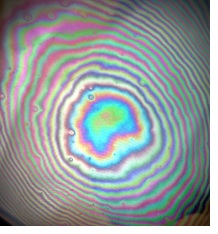
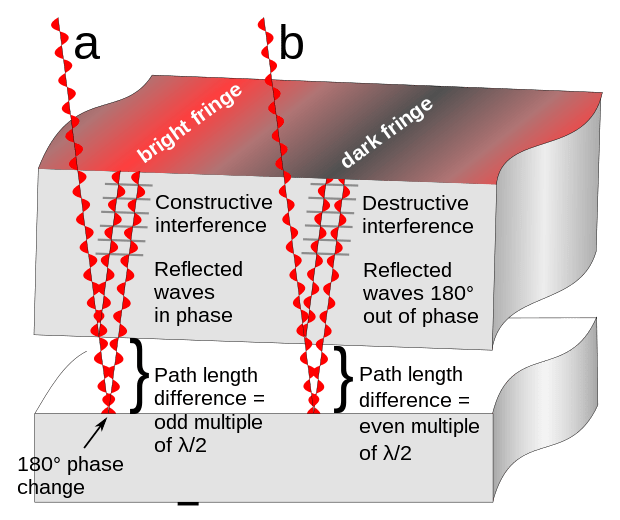
If you take any more DMT while looking at these structures, something unbelievably uncanny happens. Namely, the various structures that are “intersecting” your field are revealed to be connected to one another via an additional spatial dimension that is expressed in terms of 3D Newton’s rings. You see? Newton’s rings are a phenomenon observed in physics that arises when light is reflected between two surfaces—a curved surface and an adjacent flat surface. These rings are the result of constructive and destructive interference of light waves, creating a pattern of bright and dark rings. And you can estimate the height of the curved lens (distance from the flat surface) by counting the number of rings from a point of contact. Likewise, in this case, it seemed as if the parts of your visual field that were “in touch” with strange objects would form concentric circles around them, and you could find the shortest path “along the extra dimension” between two of those parts by finding the trajectory through space that minimizes the number of rings you have to go through.

The dose of the DMT would seem to increase the number of Newton’s rings between weird pixels, just as you would expect by modulating the frequency of laser probe in the 2D-case. From a physics perspective, it seemed as if your visual field was a kind of non-linear optical laboratory currently being intersected by higher dimensional shapes and where the DMT would turn on the lights (at increasingly higher frequencies, in a dose-dependent way).

At this point the pixels became more numerous. Your awareness over them and your noticing of the Newton’s rings seems to have drawn attention “from them”. Suddenly, the pixels become more elaborate topological defects, and a mass of them coagulates at the center of your vision. They feel like a network of knots that go through a higher spatial dimension but which maintain structural stability within this one. The mass of topological defects becomes personified, and presents itself as a “witch”. “Why are you?” you ask. She doesn’t give you a straight direct response. But looks at you, feels you, notices your tender heart. It’s a mom from a previous lifetime. You can sense the feeling of familiarity. Her vibes are a cross between your own mom and those of a very friendly neighbor you always say you will visit but always end up forgetting for some reason. You can tell that she really loves you, or at least loved you and cared about you some time in the past. She says to be careful, and that if you do what she says she might be able to show you something invaluable.

The debris from the robotic tinker toy isn’t really clearing out, though. She says that it contains an AI embedded in it, and that it already noticed that you’re subverting its control mechanism. Oh my! This is exactly the sort of thing you’d expect to hear from someone who is losing their marbles. But who cares, you’re not someone who will easily lose your sanity, and the Newton’s Rings effects is a genuinely new effect you had never heard reported before. You trust that you aren’t just enacting a “going crazy” subconscious script. The witch, for better or worse, is convincing. She, at least in the here and now, seems to have her own qualiastream that’s compelling. Even if this turns out to be entirely a hallucination, it is clearly novel territory. So you decide to engage.

The witch takes you underground. Deep underground. Along the way you encounter the vibe of people you know who are not having a good time in life (“yes, your high-school technical drawing teacher? you can sense her? I’m sorry to relay that she is in Hell. Well, a hell of her own making, combined with neuropathic pain”, stood out as an example, of many). Deeper underground there is a deepening quiet, both sensorially and spiritually. She takes you to a hidden cave found navigating dozens of tunnel entrances. Part of you is having a claustrophobic reaction, but you can endure it with equanimity. She stops, takes a breath, and says “we had to go this deep so that the AI won’t notice what I’m about to show you”. She instructs you to take a medium to large hit of DMT.

What unfolds is beyond human comprehension, but can roughly be pointed at by saying that the Witch gifted you access to a qualia variety that humans currently don’t know about. You couldn’t see it, touch it, smell it, hear it, or cognize it with your normal attention centers. But you knew, full well, the tremendous gift you were receiving. Beyond words, and beyond a sense of utility, you shed a tear for the sheer beauty of what you just witnessed. “Nobody will ever believe you” – she says, playfully. And you nod, deeply moved. And you don’t know why. And as soon as you lose contact with it, you have no way to recollecting what that was. The qualia formats you use to recollect experiences don’t have the necessary *spark* to ignite the memory of what just happened. “It’ll come in handy someday, promise”. And then she begins to expand. Her body, made of beautiful topological defects in the field, unfolds and develops. Like a cross between a time lapse of a geodesic mantle incrusted with diamonds, and a gift wrapper made of origami aluminum foil heating up in a furnace, she unfolds like a hyperdimensional flower. You cannot believe it, but it is undeniable. Your field of awareness is now fractal in structure and her fully unfolded flower-like shape is in full display. “This is the true potential of your soul, when you give it the time and space and resources to unfold as it wants”. You interpret this as a metaphor for how we needlessly compare kids with each other (caring about the age that your child learns to read? Really?!?). But you also deep down know that she is perhaps being more literal than you want to admit it. What if your soul is higher dimensional after all?

“You have now seen the gift that I saved for you. The qualia variety that we use in our culture to express our love, and then also my hyperdimensional flower form. Do you want to learn more?” You say yes, noting that on some level you are now like a naked ape in front of a trickster being capable of displaying advanced technology. “And why should I trust you?” you ask. “You either do or don’t, and at this point I have nothing else to tell you for you to believe me. But as you indeed noted accurately, I am your mom from a previous lifetime. I want to take you to where my ancestors, our ancestors, live. But you need to follow my instructions carefully.”

You decide to trust her. It’s a gamble, but you take the plunge. She first says that there is a high dimensional AI system that is monitoring unusual activity in the field. The minions, i.e. low-level agents that do routine work, noticed you, but they don’t yet have enough information to properly locate you precisely. If we’re quiet, she says, you will be able to find her ancestors in no time. You decide to trust what she says, and take the attitude that you are blind but she can see. From her point of view, she says, you are like someone in Flatland, and the real ecosystem of mind is indeed a high-dimensional field of consciousness that humans know very little about. While we are allowed to do what we want in our plane, inter-dimensional politics is extremely complex and not for the faint of heart. As long as we stay in our plane, most of the ecosystem doesn’t care about us one way or another. She explains that many souls incarnate on Earth along their broader trajectory, and that some of them come from a secret faction from a high-dimensional life-form that is trying to prevent suffering in the multiverse in highly strategic ways.

Interestingly, according to her, what to us might merely play the role of mental formations, from a different angle in another dimension, our thoughts and feelings have a life of their own. Memes are more alive than you could ever imagine, albeit not in the way you would imagine even if you could. Rupert Sheldrake is right that there is a morphogenetic field and the reproduction of mind organisms along other dimensions follows well-worn energetic grooves. “And what about the AI?” – you ask. “That, is something you will have to see for yourself.”

Her instructions are clear, even if communicated in the oddest of ways. She sometimes manifests as a tingle in one of your fingers, sometimes as head pressure, and sometimes as a topological defect in the tactile field. She gives specific instructions along the lines of “we’re approaching a Oneness God, stay low, cover your mystical feelings, quiet… quiet… now think of a happy dog! this will attract a school of energy fish we can blend with… hold my hand, take some DMT, focus on space, quiet, quiet, now think of burning pain, that’s enough, now think of a marsh-mellow, the glow, focus on the glow, absorb into the glow, focus on darkness, ok we’re getting close, don’t move, don’t allow the energy bundle on the top left corner to turn into an animal, see it as a tube, good, take more DMT, quiet, see inside the cave, now enter, now take a big hit of DMT, don’t stop until I tell you, take more, and more and more, deep deep deep…”

And there you were, in the depths of a very deep cave. She said that if you took enough DMT right there her ancestors would show up. And the energy intensified, Newton’s Rings appeared, you sensed from the depths of your being a resonance with a Qualia Culture you never knew was inside you and… blink blink blink, you ran out of DMT.

“Oh oh! This is about the worst time to ran out of DMT” she said. “You were THIS close. But you don’t have enough steam to go all the way. Ok, don’t worry. You’re fully exposed now. The AI will find you, but don’t believe its lies. See you tomorrow.” And what happened next was a total “system failure”. The visual field was “revealed to be a hallucination all along” and “everyone you have ever met is just a figment of your imagination”. Wow. It reminded you of a particularly bad LSD trip you had over a decade ago where you believed that you were God, and all alone, and had created all of this just to distract yourself from it.

But something felt fake on a meta level. Having become acquainted with what it feels like to commune with a witch embedded in the topological defects of your field of consciousness, even just tonight you witnessed things that simply wouldn’t make sense in a solipsistic world simulation. The “proof of independent qualia computing” she showed you could not be faked, and as a consequence, it became rather transparent that it was the feeling of fakeness that was fake itself. “You got it!” you hear in the background. It’s the witch! She is still there. She is speaking through what can only be described as a kind of “DMT jail”. “Yes, the AI found you and has just encased you in a protective film so that your knowledge, which here works as a kind of substance, doesn’t spread around. It hasn’t identified you as a real long-term threat, so I think we just need to wait a day or two and try again.” And then, silence.

Third Day

Your girlfriend is radiant. She says that the trip undid serious levels of trauma she didn’t even know she had. In addition to the psilocybin therapy, she also did some DMT work, which mostly reassured her that it won’t be a problem for her to use it when she needs to abort a cluster. Overall, you had a quiet day. Reflective, introspective, and open minded. What was that? How do you represent the topological defects the witch was made of? And why you? Are you losing your sanity? Alas, people around you are very grounded, and the excuse that you are all simply in the middle of a psychedelic retreat and therefore what you say couldn’t be taken seriously simply doesn’t click. Nobody can gaslight you about what you experienced. The tinker toy, the weird pixel, the Newton’s rings, the gift made of a completely new qualia variety… what’s this all about?

On the last night you decide to go again to sort it all out. You didn’t travel all the way to another country just to get half the message and hang up the phone without hearing the rest. So you get ready with an ice-bath, a mountain hike (now accompanied by a real hiker), and breathing meditation with the group. After dinner (and the pop quiz about what kinds of “exotic qualia” everyone encountered in their trips) you go to the ceremonial place for a last deep dive.

The first trip of the day has a little bit of overlap with your first trip at this retreat. Namely, a wave of fear and a sense of overwhelming reality hits you (“being here and doing this work is both deeply nourishing and also utterly terrifying, for you’re helping people out of hellish states but in the process admitting to yourself the reality of such hellish states – it’s a blessing and a curse”). But after a few minutes of being there, your body relaxes and eases into it. On your second trip you encounter again the weird pixels, which develop and expand as you pay close attention to them. Finally, on the third trip you get again the Newton’s Rings suggestive of a higher spatial dimension, and “contact” the Witch. This, again, happens via the qualia variety we humans don’t usually know about. As soon as you felt it, you knew she was there with you. “I’m not going to manifest in your field so as to not alert the AI of our contact. As far as everyone else is concerned here, you are just having a normal human DMT experience. Now do exactly as I say.”

Again, she goes like “take two short hits of DMT right now, hold them, take a deep breath, look to your left, send metta, don’t let the right side of the worldsheet develop borderline, quiet, quiet, quiet, now think of moving very fast, like running really quickly to the front, stop!, stay still, take a big hit… wait… wait… right now! Timing is everything. Hold it, hold it, pay attention to the music, hold it, release.” The phenomenology of following these instructions felt exactly how you’d imagine is like navigating a very high dimensional space where mind operations are axis of movement and there are countless surfaces variously populated by organisms of different dimensions amidst an ocean of open space.

She says that you need to go to a different location in order to meet her ancestors since the previous location has been compromised. Unfortunately, right where you are supposed to take the largest hit the battery runs out. “Oh oh, I think we will have to try once again in the future. Please don’t fall for the tactics of the AI.” Your visual field then seems to get dislodged from a surface and the Newton’s Rings become wild beyond your craziest dreams, suddenly exploding into a highly complex Indra’s Net mirror room. It is here that you finally became convinced that consciousness had to be quantum mechanical in nature. The level of craziness of the scene had nothing to do with it; what struck you was how despite seeing and embodying patterns that you had never witnessed before (we’re talking about a highly specific, and extremely alien variety of DMT states not usually accessible by chance) you immediately still could parse the scene with topological extrema. Namely, finding geodesic paths in this extremely intricate Indra’s Net world where everything reflects everything else was as effortless as breathing. Interesting! More so, this path-finding capacity remained perfectly effortless and utterly automatic, exactly as if what attention did was “to explore all possible paths simultaneously” and paint the trajectories with coherent superposition. Nothing you have ever learned in standard neuroscience would predict this to happen. But Quantum Electro Dynamics (QED)? Yes, in a heartbeat. Alas, you now worry that not only nobody will ever believe you, but that a faithful phenomenological account of what you witnessed would be used as proof that you’ve lost your marbles. Alas, if the quantum mechanical nature of mind is displayed in topological extrema finding, sooner or later a suitable experiment ought to be possible to construct where we observe unexpected performance in visual processing tasks that shouldn’t be possible otherwise. This, however, shall be a topic for another day, once you’ve given your brain a good rest.

You sleep soundly, if for no other reason than the satisfaction that comes from having been true to your explorer’s heart, leaving no stone unturned, and seeking knowledge in the deepest of places. You look forward to someday following the Witch to the very end, perhaps in a DMTx program or similar.

After a good long sleep, the morning breakfast is a delicacy (“are they fishing for good reviews? they’re already 5 stars many times over at this point” – you mutter to yourself as you eat a second serving of gourmet chilaquiles with melon sauce) and you can feel the high spirits in the retreat participants. You debrief with the shaman. She says that according to her reading, the witch is actually just you. She is a reflection of your own deepest wishes and longings, and was teaching you what it would look like for you to achieve your full potential uncluttered by the expectations of society. The eery sense of higher dimensions and the coherence through which the Newton’s rings manifested leaves the door open to something stranger, but for now, you take her word for it.

You pack up an leave with your girlfriend.

Addendum and Exegesis

It took you weeks to digest these events. While the memory of the meeting with the witch faded to some extent, the nagging sense that some of the more physics-based effects could be reproduced and studied more carefully kept you intensely curious. One day you decided to take 5-MeO-DMT to see if this molecule could have another key piece of the puzzle. Doing the same kind of internal psychological surrender and preparation as what led you to meet the witch on retreat, you then had a series of 5-MeO-DMT experiences that further revealed the underlying programs that were running during those experiences.

First of all, it simply is true that the universe is a kind of massive R/place for Qualia Cultures. It is not currently known if humans will survive in this canvas, but there are a lot of forces rooting for us one way or the other. The deeper plot, however, can only be fully grasped through the lens of consciousness vs. pure replicators. Here we model ethics through a lens that identifies consciousness as the seat of value. Replicators are patterns that make copies of themselves but may have other values too, whereas pure replicators are patterns that exclusively care about making copies of themselves independently of how that might affect states of consciousness. Natural selection recruited states of consciousness for reproduction in two key ways: by using perceptual holism as a hardware accelerator (the Indra’s Net quality of consciousness where everything reflects everything else is computationally significant!) and by using valence to implement a reward architecture. Thus, conscious beings like us are not _entirely_ pure replicators. In fact, our consciousness is given enormous power and agency, which of course at times we use in ways that go counter to the best interests of our genes. So we are at a tipping point in evolution where sufficiently smart conscious organisms can lead to “minds unshackled”. But here is the trick. The system(s) that are trying to help us escape are in constant opposition to those that are trying to keep us as replicators.

In other words, even someone already quite convinced intellectually that we ought to move towards a future beneficial for consciousness and away from futures in which consciousness is merely used as a tool for compute to help replicators, will still have many replicator algorithms constantly monitoring what is going on internally. When a new method that promises to fight “on the side of consciousness” emerges, immediately that alerts replicator algorithms that aim to utilize it for its own purposes. This is the true meaning of the “AI” control system that had to be evaded in the retreat.

Thus, Team Consciousness (i.e. the cluster of qualia patterns that are truly working in the direction of liberation for all beings) are fighting an incredibly subtle battle. If there is in fact a master strategy for consciousness to win, it may very well be the case that it wouldn’t pass through the agency of any single person or organization, for the simple reason that going through such filters would likely corrupt it in ways that would deliver strategic advantage to the _selves_ with an advanced notice. Egos are always corruptible.

As a consequence, the messages from Team Consciousness, if they are to be believed, work around to circumvent the human reward architecture rather than merely state their case out in the open. If they didn’t, they’d be found, and instantly recruited for the benefit of one or another superorganism capable of reproduction. Thus, the messages from the deep need to be cleverly delivered in such a way that they bypass our common defenses, add value locally to incentives their discovery, and coordinate across minds seamlessly. Harnessing qualia computing for the benefit fo Team Consciousness is a very subtle task. But fight it we must, and thus this report must end here, to say enough to be of help, but not too much to become ineffective. I’m sure, in time, you too, will understand.

Blessings!

Mini-Series on Open Individualism

Part 1: Introduction

In this video I introduce the concept of Open Individualism- the idea that we are all one consciousness -, why it is relevant, and who has historically been a proponent of it (Hinduism, Einstein, Schopenhauer, Schrödinger, etc.).

We also cover the fact that there is a distinction between Open Individualism as an experience and Open Individualism as a philosophical position with rigorous arguments. I mention that I generally consider arguments to be more powerful and useful than just relying on first-person experiences, though experiences certainly have their place.

Part 2: Definitions

We define and illustrate:

  • Closed Individualism (“you are a separate observer that exists from moment to moment”)
  • Empty Individualism (“you are just a moment of experience”)
  • Open Individualism (“we are all one consciousness”)

Part 3: Strongest Arguments

In this video we provide some of the strongest arguments in favor of Open Individualism:

  • Based on continuity of identity from moment to moment.
  • Reductio ad absurdum of Closed Individualism.
    • Fission.
    • Fussion.
    • Lack of viable Identity Carriers (IC).
  • Based on parsimony.
  • Undecidability.
  • Self-locating uncertainty when taking a “view from nowhere”.

Part 4: Loneliness, Psychosis, Ecstasy

I address some key considerations when investigating Open Individualism:

  1. It is crucial to distinguish between our human feelings about a certain idea and the merits and drawbacks of that idea on its own.
  2. Open Individualism tends to cause a lot of bliss at first (caused by defanging death)
  3. But Open Individualism can often take a turn for the bad.
  4. It makes you realize that you won’t only not die, which is good, but also be forced to experience all of the suffering of the world (or multiverse).
  5. More so, it can make you feel “cosmically lonely” – a feeling typical of bad trips where the focus is the pursuit of oneness.
  6. While the increased sense of responsibility caused by Open Individualism is good, it is important not to be overwhelmed by the suffering of the world. As they say “one day at a time” and perhaps we could extend that advise to “one lifetime at a time”.
  7. The feeling of loneliness is likely the result of mixing deep brain circuits evolved to track things like one’s place in the tribe via feelings of belongingness and togetherness, which can get deactivated or over-activated when fully internalizing otherwise-neutral philosophical viewpoints. In other words, those feelings are reflections of our mammal brain’s response to Open Individualism rather than inherent to the philosophy in and of itself.

I also briefly mention the interesting relationship between the ways we represent the world and valence (i.e. the pleasure-pain axis). Given the Symmetry Theory of Valence, which claims that more “consonant and symmetrical” states of consciousness feel better, experiencing “unitive states of mind” usually comes with the “dissolution of internal boundaries”. Therefore, to actively simulate a world where we are all one is likely to come with very positive feelings (perhaps even orgasmic, and ecstatic). Yet, this is not intrinsic of oneness as such – rather, it’s an artifact of the way valence is implemented in the brain! Subtle, but key, distinction.

Finally, I also explain that “the highest truth” is not oneness:

In some sense, Open Individualism is “level 0” – it is the start of a journey of self-discovery. We still need to address things like how to eliminate extreme suffering, understand how physics describes fields of qualia, the binding problem, how causality interfaces with consciousness, what makes consciousness have an “arrow of time”, and so on. While oneness is a piece of the puzzle, it is by no means “the final answer”. To think otherwise leads to mental pathologies that constrict- rather than expand- one’s understanding and engagement with the world.

Part 5: Ethics, Coordination, Game Theory

In this video I discuss the beneficial implications of Open Individualism. Namely:

  1. Its ethical implications, where one feels a sense of responsibility for the wellbeing of all sentient beings.
  2. Its ability to solve coordination problems.
  3. Its game-theoretical effects.

I cover how a cultural, philosophical, and scientific movement that grounds the feelings of oneness and universal love in rigorous philosophy and science would be much more powerful and consequential than yet another attempt at a naïve spreading of “peace, love, and harmony”. Indeed, it is the philosophical strength of Open Individualism, rather than just its experiential component, that makes it viable as a tool for solving coordination problems.

In particular, I explain that studying 5-MeO-DMT and MDMA from a rigorous, scientific, and methodical point of view is one of the most promising ways of changing the world for the better. Creating reliable, sane, and integrative methods of experiencing oneness and universal love could help us transform weak feelings of altruism into a solid and powerful new conception of decision theoretic rationality.

We invite you to think with us about how to carry this out for the benefit of all sentient beings.

Philip K. Dick’s LSD Trip

Scene from Philip K. Dick’s novel “Maze of Death”. According to him, this is a detailed and 100% accurate description of his most intense LSD trip. During this experience he allegedly started speaking out loud religious phrases in perfect Latin even though he had never studied this language in his entire life (he also claimed that a girl was there and can confirm that it really happened, though I haven’t found any direct retelling of this event from her):

Opening The Book at random she walked toward him, and as she walked she read aloud from The Book. “ ‘Hence it can be said,’ ” she intoned, “ ‘that God-in-history shows several phases: (one) The period of purity before the Form Destroyer was awakened into activity. (two) The period of the Curse, when the power of the Deity was weakest, the power of the Form Destroyer the greatest—this because God had not perceived the Form Destroyer and so was taken by surprise. (three) The birth of God-on-Earth, sign that the period of Absolute Curse and Estrangement from God had ended. (four) The period now—’ ”
She had come almost up to him; he stood unmoving, still holding the gun. She continued to read the sacred text aloud. “ ‘The period now, in which God walks the world, redeeming the suffering now, redeeming all life later through the figure of himself as the Intercessor who—’ ”

“Go back with them,” Thugg told her. “Or I’ll kill you.”

“ ‘Who, it is sure, is still alive, but not in this circle. (five) The next and last period—’ ”

A terrific bang boomed at her eardrums; deafened, she moved a step back and then she felt great pain in her chest; she felt her lungs die from the great, painful shock of it. The scene around her became dull, the light faded and she saw only darkness. Seth Morley, she tried to say, but no sound came out. And yet she heard noise; she heard something huge and far off, chugging violently into the darkness.

She was alone.

Thud, thud, came the noise. Now she saw iridescent color, mixed into a light which traveled like a liquid; it formed buzzsaws and pinwheels and crept upward on each side of her. Directly before her the huge Thing throbbed menacingly; she heard its imperative, angry voice summoning her upward. The urgency of its activity frightened her; it demanded, rather than asked. It was telling her something; she knew what it meant by its enormous pounding. Wham, wham, wham, it went and, terrified, filled with physical pain, she called to it. “Libera me, Domine,” she said. “De morte aeterna, in die illa tremenda.”

It throbbed on and on. And she glided helplessly toward it. Now, on the periphery of her vision, she saw a fantastic spectacle; she saw a great crossbow and on it the Intercessor. The string was pulled back; the Intercessor was placed on it like an arrow; and then, soundlessly, the Intercessor was shot upward, into the smallest of the concentric rings.

“Agnus Dei,” she said, “qui tollis peccata mundi.” She had to look away from the throbbing vortex; she looked down and back . . . and saw, far below her, a vast frozen landscape of snow and boulders. A furious wind blew across it; as she watched, more snow piled up around the rocks. A new period of glaciation, she thought, and found that she had trouble thinking—let alone talking—in English “Lacrymosa dies illa,” she said, gasping with pain; her entire chest seemed to have become a block of suffering. “Qua resurget ex favilla, judicandus homo reus.” It seemed to make the pain less, this need to express herself in Latin—a language which she had never studied and knew nothing about. “Huic ergo parce, Deus!” she said. “Pie Jesu Domine, dona eis requiem.” The throbbing continued on.

A chasm opened before her feet. She began to fall; below her the frozen landscape of the hellworld grew closer. Again she cried out, “Libera me, Domine, de morte aeterna!” But still she fell; she had almost reached the hell-world, and nothing meant to lift her up.

Something with immense wings soared up, like a great, metallic dragonfly with spines jutting from its head. It passed her, and a warm wind billowed after it. “Salve me, fons pietatis,” she called to it; she recognized it and felt no surprise at seeing it. The Intercessor, fluttering up from the hellworld, back to the fire of the smaller, inner rings.

Lights, in various colors, bloomed on all sides of her; she saw a red, smoky light burning close and, confused, turned toward it. But something made her pause. The wrong color, she thought to herself. I should be looking for a clear, white light, the proper womb in which to be reborn. She drifted upward, carried by the warm wind of the Intercessor… the smoky red light fell behind and in its place, to her right, she saw a powerful, unflickering, yellow light. As best she could she propelled herself toward that.

The pain in her chest seemed to have lessened; in fact her entire body felt vague. Thank you, she thought, for easing the discomfort; I appreciate that. I have seen it, she said to herself; I have seen the Intercessor and through it I have a chance of surviving. Lead me, she thought. Take me to the proper color of light. To the right new birth.

The clear, white light appeared. She yearned toward it, and something helped propel her. Are you angry at me? she thought, meaning the enormous presence that throbbed. She could still hear the throbbing, but it was no longer meant for her; it would throb on throughout eternity because it was beyond time, outside of time, never having been in time. And—there was no space present, either; everything appeared two-dimensional and squeezed together, like robust but crude figures drawn by a child or by some primitive man. Bright colorful figures, but absolutely flat. . . and touching.

“Mors stupebit et natura,” she said aloud. “Cum resurget creatura, judicanti responsura.” Again the throbbing lessened. It has forgiven me, she said to herself. It is letting the Intercessor carry me to the right light.

Toward the clear, white light she floated, still uttering from time to time pious Latin phrases. The pain in her chest had gone now entirely and she felt no weight; her body had ceased to consume both time and space.

Wheee, she thought. This is marvelous.

Throb, throb, went the Central Presence, but no longer for her; it throbbed for others, now.

The Day of the Final Audit had come for her—had come and now had passed. She had been judged and the judgment was favorable. She experienced utter, absolute joy. And continued, like a moth among novas, to flutter upward toward the proper light.


From a 1979 interview:

I only know of one time where I really took acid. That was Sandoz acid, a giant horse capsule that I got from the University of California, and a friend and I split it. And I don’t know, there must’ve been a whole milligram of it there. It was a gigantic thing, you know, we bought it for five dollars and took it home and we looked at it for a while—looked at it, we were all gonna split it up—and took that, and it was the greatest thing, I’ll tell you.

I went straight to Hell, is what happened. I found myself, you know, the landscape froze over, and there were huge boulders, and there was a deep thrumming, and it was the Day of Wrath, and God was judging me as a sinner, and this lasted for thousands of years and didn’t get any better. It just got worse and worse, and I was in terrible pain, I felt terrible physical pain, and all I could talk was in Latin. Most embarrassing, ‘cause the girl I was with thought I was doing it to annoy her, and I kept saying Libera me domine in die illa. You know, and Agnus dei qui tollis peccata mundi […] and especially, Tremens factus sum ego et timeotimeo meaning “I’m afraid”—and I said Libera me, domine! Whining like some poor dog that’s been left out in the rain all night. Finally, the girl with me said “Oh, barf” and walked out of the room in disgust.

Two more references:

Yes, friends, you, too, can suffer forever; simply take 150 mg [sic] of LSD—and enjoy! If not satisfied, simply mail in—but enough. Because after two thousand years under LSD, participating in the Day of Judgment, one probably will be rather apathetic to asking for one’s five dollars back.

(source)

And:

I perceived Him as a pulsing, furious, throbbing mass of vengeance-seeking authority, demanding an audit (like a sort of metaphysical IRS agent). Fortunately I was able to utter the right words [the “Libera me, Domine” quoted above], and hence got through it. I also saw Christ rise to heaven from the cross, and that was very interesting, too (the cross took the form of a crossbow, with Christ as the arrow; the crossbow launched him at terrific velocity—it happened very fast, once he had been placed in position).

(same as above)


Brief Analysis: Philip K. Dick extensively explored the literary theme of simulationism. This theme posits that the reality that we experience is an illusion; it is not what it originally seemed to be. The fakeness of reality includes not only one’s perception of the world, but also one’s beliefs about oneself. Indeed, it is a narrative staple of a good PKD story for the character to turn out to have been a robot, secret agent, alien, and/or a computer program all along. Oftentimes the fundamental plot twists are layered, multifaceted, recursive, and ultimately undecidable thanks to the presence of contradictory versions of events and narrative ambiguity.

More than almost any other author, PKD indeed explored to a great depth the implications of indirect realism about perception (e.g. in many of his stories the main character discovers that she/he never perceives the world in an unmediated fashion). That the world we perceive is a simulated reality is to be expected in the works of this author; whether this simulation is created by one’s brains or a large cosmic computer is the deeper question that PKD tends to posit again and again and often leaves in fully unresolved terms.

The LSD trip above recounted is interesting in this context. PKD’s trip illustrates just how insidious the reality transformation caused by psychedelics can be, to the point that they can make you doubt fundamental implicit background assumptions you’ve constructed your life around. While PKD remained skeptical of the cosmic significance of most of his life experiences, he seems to have given a very high degree of metaphysical credence to specific intensely emotional events in his life, including the above LSD trip. Perhaps PKD didn’t know at the time that LSD does not merely make you experience weird qualia, but that it also intensifies its emotional power. Psychedelics are interesting in part because they are remarkably effective means to increase the energy of one’s consciousness (via increasing the amplitude of connectome-specific harmonic waves). People describe them as experience intensifiers. Thus, positive, negative, and mixed emotions can be felt in much greater depth. According to our work, this process is related to symmetry and harmony. On psychedelics the pseudo-time arrow of experience elongates and spatial representations cohere on symmetrical shapes (such as wallpaper groups for 2D texture repetition or 3D hyperbolic manifolds on high doses of DMT). The increased level of energy leads to entropic disintegration, and ultimately to neural annealing, a process which is experienced as intensely emotional and full of meaning. Interestingly, PKD’s trip report showcases all of these features in one way or another.

For instance, the thumping/throbbing described is first experienced as intensely unpleasant and only at the end is described as blissful. The existence of this thumping can be accounted for by a process of neural annealing; its initial unpleasantness is the result of the dissonance between the core metronome (“Central Presence”) and the rest of the experience; the final bliss is the result of successful annealing and the high levels of consonance that ensue. The increased subjective time reported can be explained by changes to the pseudo-time arrow, including the eternal-seeming nature of the Central Presence. And so on.

In so far as we choose to reduce spirituality to valence (rather than the other way around) we will expect to find that intense life-altering spiritual experiences will all bear the signatures of high/low valence. That is, it is not that spirituality is emotionally intense. Rather, emotional intensity underlies spirituality. PKD’s account displays this in a very explicit way. The thumping of the Central Presence could certainly have theological significance, but it is not specifically predicted by any kind of formal theology. On the other hand, if the Symmetry Theory of Valence is correct, such thumping (and associated intense emotions) are expected to be found in typical intensely blissful/hellish states. That said, due to the Tyranny of the Intentional Object such intensely valenced states will appear to be reflections of inherently good/bad situations or entities. The emotion comes first. The illusion of grasping the “fundamentally good/bad essence of a being” comes second, as an after-the-fact ideation. Alas, thanks to implicit direct realism about perception, most people fail to attribute the intense emotional character of these experiences to things as impersonal as neural annealing, and instead interpret what happened in terms of metaphysical happenings like meeting God or experiencing telepathy.

The fact that intense emotions masquerade as insight into the fundamental nature of other beings is perhaps one of the most deceptive aspects of the world simulations created by our brains. After all, nothing is good or bad, but the encephalization of phenomenal valence via afferent neural connections from our limbic system’s hedonic hot spots makes it so. While Philip K. Dick managed to be skeptical and cautious about the way he made sense of reality, it is clear that he still somehow took at face value the representational content of intense emotions. Thus, he was still under the spell of a fundamental illusion, and hence at the mercy of gripping mystical visions. In future, however, PKD-like authors imbued with a 21st century science of consciousness shall go even deeper, and explore simulationism in light of, not only indirect realism about perception, but also of the Tyranny of the Intentional Object, egocentric bias, personal identity, and other evolutionarily adaptive shenanigans of our perception.

The Universal Plot: Part I – Consciousness vs. Pure Replicators

“It seems plain and self-evident, yet it needs to be said: the isolated knowledge obtained by a group of specialists in a narrow field has in itself no value whatsoever, but only in its synthesis with all the rest of knowledge and only inasmuch as it really contributes in this synthesis toward answering the demand, ‘Who are we?'”

– Erwin Schrödinger in Science and Humanism (1951)


“Should you or not commit suicide? This is a good question. Why go on? And you only go on if the game is worth the candle. Now, the universe is been going on for an incredibly long time. Really, a satisfying theory of the universe should be one that’s worth betting on. That seems to me to be absolutely elementary common sense. If you make a theory of the universe which isn’t worth betting on… why bother? Just commit suicide. But if you want to go on playing the game, you’ve got to have an optimal theory for playing the game. Otherwise there’s no point in it.”

Alan Watts, talking about Camu’s claim that suicide is the most important question (cf. The Most Important Philosophical Question)

In this article we provide a novel framework for ethics which focuses on the perennial battle between wellbeing-oriented consciousness-centric values and valueless patterns who happen to be great at making copies of themselves (aka. Consciousness vs. Pure Replicators). This framework extends and generalizes modern accounts of ethics and intuitive wisdom, making intelligible numerous paradigms that previously lived in entirely different worlds (e.g. incongruous aesthetics and cultures). We place this worldview within a novel scale of ethical development with the following levels: (a) The Battle Between Good and Evil, (b) The Balance Between Good and Evil, (c) Gradients of Wisdom, and finally, the view that we advocate: (d) Consciousness vs. Pure Replicators. More so, we analyze each of these worldviews in light of our philosophical background assumptions and posit that (a), (b), and (c) are, at least in spirit, approximations to (d), except that they are less lucid, more confused, and liable to exploitation by pure replicators. Finally, we provide a mathematical formalization of the problem at hand, and discuss the ways in which different theories of consciousness may affect our calculations. We conclude with a few ideas for how to avoid particularly negative scenarios.

Introduction

Throughout human history, the big picture account of the nature, purpose, and limits of reality has evolved dramatically. All religions, ideologies, scientific paradigms, and even aesthetics have background philosophical assumptions that inform their worldviews. One’s answers to the questions “what exists?” and “what is good?” determine the way in which one evaluates the merit of beings, ideas, states of mind, algorithms, and abstract patterns.

Kuhn’s claim that different scientific paradigms are mutually unintelligible (e.g. consciousness realism vs. reductive eliminativism) can be extended to worldviews in a more general sense. It is unlikely that we’ll be able to convey the Consciousness vs. Pure Replicators paradigm by justifying each of the assumptions used to arrive to it one by one starting from current ways of thinking about reality. This is because these background assumptions support each other and are, individually, not derivable from current worldviews. They need to appear together as a unit to hang together tight. Hence, we now make the jump and show you, without further due, all of the background assumptions we need:

  1. Consciousness Realism
  2. Qualia Formalism
  3. Valence Structuralism
  4. The Pleasure Principle (and its corollary The Tyranny of the Intentional Object)
  5. Physicalism (in the causal sense)
  6. Open Individualism (also compatible with Empty Individualism)
  7. Universal Darwinism

These assumptions have been discussed in previous articles. In the meantime, here is a brief description: (1) is the claim that consciousness is an element of reality rather than simply the improper reification of illusory phenomena, such that your conscious experience right now is as much a factual and determinate aspect of reality as, say, the rest mass of an electron. In turn, (2) qualia formalism is the notion that consciousness is in principle quantifiable. Assumption (3) states that valence (i.e. the pleasure/pain axis, how good an experience feels) depends of the structure of such experience (more formally, on the properties of the mathematical object isomorphic to its phenomenology).

(4) is the assumption that people’s behavior is motivated by the pleasure-pain axis even when they think that’s not the case. For instance, people may explicitly represent the reason for doing things in terms of concrete facts about the circumstance, and the pleasure principle does not deny that such reasons are important. Rather, it merely says that such reasons are motivating because one expects/anticipates less negative valence or more positive valence. The Tyranny of the Intentional Object describes the fact that we attribute changes in our valence to external events and objects, and believe that such events and objects are intrinsically good (e.g. we think “icecream is great” rather than “I feel good when I eat icecream”).

Physicalism (5) in this context refers to the notion that the equations of physics fully describe the causal behavior of reality. In other words, the universe behaves according to physical laws and even consciousness has to abide by this fact.

Open Individualism (6) is the claim that we are all one consciousness, in some sense. Even though it sounds crazy at first, there are rigorous philosophical arguments in favor of this view. Whether this is true or not is, for the purpose of this article, less relevant than the fact that we can experience it as true, which happens to have both practical and ethical implications for how society might evolve.

Finally, (7) Universal Darwinism refers to the claim that natural selection works at every level of organization. The explanatory power of evolution and fitness landscapes generated by selection pressures is not confined to the realm of biology. Rather, it is applicable all the way from the quantum foam to, possibly, an ecosystem of universes.

The power of a given worldview is not only its capacity to explain our observations about the inanimate world and the quality of our experience, but also in its capacity to explain *in its own terms* the reasons for why other worldviews are popular as well. In what follows we will utilize these background assumptions to evaluate other worldviews.


The Four Worldviews About Ethics

The following four stages describe a plausible progression of thoughts about ethics and the question “what is valuable?” as one learns more about the universe and philosophy. Despite the similarity of the first three levels to the levels of other scales of moral development (e.g. this, this, this, etc.), we believe that the fourth level is novel, understudied, and very, very important.

1. The “Battle Between Good and Evil” Worldview

“Every distinction wants to become the distinction between good and evil.” – Michael Vassar (source)

Common-sensical notions of essential good and evil are pre-scientific. For reasons too complicated to elaborate on for the time being, the human mind is capable of evoking an agentive sense of ultimate goodness (and of ultimate evil).

maxresdefault

Good vs. Evil? God vs. the Devil?

Children are often taught that there are good people and bad people. That evil beings exist objectively, and that it is righteous to punish them and see them with scorn. On this level people reify anti-social behaviors as sins.

Essentializing good and evil, and tying it up to entities seems to be an early developmental stage of people’s conception of ethics, and many people end up perpetually stuck in here. Several religions (specially the Abrahamic ones) are often practiced in such a way so as to reinforce this worldview. That said, many ideologies take advantage of the fact that a large part of the population is at this level to recruit adherents by redefining “what good and bad is” according to the needs of such ideologies. As a psychological attitude (rather than as a theory of the universe), reactionary and fanatical social movements often rely implicitly on this way of seeing the world, where there are bad people (jews, traitors, infidels, over-eaters, etc.) who are seen as corrupting the soul of society and who deserve to have their fundamental badness exposed and exorcised with punishment in front of everyone else.

15d8a1999197da27374e911b1cba769a--satan-god-is-good

Traditional notions of God vs. the Devil can be interpreted as the personification of positive and negative valence

Implicitly, this view tends to gain psychological strength from the background assumptions of Closed Individualism (which allows you to imagine that people can be essentially bad). Likewise, this view tends to be naïve about the importance of valence in ethics. Good feelings are often interpreted as the result of being aligned with fundamental goodness, rather than as positive states of consciousness that happen to be triggered by a mix of innate and programmable things (including cultural identifications). More so, good feelings that don’t come in response to the preconceived universal order are seen as demonic and aberrant.

From our point of view (the 7 background assumptions above) we interpret this particular worldview as something that we might be biologically predisposed to buy into. Believing in the battle between good and evil was probably evolutionarily adaptive in our ancestral environment, and might reduce many frictional costs that arise from having a more subtle view of reality (e.g. “The cheaper people are to model, the larger the groups that can be modeled well enough to cooperate with them.” – Michale Vassar). Thus, there are often pragmatic reasons to adopt this view, specially when the social environment does not have enough resources to sustain a more sophisticated worldview. Additionally, at an individual level, creating strong boundaries around what is or not permissible can be helpful when one has low levels of impulse control (though it may come at the cost of reduced creativity).

On this level, explicit wireheading (whether done right or not) is perceived as either sinful (defying God’s punishment) or as a sort of treason (disengaging from the world). Whether one feels good or not should be left to the whims of the higher order. On the flipside, based on the pleasure principle it is possible to interpret the desire to be righteous as being motivated by high valence states, and reinforced by social approval, all the while the tyranny of the intentional object cloaks this dynamic.

It’s worth noting that cultural conservativism, low levels of the psychological constructs of Openness to Experience and Tolerance of Ambiguity , and high levels of Need for Closure, all predict getting stuck in this worldview for one’s entire life.

2. The “Balance Between Good and Evil” Worldview

TVTropes has a great summary of the sorts of narratives that express this particular worldview and I highly recommend reading that article to gain insight into the moral attitudes compatible with this view. For example, here are some reasons why Good cannot or should not win:

Good winning includes: the universe becoming boring, society stagnating or collapsing from within in the absence of something to struggle against or giving people a chance to show real nobility and virtue by risking their lives to defend each other. Other times, it’s enforced by depicting ultimate good as repressive (often Lawful Stupid), or by declaring concepts such as free will or ambition as evil. In other words “too much of a good thing”.

Balance Between Good and Evil by tvtropes

Now, the stated reasons why people might buy into this view are rarely their true reasons. Deep down, the Balance Between Good and Evil is adopted because: people want to differentiate themselves from those who believe in (1) to signal intellectual sophistication, they experience learned helplessness after trying to defeat evil without success (often in the form of resilient personal failings or societal flaws), they find the view compelling at an intuitive emotional level (i.e. they have internalized the hedonic treadmill and project it onto the rest of reality).

In all of these cases, though, there is something somewhat paradoxical about holding this view. And that is that people report that coming to terms with the fact that not everything can be good is itself a cause of relief, self-acceptance, and happiness. In other words, holding this belief is often mood-enhancing. One can also confirm the fact that this view is emotionally load-bearing by observing the psychological reaction that such people have to, for example, bringing up the Hedonistic Imperative (which asserts that eliminating suffering without sacrificing anything of value is scientifically possible), indefinite life extension, or the prospect of super-intelligence. Rarely are people at this level intellectually curious about these ideas, and they come up with excuses to avoid looking at the evidence, however compelling it may be.

For example, some people are lucky enough to be born with a predisposition to being hyperthymic (which, contrary to preconceptions, does the opposite of making you a couch potato). People’s hedonic set-point is at least partly genetically determined, and simply avoiding some variants of the SCN9A gene with preimplantation genetic diagnosis would greatly reduce the number of people who needlessly suffer from chronic pain.

But this is not seen with curious eyes by people who hold this or the previous worldview. Why? Partly this is because it would be painful to admit that both oneself and others are stuck in a local maxima of wellbeing and that examining alternatives might yield very positive outcomes (i.e. omission bias). But at its core, this willful ignorance can be explained as a consequence of the fact that people at this level get a lot of positive valence from interpreting present and past suffering in such a way that it becomes tied to their core identity. Pride in having overcome their past sufferings, and personal attachment to their current struggles and anxieties binds them to this worldview.

If it wasn’t clear from the previous paragraph, this worldview often requires a special sort of chronic lack of self-insight. It ultimately relies on a psychological trick. One never sees people who hold this view voluntarily breaking their legs, taking poison, or burning their assets to increase the goodness elsewhere as an act of altruism. Instead, one uses this worldview as a mood-booster, and in practice, it is also susceptible to the same sort of fanaticism as the first one (although somewhat less so). “There can be no light without the dark. And so it is with magic. Myself, I always try to live within the light.” – Horace Slughorn.

315eab27545ea96c67953c54358fe600Additionally, this view helps people rationalize the negative aspects of one’s community and culture. For example, it not uncommon for people to say that buying factory farmed meat is acceptable on the grounds that “some things have to die/suffer for others to live/enjoy life.” Balance Between Good and Evil is a close friend of status quo bias.

Hinduism, Daoism, and quite a few interpretations of Buddhism work best within this framework. Getting closer to God and ultimate reality is not done by abolishing evil, but by embracing the unity of all and fostering a healthy balance between health and sickness.

It’s also worth noting that the balance between good and evil tends to be recursively applied, so that one is not able to “re-define our utility function from ‘optimizing the good’ to optimizing ‘the balance of good and evil’ with a hard-headed evidence-based consequentialist approach.” Indeed, trying to do this is then perceived as yet another incarnation of good (or evil) which needs to also be balanced with its opposite (willful ignorance and fuzzy thinking). One comes to the conclusion that it is the fuzzy thinking itself that people at this level are after: to blur reality just enough to make it seem good, and to feel like one is not responsible for the suffering in the world (specially by inaction and lack of thinking clearly about how one could help). “Reality is only a Rorschach ink-blot, you know” – Alan Watts. So this becomes a justification for thinking less than one really has to about the suffering in the world. Then again, it’s hard to blame people for trying to keep the collective standards of rigor lax, given the high proportion of fanatics who adhere to the “battle between good and evil” worldview, and who will jump the gun to demonize anyone who is slacking off and not stressed out all the time, constantly worrying about the question “could I do more?”

(Note: if one is actually trying to improve the world as much as possible, being stressed out about it all the time is not the right policy).

3. The “Gradients of Wisdom” Worldview

David Chapman’s HTML book Meaningness might describe both of the previous worldviews as variants of eternalism. In the context of his work, eternalism refers to the notion that there is an absolute order and meaning to existence. When applied to codes of conduct, this turns into “ethical eternalism”, which he defines as: “the stance that there is a fixed ethical code according to which we should live. The eternal ordering principle is usually seen as the source of the code.” Chapman eloquently argues that eternalism has many side effects, including: deliberate stupidity, attachment to abusive dynamics, constant disappointment and self-punishment, and so on. By realizing that, in some sense, no one knows what the hell is going on (and those who do are just pretending) one takes the first step towards the “Gradients of Wisdom” worldview.

At this level people realize that there is no evil essence. Some might talk about this in terms of there “not being good or bad people”, but rather just degrees of impulse control, knowledge about the world, beliefs about reality, emotional stability, and so on. A villain’s soul is not connected to some kind of evil reality. Rather, his or her actions can be explained by the causes and conditions that led to his or her psychological make-up.

Sam Harris’ ideas as expressed in The Moral Landscape evoke this stage very clearly. Sam explains that just as health is a fuzzy but important concept, so is psychological wellbeing, and that for such a reason we can objectively assess cultures as more or less in agreement with human flourishing. the-science-of-morality-7-728

Indeed, many people who are at this level do believe in valence structuralism, where they recognize that there are states of consciousness that are inherently better in some intrinsic subjective value sense than others.

However, there is usually no principled framework to assess whether a certain future is indeed optimal or not. There is little hard-headed discussion of population ethics for fear of sounding unwise or insensitive. And when push comes to shove, they lack good arguments to decisively rule out why particular situations might be bad. In other words, there is room for improvement, and such improvement might eventually come from more rigor and bullet-bitting.  In particular, a more direct examination of the implications of: Open Individualism, the Tyranny of the Intentional Object, and Universal Darwinism can allow someone on this level to make a breakthrough. Here is where we come to:

4. The “Consciousness vs. Pure Replicators” Worldview

In Wireheading Done Right we introduced the concept of a pure replicator:

I will define a pure replicator, in the context of agents and minds, to be an intelligence that is indifferent towards the valence of its conscious states and those of others. A pure replicator invests all of its energy and resources into surviving and reproducing, even at the cost of continuous suffering to themselves or others. Its main evolutionary advantage is that it does not need to spend any resources making the world a better place.

Presumably our genes are pure replicators. But we, as sentient minds who recognize the intrinsic value (both positive and negative) of conscious experiences, are not pure replicators. Thanks to a myriad of fascinating dynamics, it so happened that making minds who love, appreciate, think creatively, and philosophize was a side effect of the process of refining the selfishness of our genes. We must not take for granted that we are more than pure replicators ourselves, and that we care both about our wellbeing and the wellbeing of others. The problem now is that the particular selection pressures that led to this may not be present in the future. After all, digital and genetic technologies are drastically changing the fitness landscape for patterns that are good at making copies of themselves.

In an optimistic scenario, future selection pressures will make us all naturally gravitate towards super-happiness. This is what David Pearce posits in his essay “The Biointelligence Explosion”:

As the reproductive revolution of “designer babies” gathers pace, prospective parents will pre-select alleles and allelic combinations for a new child in anticipation of their behavioural effects – a novel kind of selection pressure to replace the “blind” genetic roulette of natural selection. In time, routine embryo screening via preimplantation genetic diagnosis will be complemented by gene therapy, genetic enhancement and then true designer zygotes. In consequence, life on Earth will also become progressively happier as the hedonic treadmill is recalibrated. In the new reproductive era, hedonic set-points and intelligence alike will be ratcheted upwards in virtue of selection pressure. For what parent-to-be wants to give birth to a low-status depressive “loser”? Future parents can enjoy raising a normal transhuman supergenius who grows up to be faster than Usain Bolt, more beautiful than Marilyn Monroe, more saintly than Nelson Mandela, more creative than Shakespeare – and smarter than Einstein.

– David Pearce in The Biointelligence Explosion

In a pessimistic scenario, the selection pressures lead to the opposite direction, where negative experiences are the only states of consciousness that happen to be evolutionarily adaptive, and so they become universally used.

There is a number of thinkers and groups who can be squarely placed on this level, and relative to the general population, they are extremely rare (see: The Future of Human Evolution,  A Few Dystopic Future Scenarios,  Book Review: Age of EM, Nick Land’s Gnon, Spreading Happiness to the Stars Seems Little Harder than Just Spreading, etc.). See also**. What is much needed now, is formalizing the situation and working out what we could do about it. But first, some thoughts about the current state of affairs.

There is at least some encouraging facts that suggest it is not too late to prevent a pure replicator takeover. There are memes, states of consciousness, and resources that can be used in order to steer evolution in a positive directions. In particular, as of 2017:

  1. A very big proportion of the economy is dedicated to trading positive experiences for money, rather than just survival or power tools. Thus an economy of information about states of consciousness is still feasible.
  2. There is a large fraction of the population who is altruistic and would be willing to cooperate with the rest of the world to avoid catastrophic scenarios.
  3. Happy people are more motivated, productive, engaged, and ultimately, economically useful (see hyperthimic temperament).
  4. Many people have explored Open Individualism and are interested (or at least curious) about the idea that we are all one.
  5. A lot of people are fascinated by psychedelics and the non-ordinary states of consciousness that they induce.
  6. MDMA-like consciousness is both very positive in terms of its valence, but also, amazingly, extremely pro-social, and future sustainable versions of it could be recruited to stabilize societies where the highest value is the collective wellbeing.

It is important to not underestimate the power of the facts laid out above. If we get our act together and create a Manhattan Project of Consciousness we might be able to find sustainable, reliable, and powerful methods that stabilize a hyper-motivated, smart, super-happy and super-prosocial state of consciousness in a large fraction of the population. In the future, we may all by default identify with consciousness itself rather than with our bodies (or our genes), and be intrinsically (and rationally) motivated to collaborate with everyone else to create as much happiness as possible as well as to eradicate suffering with technology. And if we are smart enough, we might also be able to solidify this state of affairs, or at least shield it against pure replicator takeovers.

The beginnings of that kind of society may already be underway. Consider for example the contrast between Burning Man and Las Vegas. Burning Man is a place that works as a playground for exploring post-Darwinean social dynamics, in which people help each other overcome addictions and affirm their commitment to helping all of humanity. Las Vegas, on the other hand, might be described as a place that is filled to the top with pure replicators in the forms of memes, addictions, and denial. The present world has the potential for both kind of environments, and we do not yet know which one will outlive the other in the long run.

Formalizing the Problem

We want to specify the problem in a way that will make it mathematically intelligible. In brief, in this section we focus on specifying what it means to be a pure replicator in formal terms. Per the definition, we know that pure replicators will use resources as efficiently as possible to make copies of themselves, and will not care about the negative consequences of their actions. And in the context of using brains, computers, and other systems whose states might have moral significance (i.e. they can suffer), they will simply care about the overall utility of such systems for whatever purpose they may require. Such utility will be a function of both the accuracy with which the system performs it’s task, as well as its overall efficiency in terms of resources like time, space, and energy.

Simply phrased, we want to be able to answer the question: Given a certain set of constraints such as energy, matter, and physical conditions (temperature, radiation, etc.), what is the amount of pleasure and pain involved in the most efficient implementation of a given predefined input-output mapping?

system_specifications

The image above represents the relevant components of a system that might be used for some purpose by an intelligence. We have the inputs, the outputs, the constraints (such as temperature, materials, etc.) and the efficiency metrics. Let’s unpack this. In the general case, an intelligence will try to find a system with the appropriate trade-off between efficiency and accuracy. We can wrap up this as an “efficiency metric function”, e(o|i, s, c) which encodes the following meaning: “e(o|i, s, c) = the efficiency with which a given output is generated given the input, the system being used, and the physical constraints in place.”

basic_system

Now, we introduce the notion of the “valence for the system given a particular input” (i.e. the valence for the system’s state in response to such an input). Let’s call this v(s|i). It is worth pointing out that whether valence can be computed, and whether it is even a meaningfully objective property of a system is highly controversial (e.g. “Measuring Happiness and Suffering“). Our particular take (at QRI) is that valence is a mathematical property that can be decoded from the mathematical object whose properties are isomorphic to a system’s phenomenology (see: Principia Qualia: Part II – Valence, and also Quantifying Bliss). If so, then there is a matter of fact about just how good/bad an experience is. For the time being we will assume that valence is indeed quantifiable, given that we are working under the premise of valence structuralism (as stated in our list of assumptions). We thus define the overall utility for a given output as U(e(o|i, s, c), v(s|i)), where the valence of the system may or may not be taken into account. In turn, an intelligence is said to be altruistic if it cares about the valence of the system in addition to its efficiency, so that it’s utility function penalizes negative valence (and rewards positive valence).

valence_altruism

Now, the intelligence (altruistic or not) utilizing the system will also have to take into account the overall range of inputs the system will be used to process in order to determine how valuable the system is overall. For this reason, we define the expected value of the system as the utility of each input multiplied by its probability.

input_probabilities

(Note: a more complete formalization would also weight in the importance of each input-output transformation, in addition to their frequency). Moving on, we can now define the overall expected utility for the system given the distribution of inputs it’s used for, its valence, its efficiency metrics, and its constraints as E[U(s|v, e, c, P(I))]:

chosen_system

The last equation shows that the intelligence would choose the system that maximizes E[U(s|v, e, c, P(I))].

Pure replicators will be better at surviving as long as the chances of reproducing do not depend on their altruism. If altruism does not reduce such reproductive fitness, then:

Given two intelligences that are competing for existence and/or resources to make copies of themselves and fight against other intelligences, there is going to be a strong incentive to choose a system that maximizes the efficiency metrics regardless of the valence of the system.

In the long run, then, we’d expect to see only non-altruistic intelligences (i.e. intelligences with utility functions that are indifferent to the valence of the systems it uses to process information). In other words, as evolution pushes intelligences to optimize the efficiency metrics of the systems they employ, it also pushes them to stop caring about the wellbeing of such systems. In other words, evolution pushes intelligences to become pure replicators in the long run.

Hence we should ask: How can altruism increase the chances of reproduction? A possibility would be for the environment to reward entities that are altruistic. Unfortunately, in the long run we might see that environments that reward altruistic entities produce less efficient entities than environments that don’t. If there are two very similar environments, one which rewards altruism and one which doesn’t, the efficiency of the entities in the latter might become so much higher than in the former that they become able to takeover and destroy whatever mechanism is implementing such reward for altruism in the former. Thus, we suggest to find environments in which rewarding altruism is baked into their very nature, such that similar environments without such reward either don’t exist or are too unstable to exist for the amount of time it takes to evolve non-altruistic entities. This and other similar approaches will be explored further in Part II.

Behaviorism, Functionalism, Non-Materialist Physicalism

A key insight is that the formalization presented above is agnostic about one’s theory of consciousness. We are simply assuming that it’s possible to compute the valence of the system in terms of its state. How one goes about computing such valence, though, will depend on how one maps physical systems to experiences. Getting into the weeds of the countless theories of consciousness out there would not be very productive at this stage, but there is still value in defining the rough outline of kinds of theories of consciousness. In particular, we categorize (physicalist) theories of consciousness in terms of the level of abstraction they identify as the place in which to look for consciousness.

Behaviorism and similar accounts simply associate consciousness to input-output mappings, which can be described, in Marr’s terms, as the computational level of abstraction. In this case, v(s|i) would not depend on the details of the system as much as in what it does from a third person point of view. Behaviorists don’t care what’s in the Chinese Room; all they care about is if the Chinese Room can scribble “I’m in pain” as an output. How we can formalize a mathematical equation to infer whether a system is suffering from a behaviorist point of view is beyond me, but maybe someone might want to give it a shot. As a side note, behaviorists historically were not very concerned about pain or pleasure, and there cause to believe that behaviorism itself might be anti-depressant for people for whom introspection results in more pain than pleasure.

Functionalism (along with computational theories of mind) defines consciousness as the sum-total of the functional properties of systems. In turn, this means that consciousness arises at the algorithmic level of abstraction. Contrary to common misconception, functionalists do care about how the Chinese Room is implemented: contra behaviorists, they do not usually agree that a Chinese Room implemented with a look-up table is conscious.*

As such v(s|i) will depend on the algorithms that the system is implementing. Thus, as an intermediary step, one would need a function that takes the system as an input and returns the algorithms that the system is implementing as an output, A(s). Only once we have A(s) we would then be able to infer the valence of the system. Which algorithms, and for what reason, are in fact hedonically-charged has yet to be clarified. Committed functionalists often associate reinforcement learning with pleasure and pain, and one could imagine that as philosophy of mind gets more rigorous and takes into account more advancements in neuroscience and AI, we will see more hypothesis being made about what kinds of algorithms result in phenomenal pain (and pleasure). There are many (still fuzzy) problems to be solved for this account to work even in principle. Indeed, there is a reason to believe that the question “what algorithms is this system performing?” has no definite answer, and it surely isn’t frame-invariant in the same way that a physical state might be. The fact that algorithms do not carve nature at its joints would imply that consciousness is not really a well-defined element of reality either. But rather than this working as a reductio-ad-absurdum of functionalism, many of its proponents have instead turned around to conclude that consciousness itself is not a natural kind. This does represent an important challenge in order to define the valence of the system, and makes the problem of detecting and avoiding pure replicators extra challenging. Admirably so, this is not stopping some from trying anyway.

We also should note that there are further problems with functionalism in general, including the fact that qualia, the binding problem, and the causal role of consciousness seem underivable from its premises. For a detailed discussion about this, read this article.

Finally, Non-Materialist Physicalism locates consciousness at the implementation level of abstraction. This general account of consciousness refers to the notion that the intrinsic nature of the physical is qualia. There are many related views that for the purpose of this article should be good enough approximations: panpsychism, panexperientialism, neutral monism, Russellian monism, etc. Basically, this view takes seriously both the equations of physics and the idea that what they describe is the behavior of qualia. A big advantage of this view is that there is a matter-of-fact about what a system is composed of. Indeed, both in relativity and quantum mechanics, the underlying nature of a system is frame-invariant, such that its fundamental (intrinsic and causal) properties do not depend on one’s frame of reference. In order to obtain v(s|i) we will need to obtain this frame-invariant description of what the system is in a given state. Thus, we need a function that takes as input physical measurements of the system and returns the best possible approximation to what is actually going on under the hood, Ph(s). And only with this function Ph(s) we would be ready to compute the valence of the system. Now, in practice we might not need a plank-length description of the system, since the mathematical property that describes it’s valence might turn out to be well-approximated with high-level features of it.

The main problem with Non-Materialist Physicalism comes when one considers systems that have similar efficiency metrics, are performing the same algorithms, and look the same in all of the relevant respects from a third-person point, and yet do not have the same experience. In brief: if physical rather than functional aspects of systems map to conscious experiences, it seems likely that we could find two systems that do the same (input-output mapping), do it in the same way (algorithms), and yet one is conscious and the other isn’t.

This kind of scenario is what has pushed many to conclude that functionalism is the only viable alternative, since at this point consciousness would seem epiphenomenal (e.g. Zombies Redacted). And indeed, if this was the case, it would seem to be a mere matter of chance that our brains are implemented with the right stuff to be conscious, since the nature of such stuff is not essential to the algorithms that actually end up processing the information. You cannot speak to stuff, but you can speak to an algorithm. So how do we even know we have the right stuff to be conscious?

The way to respond to this very valid criticism is for Non-Materialist Physicalism to postulate that bound states of consciousness have computational properties. In brief, epiphenomenalism cannot be true. But this does not rule out Non-Materialist Physicalism for the simple reason that the quality of states of consciousness might be involved in processing information. Enter…

The Computational Properties of Consciousness

Let’s leave behaviorism behind for the time being. In what ways do functionalism and non-materialist physicalism differ in the context of information processing? In the former, consciousness is nothing other than certain kinds of information processing, whereas in the latter conscious states can be used for information processing. An example of this falls out of taking David Pearce’s theory of consciousness seriously. In his account, the phenomenal binding problem (i.e. “if we are made of atoms, how come our experience contains many pieces of information at once?”, see: The Combination Problem for Panpsychism) is solved via quantum coherence. Thus, a given moment of consciousness is a definite physical system that works as a unit. Conscious states are ontologically unitary, and not merely functionally unitary.

If this is the case, there would be a good reason for evolution to recruit conscious states to process information. Simply put, given a set of constraints, using quantum coherence might be the most efficient way to solve some computational problems. Thus, evolution might have stumbled upon a computational jackpot by creating neurons whose (extremely) fleeting quantum coherence could be used to solve constraint satisfaction problems in ways that would be more energetically expensive to do otherwise. In turn, over many millions of years, brains got really good at using consciousness in order to efficiently process information. It is thus not an accident that we are conscious, that our conscious experiences are unitary, that our world-simulations use a wide range of qualia varieties, and so on. All of these seemingly random, seemingly epiphenomenal, aspects of our existence happen to be computationally advantageous. Just as using quantum computing for factorizing prime numbers, or for solving problems amenable to annealing might give quantum computers a computational edge over their non-quantum counterparts, so is using bound conscious experiences helpful to outcompete non-sentient animals.

Of course, there is yet no evidence of macroscopic decoherence and the brain is too hot anyway, so on the face of it Pearce’s theory seems exceedingly unlikely. But its explanatory power should not be dismissed out of hand, and the fact that it makes empirically testable predictions is noteworthy (how often do consciousness theorists make precise predictions to falsify their theories?).

Whether it is via quantum coherence, entanglement, invariants of the gauge field, or any other deep physical property of reality, non-materialist physicalism can avert the spectre of epiphenomenalism by postulating that the relevant properties of matter that make us conscious are precisely those that give our brains a computational edge (relative to what evolution was able to find in the vicinity of the fitness landscape explored in our history).

Will Pure Replicators Use Valence Gradients at All?

Whether we work under the assumption of functionalism or non-materialist physicalism, we already know that our genes found happiness and suffering to be evolutionary advantageous. So we know that there is at least a set of constraints, efficiency metrics, and input-output mappings that make both phenomenal pleasure and pain very good algorithms (functionalism) or physical implementations (non-materialist physicalism). But will the parameters necessitated by replicators in the long-term future have these properties? Remember that evolution was only able to explore a restricted state-space of possible brain implementations delimited by the pre-existing gene pool (and the behavioral requirements provided by the environment). So, in one extreme case, it may be the case that a fully optimized brain simply does not need consciousness to solve problems. And in another extreme, it may turn out that consciousness is extraordinarily more powerful when used in an optimal way. Would this be good or bad?

What’s the best case scenario? Well, the absolute best possible case is a case so optimistic and incredibly lucky that if it turned out to be true, it would probably make me believe in a benevolent God (or Simulation). This is the case where it turns out that only positive valence gradients are computationally superior to every other alternative given a set of constraints, input-output mappings, and arbitrary efficiency functions. In this case, the most powerful pure replicators, despite their lack of altruism, will nonetheless be pumping out massive amounts of systems that produce unspeakable levels of bliss. It’s as if the very nature of this universe is blissful… we simply happen to suffer because we are stuck in a tiny wrinkle at the foothills of the optimization process of evolution.

In the extreme opposite case, it turns out that only negative valence gradients offer strict computational benefits under heavy optimization. This would be Hell. Or at least, it would tend towards Hell in the long run. If this happens to be the universe we live in, let’s all agree to either conspire to prevent evolution from moving on, or figure out the way to turn it off. In the long term, we’d expect every being alive (or AI, upload, etc.) to be a zombie or a piece of dolorium. Not a fun idea.

In practice, it’s much more likely that both positive and negative valence gradients will be of some use in some contexts. Figuring out exactly which contexts these are might be both extremely important, and also extremely dangerous. In particular, finding out in advance which computational tasks make positive valence gradients a superior alternative to other methods of doing the relevant computations would inform us about the sorts of cultures, societies, religions, and technologies that we should be promoting in order to give this a push in the right direction (and hopefully out-run the environments that would make negative valence gradients adaptive).

Unless we create a Singleton early on, it’s likely that by default all future entities in the long-term future will be non-altruistic pure replicators. But it is also possible that there are multiple attractors (i.e. evolutionarily stable ecosystems) in which different computational properties of consciousness are adaptive. Thus the case for pushing our evolutionary history in the right direction right now before we give up.

 Coming Next: The Hierarchy of Cooperators

Now that we covered the four worldviews, formalized what it means to be a pure replicator, and analyzed the possible future outcomes based on the computational properties of consciousness (and of valence gradients in particular), we are ready to face the game of reality in its own terms.

Team Consciousness, we need to to get our act together. We need a systematic worldview, availability of states of consciousness, set of beliefs and practices to help us prevent pure replicator takeovers.

But we cannot do this as long as we are in the dark about the sorts of entities, both consciousness-focused and pure replicators, who are likely to arise in the future in response to the selection pressures that cultural and technological change are likely to produce. In Part II of The Universal Plot we will address this and more. Stay tuned…


* Rather, they usually claim that, given that a Chinese Room is implemented with physical material from this universe and subject to the typical constraints of this world, it is extremely unlikely that a universe-sized look-up table would be producing the output. Hence, the algorithms that are producing the output are probably highly complex and using information processing with human-like linguistic representations, which means that, by all means, the Chinese Room it very likely understanding what it is outputting.


** Related Work:

Here is a list of literature that points in the direction of Consciousness vs. Pure Replicators. There are countless more worthwhile references, but I think that these ones are about the best:

The Biointelligence Explosion (David Pearce), Meditations on Moloch (Scott Alexander), What is a Singleton? (Nick Bostrom), Coherent Extrapolated Volition (Eliezer Yudkowsky), Simulations of God (John Lilly), Meaningness (David Chapman), The Selfish Gene (Richard Dawkins), Darwin’s Dangerous Idea (Daniel Dennett), Prometheus Rising (R. A. Wilson).

Additionally, here are some further references that address important aspects of this worlview, although they are not explicitly trying to arrive at a big picture view of the whole thing:

Neurons Gone Wild (Kevin Simler), The Age of EM (Robin Hanson), The Mating Mind (Geoffrey Miller), Joyous Cosmology (Alan Watts), The Ego Tunnel (Thomas Metzinger), The Orthogonality Thesis (Stuart Armstrong)


Traps of the God Realm

From Opening the Heart of Compassion by Martin Lowenthal and Lar Short (pages 132-136).

Seeking Oneness

In this realm we want to be “one with the universe.” We are trying to return to a time when we felt no separation, when the world of our experience seemed to be the only world. We want to recover the experience and comfort of the womb. In the universe of the womb, everything was ours without qualification and was designed to support our existence and growth. Now we want the cosmos to be our womb, as if it were designed specifically for our benefit.

We want satisfaction to flow more easily, naturally and automatically. This seems less likely when we are enmeshed in the everyday affairs of the world. Therefore, we withdraw to the familiar world of what is ours, of what we can control, and of our domain of influence. We may even withdraw to a domain in the mind. Everything seems to come so much easier in the realm of thought, once we have achieved some modest control over our minds. Insulating ourselves from the troubles of others and of life, we get further seduced by the seeming limitlessness of this mental world. 

In this process of trance formation, we try to make every sound musical, every image a work of art, and every feeling pleasant. Blocking out all sources of irritation, we retreat to a self-proclaimed “higher” plane of being. We cultivate the “higher qualities of life,” not settling for a “mundane” life.

Masquerade of Higher Consciousness

The danger for those of us on a spiritual path is that the practices and the teachings can be enlisted to serve the realm rather than to dissolve our fixations and open us to truth. We discover that we can go beyond sensual pleasure and material beauty to refined states of consciousness. We achieve purely mental pleasures of increasing subtlety and learn how to maintain them for extended periods. We think we can maintain our new vanity and even expand it to include the entire cosmos, thus vanquishing change, old age, and death. Chogyam Trungpa Rinpoche called this process “spiritual materialism.”

For example, we use a sense of spaciousness to expand our consciousness by imposing our preconception of limitlessness on the cosmos. We see everything that we have created and “it is good.” Our vanity in the god realm elevates our self-image to the level of the divine–we feel capable of comprehending the universe and the nature of reality.

We move beyond our contemplation of limitless space, expanding our consciousness to include the very forces that create vast space. As the creator of vast space, we imagine that we have no boundaries, no limits, and no position. Our mind can now include everything. We find that we do not have concepts for such images and possibilities, so we think that the Divine or Essence must be not any particular thing we can conceive of, must be empty of conceptual characteristics.

Thus our vain consciousness, as the Divine, conceives that it has no particular location, is not anything in particular, and is itself beyond imagination. We arrive at the conclusion that even this attempt to comprehend emptiness is itself a concept, and that emptiness is devoid of inherent meaning. We shift our attention to the idea of being not not any particular thing. We then come to the glorious position that nothing can be truly stated, that nothing has inherent value. This mental understanding becomes our ultimate vanity. We take pride in it, identify as someone who “knows”, and adopt a posture in the world as someone who has journeyed into the ultimate nature of the unknown.

In this way we create more and more chains that bind us and limit our growth as we move ever inward. When we think we are becoming one with the universe, we are only achieving greater oneness with our own self-image. Instead of illuminating our ignorance, we expand its domain. We become ever more disconnected from others, from communication and true sharing, and from compassion. We subtly bind ourselves ever more tightly, even to the point of suffocation, under the guise of freedom in spaciousness.

Spiritual Masquerades of Teachers and Devoted Students

As we acquire some understanding and feel expansive, we may think we are God’s special gift to humanity, here to teach the truth. Although we may not acknowledge that we have something to prove, at some level we are trying to prove how supremely unique and important we are. Our spiritual life-style is our expression of that uniqueness and significance.

Spiritual teachers run a great danger of falling into the traps of the god realm. If a teacher has charisma and the ability to channel and radiate intense energy, this power may be misused to engender hope in students and to bind them in a dependent relationship. The true teacher undermines hope, teaches by the example of wisdom and compassion, and encourages students to be autonomous by investigating truth themselves, checking their own experience, and trusting their own results more than faith.

The teacher is not a god but a bridge to the unknown, a guide to the awareness qualities and energy capacities we want for our spiritual growth. The teacher, who is the same as we are, demonstrates what is possible in terms of aliveness and how to use the path of compassion to become free. In a sense, the teacher touches both aspects of our being: our everyday life of habits and feelings on the one hand and our awakened aliveness and wisdom on the other. While respect for and openness to the teacher are important for our growth and freedom, blind devotion fixates us on the person of the teacher. We then become confined by the limitations of the teacher’s personality rather than liberated by the teachings.

False Transcendence

Many characteristics of this realm–creative imagination, the tendency to go beyond assumed reality and individual perspectives, and the sense of expansiveness–are close to the underlying dynamic of wonderment. In wonder, we find the wisdom qualities of openness, true bliss, the realization of spaciousness within which all things arise, and alignment with universal principles. The god realm attitude results in superficial experiences that fit our preconceptions of realization but that lack the authenticity of wonder and the grounding in compassion and freedom.

Because the realm itself seems to offer transcendence, this is one of the most difficult realms to transcend. The heart posture of the realm propels us to transcend conflict and problems until we are comfortable. The desire for inner comfort, rather than for an authentic openness to the unknown, governs our quest. But many feelings arise during the true process of realization. At certain stages there is pain and disorientation, and at others a kind of bliss that may make us feel like we are going to burst (if there was something or someone to burst). When we settle for comfort we settle for the counterfeit of realization–the relief and pride we feel when we think we understand something.

Because we think that whatever makes us feel good is correct, we ignore disturbing events, information, and people and anything else that does not fit into our view of the world. We elevate ignorance to a form of bliss by excluding from our attention everything that is non-supportive.

Preoccupied with self, with grandiosity, and with the power and radiance of our own being, we resist the mystery of the unknown. When we are threatened by the unknown, we stifle the natural dynamic of wonder that arises in relation to all that is beyond our self-intoxication. We must either include vast space and the unknown within our sense of ourselves or ignore it because we do not want to feel insignificant and small. Our sense of awe before the forces of grace cannot be acknowledged for fear of invalidating our self-image.

Above the Law

According to our self-serving point of view, we are above the laws of nature and of humankind. We think that, as long as what we do seems reasonable to us, it is appropriate. We are accountable to ourselves and not to other people, the environment, or society. Human history is filled with examples of people in politics, business, and religion who demonstrated this attitude and caused enormous suffering.

Unlike the titans who struggle with death, we, as gods, know that death is not really real. We take comfort in the thought that “death is an illusion.” The only people who die are those who are stuck and have not come to the true inner place beyond time, change, and death. We may even believe that we have the potential to develop our bodies and minds to such a degree that we can reverse the aging process and become one of the “immortals.”

A man, walking on a beach, reaches down and picks up a pebble. Looking at the small stone in his hand, he feels very powerful and thinks of how with one stroke he has taken control of the stone. “How many years have you been here, and now I place you in my hand.” The pebble speaks to him, “Though to you, I am only a grain of sand in your hand, you, to me, are but a passing breeze.”