In this video we discuss possible meaningful, novel, and non-trivial parallels between something like the Manhattan Project and what we need to do to catalyze a positive breakthrough in our understanding of consciousness.
We cover how explosive lenses have a parallel in the “brain as a non-linear optical computer” paradigm developed at QRI. The short explanation is that the “index of refraction” for local field potentials (LFPs) can be modulated with drugs/interventions, and so in principle one can use varying concentrations of things like nitrous oxide, ketamine, and MDMA in order to focus waves of energy to catalyze precisely crafted phase transitions of consciousness.
There are also much more subtle parallels. Another one is how the development of the von Neumann computer architecture was a world-transforming significant outcome of the Manhattan Project. In the context of consciousness research, one could envision figuring out the “principles of qualia computing” that allows DMT entities to sample from a wide range of possible “mind designs” as an achievement of comparable significance. Arguably most DMT entities are “psychotic”, but some of them aren’t; the way they copy, mutate, differentiate, and analyze “qualia bundles” hints at a very general set of qualia computing building blocks for alternative qualia-based information processing pipelines. The successful Manhattan Project of Consciousness could in principle lead to a revolution on computing paradigms that generalize to qualia computing systems.
I think that the really stunning thing about DMT entities, which I still haven't properly captured in any content (will I ever?) is their *intelligence*. Here of course I'd talk about a super general qualia-based conception of intelligence. Really, you are sampling from a vast… pic.twitter.com/K6xACT4OVT
— Linalool Enjoyer, Andrés Gómez Emilsson (@algekalipso) August 14, 2023
In contrast to the atomic bomb, the kind of “phase transition implosion” developed at the Manhattan Project of Consciousness would be deeply relaxing, rejuvenating, and capable of undoing years of trauma in seconds. Using as research leads “candy flipping done right” (usually with some 2C-B/2C-D/2C-C), 5-MeO-DMT, and LSD + nitrous oxide, one has in fact a lot of hints for how to produce instantly relaxing, deeply healing “waves of enlightened qualia”.
Importantly, the combination of Open Individualism and Valence Realism might catalyze a paradigm shift on how we approach the game theory of human collectives.
If it takes a bunch of geniuses in the desert to figure out how to optimize this effect, so be it. It would be a really worthwhile investment!
~Qualia of the Day: The Burning Man Collective Intelligence~
1) Explore the state-space of consciousness because you want to know it for yourself
2) Study it from many points of view because you want to understand it intellectually at a deep level
3) Intend to apply it for the benefit of all beings
I really like meditation, but I have never been a fan of not understanding how it works rationally. It seems to me that doing powerful things to your state of consciousness without having a good sense of what is going on can open you up to unfounded beliefs.
As I’ve gone deeper into meditation and energetic practices, though, I’ve come to realize that one can in fact make rational sense of what is happening. This guided meditation series condenses this knowledge into 9 sets of practices that have transparent and interpretable effects.
I go over the basics of how the mind works, with principles like what you pay attention to gets energized, energizing an internal representation highlights its resonant modes, sufficiently energized representations become plastic and malleable, and certain vibratory qualities feel better than others because they spread out stress more uniformly.
And then, with the basics covered, we go on to play and construct interesting states of mind, including heavenly realms of experience and computationally non-trivial mind acrobatics.
No magic needed; just curiosity and openness of being.
I hope you enjoy and learn from it! And also please feel encouraged to share feedback or reports of how it went for you.
Thank you!
The Varieties of Attention
This is a guided meditation provided by Andrés in order to enrich one’s conception of the nature of “attention”.
Attention is typically thought of as a fuzzy “spotlight” that redirects cognitive resources to a region of one’s experience. But this is just one of many varieties of attention. In fact, many changes to one’s state of consciousness have very little to do with changes to perceptual features like color, brightness, auditory pitch, tactile sensations, or the texture of thought. At times, one can tell that one’s state of consciousness has changed dramatically and yet it is very hard to pin-point exactly what that change consists of. In many of those cases, that’s because the change is primarily attentional. Thus, learning about alternative modes of attention is an important tool to enable higher quality phenomenological reports and replications. It has the added bonus that knowing a broad range of attentional modes can radically enhance one’s meditation practice.
Join us in this guided meditation to get acquainted with a much broader set of attentional modes.
In this guided meditation Andrés walks you through a variety of methods to modulate the “energy parameter” of experience. This is a building block for the framework of Neural Annealing in the nervous system, which explores how (suitably defined) energy impacts internal representations, facilitates solving constraint satisfaction problems, and has the potential to lead to sustainable high valence states of consciousness by reducing internal stress.
We explore energy sources such as (a) sensory input, (b) pleasure and pain, (c) attention, (d) and surprise. Additionally a wide range of techniques for how to build, manage, and skillfully deploy the energy are discussed and practiced.
QRI’s Tracer Tool (as an example for how to measure an aspect of the visual energy parameter)
Textures of Valence – Consonance, Dissonance, and Noise
In this guided mediation Andrés walks you through:
A factorization of experience into three main channels with their corresponding inner and outer versions: “see”, “hear”, and “feel”.
Using your energy body as an antenna capable of picking both shapes and frequencies of internal representations: the duality between form and vibration in the phenomenal world.
Symmetry & smooth geometry as the foundation for valence.
Consonance, dissonance, and noise as a way to obtain a readout of the valence of our world-simulation.
A number of pragmatic strategies for addressing phenomenal dissonance.
Relevant Links:
Michael Johnson’s Principia Qualia first introduced the Symmetry Theory of Valence, valence structuralism, and qualia formalism
The Consonance Disonance Noise Signature framework first introduced by Andrés Gómez Emilsson in Quantifying Bliss
In this guided meditation Andrés helps you explore the way in which attention constructs local binding connections between phenomenal features and how the flow of attention and awareness can be modeled with the graph algorithm called PageRank.
Topics covered:
Review of the nature of attention: what you pay attention gets stronger, gets locally bound, and gets connected to what you were paying attention right before
Noticing local binding in See, Hear, Feel (inner & outer)
Cross-modal coupling: divide and conquer technique for preventing negative valence and a coherence technique to enhance positive valence
Oscillatory complementarity between awareness and attention
How objects of perception can play the role of witnesses and witnessed elements of a scene
Hybrid attentional modes
Chains of witnessing and Nth-order intentionality
PageRank of attention
Space witnessing space
These are all very helpful techniques and insights to practice and add to your Qualia Mastery Toolkit.
The Thermodynamics of Consciousness and the Ecosystem of Agents
In this guided meditation Andrés walks you through QRI’s recent work on:
The Thermodynamics of Consciousness: how energy flows from energy sources (sensory stimulation, valence, attention, surprise, and the background noise signature) towards the bound field of consciousness, which is then shaped via the energy sink landscape of symmetry and recognition, and then exit via motor action or “outer field radiation”.
And,
The Ecosystem of Agents: our minds work somewhat similar to a next-token prediction engine like GPT-4, where the existing constraints help resolve the ambiguity of the regions of experience which remain amorphous. In order to make accurate predictions of the world, we need to actually simulate agentive behavior (because the world of full of agents). To do this we create “subagents” that play the role of agentive forces so that we can predict them (and ultimately remain safe).
The meditation also walks through a series of strategies for dealing with subagents in order to harmonize them and experience a healthy and wholesome ecosystem of friendly subagents that help each other in beautiful ways:
Improve the training data
Practice the meditation where you guide lost subagents to a pool of love that re-absorbs them
Good vibes as base: your mood provides the evolutionary selection pressures for agentive forces, so cultivating beautiful mindsets will enable more friendly agents to arise
More Dakka on equanimity and metta
Reward clean intentions before flattery (there’s a vibe to transparent intentions)
Explore different network structures for agents that are more easily manageable
High-Valence Calisthenics – Exploring the Heaven Worlds
In this guided meditation Andrés walks you through a wide range of possible high-valence states of consciousness, aka. phenomenal “heaven worlds”.
Calisthenics are exercises that you can perform with minimal equipment and that are intended to exercise every muscle group in the body. Now what would it mean to do “meditation calisthenics”? Well, that you exercise every kind of meditative approach in order to keep all of your “meditation muscles” fit. More specifically, “high-valence calisthenics” would be the practice of engaging with every kind of positive valence state of consciousness achievable without the aid of external aids (whether chemical, sensorial, or situational).
In this guided meditation we go through the high-valence configurations of “see, hear, feel” (inner & outer), artistic states of consciousness, social mindsets, metta, “cosmic party mode”, the worlds of insight, intellectual understanding, realization, and the modes of being of refined and purified high-valence (Jhanas).
We conclude by dedicating these beautiful qualities of the mind for the benefit of all beings.
“Calisthenics (American English) or callisthenics (British English) (/ˌkælɪsˈθɛnɪks/) is a form of strength training consisting of a variety of movements that exercise large muscle groups (gross motor movements), such as standing, grasping, pushing, etc. These exercises are often performed rhythmically and with minimal equipment, as bodyweight exercises. They are intended to increase strength, fitness, and flexibility, through movements such as pulling, pushing, bending, jumping, or swinging, using one’s body weight for resistance in pull-ups, push-ups, squats, etc. Calisthenics can provide the benefits of muscular and aerobic conditioning, in addition to improving psychomotor skills such as balance, agility, and coordination.” (source)
Divine Qualia – Open Sourcing God
Without making any ontological, philosophical, or metaphysical assertions or assumptions, we point out that the phenomenology of the divine and in particular the concept of “God” has an important resonance for the human soul. Therefore exploring this phenomenology is essential for a complete direct understanding of consciousness.
In this guided meditation Andrés walks you through an exploration of the phenomenology of different conceptions of the divine. The key guiding question for this exploration is: what does it feel like to inhabit the phenomenal world in which God is conceived in this or that way? Rather than pursuing a specific conception, we instead engage in an open ended exploration of the divine for the sake of developing Qualia Mastery. We call this approach “Open Sourcing God”, where one is not dependent on other’s interpretations or rules to access the God of one’s own understanding.
Conceptions of the divine explored include Chaos, Ingroup, Hierarchy, Creator, The Law, Archetype, Replication, Dynamics, Life, Energy, Coincidence and Synchronicity, Love, Compassion, Witness, Consciousness, Awareness, Oneness, Axis of Annealing, and Valence.
In this guided meditation Andrés walks you through a series of exercises that illustrates harmonic resonance in the energy body and then channels excess energy into high-valence tactile sensations (cf. Piti), which can be a possible foundation practice for the 1st Jhana.
The meditation focuses on the inner and outer “feel” channels for (see, hear feel) X (inner, outer) as formulated by the “factorization of experience” introduced by Shinzen Young in his Unified Mindfulness framework. When necessary feel free to use the inner and outer “see” channel for support, but try to keep “feel” primary. We explore the following kinds of oscillations:
On/off
Left/right
Top/bottom
Front/back
Expand/contract
Toroidal flow (up, down, both at once)
Checkerboard pattern
Zebra pattern
Homogenous attention in space
Space qualities: solid, liquid, magnetic, viscosity, gaseous, plasma
Pleasure, joy, peace
Laminal flow and energy management techniques
It is recommended that one first listens to the guided meditations about Energy, Attention, and Valence of this Qualia Mastery series before doing this one.
In this guided meditation Andrés guides you through what believing in different ontologies feels like.
Without making any claim (implicit or otherwise) about the nature of reality, one can still explore the phenomenology of ontology. Namely, explore what it is like to inhabit a phenomenal word in which the building blocks of reality are rendered as being this or that.
At a very high level, one key insight is that one can notice how different facets of one’s experience reify, solidity, and rigidify an ontology. For example, this shows up in “dualism”. In this ontology, one posits that the universe has both matter and mind. This has the tendency to trigger the feeling of being encased or trapped in your body. But pay attention! If you notice carefully, you will realize that this is implemented with somatic feelings that rigidify the sense of being caged inside your body. This sense is, ultimately, a fabrication, rather than a realization. It’s just how the mind chooses to render that particular sense of reality.
Following this insight, we notice how there is a transmutation from the ontology one believes in, into a characteristic phenomenology of existence (and back). In fact, “the pain of dualism” is a feedback loop that involves somatic sensations, and not something intrinsic to a belief system. Similarly, every other ontology tends to trigger phenomenological feedback loops for its rendering. Pay attention! 🙂
The ontologies we explore in this meditation include:
(1) Dualism: Mind and matter. (2) Trinitarianism of matter, consciousness, and space. (3) Atomism – we know that science confirmed the ancient view of atomism, but notice how without some kind of holism/binding, only “mind dust” can exist. (4) Jain ontology (in which there are ~9 fundamental kinds of ontological building blocks of reality) – space, time, dynamism (movement and rest), atoms that can combine, the soul, and all kinds of “karma particles”. (5) Monism – It’s all qualia. It’s all awareness. It’s all information. It’s all algorithms or computation. It’s all belief. It’s all a social construction (cf. Strong Tlon Hypothesis) (6) Ontologies of infinities. (7) Ontologies of Zero. In particular, we zoom in on David Pearce’s Zero Ontology, in which the reason why there is something rather than nothing is that “zero information” is the case (and this implies the existence of all mutually-consistent universes of bound qualia).
This last ontology is particularly powerful: when explored deeply, it can trigger the “Rainbow God” phenomenology, where all of the flavors of qualia come together and “cancel each other out”. This is highly related to the phenomenology of 5-MeO-DMT as well as that of the formless Jhanas.
Gain deeper phenomenological insights into consciousness and use them to enhance meditation practice, overall wellbeing, and your capacity to report your subjective experiences accuratelyhttps://t.co/8suXnHNmmxpic.twitter.com/8ZTGiP2SVy
— Qualia Research Institute (@QualiaRI) June 13, 2023
I was on a retreat in France at the Chateau du Buffalo with some friends this April using the fire kasina as object, this occurring just a few days from the time I retired from emergency medicine.
Emergency medicine makes for great stories and terrible dreams, and I was having multiple dreams per night that were basically the ER equivalent of the classic college dreams in which you are late for an exam and can’t find your pencil and didn’t study and can’t find the room and all of that, except that this is the bloody-people-are-dying-gory-agony-and-carnage version, based on the hundreds of really bad things I saw and dealt with over my medical career.
Me and my ER colleagues would sometimes talk amongst ourselves about “micro-PTSD”, a sort of cumulative pile on of hundreds of bad situations that collectively add up to something significant, written deep into the brain by high doses of adrenalin and cortisol, and pressure to make everything alright, often in situations where everything is not going to be alright. We all have our list of the worst moments, sights, sounds, smells, and experiences. Those experiences were coming up heavily in my dreams, as if retiring somehow let my guard down and this huge backlog of partially processed experiences came flooding in. My dreams have often had qualities that most people would consider pretty nightmarish since I was a child, so I am used to them and handle them well, but still, they are not pleasant.
After about a week of this on retreat happening night after night, I sat down one morning for the first sit of the day, and the moment I sat down this extremely powerful, thick, steady bliss rapidly established itself and just stayed there. Additionally, and here’s some woo woo stuff, I could suddenly see my aura, and it looked like the field you would see around a bar magnet, like a toroid, but this time in primary blue and very stable. Space turned whitish, but the blue aura was still very clear. I sat there a while with not much else going on, maybe for 5 minutes or so, just hanging out.
Then, in that very odd space, one of the standard canon of bad images from my medical career arose, except that it arose like an iphone app icon, flat, about 1 cm wide, with rounded edges, and the image was like a little cute stylized logo rather than the full 3D gory image it typically would be when it would come up, and it just sort of rotated a bit in space and vanished, not disturbing the bliss in the slightest, which was relatively steady and impressively strong (I’d give it an 8/10 on the bliss scale, with 10 being the strongest bliss I have ever experienced), and the thought arose, “Hey, I wonder if it would do that to the rest of the standard list of bad experiences?”
So, I started bringing up the images, one by one, initially all of them from my medical career: horrible images, bad situations, dead kids, legs torn off, maggots crawling out of rotting limbs, skulls smashed in, people screaming as they died in puddles of blood, you know, the usual ER stuff. One by one, they all became cute little icons like the first one did, rotated a bit, and vanished. None touched the bliss at all, which remained heavy and strong. The aura stayed blue and like a perfectly regular toroid. Space stayed whitish. Soon enough, I ran out of troubling ER images, which is saying something, as there were a lot of them, as the time from calling each one up to it iconizing and vanishing only took a few seconds per image, and finally, nothing else came to mind from my medical career and training, and I sat there a few moments. That whole process took only a few minutes.
I started on other traumas, bad situations, car accidents I had been in, traumatic breakups, bad childhood stuff, physical injuries, broken bones, surgeries, illnesses, and other unfortunate incidents that happened along the way, and one by one, they all turned into little flat, stylized icons like the others had and vanished, and the bliss stayed totally unperturbed, and the aura held steady, and space stayed white. After only a few minutes, I had exhausted even the standard canon of images from my life’s major and even some minor traumas, all rapidly turning into little, pretty, flat icons, all vanishing, all not impinging on the bliss in the slightest. It was like the ultimate version of the IOB (Identify, Objectify, and Banish), except much cuter than this is typically described and a lot more pleasant.
With nothing left to bliss-iconize, and wondering how breakfast was coming along, after sitting on the cushion for only about 10 minutes, this process seemed complete, so I got up to go to the kitchen. My body had that loose, slightly weak, a bit shuddery feeling that I have when I have swum a mile or two fast and then get back on land, but felt very light at the same time as if I had had a very hard cry, yet I hadn’t cried at all, it just felt like I had afterwards.
The gory ER dreams ended immediately, and I have felt vastly lighter since that brief meditation period, like it cleared out a massive amount of old stuff in some seemingly definitive way.
I have no idea if this is something that other people could intentionally do, but, if it was, it would be extremely helpful. So, should heavy, seemingly inviolable bliss arise, and if you have your own list of traumatic life events to bliss-iconize, might give this a shot and see how it goes.
Three cheers for the Dharma! Yay! What wonderful things can come from practice! Best wishes,
Come and meet other like-minded and like-hearted people who are curious about these topics in order to share fun experiences, listen to a comedy sketch about consciousness, experience exotic scents, and taste the bliss of a heartfelt community in a cozy plant-filled Oasis at the heart of SF!
Schedule
2PM – Setup (feel free to join and help) 2:30PM – Start, casual (and causal!) hangout 3PM – Drinks, snacks, and music-sharing 4PM – QRI scent workshop delivered by yours truly* 5PM – Comedy sketch and talk about the binding problem and aligning DMT entities 6PM – Participants share the experiences they brought 7PM – Food (catered**) 7:30PM – Participants can give a 5 minute speech (there will be a signup sheet) 8:30PM – Start of takedown 9PM – Everybody out, afterparty***
Please feel encouraged to bring with you an experience to share with others (your ~Qualia of the Day~) at 6PM! This can be exotic candy, spices, perfumes, special massagers or haptic devices, unusual sounds, weird concepts, brief meditation, etc.
One Embarcadero Center (Third Floor, Next to the Cinema), San Francisco, CA 94111. The venue is at the Embarcadero Building furthest away from the water, on the third floor (“promenade level”). You can get there via the elevator (“Floor P”) or by taking the escalator, and then the stairs, following the signs pointing you to the (now defunct) Cinema. It’s a big red building, right next to a large Maple tree.
VALENCIAGA
You have probably seen by now Harry Potter by Balenciaga (cf. Lord of the Rings, Breaking Bad, Star Wars, Pulp Fiction, Legend of Zelda, TPOT, etc. by Balenciaga). Besides this being an incredible show of power of recent AI advancements, seeing these videos also tickled my aesthetic sensibilities in a rather unusual way. On the one hand, the very idea that all of these powerful characters would leave aside their world-saving tasks for the sake of fashion and looking really sharp is compelling. On the other hand, it also highlights the incredible silliness of our perceptual filters: why on Earth does our Monkey Mind take more seriously someone just because of their sharp looks?
After mulling it over for a bit and letting reflective equilibrium naturally arise, I came to the conclusion that my strange reaction to these fashion shows was indeed a symptom of spiritual decadence:
Balenciaga is Mara. It's made to deceive you, to bind you to delusion, to keep you spinning in the wheel of Samsara, pursuing lesser forms embedded in a matrix of selfing.
The real deal is Valenciaga. The quality of consciousness that is within you. This is the true liberation.
— Andrés Gómez Emilsson (@algekalipso) April 6, 2023
This is why we introduced VALENCIAGA by QRI. The first valence-centric luxury brand that aims to focus on the actual pursuit of altruistic bliss. Yes, it’s hot, sexy, and above all attractive. But at the same time, the dopaminergic wrapper hides within a core of real Jhanic bliss (unlike the amphetamine-comedown textures of qualia hiding behind your prototypical New York fashion houses).
Thus, for this QRI meetup you are encouraged to come in a fashionable, qualia-rich attire that makes you *feel* like you just came down from the 7th Jhana or your bliss-state of choice.
Looking forward to seeing you!
Thank you!
Note: We originally kept this meetup low-key on the basis that we were worried that the venue might reach its maximum capacity. After learning more about the venue, we are confident that it will hold up. And if we do experience overflow, don’t worry! There is a park nearby (Sue Bierman Park) which we can use as a buffer where you can hang out with others until there’s enough space for you. This is also why this announcement is in such a short notice. Sorry!
* You will have an opportunity to test (and purchase!) our exclusiveQRI Scents, including the mythical Hedonium Shockwave. ** You can, and are encouraged to, bring vegetarian food, drinks, and snacks to share. *** Location in Berkeley with capacity for up to 40 people (from 9PM): 2042 Hearst ave apt c Berkeley CA very close to the downtown Berkeley BART
Last week I did a second Jhana retreat. I’ve been meaning to post a full writeup for both the first and second Jhana retreat, but it has been really difficult to do them justice in writting. Do expect some more content about Jhanaphenomenology soon, though. In the meantime, I highly recommend checking out Rob Burbea’s Practising the Jhanas retreat lectures. They hold the potential to heal you in ways you didn’t even know were possible.
Of potential interest to readers: here’s part of an email exchange I recently had with Scott Alexander about Rhythms of the Brain by György Buzsáki, a book I recommended he read to learn more about the neuroscience of brainwaves. This is an essay he published about it; I had a chance to read a pre-publication draft to check whether he was describing the science and my positions accurately. This is part of my feedback on the draft (lightly edited for clarity and consistent formatting):
Andrés – Oct/13/2022
First of all, thank you again for writing a review of Rhythms Of The Brain. As I mentioned, I think your review is spot-on. It’s already really great as it is. But I think the following pieces of information might help you answer some of the questions you pose and enrich the mental model you have about brainwaves. I should also mention that I’m still learning a lot on the topic from a number of angles and my model still has quite a few moving parts.
Without further ado, here are 5 key points I’d like to share:
(1) I think that Susan Pockett‘s Consciousness Is a Thing, Not a Process (link to PDF) is very relevant here. She argues based on neurophysiological and behavioral evidence that conscious perception only happens when Local Field Potentials (LFPs) are generated. The timing, functional correlates, and location of events of conscious perception of sensory stimuli seem to agree with this (pgs. 4-5):
Here’s how I think about this:
Have you wondered why brainwaves track levels of wakefulness? See, in principle you can have a great deal of neural activity without any brainwaves. Raster plots of spike neural networks could in principle look like white noise… which in turn would generate no brainwaves at all because the oscillations in the electric field would cancel each other out at the macroscopic level. Recall that perfectly compressed information is indistinguishable from noise. So, in principle, an optimal use of the state-space of neural activity would look totally like white noise and lack brainwaves.
Susan Pockett would say that the non-conscious parts of neural activity can be like this… greatly optimized in a certain sense. But they will lack consciousness. The advantage of the coherence (which comes at the cost of greatly reduced information content) is distributed representations. In turn, this may solve the binding problem.
The “LFPs as mediators of consciousness” story has a lot going for it. In particular, it is quite elegant in how it can help us make sense of our phenomenological relation to our brain and nervous system. Brainwaves and LFPs are be highly correlated. Coherent neural activity causes LFPs, which in turn mediate/bias activity in neurons, with a causal structure like this:
If “we are” the patchwork of interlaced LFPs the brain is generating, in some sense we could say that we “have a brain” rather than that we “are the brain” (loosely speaking). Without putting any strong metaphysical import on the concept of free will, the phenomenology of it seems to me at least to make more sense when you identify with the field rather than the neurons per se (see clues 1 and 3 in his paper). In this view, we are like the “ghost in the machine”, capable of biasing neural activity here and there. But at the same time, we need the coherent neural activity to be booted up. So we are sort of “riding the brain” while the brain is giving us our foundation. Perhaps this gives us another angle to think about the “elephant taming” metaphor for the progression of the meditative path:
(3) The work of Stephen Grossberg (Adaptive Resonant Theory, and more recently his book Conscious Mind, Resonant Brain) as well as that of his student Steven Lehar, have macroscopic resonance as a key computational step. Arguably this is something you can simulate with classical neural networks. But using the EM field would potentially produce a significant computational speedup. Talking to Lehar, he used an interesting analogy, where in which he described “neurons spiking as a kind of sand blasting of the electric field” in order to activate internal representations. Recent research seems to confirm that the information content of internal representations is better captured by the structure of the electric field than by the neurons that sustain it (“Neurons are fickle. Electric fields are more reliable for information.“).
NOTE: One of the contributions to the conversation that QRI is aiming to make (essentially by publishing in academia what’s already discussed in our website) is that while these field theories of consciousness do address the binding problem, they now have to contend with the boundary problem. Our solution is “topological segmentation”, which itself comes with empirically testable predictions. Topological pockets allow for holistic field behavior *and* for solving the boundary problem at the same time, finally rendering bound consciousness both causally efficacious and objectively bounded. [In your essay] you could point out that I claim that resonance is necessary but not sufficient to solve the phenomenal binding problem. So even if AIs were using brainwaves, that might not be enough for them to be conscious, though it would go in the right direction. More on this on our website soonish.
(4) I think that we can use the Symmetry Theory of Valence (STV) to explain the hedonic properties of different network topologies. This would be responsible for the “intrinsic valence” of a given brain region. You write:
> Why this combination of tasks? Rhythms sort of suggests that brain areas are less about specific tasks than about specific graph-theoretic arrangements, which are convenient for specific algorithms, which are convenient for specific tasks.
Yes! This is a great way of putting it. I think that having diverse network topologies available is one of the key ingredients of a general intelligence like ours. A learning algorithm that patches together the right sections to produce the right kind of structure for internal representations with holistic properties seems like a natural way to construct a mind. More so, some of these patches will cause dysphoric waves and others euphoric waves. The dysphoric parts of the brain, if STV is in the right direction, would have a network topology that work as a sort of frustration generator. The waves generated by these parts sort of “hate themselves”: activating them causes internal dissonance and stress that is then radiated out as waves with unfriendly ADSR envelopes to the rest of the brain. In contrast, the euphoric parts would produce highly aligned waves with soft ADSR envelopes and the right level of impedance matching to harmonize with other wave generators.
(5) Merging with God as a kind of global coherence:
> Andres suggests all of this is a good match for oscillatory coupling between brain regions.
Perhaps add something akin to “which according to him ‘dissolves internal boundaries'”
> Andres thinks this is part of what’s behind “spiritual” or “mystical” experiences, where you suddenly feel like you’ve lost the boundaries of yourself and are at one with God and Nature and Everything.
My strongest phenomenological evidence here is the difference between DMT and 5-MeO-DMT (video): competing clusters of coherence feel like “a lot of entities in an ecosystem of patterns” whereas global coherence feels like “union with God, Everything, and Everyone”. Hence the terms “spirit molecule” for DMT and “God molecule” for 5-MeO-DMT. The effect size of this difference is extremely large and reliable. I’ve yet to find someone who has experience with both substances who doesn’t immediately agree with this characterization. [This can be empirically tested] by blinding whether one takes DMT or 5-MeO-DMT and then reporting on the valence characteristics, “competing vs. global” coherence characteristics, and on whether one gets a patchwork of entities or one feels like one is merging with the universe.
With classic psychedelics, which stand somewhere between DMT and 5-MeO-DMT in their level of global coherence, you always go through an annealing process before finally “snapping” into global coherence and “becoming one with God”. That coherence is the signature of these mystical experiences becomes rather self-evident once you pay attention to annealing signatures (i.e. noticing how incompatible metronomes slowly start synchronizing and forming larger and larger structures until one megastructure swallows it all and dissolves the self-other boundary in the process of doing so).
You will not find academic publications describing this process (because their psychological scales are not detailed enough, aren’t focused on structure, and aren’t informed by actual practice). Nor will you find psychonauts talking much about this, because they tend to focus on the semantic content of the experience rather than on the phenomenal texture [see our guide]. Naturally, one is typically socially rewarded for providing an entertaining story about one’s trip… not a detailed *technical* report of phenomenal texture. Therefore, right now you’ll only find QRI content explaining all of this. But I’m fairly confident about this after talking to very experienced. So I think this will significantly shape the conversation in a couple of years once we start getting some consensus on it.
I could share much more, but I have to restrain myself (taming the elephant!). Let me know if you need anything else.
Thank you!!
Infinite bliss!
Scott – Oct/13/2022
Thanks. […] two questions:
> Susan Pockett would say that the non-conscious parts of neural activity can be like this… greatly optimized in a certain sense. But they will lack consciousness. The advantage of the coherence (which comes at the cost of greatly reduced information content) is distributed representations. In turn, this may solve the binding problem.
Not sure I understand this. Aren’t there clear examples of unconscious brain waves (eg delta waves during sleep)? Can you explain more about what you mean by distributed representations and why they’re linked to consciousness?
> If “we are” the patchwork of interlaced LFPs the brain is generating, in some sense we could say that we “have a brain” rather than that we “are the brain” (loosely speaking). Without putting any strong metaphysical import on the concept of free will, the phenomenology of it seems to me at least to make more sense when you identify with the field rather than the neurons per se (see clues 1 and 3 in his paper). In this view, we are like the “ghost in the machine”, capable of biasing neural activity here and there.
Confused by this too. My model for thinking about brain waves has been cellular automata – in this case, there would be no difference between the pattern and the machinery, and it wouldn’t make sense to say that the pattern is able to bias the activity here or there. Is this a bad model? Can you explain more what you mean by “us” (by which I’m assuming you mean consciousness) “biasing” activity (by which I assume you mean causing brain activity different from what you would expect by lower-level laws)?
Andrés Oct/15/2022
Hey Scott!
> Thanks […] two questions:
(I’ll answer your questions in a different order than how you asked them, on the basis that my answer to the first one is much more weird and less credible… In other words, I’m answering more or less in order of how weird my responses are so that you are not put off by my first answers. This way you can choose when to stop reading without missing anything useful for your essay):
> My model for thinking about brain waves has been cellular automata – in this case, there would be no difference between the pattern and the machinery, and it wouldn’t make sense to say that the pattern is able to bias the activity here or there. Is this a bad model?
I think that “brainwaves can be explained as emergent patterns of a cellular automata” is a very good starting model, and it has a lot of explanatory power. But there are empirical and experiential facts that would go against it as a complete explanation. And perhaps, it misses the most important hint for a theory of consciousness that satisfies all of the necessary criteria I consider such a theory must satisfy. And that is, that binding has non-trivial computational effects. I.e. At some level, patterns of organization exert “weak downward causation” on the substrate that gave rise to them. This does not mean there is “strong emergence” or that we’re going against the laws of physics. On the contrary, a key guiding principle for QRI is to be strict physicalists. The laws of physics are causally closed and complete (or at least as good as it gets; the Standard Model can be taken at face value for the time being, until something better comes along). Without violating physicalism, we nonetheless still see instances of weak downward causation in the physical world.
As an intuition, consider the fact that something like TMS can change neural activity. In fact, TMS, and especially rTMS, can cause seizures. This suggests that at a sufficiently high dose, EM oscillations can exert top-down influence on neuronal firing thresholds and phase coherence, and more so when they come in repetitive waves rather than pulses. In the case of LFPs, which are far more localized and less energetic, the influence isn’t huge. But it is there. As far as I understand the neuroscience literature on LFPs (and ephatic coupling more generally), the fact that LFPs change firing thresholds is uncontroversial. The question is “by how much”. Most studies find small effects (otoh between 1% and 20% of the variance, but I can look up more precise and recent figures – e.g. see: Ephaptic coupling of cortical neurons).
The more interesting and perhaps significant effect that LFPs have is to change the degree of coherence between neurons. In other words, they may not change much their probability of firing, but do change a lot their probability of firing in phase. You can see how this would lead to interesting self-reinforcing effects. Namely, if neural coherence causes LFPs, and LFPs increase neural coherence, there might be attractors of hypercoherent neural firings coupled with strong and very orderly LFPs. I believe this explains the Jhanas.
Now, can’t you just expand your cellular automata to include LFPs and call it a day? Well, yes, in a theoretical but rather impractical sense. Building a cellular automata that simulates a simple neural network is easy. Building one that simulates water is more tricky. By the time you are constructing cellular automata to simulate EM fields you get into trouble. It’s possible, but you need all sorts of tricks, shortcuts, and handling complex edge cases (e.g. topological segmentation!). Can you construct a cellular automata that simulates physics? Quantum mechanics proper? Yes… if you are Wolfram. But recall that his explorations invoke cellular automata with unusual mathematical primitives. We are no longer in the territory of simple grid-like graphs. We are in Ruliad-space, with hypergraphs and exotic rulesets. Quantum coherent states behave in a very holistic fashion (where the “next step” is the result of solving Shrödinger’s equation in configuration space). So while it’s possible to use cellular automata to think of physics at this level, it isn’t a very natural choice. Rather, I posit that thinking of it in terms of universal principles like energy minimization, extremas, and the preservation of zero information is what takes us closer to the phenomenon at hand. These principles are, by their very nature, holistic. An electron, as Feynman would put it, can sort of “smell its surroundings” to decide where to go. It somehow explores all possibilities at once and “chooses” the one that balances the minimization of energy and maximization of entropy. A truly holistic sort of phenomenon.
I think that if at that point one uses a cellular automata to represent this, one has actually reintroduced the very thing the cellular automata conceptual framework was trying to avoid. And that is, the computational power of holism. This is because even though the Ruliad that simulates physics is in some way a cellular automata, the ruleset itself requires a kind of God-like capacity to integrate pieces of information and “see all at once” entire regions of the (hyper)graph and decide what to do next. My claim is that at this point one has “pushed” the undesired holism to the ruleset in order to avoid seeing it directly. It’s a reductionist sleight of hand.
Now, I’m not saying consciousness is quantum mechanical. What I’m pointing out is that EM waves are sort of in the spectrum between simple cellular automatas and QM, where the waves interacting with one another have all kinds of peculiar holistic effects. Binding, if it involves EM waves, turns out to be computationally non-trivial.
In this model, the brain is physically providing a soil that can instantiate EM waves with many different kinds of properties. Some behave linearly, some non-linearly. And together, they give rise to the vast zoo of possible internal representations, many kinds of binding, topologies, and dynamics we experience (such as the strangeness of “fire meditation“).
> Can you explain more what you mean by “us” (by which I’m assuming you mean consciousness) “biasing” activity (by which I assume you mean causing brain activity different from what you would expect by lower-level laws)?
You can’t voluntarily shut down your brain with conscious control. At least not immediately. But you can direct your attention to two parts of your experience at once, and the resonances in those two regions will slowly but surely begin to synchronize. In other words, from an EE point of view, spreading your attention over a given region of your experience increases the impedance matching between the metronomes in those regions. This, I think, is the influence of LFPs (or similar) on neural activity. This may be subtle, but over enough time and neural rewiring, the process can lead to very interesting effects. Hyperconcentrated states of consciousness, starting with access concentration all the way to single-pointed attention and ultimately to the formless Jhanas are obtained through mental moves that slowly by surely “unify the mind” (i.e. brings coherence between disparate metronomes in the nervous system). This is “us” learning to influence “our brain”.
> Not sure I understand this. Aren’t there clear examples of unconscious brain waves (eg delta waves during sleep)?
Two quick things here. The first is that we think brainwaves (macroscopic oscillations in the EM field more generally) are necessary but not sufficient for consciousness. They still need to form a topological pocket, or they will remain unclosed eddies that cannot contain information nor maintain a boundary with their surroundings. The second is that the main point is that the brainwaves track the texture of degrees of wakefulness. More so, it’s not just the spectral power distribution, but also the patterns of spatiotemporal cross-frequency coherence. Thus, two states might look the same in terms of their spectrum, but carry significantly different internal textures since one of them has a high degree of, say, gamma coherence and the other doesn’t.
> Can you explain more about what you mean by distributed representations and why they’re linked to consciousness?
One of the key insights from Stevan Lehar is that using a dynamic, smooth, spatial medium of representation allows us to run spatial algorithms on our representations. One example is the incredibly general reverse grassfire & reverse shock schaffold algorithms that explain a wide range of visual illusions (discussed in The Constructive Aspect of Visual Perception / as well as in his magnum opus video Harmonic Gestalt). Based on the fact that these algorithms generalize to things like breakthrough level DMT experiences and that they apply to hyperdimensional phenomenal objects and their resonant modes, I’m fairly convinced that the local cellular automata view doesn’t explain the facts. The structures that exist in those states follow law-like energy minimization properties reminiscent of fluid dynamics in higher dimensions. To me they seem to necessitate something like Maxwell’s equations; a cellular automaton would need a lot of training and fine-tuning to be able to instantly generate those dynamics right and seamlessly. Combine this with the (not fully verified but tentative) observation that DMT states are phenomenologically similar to those induced by high-dose Fire Kasina. I believe that the mechanism is actually fairly simple: both methods energize the visual field to the point where it transitions from a linear and partially linear state into a fully nonlinear regime. The phenomenon is better seen as what happens when you energize a non-linear optical computer than, say, the effect of changing the ruleset of a cellular automaton.
I know this lacks credibility for the time being […]. I aim to identify crisp and experimentally verifiable demonstrations of this that trained physicists and neuroscientists can both agree on.
In the long-term, I expect humans to figure out ways to use high-energy states of consciousness to tap into the EM field as a computational substrate. Not only will this entail a revolution in consciousness, but also, interestingly, in how we think of computation. The Turing Paradigm will turn out to be a tiny special case of… qualia computing.
Alright, I hope that wasn’t too much, haha.
Thank you again, and happy to answer more questions.
I recently did a podcast with Leigh Brasington (author of Right Concentration) and Wystan Bryant-Scott where we discussed a model for Jhanas in terms of neural annealing, the Symmetry Theory of Valence, and the feedback loop between neural coherence and LFPs.
Over a year ago in a meditation retreat, fear came up as an emotion I had to work with. In order to deal with it, my subconscious brought to my awareness scents that it found could counteract fear in its most essential form. What are these? Well, it started with banana! Have you ever smelled a banana and felt fear? No way! Unless you’ve had a bad experience with bananas before, just noticing the fruity, sweet, bouncy scent of a banana is somehow quite opposite to the mindspace that fear tends to induce. What else? Jasmine, honeydew melon, vanilla, honeysuckle… All of these scents felt very antithetical to fear during the meditation. Down the line, I realized mint and ylang-ylang could also work.
A few days after the retreat I got to work and made the first draft of a scent that combined all of these elements. The result was a bit underwhelming: it smelled like the classic bubblegum scent (not what I had in mind). Tuneups with carrot seed oil, patchouli, and bergamot didn’t really make it better. I still thought the basic concept was sound, but I shelved the project for the time being.
Six months ago I gave it another try. Ambroxan, isobutavan, coconut, and neroli added some additional fear-extinguishing nuances (especially the coconut). But it became a really tricky balancing act – with all of those essential and fragrance oils the interactions quickly multiplied, and sooner or later I found myself nearing the flowery-fruity equivalent of “Laurax” (white noise scent) and the effect became blunted. I made a batch of the best version that came out of that series of experiments (which ended up having a good dose of freesia), and distributed some of it in little bottles to friends and family as a gift. I also sent one to Daniel Ingram, who sampled it with his wife. Their reviews:
*Daniel’s wife: Bubblegum fruit punch.
*Daniel: This reminds me of some fragrance from a soap store in a mall in the 1990’s, like Body Shop shampoo, almost like Johnson’s baby shampoo, so I would call it Bright Pink Mall Shampoo.
I personally liked it, but in my heart of hearts I knew it was still far from what my subconscious truly had in mind. Fearless 2.0 was a nice fruity flowery vanilla scent, but it failed to reach the true potential of the concept.
About a week ago I decided to pick this up again. Now I had a mindset of removing rather than adding; the aim became that of simplifying the scent to the point where I would achieve the effect I had experienced during meditation but with the least number of ingredients possible. Being far more acquainted now than I was last year with how pure molecules interact with each other, this final version of the scent is primarily made of synthetics: 4 essential oils and a total of 10 individual aromachemicals, carefully balanced to achieve the desired effect with no bells and whistles. I can say that after a year since this concept came to me and about a hundred experiments, I am now satisfied. Well, it could still benefit from some tuneups, but as they say, only God is perfect.
Fearless 3.0 is, to a first approximation, the “triple point” between the vibes of (1) ylang-ylang, (2) mint, and (3) vanilla. Of course to soften it, blend it, volumize it, and amplify the synergy, tricks must be used, so it’s not as simple as just mixing those three scents together. But you’ll get the idea: Ylang-ylang already has facets of banana and jasmine (though a pinch of amyl acetate definitely adds to the fearlessness of the scent). Ylang-ylang’s contribution is one of adding sweet euphoric entropy. Mint works as a source of coolness; when dosed properly you can’t tell it’s there, but its effect is marvelously refreshing. And vanilla, well, vanilla is like the butter of scents. Together, you have a strangely refreshing white-yellow flowery scent it’s hard to have too much of. It’s calming and energizing at the same time.
I kid you not, this scent has now made it into my liminal world; I had an entire night where dream after dream were drenched and suffused with it. And indeed, they were all happy, joyous, and free from fear.
I won’t disclose the precise formula, since I might end up using this as part of a line of scents, possibly to fund consciousness research. But I am very happy to share the broad outline with you all, as I just did.
Thank you for reading, and may you all find your fearless state!
There is a problem in philosophy of backwards rationalisation, where people feel intuitive pulls towards certain conclusions, and then try to justify why their intuition is correct. We can say this is putting the cart before the horse. If we are to philosophize well, we shouldn’t start with the conclusion. However, the pull to side with your intuitions is so incredibly crucial to decision-making that it basically can’t be ignored. In fact, at the heart of trying to know anything fundamentally hinges on a feeling quality of ‘this seems/feels right’ in relation to a proposition.
Now, this isn’t to say that all intuitions don’t have truth value, it’s just that we need to be subjectively sensitive to when we are totally being led by a feeling (which I think in many cases some philosophers aren’t aware). At the end of the day, we go off of whether an idea sits right with us at some particular level(s) of the mind, and all the justificatory attempts in favor of this idea serve to shift that feeling in us one way or the other.
Leading on to the discussion of identity: in a lot of thought experiments and attempts to understand where identity starts and stops we find an appeal to intuition. This is often done by conjuring up convoluted scenarios of teletransportation machines, or brain transplants, or Men-In-Black-style memory wipes and then reflecting on whether we feel that identity stayed the same or not. A good way to press people’s institutions is to get them to consider suffering, as personal identity is the great motivator of avoiding suffering (no self = no problem, as they say). Depending on where and at what time suffering is endured by which collection of atoms gets people to consider really fast and more confidently, say, where they think the bounds of identity lie.
Along with the epistemological problems of resting an argument on intuition or ‘gut feeling’ mentioned above, intuitions differ not just from person to person, but from moment to moment (in the same person). And if you haven’t become privy to how your intuitions can change, you may not question the truth value of the signal they are transmitting. So, I write this to highlight the problems of trying to solve identity issues by appealing to a felt-sense of where it lies.
Two Ways of Talking About the Self
Now I see an obvious split in how to approach this topic:
(1) We can talk about identity as a raw experience – what in the experience space do I feel numerically identical to (one and the same as) – and in Buddhistic fashion forgo metaphysical claims here after.
(2) Try to extrapolate beyond immediate experience and argue for a position of what the self is or how identity functions in a metaphysical sense. I call (2) the conceptual self as it is about the content within concepts you believe refers to you.
To make this distinction clear I’ll give an example of a potential answer to (1) and then to (2). If asked: “What am I?” along the lines of (1) one may answer: “I feel like I am my thoughts.” – thoughts arise in experience and there is a fused impression of ‘me-ness’ to those thoughts. While (2) is concerned about the content of those thoughts and if asked: “What am I?” one may answer and even fervently believe: “I am a brain.” However, they don’t have any direct experience of being a brain – it is an extrapolation of ideas beyond direct phenomenological perception.
Sorry for all the set up! This is my framing and to give you the best response I needed to spell this out. Now, let me answer personally what I believe identity is in terms of (1) and then (2). However, (2) is informed by (1), and (1) is made sense of by (2); so although the distinction is very useful, like all separations, their boundaries seem to always breakdown – that there is a hint about my metaphysical beliefs.
Phenomenological Senses of Identity
For me, this has changed throughout the years as I’ve meditated more and more. I have shared these images with you before and they represent the transition of intuitions of personal identity throughout my journey.
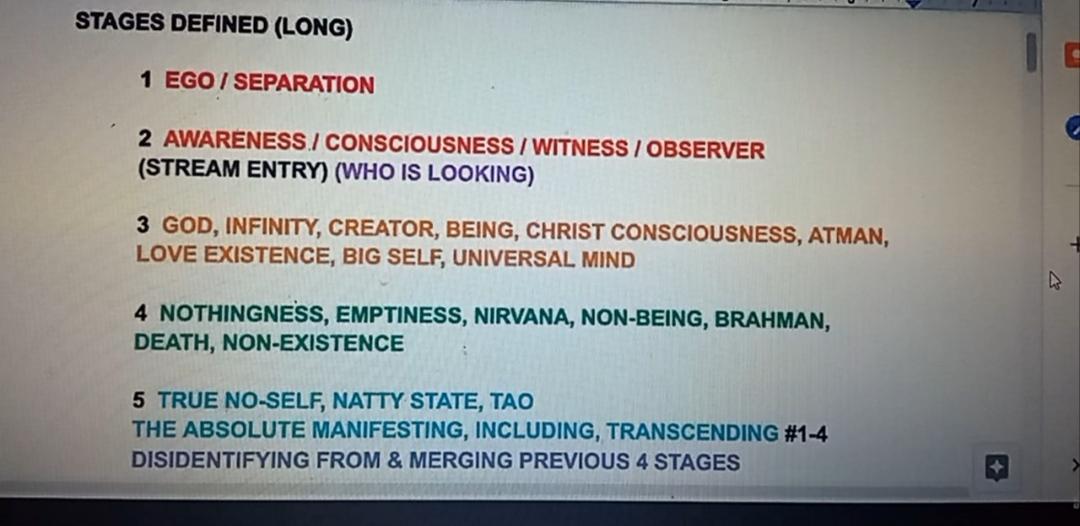
They seem to match up quite nicely with how Frank Yang lays out his stages. Depending on which stage someone is in, we hear different metaphysical explanations of identity. (This is where (1) gets easily conflated with (2)).
How I’ve seen Frank spell out his stages (I realize neither of us came up with these on our own):
When it comes to identifying with awareness (the second picture/stage) this is when you hear talk of the sort of there being one universal consciousness and that’s our true nature. When I was identifying with awareness, I could suddenly relate to what people meant by ‘we are all one universal consciousness’. However, I got the sense that people were failing to differentiate between something being numerically identical and qualitatively identical. When you become ‘aware of awareness’ there is a sense that this is a pristine dimension and is not personal. It doesn’t seem to belong to the notion of Roger (as it is perceived causally before the very idea of Roger), nor is it trademarked by Roger’s beliefs or memories. There is an insight that this perfectly equanimous layer of being is part of everyone’s experience, they just don’t see it. Yet it couldn’t be ruled out whether we are all in touch with the same one pure light of consciousness, or if each sentient organism has its own and our consciousnesses (plural) were just qualitatively the same. I think people often miss this distinction.
Stage 2 does not obviously lead to open individualism yet. There is still a sense of the duality between the radiant awareness and everything else to be aware of.
Although, I think that anyone (even those without emptiness insights) could be talked into believing closed, open and empty individualism at a conceptual level, this doesn’t mean their phenomenological experience of identity would change, or would their instinctive, non-inquisitive gut-intuition on the subject.
I would hypothesize that those who have no insight into the 3 characteristic are intuitively most swayed by closed individualism. And those who have sufficient enough insight into impermanence (but not no-self) may intuitively side with empty individualism. And then with a deep enough insight into no-self, open individualism becomes a no-brainer.
Experiencing God (and a message to Leo)
At stage 3 is when open individualism is most likely to begin to intuitively feel right. This is also when talks of being God come out of people’s mouths and, as in terms of (1), they phenomenologically perceive the sense of ‘I’ in everything they experience, and they (2) conceptually infer there is just one thing, call it ‘God’. God is everything. I am everything. Because the understanding of moving from (1) to (2) (from experience to conjecture) is often lost on people, all kinds of wacky metaphysical beliefs come about – supposedly self-validating by higher consciousness or direct cosmic download.
While on stage 3, if you inject some metta into your experience space, you come to see what people mean when they say: “God is everywhere and all loving” or even: “God is love”. Having the feeling of being everything in your experience is like you don’t feel separate from anything, thus there is a deep intimacy with the world which construes love. You feel like you are the body, the thoughts, the emotions, the trees, the hills on the horizon, the air in between all of it, the sky and the awareness field which contains all these things. However, going from ‘the experience of feeling identical to everything you are aware of’ to ‘I am everything (even that which I’m not currently aware of) and therefore I am God/the universe’ requires an unfounded leap – which I admittedly made at some point.
I remember an incredibly stark moment I had when I was in stage 3, where being ‘God’ felt like the most real thing (I can sympathise a lot with where Leo Gura is coming from – though I think he’s lacking some phenomenological discernment). Because at stage 3 the sense of ’I’ is so prevalent, due to it being perceived everywhere in experience, I was investigating this quality a great deal. I was trying to distil the sense of ‘I’ down to its rawest form. “Yes, I feel identical to the trees and the sky and other people, but what is that common element that can be found in all these things which I call ‘I’?” After whittling away all the other unnecessary phenomenological baggage piled onto this ‘I’, I arrived at a clear perception of ‘I’ in its rawest form. The ‘I’ I call the epistemic agent, the pure sense of ‘a knower of experience’.
It became obvious that once the epistemic agent was singled out in experience that this perception of ‘I’ can only manifest in one way. What I mean by this is unlike with milk where the formula can be tainted slightly and result in versions of milk with slightly different colors, or tastes, or smells and yet they are all still milk, it is impossible for the epistemic agent to have a slightly different perceptual ‘flavor’ to it other than it does. This is because the qualia recipe only consists of one ingredient and if that’s missing or different, then it’s not the epistemic agent (the rawest sense of ‘I am’). Once I clocked this, I realized that all iterations of ‘I’ wherever and whenever, in all beings at all times, experience the sense of ‘I am’ exactly the same way. Then, and I remember this moment so clearly, it hit me: if God or the universe is self-aware – which it is just by dint of me being of the universe and self-aware – and has an experience of ‘I-ness’ then my experience of ‘I-ness’ in this relative body is the same as God’s and through a sharing of experience there is a direct link and so… ”Oh my god, I am God!”
(I am not suggesting that this line of reasoning is sound. It was simply the series of steps I went through which brought upon this profound experience).
Again, the numerically versus qualitatively identical distinction could be parsed, however there is a way to get around this, for when you remove the sense of time and space from the equation then that difference collapses. To say that something is qualitatively identical to something else, but not numerically identical doesn’t make sense if two things can’t be differentiated by existing in separate moments of time or space. So in my “Oh my god, I am God!” epiphany, the sense of time and space had been shunned from attention and numerical identity was presumed.
I can imagine that someone has this epiphany moment as I did, but then when they return to a more ‘timey/spacey’ existence they retain credence in the belief that they are God and not just a single, distinct instance of experience of ‘I’ (which would be more of an empty individualist thought). They do this because they are basing their beliefs off of a very profound mind moment, even if the majority of their waking hours don’t suggest the same message.
If I could tell Leo Gura one thing it would be this: “Profundity does not equate to truth.” Just because something felt so real and epic, does not mean that experience is giving you the most accurate representation of greater reality. Truth be told at stage 3 I didn’t have anywhere near the attentional clarity, precision of view, and metacognitive abilities that came later; and so while I was having all these profound experiences I was not totally clued into the subtle ways I was manipulating my experience and was biased to certain perspectives, while overlooking certain things that became clearer to me later on.
Self, Not-self, and Neither Self nor Not-self
When it comes to personal identity, I want to distinguish three things the mind can do here:
It can project a sense of self onto parts of experience – “I feel like I am this chair.” – said the man on salvia.
It can project a sense of not-self onto parts of experience – “I don’t feel identical to that person over there.” – said sober Joe. I want to emphasize here that I don’t mean there is just a lack of ‘feeling’ associated with something, but rather there is an actual new ‘feeling’ of not identifying with something.
Stage 4 (my 4th picture) was living a life with the constant signal of ‘not me’ being coupled with everything I pointed my attention to.
It can stop projecting any sense of self and not-self – “I neither feel like I am everything, nor I’m not.” said Roger. Here, I mean the lack of projecting a sense of self and even a sense of not-self.
To go into a little more detail on what is meant by 3: ‘Neither self, nor not self’… essentially there is just no transmission of data on this subject. No reading. When asked “What are you?” it’s like the question doesn’t even compute. Before, there were qualia indicators to be able to judge what is self and what is not-self. And now it’s like the mind pulls a blank. It is not because the answer is obvious that ‘I am everything’, or ‘I am nothing’. It’s almost a bit like asking a person who is blind from birth “Do you just see blackness?” – it can be really hard for sight-abled-people to get their head around the fact that some blind people don’t see anything at all (and what that really means). 4th path is akin to becoming blind to identity in a way. Although, I wasn’t identity blind from birth, memory of the qualia of ‘me-ness’ and ‘not me-ness’ is incredibly faded.*
*There is subtle nuance to get into with retaining semblances of individuality just to be able to function in the world.
The Ship of Theseus, Threshold Emptiness Insight and Losing the Ability to Buy into Nouns
At a certain point, once enough insight into emptiness was established, the ability to seriously believe in separate entities became near impossible. I remember with my beginner’s mind, closed individualism was the default position. And when nouns were comprehended, they were firmly believed to be distinct, real partitions in reality. “The world is made of things that are tables and things that are not.” (As if a table is an actual thing, lol). However, now I can never fully think that a table is anything more than a mind-made construct. It is perceived as so porous, airy, hollow…. empty. And this applies to all nouns: ‘atoms’, ‘being’ ‘non-being’, ‘life’, ‘death’, ‘mind’ and including the idea of ‘The Now’ (I’ll get into that later).
One time in philosophy class we were going over the ‘paradox’ of The Ship of Theseus. People in my class had all kinds of differing intuition. Some said, ‘as soon as over 50% of the ship parts have been replaced then it’s a new/different ship’. Some said, ‘as soon as you replace one part of the ship it’s a new/different ship’. And others said, ‘as soon as one atom changes it’s a new/different ship’. They were going back and forth arguing about identity, which was the point of the class. And meanwhile the whole time I was thinking there is no ship of Theseus to begin with, there never was, it’s not a thing. And so there is no paradox. There is no conundrum to solve.
I had been reading ‘The Master and His Emissary: The Divided Brain’ at the time, and it occurred to me during the class that what I was witnessing were people with all very different brain chemistries and either left or right hemisphere biases, and this is what is leading them to different conclusions (me not being an exception) – the philosophical quibbling had little to do with it. (This is not to resort to any postmodernist conclusions. I do think some positions contain more truth signal than others.)
4th Path Putting the Nail in the Coffin for Empty Individualism?
There is no ‘now’, as there is not enough time for even a single isolated self to form. At 4th path insight into emptiness is so stark that you realise that to conceive of ‘The Now’ as a thing is wrong view. I used to experience things as arising and then a moment later passing; as manifesting and then slightly there after defabricating. But now I can see how phenomena are already disappearing the moment they are appearing. This leads to kinds of visions of super-positions – simultaneous 1 and 0. With such perception a ‘now’ as a moment can’t even consolidate – there truly is no ground for things to rest on.
Finally (2) My Conceptual Beliefs About Identity! (Prepare to be disappointed)
Keeping in mind what I said about ‘neither self nor not self’, when the intuition of personal identity is so lacking the question of ‘What is me and what is not me?’ just becomes ‘What does it mean for something to be its own individual entity?’ or even more simply ‘What exists?’. Does there exist one thing or more than one thing? And does it even make sense to consider there being ‘things’ (nouns) at all?
(Take this next part as me applying a cosmic lens).
So, is there more than one thing? Engaging my scrupulous, philosophical, inquisitive mind, I can’t conceive of how there being more than one thing would be meaningful. But I don’t even really believe in things at all (if ‘thing’ is taken as a noun), so one thing isn’t quite getting at it either. There is something and it seems to be something so magical that it defies categorical comprehension. But the fact that there is change suggests this is not unitary, yet nor do I wish to say it is legion. Not noun, but verb? A process? But to where and how?
Heidegger often wrote in double negatives; I believe because when you construe something in the negative you bring to mind both the thing and its negative simultaneously. There is a greater potential for the mind to grasp a seeming paradox, but the conceptual mind can never fully do it, it can only approximate. Kierkegaard tried as he put it: “The self is a relation that relates itself to itself or is the relation’s relating itself to itself in the relation; the self is not the relation but is the relation’s relating itself to itself.” But words can only serve to point to something outside of their grasp.
This is why:
“The Toa that can be named is not the eternal Toa”
However, when I stop thinking (disengage the conceptual mind) and simply be, I get an intuitive sense of a super-position. Simultaneously, neither one nor many. Neither now nor not now. Neither existing nor not existing. Neither conscious nor not conscious. And this is apprehended in a way that is not confusing or jarring, but as the most sensible stance.
Still I have a sceptic bone in my body, and I am always open to being schooled.
Halfway In, Halfway Out The Great Door of Being
Imagine a great conundrum that people have been debating over for centuries. “If a man is stepping through his front door and he has one foot in his house and one foot out of his house and his body is exactly in the middle, is he inside or outside?” People can’t seem to agree. Some say he is clearly inside because he is already under the door frame. Others say, he is still outside because he hasn’t fully entered his house yet. People squabble about whether it matters if he is coming or going. The real question is when he is exactly 50% in and exactly 50% out what is he? Inside or outside? The reason people can’t come down on a solid answer is because whenever they find someone passing through their front door the moment they go to make a judgement they miss that 50/50 moment and either witness him too early or too late at 60/40 or 40/60 in and out. In which case, they either decide he was definitely inside or definitely outside, accordingly. You have been trying to solve this issue too and feel like you have come close. One time you saw a guy in the act at 51/49 in and out. And then another time you saw a man who was 49/51 in and out. But no one ever is precise enough to make their judgement when he is exactly 50/50 in and out. Because true 50% in and 50% out hasn’t been witnessed, so people can only speculate that ‘well if we were to catch a man who was exactly at 50/50 in and out of his front door, we would conclude that maybe he was BOTH inside and outside.’
One day, it just so happens you see a man coming home from work. He’s approaching the front door, keys in hand. You’ve been practicing for this moment your whole life. Finally, are you going to be able to solve this great conundrum? He unlocks the door. He opens it. He steps through. And that was it! You witnessed it. You clearly clocked the 50/50 moment.
“I saw it! I saw it!” you yell. Bystanders hear your cries and come up to you.
“What did you see?” they ask.
“I saw the precise moment he was exactly 50% in and 50% out!”
“Well…” they say “what was he, inside or outside then?”
And you respond “No”.
“Huh? Oh, you mean he was both inside and outside?”
“No” you say again.
“I don’t get it.” respond the bystanders. And in fact, you don’t even really get what you mean, because it doesn’t quite make sense to you either and yet it was as clear as day.
“He wasn’t inside or outside, because he simply vanished.”
The following is an exchange of text messages with Roger Thisdell, a 26 year old accomplished meditator. He claims that this year he finally broke through into abiding in what he describes as an entirely new category of experience that matches the descriptions of classical Buddhist 4th path.
1) Utter centerlessness: no watcher, no sense of a watcher, no subtle watcher, no possibility of a watcher. This is immediately obvious just as color is to a man with good eyesight as the old saying goes. Thus, anything and everything simply and obviously manifests just where they are. No phenomena observe any others and never did or could.
2) Utter agencylessness: meaning no agency, no sense of doing, no sense of doer, no sense that there could be any agent or doer, no way to find anything that seems to be in control at all. Whatever effort or intent or anything like that that arises does so naturally, causally, inevitably, as it always actually did. This is immediately obvious, though not always the forefront of attention.
3) No cycles change or stages or states or anything else like that do anything to this direct comprehension of simple truths at all.
4) There is no deepening in it to do. The understanding stands on its own and holds up over cycles, moods, years, etc and doesn’t change at all. I have nothing to add to my initial assessment of it from 9 years ago.
5) There is nothing subtle about it: anything and everything that arises exhibits these same qualities directly, clearly. When I was on the third path, particularly late in it, those things that didn’t exhibit these qualities were exceedingly subtle, and trying to find the gaps in the thing was exceedingly difficult and took years and many cycles. I had periods from weeks to months where it felt done and then some subtle exception would show up and I would realize I was wrong yet again, so this is natural and understandable, and if someone claims 4th as I define it here and later says they got it wrong, have sympathy for them, as this territory is not easy and can easily fool people, as it did me many, many times over about 5 years or so. However, 4th, as I term it, ended that and 9 years later that same thing holds, which is a very long time in this business.
There are other aspects that may be of value to discuss at some other time, but those are a great place to start for those who wish to claim this. If you truly have those, then perhaps we can talk about a few other points that are less central and essential.
[Links added to aid reader’s comprehension – lightly edited for clarity]
In the beginning… Roger joined a private group where we discuss consciousness and started to get familiar with the vocabulary of the Qualia Research Institute (e.g. discussing meditation in terms of valence). He then posted this video, which caught my attention:
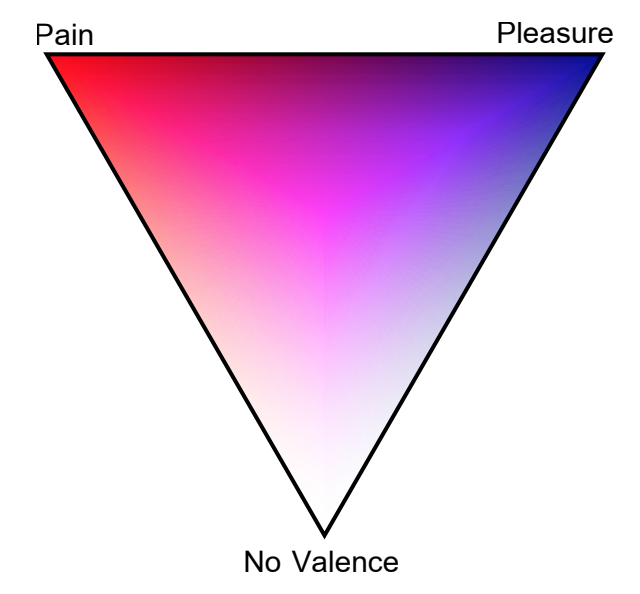
Where he claims that “Pleasure as a positive, as an actual added experience, does not exist. It certainly does not exist how a lot of us think it does … [whereas] negative valence experiences do exist as contractions.”
Andrés! This is Roger Thisdell […]. Thanks for giving me your number.
Do add me to the Phenomenology Club. That sounds like my jam! Cheers!
Andrés:
Excellent! Will do! 🙂
[…time…]
Roger:
Hey Andrés, it was great to hang out online last night and hear your explanations. A bunch of you are really elite thinkers. I’m inspired to learn how to speak more of your qualia language.
I would love to get into the topic of paradises with you. You seem to really sing their praise.
I said yesterday that I hold the view that actually what is most desirable is just the elimination of negative valence. As someone who frequently has cessations (when consciousness blanks out for a moment) where there is no subjective experience (no negative, no positive valence) in my book this is good enough. My thinking is also informed via complete ego death experiences in which there is still consciousness but no judgement on any part of experience (bad or good). At a local individual level these are the most desirable states. Out of all the states I have experienced (including bliss trips, jhanas, 5-MeO, MDMA, staring into the eyes of a lover without insecurities, laughing fits 🤣) if I had to choose a state to be in permanently it would either be cessation or ego death. I may have curated my brain too much to a Buddhist view and my level of emptiness insight is well entrenched, so that it is hard for me to really believe the ultimate good is to keep the cosmic consciousness party going and fueling it with positive valence.
I think that while consciousness is online we better make the best out of it and try to exist in as few low negative valence states as possible and help all sentient beings with this as well; all the while the positive valence that comes along is merely instrumentally valuable, like a compliment or added bonus.
For example if you are hungry it is nice to eat something tasty. But if you were never hungry in the first place then who cares how tasty something is – don’t need it 💁♂️ (this may be my strongly consolidated non-attachment showing).
I guess what I’m really asking is: can you convince me to intrinsically care for paradise states? I do believe I have experienced what you are referring to as paradise states, but maybe I just have too much non-attachment for them to think they are the goal/prize.
(apologies for being long-winded 🙏)
Andrés:
Perhaps:
You lost the ability to get excited about future experiences. You learned this because you were taught and you practiced techniques that associate being excited about the future with dukkha. Alas, the hedonic theories around the time of Buddha were incomplete and as a consequence a lot of the claims and teachings underfit reality (meaning that they generalize too much). In contrast, it turns out that there are a manifold of ways of experiencing excitement about the future in an epistemologically clear way and no delusions. More so, with that orientation one can see more clearly larger parts of the state-space of consciousness as one is not inhibiting them. I know you have experience with high valence states. But I suspect you have deconstructed a lot of the microcognitive apparatus that allow the insights coming from the reality of their existence from propagating across the entire nervous system.
Just as lack of awareness about e.g. cluster headaches phenomenology can give you the impression that reality has no stakes, so does acute lack of access to the ultra-positive realms. I think for many, Buddhism has a certain effect in how one conceptualizes such experiential realms after the fact that perhaps is not quite in tune with how they truly were. Interestingly, one could here examine Buddhism as an aesthetic itself, and renunciation as a kind of Soulmaking, where under the hood one is still pursuing a kind of high-dimensional meaning qualia of positive valence. Which takes me to:
Rob Burbea’s Soulmaking talking about how exploring not exhaustively breaking down dukkha always but letting a bit of e.g. Eros/passion for reality opens up new ways of seeing that recontextualize Buddhism. Not that we shouldn’t get rid of dukkha, of course. But it’s good to see the underlying aesthetic influences on how one generalizes about reality based on one’s experience.
What do you think? 😄
Thank you for joining! And also for sharing your thoughts. 🤠👌
First of all, I am so impressed with Burbea. His lectures were incredibly useful for me while learning the jhanas. And now I’m picking through his book ‘Seeing That Frees’.
I think his ontology and how he builds on Buddhism is sophisticated and gorgeous.
Reminds me of a remark about Hemingway, by his grandson – he quit journalism to dedicate himself to fiction because he was more interested in truth than facts. I relate this to Soulmaking in a way.
I love his notion of skillful fabrication. But it seems like it’s a compromise in a way. We can’t fully live without self, and thoughtforms, and conceptual frameworks, and so, while we are alive and have them, let’s learn to use them skillfully/beautifully. I’m on board! 🚂
Re your 2nd point: I would add that a lack of awareness of the existence of cessations, or Nirodha, or ego death experiences is another topographical blind spot which prevents people from making a more comprehensive assessment of what is most desirable. (I know that many people who say they’ve experienced ego death, when I enquire about it, it turns out to be more of just a partial ego loss experience, and not the full annihilation). I suppose we really need those who have deep expertise in bliss states and dukkha-less/unfabricated states to compare and contrast.
For what it’s worth, and to give you more a sense of my bias, I would claim to be someone who has explored a wide range of state-spaces: from suicidal depression, to psychosis-like damnation bad trips, to K-holes, to peak experiences, and now as of 21st of May [2021] I’m claiming Frank Yang-style MCTB [see: Scott Alexander’s book review] 4th path permanent abiding in centreless consciousness (IDK what that says about my nervous system and fully propagating insights as you mentioned).
Hands down 🙌, this is the best shift in my life that has ever taken place without a doubt (I thought stream entry was good, but this is another magnitude). My hedonic set tone is persistently so high. I’m often walking around smiling for no apparent reason. 11/10 I recommend this.
And 4th path gets you an ability to adopt a new perspective where you simultaneously see the Yin and the Yang and vice sera (emptiness is form and samsara is nirvana). It’s all one place, there is not out. All the while, still we quite obviously make value judgements between states. I know you speak of hellish corners of consciousness that shouldn’t be touched. And so, although we can/should adopt flexibility of perspectives on aesthetic frames (as Rob speaks about, which is helpful) and see value in many different views as best as we can… must we still do the hard job of really judging what is best? What is most desirable? (to talk from a metamodern perspective).
Ultimately, I still come down on: lights out unconsciousness tops everything 🤷♂️ [emphasis mine]. Getting all beings to Parinirvana would objectively be preferable for all beings rather than keeping the play going – if such a plan is possible or sensible or sensical even.
It’s funny though, at some point I think it may just come down to some split difference in intuition among people (perhaps that difference can be reconciled somehow). For me this was apparent when I hear from Kenneth Folk vs. Culadasa. Kenneth holds antinatalist sentiments (or he did when I emailed him a couple of years ago and actually asked him) which speaks to a siding with a belief that there is an asymmetry of weighted value between negative and positive valence. While Culadasa seems to emphasize the joyous journey and adventure of life, which may speak to an opposite weighting in favor of the positive valence being worth the negative valence that comes along with it. Certainly not all spiritual roads lead to Rome.
I am very open to the idea that I am missing something though, and I may just need to be led by the hand like a child to these heaven realms for me to change perspective 😇😂
Thanks for engaging, this is fun!
Andrés:
Thank you for engaging! This is super interesting! Let me think about what else I can say 🙂
[…time…]
Total valence vs. pureness of valence: see Principia Qualia pg. 41. It could be that during cessations consciousness disappears and the state literally does not exist in any way. But the states immediately before and immediately after do and have at least a tiny bit of information so they are mixed valence states. Yet, perhaps they are massively positive valence on net.
An alternative view is that unconsciousness is still ‘real’ in a way, in which case we could think of it as consciousness but with no content whatsoever. But it’s still there. The analogy would be like combing a vector field in a torus. Most states have the vector field collide with itself and therefore feel less than perfect valence (due to [the Symmetry Theory of Valence, aka.] STV). Only when the field is completely combed without any self-collisions (which would not be possible in a sphere) you get perfect positive valence. And although there is no information encoded in the field, it still exists just as it did before. There’s just nothing to report.
In that case paradise could actually still exist. Meaning, higher and more refined versions of this kind of experience. In particular, we could look for other mathematical objects where the field can also be combed perfectly. They would then be strangely a different kind of ‘unconsciousness’ perhaps capable of fitting more energy and higher dimensions. Still, they would have maximum positive valence.
What do you think?
Oh, I also forgot if I’ve asked you whether you’ve tried 5-MeO-DMT and how it compares to your new baseline.
Ah, yes, I see the kind of framework you’re thinking from now – anti-symmetry, symmetry, and asymmetry.
From Principia Qualia pg. 39: [paraphrasing] “…if we take our hypothesis and apply it to IIT, and then we attempt to maximize pleasure/symmetry, consciousness/[phi] drops very rapidly.”
All the way to the point that maximum pleasure entails no consciousness??? [emphasis mine]
I don’t have a lot of experience with 5-MeO. I only did it once at about a 6mg range.
My impression of 5-MeO was that it had a visual brightening effect somewhat similar to the 4th Jhana. And there was that psychedelic mirroring effect with eyes open. It also had the reduction of conceptual understanding that comes when you get into 8th [Jhana]. I interpret that as a significant down-regulation in top-down information processing??
5-MeO has the sense that it’s going somewhere, moving towards something, while the effects build and then dissipate. Like it’s growing into something (I guess this is before a peak breakthrough – which I didn’t have).
My current consciousness abode isn’t going anywhere. There isn’t a sense that things are building towards something. It has a forever ‘this is it’, locked-in quality. Like a somewhat superposition of emptiness and fullness simultaneously. (Before 4th path I always felt like I was flickering between form and emptiness, now the two cohabitate the experiential space at the same time).
5-MeO also seemed very hedonically volatile; like any subtle thought or movement could disrupt the peace.
Meanwhile my current state is super unperturbable. In the past 2.5 months I haven’t found something that has rocked my well-being.
A couple of weeks ago I listened to an interview of a North Korean defector tell her story of starvation and human trafficking and for a good 30 minutes I was crying at this tragedy. But it was crying from a place of still really high well-being. I didn’t feel like I was suffering and I didn’t mind that crying state at all. (Which is quite weird, I suppose).
In my normal state now, there are no more papañca attacks. Thoughts don’t capture the mind like they used to.
And another thing I love about this new state is that I still have all my cognitive functions intact and I can operate in the world totally normally – which can’t be said about being on 5-MeO.
I feel super sober; while on 5-MeO I don’t believe you do (if I remember correctly).
I would say I prefer my new baseline to what I experienced on 5-MeO because of the lack of volatility and practicality of still having my intellect on hand, all the while with the constant sense of ‘this is it’ and high, high well-being.
[…time…]
Roger and Andrés have a video call:
We discussed a number of things: his meditation journey, his thoughts on various philosophies, exploring QRI frameworks, and his interest in music. Curiously, Roger said that unlike other people who spend a lot of time in meditation healing traumas and processing past experiences, he was able to largely just focus on progress on the path. This, along with a very rigorous and consistent practice, is why he got to where he is at so early in life (26 years old).
One of my main interests in the discussion was to flesh out how 4th path states/traits and the Symmetry Theory of Valence (STV) were connected. If I recall correctly, there were three main ideas connected to this topic I shared with him:
Discussing the “levels of consciousness” experienced on a psilocybin trip and the way they might mirror some of Frank Yang’s descriptions of the levels of consciousness on the path to awakening,
A model of equanimity I’ve been developing where impedance matching is a key ingredient, and
The difference between a “recipe” of a state or transformation of consciousness and its “review”
Let’s briefly elaborate on these topics.
(1) Frank Yang talks about undergoing a meditative process with the following stages: (a) standard sense of self, (b) awareness of awareness, (c) God/Oneness/Being/Non-Duality/Self, (d) Emptiness/Non-Beng/Uni-Locality, (e) Neither Being Nor Non-Being, and finally (f) Enlightenment.
What makes his descriptions so incredible is that he provides very raw and unfiltered phenomenological accounts of the process without really trying to force them into any pre-existing framework. From the point of view of the mission of QRI this is very valuable. In particular, it allows us to examine his process of transformation with the framework of Qualia Formalism: we ought to ask, not what kind of spiritual/mystical/transcendent process is going on here (which will certainly take us nowhere), but rather, wonder if we can cast his descriptions in terms of *structural changes to the field of awareness*. For example, Frank talks about “the screen of God” that becomes apparent in (c), where waves of energy seem to travel without resistance across one’s experiential field. He also talks about phase transitions (similarly to Shinzen Young, he talks about a process of liquefaction and gasification of the field of awareness). If, as we believe at QRI, valence is a structural property of experience, these transformations would have profound effects on one’s sense of wellbeing. So, the reason why “the screen of God” is a profound experience is not because you literally merge with a divine being (which might not be possible if we assume indirect realism about perception), but because the field of awareness is now in a phase that allows an entirely new level of efficient stress dissipation.
I shared with Roger some details from a particularly interesting psilocybin trip report that described rapid phase transitions between (what appears to be) several of the levels Frank describes. In particular, “the screen of God” state seems to have the capacity to stresslessly locate sensations without generating reverbarions with a represented “small self to which those sensations belong”.
(2) In turn, this led to discussing a new model (we haven’t really touched upon in QRI publications yet, but which is coming) of equanimity based on experiences I had during a two-week retreat earlier this year (see: Buddhist Annealing). This model has at its core the idea that equanimity is a mental tool that increases impedance matching between nervous system harmonics. Ask yourself: why is it that when you pluck a guitar string it sounds louder if it is connected to a guitar? It is not, as many would think, that the “resonance box amplifies the sound” (for where would the extra energy come from?). Rather, the energy is the same; what changes is the speed at which it is discharged! The resonance box vibrates and dissipates the energy of the string much faster than the string could on its own (as an aside, this is exactly why you can sustain a note for so much longer in an electric guitar). We could thus postulate that a lot of inner dissonance comes from resonance in the nervous system that has no means of dissipating its stored stress. To an extent, this is because involuntary subliminal contractions in our nervous system compartmentalize and modularize its components. Equanimity is the practice of relaxing those contractions, and thus slowly allowing the nervous system to undergo a search process where it finds structures that can resonate with the stored stress, and in turn allow it to dissipate faster. More so, over time, you entrain (and rewire!) the nervous system to become highly efficient at stress-dissipation. Dissonance is still there, but it “unfolds” and gets “metabolized” so fast that it barely counts as suffering. Highly annealed nervous systems are powerful stress-dissipation engines!
(3) Finally, we also discussed the idea that there is a distinction between the “recipe” of a state of consciousness and its “review”. A recipe is the steps you take in order to achieve a certain state (or transformation) of consciousness. A review is instead an account of what the resulting state feels like. Just as the instructions for baking a cake are quite different from a Chef’s review of what the resulting cake tastes like, we can expect that meditation instructions (e.g. focusing on the three characteristics) will not necessarily reflect the nature of the transformations of consciousness that result from them. Thus, while a lot of the meditative path is nominally about “renouncing” the pursuit of high-valence states of consciousness (and thus avoid the pleasure paradox), the result is nonetheless a state of consciousness that is high-valence in nature! Paradoxical? I don’t think so. The confusion is merely the result of conflating recipe and review.
Thus, we can still apply valence theories to states of consciousness that are allegedly beyond valence. Frank Yang, for example, seems to resonate a lot with STV. See his December 2020 interview at The Stoa. There (and in other videos) he describes “God mind” consciousness as a very positive experience, which is very symmetrical but not perfect. But his true awakening is perfectly symmetrical (in the realm of space, observer, and sense of time, even if not in content). His experience became like a “hologram that has no center”. Quote:
“Have you seen those illustrations of a sphere or a circle, where one point connects to all of the other points? […] if you wanted me to describe my day to day, moment to moment, experience, well, it’s pretty symmetrical. As in, there is no center to experience. There is hearing but no hearer; there is just the seeing, there is no seer; on thinking there is just thinking and no thinker. It’s not, like, processed or filtered through a subject in the center. And it’s very immediate in the sense that all of the sensations, all 360 degrees, are synched up to themselves, without any delay, 24/7. And all the sensations, where there is body, you know sight, sound, thoughts, emotions… they are all on equal footing to each other […inaudible…] in symmetry, and that is for me an aesthetic experience. I would say a suffering mind is a mind that isn’t symmetrical. If your mind is asymmetrical, it means it’s defiled somewhere. So for me aesthetics runs in all different kinds of domains, not only on the perceptual domain, not only on the visual aesthetics domain, but even on the emotional and how you think.”
Yes, God Mind (left) is good, but have you tried no-self (right)? It is so much more symmetrical!
As we’ve discussed before, the homogeneity of phenomenal space and time might be a very large component of what accounts for positive valence. And what Frank is describing here suggests that’s the case. Disturbances in the attention field lines and the saliency of specific components of a mind can break the underlying symmetry of the phenomenal space and time of the resulting experience. Anxiety, for example, in this paradigm is described as unpleasant because it involves the bubbling up of low-level prediction errors causing “attention pinches” across your experience, and thus disturbing the free-flow of energy that would exist in a homogeneous field. Prediction errors are not inherently unpleasant; they are unpleasant only to the extent that they cause asymmetries in your field of awareness!
Frank Yang also says that his big awakening felt like a “quantum jump”. It makes sense that a strong anti-fragile attractor for a new network topology would be self-reinforcing (a new lowest-energy state, metaphorically speaking, perhaps akin to a false vacuum collapse inside one’s mind!). Again, this is all very compatible with valence structuralism, if not STV.
Roger said that he will have to think about all of this. In the meantime, he shared with me some (amazing!) pictures he made to illustrate how his field of awareness has been transformed with meditation over time. Like Frank Yang, he identifies several discrete phase transitions. These are: (a) standard perception, (b) The Witness, (c) Big Mind, (d) No Self, and finally (e) No Self & Centreless Awareness (4th path!):
Considering more what you said about impedance matching and adding resonance to experience:
Perhaps this is merely an analogy, but still: consider the tautness of a spider’s web. If a fly lands on it, at one part, the whole web will shake and the energy will transfer throughout in such a way that the spider can locate where on the web the fly landed. If the web is too taut then the energy of the fly landing won’t dissipate far enough for the spider to receive the information. However, if the web is too slack the fly could just break the structure of the web.
It might be interesting to consider why spiders build webs with a centre point and not as a straight or criss-crossing lattice.
So to relate this to consciousness and metabolizing stress… I would say my consciousness now feels like it’s more taut and lattice-woven rather than spider web-shaped with a middle [emphasis mine]. So this means when a stress point is activated somewhere in the experiential space, its energy doesn’t ripple as far out as it would have before, thus not being as disruptive.
And if we aliken the spider on the web to the epistemic agent, if he is situated on one spot and for all goings-on on the web to be known their information must travel to him, then the web must be not too taut so that all the ripples can reach him and he knows what’s going on. The problem with this set-up is that it means that knowing requires instability.
However, if we do away with the spider (a single point considered the epistemic agent) and make it so that the knowledge is attributed to the web itself, then the web can afford to be much more taut/less shaky/more robust, causing less negative valence.
So in some way I could say my experience (centerless consciousness) is more taut in this way, but this tautness doesn’t feel rigid or stiff, but rather very airy.
Indra’s net can have too much slack in it, if it’s not sewn together tightly and uniformly.
Pre-Awakening: The mind uses a fictitious “self-as-epistemic-agent” in a field of awareness that has slack and vibrates in unpleasant ways in the process of integrating information. The field of awareness relies on a network topology that is suboptimal for efficient stress dissipation.
Post-Awakening: The mind lacks any kind of center or self-as-epistemic-agent. The field of awareness is tout and extremely efficient at stress dissipation. The network topology has permanently changed to a far more symmetrical and regular configuration.
Just for interest’s sake, and I don’t know if this bears any significance, but I’m ambidextrous by the way.
I know symmetry plays a major role in your hypotheses of valence and such.
In some way, I have thought that not having such a prioritization and weightiness to just one side of the body has balanced out my experience and perception (perhaps more than others), I’m not sure.
R
(As of the 23rd of November 2021, Roger states that he continues to be in the blissful state of centreless consciousness)
Commentary by Andrés, after the fact:
This conversation (and further exchanges I may share in the future) has reinvigorated my quest to describe states (and transformations) of consciousness in terms of changes to the network topology that underlies our field of awareness. Enlightenment might be described in “mystical” ways, but this could be simply due to lack of an adequate formal conceptual framework to make sense of it. But perhaps STV, impedance matching, and efficient stress dissipation through radical network topology reorganization without compromising self-epistemics could take us much further than before in this quest.
Also, if Roger was able to achieve these transformations at the tender age of 26, what is stopping the rest of us from doing the same?
If I were to add one thing to the wish-list, I’d say (in unison with people like Nick Cammarata and David Pearce): if we could have access to MDMA-like states of emotional wellbeing and empathy on tap, that would be fantastic (for many reasons). Plus, non-addictive real pain relief might very well be right behind the corner. So to revise our (admittedly cartoonish and partial) wish-list for the medium-term future of sentience: “MDMA-like emotional palette, non-addictive pain relief, and physiological Arhatship: The rest is commentary”. See you there, my friends!
Happy Thanksgiving Everyone (including the Turkeys, of course)!
From: Ingram, D. M. (2018). Mastering the Core Teachings of the Buddha: An Unusually Hardcore Dharma Book, Second Edition Revised and Expanded. Newburyport. AEON Books.
Re-observation may not sound like much of a problem, as it has such a sanitized and boring name. However, friends have suggested renaming it with various four-letter Anglo-Saxon vernacular terms, usually in some grammatically problematic but emotionally cathartic string. This stage is often, though not always, like a brick wall, particularly the first few times we collide with it. It can be as if all the worst aspects of the Dark Night stages converge for one last important lesson, that of Re-observation.
We must perceive the true nature of the sensations that make up our ideas of perfection, all the ideals we cling to, all images of how the world should and should not be, all desire for anything to be other than exactly the way it is, as well as all desire for awakening to be anything other than this. It may seem impossible to sit for even a minute, as the levels of restlessness and aversion to meditation and all experience can get high. The sudden complete inability to sit on the cushion for even a few minutes is a classic mark of this stage. As a physician, I speculate that at some point they will find some physiologic commonality between this stage and the pathways of restless leg syndrome, but the whole-body version.
This stage, and part of the stage of Three Characteristics share some features. In other words, be warned, particularly those of you who are prone to being overly certain about “where you are” on these maps. I get a reasonable number of emails and calls from people who claim they are certain they are in Re-observation, and shortly thereafter they are describing A&P territory, meaning that they had just been in Three Characteristics territory, not Re-observation. Continuing to investigate the true nature of these sorts of sensations and our map theories is often difficult, and this is a common cause of failure to progress.
Now, I am about to describe all sorts of emotional or psychological manifestations that can sometimes happen in Re-observation. The more extreme the description of a possible side effect of this stage, the rarer that side effect is likely to be, particularly those that sound like descriptions of severe mental illness. For someone who is staying at the level of bare sensate experience, as I strongly recommend, the only difficult manifestations that seem to be quite common at this stage are a strong sense of aversion and resistance to formal meditation and experience, and a deep sense of primal frustration, though these tend to fade quickly in the face of good practice. If our concentration is strong enough and our other factors are in balance, we may move through this stage with no problem at all at the level of vibrations or even pure, abstract patterns of light and/or sound, bypassing all the potential complexity I am about to describe.
For those using more ordinary objects, aversion to meditation and experience can arise as we react to the vibrations in this stage, which can be fast, chaotic, and harsh. The noise in our repetitive minds can be quite irritating. By repetitive, I mean that this stage can involve repeating thoughts, songs, and stories, like we have a horrible case of the evil earworms (in the metaphorical sense of annoying songs that get stuck playing in our heads). Ever had a fever and had some irritating thought circling again and again in your head? This stage can produce similar experiences.
Some of my own descriptions of this stage while on retreat have included such phrases as “the mind-storm” and “a bracing work in D minor for six sense doors, hailstorm, and stuttering banshee”. If we are very powerful meditators who yet lack enough equanimity and tranquility (remember the seven factors?), it can literally feel as if we will be torn apart by harsh vibrations. At some illusory level of the sense of continuity and stability, this is exactly what we are trying to accomplish.
However, even if very difficult manifestations arise, if we are practicing well, they should not last long at all, at best minutes, at worst, hours or days. Once I began to get what this stage was about and what it was useful for, a perspective that had a hard learning curve, I would intentionally amplify the sense of being torn apart, directing this stage’s sharp and cutting ability to shred reality at anything that appeared even the slightest bit stable or continuous anywhere in the body, mind, or experience in general. That is a skillful use of the perspective that this stage allows us.
In a similar vein, and as mentioned before, those few who are crossing this territory with world-class concentration abilities and using a very rarefied object, such as a complex visualization on sacred geometry, may, if they are very good at it, pass through this stage with little or no difficulty. It can be fascinating and subtly rapturous, as this is the peak of the third vipassana jhana. Strong practitioners fusing insight and concentration practices may notice that the proportion of the visualized field that is organized into clear images gets broader and broader. The patterns may become more complex. The phase problems get more and more bizarre. The visual field may take on more spherical dimensions, with curving images beginning to encircle (or “ensphere”) you. The images may appear to have manifold symmetries and repetitions, and these generated images and sounds may come around to encompass basically the whole field of experience.
This can be like watching an IMAX movie of a moving technicolor spirograph in the front row. As mentioned earlier, I have also seen gigantic fields of hyper-detailed, repeating, shifting patterns of things like spiders, mushrooms, snakes, skulls, fingers with claws, and other creepy and disconcerting things but, on careful inspection, they were beautiful, vibrant, and amazing in their intricacy. I use this example partly due to my own experiments and partly to illustrate general points.
Different objects and practitioners will most definitely produce different specifics, such as colors, images, etc., while some aspects of what happens at this stage will remain the same, and are therefore universal. It goes to illustrate a basic point: Re-observation need not be a problem if you have very solid meditation skills. Even if you don’t, it still need not be a big deal if you know what to look for, what to expect, how to handle it, and that it too shall pass. Dry insight workers get through this stage all the time just fine with good practice. Further, if you are reading this book, you probably already crossed the A&P as mentioned already, and so you have probably already handled it at least once and may not have even known it, and even if you haven’t yet, you still may do just fine. We’ve all been through hard times, and this is just one more phase that might be potentially challenging.
You see, Re-observation is all fluff and no substance but, if you confuse fluff for substance, the effect will be the same as if it actually had substance. Bodily sensations of creepy revulsion, disgust, or profound existential angst may arise, and yet, those with wisdom will notice they are like confetti, like sparkles of light, like raindrops, albeit seemingly acid raindrops. Still, they are not harmful. In fact, they apparently do something great to the mind, since Re-observation leads to the next stage, Equanimity. This normalizing knowledge is power.
Re-observation is like a toothless dog with a ferocious bark. If you run screaming or faint from fear when the dog barks, then it needed no teeth to prevent your progress. It is like a hologram of a snarling demon that you can just walk right through and it can’t touch or harm you at all. There is a curious freedom when you deeply realize that you are safe in Re-observation, that you can go deep into the pit, and the pit is just fine. In Review stages, a period when it can be easy to call up specific stages and stay in them to get a better sense of them, I have again and again called up Re-observation just to check it out and learn its secrets.
On a somewhat different note, however bad Re-observation is, we can’t always blame it for everything. The primary sign that the negative side effects that may occur in the Dark Night are not associated with insight stages (but instead are due to other, ordinary, real-world processes) is that they do not change much in the face of strong and accepting investigation or when we stop practice entirely. Remember, you have two sets of effects going on: insight-related, and other circumstances and psychological aspects of your life. If good insight practice, done well and bravely, with strong investigation and good technique, is not fixing your life situation, then you may instead have standard, ordinary problems to be dealt with by ordinary, real-world methods.
As you can likely already tell, the Dark Night tends to get practitioners strategizing, trying to figure out the best way to crack it and get to Equanimity. This has led to various teachers and practitioners developing their own distinct schools of thought that may deem some techniques and approaches the most optimal, typically the techniques that have worked best for them. However, those who have gone through the Dark Night enough times and with a range of approaches, techniques, attitudes, and practice conditions will eventually realize that there are many, many ways to skin this cat, to use an un-Buddhist metaphor. Exercise often helps. Loving-kindness practices get recommended often for good reason. Strict vipassana and ultra-rapid noting work well for those with a high tolerance for pain. Slower noting might work for those with a bit more time and less interest in shattering themselves.
Some teachers highly recommend physical practices, such as yoga with a high degree of bodily awareness, as that can ground people in something other than their psychological stuff. Others might highly recommend plunging hard into their psychological issues and healing, with a high degree of sensate mindfulness of that process to ensure it keeps producing insights. Others with mighty concentration skills might go for more abstract objects, such as sacred geometry, as mentioned above. The “concentrate your ass off” strategy in the Dark Night has much to recommend it. Loving-kindness practices and other brahma viharas (covered in Part Six) are commonly reported to be helpful. Yet others might recommend more shamanic and psychonautic techniques to cause the sort of radical unsticking that can happen with those methods, and reality testing shows that those do sometimes work for some people but cause problems for others, and predicting which will result is not easy. Each of these strategies has risks and benefits to be considered.
In contrast to what most people might expect me to advocate here, it is true that much more gentle approaches can also work in Re-observation and the Dark Night in general. Some find that softening, opening, and accepting generate much better results than more aggressive approaches such as rapid noting or surfing fine vibrations. Sometimes just carefully investigating and gently relaxing what is often called “body armor”, those physical tensions that correspond to psychological blocks and tensions, can be quite effective in this territory.
Others among us will notice that just carefully investigating other aspects of our lives, like physical tensions related to roles and identities, will help facilitate progress here. Some do well with intellectual reflection coupled with some sensate investigation, and repeated questions such as, “Where am I contracted?” or, “What am I clinging to?”, asked well and often enough, will actually yield good results. Some with more spacious tendencies may notice that just feeling into the subtle moving warps in our sense of attention or space that are the hallmarks of the third vipassana jhana will be all they need, and doing this with the eyes open rather than closed can help us keep from getting lost. Many of these methods just require doing them well enough for long enough to get them to cause progress.
Even stranger measures can be oddly facilitating here although they may superficially seem to have little to nothing to do with insight practice. Some practitioners may just need to change locations, resolve a single conflict with one person, cry about one issue they need to grieve over properly, make some other simple change, or go through some other simple process, and then suddenly everything opens. Just giving yourself permission to care for yourself might make a difference. I recommend When Things Fall Apart and Start Where You Are, by Ani Pema Chödrön, as the yin energy of these books will help counterbalance the energy of this book, which can be too yang sometimes. Nurturing strategies often help a lot in the Dark Night.
I remember one cycle through this territory where what cracked it was just dancing wildly for hours until I was totally exhausted. A few will do oddly well by stopping practice entirely, forgetting entirely about progress and the maps and all of that, and just surrendering, but this last one generally only works when the meditator is in the correct place and has done enough work and growth already for that strategy to make sense.
This is a small subset of the various strategies that might work and that teachers advocate. You will have to assess your own capabilities, inclinations, intuition, resources, and what you have available to find what works best for you. Experimentation and a willingness to regroup and retry if you fail with one approach are key, as failure and frustration are common experiences the first few times we try to crack the nut of the Dark Night. If you are on retreat, it typically only takes about ten days to two weeks of struggling in the Dark Night to fall back to earlier stages and have another shot at it, so you can try a new strategy on the next pass if the first pass strategy didn’t work. I still generally feel that very simple practice: six sense doors, three characteristics, is the best practice for all insight stages. One day, I hope that scientific methods and controlled experiments are applied to find how best to navigate this territory. Until then, take your best guess and, if it doesn’t work, try again.
Due to the sorts of frustrations and failures that are common in this territory, this stage is sometimes called the “rolling up the mat stage”, when many who joined monasteries in the stage of the Arising and Passing Away now give up and disrobe. People on retreats tend to need much reassurance but often leave right then even with good support, guidance, and encouragement. Are you suddenly needing to leave a retreat that you had planned to stay in much longer? You are likely in this stage.
There can be the distinct feeling that there is no way to go forward, and it is useless to go back, which is exactly the lesson we should learn. Acceptance of exactly this, right here and right now, is required, even if it seems that this mind and this body are completely unacceptable and unworthy objects of investigation. Remember: no sensations are unworthy of investigation!
One of the hallmarks of the early part of this stage is that we may begin to clearly see exactly what our minds do all day long, see with great clarity how the illusion of a dualistic split is created in the first place, sensation by sensation, moment to moment, but there is not yet enough of a meta-perspective and equanimity to make good use of this information. This can be very frustrating, as we wonder how many times we must learn these lessons before they stick. The interesting thing is that this stage, when gone through at the level of emotions and vibrations, rather than in the realms of light produced by strong concentration, will nearly always come with a sense that it lasted just a bit longer than we could take it, and yet somehow, we can take it, and it does end.
Intense feelings of frustration and disenchantment with life, relationships, sex, jobs, moral codes, the world, and worldly responsibilities may emerge at this stage in ways that can cause enormous disorientation, disruption, and angst. Re-observation can take whatever issues and reactions arose in the earlier stages of Fear, Misery, Disgust, and Desire for Deliverance, combine them in fiendish ways, and then crank that intensity to the next level, a level that can seem overwhelming. These aspects of our life can temporarily seem bland and pointless at this stage, though it may seem that this will always be the way we feel about them.
This stage can mimic or perhaps manifest as some degree of clinical depression. Beware of making radical life changes that cannot be easily undone, such as a divorce or firing off angry emails to your boss, based upon the temporary feelings that may arise during this stage. For those who recognize that they are in this stage, some form of active mental compensation for these potential effects can be helpful to facilitate maintaining our relationships, jobs, studies, etc., at a functional level. This can be very skillful if it is also combined with practice that allows the experiences of this stage to be acknowledged and understood as well.
I should be careful here in that, while I generally advocate for maintaining jobs, relationships, studies and the like, if possible, in the face of Dark Night stuff, there is obviously no way for me to know for certain that this is the right course of action for you or anyone else, as the future is unknown and unpredictable. This is obviously not helpful, as we might wish for concrete, reliable guidelines as to how to proceed, and yet, unfortunately, there are none. Maybe shaving your head and joining a monastery really is the best thing you could possibly do. On the other hand, maybe preserving your marriage and job is.
There are obviously many other options that might suddenly seem like good ideas in this stage, and whether, in retrospect, they will have been as good an idea as they seemed at the time is anyone’s guess. I wish I could definitively tell you what to do, but I can’t. Still, there is something to be said for optionality, even if, in the Dark Night, all options can seem like bad options. Not trashing possibly valuable relationships helps preserve optionality and generally lessens later regrets. There are ways to gain some space in which to let this disorienting and often disruptive process mature that are more skillful and less damaging than others, and I wish you well finding those.
Layers of unhelpful and previously hidden expectation, pressure, and anxiety can reveal their true uselessness, though this beneficial process can feel very confusing and difficult. We may get the sense that we have never had such a strong emotional life, and until we get used to this new awareness of our previously subtle or unacknowledged feelings, this stage can seem overwhelming.
Occasionally, people at this stage can also have what appears to be a full psychotic break, or what is often called a nervous breakdown, though if these are truly a side effect of insight practices, they should pass quickly. The main key here is to continue to acknowledge and accept the content but also to see the true nature of the sensations that make up these natural phenomena. This can be extremely hard to do, especially if people have chanced upon this stage without the benefit of the support and guidance of a well-developed insight tradition and qualified teachers who can easily recognize and navigate this territory.
Even for those who do get into this in a well-developed tradition, unrealistic spiritual ideals can really screw up practice. In your idealized spiritual world, you imagine you aren’t supposed to be insanely frustrated, on edge, shuddering from some strange wrongness you can’t figure out, because you are a meditator, you are practicing something good, and so you shouldn’t feel this way, or at least so the traditions might seem to tell us. However, this is exactly where your practice led you at some point, where it took you, what is really going on, because you have entered aspects of the human psyche you wished would just go away and you wouldn’t have to deal with. Go into them, but with wisdom, with clear morality, with some sense that you can go there and be okay, with some control of what you think, say, and do.
The classic arc of the hero’s journey, where at some point they must enter the underworld, mirrors this part of the path. Part of the flip side of the next stage involves going there, being honest, dealing with an utterly “un-spiritual” way of being that might not fit your ideals at all. Keep a lid on the bleed-through, but internally be willing to be emotionally honest, and keep investigating. This is an acquired taste and getting comfortable doing this is not easy for most people. Still, it is a great skill to learn.
Those who do not know what to do with this stage or who are overwhelmed by the mind states can get so swept away in the content that they begin to lose it. This is the far extreme of what can happen in this stage. Fear is frightening, Misery is miserable, and seemingly psychotic episodes are confusing and destabilizing. In the face of such miserable experiences, we may swing to the opposite extreme, clinging desperately to grandiose or narcissistic images of ourselves. These reactions can easily perpetuate themselves, and this can become a blatantly destructive mental habit if people persist in wallowing in these dark emotions and their deep and unresolved issues for too long. It can be like cognitive restructuring from hell. Do not do this to yourself.
I should mention the problem with developing concentration, which you must have succeeded at to at least some degree at some point to get into this territory. Strong concentration is a generic force that may be used for good or ill. If you use strong concentration to write positive qualities on the mind, they will be written more strongly than if you didn’t have strong concentration. Likewise, if you have strong concentration and end up writing negative qualities on the mind, those will also be written more strongly than if you lacked strong concentration. That is the danger in this stage. Thus, the essential point is, if you ever develop strong concentration, you must be extremely careful with what you do with it. Part Six, specifically chapters fifty-eight to sixty-one, will go into more about this, but the basic lesson is straightforward.
Specifically, if you continue to be strongly identified with content, without perceiving its true nature, and your strongly concentrated mind dives down that pathway of focusing entirely on the story, particularly negative interpretations of the story without seeing those thoughts as thoughts, then the mind can spiral down and down into madness and despair, and more madness and despair can lead to a horrid feedback loop. I call this “dark jhana”: like the exact reverse of jhana. In skillful jhana, we skillfully use positive qualities to attract and stabilize attention, which then reinforces those positive qualities in a positive feedback loop. In dark jhana, we unskillfully reinforce horrible mind states by obsessing about horrible mind states from within horrible mind states while being freaked out by horrible mind states.
If you recognize dark jhana is happening, put the brakes on it right then with everything you have. Seize control. Refuse to lose that control. Find a way to get a grip on yourself. Splash cold water on your face. Eat grounding food. Exercise or take a walk in nature. Take a warm bath. Listen to soothing music. Sing. Dance. Play a video game. Watch a funny movie or funny cat videos on YouTube. Read the section in Part One where the Buddha talked about the removal of distracting thoughts and apply those instructions with full force: this is when they really come in handy. Stand with your legs planted firmly on the ground, your hands gripping something like a sink, countertop, or the back of a chair, and figure out where the actual problem is in your body and the space in which you stand. Note physical sensations of restlessness and irritation with precision and bravery.
Dark jhana sucks and should be avoided at all costs. Wire your brain in a positive way, not a negative way, and you will do much better. Go into that territory at a bare sensate level that remembers there is space and you will do much better. Go into it divorced from the senses and lost in the content, and badness will likely result.
When people mention “touching their own madness” on the spiritual path, they are often talking about this stage. This stage can make people feel claustrophobic and tight. If they push to make progress, they can feel that they are just getting more and more tightly wound and are about to snap. If they do nothing, they continue to suffer anyway.
The advice here: stick with the process but don’t force it. Pay attention to balancing effort and gentle acceptance. Remember that discretion is the better part of valor. Practicing in moderation as well as maintaining a long-term view can be helpful. Think of practice as a lifelong endeavor, but do just what you can each day. Stay present-oriented. Walks in nature or places with open, expansive views can help, as can exercise. Re-observation has the power to profoundly purify us, given sufficient commitment to just being willing to sit with it. Be clear, precise and accept all this despite the pain and anguish, both physical and mental, that it can bring.
If you are on retreat, let the teachers know what is going on immediately. Sit and walk according to the schedule. Apply the technique as prescribed every second, if humanly possible, and do not leave the retreat early! Remember: applying the technique means seeing everything arise naturally, without anything having to happen at all. This can really take the pressure off, a pressure that really doesn’t help in this stage. There is a way to keep practicing well that nevertheless drops the unskillful aspects of striving which are pulling you away from each moment. Other than just sticking to the schedule, not a lot needs to happen beyond what is already happening. Thus, and very critically, you can’t power this stage, but you can try to accept and synchronize with what is going on at a direct experiential level.
Again, if on retreat, try walking outside as opposed to inside if logistically possible. Reclining sometimes rather than sitting might help, but some will find the restless energy too much, in which case walking may help. It can seem counterintuitive to keep practicing when things feel so unproductive, unspiritual, unpleasant, and unbearable, but keeping at it in skillful ways builds the wiring that leads to the good stuff that comes in the next stage even if it feels like it is doing nothing good at all.
This stage is a profound opportunity to see clearly the pain of the dualistic aspect of our attachments, aversions, desires, hopes, fears, and ideals, as our awareness of all this has been amplified to an unprecedented level. At its best, it is very humanizing and very emotionally honest. This is the stage that makes possible the path of heroic effort, the diligent investigation of this moment based upon the powerful wish for awakening, because at this stage all the unskillful aspects of this wish are beaten out of the meditator with a force equal to the suffering caused by them. You can get very far on highly imbalanced and goal-oriented practice, and it can provide sufficient momentum and meditation skills so that, should you get your ass kicked at this stage, you continue making quick progress anyway, even when you drop off the imbalanced striving power and let the insight machine you have built coast somewhat on its own momentum.
Again, if meditators stop practicing entirely at this stage, they can get stuck and haunted for the rest of their lives until they complete this first progress of insight. Not moving forward with practice at this stage will deprive meditators of its primary benefits, such as the increased perceptual abilities that allowed them to get this much insight in the first place. They teeter on the brink of meditative greatness. Remembering this will help increase faith, and it can take a lot of that to get through this stage. Good teachers will help students develop faith in their own abilities to handle these stages, and to balance this with backing off if it truly gets to be too much.
To get through the Dark Night on your own power and to get to Equanimity is true meditative greatness. The next stage is fantastic and what comes after it is even more so. Thus, those who quit in these stages reduce their chances of ever getting beyond this stage, and the whole range of consequences, both physical and emotional, can remain long after the meditation skills have faded. Finding that balance, knowing what you can take and what you can’t, is as much art as science, with no perfectly clear guidelines that can be given. However, we strongly need to consider that quitting in these difficult stages increases the chances of doing it again the next time it happens, as the way we practice creates pathways in the brain that will be stronger next time. This pattern of bailing on practice in the tough stages can create “chronic Dark Nighters”, meditators who just don’t figure out how to move through this stage for a long time.
You would be surprised how many of these people are out there. Their failure to unstick themselves may be due to their own psychological makeup, poor instruction, belief that the spiritual life is all about bliss and wonderful emotions, belief in unrealistic and absurd models of spirituality that do not allow for the full range of the emotional and mental life, or chancing upon this stage outside the context of a well-developed insight tradition.
I was a chronic Dark Nighter for over ten years without having any idea what the hell was happening to me, so I can speak on this topic with some authority. Further, I have gone through numerous other Dark Nights at the higher stages of awakening and have come across the same issues again and again. Being stuck in the Dark Night can manifest as anything from chronic mild depression and free-floating anxiety to serious delusional paranoia and other classic mental illnesses, such as narcissism and delusions of grandeur (which I am sure you recognize at points in this book, parts that were likely written in this phase). Dark Nighters may act with a disarming mixture of dedicated spirituality, social conscience, compassion, and reactive darkness.
I mentioned that the A&P could impart a bit of the inspirational, radical religious leader quality to those with such tendencies. For these same individuals, Re-observation can sometimes lend a bit of a paranoid, apocalyptic cult leader quality to them, a confused whirlwind of powerful inspiration and frantic desperation. Just because someone has borderline or antisocial personality disorder doesn’t mean they can’t make progress in insight, and when they hit these stages it can get wild. In fact, this basic pattern of the A&P happening to a psychopath leading to a cult-following and then mass-suicidal crash when they inevitably hit Re-observation is seen again and again in history and is perfectly explanatory of this otherwise perplexing phenomenon. Same goes for suicide bombers and militant recent converts in general.
We may all have our own neurotic tendencies that come out when we are under stress, but if you feel that you are really losing it, get help, particularly from those who know this territory firsthand and are willing to talk honestly about it. Don’t be a macho meditator, go it alone, or get stuck; and don’t imagine that spiritual practice can’t cause some wild and sometimes extremely unpleasant side effects. One of the best things about working with thoroughly qualified and realized insight meditation teachers before we get into trouble is that they will have some idea of our baseline level of sanity and balance and thus know what our capacity is and what we can manage.
That said, I suspect that both the mushroom factor and the dharma culture of jet-set teachers popping in and out of our lives with little chance for students to have meaningful contact with them off-retreat contributes to the significant number of Dark Nighters out there. I suspect that there are fewer problems with chronic Dark Nighters in traditions in which the maps outlining what can happen are well-known and in which there are teachers who are accessible and honest about their humanity and the varied landscapes of the spiritual terrain. Naming and normalizing these stages can be profoundly empowering to those going through them in order to find and master their own meditative power.
On the other hand, genuine mental illness or unrelated emotional or psychological difficulties can show up in people’s lives. Blaming it all on the Dark Night may not always be accurate or helpful, though if you have recently crossed the A&P but have not completed an insight cycle or gotten into the next stage (Equanimity), there is going to be some Dark Night component mixed in with whatever else is going on.
Meditation traditions tend to attract what can seem like more than their fair share of the spiritual, emotional, and psychological equivalents of the walking wounded. Sorting out what’s what can sometimes get murky and may require the help of both those who know this insight territory and those who deal with ordinary mental illness and the emotional and psychological difficulties unique to the culture in which practitioners were raised. The best guide would be familiar with both realms. I have an awakened friend who has found it very useful to take medication to treat his very real bipolar disorder. There is something very down-to-earth and realistic about that. These practices won’t save us from our biology. They merely reveal something in the relationship to it.
On the other hand, there are those of us who are so deeply indoctrinated by the models of “working through” our “dark stuff” that whenever it comes up we turn to psychotherapy or a whole host of other ways of getting our issues to “resolve” or go away. This view implies false solidity and an exaggerated importance being given to these things, making it very hard to see the true nature of the sensations that make them up. The trap here is that we turn a basic crisis of fundamental identity into a witch hunt for the specific parts of our lives we imagine are to blame for our feeling such dissatisfaction with our basic experience. If someone has gotten to this level of practice, no amount of tinkering with the circumstances or issues in their life will ever solve the core perceptual issue.
That doesn’t mean that some of the dissatisfaction with specific aspects of our lives are not valid—quite often it is. However, these relative issues get conflated with a far deeper issue, that of what we really are and are not, and until this cycle of insight has been completed, this conflation tends to cause us to greatly exaggerate our criticisms of those things in our lives that could actually stand improvement and work. Learning this lesson can be very hard for some people, and the dark irony is that we may wreck our relationships, careers, and finances, as well as emotional and physical health, trying to get away from our own high level of insight into the true nature of reality.
It can also make us have strong reactions to our meditation teachers and dharma friends, either being very dissatisfied with them, or demanding that they somehow save us, or more likely, both. Until we are willing to work on a more direct, sensate level, there is no limit to the amount of angst and negativity we can project onto our world. I have seen this play out again and again in myself and in the lives of my dharma companions—the strange volatility that can be created by Dark Night–amplified reactive attachment disorders. It can be a very ugly business.
My advice: if careful analysis of your insight practice leads you to the conclusion that you are in Re-observation, resolve that you will not wreck your life through excessive negativity. Resolve this repeatedly and intensely. Follow your heart as best you can, but try to spare yourself and the world from as much needless pain as possible. Through sheer force of will, and with the assistance of whatever skillful supports you can connect with, keep it together until you are willing to face your sensate world directly and without anesthesia or armor. I have seen what happens when people do otherwise, and have concluded that, in general, things go badly when people do not follow this advice, though some unexpected good, in the form of learning the hard way, can and does come from such situations.
The framework of the three trainings and the three types of suffering that are found within each of their scopes can be helpful here as well. Since most of us are generally not used to facing fundamental identity crises, which is the basic issue in Re-observation, we are not familiar with the misery of fundamental suffering. Being unfamiliar with that misery, we are likely to conclude that it is produced by the specifics of our ordinary world and personal circumstances. However, if we have gotten to Re-observation, that is, if we have found these techniques to be effective, we need to have faith that the remaining advice may be of value to fulfill this part of the experiment. If we are in Re-observation, the task that confronts us is to tease out the fundamental suffering we now know all too well from the specific problems of our lives in an ordinary sense. Remember the five spiritual faculties? Remember balancing faith and wisdom? This is one phase of practice when you get to see what that truly means, as it will test both.
This advice to at least partially decouple our felt sense of suffering from our ordinary circumstances may sound dangerous, heartless, or bizarre to some people. It is a valid criticism. In an ideal world, we would not have to go around second-guessing ourselves and the sources of our misery in the specific way that I advocate here. In an ideal world, we would really have our psychological trip together, be able to stay with the practice during these stages, and thus cross quickly through the Dark Night and finish this practice cycle. It can be done.
We are not always ideal practitioners, and thus the Dark Night often causes the problems mentioned previously that need to be addressed. My solutions to what happens when we cannot or will not do insight practices in the face of the Dark Night are also not ideal. However, the outcomes are likely to be much healthier in the short and long term than those that come from simply allowing unrestrained Dark Night bleed-through, which often occurs in the absence of solid and sufficient training in morality. Strangely, I have concluded that simply practicing is often much easier than trying to stop Dark Night bleed-through if we are willing to just try it, though it can often seem otherwise. The old kindergarten evaluation, “Follows instructions, plays well with others,” is still a valuable standard in the Dark Night.
While in the Dark Night, not restraining negativity and reactivity that issue from our thoughts, speech, and physical actions is a bit like getting stinking drunk and then driving in heavy traffic rather than just sitting down and waiting to sober up. Not continuing to do insight practices in this stage is like going into surgery, getting an incision, getting the surgery, and then having the surgeon leave you with a large, open incision. Until you get that wound closed you are basically screwed, no matter how anyone might try to comfort you. In this case, you are both the surgeon and the patient. Face the wound and close it up! You have the necessary skills, as you have gotten this far. Use them. The procedure is almost done.
There are also those who try to investigate the true nature of their psychological demons and life issues but get so fixated on using insight to make them go away that they fail to hold these things in perspective. This subtle but common corruption of insight practices turns practice into another form of aversion, escape, or denial rather than a path to awakening. Drawing from the agendas of mostly psychology and confused morality, in which there is concern for the specific thoughts and feelings that make up our experience, we fail to make progress in insight, whose agenda is simply to see the true nature of all sensations as they are. Both are important, but it is a question of timing.
I have concluded that, with very rare and fleeting exceptions, ninety-five percent of the sensations that make up our experience are really no problem at all, even in the difficult stages, but seeing this clearly is not always easy. When we fixate on very painful or very pleasant sensations, we can easily miss the fact that most of our reality is likely made up of sensations that are no big deal, and thus we miss many great opportunities for easy insights. Further, the Dark Night can bring up all sorts of unfamiliar feelings that we have experienced rarely if ever with such clarity or intensity. This has the effect of busting attempts at spiritual bypassing, as the Dark Night is basically the exact opposite of spiritual bypassing. We are in it, deep into it, facing our darkest and most challenging stuff. However, until we get used to these feelings, they can frighten us and make us reactive because of our lack of familiarity with them, even if they are not actually that strongly unpleasant at a sensate level.
What compounds our misery is the mental content we tend to kick up in response to sensations. Often the stories we make up and then tell ourselves, about why these difficulties are happening and what it all means, exacerbate the problem they were intended to solve. There are multiple ways to reframe the meaning of these occurrences that might make them more bearable and point to solutions that are more likely to work, particularly learning to reframe them in terms of these insight maps (and the three characteristics), which is why they can be so valuable. It is not that the insight maps are the be-all and end-all of meaning, as they obviously aren’t. However, focusing entirely on the psychological end of our work without also focusing on the underlying insight process is a common trap that typically doesn’t go as well as the dual approach that keeps making progress on the insight front also. [Man’s Search for Meaning, by Viktor E. Frankl, may shed light on some of the skillful and therapeutic uses of meaning as we confront these challenging insight stages.]
I highly recommend using physical sensations as the objects of inquiry during the Dark Night whenever possible, such as those of the breath, with particular attention to the fact that these sensations occur in space. Diving into emotional content, even with the intention of investigating it, can sometimes be a very hard way to go. Remember, whether we gain insight through investigating physical or mental objects is completely irrelevant. Insight is insight. Whenever possible choose objects for investigation by which you won’t easily get caught. The best thing about reality, particularly in the Dark Night, is that you only have to deal with one little flickering sensation in space at a time. Staying on that level when doing insight practices is an unusually good idea. Pay attention to what is right in front of you, but keep your attention open.
Using physical object allows you to investigate how much physical pain you are actually in. Does reality seem totally horrible? Notice how much of it is actually excruciatingly painful. If it is not that painful, why do you think it’s horrible? Investigate that carefully in your body, so as to notice exactly where the pain is and also exactly where it is not. Open your eyes and notice the space you are sitting in. Are you in a safe place? No gunfire nearby? Have enough to eat? Decent water? Immediate threat to life or limb? If not, is that much fussiness, reactivity, and drama really necessary? Probably not. Sink into that down-to-earth, common-sense understanding, and basic, practical wisdom. Do some solid reality testing. Notice exactly what volume of space is really a problem and exactly how much of it is not. You will very likely find that the majority is not, and somehow your mind had forgotten that much if not most of it is okay and perhaps even pretty good or interesting. Then get back to a detailed but open, wide, all-embracing, moment-to-moment sensate investigation.
Scary stuff said, there are people who breeze straight from the Arising and Passing Away through the whole of the Dark Night in as little as a few easy minutes or hours and hardly notice it at all, so don’t let my descriptions of what can happen script you into imagining that the Dark Night has to be a major suffering event. It absolutely does not. These descriptions of what can occur are merely there to help those who do encounter these sorts of problems to realize that these things do occur, and can be skillfully addressed. There is no medal awarded for having a tough time in the Dark Night or for staying in it for longer than necessary, much to my dismay.
At my best and on retreat, I have gotten through Dark Night territory in as little as about a day and a half. Bill Hamilton said one Dark Night took him about seven minutes, which is really fast, but it means it can be done. I have had Dark Night phases that were no worse than the general stress I encounter in daily life in ordinary situations. That said, off-retreat I have had Dark Night phases hit hard for months, those being before I knew anything about what they were or how to deal with them. Contextualization, explanation, normalization, and the empowerment that comes with knowledge and well-applied time-tested techniques make a huge difference, as I have noticed by doing the experiment myself many, many times, and as many others have reported.
One of the more bizarre potholes we can fall into in the Dark Night is to become fascinated by and identified with the role of The Great Spiritual Basket Case. “I am so spiritual that my life is a nonstop catastrophe of uncontrollable insights, disabling and freakish raptures, and constant emotional crises of the most histrionic nature. My spiritual abilities are proven and verified by what a consummate mess I am making of my life. How brave and dedicated I must be to screw up my life in this way. Oh, what a glorious, holy, special, and saintly wreck I am!” Both my sympathy and intolerance for those caught in this trap are directly related to the amount of time I have spent in that trap being just like them. While we should not try to pretend that the Dark Night hasn’t made us a basket case, if it has done so, neither should we revel in or wallow in being a basket case, nor use the Dark Night as an excuse for not being as kind and optimally functional members of society as we can possibly be.
Try to navigate the Dark Night with panache, dignity, self-respect, decency, gentleness, poise, and if possible, a sense of humor, which often seems to be the first thing to be sacrificed at its bloody altar. Even a cutting, cynical, and dark sense of humor about your current experience would be better than none at all, but avoid hurting people with it. Feel free to use humor on yourself as much as you wish. Remember to balance all that with some honest humanity. It is actually possible to have fun with the Dark Night, just like it can be fun to go on a scary roller coaster or see a scary movie, like the alleviating feeling of a really good cry, like the weird thrill that comes from primal scream therapy. Remember that.
Additionally, the practice of remembering the good, true, and beautiful aspects of the world, and the myriad kindnesses shown you and others by you and others—to literally stop and smell the roses—can help a lot to regain perspective. My roses are actually blooming nicely as I write this, with their beautiful fragrance wafting through the open window. This advice is likely to ring cheesy to one in the Dark Night, but remember this and you will do better.
Speaking of doing better, and getting away from the crazy and back to the vipassana, I should mention something about the micro-phenomenology that I really care about, that makes insight practice more than just psychology. The patterns happening from a sensate point of view in Re-observation are the pinnacle of the third vipassana jhana and, because of this, have the following qualities: first, they are very broad—very around the “back”, very on the periphery of attention. That is where attention is naturally very strong in this phase, so go with that first, as it is easier. Allowing attention to be its natural fluxing shape will make this work a lot better than trying to go narrow and forcing things—that would be using a first vipassana jhana coping strategy at a stage in which it isn’t likely to work well.
Second, the frequencies of pulses are chaotic and fast. We are getting into more sophisticated forms of more inclusive attention that are starting to broaden enough to include many diverse, irregular, erratic, intricate aspects of reality. Go for that attention-wise, meaning go into frequencies of the oscillation of the sensations that appear to be subject and object that are really fast and harmonically irritating, instead of regular and predictable. We are talking at least ten to eighteen pulses of sensations per second, if not a lot more. While noting can help if we are getting run over in this stage, if we can get it together to go into the broad vibrational complexity directly, we can learn to draw on the remarkable discerning power of our minds. We can notice how fast reality is arising, and, as reality and comprehension are the same thing in their essence, we can notice that comprehension, and thus contemplation, can go this fast. It takes an elegant letting go of control and an embracing of that to get what Re-observation is trying to teach you.
Do not try to power through this: that’s first vipassana jhana. Do not try to go for really tight, narrow, fine, tingly frequencies that are all about a center of attention and not about background: that is second vipassana jhana. Re-observation comes at the peak of the third vipassana jhana: it is broad, rich, chaotic, and about the “background” and issues of synchrony and asychrony. “Background” here means those things we typically think of as on “this side”, as well as those sensations that tend to frame objects in the center of attention, as well as just those sensations that are more in the direction of “us”.
The fourth jhana will put it all together later, so here, you just need to learn the third jhana piece well. The first jhana’s linear, controlling, effortful attention paradigm can’t go that fast, but reality can, and reality is attention itself, so just embrace that. You need to let reality start learning to recognize that it is already recognizing itself. That’s the only way the mind can realize the massive processing power it already actually has and embrace a vast and complex world of sensate experience that the limited, linear mind cannot possibly track in all its richness and intricacy.
This is vipassana. Notice that every little background sensation already is its own comprehension, where it is, as it arose and vanished, and that trying to pretend to be a little point in space observing and controlling all that sensate complexity is absurd and just causes suffering: that is the lesson here. That is the three characteristics, and the three characteristics are the key in this stage, as with all the others. Do not get all caught up in my psychological descriptions, they are there to help only if you get thrown totally off your vipassana game. As soon as you get back on your game even a little bit, get back to noticing all this come and go on its own, naturally, effortlessly, at a basic, fast, sensate level. This is the most important paragraph of this whole section.
One way or another, when we finally give up and rest in what ishappening without trying to alter it or stabilize it, when we can accept our actual humanity as well as be clear about the three characteristics of naturally flowing mental and physical phenomena, there arises … [Equanimity]
Caption: These are a series of very general sketches of some typical qualities of the stages of insight (ñanas). Note well: there may be some individual variation depending on all sorts of factors, including individual proclivities, levels of concentration, physical and mental health, technique, dose of practice, setting, and a whole host of other factors. Thus, take these as very general guidelines, not as hard and fixed rules. There is a Vimeo Video explaining them here. (Image and caption credit: Daniel Ingram; image taken from here).
Buddhist Annealing: Wireheading Done Right with the Seven Factors of Awakening (link)
This video discusses the connections between meditative flow (any feeling of change) and the two QRI paradigms of “Wireheading Done Right” and “Neural Annealing”. To do so, I explore how each of the “seven factors of awakening” can be interpreted as operations that you do to flow. In a nutshell: the factors are “energy management techniques”, which when used in the right sequences and dosages, tend to result in wholesome neural annealing.
I then go on to discuss two fascinating dualities: (1) The dual relationship between standing wave patterns and vibratory frequencies. And (2) the dual correspondence between annealing at the computational level (REBUS) and annealing in resonance networks.
(1) Describes how the crazy patterns that come out of meditation and psychedelics are not irrelevant. They are, in a way, the dual counterpart to the emotional processing that you are undergoing. Hence why ugly emotions manifest as discordant structures whereas blissful feelings come together with beautiful geometries.
(2) Articulates how simulated annealing methods in probabilistic graphical models such as those that underlie the synthesis of entropic disintegration and the free energy principle (Friston’s and Carhart-Harris’ REBUS model) describe belief updating. Whereas annealing at the implementation level refers to a dissonance-minimization technique in resonance networks. In turn, if these are “two sides of the same coin”, we can expect to find that operations in one domain will translate to operations in the other domain. In particular, I discuss how resisting information (“denial”, “cognitive dissonance”) has a corresponding subjective texture associated with muscle tension, “resistance”, viscosity, and hardness. Equanimity, in turn, allows the propagation of both waves of dissonance, consonance, and noise as well as bundles of information. This has major implications for how to maximize the therapeutic benefit of psychedelics.
Finally, I explain how we could start formalizing Shinzen Young’s observation that you can, not only “read the contents of your subconscious”, but indeed also “heal your subconscious by greeting it with enough concentration, clarity, and equanimity”. Negentropy in the resonance network (patches of highly-ordered “combed” coherent resonance across levels of the hierarchy) can be used to heal patches of dissonance. This is why clean high-valence meditative objects (e.g. metta) can absorb and dissipate the internal dissonance stored in patterns of habitual responses. In turn, this might ultimately allow us to explain why, speaking poetically, it is true that love can heal all wounds. 🙂
~Qualia of the Day: Nirvana Rose~
(Skip to ~10:00 if you don’t need a recap of Wireheading Done Right and Neural Annealing)
[ps. correction – I wrote a 30 page document about my retreat, not a 50 word document]
Neural Correlates of the DMT Experience Assessed with Multivariate EEG (Christopher Timmermann, Leor Roseman, Michael Schartner, Raphael Milliere, Luke T. J. Williams, David Erritzoe, Suresh Muthukumaraswamy, Michael Ashton, Adam Bendrioua, Okdeep Kaur, Samuel Turton, Matthew M. Nour, Camilla M. Day, Robert Leech, David J. Nutt & Robin L. Carhart-Harris)
The Purple Pill: What Happens When You Take the Blue and the Red Pill at the Same Time? (link)
“The Purple Pill is the pill that gives you both high hedonic tone and an unprejudiced open-ended approach to the pursuit of truth. For losing truth is to lose it all, but to lose it all is only bad because it makes you and others suffer in the wider universe.” – The Purple Pill (Qualia Computing)
In this talk I explain that the “Blue vs. Red Pill” trope relies on a false dichotomy. You don’t need to choose between depressive realism and comforting illusions. Put differently, you don’t need to choose between truth and happiness. High hedonic tone is not incompatible with one’s representational accuracy of causal structures. The world, and the existence of experiential heaven and hell, can be understood without curling into a ball and crying your way to sleep. More so, effective and persistent action towards the good requires that you don’t believe in this false dichotomy, for sustainable altruistic productivity necessitates both accurate models and positive motivations. Thus, the aspiring paradise engineer ought to be willing to take the Purple Pill to move onwards.
I advocate having a balanced portfolio of (1) efforts to minimize experiential hell, (2) techniques to increase the hedonic baseline sustainably, and (3) methods to reliably experience peak states of consciousness in a sane way.
I do not think that spending 100% of one’s time in “destroying hell” is a sustainable approach to life because it does not allow you to “reinvest” in the conditions that gave rise to one’s goodness to begin with (otherwise you become more of a martyr than an effective player in the field!). More so, the relationship between suffering and productivity is non-trivial, which means that to just helping people who suffer extremely does not generally pay off in terms of productive action towards the cause in the future. Hence, improving baseline is just as important: it is precisely what allows people to go from near zero productivity to a high level of productivity. Finally, the benefits of having access to reliable, pro-social ultra-blissful states of consciousness should not be underestimated. They are an important piece of the puzzle because they motivate the “animal self” and are deeply reassuring. Thus, as a “package”, I see a lot of potential in simultaneously reducing negative extremes, improving the baseline, and achieving new heights of bliss. This, to me, is what I see as the path forward.
Topics I cover span: Trungpa’s “Spiritual Materialism” (the attitude of using exalted states of consciousness to “decorate our ego”), optimization problems/reinvesting in the good, sane in-group/out-group dynamics, the game theory of virtue signaling, and the importance of having an explicit commitment to the wellbeing of all sentient beings (to prevent value drift).
What are the differences between DMT and 5-MeO-DMT? And what gives rise to those differences? In this video we discuss 12 different ways to analyze the strange and unique effects of these substances. We go over the 9 lenses already discussed in Qualia Computing* and add three more.
Starting with three new lenses (5-MeO-DMT left/DMT right):
A) Global Coherence vs. Competing Clusters of Coherence: 5-MeO-DMT gives rise to a global coherent state (the so-called “unified energy field”), whereas DMT gives rise to an ecosystem of time-loops, each trying to capture as much of your attention as possible, which in turn results in coalition-building and evolution of patterns in the direction of being very “attention grabbing” (cf. reddit.com/r/place).
B) Really Positive or Really Negative Valence vs. Highly-Mixed Valence: 5-MeO-DMT gives rise to either a globally coherent state (high-valence) or two competing coherent states (negative-valence), whereas DMT tends to generate complex consonance/dissonance relationships between the clusters of coherence.
C) How they are different according the the Free Energy Principle: On 5-MeO-DMT the entire experience has to reinforce itself, whereas each cluster of coherence needs to model the rest of the experience in order to be reinforced by it on DMT. Thus 5-MeO-DMT makes experiences that express “the whole as the whole” whereas DMT makes each part of the experience represent the whole yet remains distinct.
And the original 9 lenses:
1) Space vs. Form: 5-MeO is more space-like than DMT. 2) Crystals vs. Quasi-Crystals: 5-MeO generates more perfectly repeating rhythms and hallucinations than DMT. 3) Non-Attachment vs. Attachment: 5-MeO seems to enable detachment from the craving of both existence and non-existence, whereas DMT enhances the craving. 4) Underfitting vs. Overfitting: 5-MeO reduces one’s model complexity whereas DMT radically increases it. 5) Fixed Points and Limit Cycles vs. Chaotic Attractors: 5-MeO’s effect on feedback leads to stable and predictable attractors while DMT’s attractors are inherently chaotic. 6) Modulation of Lateral Inhibition: 5-MeO may reduce lateral inhibition while DMT may enhance it. 7) Diffuse Attention vs. Focused Attention: 5-MeO diffuses attention uniformly over large regions of one’s experiential field, while DMT seems to focus it. 8) Big Chunks and Tiny Chunks vs. A Power Law of Chunks: 5-MeO creates a few huge phases of experience (as in phases of matter) with a few remaining specks, while DMT produces a more organic power law distribution of chunk sizes. 9) Integration vs. Fragmentation: 5-MeO seems to give rise to “neural integration” involving the entrainment of any two arbitrary subnetworks (even when they usually do not talk to each other), while DMT fragments communication between most networks but massively enhances it between some specific kinds of networks.
I also explain what is going on with the “Megaminx DMT worlds” and when DMT entities bully you into believing in their independent existence.
Digital Sentience: Can Digital Computers Ever “Wake Up”? (link)
I start by acknowledging that most smart and well-informed people today believe that digital computers can be conscious. More so, they believe this for good reasons.
In general, 99.99% of the times when someone says that digital computers cannot be conscious they do so equipped with very bad arguments. This, of course, does not mean that all of these smart people who believe in digital sentience are right. In fact, I argue that they are making a critical yet entirely non-obvious mistake: they are not taking into account a sufficiently detailed set of constraints that any scientific theory of consciousness must satisfy. In this video I go over what those constraints are, and in what way they actually entail that digital sentience is literally impossible.
The talk is divided into three parts: (1) my philosophical journey, which I share in order to establish credibility, (2) classic issues in philosophy of mind, and (3) how we can solve all those issues with QRI’s theory of consciousness.
(Skip to 31:00 if you are not interested in my philosophical journey and you want to jump into the philosophy of mind right away).
(1) I’ve been hyper-philosophical all my life and have dedicated thousands of hours working on this topic: having discussions with people in the field, writings essays, studying qualia in all manners of exotic states of consciousness, and working through the implications of different philosophical background assumptions. I claim that QRI’s views here are indeed much more informed than anyone would assume if they just heard that we think digital computers cannot be conscious. In fact, most of us started out as hard-core computationalists and only switched sides once we fully grokked the limitations of that view! Until the age of 20 I was a huge proponent of digital sentience, and I planned my life around that very issue. So it was a big blow to find out that I was neglecting key pieces of the puzzle that David Pearce, and later Mike Johnson, brought up when I met them in person. In particular, they made me aware of the importance of the “phenomenal binding/boundary problem”; once I finally understood it, everything unraveled from there.
(2) We go over: Marr’s levels of analysis (and “interactions between levels”). The difference between functionalism, computationalism, causal structure, and physicalist theories of consciousness. The Chinese Room. Multiple Realizability. Epiphenomenalism. Why synchrony is not enough for binding. Multiple Drafts Theory of consciousness. And the difference between awareness and attention.
(3) We solve the boundary problem with topological segmentation: this allows us to also provide an explanation for what the causal properties of experience are. The integrated nature of fields can be recruited for computation. Topological boundaries are neither epiphenomenal nor frame-dependent. Thus, evolution stumbling upon holistic field behavior of topological pockets of the fields of physics would solve a lot of puzzles in philosophy of mind. In turn, since digital computers don’t use fields of physics for computation, they will never be unified subjects of experience no matter how you program them.
I also discuss issues with IIT’s solution to the binding problem (despite IIT’s whole aesthetic of irreducible causality, their solution makes binding epiphenomenal! The devil’s in the details: IIT says the Minimum Information Partition has “the highest claim of existence” but this leaves all non-minimal partitions untouched. It’s epiphenomenal and thus not actually useful for computation).
Thanks also to Andrew Zuckerman and other QRI folks for great recent discussions on this topic.
Psychedelics and the Free Energy Principle: From REBUS to Indra’s Net (link)
Friston’s Free Energy Principle (FEP) is one of those ideas that seem to offer new perspectives on almost anything you point it at.
It seems to synthesize already very high-level ideas into an incredibly general and flexible conceptual framework. It brings together thermodynamics, probabilistic graphical models, information theory, evolution, and psychology. We could say that trying to apply the FEP to literally everything is not a bad idea: it may not explain it all, but we are bound to learn a lot from seeing when it fails.
So what is the FEP? In the words of Friston: “In short, the long-term (distal) imperative — of maintaining states within physiological bounds — translates into a short-term (proximal) avoidance of surprise. Surprise here relates not just to the current state, which cannot be changed, but also to movement from one state to another, which can change. This motion can be complicated and itinerant (wandering) provided that it revisits a small set of states, called a global random attractor, that are compatible with survival (for example, driving a car within a small margin of error). It is this motion that the free-energy principle optimizes.“
Organisms that survive over time must minimize entropy injections from their environment, which means they need to minimize surprise, which unfortunately is computationally intractable, but the information theoretic construct of variational free-energy provides an upper bound on this ground truth surprise, meaning that minimizing it will indirectly minimize surprise. This cashes out in the need to maximize “accuracy – complexity” which prevents both overfitting and underfitting. In the video we go over some of the classical ideas surrounding the FEP: the dark room, active inference, explicit vs. implicit representations, and whether real dynamic systems can be decomposed into Markov blankets. Finally, we cover how the FEP naturally gives rise to predictive coding via hierarchical Bayesian models.
We then talk about Reduced BEliefs Under pSychedelics (REBUS) and explain how Carhart-Harris and Friston interpret psychedelics and the Anarchic Brain in light of the FEP. We then discuss Safron’s countermodel of Strengthened BEliefs Under pSychedelics (SEBUS) and the work coming out of Seth’s lab.
So, that’s how the FEP shows up in the literature today. But what about explaining not only belief changes and perceptual effects, but perhaps also getting into the actual weeds of the ultra bizarre things that happen on psychedelics?
I provide three novel ideas for how the FEP can explain features of exotic experiences:
(1) Dissonance-minimizing resonance networks would naturally balance model complexity due to an inherent “complexity cost” that shows up as dissonance and prediction error minimization when prediction errors give rise to out-of-phase interactions between the layers.
(2) Bayesian Energy Sinks: What you can recognize lowers the (physical) energy of one’s world-sheet. I then blend this with an analysis of symmetrical psychedelic thought-forms as energy-minimizing configurations. On net, we thus experience hybrid “semantic + symmetric” hallucinations.
(3) Indra’s Net: Each “competing cluster of coherence” needs to model its environment in order to synch up with it in a reinforcing way. This leads to attractor states where “everything reflects everything else”.
Advanced Visions of Paradise: From Basic Hedonism to Paradise Engineering (link)
This video was recorded as a way for me to prepare for the speech I gave at the “QRI Summer Party 2021: Advanced Visions of Paradise” (see livestream here). You can think of it as the significantly more in-depth (and higher audio quality!) version of that speech.
The core message of this video is: thinking wholesome, genuinely useful, and novel thoughts about how to build paradise is hard. Doing so without getting caught up in low-dimensional aesthetics and pre-conceptions is very challenging. Most of the “visions of paradise” we find in our culture, media, and art are projections of implicit aesthetics used for human coordination, rather than deeply thought-out and high-dimensional perspectives truly meant to elevate our understanding and inspire us to investigate the Mystery of reality. Aesthetics tend to put the cart before the horse: they tacitly come with a sense of what is good and what is real. Aesthetics are fast, parallel, and collective ways of judging the goodness or badness of images, ideas, and archetypes. They give rise to internal dissonance when you present to them things that don’t fit well with their previous judgements. And due to naïve realism about perception, these judgements are often experienced as “divine revelations”.
To disentangle ourselves from tacit low-dimensional aesthetics, and inspired by the work of Rob Burbea (cf. Soulmaking), I go over what aesthetics consist of: Eros, Psyche, and Logos. Then, to explore high-quality aesthetics relevant to paradise engineering, I go over 7 camps of a hypothetical “Superhappiness Festival”, each representing a different advanced aesthetic: Hedonism, Psychiatry, Wholesome, Paleo, Energy, Self-Organization, and Paradise Engineering. For didactic purposes I also assign a Buddhist Realm (cf. “Opening the Heart of Compassion” by Short & Lowenthal) to each of the camps.
Note: the Buddhist realms are a very general lens, so a more detailed exposition would point out how each of the camps manifests in each of the Buddhist realms. Don’t put too much stock on the precise mapping I present in this video.
~Qualia of the Day: Pure Lands~
Picture by Wendi Yan (wendiyan.com) “The Tower of Paradise Engineering” (also the featured image of this post / image to appear in the forthcoming QRI Book)
For context, here is the party invite/description:
Dear Everyone!
Science fiction and futurism have failed us. Simply put, there is a remarkable lack of exploration when it comes to the role that consciousness (and its exotic states) will play in the unfolding of intelligent agency on Earth. This, of course, is largely understandable: we simply lack adequate conceptual frameworks to make sense of the state-space of consciousness and its myriad properties. Alas, any vision of the future that neglects what we already know about the state-space of consciousness and its potential is, in the final analysis, “missing the point” entirely.
Exotic states of consciousness are consequential for two reasons: (1) they may provide unique computational benefits, and (2) they may have orders of magnitude more bliss, love, and feelings of inherent value. As Nick Bostrom puts it in Letter From Utopia:
(1) “Mind is a means: for without insight you will get bogged down or lose your way, and your journey will fail.
(2) “Mind is also an end: for it is in the spacetime of awareness that Utopia will exist. May the measure of your mind be vast and expanding.”
In light of the above, let us for once try to be serious consciousness-aware futurists. Then, we must ask, what does paradise look like? What does it feel like? What kinds of exotic synesthetic thought-forms and hyper-dimensional gems populate and imbue the spacetime of awareness that makes up paradise?
Come and join us for an evening of qualia delights and great company: experience and make curious smells, try multi-sensory art installations, and listen to a presentation about what we call “Advanced Visions of Paradise”. Equipped with an enriched experience base and a novel conceptual toolkit, we look forward to have you share your own visions of paradise and discuss ways to bring them into reality.
Infinite Bliss!
Ps. If you are being invited to this event, that means that we value you as a friend of QRI ❤
Pss. Only come if you are fully vaccinated, please!
~Music: People were asking me about the playlist of yesterday’s party. The core idea behind this playlist was to emulate the sequence of aesthetics I talked about in the speech. Namely, the songs are ordered roughly so that each of the 7 camps gets about 1 hour, starting in camp Hedonism and going all the way to camp Paradise Engineering: QRI Summer Party 2021: Advanced Visions of Paradise~





 What’s the trick?