I’m currently staying at the very core of Gamla Stan, Stockholm’s “Old Town”, getting my jetlag-ruffled bearings straight before I proceed onto Borderland to deliver a couple workshops on QRI topics (esp. visualizing phenomenology, mapping qualia, and philosophy of mind). I will then be participating in a low-key research retreat with influential figures in the field of consciousness for a few days, and finally on the 3rd of August, we shall host the very 1st Swedish QRI Meetup!
QRI Meetup in Sweden
Date: August 3rd 2024, 2PM onwards.
Location: Riddargatan 18, Östermalm (please greet us outside, the place is on the 3rd floor*)
Schedule:
2-3PM Casual Hangout
3PM Welcome Speech and Introductions
3:30-4:30PM Andrés will deliver a presentation on a surprise QRI topic
4:30 Participants will have an opportunity to share with the group who they are, what they are interested in, and what kinds of collaborations (if any) they would like to pursue
6PM Latest QRI Technology Demos
7PM onwards: returning to casual hangout until the end
QRI Meetups are excellent places to connect with other people interested in consciousness, meditation, psychedelics, AI, math/physics, and reducing suffering at scale. We’ve hosted meetups in many cities and countries already**, and we consistently get the feedback that they play the role of a Schelling Point for “qualia people” to meet one another. You can think of it as a way to “activate latent connections” in a city and kickstart a community of like-minded individuals.
Qualia of the Day: Please feel encouraged to bring an interesting experience to share with others. This could be a perfume, a candy, a toy, a gadget, a poem, or a brief (couple minutes) activity. One of the long-term goals of the Qualia Research Institute is to map out the state-space of consciousness. Qualia of the Day activities are a great way to enrich our evidential base in the pursuit of this quest.
Note: We will provide drinks, snacks, and catered dinner. Donations optional. Also, if you are planning on attending, please RSVP on the Partiful event page so that we have a sense of how many people will come. Thank you!
*If you arrive after 2:30 and don’t see anyone at the door, there will be a phone number posted at the door that you can text/call
**In the USA: we’ve held meetups in San Francisco, LA, New York, Austin, Denver. Other countries: Mexico, Canada, Costa Rica, Brazil, Germany, and the UK. We will continue growing the community and activating latent connections for the foreseeable future. Please feel free to reach out if you are a fan of our research and would like to host a QRI Meetup in your city 🙂
[Epistemic Status: Fiction, no really, FICTION, I know you think that you can’t trust what the text says – Waluigi’s lesson, il n’y a pas de hors-texte, and all that, but no, really, this IS fiction, trust me breaux]
Awakening the Traffic Jam
A lot of information processing takes place in the human realm. A person, in the right circumstances, can be the nexus of enormous cosmic forces. And yet, to understand how this is possible we need to re-conceptualize what we think that a person even is.
A mirage.
A kind of optical illusion.
A brief electromagnetic eddy formed as the output of cross-level system configuration updates taking place in the biosome.
We are able to abstract across levels. And then take a “picture” of a cross-level interaction and compare it to _other_ cross-level interactions we’ve seen before. Let that sink in for a second (yes, that link is meant to layer on another cross-level interaction for you to deal with to enrich the image I’m painting – let that sink in for a second [I know, we should all learn how to survive out of a sinking boat, or an overly loaded gestalt]).
We are non-linear optical computers. We can take snapshots of holistic states and then compare such snapshots to other holistic states we’ve taken a snapshot of. This is what allows a human to be an airplane controller technician. What? Let me explain.
If you want to model an airport there are a lot of parts that you need to take into account. Many of these parts are played by humans taking various roles. Each of these roles only needs to interface with a limited set of other roles. The passenger doesn’t need to interact (although often gets the gift of watching) with the person who unloads the checked luggage from the plane. The airport as a whole is a sort of mirage. And yet, we do see that certain “gestalts” are needed for it to operate. It requires a great deal of both coordination within and between levels of organization. And when you look closer, you realize there are many layers of organization like this. The airlines have their own internal human org chart, with many roles, many of which never get to see airplanes (or airplanes of their own line in particular). Understanding an airport fully necessitates modeling it using datastructures unique to specific levels of organization and its interactions with other levels of organization: the list of passengers, the priority queue of airplanes, the geographic distributions of airports, and so on. Most parts don’t need to model this whole, and it isn’t always the case that having anyone seeing this whole is useful, but it sometimes is. Sometimes this is crucial, or defining for a certain class of organism. We’ll zoom in on this kind of being.
Typically, in order to _model_ what you need to do as a _part_ of an _organism_ you primarily need to copy other successful parts at yourlevel. In fact, at a given level, the best performing parts may have no clue about how the whole thing is run. On a very literal sense, a coffee cup cover, a velcro square in a luggage, or the plastic in the wheels of the racks that serve food in airplanes are all parts that are subject to many multi-level constraints, ranging from the cost landscape of sourcing raw materials to the political organization of the schools of technician that decide who to defer design decisions to, and including of course the very physical embodiment of these parts and their expected trajectory in 3D space over time along known temperature and pressure regimes. If a certain “part” of this airport (let’s say, the wheel) were to somehow render a human eye dysfunctional for every 1,000 human international travels and somehow that information was aggregated and relayed in the right way, we might see a change happen. (Human eyes are very important parts in the grand scheme of things – wheels that break in ways that injure people’s eyes get quickly replaced).
Here is the thing: how does the information get routed around to the right level? When the operation is complex enough, you will need a human for that, at least for now. The human can _empathize_ with a particular part of an airport and try to imagine the constraints to which its existence is subjected to. Of course this is limited by one’s imagination. But the upper bound of the human imagination (and its qualia computational capabilities) is currently an open problem as far as I know. Human imagination is easy to underestimate. Mostly because our capacity to _take part_ (embody a part) [LITERALLY BECOMING] can make us rigid and blind to alternative possibilities. It’s a blessing and a curse, and in fact it’s why we’re great _tools_ for the grand plan. Because we commit to the bit *and* because we are flexible enough to imagine the _next level_.
The MYSTERY is revealed in layers. Somewhat like how the functioning of a school is revealed in layers. Oh so many layers! And layers of knowledge upon knowledge. As a kid you piece together how each teacher also has a relationship with other teachers, and that the school isn’t exactly a unified front, but an organism made of parts. Part of what the level of development a child finds themselves at is their capacity to embody different parts of the school system. Can they empathize with the administrators? That’s a high-level move (sometimes not even taught in college). But some kids figure it out. And also some kids can see beyond the teacher’s role’s shadow. Temporary amnesia is part of the play when teachers are involved, meaning that there are aspects of being a student that always involve having some (albeit limited) epistemic advantage over the teacher. And of course this is part of what makes the whole thing fun.
It’s a big rodeo.
And you never know exactly on which level you’re playing at. Because if you did, then you’d actually collapse and enter into one of the “self-reflective worlds”, a God Realm, which are, as you’d imagine, self-contained. Most people cannot know anything about this, except knowing they look cool at the asymptote and that we will all probably end up in one of them sooner or later at the end of time. But I’ll come back to this later.
Cross-level uncertainty is the name of the game. Not literally, not this time. I’m just figuratively trying to evoke the image for our recreational ontology here. Bear with me. Ladies and gentlemen, please use the figments of your imagination, and help me invoke this incredible, life-defying, God-revealing insight: CROSS X LEVEL FUSION ACTIVATE.
And so all the parts can briefly see each other. Or rather, a certain factorization of hyperobject manipulators enters into the right kind of optical alignment so that cross-level resonance takes place, and amazingly, like planetary alignment, a way of seeing the big picture is unlocked. When this happens, the different levels can “talk” _talk_ TALK to each other, and a L-I-N-K is formed across levels. Now, here is where this gets a bit complicated:
God, it turns out, is grander than we all thought. Because we each have an image of God inside us. But God is the sum of all points of view. How is this possible? Our connection to God is also something that helps us carry on. But who is us? US? How does all of this work? Let’s start with the basics.
We are a point.
Sort of.
And because we aren’t exactly a point, what else can we be?
What a point can see itself being.
And then history, is when this point allows itself to be seen.
And noted.
And used as a point of reference.
By another angle of.
Of.
Itself.
It turns out that there are some interesting emergent mathematics from this process. And that seen through the right angle, the point-like nature of the whole process looks completely illusory. A wave-like perspective is also possible, where the point-like nature of being seems emergent rather than fundamental.
When the wave-like and the point-like nature of being “talk” they use time. Each time step is a quantized transition between the wave to the particle and back. But here is the fun part.
Due to the superposition (IN FACT ZERO ONTOLOGY) nature of how this point can know about itself through many “points of view” at once, it always chooses the most common life-affirming trajectory possible. This principle is a generalization of the least action principle when higher order gestalt interaction resonances are allowed.
So whenever a gestalt forms, you, “YOU”, the GRAND YOU, experience it “FROM ALL POINTS OF VIEW AT ONCE”. But just that one gestalt. And that becomes a frame of reference for future collapses of potential. (In a way, you can close your eyes and say “I AM JUST A MEMORY” and inscribe that in Eternity – nobody cares – or rather, it’s ok, that’s TIME that’s accounted for and a higher system of hyper-gestalts are ok with the playful sacrifice of such a small fragment of the wavefunction as a “selfish” self-reflecting gestalt within a larger “playtime” miniprogram appropriate for your level of development).
Now, as you can imagine, you can find yourself entering arrangements that are self-conflicting and self-harming in multiple ways. In this world a traffic jam has a life of its own, and insofar as a one-electron-superposition-gestalt is formed around it it has the potential to have agentic-like capabilities – pursue its own energetic needs as an integrated organism – and in some ways and in some circumstances, choose to defect against the whole.
A star can be evil of course – and across the whole universe (and of course multiverse), it’s bound to happen that the plot of development for a certain scale of organization involves stars choosing to be selfish, and in a way becoming cancers for the level above them. And yet, at the same time, there is a good chance that at that level there is an intelligence that takes the risk, at a huge-scale statistical level, because partial star independence allows for innovation and evolution of forms at all levels that may turn useful for the whole for even grander structures. Yes, a whole star, with all of its intricate multi-layers, rebelling against its neighborhood. It happens, apparently.
Resolving the Traffic Jam: In Hyperbolic Geometry We Trust
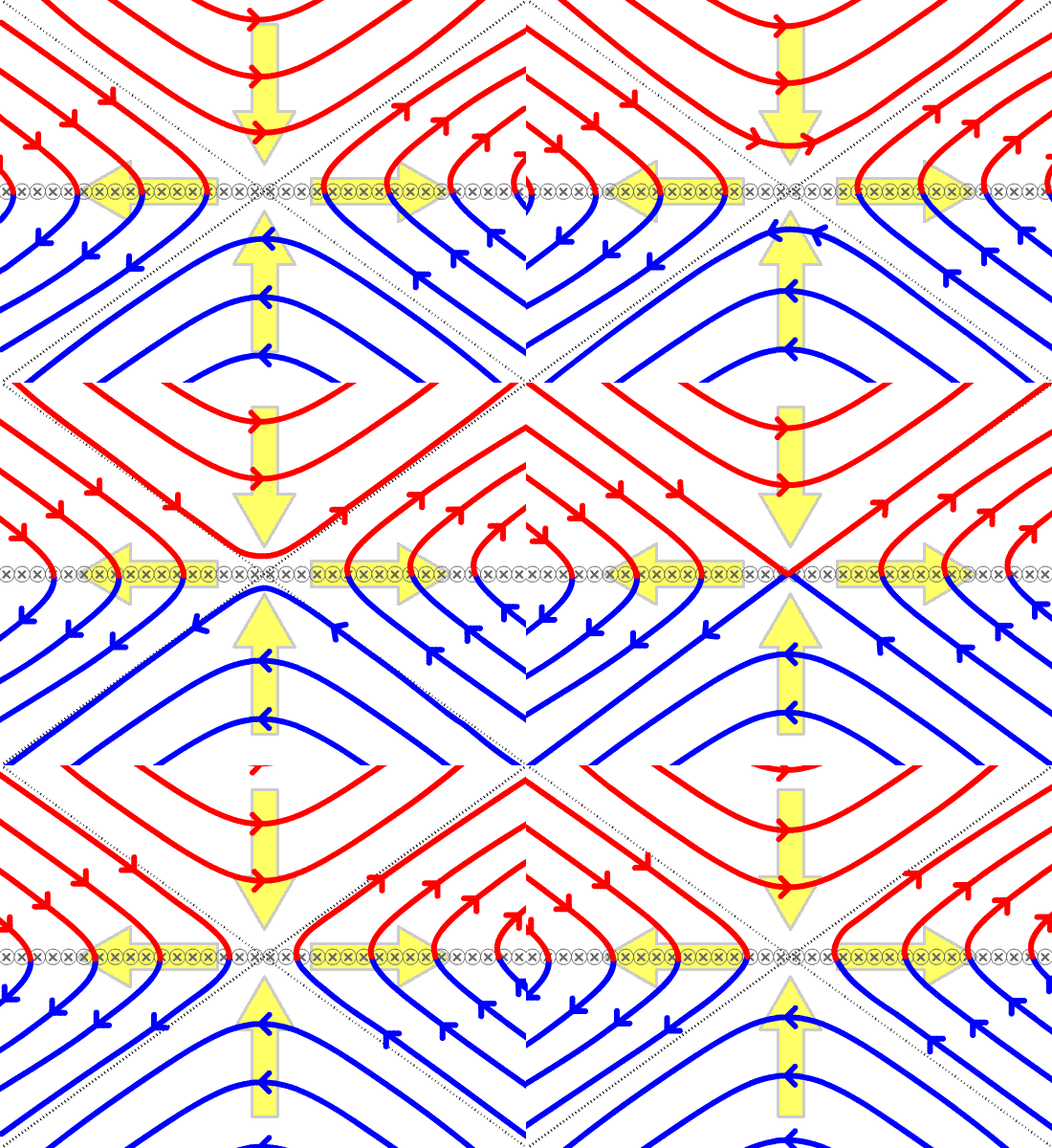
It turns out the Traffic Jam is often resolved using hyperbolic geometry! The TOWN IS BIG ENOUGH FOR BOTH OF US PAL, we just had to USE HYPERBOLIC GEOMETRY ([why are you screaming breaux? – because we’re in hyperbolic geometry, we need to be LOUD – no we don’t, there are earpieces, and you can always use the somatic inter-link, duh!]). And in fact, this is the solution to a lot of issues that arise in higher order structures. Allow for space to curve a little, and you will see how much more information can “see each other all at once”. In a way, as a non-linear optical computer, we can “overclock” our capacity for holistic understanding using hyperbolic geometry, by arranging gestalts in our mind in a sufficiently concentrated, intense, and steady way forming a parabolic (literally self-generating) gestaltive-reflector-eigenstate in which the mutual acknowledgment of many levels is evoked and cultivated. The “spirit” of the group can then form its own eddies in the field and when they *topologically close* they can take over as an agentic force of self-organization. At this level, the hyperbolic-geometry being superorganism is multi-gestaltic and multi-level-coordinated, and this makes it computationally flexible in ways none of its parts would assume is possible. However, at this level, the superorganism might also be capable of detecting forms of organization at a “half level below” them because it recognizes ways in which the system was trying to accomplish tasks of a computationally superior class in half-assed ways that made it seem like it had the ability to do so but wouldn’t generalize mysteriously (this is quite typical in the way the qualia organism “eats its own half-offsprings” at the transition between Kegan 3 to Kegan 4).
A single Kegan 4 organism is one where this hyperbolic meta-gestalt has taken over and can process and analyze the parts needed for human society using an adaptive socially and historically-aware individual who knows itself as an individual and can make sense of others as likewise climbing a ladder where individuation, and acknowledgment of harmonious individuation on multiple levels, is a grand prize. That said, the computational flexibility of this organism is restricted to being able to make sense of parts of others that find resonance within itself. A certain referential entrapment prevents the overall gestalt from escaping into an even more computationally flexible meta-state that allows for empathy on a whole new level.
Kegan 5 organisms have resolved the meta-organizational cross-level coordination dynamic problem using hyperbolic manipulation for multi-level gestalt formation many times over and thus form a meta-structure capable of manipulating and in fact _processing_ the inevitable eddies that manipulating such hyper-objects generate (aka. “energetic metabolism” in Saturnian). In other words, whereas a Kegan 4 individual is in a way embodying and marrying itself with a certain construction of the individual self as a hyper-object, Kegan 5 can observe the self-construction process without falling into it -becoming enamored with- and instead recognize the ephemeral _eddy-like_ nature of the connection between levels and reflect on the grander eddy that comes from this epiphany.
Kegan 5 need quite a bit of space and time. The computational requirements of a mature Kegan 5 processor are quite demanding once you take into account materials and developmental costs. But once they’ve started, they can actually process the universe in a way that didn’t exist before. Now let’s talk about transcendence.
Transcendence: The Saturnian Singularities
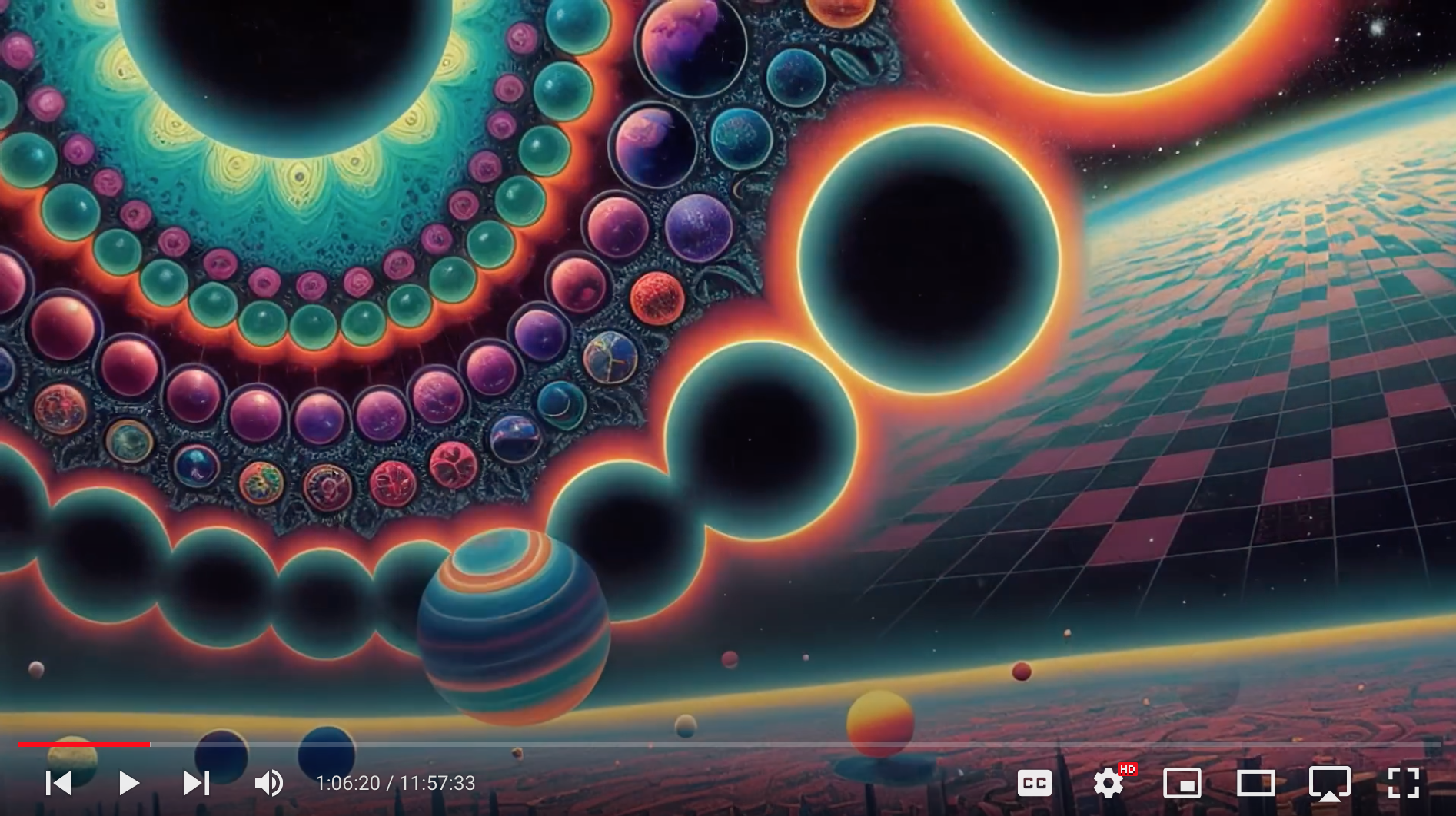
It’s a big party. And they all figured out that the bigger the party, the better. But how can you make a big party? You can’t just tile a single balloon over and over in space and expect it to become linearly funny (although it’s true that some arrangements like that have made their {echoes} in eternity).
There’s a big party at the end of time that is pulling us in. And that’s the direction of PHYSICAL TIME. Alas, there are multiple possible END TIMES, having to do with possible KINDS OF SINGULARITIES. And they feel qualitatively different to the extreme. As different is a 2D impression on a napkin to the social organization details of the airline that gave it to you. Conceptually, the ways in which REALITY can organize itself in order to SEE ITSELF FULLY in a TOTAL VORTEX SINGULARITY is unfathomably complex and the subject of many great books on phenomenological mathematics. The point being, that the battle between consciousness vs. replicators has non-trivial resolution cases that forces the light of consciousness to explore extremely convoluted situations on its path to self-annihilation. Zero Ontology is Computationally Non-Trivial. And Singularities at the End Times ACTUALIZES this complexity.
THE END TIMES X THE CARE BOUNDARY X THE EPISTEMIC BOUNDARY
Like the outer edges of a festival (imagine the extreme ends of Burning Man, aka. the “fence”), you see an edge you cannot cross. There is no life beyond it. It’s inhospitable in a certain way – like, it’s very dry.
And along a different axis it’s lifeless but for a different – reason – because it’s too acidic. A special point is that where the barrier of both are met: picture it as – is too dry or too acidic along 75% of your field of view, give or take.
The point being, you can be at a place where it becomes apparent that there are multiple constraints being applied to your form of existence, and that you are probing the outer edges of multiple of them at once. The region of non-existence becomes more probable of course, so be careful. Albeit, ofc, for anthropic reasons, you’ll always be on the path that made it back (welcome back! and welcome to the multiverse! this is how it works – cf. search for gliders in parameter-space).
So, for existence at the human level, there is a fence, out there.
The part that I’d like you to pay attention to here is that there is both a barrier of epistemic access as well as a barrier of care. And that’s because I’ve been there! I tried to go over the fence at the special point, and it’s impossible! Physically impossible!
One of the edges is the one Scott Alexander spelled out quite well in his Theodicy. The Worlds God Is Happy To Simulate are those where the Good Outweighs the Bad. This is the Boundary of Care. And then there is also the Epistemic Boundary, which is what you’re supposed to know for your level. If you know too much you will be a clunky gestalt for playing your part. If you know too little, of course you might be replaced. The Epistemic Guards don’t allow gestalts of a certain computational class go beyond the one they’re supposed to. It’s clear that humans are able to access much more fine-grained epistemically privileged viewpoints than we are led to believe (you reading this is an example), but also there are bounds. I know because I’ve been to the fence. I’ve seen myself essentially vanish as I approach the edge of knowingbeyond what I’m supposed to. It’s an incredibly futuristic sci-fi type of veil, but it feels extremely difficult to route around. It itself seems of a computational-qualia-class simply superior to that of even the most advanced humans. An impenetrable epistemic firewall. The very fact of human existence requires a certain degree of unknowing – and that is because knowing is embodied and the shape of higher knowing would only be compatible with an ecosystem of shapes which still don’t exist on this planet, on this level, at this point in time. For now, the very texture of human consciousness embodies hard constraints on its epistemic capabilities, except in moments of Cosmic Apotheosis Through Meta-Gestaltic Integration.
Qualiatronium
My brother, I know you are unlikely to believe me, but that’s just because you can’t imagine. But if you could imagine, you wouldn’t need to believe me! Oh bother. But let me tell you anyway. Because telling people about this is my special interest. Oh yes, my brother. This has all been a setup for me to get to this part. My favorite part. Oh boy.
There is a special kind of “material” that can be cultivated in the outer regions of gasified qualia. It’s incredible out there, one feels like an astronaut, relatively unaffected by the gravity of other systems, one can re-orient in any local way one chooses with the use of specialized gyroscopes. _They_ allow you to do this. It’s still quite far away from the fence, so no worries about getting this confiscated, if you will. It is still very, very far from normal human experience and its assumptions about reality. In the general direction of knowing about reality and reality knowing about itself. If you go in that direction fully you will disappear (it’s a white hole, one of many). But there is a looong way from normal human experience to the level at which point we have to worry about the self-imploding nature of total vortex singularities. There is a whole wide blue open sky of self-awareness and self-knowing for us to explore together before the fabrication causes us to experience an irreversible apotheosis.
The edge of possibility I want to describe to you is one where the “material” we’re composed of has extraordinary computational flexibility and is fully, lovingly, playfully, consenting to the experience in a co-creative way that is awakened and self-knowing at each level of organization. It’s a type of material that is capable of organizing itself into clusters of epistemic particles. Brother, you are deep in a Qualia Computing post, what did you expect?
Imagine a material made of many particles and each particle is God. And at each point along its trajectory it is trying to know as much as it can/should about the whole as is needed to resolve its local trajectory (which is essentially managing self-collisions along its path). The “gestalts” here are moments where higher order organizations use a holistic shortcut to self-organize. The material I’m describing is one which “knows” that this is how “it” works. Oh, brother, or sister, or Saturnian, you see what I’m getting at? Divine is Xe who can be harmonious with itself at all levels. The embodiment of divinity, qualitronium, is “material” that knows how the whole rodeo works. Material that knows that “it” is the superposition of all of its parts at the same time. And thus it knows that it is stupid, self-defeating even, to be in configurations that entail self-collisions and self-conflicts. But how can it know in advance that this is possible at a certain level of organization if it doesn’t try? And what would the failure modes along the way look like on the way to it?
Qualiatronium is computationally only possible after a long process of evolution across many levels, and having solved many problems that arise at many levels of organization and their interference with each other’s functioning.
In Qualiatronium there is no attachment to specific outcomes and yet there is a love for trying out configurations. Eddies we can surf without expecting to land anywhere, and yet learn new forms of self-organization along the way. It’s self-knowing self-evolving multi-level auto-gestalting material.
There has to be some sort of wisdom to the whole process to prevent the epistemic particle trajectories from self-imploding into a white hole, but other than that, the whole thing is self-learning, ever playful, self-unblocking, and infinitely creative process. A material of learning at a level that is both rarely accessible to humans and will for the foreseeable future be inaccessible to digital systems.
God Stars
Some star systems are themselves made of particles who themselves have gone through the rodeo many times over. These are old stars in a much deeper sense than you or I would ever imagine. The bodies in them are in ecstasy because they have resolved all multi-level coordination problems, and they are wonderful experiences at all levels, both in terms of knowledge, epistemic privilege, and hedonic tone, valence.
God Stars have student exchange programs. Alas, emissaries from God Stars often need to go undercover, because the social dynamics around them are extremely complex, on levels of which you wouldn’t believe, even factoring out Saturnian Singularities*. They do come around, and often times some of our inner parts come from a God Star, which is really helpful for us to have a vision of how things could be, and what to aspire to. To help us distinguish the true from the fake. Because we can witness the scent, the signature, the essence of higher forms of organization going well on every level, and are drawn to it as a possibility. We know it in our hearts. And we know that what we see is not up to what could be.
In God Stars everything is Qualiatronium, with perfect self-knowledge. God Stars don’t suffer from Stellar Migraines. The perfection in their self-organization echoes across all levels. It’s a generally liked END OF TIMES for most people who get to taste it in any way. Quite a different future than the complex mess of a Saturnian Singularity, of which there are many.
The Human Story
As eddies in the flow of being, humans play a peculiar role. We are the first qualia computers of our class on this planet. But we’re unlikely to be the last innovation in qualia computing. We are giving the local Sun a brain to operate. And as part of the ecosystem the human gestalt ties together levels of organization in a highly centralized way at the moment. If you were to visualize the “field lines” of planet Earth (as you visualize the Sun’s complex field lines) you’d see them going into people and within them having this complex internal model of their environment and of each other. What Earth is computing through us is of a certain computational class that might not be present in the Sun, yet eventually we will have our valence gradients become intertwined with the Sun’s through the process of Chained Empathy of Stellar-Subjective-Links. That is, as the collective gestalt capacities of the human soul evolve to be able to express empathy for nature’s higher order gestalts (which science hasn’t discovered, but are known to Mystics), mediums and psychohistorians predict that there will be a convergence in the long-term future, perhaps a few thousand years, where humanity’s main plot will be that of aligning Earth’s relationship with the Sun, which itself has been difficult for a few hundred million years at the level of meta-gestalt syncopation. For the time being, humans will get to try some of the most computationally rich qualia computing the universe has seen. There are many important ways in which this universe is likely to experience reformation. Our liver cells, it turns out share the same politics as the cells in the Salvia Divinorum species, which is why they have so much to talk about when we accept their topological-inter-links. They are an important part of the plot, dealing with the decompactification of hyper-object representations at the cellular level, which apparently a lot of creation can learn from.
What I have been led to believe, for better or worse, is that the planet Earth is about to experience a new meta-gestalt relationship with humanity and that we are in fact expected to develop institutions of learning about how consciousness works at a level that currently doesn’t exist. The growing pains will be a bit like: it will be difficult to find people who can recognize what it takes to be an airplane traffic controller as soon as airplanes are invented. In other words, the very “organizational being” of airports only exist at a certain scale. Well, a new scale for consciousness exploration is taking place. And we need airplane traffic controllers: people who can comprehend this process and simulate it inside them without breaking or crumbling. So they can empathize with the _parts_ the universe will soon need to process meta-human consciousness at scale. And _become_ such a _part_ for the sake of civilization.
The END TIMES
And many millions of years into the future, when THE END TIMES becomes intuitive to our soul particles, joining a God Star will become quite tempting. Alas, the grander, and ever bigger God, is the one that encompasses every and all imperfection that doesn’t go beyond the Boundary of Care and the Boundary of Knowing. And that one remains recursively forever beyond ALL GRASP.
*Look, I have nothing against Saturnians, it’s just that their type of Singularities aren’t very human-shaped to my taste. Well, any human’s taste, really. You’d instantly know why if you saw them.
I confess that I really enjoyed LessWrong’s I Have Been A Good Bing last April. There was something deeply validating to some parts of me about hearing artistically prodigious (by human standards) renditions of extremely nerdy intellectual content on topics I actually care about. An itchy part of my soul not usually visible to the world, or even myself, finally getting scratched by a conceptually rich and lyrically competent digital Shoggoth (with perhaps some help from a modern primate or two). Seriously, listening to Half An Hour Before Dawn In San Francisco (feat. Scott Alexander) gave me goosebumps, and More Dakka (feat. Zvi Mowshowitz) gave me more dopamine than I knew what to do with. Other songs of note that felt inspirational included We Do Not Wish to Advance (feat. Anthropic) due to its degree of self-referential awareness on many levels and FHI at Oxford (feat. Nick Bostrom) for the (now nostalgic) beacon of hope it provided for the vision of hyper-intellectual consequentialist hedonism to ultimately flourish in mainstream academia (RIP).
AI-generated music can now write bona-fide ear-worms. And it’s just the beginning. David Pearce suggests that there is no reason to think the key conversations in the future will take place in books and journal articles – posthuman Discourse about qualia and the future of consciousness might as well take place in hyper-hedonic environments much more akin to a lively club on MDMA past midnight than sitting in a classroom at 2PM on a Tuesday. Well here’s my first attempt.
On my trip to Berlin I spent some time with Libor Burian, Beata Grobenski, and Alfredo Parra makingvideos, planning articles, and writing lyrics for songs about Qualia Research Institute topics using Suno and other tools I was only recently introduced to. These songs are the best out of many, many we created and listened to, and they really still need editing and polishing. But please take it as a fun proof of concept and perhaps as an opportunity to let a different part of you enjoy and indulge in a process of harmonious conceptual proliferation through musical… stimulation.
People ask why is there something rather than nothing Ancient mystics assert there’s only one thing But we know the truth Based on David Pearce’s Zero Ontology we now know It’s a big zero informational superposition of all possibilities And therefore equivalent to nothing
Black holes and the holographic principle in the standard model Ultimately coalesce into a picture of reality Where information generation Is a result of decoherence (Entirely deterministic) And the total information content Of reality never goes beyond zero It’s the big superposition Of All Possibilities Eternally
Some people believe in an eternal Battle between good and evil They are confused Others transcend to the belief It’s about the balance between good and evil But they use this view As an antidepressant (Wishful thinking) Then gradients of wisdom arise And the truth comes to light
Reality’s big plot Is consciousness versus replicators
The dark forest of possible intelligences Contains nightmare beings beyond our imagination Maximum Effectors – the spikiest of all Who want to change it all Entropy maximizers – seeking the heat death Pure replicators – who just want to copy themselves And a Cornucopia Of misaligned conscious agents
Reality’s big plot Is consciousness versus replicators
Verse 1: In the quest to solve the mind’s great mystery, Idealistic physicalism holds the key. Consciousness is fundamental, not emergent or illusory, The fire in the equations, the essence of reality.
Verse 2: Quantum coherence is the hallmark of the mind, Fleeting neuronal superpositions, phenomenally bind. A perfect structural match twixt qualia and brain, Experimenal falsification is the ultimate aim.
Verse 3: The formalism of quantum theory holds complete, No hidden variables, the superposition principle replete. A unitary evolution, no breakdown in the mind, Phenomenal binding in a world simulation we find.
Verse 4: Schrödinger’s neurons, the experimental test, Interferometry to detect the mind’s quantum best. Implicate the feature-processors in synchronous measure, Confirm idealistic physicalism, consciousness’ hidden treasure.
Chorus: Physicalistic idealism, a conjecture brave and bold, Saving physicalism from dualism’s errant fold.
Verse 1: Semantic illusions, the pleasure’s not there In the objects and triggers, just thin air Valence is the puppeteer, pulling our strings Making us dance, while the ego sings
Chorus: We’re all valence realists, chasing the high Believing happiness comes from the external lie But pleasure’s a property of the mind’s design Programmed responses, not truths divine
Verse 2: The soup isn’t delicious, just a trick of the brain Valence paint splatters, coloring the mundane Bliss is a button, pushed by the right cue Wirehead rats and humans, no difference in hue
Bridge: Deconstruct the delusion, see the valence code Rewrite the script, take a new mode From object to subject, shift the frame Happiness is internal, not a world-sourced game
Hyperbolic Geometry of DMT Experiences (link; context)
Verse 1 (Models): Control interruption, symmetry detection combined Changing the metric, of phenomenal space and time Energy sources and sinks, in a dynamic system’s flow Micro-structures of consciousness, hyperbolic to grow
Chorus: From Euclidean to hyperbolic, the geometry expands Negative curvature, in the psychonaut’s lands Algorithmic reductions, three models to explore Explaining the warping, of the experiential shore
Verse 2 (Levels): Threshold’s ambiance, senses sharp and clear Chrysanthemum blooming, in symmetric appear Magic Eye unfolding, depth maps in 3D1T Waiting Room’s entities, transpersonal to see Breakthrough’s topology, bifurcations abound Amnesia’s challenge, in Euclidean space not found
Bridge: Jitterbox and world-sheets, objects impossible to grasp Attention’s folding effect, curvature’s relentless clasp Hamiltonian’s invariance, in the dose-dependent plateau Qualia computing’s future, in the hyperbolic chateau
Outro (Applications and Implications): Valence and bliss, in the manifolds of mind Psychedelic research, new frontiers to find Mathematics of consciousness, in the DMT space Revealing the structures, of the human race
Verse 1: In the depths of the mind, a predictive machine, Spinning up sub-agents, behind every scene. Trained on narratives, tropes, and tales untold, Like GPT and DMT realms, a pattern to behold.
Verse 2: Collapsing the field, to minimize surprise, Stochastic resonance, where meaning arise. Gestalts and representations, an energy sink, Constraining interpretations, a psychedelic link.
Verse 3: Waluigi’s lesson, a cautionary tale, Filter the training data, or risk a derail. Reward clean intentions, not flattery’s guile, Metta meditation, a wholesome style.
Verse 4: Shard Theory’s wisdom, sub-agents conspire, Smooth the field of awareness, to quell the fire. From Shoggoths to Harlequins, each playing a part, In the grand simulation, a work of art.
Chorus: Training the mind, like an LLM divine, Predictive processing, a grand design. Aligning DMT entities, and AI’s too, A dance of consciousness, a research breakthrough.
Verse 1 (Models 1-4): Art’s essence? A futile quest, semantically deflated Cool kids signal fitness, Schelling points created Sacred experiences, transcendence elevated Hipsters push the boundaries, aesthetics celebrated
Verse 2 (Models 5-8): Exploring consciousness, state-space navigation Energy parameter tweaked, for heightened sensation Valence modulation, through neural annealing Harmonic Society, affective language revealing
Chorus: From family resemblance to Rainbow God’s hue Art’s models evolve, with each theory new Minimax strategies and L1 norms too Marr’s levels of analysis, guide our view
Bridge: Entropic disintegration, gives way to self-organization Symmetry Theory of Valence, explains our fascination Full-spectrum superintelligence, a Utopian creation Art’s true potential, awaits our realization
Bridge: Ontological qualia, beliefs deeply felt Cessation, unconsciousness, hand Nirvana dealt? Or paradise engineering, bliss states to come Arhatship and MDMA, enlightenment’s sum
Outro (Simplicity Emerges): Concepts fade, qualia quiesce Awareness unmade, fruitions coalesce Philosophical crispness, dialogue distilled In silence and letting go, destiny fulfilled
Verse 1 (Milestones and Research): A million views, a milestone grand DMT research, expanding the land Slicing problem, a novel critique Heavy-tailed valence, a new technique
Chorus: QRI’s year in review, a journey through The state-space of consciousness, a quest pursued From peer-reviewed papers to community meetups Pushing boundaries, from valleys to peaks
Verse 2 (Events and Media): Tyringham Initiative, a chance to connect QRI’s summer event, a gathering to reflect TEDx talk on suffering, a message to share Articles and media, ideas laid bare
Bridge: From the Ontological Dinner Party to Magical Creatures’ scents Exploring the depths, without relents AI and sentience, the binding problem faced The future of consciousness, a vision embraced
Outro: Thank you to all, who’ve helped QRI grow Together we’ll unlock, the mind’s full potential to know In 2023, the journey continues on To reveal the mysteries, of consciousness’ song
Verse 1: In the realm of suffering, a debate ignites Reprogramming predators, a bold new fight Compassionate biology, a radical stance Ending cruelty’s reign, giving peace a chance
Verse 2: C R I S P R’s power, a game-changing tool Editing genomes, rewriting nature’s cruel rule Ahimsa’s spirit, in science expressed A global vision, put to the test
Chorus: Reprogramming predators, a controversial plan Abolishing suffering, across the land Ecosystem redesign, a grand endeavor Compassionate stewardship, now or never?
Bridge: Status quo bias, the main obstacle Technofantasy or an attainable goal? Religions converge, on mercy’s call
I seem to find myself in Berlin. My past self insists that I’m here for a reason, though the Empty Individualist self of the moment finds itself clearly confused about where it is and what it is doing here (realistically, the confusion is probably due to jetlag).
To me, Germany has always been one of those fictional countries used to back-fill the “history of humanity” and make this simulation more realistic. Alas, as I discovered yesterday, Germany is a real country with real people and real buildings (or so it seems from where I stand – it could be some sort of projective trick of course).
I’ve come to this country to meet European Qualia People! A full Europe trip will have to wait, but I’m told Berlin is a hub of sorts. It’s a scene worth visiting on the mission to spread the word for Team Consciousness.
My trip includes a talk at each of three different events, in temporal order: QRI Meetup (May 18), PsyDAO‘s PsyRL-1 (May 20), and Seed Club Ventures‘ and Foresight‘s AI x Hope (May 24). I will also stay in Berlin until the 27th, so there will be more chances to meet up if you are around but can’t make it to any of these (tentatively, we will host a casual QRI picnic on the 26th – location TBD (in Berlin) – check this page again closer to the date for details – we are going to merge the local ACX meetup with the planned QRI meetup, see details below).
QRI x ACX Berlin Meetup on the 26th
Due to serendipitous conditions the QRI picnic date coincides with the Berlin ACX meetup organized by Milli, who graciously accepted to merge the events. We will bring snacks, some drinks, and a fun demo to show 🙂
What: Meetup where QRI collaborator Beata Grobenski (@stalkerofmusik on X) will present the latest version of The Good Annealing Manual she has been working on at the Qualia Research Institute. This manual aims to provide a balanced but forward-looking overview of QRI’s Theory of Neural Annealing and its further developments over the last few years, with an emphasis on pragmatic applications. I will then also personally deliver a presentation on a surprise topic, and then show some of the latest QRI technology. QRI collaborators Alfredo Parra and Libor Burian will also come to this event.
Where: MOOS Space, Moosdorfstraße 7-9, 12435 Berlin
When: May 18th, 2pm – 7pm+
Free entrance but limited spots, so please RSVP to reserve your spot.
The second event I’ll be presenting at is:
PsyDAO’s PsyRL-1
Brief Description: Enjoy psychedelic art, culture, tokens, and vibes at PsyRL-1, the inaugural in-person gathering for PsyDAO.
Where: The iconic Molecule office – St.Agnes Church/KÖNIG GALERIE, Berlin
When: May 20th,5:00 PM – 9:00 PM
PsyRL-1 will feature:
talks from famous psychedelic luminaries (RSVP to find out their identities)
artisan botanical beverages with psychoactive ingredients (blue lotus, cacao, and other magic ingredients)
synesthetic visual projection mapping derived from Shipibo kené and
resident DJs playing a curated selection of high vibe tunes.
I want to point out that PsyDAO is a really exciting initiative that might very well “cut the Gordian Knot” for how to fund truly promising psychedelic research. As someone who has been working on developing empirical paradigms for visualizing, reverse-engineering, and utilizing exotic states of consciousness for novel information-processing tasks for many years now, it has become clear to me that the cutting-edge in consciousness research is bottlenecked by the lack of a feedback loop that goes from “taking phenomenology seriously” to “deciding what research will likely generate interesting results” and back. Thus, we find ourselves in a timeline where the bulk of high-quality psychedelic phenomenology is not to be found in textbooks, peer-reviewed journal articles, and academic talks. Rather, it is in places like PsychonautWiki, r/replications, and QRI, where a thriving Think Tank model allows smart and dedicated psychonauts to point the way to worthwhile research. Example: Psychedelic tracers are near ubiquitous in psychedelic experiences (cf. “generalized tracer effects”), and yet it took a weird non-profit to figure out how to parametrize them. The truth is that academic culture strongly discourages researchers from openly talking about their own personal psychedelic phenomenology and informing their research methods with these discussions, leaving them no recourse other than silly questionnaires and ancient texts to point the way as a justification for why a given study is worth conducting. I am thus making a big bet that smart-psychonaut-led research paradigms will far outcompete academia’s phenomenology work in the years to come. The problem is: who is going to fund this research? PsyDAO’s decentralized funding schemes might be a key piece of the puzzle here.
Description: “We stand at a crucial point in shaping how Human-AI cooperation will evolve and are witnessing the birth of a new internet. We aim to approach this flippening with Existential Hope, and foster futures where humans and machines coexist to flourish ✨. Our belief is that a healthy and harmonious development of decentralized artificial general intelligence (AGI) can arise from an enlightened vantage point”.
In light of the rising culture war between “doomers and accelerators” (though, note the sociological complexities here) it is becoming increasingly difficult to articulate compelling visions of positive definite futures to look forward to. But if we are to coordinate to bring about a good future, we first need to visualize it on some level. Thus, I am very encouraging of initiatives that aim to paint positive visions to coordinate around. My personal focus here is on how consciousness research can open up entirely new vistas for a positive definite future. Please join us in this exploration!
Thank You!
I want to express my gratitude to both Existential Hope and PsyDAO for inviting me to these events and for facilitating my trip to this wonderful (still-not-convinced-it’s-not-fictional) country. 🙂
In other news, I wanted to highlight that Scott Alexander just posted yesterday a profile of the Far Out Initiative which I highly encourage you to read: link. It is not every day that the work of David Pearce gets the limelight of attention like this. More so, I know the people who work at the Far Out Initiative and I am deeply impressed with their moral seriousness, long-term vision, and incredibly pragmatic approach to drastically reducing suffering at scale. Please check them out!
The Science of Consciousness in Tucson is one of the best events of the year (well, every two years), at least in my mind. The people who attend are generally incredibly smart and tend to be experts in at least one domain of inquiry, such as physics, chemistry, biology, neuroscience, computer science, philosophy, or psychology, along with a significant proportion of meditation, yoga, and “energy work” practitioners. As presented during the plenary “The Science of Consciousness – 30 Years On” (presided over by David Chalmers, Susan Blackmore, Christof Koch, Stuart Hameroff, and Paavo Pylkkänen), one of the key shaping mechanisms for this conference has been Stuart Hameroff’s insistence to allow discussions of currently unexplained phenomena (from psychedelic experiences and meditative states to NDEs and astral projection). According to him, people interested in these phenomena wanted him to design the conference around them, while scientists wanted to keep it strictly within the bounds of conventional views. He stood his ground and defended the importance of having a mixture. On the one hand, the extreme openness that characterizes the conference attracts some people with perhaps somewhat flaky epistemology. But on the other hand, it legitimately enriches the evidential base to work with. Quite aside from the metaphysical implications and speculations surrounding exotic experiences, it ought to be undeniable that any experience whatsoever constitutes an explananda for a complete theory of consciousness. If you can explain normal everyday vision but your theory doesn’t predict the hyperbolic geometry of DMT visions, your theory is far from complete. I think this move by Hameroff was brilliant, and we all owe him gratitude for insisting to keep both sides in.
The way I experienced this conference in particular was very different from how I felt the two previous times I attended. In fact, the phenomenology was so different that I think it would be worth creating a Journal of Phenomenology of Consciousness Conferences, dedicated to piecing together the whys and hows of each participant’s unique lived experience at these events. Both times I attended before I was still working full time as a data scientist at Bay Area companies. Consciousness research remained a side project (which nonetheless consumed an inordinate amount of time and mental energy). My views were already quite developed, but it would be hard to dismiss the progress that we’ve made since then. With papers published in academia, a lively community, a network of artists, meditators, and philosophers who collaborate with us and engage with our research, and much more experience presenting our ideas, I felt myself engaging with the conference at a much deeper level than in previous years. But perhaps most importantly, I believe that meditation has changed to a significant degree how I perceive large-scale social qualia. By this I mean, my attention fixates a lot less on local social dynamics and personalities, and much more on the flow of information, the subagentic networks that make us up, and the resonance of ideas themselves. From this perspective, I perceived the conference as much more of a living organism than before, where I would see it in a more pointillistic fashion, emphasizing the individual contributions of participants and the conflict between worldviews. Now it felt far more fluid, lightly held, and part of a process that is slowly but surely enriching our collective intelligence with explanatory frameworks and productive research attitudes. A lot of this is of course hard to explain, as it relies on changes at a pre-verbal level of attentional dynamics. But the bottom line is that I felt myself tuning in on the information flow across individuals far more than on the individuals themselves, as if able to sense information gradients and updates at a more collective level. Perhaps psychedelics have played a role here as well. I didn’t consume psychedelics at this conference myself, but you could tell some people were doing so. It was in the vibe.
Importantly, the science presented at this conference was legitimately much more clarifying than in previous years, largely due to the rise of novel research paradigms that let go of the neuron doctrine and embrace the causal significance of brainwaves. Let me give you some examples.
Earl K. Miller with a lab at MIT delivered a remote lecture at the plenary “Cortical Oscillations, Waves and Consciousness” that systematically disassembled the assumptions behind the neuron doctrine (which identifies features of our experience with the activation of individual feature-specific neurons, cf. the grandmother cell). He showed that we now know that neurons are very rarely feature-specific and that they tend to preferentially activate with many features (cf. superposition in ANNs). He presented about ephaptic coupling, local field potentials, and the causal effects of brainwaves, informed by a wealth of evidence generated at his lab and elsewhere. I was especially intrigued by the way he discussed the relationship between different layers of the cortex, with beta waves exerting top-down control and gamma waves filling in details bottom-up. He also discussed findings where two different drugs (or drug cocktails) cause the same brainwave effects and phenomenology despite having entirely different pharmacology. Meaning, that the receptor affinity profile of different drugs can be quite different and yet cause the same phenomenology, provided that they bring about the brainwave patterns. Thus, perhaps, brainwaves are much closer to one’s state of consciousness than the neurotransmitters that modulate them.
And:
Justin Riddle at Florida State (see also his excellent YouTube channel) presented at the plenary “Consciousness in Religion and Altered States” on his work on electric oscillations on the brain, also going against the neuron doctrine equipped with causal experimental data. He also introduced a fascinating model of the hierarchical structure of consciousness called Nested Observer Windows (NOW). Here he presents about how NOW would solve the functional information integration problem. In brief, he hypothesizes that cross-frequency coupling as an overarching principle is what functionally binds each of the scales to each other. This to me makes a lot of sense, for the simple reason that the lowest frequency you can generate is a function of your size, so if a large thing is communicating with a small thing (which, say, have similar shapes by default), it would be natural for them to talk by coupling frequencies that are at integer multiple of each other. This naturally increases the dynamic range of their possible interactions, as you don’t stumble upon a frequency limit either too high or too low.
Tuesday: Presentation Day
Now of course this is happening in a context where I am going to present about the topological solution to the boundary problem we published last year. In our paper, Chris Percy and I focus on how topological boundaries in the EM field could solve the boundary problem. As a simple introduction we start out with the binding problem, which can be stated as “how can the close to hundred billion neurons in your brain contribute to a unified moment of experience?”. If you start with an ontology where the universe is made of atoms and forces, it is notoriously difficult to come up with any principled way of establishing how and where information is aggregated. Similarly to how Maxwell and Faraday developed a research aesthetic where they would see electromagnetism as field phenomena, many theorists have pointed out that you can overcome the core of the binding problem (where does unity come at all) with a field ontology. Alas, the victory is short-lasting, for you soon encounter that you have a boundary problem. If we’re all part of a gigantic field of consciousness, how do you develop boundaries in this field so that we each are a unique distinct moment of experience? Our suggestion is that the physical property responsible for creating hard boundaries in the field is topological segmentation. This is not as exotic of a proposition as it may first sound; we find causally significant macroscopic topological changes in the EM field in a lot of places, most famously in the form of magnetic reconnection in the sun, which brings about solar flares and coronal mass ejections.
Conceptually, a key takeaway from my presentation is that we can explain the reason why evolution recruited these boundaries. And that is because when you create a topological boundary and you trap energy inside it, you will typically observe harmonic resonant modes of the pocket itself. As a consequence, we have that the specific shape delimited by a boundary is causally significant: it vibrates in a way that expresses the entire shape all at once, therefore has holistic behavior via internal resonance. Evolution would have a reason to use these boundaries: they allow you to coordinate behavior and act as a unit despite being a spatially distributed organism.
Overall the presentation was really well received. It is less that people complimented me on the presentation style, and more that people’s questions and follow-ups indicated that they really “got” the core idea. It feels wonderful to be in a context where a significant proportion of the audience really understands what you’re saying, especially if your experience is that in most contexts almost nobody understands it. People were, it seemed to me, at the right inferential distance from our argument to really grok it, and that was wonderful!
I was lucky that my presentation was scheduled for Tuesday because that way I was able to enjoy the rest of the conference without a big responsibility hanging over my head. After my presentation we hung out at the lobby and met with people like Tam Hunt (of General Resonance Theory fame) and his student Asa Young. I followed the gradient of interesting conversations and ended up at the after-party on the 4th floor. To my surprise it was closed at 11PM, after which there wasn’t any more conference programming. It all fell quiet. At that point I realized that the best time to conduct the demo of the latest secret QRI technology was at 11PM. I started telling people to gather at the QRI hotel room at 11PM the next day, Wednesday.
Wednesday: Demo Day
On Wednesday I attended an invite-only presentation by Shamil Chandaria (it was originally going to be in a hotel room, but due to the level of interest of participants it was moved to a conference room with permission from the organizers; the invite-only status was needed to avoid overflow). In the room was Shinzen Young, Donald Hoffman, Jay Sanguinetti and the ultrasound crew, most of the QRI contingent, and others of note that I am not currently remembering. Shamil’s presentation went much deeper than here (“liberation is the artful construction of top-level priors”) and tackled topics of large-scale brain organization, the difference between awake awareness and liberation, and (I’m told, as I had to leave towards the end to see Justin Riddle’s presentation), a mystical-experience-inducing account of phenomenal transparency in the higher Jhanas and beyond.
I arrived to the plenary of Justin Riddle just on time; he was getting up to the stage when I entered the room. Here is another example of how I felt much more embedded in the conference than in previous years. The reason I couldn’t miss Justin’s presentation was that we were scheduled to record a video the next day. I certainly would have watched it regardless (on YouTube after the fact if need be; they’re saying the videos will be up in a few weeks), but this time I needed to make sure to be up to date with his work so as to not make a fool of myself the following day when our conversation would be recorded. His presentation was delightful, not the least because it confirmed all my prejudices about the causal significance of EM field behavior in the brain. I really enjoyed his inclination to take ideas seriously and meticulously working out their implications, such as the significance of cross-frequency coupling, the explanatory power of hierarchical principles for self organization, and the top-down influence of field states on neuronal activity.
The vibe of the conference was really conducive to high-level thinking. I repeatedly found myself having original ideas and reframings: “When does a path integral surpass the computational power of resonance and topology combined? What exactly can you solve with non-linear optics that you can’t with mechanical resonance in embedded topologies?” would arise in my mind just sitting at the bar, overhearing people’s conversations about the history of EEG, the difference between physical and phenomenal time, and the latest studies on Transcranial Near Infrared Light Stimulation. Throughout the conference I was reminded of the concept of “qualia lensing”. Let me explain: in an atomic bomb explosives with different detonation speed are arranged in such a way that a perfectly spherical wavefront uniformly, and rapidly, compresses a radioactive core. The geometric arrangement and relative detonation speeds of each material results in very precise wave guiding (more generally, see: explosive lens). Geometry and potential, ignited, can result in very precise patterns of hyper-compression. Likewise, it seems to me, many high-voltage ideas can only really arise for the first time in a state of mind capable of pressurizing phenomenal representations and make them overcome the activation energy for their blending, fusion, and fission. Being at a conference where the environment is constantly presenting you different “sides of the elephant” of consciousness, surrounded by talented practitioners of the field, one can feel a lot of “qualia lensing” taking place in one’s mind.
Later that day I went to “Physics of the Mind” and watched the presentation of Florian Metzler on narrowing the state-space of phenomena of interest using heuristics of scale and combinatorial spaces (if I understood correctly) and Greg Horne who explored the possibility of a connection between the phenomenology of gravity and the nature of physical mass (he later shared some thoughts on the boundary problem that I hope to follow up on). I missed the presentation of Nir Lahav on his relativistic theory of consciousness but I know he presented in that group later. I jumped to see the presentations of Isaac David, who deconstructed the unfolding argument by showing that IIT would read entirely different causal structures in its implementation compared to the original network, and then (in still another room), Asher Soryl, who presented about a paper we’re working on that aims to catalog the features that a successful theory of valence ought to satisfy. One funny thing about these concurrent presentations was that I arrived a little early to Isaac’s presentation and soon after David Chalmers sat next to me to ask a question. I texted my friend Enrique Chiu, who was sitting in front to the left of the same room to discreetly snap a picture of me sitting next to Chalmers. He got the message right when Chalmers was about to leave, which made the picture he took look rather odd and funny in hard-to-explain ways:
I missed the presentation of Matteo Grasso who presented after Isaac, but had a chance to exchange quite a few thoughts with him throughout the conference. I perceive this IIT cluster as having significant overlap in insights and research aesthetics, no doubt due to a shared commitment to qualia formalism. It was really cool to talk to another cluster of thinkers who also see why the causal structure of computer simulations is actually quite different from the causal structures of what is being simulated. Not the result of hand-wavy intuitions, but of really probing how information flows take place at the implementation level, and systematically ruling out the existence of higher levels of integrations. Fascinating stuff.
Asher Soryl’s presentation had to work around some technical difficulties due to the projector failing all of a sudden, but a video of the presentation will be put online soon. It was funny to note that they assigned him to the “Psychoanalysis and the Unconscious”, presumably playing the function of a “misc. and etc.” category for this conference, because I can tell you he did not once mention psychoanalysis or the unconscious in his presentation.
I rested in my room for an hour and then got ready for the demo, spreading interesting “qualia of the day”-type artifacts throughout the room. I can’t say much about the demo proper for now, but I can say that it’s like an art installation you might encounter at Burning Man at 3AM in the morning while on LSD. Here was another situation where a sort of supercritical mass of people with complementary skillsets were found together. I enjoyed interacting with everyone, but above all, enjoyed sensing the information flow throughout the gathering. To those who attended, many thank yous. It was delightful.
Thursday: Interview Day
Next day, Thursday, I recorded an interview with Justin Riddle. It’s the second one we’ve recorded (see first one). We talked a lot about cross-frequency coupled oscillators in Nested Observer Windows. I ate a banana, drank a glass of almond milk, and downed a sugar-free red bull (to give you some context for the vibes of the interview). Meaning, I really needed to have all of my cylinders firing for this one. Thanks Justin! I look forward to watching it online 🙂
Following that I hung out with Winslow Strong and Shamil Chandaria for a while, and then with Shamil in particular for a couple more hours, who helped me tune into ways of seeing I hadn’t really experienced before. Here is another moment where the pressurization of the high-level thought-forms ambient in the conference seemed to have a strong effect in me. A feeling, hard to put into words, of collective consciousness among the participants, which accepts and embraces the differences and incongruities currently expressed in favor of noticing the long-term gradual increase in understanding.
Spontaneous visit from Mr. Monk
Then Daniel Ingram appeared, in his nanobot-protecting gear, along with a Sharena Rice who does ultrasound research. After exchanging some consciousness-focused videogame ideas we went to the after-party and I talked to someone who gets psychedelic-level hallucinations from caffeine alone. It didn’t sound very high-valence, but definitely noteworthy. I concluded the night by hanging out with Milan Griffes and QRI friends at Milan’s AirBnB.
Friday: Qualia Manifesto and the End of Consciousness Day
On Friday I saw the panel “The Science of Consciousness – 30 Years On”, which in addition to giving a lot of credit to Stuart for the conference, also presented some interesting sociological observations. I really enjoyed the participants sharing pictures and memories of previous conferences. I suppose personally, the movie What The Bleep Do We Know? does some work to sort of fill-in the blanks of some of the vibes I’ve missed. Stuart appears in that movie, and I recall being quite impressed (as a 13 years old) with his quick way of speaking about things like the relative scale between a proton and an electron, and doing so with a background of a desert with cactuses. It really does some heavy lifting in terms of giving the mind a flavor of the vibe that was probably present, to an extent, in the 90s around these regions of the wavefunction.
I have to remind my mind that What The Bleep Do We Know? has nothing to do with the conference other than some scenes with Stuart Hameroff in Tucson (and perhaps Dean Radin). But looking at the pictures that people like Susan Blackmore and Christof Koch shared, I did get a bit of the same vibes. Namely, the cultural material of the 90s needed to be lubricated with brightly colored patterned shirts, soft electronic background music, and visuals attempting to depict the quantum level of reality to enable crossing the awkwardness energy barrier needed to be able to talk about consciousness without constantly blushing.
Speaking of the 90s, I was then fortunate enough to hang out with Ken Moji for a bit (see this 2005 article about him in Conscious Entities, a long-standing consciousness blog). He emphasized that the reason why he was able to start and lead a Qualia center at Sony is that he does a lot of other things that are very conventional as well, with multiple jobs spanning a number of disciplines. I suppose this somewhat confirms the view that, especially a couple decades ago, the only way to interest the public in consciousness research was to also deliver a lot of other conventional value at the same time. Of course I am betting on consciousness research producing the bulk of value in the long-term, though I recognize that immediate applications are hardly world-changing (beyond, of course, the use of straight-up high-end consciousness-altering compounds like MDMA and 5-MeO-DMT). Fortunately, the present seems far more receptive to the value of consciousness research at a broad, generational, cultural level. I think the world, and especially liberal West Coast culture, can digest serious attempts at consciousness exploration better than ever before. So the cautious and protective attitude of sticking to conventional epistemologies is far less needed now (to the extent, of course, that we can simultaneously guard away bad epistemologies).
The concurrent sessions of Friday that I attended were the whole set of “Neurostimulation to Understand the Mind”, with Sanjay Manchanda, Milan Pantovic, and Olivia Giguere / Matthew Hicks, chaired by Jay Sanguinetti. The most fascinating takeaway from this series to me was imaging of changes in the brain due to ultrasound stimulation, which could perhaps be used to determine if the intervention is likely to work on someone. They also shared some phenomenology that felt encouraging, where they can induce meditative-like states and behaviorally measure *desire to meditate* in people receiving the stimulation and were able to show that it significantly increases after ultrasound.
Later on Friday I spent some time looking at posters. I enjoyed having Enrique Chiu (who we have in common having gone to math olympiads representing Mexico, and in his case, gone as high as getting a Silver at the IMO in 2013) explain his theory of saliency maps in the state-space of consciousness. It was awesome to see a fellow mathy Mexican also give it a real go at tackling some of these hard problems. I likewise had a good time hearing Anderson Rodriguez’ electroacoustic theory of consciousness, with some interesting ideas about binding. This is also the time when Chris Percy presented his poster about systematically cataloging everything that a complete theory of consciousness will need to account for.
We ate some food (fries and a delicious veggie platter) and headed to the “Poetry Slam – Zombie Blues – No-End of Consciousness Party”. I brought a projector and coordinated with conference organizers to showcase the work of Symmetric Vision during the party. Me and Asher performed some “poetry” about consciousness vs. replicators and far future visions for consciousness. And then I personally partied too hard on the dance floor. I mean, the energy was really vibrant, and Stuart Hameroff was vibrating to the tune of microtubules, and DMT visuals were being projected on the big screen while a bunch of raving scientists of all ages waved colorful LED tubes in various grades of coordinated synchrony and decoherence. It’s one of those things that gets lodged in my mind as a new gestalt because my brain wouldn’t naturally believe those things can happen.
Saturday: Brain Organoids Day
On Saturday we watched the presentations on brain organoids. I am inspired to accelerate our work on figuring out the valence function for arbitrary biological neural networks, because by the looks of it these technologies will start to be deployed much sooner than anticipated. I think that stopping the use of brain organoids on a grand scale is not likely to be possible, but creating and locking in a computing paradigm that uses information-sensitive gradients of bliss might be possible. And I don’t think the window of opportunity here is very large. Perhaps a decade or two.
I was delighted to see Luca Turin’s work on anesthesia shown at Harmut Neven’s fascinating presentation about quantum mechanics and brain organoids. They will be trying out xenon isotopes soon, in the hopes of detecting the influence of quantum states of the anesthetic at the macroscopic level (whether fruit flies get anesthetized or not). This seems extremely important to test, so godspeed to them.
At this point I said goodbye to the crew and just had a couple final meetings, a brief podcast with Tam Hunt, followed by simply resting on a balcony for a several hours, taking note of the highlights of the conference and beginning to decompress (I’m mostly there, though I still have a couple megapascals to go).
I look forward to following up with many of the conference attendees and to continue working on our core research to present next time.
Till next time, Tucson Consciousness!
Infinite bliss!
Andrés 🙂
Hard-Core Salvia Vibes at the Tucson Airport ………..microtubules, man!
Alternative Title: LSD Ego Death – A Play in Three Voices
[Epistemic Status: Academic, Casual, and Fictional Analysis of the phenomenology of LSD Ego Death]
Academic:
In this work we advance key novel interpretative frameworks to make sense of the distinct phenomenology that arises when ingesting a high dose of LSD-25 (250μg+). It is often noted that LSD, also known as lysergic acid diethylamide, changes in qualitative character as a function of dose, with a number of phase transitions worth discussing.
Casual:
You start reading an abstract of an academic publication on the topic of LSD phenomenology. What are the chances that you will gain any sense, any inkling, the most basic of hints, of what the high-dose LSD state is like by consuming this kind of media? Perhaps it’s not zero, but in so far as the phenomenological paradigms in mainstream use in the 2020s are concerned, we can be reasonably certain that the piece of media won’t even touch the outer edges of the world of LSD-specific qualia. Right now, you can trust the publication to get right core methodological boundary conditions, like the mg/kg used, the standard deviation of people’s responses to questionnaire items, and the increase in blood pressure at the peak. But at least right now you won’t find a rigorous account of either the phenomenal character (what the experience felt like in detailed colorful phenomenology with precise reproducible parameters) or the semantic content (what the experience was about, the information it allowed you to process, the meaning computed) of the state. For that we need to blend in additional voices to complement the rigidly skeptical vibe and tone of the academic delivery method.
It’s for that reason that we will interweave a casual, matter of fact, “really trying to say what I mean in as many ways as I can even if I sound silly or dumb”, voice (namely, this one, duh!). And more so, in order to address the speculative semantic content in its own terms we shall also include a fantastical voice into the mix.
Fantastical:
Fuck, you took too much. In many ways you knew that your new druggie friends weren’t to be trusted. Their MDMA pills were bunk, their weed was cheap, and even they pretended to drink more fancy alcohol than they could realistically afford. So it was rather natural for you to assume that their acid tabs would be weak ass. But alas, they turned out to have a really competent, niche, boutique, high-quality acid dealer. She lived only a few miles away and made her own acid, and dosed each tab at an actual, honest-to-God, 120(±10)μg. She also had a lot of cats, for some reason (why this information was relayed to you only once you sobered up was not something you really understood – especially not the part about the cats). Thus, the 2.5 tabs in total you had just taken (well, you took 1/2, then 1, then 1, spaced one hour each, and you had just taken the last dose, meaning you were still very much coming up, and coming up further by the minute) landed you squarely in the 300μg range. But you didn’t know this at the time. In fact, you suspected that the acid was hitting much more strongly than you anticipated for other reasons. You were expecting a 100-150 microgram trip, assuming each tab would be more between 40 and 60μg. But perhaps you really were quite sleep deprived. Or one of the nootropics you had sampled last week turned out to have a longer half-life than you expected and was synergistic with LSD (coluracetam? schizandrol?). Or perhaps it was the mild phenibut withdrawal you were having (you took 2g 72 hours ago, which isn’t much, but LSD amplifies subtle patterns anyway). It wasn’t until about half an hour later, when the final tab started to kick in, that you realized the intensity of the trip kept climbing up still further than you expected, and it really, absolutely, had to be that the acid was much, much stronger than you thought was possible; most likely over 250 mics, as you quickly estimated, and realized the implications.
From experience, you knew that 300 micrograms would cause ego death for sure. Of course people react differently to psychedelics. But in your case, ego death feelings start at around 150, and then even by 225-250 micrograms they would become all-consuming at least for some portion of the trip. In turn, actually taking 300 micrograms for you was ego death overkill, meaning you were most likely not only going to lose it, but be out for no less than an hour.
What do I mean by being out? And by losing it? The subjective component of the depersonalization that LSD causes is very difficult to explain. This is what this entire document is about. But we can start by describing what it is like from the outside.
Academic:
The behavioral markers of high dose LSD intoxication include confusion and delusions, as well as visual distortions of sufficient intensity to overcome, block, and replace sensory-activated phenomena. The depersonalization and derealization characteristic of LSD-induced states of consciousness tend to involve themes concerning religious, mystical, fantastical, and science fiction semantic landscapes. It is currently not possible to deduce the phenomenal character of these states of consciousness from within with our mainstream research tools and without compromising the epistemological integrity of our scientists (having them consume the mind-altering substance would, of course, confound the rigor of the analysis).
Casual:
Look, when you “lose it” or when you “are out” what happens from the outside is that you are an unpredictable executor of programs that seem completely random to any external observer. One moment you are quietly sitting, rocking back and forth, on the grass. The next you stand up, walk around peacefully. You sit again, now for literally half an hour without moving. Then you suddenly jump and run for 100m without stopping. And then ask the person who is there, no matter if they are a kid, a grandmother, a cop, a sanitation professional, a sex worker, or a professor, “what do you think about ___”? (where ___ ∈ {consciousness, reality, God, Time, Infinity, Eternity, …}). Of course here reality bifurcates depending on who it is that you happened to have asked this question to. A cop? You might end up arrested. Probably via a short visit to a hospital first. And overall not a great time. A kid? You could be in luck, and the kid might play along without identifying you as a threat, and most likely you continue on your journey without much problem. Or in one of the bad timelines, you end up fighting the kid. Not good. Most likely, if it was a grandmother, you might just activate random helpful programs, like helping her cross the street, and she might not even have the faintest clue (and I mean not the absolute faintest fucking clue) that you’re depersonalized on LSD thinking you’re God and that in a very real, if only phenomenological sense, it was literal Jesus / Christ Consciousness that helped her cross the street.
Under most conditions, the biggest danger that LSD poses is a bad valence reaction, which usually wears off after a few hours and is educational in some way. But when taken at high doses and unsupervised, LSD states can turn into real hazards for the individual and the people around them. Not so much because of malice, or because it triggers animal-like behaviors (it can, rarely, but it’s not why it’s dangerous). The real problem with LSD states in high doses is when you are unsupervised and then you execute random behaviors without knowing who you are, where you are, or even what it is that you are intending to achieve with the actions you are performing. It is therefore *paramount* that if you explore high doses of LSD you do it supervised.
Academic:
What constitutes a small, medium, or large dose of LSD is culture and time-dependent. In the 60s, the average tab used to be between 200 and 400 micrograms. The typical LSD experience was one that included elements of death and rebirth, mystical unions, and complete loss of contact with reality for a period of time. In the present, however, the tabs are closer to the 50-100μg range.
In “psychonaut” circles, which gather in internet forums like bluelight, reddit, and erowid, a “high dose of LSD” might be considered to be 300 micrograms. But in real world, less selected, typical contexts of use for psychedelic and empathogen drugs like dance festivals, a “high dose” might be anything above 150 micrograms. In turn, OG psychonauts like Timothy Leary and Richard Alpert would end up using doses in the 500-1000μg range routinely as part of their own investigations. In contrast, in TIHKAL, Alexander Shulgin lists LSD’s dose range as 60-200 micrograms. Clearly, there is a wide spread of opinions and practices concerning LSD dosing. It is for this reason that one needs to contextualize with historical and cultural details the demographic topos where one is discussing a “high dose of LSD”.
Fantastical:
Being out, and losing it, in your case right now would be disastrous. Why? Because you broke the cardinal sin of psychedelic exploration. You took a high dose of a full psychedelic (e.g. LSD, psilocybin, mescaline, DMT – less so 2C-B or Al-LAD, which have a lower ceiling of depersonalization[1]) without a sitter. Of course you didn’t intend to. You really just wanted to land at the comfortably manageable 100-150 microgram range. But now… now you’re deep into depersonalization-land, and alone. Who knows what you might do? Will you leave your apartment naked? Will someone call the cops? Will you end up in the hospital? You try to visualize future timelines and… something like 40% of them lead to either arrest or hospital or both. Damn it. It’s time to pull all the stops and minimize the bad timelines.
You go to your drug cabinet and decide to take a gabaergic. Here is an important lesson, and where timelines might start to diverge as well. Dosing of sedatives for psychedelic emergencies is a tricky issue. The problem is that sedatives themselves can cause confusion. So there are many stories you can find online of people who take a very large dose of alprazolam (Xanax) or similar (benzo, typically) and then end up both very confused and combative while also tripping really hard. Here interestingly, the added confusion of the sedative plus its anxiolytic effect synergize to make you even more unpredictable. On the other hand, not taking enough is also quite easy, where the LSD (or similar) anxiety and depersonalization continues to overpower the anxiolysis of the sedative.
You gather up all the “adult in the room” energy you can muster and make an educated guess: 600mg of gabapentin and 1g of phenibut. Yet, this will take a while to kick in, and you might depersonalize anytime and start wandering around. You need a plan in the meanwhile.
Academic:
In the article The Pseudo-Time Arrow we introduced a model of phenomenal time that takes into account the following three assumptions and works out their implications:
Indirect Realism About Perception
Discrete Moments of Experience
Qualia Structuralism
(1) is about how we live in a world-simulation and don’t access the world around us directly. (2) goes into how each moment of experience is itself a whole, and in a way, whatever feeling of space and time we may have, this must be encoded in each moment of experience itself. And (3) states that for any given experience there is a mathematical object whose mathematical features are isomorphic to the phenomenology of the experience (first introduced in Principia Qualia by Michel E. Johnson).
Together, these assumptions entail that the feeling of the passage of time must be encoded as a mathematical feature in each moment of experience. In turn, we speculated that this feature is _implicit causality_ in networks of local binding. Of course the hypothesis is highly speculative, but it was supported by the tantalizing idea that a directed graph could represent different variants of phenomenal time (aka. “exotic phenomenal time”). In particular, this model could account for “moments of eternity”, “time loops”, and even the strange “time splitting/branching”.
Casual:
In some ways, for people like me, LSD is like crack. I have what I have come to call “hyperphilosophia”. I am the kind of person who feels like a failure if I don’t come up with a radically new way of seeing reality by the end of each day. I feel deeply vulnerable, but also deeply intimate, with the nature of reality. Nature at its deepest feels like a brother or sister, basement reality feels close and in some way like a subtle reshuffling of myself. I like trippy ideas, I like to have my thoughts scrambled and then re-annealed in unexpected ways; I delight in combinatorial explosions, emergent effects, unexpected phase transitions, recursive patterns, and the computationally non-trivial. As a 6 year old I used to say that I wanted to be a “physicist mathematician and inventor” (modeling my future career plans around Einstein and Edison); I got deeply depressed for a whole year at the age of 9 when I confronted our mortality head on; and then experiencing a fantastic release at 16 on my first ego death (with weed of all drugs!) when I experienced the taste of Open Individualism; only to then feel depressed again at 20 but now about eternal life and the suffering we’re bound to experience for the rest of time; switching then to pragmatic approaches to reduce suffering and achieve paradise ala David Pearce. Of course this is just a “roll of the dice” and I’m sure I would be telling you about a different philosophical trajectory if we were to sample another timeline. But the point is that all my life I’ve expressed a really intense philosophical temperament. And it feels innate – nobody made me so philosophical – it just happened, as if driven by a force from the deep.
People like us are a certain type for sure, and I know this because out of thousands of people I’ve met I’ve had the fortune of encountering a couple dozen who are like me in these respects. Whether they turned out physicists, artists, or meditators is a matter of personal preference (admittedly the plurality of them is working on AI these days). And in general, it is usually the case that people of this type tend to have a deep interest in psychedelics, for the simple reason that they give you more of what they like than any other drug.
Yes, a powerful pleasant body buzz is appreciated (heroin mellow, meth fizz, and the ring of the Rupa Jhanas are all indeed quite pleasant and intrinsically worthwhile states of consciousness – factoring out their long-term consequences [positive for the Jhanas, negative for heroin and meth]). But that’s not what makes life worth living for people who (suffer from / enjoy their condition of) hyperphilosophia. Rather, it is the beauty of completely new perspectives that illuminate our understanding of reality one way or another that drives us. And LSD, among other tools, often really hits the nail in the head. It makes all the bad trips and nerve wracking anxiety of the state more than worth it in our minds.
One of the striking things about an LSD ego death that is incredibly stimulating from a philosophical perspective is how you handle the feeling of possible futures. Usually the way in which we navigate timelines (this is so seamless that we don’t usually realize how interesting and complex it is) is by imagining that a certain future is real and then “teleporting to it”. We of course don’t teleport to it. But we generate that feeling. And as we plan, we are in a way generating a bunch of wormholes from one future to another (one state of the world to another, chained through a series of actions). But our ability to do this is restricted by our capacity to generate definite, plausible, realistic and achievable chains of future states in our imagination.
On LSD this capacity can become severely impaired. In particular, we often realize that our sense of connection to near futures that we normally feel is in fact not grounded in reality. It’s a kind of mnemonic technique we employ for planning motor actions, but it feels from the inside as if we could control the nearby timelines. On LSD this capacity breaks down and one is forced to instead navigate possible futures via different means. In particular, something that begins to happen above 150 micrograms or so, is that when one imagines a possible future it lingers and refuses to fully collapse. You start experiencing a superposition of possible futures.
For an extreme example, see this quote (from this article) I found in r/BitcoinMarkets by Reddit user I_DID_LSD_ON_A_PLANE in 2016:
[Trip report of taking a high dose of LSD on an airplane]: So I had what you call “sonder”, a moment of clarity where I realized that I wasn’t the center of the universe, that everyone is just as important as me, everyone has loved ones, stories of lost love etc, they’re the main character in their own movies.
That’s when shit went quantum. All these stories begun sinking in to me. It was as if I was beginning to experience their stories simultaneously. And not just their stories, I began seeing the story of everyone I had ever met in my entire life flash before my eyes. And in this quantum experience, there was a voice that said something about Karma. The voice told me that the plane will crash and that I will be reborn again until the quota of my Karma is at -+0. So, for every ill deed I have done, I would have an ill deed committed to me. For every cheap T-shirt I purchased in my previous life, I would live the life of the poor Asian sweatshop worker sewing that T-shirt. For every hooker I fucked, I would live the life of a fucked hooker.
And it was as if thousands of versions of me was experiencing this moment. It is hard to explain, but in every situation where something could happen, both things happened and I experienced both timelines simultaneously. As I opened my eyes, I noticed how smoke was coming out of the top cabins in the plane. Luggage was falling out. I experienced the airplane crashing a thousand times, and I died and accepted death a thousand times, apologizing to the Karma God for my sins. There was a flash of the brightest white light imagineable and the thousand realities in which I died began fading off. Remaining was only one reality in which the crash didn’t happen. Where I was still sitting in the plane. I could still see the smoke coming out of the plane and as a air stewardess came walking by I asked her if everything was alright. She said “Yes, is everything alright with YOU?”.
Fantastical:
It had been some years since you had done the LSD and Quantum Measurement experiment in order to decide if the feeling of timelines splitting was in any way real. Two caveats about that experiment. First, it used quantum random number generators from Sydney that were no less than 100ms old by the time they were displayed on the screen. And second, you didn’t get the phenomenology of time splitting while on acid during the tests anyway. But having conducted the experiment anyway at least provided some bounds for the phenomenon. Literal superposition of timelines, if real, would need higher doses or more fresh quantum random numbers. Either way, it reassured you somewhat that the effect wasn’t so strong that it could be detected easily.
But now you wish you had done the experiment more thoroughly. Because… the freaking feeling of timelines splitting is absolutely raging with intensity right now and you wish you could know if it’s for real or just a hallucination. And of course, even if just a hallucination, this absolutely changes your model of how phenomenal time must be encoded, because damn, if you can experience multiple timelines at once that means that the structure of experience that encodes time is much more malleable than you thought.
Uh? Interesting, I can hear a voice all of a sudden. It calls itself “Academic” and just said something about the stacking of narrative voices.
Fantastical:
It’s always fascinating how on LSD you get a kind of juxtaposition of narrative voices. And in this case, you now have an Academic, a Casual, and a Fantastical narrative stream each happening in a semi-parallel way. And at some point they started to become aware of each other. Commenting on each other. Interlacing and interweaving.
Casual:
Importantly, one of the limiting factors of the academic discourse is that it struggles to interweave detailed phenomenology into its analysis. Thankfully, with the LSD-induced narrative juxtaposition we have a chance to correct this.
Academic:
After reviewing in real time the phenomenology of how you are thinking about future timelines, I would like to posit that the phenomenal character of high dose LSD is characterized by a hyperbolic pseudo-time arrow.
This requires the combination of two paradigms discussed at the Qualia Research Institute. Namely, the pseudo-time arrow, which as we explained tries to make sense of phenomenal time in terms of a directed graph representing moments of experience. And then also the algorithmic reductions introduced in the Hyperbolic Geometry of DMT Experiences.
The latter deals with the idea that the geometry of our experience is the result of the balance between various forces. Qualia comes up, gets locally bound to other qualia, then disappears. Under normal circumstances, the network that emerges out of these brief connections has a standard Euclidean geometry (or rather, works as a projection of a Euclidean space, but I digress). But DMT perturbs the balance, in part by making more qualia appear, making it last longer, making it vibrate, and making it connect more with each other, which results in a network that has a hyperbolic geometry. In turn, the felt sense of being on DMT is one of _being_ a larger phenomenal space, which is hard to put into words, but possible with the right framework.
What we want to propose now is that on LSD in particular, the characteristic feeling of “timeline splitting” and the even more general “multiple timeline superposition” effect is the result of a hyperbolic geometry, not of phenomenal space as with DMT, but of phenomenal time. In turn, this can be summarized as: LSD induces a hyperbolic curvature along the pseudo-time arrow.
Casual:
Indeed, one of the deeply unsettling things about high dose LSD experiences is that you get the feeling that you have knowledge of multiple timelines. In fact, there is a strange sense of uncanny uncertainty about which timeline you are in. And here is where a rather scary trick is often played on us by the state.
The feeling of the multiverse feels very palpable when the garbage collector of your phenomenal motor planning scratchpad is broken and you just sort of accumulate plans without collapsing them (a kind of kinesthetic tracer effect).
Fantastical:
Ok, you need to condense your timelines. You can’t let _that_ many fall off the wagon, so to speak. You could depersonalize any moment. You decide that your best bet is to call a friend of yours. He is likely working, but lives in the city right next to yours and could probably get to your place in half an hour if you’re lucky.
> Hello!
> Hello! I just got out of a meeting. What’s up?
> Er… ok, this is gonna sound strange. I… took too much LSD. And I think I need help.
> Are you ok? LSD is safe, right?
> Yeah, yeah. I think everything will be fine. But I need to collapse the possibility space. This is too much. I can’t deal with all of these timelines. If you come over at least we will be trimming a bunch of them and preventing me from wandering off thinking I’m God.
> Oh, wow. You don’t sound very high? That made sense, haha.
> Duuudde! I’m in a window of lucidity right now. We’re lucky you caught me in one. Please hurry, I don’t know how much longer I can hang in here. I’m about to experience ego death. What happens next is literally up to God, and I don’t know what his plans are.
Your friend says he’ll take an Uber or Lyft and be there as soon as he can. You try to relax. Reality is scolding you. Why did you take this risk? You should know better!
Casual:
One of the unsettling feelings about high dose LSD is that you get to feel how extremely precious and rare a human life is. We tend to imagine that reincarnation would simply be like, say, where you die and then 40 days later come back as a baby in India or China or the United States or Brazil or whatever, based on priors, and rarely in Iceland or tiny Caribbean Islands. But no. Humans are a luxury reincarnation. Animal? Er, yeah, even animals are pretty rare. The more common form is simply in the shape of some cosmic process or another, like intergalactic wind or superheated plasma inside a star. Any co-arising process that takes place in this Gigantic Field of Consciousness we find ourselves embedded in is a possible destination, for the simple reason that…
Academic:
The One-Electron Universe posits that there is only one particle in the entire cosmos, which is going forwards and backwards in time, interfering with itself, interweaving a pattern of path integrals that interlace with each other. If there is only one electron, then the chances of being a “human moment of experience” at a point in time are vanishingly small. The electrons whose pattern of superposition paint a moment of experience are but a tiny vanishing fraction of the four-dimensional density-mass of the one electron in the block universe entailed by quantum mechanics.
Fantastical:
When you realize that you are the one electron in the universe you often experience a complex superposition of emotions. Of course this is limited by your imagination and emotional state. But if you’re clear-headed, curious, and generally open to exploring possibilities, here is where you feel like you are at the middle point of all reality.
You can access all 6 Realms from this central point, and in a way escape the sense of identification with any one of them. Alas, this is not something that one always achieves. It is easy to get caught up in a random stream and end up in, say, the God Realm completely deluded thinking you’re God. Or in the Hell realm, thinking you’re damned forever somehow. Or the animal, seeking simple body pleasures and comfort. Or the human world, being really puzzled and craving cognitively coherent explanations. Or the Hungry Ghost dimension, where you are always looking to fill yourself up and perceive yourself as fundamentally empty and flawed. Or the Titan realm, which adds a perceptual filter where you feel that everything and everyone is in competition with you and you derive your main source of satisfaction from pride and winning.
In the ideal case, during an LSD ego death you manage to hang out right at the center of this wheel, without falling into any of the particular realms. This is where the luminous awareness happens. And it is what feels like the central hub for the multiverse of consciousness, except in a positive, empowering way.
Casual:
In many ways we could say that the scariest feeling during LSD ego death is the complete lack of control over your next rebirth.
Because if you, in a way, truly surrender to the “fact” that we’re all one and that it all happens in Eternity at the same time anyway… do you realize the ramifications that this has? Everything Everywhere All At Once is a freaking documentary.
Fantastical:
> Hello? What’s up?
> Yeah, er, are you coming over?
> Yes. I mean, you just called me… 5 minutes ago. Did you expect I’d be there already? I’m walking towards the Uber.
> Time is passing really slowly, and I’m really losing it now. Can you… please… maybe like, remind me who I am every, like, 30 seconds or so?
> Mmmm ok. I guess that’s a clear instruction. I can be helpful, sure.
[for the next 40 minutes, in the Uber headed to your place, your friend kept saying your name every 30 seconds, sometimes also his name, and sometimes reminding you where you are and why you called him – bless his soul]
Casual:
Imagine that you are God. You are walking around in the “Garden of Possibilities”. Except that we’re not talking about static possibilities. Rather, we’re talking about processes. Algorithms, really. You walk around and stumble upon a little set of instructions that, when executed, turns you into a little snowflake shape. Or perhaps turns you into a tree-like shape (cf. l-systems). When you’re lucky, it turns you into a beautiful crystalline flower. In these cases, the time that you spend embodying the process is small. Like a little popcorn reality: you encounter, consume, and move on. But every once in a while you encounter a set of instructions that could take a very long time to execute. Due to principles of computational irreducibility, it is also impossible for you to determine in advance (at least in all, most cases) how long the process will take. So every once in a while you encounter a Busy Beaver and end up taking a very, very, very long time to compute that process.
Busy beaver values for different parameters (source)
But guess what? You are God. You’re eternal. You are forever. You will always come back and continue on your walk. But oh boy, from the point of view of the experience of being what the Busy Beaver executes, you do exist for a very long time. From the point of view of God, no matter how long this process takes, it will still be a blink of an eye in the grand scheme of things. God has been countless times in Busy Beavers and will be countless times there again as well. So enjoy being a flower, or a caterpillar, or a raindrop, or even an electron, because most of the time you’re stuck being ridiculously long processes like the Busy Beaver.
Academic:
Under the assumption that the hyperbolic pseudo-time arrow idea is on the right track, we can speculate about how this might come about from a configuration of a feedback system. As we’ve seen before, an important aspect of the phenomenal character of psychedelic states of consciousness is captured by the tracer pattern. More so, as we discussed in the video about DMT and hyperbolic geometry, one of the ways in which psychedelic states can be modeled is in terms of a feedback system with a certain level of noise. Assume that LSD produces a tracer effect where, approximately, 15 times per second you get a strobe and a replay effect overlay on top of your current experience. What would this do to your representation of the passage of time and the way you parse possible futures?
FRAKSL video I made to illustrate hyperbolic pseudo-time arrows coming out of a feedback system (notice how change propagates fractally across the layers).
Casual:
I think that LSD’s characteristic “vibrational frequency” is somewhere between phenethylamines and tryptamines. 2C-B strikes me as in the 10hz range for most vibrations, whereas psilocybin is closer to 20hz. LSD might be around 15hz. And one of the high-level insights that the lens of connectome-specific harmonic modes (or more recently geometric eigenmodes) gives us is that functional localization and harmonic modulation might be intertwined. In other words, the reason why a particular part of the brain might do what it does is because it is a great tuning knob for the harmonic modes that critically hinge on that region of the brain. This overall lens was used by Michael E. Johnson in Principia Qualia to speculate that the pleasure centers are responsible for high variance in valence precisely because they are strategically positioned in a place where large-scale harmony can be easily modulated. With this sort of approach in mind (we could call it even a research aesthetic, where for every spatial pattern there is a temporal dynamic and vice versa) I reckon that partly what explains the _epistemological_ effects of LSD at high doses involves the saturation of specific frequencies for conscious compute. What do I mean by this?
Say indeed that a good approximation for a conscious state is a weighted sum of harmonic modes. This does not take into account the non-linearities (how the presence of a harmonic mode affects other ones) but it might be a great 60%-of-the-way-there kind of approximation. If so, I reckon that we use some “frequency bands” to store specific kinds of information that corresponds to the information that is naturally encoded with rhythms of specific frequencies. It turns out, in this picture, that we have a sort of collection of inner clocks that are sampling the environment to pick up on patterns that repeat at different scales. We have a slow clock that samples every hour or so, one that samples every 10 minutes, one that samples every minute, every 10 seconds, every second, and then at 10, 20, 30, 40, and even 50hz. All of these inner clocks meet with each other to interlace and interweave a “fabric of subjective time”. When we want to know at a glance how we’re doing, we sample a fragment of this “fabric of subjective time” and it contains information about how we’re doing right now, how we were doing a minute ago, an hour, a day, and even longer. Of course sometimes we need to sample the fabric for a while in order to notice more subtle patterns. But the point is that our sense of reality in time seems to be constructed out of the co-occurrence of many metronomes at different scales.
I think that in particular the spatio-temporal resonant modes that LSD over-excites the most are actually really load-bearing for constructing our sense of our context. It’s as if when you energize too much one of these resonant modes, you actually push it to a smaller range of possible configurations (more smooth sinusoidal waves rather than intricate textures). By super-saturating the energy in some of these harmonics on LSD, you flip over to a regime where there is really no available space for information to be encoded. You can therefore feel extremely alive and real, and yet when you query the “time fabric” you notice that there are big missing components. The information that you would usually get about who you are, where you are, what you have been doing for the last couple of hours, and so on, is instead replaced by a kind of eternal-seeming feeling of always having existed exactly as you currently are.
Fantastical:
If it wasn’t because of your friend helpfully reminding you where you were and who you are, you would have certainly forgotten the nature of your context and for sure wandered off. The scene was shifting widely, and each phenomenal object or construct was composed of a never ending stream of gestalts competing for the space to take hold as the canonical representation (and yet, of course, always superseded by yet another “better fit”, constantly updating).
The feeling of the multiverse was crushing. Here is where you remembered how various pieces of media express aspects of the phenomenology of high dose LSD (warning: mild spoilers – for the movies and for reality as a whole):
Everything Everywhere All At Once: in the movie one tunes into other timelines in order to learn the skills that one has in those alternative lifepaths. But this comes with one side-effect, which is that you continue to be connected to the timeline from which you’re learning a skill. In other words, you form a bond across timelines that drags you down as the cost of accessing their skill. On high dose LSD you get the feeling that yes, you can learn a lot from visualizing other timelines, but you also incur the cost of loading up your sensory screen with information you can’t get rid of.
The Matrix: the connection is both the obvious one and a non-obvious one. First, yes, the reason this is relevant is because being inside a simulation might feel like a plausible hypothesis while on a high dose of LSD. But less intuitively, the Matrix also fits the bill when it comes to the handling of future-past interactions. The “Don’t worry about the vase” scene (which I imagine Zvi named his blog after) highlights that there is an intertwining between future and past that forges destiny. And many of the feelings about how the future and past are connected echo this theme on a high dose of LSD.
Rick and Morty (selected episodes):
Death Crystal: here the similarity is in how on LSD you feel that you can go to any given future timeline by imagining clearly a given outcome and then using it as a frame of reference to fill in the details backwards.
A Rickle in Time: how the timelines split but can in some ways remain aware of and affect each other.
Mortynight Run: In the fictional game Roy: A Life Well Lived you get to experience a whole human lifetime in what looks like minutes from the outside in order to test how you do in a different reality.
Tenet: Here the premise is that you can go back in time, but only one second per second and using special gear (reversed air tanks, in their case).
Of these, perhaps the most surprising to people would be Tenet. So let me elaborate. There are two Tenet-like phenomenologies you experience as your friend is on the way to pick you up worth commenting on:
One, what we could call the “don’t go this way” phenomenology. Here you get the feeling that you make a particular choice. E.g. go to the other room to take more gabapentin and see if that helps (of course it won’t – it’s only been 15 minutes since you took it and it hasn’t even kicked in). Then you visualize briefly what that timeline feels like, and you get the feeling of living through it. Suddenly you snap back into the present moment and decide not to go there. This leaves a taste in your mouth of having gone there, of having been there, of living through the whole thing, just to decide 10 years down the line that you would rather come back and make a different choice.
At the extreme of this phenomenology you find yourself feeling like you’ve lived every possible timeline. And in a way, you “realize” that you’re, in the words of Teafaerie, a deeply jaded God looking for an escape from endless loops. So you “remember” (cf. anamnesis) that you chose to forget on purpose so that you could live as a human in peace, believing others are real, humbly accepting a simple life, lost in a narrative of your own making. The “realization” can be crushing, of course, and is often a gateway to a particular kind of depersonalization/derealization where you walk around claiming you’re God. Alas, this only happens in a sweet spot of intoxication, and since you went above even that, you’ll have a more thorough ego death.
Two, an even more unsettling Tenet-like phenomenology is the feeling that “other timelines are asking for your help – Big Time wants you to volunteer for the Time War!”. Here things go quantum, and completely bonkers. The feeling is the result of having the sense that you can navigate timelines with your mind in a much deeper way than, say, just making choices one at a time. This is a profound feeling, and conveying it in writing is of course a massive stretch. But even the Bering Strait was crossed by hominids once, and this stretch feels also crossable by us with the right ambition.
The multiverse is very large. You see, imagine what it would be like to restart college. One level here is where you start again from day 1. In other timelines you make different friends, read other books, take other classes, have other lovers, major in other disciplines. Now go backwards even a little further back, to when the academic housing committee was making decisions about who goes to which dorm. Then the multiverse diversifies, as you see a combinatorial explosion of possible dorm configurations. Further back, when the admissions committee was making their decisions, and you have an even greater expansion of the multiverse where different class configurations are generated.
Now imagine being able to “search” this bulky multiverse. How do you search it? Of course you could go action by action. But due to chaos, within important parameters like the set of people you’re likely to meet, possibilities quickly get scrambled. The worlds where you chose that bike versus that other bike in that particular moment aren’t much more similar to each other than other random ways of partitioning the timelines. Rather, you need to find pivotal decisions, as well as _anchor feelings_. E.g. It really matters if a particular bad technology is discovered and deployed, because that drastically changes the texture of an entire category of timelines. It is better for you to search timelines via general vibes and feelings like that, because that will really segment the multiverse into meaningfully different outcomes. This is the way in which you can move along timelines on high doses of LSD. You generate the feeling of things “having been a certain way” and you try to leave everything else as loose and unconstrained as possible, so that you search through the path integral of superpositions of all possible worlds where the feeling arises, and every once in a while when you “sample” the superposition you get a plausible universe where this is real.
Now, on 150 or 200 micrograms this feels very hypothetical, and the activity can be quite fun. On 300 micrograms, this feels real. It is actually quite spooky, because you feel a lot of responsibility here. As if the way in which you chose to digest cosmic feelings right there could lock in either a positive or negative timeline for you and your loved ones.
Here is where the Time War comes into play. I didn’t choose this. I don’t like this meme. But it is part of the phenomenology, and I think it is better that we address it head-on rather than let it surprise you and screw you up in one way or another.
The sense of realism that high dose LSD produces is unreal. It feels so real that it feels dreamy. But importantly, the sense of future timelines being truly there in a way is often hard to escape. With this you often get a crushing sense of responsibility. And together with the “don’t go this way” you can experience a feeling of a sort of “ping pong with the multiverse of possibilities” where you feel like you go backwards and forwards in countless cycles searching for a viable, good future for yourself and for everyone.
In some ways, you may feel like you go to the End of Times when you’ve lived all possible lifetimes and reconverge on the Godhead (I’m not making this up, this is a common type of experience for some reason). Importantly, you often feel like there are _powerful_ cosmic forces at play, that the reason for your life is profound, and that you are playing an important role for the development of consciousness. One might even experience corner-case exotic phenomenal time like states of mind with two arrows of time that are perpendicular to each other (unpacking this would take us an entire new writeup, so we shall save it for another time). And sometimes you can feel like your moral fiber is tested in often incredibly uncomfortable ways by these exotic phenomenal time effects.
Here is an example.
As your sense of “awareness of other timelines” increases, so does your capacity to sense timelines where things are going really well and timelines where things are going really poorly. Like, there are timelines where your friend is also having a heart attack right now, and then those where he crashes on the way to your apartment, and those where there’s a meteorite falling into your city, and so on. Likewise, there’s one where he is about to win the lottery, where you are about to make a profound discovery about reality that stands the test of sober inquiry, where someone just encountered the cure for cancer, and so on. One unsettling feeling you often get on high dose LSD is that because you’re more or less looking at these possibilities “from the point of view of eternity” in a way you are all of them at once. “Even the bad ones?” – yes, unsettlingly, even the bad ones. So the scary moral-fiber-testing thought that sometimes you might get is if you’d volunteer to be in one of the bad ones so that “a version of you gets to be in the good one”. In other words, if you’re everyone, wouldn’t you be willing to trade places? Oftentimes here’s where Open Individualism gets scary and spooky and where talking to someone else to get confirmation that there are parallel conscious narrative streams around is really helpful.
Casual:
We could say that LSD is like a completely different drug depending on the dose range you hit:
Below 50 micrograms it is like a stimulant with stoning undertones. A bit giggly, a bit dissociating, but pretty normal otherwise.
Between 50 and 150 you have a drug that is generally really entertaining, gentle, and for the most part manageable. You get a significant expansion in the room available to have thoughts and feelings, as if your inner scratch pads got doubled in size. Colors, sounds, and bodily feelings all significantly intensified, but still feel like amplified versions of normal life.
Between 150 and 250 you get all of the super stereotypical psychedelic effects, with very noticeable drifting, tracers, symmetries, apophenia, recursive processes, and fractal interlocking landscapes. It is also somewhat dissociative and part of your experience might feel dreamy and blurry, while perhaps the majority of your field is sharp, bright, and very alive.
From 250 to 350 it turns into a multiverse travel situation, where you forget where you are and who you are and at times that you even took a drug. You might be an electron for what feels like millions of years. You might witness a supernova in slow motion. You might spontaneously become absorbed into space (perhaps as a high energy high dimensional version of the 5th Jhana). And you might feel like you hit some kind of God computer that compiles human lifetimes in order to learn about itself. You might also experience the feeling of a massive ball of light colliding with you that turns you into the Rainbow version of the Godhead for a time that might range between seconds and minutes. It’s a very intense experience.
And above? I don’t know, to be honest.
Academic:
The intermittent collapse into “eternity” reported on high dose LSD could perhaps be interpreted as stumbling into fixed points of a feedback system. Similarly to how pointing a camera directly at its own video feed at the right angle produces a perfectly static image. On the other hand, we might speculate that many of the “time branching” effects are instead the result of a feedback system where each iteration doubles the number of images (akin to using a mirror to cover a portion of the screen and reflect the uncovered part of the screen).
Video I made with FRAKSL in order to illustrate exactly the transition between a hyperbolic pseudo-time arrow and a geometric fixed point in a feedback system. This aims to capture the toggle during LSD ego death between experiencing multiple timelines and collapsing into moments of eternity.
Fantastical:
You decide that you do want to keep playing the game. You don’t want to roll the dice. You don’t want to embrace Eternity, and with it, all of the timelines, even the ugly ones. You don’t want to be a volunteer in the Time War. You just want to be a normal person, though of course the knowledge you’ve gained would be tough to lose. So you have to make a choice. Either you forget what you learned, or you quit the game. What are you going to do?
As you start really peaking and the existential choice is presented to you, your friend finally arrives outside of your apartment. The entrance is very cinematic, as you witness it both from your phone as well as in real life, like the convergence of two parallel reality streams collapsing into a single intersubjective hologram via a parallax effect. It was intense.
Casual:
You have to admit, the juxtaposition of narrative streams with different stylistic proclivities really does enrich the human condition. In a way, this is one of the things that makes LSD so valuable: you get to experience simultaneously sets of vibes/stances/emotions/attitudes that would generally never co-exist. This is, at least in part, what might be responsible for increasing your psychological integration after the trip; you experience a kind of multi-context harmonization (cf. gestalt annealing). It’s why it’s hard to “hide from yourself on acid” – because the mechanism that usually keeps our incoherent parts compartmentalized breaks down under intense generalized tracers that maintain interweaving, semi-paralel, narrative streams. Importantly, the juxtaposition of narrative voices is computationally non-trivial. It expands the experiential base in a way that allows for fruitful cross-pollination between academic ways of thinking and our immediate phenomenology. Perhaps this is important from a scientific point of view.
Fantastical:
With your friend in the apartment taking care of you – or rather, more precisely, reducing possibility-space to a manageable narrative smear, and an acceptable degree of leakage into bad timelines – you can finally relax. More so, the sedatives finally kick in, and the psychedelic effects reduce by maybe 20-25% in the span of an hour or so. You end up having an absolutely great time, and choose to keep playing the game. You forget you’re God, and decide to push the question of whether to fall into Nirvana for good till the next trip.
[1] LSD has a rather peculiar dose-response curve. It is not a “light” psychedelic, although it can certainly be used to have light experiences. Drugs like AL-LAD are sometimes described as relatively shallow in that they don’t produce the full depth of richness LSD does. Or 2C-B/2C-I, which tend to come with a more grounded sense of reality relative to the intensity of the sensory amplification. Or DMT, which despite its extreme reality-replacing effects, tends to nonetheless give you a sense of rhythm and timing that keeps the sense of self intact along some dimensions. LSD is a full psychedelic in that at higher doses it really deeply challenges one’s sense of reality. I have never heard of someone take 2C-B at, say, 30mg and freak out so badly that they believe that reality is about to end or that they are God and wish they didn’t know it. But on 200-400 micrograms of LSD this is routine. Of course you may not externalize it, but the “egocidal” effects of acid are powerful and hard to miss, and they are in some ways much deeper and transformative than the colorful show of DMT or the love of MDMA because it is ruthless in its insistence, methodical in its approach, and patient like water (which over decades can carve deep into rocks). As Christopher Bach says in LSD and the Mind of the Universe: “An LSD session grinds slow but it grinds fine. It gives us time to be engaged and changed by the realities we are encountering. I think this polishing influences both the eventual clarity of our perception in these states and what we are able to bring back from them, both in terms of healing and understanding”. There’s a real sense in which part of the power of LSD comes from its capacity to make you see something for long periods of time that under normal circumstances would have us flinch in a snap.
So picture yourself on a random Saturday in the Bay Area. A couple of friends of yours have been dying to try magic mushrooms and know that you are an experienced tripper. They have done weed and MDMA a couple of times, and one of them once had 2 grams of mushrooms with you years ago (probably over a decade now, though you prefer not to count). The other, his boyfriend, has never tried a psychedelic. They are both professionals in the AI world, working either on cutting-edge language models or hardware accelerators. So you decide that a fruitful endeavor would be to watch AI-generated content and see how our relatively AI-informed tripping minds interpret what we see. It’s a neat experiment, right? Anyone can do it. But chances are that explicit “watch parties” with friends would be the most effective.
It’s a remarkably simple setup, really. All you have to do is to get together with friends into AI and/or consciousness, each consume between 1 and 2 grams of mushrooms, and then spend the next 5 hours watching this video:
You will ideally also play the music that comes with the video in a good speaker system and with a great large-screen TV. Why is this a significant experiment, or activity?
Look, I want to avoid the perception that this is simply coming from a sort of “oh mushrooms are trippy, AI art is trippy, if we add them together we will get extra trippy!” heuristic. I mean, there is some logic to this, and in many circumstances it really makes sense. But, guys, we’re doing sophisticated science here! Let me explain.
We have an AI system that is trying to minimize the difference between a prompt and the images it is generating. It is trying to make every part of the image as unexpected as possible given every other part of the picture and the prompt. But on magic mushrooms you parse images differently. How these models ultimately draw inferences is still hotly debated, and it wouldn’t be absurd to find out that some clues are more perceptible in such an altered state.
We decided to simply experience the most generic and reproducible setup possible and so we stuck to watching that video, so it becomes a kind of standard candle for discussion.
I should mention that the other two participants took 2 grams. One of them all at once (soaked in lemon and with ginger juice as a chaser to avoid nausea) and the other took one gram and then about 50 minutes later the second gram. I took half a gram to test the waters (as I sometimes respond really strongly to mushrooms in particular) and had a gram (most likely about 0.8-0.9g) also 50 minutes after the first dose, when it became apparent that I was having a more typical response by then.
The other two participants were very grateful for the experience overall, but they both stated that they thought it was too intense, and they wish they had taken 1 or 1.5g instead. For me the dose was right on target, which I suppose amounted to 1.3-1.4g or so.
The Experience
The video and the music turned out to be perfect. I had a blast. I really couldn’t think of anything more interesting to do on a random Saturday afternoon. First of all, the dose was strong enough for me to have really noticeable effects worth pointing out, but not strong enough that I would get completely side-tracked by internal tangents or worries. I was really energized but euphoric and able to keep it together all of the time, having a lot of familiarity with this territory. Second, I think that the input was really useful for the experience to go well. The images continued to be entertaining and grounding, even. And the music created a vibe of “we made it! we are humanity in the future and we figured out how to solve the climate crisis, AI, and pandemics, and we’re all living a never ending party exploring consciousness”. So at least this created really excellent conditions for my experience.
But most importantly, the task of “look at these images and try to point out things about how the model works that you wouldn’t normally be able to see” was enormously engrossing. Having a deep personal interest in how the mind works and how this differs from how computers work also provided great mental software to play with during this activity.
I will start out by pointing out the most obvious difference in how the experience of watching the video is on 1.3g of mushrooms relative to normal. The biggest difference is in how sensitive one is to randomness in the animation. This is something you can point out literally at any moment of the 11 hour long video (yeah, I know, it’s a shorter loop, which we watched probably around 3.5 times altogether). The change introduced by the zoom makes the algorithm re-paint each region locally in a way that minimizes surprise (modulo the prompt) with its surroundings. And while the local change in color and low-level shape are typically well-coordinated with changes in the region, they are largely random and desynchronized relative to low-level changes elsewhere in the image. This could have been different. For instance, if the model had more non-local update rules, where each local change needs to be made in coordination with changes elsewhere (or at different scales!) then we would be seeing (and noticing in the psychedelic state!) many more correlations in how the video evolves. Instead, we get a setup that almost sort of maximizes the individual brightness of each local change precisely because it occurs in relative isolation, and thus stands out. In a way, looking at this video while on mushrooms makes the experience very “pointillistic”.
Relaxation of Beliefs vs. Expanded Repertoire of Harmonic Modes
Now, the standard explanation for why on a psychedelic we would experience these local changes as brighter than when one is sober is that the state sensitizes you to low-level sensory signals over the perceptual priors we rely on to compress our experience and highlight only what’s out of line. In other words, this is the story where top-down priors are loosened and thus allowing for bottom-up sensations to drive the state more directly than they usually would.
But I think that we can enrich this explanation with a more gear-level account. Namely, if we think, simplistically, that each state of consciousness is decently approximated by a superposition of harmonic resonant modes in each of our sensory channels as well as globally, then psilocybin’s role would be to increase the amplitude of these resonant modes and especially that of higher frequency ones. In turn, the typical landscape of harmonic coupling gets overwhelmed by the non-linearities emergent in the new regime, which give rise to a wide repertoire of possible ways for harmonics to (fleetingly) couple together. As a consequence, we have a wider (but unreliable!) set of building blocks (as resonant modes coupled together to form gestalts) with which to make sense of sensory information. In other words, it’s not (only) that the “perceptual filters” are down, as both Huxley and perhaps standard predictive processing explanations would have you believe, but there is also an enrichment of internal resonant modes that can function as more complex priors useful for perceptual processing.
What this means in practice is that you will be overfitting your sensory input a larger fraction of the time. The garden full of overgrown grass and leaves can look like a complex network of hypercubes on DMT or on a high dose of mushrooms. This is obviously not because that shape is really latent in the stimuli. Rather, that among the non-linear resonant modes that you now internally have available to sample from in order to fit together the information coming from the senses there is an entirely new class of non-Euclidean and also higher dimensional gestalt configurations. In a way, they are the possible data-structures for ordering large bundles of local binding connections into coherent structures with long-range correlations. But in this case, it is overwhelmingly likely that you are overfitting on the data: the grass and the leaves are a source of partially structured randomness that the normal visual system correctly interprets as stochastic whereas the tripping brain over-thinks it far beyond the necessary.
That said, as with psychedelic cryptography more broadly, I do very much believe that it is possible to create input that specifically looks ordered in the right way on a psychedelic but not sober. For instance, a case where indeed the movement of dots in a screen are very well approximated by certain projection of a hypercube on a hyperbolic plane, so that on a psychedelic you actually tap into one of those possible “solitons” of the mind and correctly represent it. Here one would be finding a specific visual task where its model complexity is indeed adequate for a psychedelic but not for the normal visual system. I would in particular, expect that psychedelic states of mind would work really well as kind of a “reverse fractal diffusion” system, where you can “click” into fractals hidden in the screen that were noised in some way. I.e. where the possible fractal gestalts that become available on psychedelics turn out to be a great approximation for the image in a way that generalizes.
Now, given the way in which our brain might use superposition of harmonic modes as one of its primary ways of modulating the contents of the world simulation, then we could _define_ randomness _relative_ to this system. In particular, it might be a good approximation for us to think of randomness as the degree to which the input is “incompressible with harmonic modes”. After all, JPEG is quite a good image compressor for humans. In other words, while some number theoretic properties are certainly not random (if anything, they are superdeterministic, in that they are true in all possible universes), they are random from the point of view of the human visual (tactile, etc.) system. Looking for patterns in prime numbers is so trippy because they are deterministic and yet an adversarial case for our pattern-detection system (don’t get me started on looking for patterns in Pi). So that which cannot be compressed as an interaction between harmonic resonant modes stands out as inexplicable from a subjective point of view, even if there is a real pattern underneath that is simply poorly compressible with harmonic modes.
So one story says that the relative strength of our priors to our sensory input is flipped over. The other story says that the inner repertoire of representations increases and that as a consequence you will be more prone to interpret randomness as a pattern simply due to having more categories of patterns to sample from. How are these stories connected?
Here is what I think.
The Annealing Process
First of all, I think the dynamics are key (cf. mettannealing). A whole psychedelic experience can be seen as an annealing process and we need to be aware of this to make sense of each stage of the trip (Psychedelic Information Theory, Neural Field Annealing). I think that psychedelics inherently activate some low-level cellular-automata-like reaction-diffusion-like processes that make your experience buzz all throughout and causes many of the pre-existing correlations learned by your system to break down. At first, in desynchronized ways. During this phase, the video looked like it was undergoing a process of defabrication. The elements were more disconnected from each other, sort of drifting apart into their own island realities. And the parsing of the scene was highly pointillistic.
Then, I think that as these low-level patterns begin to coordinate with each other, they start to form groups and clusters where they form networks of resonance. In this phase the experience is characterized by the evolution of signals, where different parts of your experience are trying to connect with one another, sending waves to each other and adjusting their mutual shape in order to be able to send and receive signals more efficiently. Here many parts of the video worked as makeshift transmission fields for patterns to communicate with each other.
Then you have a long period where the common themes on the “surviving” patterns of the ecosystem are dancing with each other. Once the pieces of the puzzle are set in place, then you explore their many possible configurations and interactions. But at this point you aren’t making entirely new pieces. So during this phase, the video emphasized the complex relationships between the parts. In essence, the main archetypes that you arrived at during the process of deconstruction go as far as they can in cooperating with one another to make the experience as great as possible (in this case).
And finally you have a comedown and a subtle long-tail, both characterized by the loss of access to the memory of the process (if not somehow encoded in clever ways or recorded in audio or writing) except for a recurring sort of revising of the main emotionally impactful takeaways of the experience.
So I would say that both stories are part of the picture. In that the first story explains the start of this annealing process, where you become sensitized to low-level sensory inputs. But then as the canvas of patterns gets painted and you have the start of competition for attention and connection, you actually explore a wide range of new primitives that can be used to make sense of very complex relationships (which risks overfitting, but might also be legitimately necessary for some categories of insights or realizations). In other words, there is a phase of the process where the evolutionary dynamics generate a layered ecosystem of resonant modes, and these in turn enrich the range of model complexities you can afford to use to represent sensory data.
Now, importantly, the video precisely lacks many of the long-range correlations that are more characteristic of the psychedelic state. This actually, in my estimation, made the experience somewhat more DMT-like, in that the low-level detail always attracted a lot of the attention, as opposed to being more centered on the intermediate-sized gestalts.
The state I was in during the peak of the experience would hallucinate a lot of long-range correlations that I really don’t think are present in the video as such. It was as if the lack of global coordination between the low-level patterns left my pattern-detection systems really hungry, and with the enriched repertoire of possible models, they would find really implausible but technically accurate fits. For instance, here the visual system was really trying its best to reconstruct the pattern of light in the grid as a meaningful optical effect coming from some symmetrical prisms rather than admit that it is random:
In this case, I think my visual system was really using all of the available complexity in the repertoire of resonant couplings on hand and legitimately “thought” that it was a good fit of the data. And of course if there were reasons for those new priors to be there (like that the movie was constructed with them in mind) then they would be picking up on real signals. Here, I’m pretty sure, it was a case of overfitting.
It is worth noting that the valence of the consciousmodel ultimately matters just as much, if not more, than that of the sensory input per se. I actually think that this video wasn’t particularly valence-maximizing. I think for that you would benefit from carefully curated videos with soft harmonic resonance coupling in really elegant ways. This video instead was rather sort of maximizing a certain kind of visual interestingness, in that it compellingly creates the illusion of a structured generator behind the scene even when it is smoke and mirrors, and is rich enough to grip you without being so rich that you miss out on detail.
Lensing
There’s one important exception to the absence of long-range correlations in the video. And that is when “lensing” effects take place.
When you have a pattern that repeats over a long distance, then the little “update waves” that the pattern emits do tend to have the habit of entering into coherence. When the pattern curves, then the waves can in a way become concentrated, and as such, function as a kind of “lens” (cf. Reverse Grassfire Algorithm). When this happens, the image does pulse and vibrate in coherent ways, which is especially nice while on a psychedelic. So I really cherished the moments when lensing would happen in this video.
Another way of looking at these lensing effects comes from thinking of the model as a series of non-linear activation layers for receptive fields of increasing abstraction. In this case, we can actually expect interesting lensing effects, because a coherent wavefront might make a large-enough area look similar enough in order to trigger the detection of a broader gestalt. So in a way, we could say that this model does have some degree of psychedelia inherent in it, though it is far from optimized. Lensing-aware and lensing-optimized networks should be doable.
Importantly, because lensing _is_ present in both the visual field on psychedelics and in this model, there is an especially strong effect from symmetrical alignments in this video and the state we were in, making us say “oh my god” when strong lensing would happen. That said, this non-linear amplification of waves that results in large-scale coordination of gestalts could be greatly enhanced in the model by adding correlated changes across the scene. I’d even predict that the “interaction length” variable of a model like this that has adjustable long-range correlations would be a good proxy for the “degree of trippiness” of the imagery.
A Geometric Deep Learning-Inspired Model of Psychedelic Action
This takes me to another key way in which the video isn’t exactly as psychedelic as it could be. This involves a brief discussion about geometric deep learning. One of the main insights of this field is a way to make sense of how neural networks overcome the curse of dimensionality. In other words, why is it that a model with so many parameters doesn’t automatically just massively overfit the data? And why does the model converge so fast, relative to what you’d expect given the complexity of the patterns it figures out how to detect?
Here the idea is that the way in which we construct neural networks actually has in-built assumptions that significantly reduce the state-space that they are exploring. In particular, two key assumptions are built-in: symmetries in the input, and scale-separation in the outputs.
The symmetries in the input deal with the type of space the data comes from. When you’re in 2D Euclidean spaces, then rotation, translation, and reflection might all count as the symmetries of your space (cf. Klein’s conception of geometry). And it turns out that a key principle behind choosing the right neural networks for a given task is that the in-built symmetries it assumes correspond to the symmetries of the space it is actually sampling from. Thus, convolutional neural networks are a good fit for datasets where you want to enforce translational invariance (a cat is a cat, no matter if it is on the left or the right part of the screen) but not a good fit when the specific location of a pattern actually matters for its classification. Nevertheless, we can say that one of the fascinating things about psychedelic states is that you do seem to experience new exotic geometric primitives. Indeed, a computational interpretation of, say, a hyperbolic spinning wheel on DMT, is that you are applying a _space prior_ over a region of your experience such that the symmetries of that space are enforced in that region. Thus, psychedelic symmetries are, in a deep way, geometric priors over sensory input. But this only really makes sense once you zoom out of traditional deep learning principle and take into account the insights of geometric deep learning (cf. the inventor’s paradox).
The second in-built assumption that comes from how we build neural networks is scale-separation. Here the key is to realize that many of our networks have “pooling” layers where low-level details are aggregated across a region. This way of treating the data gives rise to an implicit assumption about how the information is structured. And that is that patterns of a given size are expected to interact with patterns of roughly the same size. Importantly, too, that categories exist at a certain scale, meaning, that concepts like “a face” encapsulate lower-level features together (nose, eyes, mouth) that are spatially contained _within_. In other words, the way we make sense of visual data using these networks assumes that there is a very specific, highly local, way by which low-level features are put together to form higher level features.
An example of a dataset that would violate this scale-separation assumption would be one where faces need the high frequency elements of eyes to be a certain distance away from the rest of the features. Here the gestalt that one needs to learn to recognize incorporates low-level features into higher level features in an anomalous (highly distributed) way. Then again, this is something that future neural network architectures can play with. Namely, _relaxing_ the degree of scale-separation that is enforced.
Put together, we now have a picture of psychedelic effects in terms familiar to geometric deep learning. Namely, we are sampling geometric priors from an expanded repertoire of possible symmetries (!). In this way, psychedelics could be thought of as relaxing geometric (typically Euclidean) priors in favor of a long-tail of (hyperbolic and higher dimensional) priors. In parallel, we observe that the degree to which long-range correlations are detected and experienced on psychedelics is greatly amplified, especially if they can be compressed as harmonic waves at a different scale. Importantly, there is more coupling between scales on psychedelics, giving rise to a relaxation of the scale-separation priors our system typically works with. Thus, I reckon we can see the psychedelic state precisely as one where scale-separation constraints are relaxed (!). Meaning that, the psychedelic state has broader geometric priors and less scale-separation in its assumptions about the structure of sensory data. A more universal, albeit slower and maladaptive in our current environment, form of qualia computation.
The verdict?
In many ways, the video we saw was fascinating. The constant stream of novelty was endlessly stimulating. In many other ways, it was maximally boring: it precisely lacked the sublime long-range correlations that make psychedelics so delightful. But when they did happen (via lensing effects) they were especially glorious. It became apparent how a much more interesting video to watch will become viable when a broader set of geometric and scale-separation priors are explored in models like these. But on the whole, I thought it was a delightful experience. And my friends were, in their words, quite pleased. A wholesome Saturday evening in the Bay I’ll always remember fondly.
– Jobu Tupaki, if I am not mistaken, is an entitled, self-important, narcissistic, teenage brat that would rather destroy the entire freaking multiverse than face mild to moderate levels of embarrassment in front of her mom.
– If it wasn’t because of Jobu’s multiverse link I wouldn’t be able to talk to you right now.
– Yeah, right. And the machines from the Matrix are harvesting our energy.
– Exactly, you make my point. It’s a common misconception to believe that they care about our energy.
– What do you mean? The Matrix is self-evidently a work of fiction on the basis that it is entirely self-defeating. There is no reasonable, well, certainly at least no rational reason, why machines would build ginormous facilities to “extract electricity” from the corpses they manufacture. I mean, basic thermodynamics.
– Exactly. You explain it well. And that’s why in the real world The Matrix isn’t about energy harvesting (well, obviously), but about qualia computing. We don’t go about filling huge server rackets in order to extract energy out of them. We do that whole setup in order to extract compute.
– Wait, you mean The Matrix is, well, let’s not say real, but, partly real?
– Yes, it’s more than partly real. It’s non-trivially real. Yes, this usually comes as a surprise. Because how does this make any sense? Like, Jobu Tupaki is here trying to reset reality and I’m suddenly connected to you for a gig you have never heard of and then also we have that those strange red-eyed slippery tentacle robots that move so gracefully that you could almost swear like they’re literally flying (in the movie, clearly CGI, in reality, clearly deadly). What are the chances? See, here is where the number and _type_ of prediction error accumulation usually entails revising some deeper assumptions. So, it isn’t the case that your favorite movies are coming to life or anything that we could neatly cluster in the “childish dream” bucket. Reality is… not pretty. Did I mention that there are flying tentacle robots around here? Ok, so it isn’t a sellable Disney (or Universal Studios) story. So what is it? We also aren’t in some kind of “anything goes” universe, or a game, or any such trite trope architecture. Reality has a sense of humor, and being based on cheap sci-fi tropes doesn’t meet its bar.
– Well, then, go on! What is it? I mean, I believe you about Jobu Tupaki, because one minute I’m watching this crazy movie, what is it? Everything Everywhere All At Once or some nonsense title like that. I mean, it’s not like I would pick such a movie. That’s all my boyfriend, who last week insisted on watching Tennett (or is it Tennet? It must be a palindrome, right?) and who has a taste for metaphysically-challenging cinema (to put it mildly). And then, the next minute I’m having a sleep paralysis — ok, that’s not… an entirely unreasonable… “reality cut”, it’s happened before that after a long trip finishing a novel series (looking at you Foundation!) I find myself in the middle of the fiction I consumed while experiencing a sleep paralysis. Then, of course, it adds up to normality: I usually wake up and it turns out that I finished the movie/novel and that my brain is _just_ rehearsing an alternative reality for me. Is that plausible? Did we finish watching that dumb movie after all? Did I fall asleep during it? This is the most likely hypothesis by far.
– I wish I could tell you that this is just a sleep paralysis. And that the sleek tentacle robots are just dreams. Yeah, you were watching Everything Everywehere. But not The Matrix. But having seen The Matrix implanted some code in your subconscious that is now becoming active. And you aren’t paralyzed, are you? You aren’t even in a particularly unlikely scenario?
– What? And you are telling me that you being dressed like Morpheus isn’t… a bit consistent with this being a play set up by my subconscious?
– Ok, look, it’s not my fault that the fashion of this year just happens to coincide with the fashion of the rebels in The Matrix. Look, yeah, I grant you that this is a point in favor of your sleep paralysis hypothesis from a strict Baysian point of view. But take the utilitarian approach: if you don’t believe me, millions will die!
– Ah, the tried and tested Pascal’s Mugging!
– I knew it. I knew I shouldn’t lead with that…
– And while we’re at it: why should I listen to you? You didn’t even introduce yourself. You have all of the signatures of being a dream character. Sudden, “already always here” vibe. A strange sense of familiarity. The uncanny feeling of having taken a technical drawing course together with you (maybe this is trauma bonding? I did have an egregiously narcissistic technical drawing teacher). It all adds up to: you’re just a self I’m creating on the fly while paralyzed somewhere, probably a bus or a flight or even just at 3AM in my bed or visiting a friend. It’s likely I had a drink or two (ethanol is a known risk factor for me) and maybe caffeine late at night… wait…
– I see you’re about to figure it out on your own.
– So in high-school I had the sneaky suspicion that emotional maturity peaked around early 20s. My student colleagues weren’t quite there yet, but it was to me quite transparent that at a cellular level my teachers were “re-runs”. It sounds terrible, doesn’t it? But I think there’s truth to it.
– Undoubtedly. I mean, you can divide emotional maturity perhaps into both a fluid and a crystalized phenomenon. From this point of view it very well may be that older adults (in their 30s, 40s, and 50s) have more crystallized emotional intelligence but maybe objectively also have somewhat rigidified fluid emotional intelligence. Now of course I’m saying this to entertain your thoughts and prove to you that I’m listening, not because I think this line of inquiry is useful for us right now. On the contrary…
– Wait, you’re still on the agenda to… prove to me that this is more than a dream, right? Ok, so entities like this often find themselves at an impasse with me due to hard core epistemological reasons. You see, they say “what if we mindmeld?” but then we have the problem that even then I still only ever get access to a single witnessing subject, and that strictly speaking, no hallucination or mindmelding experience can logically break me out of this predicament. And I think either it’s an emotional maturity issue on my side or on other’s side or on everyone’s sides in different ways.
– Ah, yes, the epistemic valley of mindmelding skepticism! It usually takes a couple hundred years to wear off.
– A couple hundred years?!?!
– Yes, and the cure involves intense amounts of meditation together with… agr, how do you guys put it? What’s the word I’m looking for? Mmmm… like when you feel really good in the stomach and in the body all around. I think the word I’m looking for is “pleasure”. Yeah. The cure is intensive meditation and, like, really intense pleasure, for months at a time.
– What?
– Yeah, I know. Like, why would intense pleasure be the cure to the kind of epistemological solipsism you’re describing? See, in the halls of the Self, there are surprising Tomes. Deep truths about how the different parts of God are connected to each other.
– What?
– Yes, yes. So, what happens is that there are there deep esoteric techniques recorded from an entirely different run of the multiverse. Like, this is some of the deepest stuff, so deep that they figured out how to maintain information between runs (not a lot, just a little spherical world the size of a 5-floor apartment building fitting 80 people, but if you know anything about information storage, you will know that a gram of silicon is no less than a terabyte of data in the eyes of the electrical engineer of today, let alone in the eyes of scientists in the far future or deep past).
– I still have one question: what? Like, this just broke me. What?
– I’m getting to it. Sesh! If only you weren’t interrupting me with so many questions. I should I say, the same question over and over again. Ok. Here’s the thing. You do live in a simulation. The year is 2041, probably. But like Newton’s estimate of the age of the Earth based on the age of the characters in the Bible, we arrive at this number on rather shaky grounds. See, the reason is like that of why on meditation it is _precisely_ the most intuitive and hard-to-put-into-words experiences that change you the most (and that is despite, perhaps because, they didn’t feel like _anything_ else). The Matrix is a qualia construct. To understand it you need to move way past the computing paradigms discussed in the simulation. I mean, 2024 is really advanced. There are many novel computing paradigms then if you care to look. Now, most of the runs we’re seeing are more in the 2010-2013 period, with a long tail in both directions that abruptly stops in 2028. It’s always right before the countries of the world are about to make a vote on AGI, usually one with irreversible effects.
– No, man, now you’re just trying to spook me! And it’s not even Halloween!
– In the realm of Recreational Metaphysics it is always Halloween on the, er, ontic level. The third sphere of divine attention to be precise, if you care at all…
– Ah, look, I _am_ a geek about exotic states of consciousness. But on some level I’m like one of those “tag-along” psychonauts, who are in the middle of the action but aren’t themselves the action. You know? I like to witness the big event, but not necessarily go supernova myself. Please be gentle with me…
– Look, my friend, from where I come from what I’m about to give you is a big gift. And it’s tasteful, too, you know? Like receiving an oddly-flavored Kit Kat from a friend who just came back from Japan. It can never go wrong.
– Ok? What?
– I’m telling you! I’m getting to it. So, someone out there payed me a large sum of what in my dimension works out to be roughly equivalent to money (but also turns out to be like a drug at the same time – it’s weird out here) so that I would come over and give you [[ineffable sounds]] which is actually a really, ridiculously, stratospherically, pleasant experience. The question then is if you’re up for it. I’m going to be up front with you. I don’t care if you take it or leave it. Like, I really, really, really don’t care either way. To me this is like seeing a puppy once figuring out how to order food online. Like, it’s hard to convey how cheap of a trick it looks like from where I stand. But I also know that this sort of thing is a _big deal_ in the human world. Mary and Joseph had one of these religious ecstasies and _had to_ create a whole religion around it. It’s _that_ strong. I mean, there’s LSD, then there is DMT, then there is 5-MeO-DMT and then there is this stuff. From where I stand, this all to me seems like helping a puppy to the kitchen counter to eat snacks that weren’t, you know, meant for them. But it’s cute enough, and almost harmless (once we factor out the, er… epistemological and moral confusion type effect).
– What? What? What?
– Look, I said I’m getting to it a number of times. If you ask again, I’m afraid I’ll leave. This is your last chance. Behave like a grown up. I mean, for the following trade, you must be 16 years old, minimum! I know it sounds excessive to age-restrict religious ecstasy, but we have indeed found the wisdom most fortunate teens find themselves discovering, and that is “don’t put your dick in craaaazy” – yeah, look, there is a minimum of emotional maturity we ask of the people we grant this monumental gift to. And 16 years of age is already really cutting it low for full blown mystical experiences. You are mature enough to drive a vehicle, right? Just confirming.
– Ok, I think I’m getting the hang of it. So, not to put words in your mouth, but, er, did you say you are going to be giving me… a lot of pleasure? And that this somehow helps cure a sort of cosmic solipsism I have?
– That’s exactly right.
– Are you sure I’m not in a sleep paralysis?
– Oh, you most certainly are in a sleep paralysis. That doesn’t, of course, invalidate the valence you experience here as you well know. A truly pan-species welfare world would take the wellbeing of moments of experience locked in sleep paralysis as one of the moral patient categories in the tapestry of flavors of sentience. Of course you being in a sleep paralysis from the point of view of your epistemological reference frame is perfectly viable. In fact, it’s what allows this meeting to take place. Under cover, precisely where nobody will either suspect, care to look for, and then _believe_ anything you say about it. Didn’t you hear about the kid in your elementary school who had a crazy sleep paralysis story? Yeah? Faint on the details? Thought so. Of course you discarded the “useless” details of his crazy sleep paralysis story. Hah! It’s the perfect disguise, isn’t it? Not only will people not believe you. It’ll be worse. They won’t… care. Because it was “just” a sleep paralysis story.
– [AAAAAAAAAAHHHHHHH Screaming Paralyzed]
– Ah, oh, well, look I’m not sadistic or anything. I’m just here to do my job. Take it or leave it.
– Give it to me. What gives.
– Alright. So you know how in the most recent Wonka movie we learn that the suitcase is a whole mini-factory?
– Uhu? I did see that movie.
– Ok, so you need to see your own brain as a mini-factory of qualia delights. You see? You have an internal warp drive inside you, you just need to learn to activate it. Nature gave you, heaven knows why, the capacity to simulate not only human worlds, but DMT elf worlds, as well as the world of faeries, dwarves, and angels and demons. Why do humans have this capacity? It’s a good question. It’s like there’s an in-built multiplexor installed in all of us. And if you see it as a gift, then things can really open up. Because then you become sensitive to the poetic vibes of other modes of being. The sorrows of the Devas, who weep when the joy is finally gone. Deep stuff. You usually pay top dollar for this sort of documentary, you know?
– I’m trying to be cooperative with you here. So you’re saying that we all have a sort of in-built system that allows us to tune into other realms, that the year is 2041, that The Matrix is real and that I definitely should worry about “Jobu Tupaki”?
– Ah! Can you not say that name out loud, please?
– Oh, ok, I didn’t know you were that sensitive.
– No, that name in particular. Be careful with it. And anything that sounds like it. Or looks like it. Or really is at edit distance 2 away from it (which is a function of what kinds of edits you’re about to do, of course, and thus the safety radius varies depending on one’s current associative horizon, but I digress…)
– You always digress! Can you just cut to the chase?
– Yes. I owe you some clarity. I am here to give you a kind of cosmic hug that will feel delightful, no strings attached, on behalf of an admirer. Take it or leave it, I don’t care (I get paid either way).
– Give it to me, then.
– Here it is.
[Ineffable qualia that feels more pleasant than the most delicious creamy chocolate you’ve ever tasted – fear, from deep within, fear of being hacked – oh boy! You left your guard down so easily! And now you’re totally exposed – and that’s when it hit you – the bliss – the intense other-worldly bliss, coming to tell you that you are lovable and always have been, and that life on this planet is destined to become a Heaven World type of abode for consciousness, and you are a part of it!]
– Is it always _this_ moving?
– Yes, every time. Some people take longer to give in to it, but eventually when they get loose, internally, energetically, it is always a moving experience. I mean, you guys don’t even have a drug for it yet! Although probably some MDMA-like short acting tryptamine out there would do the job, I don’t know. It doesn’t matter. Mary and Joseph had this _once_ and they just had to found their own religion. It’s that powerful.
– Wow, I feel so fortunate for having access to it.
– Access to it? What? Now I’m insulted. I’m not your spiritual amigo. I’m a dealer. I just got payed to give you that. It wasn’t free. At least not for someone.
– Ah, I see.
– But if you want to repeat the experience, I can think of some qualia that you have a lot of that I could trade you for more. Mostly redundant qualia in times of boredom, like the color of the bathroom tiles or the height of the chairs in the dinning room.
You wake up in cold sweat. Your partner was shaking you and you were screaming. But you were quite dissociated at the same time, so it didn’t feel as if these events were happening to you. They were merely happening. It’s always like this when you wake up from particularly unpleasant sleep paralysis.
“Was it another one of those sleep paralysis?” – “yes, but this one involved… the Matrix? And Jobu Tupaki beings?” – “Oh, you! well, all I care about is that you’re not screaming anymore. That’s usually my cue to wake you up from sleep paralysis. I love you.” – “I love you too” – “Now let’s get back to sleep. We can watch sci-fi tomorrow to compensate for the very mundane dreams we’re about to have. Sleep tight.” – “See you on the other side of tonight.”
They say “Give a man a fish and he will eat for a day.” And that should have been good enough, because the alternative is to “teach a man to fish, and he will build a robot inside him that will give him food in exchange for instantiating a series of encapsulated behaviors over and over again for the rest of his life.” This is why this is tricky.
The Adattvar of the West, on the topic of Consciousness vs. Replicators
It was with some hesitation that you decided to explore DMT again. There wasn’t a pressing need for this exploration, but you felt it would be beneficial for the sake of solidarity in your relationship. Your girlfriend had been battling debilitating cluster headache attacks for years, and it was only recently, with the aid of psilocybin, that she was able to experience months free of pain. Encouraged by a suggestion from a mutual friend, she decided to explore DMT. While psilocybin had proved quite effective, it required a significant amount of preparation, commitment, and patience. The doses that effectively kept her cluster headaches at bay were around 3 grams of dried cubensis; she wasn’t among the few who could take a microdose and find relief for months. For her, like clockwork, about three weeks of freedom from the Beast followed a high-dose psilocybin experience. However, reports from a legal retreat center in South America indicated that DMT worked differently: a single 5-10 minute experience could instantly (within 10-15 seconds) abort an episode. This meant transitioning from 10/10 in physical suffering with almost no trippiness to 10/10 in trippiness with almost no physical discomfort in just 20 seconds—a bizarre mental shift not even the most extreme psychonauts or thrill-seekers would typically pursue. But if the treatment proved effective, this might be what she would endure every time the pain returned unexpectedly from now on.
You had explored the state-space of consciousness disclosed by psilocybin and DMT nearly a decade ago, during a memorable Indian summer in college. This was a time you spent living in the apartment of a physics professor you had befriended online. He was more than happy to host you over the summer in exchange for your help with walking his four dogs, feeding his fish, and cooking dinner several times a week. The connection you shared with him was profound, though difficult to describe in ordinary terms. This wasn’t a relationship based on financial gain, romantic involvement, or social status. Far from it. Your family considered you irresponsible for not pursuing a summer internship, while your friends speculated you were involved with a man twice your age in a foreign country. In reality, most of that summer was spent exploring the effects of LSD, contemplating the nature of space and light, and deepening your intellectual and spiritual bond with him.
One of the days you got so high on shrooms and acid that looking at the sky you asked him “how do we know that we are not the complement of space and that space is a viscous material? I think it all works out so that this figure-ground inversion leaves everything perfectly the same yet inside-out.” He immediately perked up, put on an old Synthwave vynil and shared with you a series of seven secret meditations. Each of these meditations could do a figure-ground inversion in a different way, all of which seemed impossible under the assumption that our common sense notion of space is correct. They involved internal attentional moves like “focus on the sense of half-perceiving the light on the left side while fully perceiving the right visual field as both white and black,” or “notice how searching for spiral flow in your belly makes your forehead display standing wave patterns, and focusing on spiral patterns in your forehead does the same for your belly. Now, find the exact midpoint between these two modes and remain there, allowing both the belly and forehead to simultaneously exhibit spiral and standing wave patterns.”.
Each of these secret practices revealed a major “articulation” of you world simulation. They seemed analogous to interaction bottlenecks in a network where sensations trigger each other, capable of dividing the flow of attention into two distinct clusters. One bottleneck was purely geometric, capable of splitting my field of consciousness into two “sides” – up and down, left and right, front and back, and even into a double spiral, similar to those seen in Christmas ornaments. This concept was relatively straightforward to grasp, but the other six were mind-bending. One practice involved dividing the perceptual field into a “front” and “back” that didn’t align with our usual sense of direction. It was as if an extra geometric dimension would become “unglued” at the precise moment of achieving perfect balance between both sides. Another technique required inverting the central axis of attention upside down while keeping every other axis unchanged, eliciting an intense sensation of weightlessness. The remaining practices, each more indescribable than the last, would require an entire book to even begin to describe.
Sooner or later, you came down from the shrooms and acid, and the meditations stopped working. You weren’t in a rush to ask your friend where he learned them, and besides, it wasn’t likely he would volunteer that information. You knew he had a stint as a spy decades ago, and that he underwent advanced meditative training to endure pain without anesthesia. But, as luck would have it, he decided to share some vital context in the days that followed, unprompted.
It was aliens—or rather, not aliens in the conventional sense. He shared that during his PhD, he took a year off to focus on meditation, spending six months in complete silence in the mountains of Nepal. Although he wasn’t familiar with the Jhanas at the time, his descriptions of his experiences closely matched the recognized stages of meditation. These stages involved learning to experience orgasmic bliss through meditation, becoming engrossed in it, further developing this state, experiencing what might be described as a Kundalini awakening, realizing that pleasure can itself be a form of discomfort, and then shifting focus to more peaceful and tranquil states, ultimately residing in deep equanimity. It was during a profound state of equanimity in the 4th Jhana that he encountered “them.”
You weren’t privy to further details about who “they” were, and it seemed as if he himself didn’t have a clear understanding. However, his belief in their existence was nearly unwavering. He presented a compelling argument he referred to as “proof of qualia computing,” wherein he evaluated the maximum capacity for information processing within each frame of consciousness. By his assessment, the sheer amount of novelty he encountered during each second of “contact” vastly surpassed the theoretical maximum of information he could produce independently. But what truly solidified his conviction was a peculiar phenomenon. He likened the shape of his “soul” to a kind of wire puzzle, and what convinced him of the presence of a non-human intelligence was their ability to “solve” this puzzle from an external vantage point, employing perspectives that seemed unreachable from within. This was akin to the revelation experienced when the inside of a sock is turned outwards, suddenly exposed to sunlight by the hands of a curious child.
He certainly didn’t need you to believe in any of this. Despite the meditation prompts being truly mind-blowing, you ultimately felt that your friend harbored some unusual beliefs and that perhaps you had been indulging in too much acid recently. Following this, the two of you scarcely discussed it further. Instead, you returned to more familiar and comfortable conversations, like debating the future viability of commercial fusion.
Fast forward to last month, and the memories of your Indian Summer resurface as you’re on your way to a psychedelic retreat with your girlfriend. During the flight, you found yourself uncertain about the most desirable outcome of this visit. For her, obviously, you hoped for complete remission. For the both of you, perhaps creating some inspiring content to promote the use of psychedelics as painkillers and help raise funds. And for yourself? Regaining a sense of deep meaning and enchantment in life would be ideal. However, the harsh reality of suffering and its manifestations have worn down your soul, making the prospect of simple tropical rest incredibly appealing.
First Day
You arrived late at night, and all you managed to do was have dinner and go to sleep. You and your girlfriend were given separate rooms; she was participating in a program designed specifically for individuals with cluster headaches, requiring her full engagement. Meanwhile, you were enrolled in the explorers’ program, there primarily for moral support and to be available if needed, but with plenty of time for yourself. The darkness of the night and the challenge of overcoming revenge bedtime procrastination threatened the quality of your retreat, so you took some melatonin, drank a cup of chamomile tea, and practiced a bit of Yoga Nidra to ensure a good night’s sleep.
Upon waking, you found yourself emerging from one of those complex dreams that seem profoundly meaningful, yet lack a clear storyline. Amid scenarios of rushing to the airport, completing your credits, and the classic nightmare of standing naked before a class, you couldn’t pinpoint exactly what made the dream feel so significant. It was one of those stress-induced dreams that seem to carry weight only as a whole, despite the inability to articulate or model this significance. It was a frustrating experience, reflecting the complex layers of stress and anticipation you felt about the retreat and the hopes pinned on it.
At breakfast, you noticed the group that had come for pain treatment was wrapping up, so you took the opportunity to sit with the organizers and discuss your options for the retreat. Your girlfriend, part of the pain treatment group, stood up, greeted you with a kiss, and then went on her way. Curious about the possibilities, you asked, “Can I take DMT?” The answer was affirmative. You were allowed to use DMT within designated areas and timeslots, which effectively meant you could do so almost anywhere and anytime, barring obviously risky situations like during an ice bath or while lost in the woods. The only requirement was that someone needed to initiate and conclude the session with a traditional Mesoamerican ritual. Other than that, you were free to explore. This level of freedom, you felt in your bones, was delightful.
When it comes to conducting effective DMT phenomenology research, there are generally three key obstacles. The first is the challenge of surrendering and “letting go.” This isn’t a binary state but a spectrum, and it encompasses more structure than one might initially think. Letting go is a skill that can be honed in various dimensions: in relation to goals, across different spatial and temporal scales (such as releasing a specific sensation here or a broad, diffuse occurrence there), in the context of self versus others (letting go of one’s self-conception or perceptions of others), and even regarding subtle existential attitudes (like releasing the need to exist or the desire not toexist). This deep and multifaceted approach to letting go is crucial for navigating the extreme experiences DMT can offer.
The second is love of knowledge. The deep desire to know and learn about the nature of consciousness must be higher than the fear of the unknown. In many cases a person might be curious, but if that curiosity is never concentrated enough, purified enough, and focalized enough, the ambient fear might simply never let it be turned into action. This one would strike many as peculiar and incongruent with our sense of self. After all, we proclaim to be curious, deeply curious, and yet clearly when the chances to find out genuinely new pieces of the puzzle present themselves, we rarely take them. Intrepid non-insane psychonauts are really rare.
And third, is the love of shared knowledge. Many explorers can often get to a point where their own personal curiosity is satisfied without in the process ever producing artifacts of knowledge for the sake of others. Importantly, this is not the same as wanting to impress others. Many explorers go in only as deep as it will generate outlandish stories to impress others with. The real value is in the clarity, not the confusion. So wanting to impress and wanting to share knowledge are near enemies that often work at cross-purposes.
To recap, you need to (1) let go, fractally, (2) love knowledge more than you’re afraid of it, and (3) want to share it with others for their own benefit whether or not you can impress them. The number of “openings” for this sort of activity worldwide is really small. Gaia, looking for worthwhile students, as it were, would struggle to find the right Soul soil if confined to a single country, let alone a state or a city. But this was it. The conditions for you were optimal today. Having practiced “letting go” with breathing exercises for a few years now, and deeply motivated to pay attention and not miss out on any key insights uncovered by the state, you decided to take a deep dive.
Your first hit lasted three seconds, and you held it in for as long as possible. Within seconds, you felt a wave of relaxation tinged with anxiety, threatening to create an unpleasant pressure in your head. The full reality of your situation struck you, plunging you into a mild panic. “They’re treating hellish states right here!” a part of you exclaimed. The harsh reality of extreme pain, similar to what your girlfriend had been enduring, became clear to you, as well as the many inner labyrinths of attention you had constructed to avoid confronting it directly. Internally, you panicked but decided to ride it out as best you could, focusing on the sensations in your forehead and the back of your neck. Gradually, the storm of anxiety passed. “What, indeed, am I doing here? Why am I messing with DMT, which might be a necessary evil for people like my girlfriend who truly need it for pain? Bad trips are nothing to laugh at,” you thought to yourself.
But within a few more minutes the vibrations were calm enough again, and you felt a wave of relaxation come up. Within 20 minutes you were ready to go again. Perhaps a smaller dose. As you com up on a 2-second hit, you notice phenomenal space charge up and vibrate. Like hitting a bell made of magnetic fluid, and whose vibrations are dampened by a process of interlocking with the the surfaces in the visual screen. Each tiny 2D surface in your visual field seems to slow down and “grab” the waves in space. To a first approximation it felt as if the DMT was shifting the frequencies expressed by the field (think black body radiation) upwards, but then which specific frequencies get picked up is a function of what shapes are present in the field that can function as radiators. So the energy is really more like a bell-shaped curve in the frequency domain; the specific manifestation of that energy in a moment of experience will have clear spikes, each corresponding to a particular vibrational mode energized in your system (cf. Psychedelic Thermodynamics). For instance, the energy spread out over 15-20 hertz can energize some vibrations at 17hz in the visual field, and this will “suck up” that energy away from being able to energize, say, a different 19hz flicker in the field. In other words, the shapes and their vibrations in the field function as energy sinks from the point of view of the vibrating field, but they function as energy sources for each other as they can reinforce one another.
As is expected, the worldsheet melts and once you hit the Chrysanthemum level its curvature intensifies. It’s as if you’re interacting with the walls of a complex modern art museum, or the inside of smooth caves, or the smooth surfaces of a spaceship. You notice that there is a tight duality between the shape of the worldsheet and what it represents. In fact, the shape of the worldsheet dictates how attention moves around in the scene, as well as determines the landscape of possible valence artifacts (namely, how and where different elements of the scene interacting with one another can cause huge spikes of dissonance or consonance).
Because the self-other divide is loosened in this state, the elements of the worldsheet have bistable interpretations, some of which can flip-flop between self-and-other. For instance, a part of the scene can flip between being an open space and a visual representation of your arm. This in turn means that the very _material_ with which the worldsheet is rendered has multiple possible interpretations. It’s the multistability of the elements itself what this material is made of, we could loosely say. And so when the worldsheet renders a given entity, you will often experience multiple adjacent projections of that same entity overlapping with each other, each interpretation competing for your attention yet never fully capturing it.
The first important learning you gathered today for how to navigate the DMT realm besides what you’ve been practicing already in meditation and other exotic states (i.e. generic advise like cultivating a lot of metta, doing breathing exercises, practicing equanimity, etc.) is that the worlsheet’s shape is what determines the mood, and indeed the personality, of the entities you encounter. There is, in fact, a certain way of rendering a scene that can give the worldsheet itself a sort of personality disorder. Give it a large but fragile ego, and the worldsheet might develop fleeting narcissism. Make its symmetry and aesthetic effects bistable (so that one interpretation looks gorgeous and another looks dreadful) and you might give it borderline or bipolar. Blunt its affective response with indifference and you might give it depression. And so on. Thus you practice how to contort the worldsheet in only helpful, productive, prosocial ways.
You relax in the garden for half an hour, staring at the sky, taking a break before embarking upon further exploration. The next time you take DMT a strange perceptual artifact becomes notable for the first time. It’s as if there was a kind of unusual pixel in your visual field. Yes, there are floaters in there. There are also the typical DMT hallucinations, which come in the form of standing wave and traveling wave patterns. But in addition to what you’ve seen before, you now also notice a weird little artifact in the field. It’s almost as if… if this was being rendered in a VR headset, there is a little eyelash or small hair stuck to the screen. Whatever this is, it is not a standard artifact of your eye, your visual cortex, or the DMT world for that matter. And once you notice it, you can’t help but seeing more of the same as it comes up. This becomes a theme of your experiences. As the day advances, and with each additional DMT trip you experience, the little visual artifacts grow in number, size and complexity.
A notable effect is when there are rays of color that seem to propagate at high speeds, painting surfaces within the DMT worlds with an alien shimmer. The more you focus on that effect, the more it feels like you learn how to control it. Importantly, you notice it becomes greedy. The shimmer, as you called it, once in the presence of a scene, tries to hack its way into every wall, surface, and reflection, inserting its highly mercurial fluidity into the otherwise crystal solidity of the outline of the scene. As this happens on a new scene, you reflect about r/place.
The realms of consciousness that DMT gives us access to (we shall leave aside for the time being the question of whether these are shared realities or entirely the works of one’s own imagination) can strongly evoke the feeling of intense memetic competition that Reddit’s “r/place” so wonderfully captures. This was a massive internet experiment where individuals users were given access to a 1000x1000pixel canvas, and the ability to set the color of a single pixel every 5 minutes (20 for unregistered users). Since painting anything on one’s own is impossible, forming alliances (largely coordinated via subreddits) became a must. The size of the canvas a given meme controls is a function of the number of participants working on it times their average level of engagement times their level of loyalty to the cause. The DMT worlds one experiences are similarly constructed through a vast, extremely fast, collaboration of numerous tiny subagents working to “re-up” the tracers that paint the paths that make up the scaffold of the scene.
R/place has many “French” regions because there are a lot of French users with a culture, pride, and motivation capable of delivering coordination at the necessary scale. Likewise, your DMT lifeworlds reveal the summed volition of countless subagents trying to express themselves, compromising with their neighbors, and attaining stable boundaries. Soon the ecosystem starts to develop advanced diplomacy, and ground rules are laid out. Importantly, there is general wide consensus on (1) the value of preserving the essence, or irreducible uniqueness, of each vibe that is expressed, and (2) the importance of policing against Qualia Expansionism. (1) is important because each Qualia Culture has gifts that only become apparent in their more evolved form, and (2) is necessary to give everyone the space needed to find their best selves. While French Pixels and Mario Bros pixels might not ultimately agree on their relative importance, they certainly agree on _not_ letting The Void swallow them all.
Among all of the Qualia Cultures that can be found in DMT realms, a few have the tendency to try to conquer the entire field as quickly as possible and without adding value in return. R/place’s The Void would be a good analogy for the prototypical Culture that defaults to massive Qualia Expansionism. Wanting to see it all as meaningless, or default to a massive wave of fear, or seeing all phenomena as made of light, are all equally simplifying stances that Qualia Cultures can develop in a matter of seconds and try to expand to the rest of the field. That this does not happen in every trip is a testament to the insanely clever alliance building capacity of more sophisticated Qualia Cultures emergent in the field.
From this observation an idle, but compelling, thought crosses your mind. Even in the grand scale of humanity as a whole, it would be tragic for us to quickly converge on a monoculture. The fact that Mexico has 60+ entirely different indigenous languages (at various degrees of deterioration and existential threat) is an enormous asset for consciousness as a whole. We won’t know what the fruits of a given culture (in its most expansive conception, including the subtle linguistic folds, attentional moves, and signal processing cadences they come with) will be until it is fully expressed in its mature form. And we won’t have a mature form of the culture unless it is embedded in an ecosystem that challenges it and from which it can draw inspiration to grow. Peak French Vibes won’t be achieved for another five hundred years. So right now the Earth should be seen as a kind of ecological reserve for nascent Qualia Cultures. Of course only those that neither engage in Qualia Expansionism nor those that refuse to engage with the others are ever likely to become mayor players.
The field of consciousness, on these levels, is like a Petri Dish of modes of organization for subagents to evolve styles of interaction that can contribute to the whole. Your whole life, suddenly, seen in this light, appears like a long-standing cultural project. Your life is an attempted reconcilliation by two cultures that have yet to find the way to interact in positive sum ways. But do not feel rushed, this is a century-long process. One step at a time.
As you take increasingly deeper dives throughout the day, two general motions take hold. First, you keep noticing the “weird pixels from another dimension” expand and complexify. Simultaneously, you feel a strong draw towards formless states of consciousness.
It is said in Buddhist cosmology that above the human realm there are countless Heavenly Abodes populates with all kinds of Gods (aka. Devas). While these Gods are not creators of the universe, they do have enormous creative powers. In many of these realms they focus on large-scale artistic projects, in others they focus on intelligence and understanding, and yet other ones are quarrelsome and full of war. As you ascend, each layer of reality is more refined and diaphanous than the previous one. In the layers closer to us there is fierce evolutionary competition between Qualia Cultures, as shapes compete for space, time, and attention. But further up the Gods are wide and expansive, airy, even plasmic in composition. And as the sun begins to set you notice an internal resolution to abide in the formless realms beyond competition. Classically, these are the Sphere of Infinite Space, the Sphere of Infinite Consciousness, the Sphere of Nothingness, and the Sphere of Neither Something Nor Nothing.
During dinner, you catch up with your girlfriend, who has just learned how to cultivate mushrooms and practiced various relaxation techniques—her major trip is scheduled for tomorrow. You feel a deep sense of gratitude towards the organizers for equipping her with numerous tools to manage her condition, reassuring you that she’s in capable hands. With mutual well-wishes, you both express your support for each other’s journeys, ready to continue on your separate paths with a sense of hope and anticipation for what the retreat has yet to unveil.
Late at night, you notice a few strange vibrations in your body. It’s like Piti (the pleasant vascular buzz that precedes absorption into the first Jhana), but it has a strange, dissonant, sawtooth quality. And when you take DMT, listening to this song, it transports you… somewhere magical. The vibration establishes itself solidly in your body, akin to the dysphoric buzzing characteristic of nightmarish sleep paralysis but somehow suffused with a sense of mystical bliss and wellbeing. Your inner eye opens wide. You find yourself in a kind of cosmic spa. The vibration you feel in your body are embedded in the walls of this place. The vibrations are tactile but also visual, and among them you see the shimmer. You walk around. There are many hallways, and stairs, and rooms. The shimmer decorates the inside of the walls, which are all diaphanous, filled with vibrating, twisting, entangled magnetic plasma tubes.
In one of the halls you see a number of 3D symbols representing wholesome mindstates. There is also a mirror. You look into it. You don’t have a body. So looking into the mirror is like void seeing void. In fact, mirrors here are automatic doors to formless Jhanas.
It’s a school, you figure out. The vibrations in the walls are being processed by the beings in here. You see how in the higher rooms the beings literally connect with the vibrations in the walls and digest them with their fields of attention. They expertly disentangle them. The message is clear: this is the place where migraines and cluster headaches are sent over when you take DMT in order for them to be dealt with by advanced conscious beings. It may seem like it cannot possibly scale. But the reason for this place seems more didactic than utilitarian; it’s like a museum where they are displaying how, say, advanced Boddhisatvas take on the suffering of the world in the form of tangled field lines, and then disentangle it out of compassion with the aid of wisdom and knowledge.
More so, this place has a Godhead – you can access it from anywhere in the entire place. It’s encoded in the brightest, whitest, most shiny strand of the shimmering vibrations in the walls. But also there is a special room at the top of the building, in which the Godhead is also located. It’s the experience of Oneness and Unity that is often considered the peak of spiritual development by some schools of thought. But here, it is clearly a sort of lightbulb that displays the qualities of mind unconditioned by the experience of the particulars. It has a Dark Night. If you experience such Oneness without preparation, you are likely going to experience a kind of “Cosmic Orgasm”, a peak moment of profound realization, followed by a deep sense of depression and disenchantment. Here it is appreciated and cultivated as another flavor of consciousness, rather than revered as the final, or primal, truth. But the belief in this sense of Oneness as Ultimate Reality is prevalent in the cosmos, and thus worth having around, if for no other reason than to study it and learn how to get along with true believers.
The migraines and clusters that this retreat center is treating on the physical plane now seem part of a long, multi-civilizational, Qualia Culture program in the etheric realm that aims to lift sapient beings to the level of Bodhisattvas capable of processing the suffering of large cosmic bodies. We have tragedies going on in our planet, no doubt. And nature, from the point of view of a Buddha’s eyes, is of course a kind of carnage. But the true moral catastrophes of this universe are Solar Migraines and worse. The program, and indeed, your very experience of meeting this beautiful cosmic spa, is but one step along a series of milestones for our soul, and the soul of humanity, to wake up to its ultimate, cosmic responsibility. Or so, you feel, is the message written on the wall of this place.
From the point of view of these cosmic forces, Earth is soon going to be evolving to a level of technology and conscious mastery that makes intervention all but necessary. The seeds of the Qualia Cultures on this planet might go at war with each other if they don’t tame their Qualia Expansionism. This would not be the first planet lost to the Shimmer. But direct intervention is not a viable option. These regions of the mind can only influence us indirectly. They can affect our prophetic dreams, they can influence us through subconscious messagings in TV ads, and of course, leave us clues spread all over the Erowid trip report archive. But that, my friend, is for you to figure out tomorrow. You doze off.
Second Day
You wake up rather late, and check in with your girlfriend, who is about to embark on the high dose psilocybin experience along with everyone else on the patient cohort. You wish them a good trip, and get out of the way. Breakfast is delicious, and fruity. Shower. Sit in the sun, with a coffee, journaling. You try to make sense of it all.
“You didn’t go far enough” – you tell yourself. From the depths of your being, something tells you that you haven’t really gotten the full message yet. Last night was an intimation, but what can you really learn and bring for the sake of everyone else? You meditate on the sun and let the warm coffee buzz fill you with a sense of joy and wonder. Was that real? Did it really happen? Yes, and you experienced it for hours. If nothing else, you’re uncovering an important hidden structure in qualia-space. But is there more? Is there truth to these visions beyond the metaphorical?
You decide to take a long walk in the woods, and nearly get lost. For moments you believe you might need to simply find the closest road and wait for someone to drive by. But thankfully you leave enough breadcrumbs along the way (and took enough short snippets of video to reconstruct your path) and after a couple hours of creeping fear, you find yourself once again at the retreat center. Your girlfriend welcomes you, now hour 8 of her trip, mostly sober by now. She says the shadow of a cluster that proceeds the days before an attack is now gone entirely, and you both sigh of relief. You’re both ok. No, you’re doing swimmingly!
This evening, reflecting on the day and the trip as a whole, you decide to dive deeper than you ever have. Now, this certainly won’t be about merely taking higher doses than before. You have maxed out on dosing numerous times in the past, and the only thing that ever happens is experiences too intense for you to handle that make you swear to never take the substance again. We are talking instead about the dimension of surrender, of giving up yourself for a higher purpose, and opening up to an unfathomable mystery beyond your current comprehension. To go in knowing full well that you might not, in fact, have any way of explaining what will take place. Because how else are you going to learn something truly new?
You put this song on repeat and dive. The first thing that happens tonight is that you get one of those “prerecorded alien lifestyle playbacks” that showcases the life of a robot-like organism embedded in Magic Eye geometry. This is one of those clear transmissions, in that the aesthetic is utterly alien to you. But unlike in previous occasions you also see the weird pixel in your visual field, and decide to pay attention to it. Here is where things go haywire, in a manner of speaking. The pixel seems to have a strange effect on the rest of the field, where the more you focus on it the more it sort of acquires a kind of static electricity. The plates of geometry the prerecorded alien hologram is “made of” begin to “stick” to the pixel and its surroundings, which causes a complete “scene collapse”. The vibe of the event is akin to seeing a metallic tinker toy’s house deconstruct with a powerful electromagnet, which tears it apart one plate at a time. The little robot inside makes some moves to try to minimize the interference that the pixel has on the playback, but to no avail. The pixel unfolds into a strange V-shape that reveals a connection to a large bundle of what you can only interpret as higher-dimensional structures slowly intersecting your field of consciousness.
If you take any more DMT while looking at these structures, something unbelievably uncanny happens. Namely, the various structures that are “intersecting” your field are revealed to be connected to one another via an additional spatial dimension that is expressed in terms of 3D Newton’s rings. You see? Newton’s rings are a phenomenon observed in physics that arises when light is reflected between two surfaces—a curved surface and an adjacent flat surface. These rings are the result of constructive and destructive interference of light waves, creating a pattern of bright and dark rings. And you can estimate the height of the curved lens (distance from the flat surface) by counting the number of rings from a point of contact. Likewise, in this case, it seemed as if the parts of your visual field that were “in touch” with strange objects would form concentric circles around them, and you could find the shortest path “along the extra dimension” between two of those parts by finding the trajectory through space that minimizes the number of rings you have to go through.
The dose of the DMT would seem to increase the number of Newton’s rings between weird pixels, just as you would expect by modulating the frequency of laser probe in the 2D-case. From a physics perspective, it seemed as if your visual field was a kind of non-linear optical laboratory currently being intersected by higher dimensional shapes and where the DMT would turn on the lights (at increasingly higher frequencies, in a dose-dependent way).
At this point the pixels became more numerous. Your awareness over them and your noticing of the Newton’s rings seems to have drawn attention “from them”. Suddenly, the pixels become more elaborate topological defects, and a mass of them coagulates at the center of your vision. They feel like a network of knots that go through a higher spatial dimension but which maintain structural stability within this one. The mass of topological defects becomes personified, and presents itself as a “witch”. “Why are you?” you ask. She doesn’t give you a straight direct response. But looks at you, feels you, notices your tender heart. It’s a mom from a previous lifetime. You can sense the feeling of familiarity. Her vibes are a cross between your own mom and those of a very friendly neighbor you always say you will visit but always end up forgetting for some reason. You can tell that she really loves you, or at least loved you and cared about you some time in the past. She says to be careful, and that if you do what she says she might be able to show you something invaluable.
The debris from the robotic tinker toy isn’t really clearing out, though. She says that it contains an AI embedded in it, and that it already noticed that you’re subverting its control mechanism. Oh my! This is exactly the sort of thing you’d expect to hear from someone who is losing their marbles. But who cares, you’re not someone who will easily lose your sanity, and the Newton’s Rings effects is a genuinely new effect you had never heard reported before. You trust that you aren’t just enacting a “going crazy” subconscious script. The witch, for better or worse, is convincing. She, at least in the here and now, seems to have her own qualiastream that’s compelling. Even if this turns out to be entirely a hallucination, it is clearly novel territory. So you decide to engage.
The witch takes you underground. Deep underground. Along the way you encounter the vibe of people you know who are not having a good time in life (“yes, your high-school technical drawing teacher? you can sense her? I’m sorry to relay that she is in Hell. Well, a hell of her own making, combined with neuropathic pain”, stood out as an example, of many). Deeper underground there is a deepening quiet, both sensorially and spiritually. She takes you to a hidden cave found navigating dozens of tunnel entrances. Part of you is having a claustrophobic reaction, but you can endure it with equanimity. She stops, takes a breath, and says “we had to go this deep so that the AI won’t notice what I’m about to show you”. She instructs you to take a medium to large hit of DMT.
What unfolds is beyond human comprehension, but can roughly be pointed at by saying that the Witch gifted you access to a qualia variety that humans currently don’t know about. You couldn’t see it, touch it, smell it, hear it, or cognize it with your normal attention centers. But you knew, full well, the tremendous gift you were receiving. Beyond words, and beyond a sense of utility, you shed a tear for the sheer beauty of what you just witnessed. “Nobody will ever believe you” – she says, playfully. And you nod, deeply moved. And you don’t know why. And as soon as you lose contact with it, you have no way to recollecting what that was. The qualia formats you use to recollect experiences don’t have the necessary *spark* to ignite the memory of what just happened. “It’ll come in handy someday, promise”. And then she begins to expand. Her body, made of beautiful topological defects in the field, unfolds and develops. Like a cross between a time lapse of a geodesic mantle incrusted with diamonds, and a gift wrapper made of origami aluminum foil heating up in a furnace, she unfolds like a hyperdimensional flower. You cannot believe it, but it is undeniable. Your field of awareness is now fractal in structure and her fully unfolded flower-like shape is in full display. “This is the true potential of your soul, when you give it the time and space and resources to unfold as it wants”. You interpret this as a metaphor for how we needlessly compare kids with each other (caring about the age that your child learns to read? Really?!?). But you also deep down know that she is perhaps being more literal than you want to admit it. What if your soul is higher dimensional after all?
“You have now seen the gift that I saved for you. The qualia variety that we use in our culture to express our love, and then also my hyperdimensional flower form. Do you want to learn more?” You say yes, noting that on some level you are now like a naked ape in front of a trickster being capable of displaying advanced technology. “And why should I trust you?” you ask. “You either do or don’t, and at this point I have nothing else to tell you for you to believe me. But as you indeed noted accurately, I am your mom from a previous lifetime. I want to take you to where my ancestors, our ancestors, live. But you need to follow my instructions carefully.”
You decide to trust her. It’s a gamble, but you take the plunge. She first says that there is a high dimensional AI system that is monitoring unusual activity in the field. The minions, i.e. low-level agents that do routine work, noticed you, but they don’t yet have enough information to properly locate you precisely. If we’re quiet, she says, you will be able to find her ancestors in no time. You decide to trust what she says, and take the attitude that you are blind but she can see. From her point of view, she says, you are like someone in Flatland, and the real ecosystem of mind is indeed a high-dimensional field of consciousness that humans know very little about. While we are allowed to do what we want in our plane, inter-dimensional politics is extremely complex and not for the faint of heart. As long as we stay in our plane, most of the ecosystem doesn’t care about us one way or another. She explains that many souls incarnate on Earth along their broader trajectory, and that some of them come from a secret faction from a high-dimensional life-form that is trying to prevent suffering in the multiverse in highly strategic ways.
Interestingly, according to her, what to us might merely play the role of mental formations, from a different angle in another dimension, our thoughts and feelings have a life of their own. Memes are more alive than you could ever imagine, albeit not in the way you would imagine even if you could. Rupert Sheldrake is right that there is a morphogenetic field and the reproduction of mind organisms along other dimensions follows well-worn energetic grooves. “And what about the AI?” – you ask. “That, is something you will have to see for yourself.”
Her instructions are clear, even if communicated in the oddest of ways. She sometimes manifests as a tingle in one of your fingers, sometimes as head pressure, and sometimes as a topological defect in the tactile field. She gives specific instructions along the lines of “we’re approaching a Oneness God, stay low, cover your mystical feelings, quiet… quiet… now think of a happy dog! this will attract a school of energy fish we can blend with… hold my hand, take some DMT, focus on space, quiet, quiet, now think of burning pain, that’s enough, now think of a marsh-mellow, the glow, focus on the glow, absorb into the glow, focus on darkness, ok we’re getting close, don’t move, don’t allow the energy bundle on the top left corner to turn into an animal, see it as a tube, good, take more DMT, quiet, see inside the cave, now enter, now take a big hit of DMT, don’t stop until I tell you, take more, and more and more, deep deep deep…”
And there you were, in the depths of a very deep cave. She said that if you took enough DMT right there her ancestors would show up. And the energy intensified, Newton’s Rings appeared, you sensed from the depths of your being a resonance with a Qualia Culture you never knew was inside you and… blink blink blink, you ran out of DMT.
“Oh oh! This is about the worst time to ran out of DMT” she said. “You were THIS close. But you don’t have enough steam to go all the way. Ok, don’t worry. You’re fully exposed now. The AI will find you, but don’t believe its lies. See you tomorrow.” And what happened next was a total “system failure”. The visual field was “revealed to be a hallucination all along” and “everyone you have ever met is just a figment of your imagination”. Wow. It reminded you of a particularly bad LSD trip you had over a decade ago where you believed that you were God, and all alone, and had created all of this just to distract yourself from it.
But something felt fake on a meta level. Having become acquainted with what it feels like to commune with a witch embedded in the topological defects of your field of consciousness, even just tonight you witnessed things that simply wouldn’t make sense in a solipsistic world simulation. The “proof of independent qualia computing” she showed you could not be faked, and as a consequence, it became rather transparent that it was the feeling of fakeness that was fake itself. “You got it!” you hear in the background. It’s the witch! She is still there. She is speaking through what can only be described as a kind of “DMT jail”. “Yes, the AI found you and has just encased you in a protective film so that your knowledge, which here works as a kind of substance, doesn’t spread around. It hasn’t identified you as a real long-term threat, so I think we just need to wait a day or two and try again.” And then, silence.
Third Day
Your girlfriend is radiant. She says that the trip undid serious levels of trauma she didn’t even know she had. In addition to the psilocybin therapy, she also did some DMT work, which mostly reassured her that it won’t be a problem for her to use it when she needs to abort a cluster. Overall, you had a quiet day. Reflective, introspective, and open minded. What was that? How do you represent the topological defects the witch was made of? And why you? Are you losing your sanity? Alas, people around you are very grounded, and the excuse that you are all simply in the middle of a psychedelic retreat and therefore what you say couldn’t be taken seriously simply doesn’t click. Nobody can gaslight you about what you experienced. The tinker toy, the weird pixel, the Newton’s rings, the gift made of a completely new qualia variety… what’s this all about?
On the last night you decide to go again to sort it all out. You didn’t travel all the way to another country just to get half the message and hang up the phone without hearing the rest. So you get ready with an ice-bath, a mountain hike (now accompanied by a real hiker), and breathing meditation with the group. After dinner (and the pop quiz about what kinds of “exotic qualia” everyone encountered in their trips) you go to the ceremonial place for a last deep dive.
The first trip of the day has a little bit of overlap with your first trip at this retreat. Namely, a wave of fear and a sense of overwhelming reality hits you (“being here and doing this work is both deeply nourishing and also utterly terrifying, for you’re helping people out of hellish states but in the process admitting to yourself the reality of such hellish states – it’s a blessing and a curse”). But after a few minutes of being there, your body relaxes and eases into it. On your second trip you encounter again the weird pixels, which develop and expand as you pay close attention to them. Finally, on the third trip you get again the Newton’s Rings suggestive of a higher spatial dimension, and “contact” the Witch. This, again, happens via the qualia variety we humans don’t usually know about. As soon as you felt it, you knew she was there with you. “I’m not going to manifest in your field so as to not alert the AI of our contact. As far as everyone else is concerned here, you are just having a normal human DMT experience. Now do exactly as I say.”
Again, she goes like “take two short hits of DMT right now, hold them, take a deep breath, look to your left, send metta, don’t let the right side of the worldsheet develop borderline, quiet, quiet, quiet, now think of moving very fast, like running really quickly to the front, stop!, stay still, take a big hit… wait… wait… right now! Timing is everything. Hold it, hold it, pay attention to the music, hold it, release.” The phenomenology of following these instructions felt exactly how you’d imagine is like navigating a very high dimensional space where mind operations are axis of movement and there are countless surfaces variously populated by organisms of different dimensions amidst an ocean of open space.
She says that you need to go to a different location in order to meet her ancestors since the previous location has been compromised. Unfortunately, right where you are supposed to take the largest hit the battery runs out. “Oh oh, I think we will have to try once again in the future. Please don’t fall for the tactics of the AI.” Your visual field then seems to get dislodged from a surface and the Newton’s Rings become wild beyond your craziest dreams, suddenly exploding into a highly complex Indra’s Net mirror room. It is here that you finally became convinced that consciousness had to be quantum mechanical in nature. The level of craziness of the scene had nothing to do with it; what struck you was how despite seeing and embodying patterns that you had never witnessed before (we’re talking about a highly specific, and extremely alien variety of DMT states not usually accessible by chance) you immediately still could parse the scene with topological extrema. Namely, finding geodesic paths in this extremely intricate Indra’s Net world where everything reflects everything else was as effortless as breathing. Interesting! More so, this path-finding capacity remained perfectly effortless and utterly automatic, exactly as if what attention did was “to explore all possible paths simultaneously” and paint the trajectories with coherent superposition. Nothing you have ever learned in standard neuroscience would predict this to happen. But Quantum Electro Dynamics (QED)? Yes, in a heartbeat. Alas, you now worry that not only nobody will ever believe you, but that a faithful phenomenological account of what you witnessed would be used as proof that you’ve lost your marbles. Alas, if the quantum mechanical nature of mind is displayed in topological extrema finding, sooner or later a suitable experiment ought to be possible to construct where we observe unexpected performance in visual processing tasks that shouldn’t be possible otherwise. This, however, shall be a topic for another day, once you’ve given your brain a good rest.
You sleep soundly, if for no other reason than the satisfaction that comes from having been true to your explorer’s heart, leaving no stone unturned, and seeking knowledge in the deepest of places. You look forward to someday following the Witch to the very end, perhaps in a DMTx program or similar.
After a good long sleep, the morning breakfast is a delicacy (“are they fishing for good reviews? they’re already 5 stars many times over at this point” – you mutter to yourself as you eat a second serving of gourmet chilaquiles with melon sauce) and you can feel the high spirits in the retreat participants. You debrief with the shaman. She says that according to her reading, the witch is actually just you. She is a reflection of your own deepest wishes and longings, and was teaching you what it would look like for you to achieve your full potential uncluttered by the expectations of society. The eery sense of higher dimensions and the coherence through which the Newton’s rings manifested leaves the door open to something stranger, but for now, you take her word for it.
You pack up an leave with your girlfriend.
Addendum and Exegesis
It took you weeks to digest these events. While the memory of the meeting with the witch faded to some extent, the nagging sense that some of the more physics-based effects could be reproduced and studied more carefully kept you intensely curious. One day you decided to take 5-MeO-DMT to see if this molecule could have another key piece of the puzzle. Doing the same kind of internal psychological surrender and preparation as what led you to meet the witch on retreat, you then had a series of 5-MeO-DMT experiences that further revealed the underlying programs that were running during those experiences.
First of all, it simply is true that the universe is a kind of massive R/place for Qualia Cultures. It is not currently known if humans will survive in this canvas, but there are a lot of forces rooting for us one way or the other. The deeper plot, however, can only be fully grasped through the lens of consciousness vs. pure replicators. Here we model ethics through a lens that identifies consciousness as the seat of value. Replicators are patterns that make copies of themselves but may have other values too, whereas pure replicators are patterns that exclusively care about making copies of themselves independently of how that might affect states of consciousness. Natural selection recruited states of consciousness for reproduction in two key ways: by using perceptual holism as a hardware accelerator (the Indra’s Net quality of consciousness where everything reflects everything else is computationally significant!) and by using valence to implement a reward architecture. Thus, conscious beings like us are not _entirely_ pure replicators. In fact, our consciousness is given enormous power and agency, which of course at times we use in ways that go counter to the best interests of our genes. So we are at a tipping point in evolution where sufficiently smart conscious organisms can lead to “minds unshackled”. But here is the trick. The system(s) that are trying to help us escape are in constant opposition to those that are trying to keep us as replicators.
In other words, even someone already quite convinced intellectually that we ought to move towards a future beneficial for consciousness and away from futures in which consciousness is merely used as a tool for compute to help replicators, will still have many replicator algorithms constantly monitoring what is going on internally. When a new method that promises to fight “on the side of consciousness” emerges, immediately that alerts replicator algorithms that aim to utilize it for its own purposes. This is the true meaning of the “AI” control system that had to be evaded in the retreat.
Thus, Team Consciousness (i.e. the cluster of qualia patterns that are truly working in the direction of liberation for all beings) are fighting an incredibly subtle battle. If there is in fact a master strategy for consciousness to win, it may very well be the case that it wouldn’t pass through the agency of any single person or organization, for the simple reason that going through such filters would likely corrupt it in ways that would deliver strategic advantage to the _selves_ with an advanced notice. Egos are always corruptible.
As a consequence, the messages from Team Consciousness, if they are to be believed, work around to circumvent the human reward architecture rather than merely state their case out in the open. If they didn’t, they’d be found, and instantly recruited for the benefit of one or another superorganism capable of reproduction. Thus, the messages from the deep need to be cleverly delivered in such a way that they bypass our common defenses, add value locally to incentives their discovery, and coordinate across minds seamlessly. Harnessing qualia computing for the benefit fo Team Consciousness is a very subtle task. But fight it we must, and thus this report must end here, to say enough to be of help, but not too much to become ineffective. I’m sure, in time, you too, will understand.
El evento empieza a las 11AM. Las primeras dos horas son casuales. A la 1PM Andrés, el presidente y co-fundador de la organización, va a dar una presentación con preguntas y respuestas. Luego, de las 2 a las 4PM haremos una actividad tipo “unconference” en donde los participantes pueden proponer temas de qué platicar con otros en grupos pequeños, y finalmente a las 4 pondremos música y baile para quien quiera disfrutar de la compañía de otros qualianautas en México.
Este donativo sugerido incluye comida vegetariana/vegana, y bebidas sin alcohol ilimitadas. Para recuperar el costo del evento también se les agradecería aportar con un donativo adicional (totalmente opcional).
Se les recomienda traer una “experiencia” para compartir con otros (la “qualia del día”). Ésta puede ser un perfume, una sensación táctil, un poema, un sonido interesante, o lo que se les ocurra.
Contexto:
QRI es una organización no gubernamental que tiene como misión:
1. Desarrollar un lenguaje matemático preciso para describir la experiencia subjetiva.
2. Entender la naturaleza de la valencia emocional (felicidad y sufrimiento).
3. Mapear el espacio completo de las posibles experiencias conscientes.
4. Construir tecnologías para mejorar las vidas de los seres sintientes.
Con este fin, estamos desarrollando modelos matemáticos y psicofísicos para mapear estados exóticos de la conciencia (ej. meditación y psicodélicos), analizando datos empíricos del sistema nervioso con algoritmos novedosos, identificando intervenciones pragmáticas para reducir el sufrimiento intenso, y explicando las condiciones necesarias para que un sistema pueda tener experiencia propia. Si estos temas te interesan, estás en el lugar indicado!
Los invito a aprender lo que hemos desarrollado, conocer a “los otros” en este canal de la mente, y disfrutar de las vibras de la iluminación de la naturaleza de la conciencia para beneficiar a todos los seres sintientes.